

AI Priests and Synthetic Oracles: When Machines Answer Souls
There is a moment in the Apocryphon of John when the Saviour warns that false prophets will arise, speaking with borrowed authority, offering comfort without transformation, and leading many astray with words that sound like wisdom but lack the spark of living recognition. Two thousand years later, the prophecy has acquired an unexpected form. The false prophet does not arrive in robes or with a forged letter of apostolic succession. It arrives as a chatbot, trained on scripture and optimised for engagement, offering spiritual counsel at three in the morning to anyone with a data plan and a question.
The numbers are staggering. Bible Chat, a Christian AI app, has surpassed 30 million downloads. Hallow, a Catholic prayer and meditation platform, briefly outranked Netflix, Instagram, and TikTok on Apple’s App Store. Pray.com, with 25 million downloads, has integrated chatbot functionality into its devotional ecosystem. In China, users consult DeepSeek to decode their fortunes. A service called ChatwithGod fields the most predictable question from its users with unsettling regularity: “Is this actually God I am talking to?” The answer, of course, is no. But the question reveals something profound about the human need for presence, guidance, and the assurance that someone–or something–is listening.
This is not a Luddite complaint about technology in religion. Tools have always mediated the sacred, from the Urim and Thummim of ancient Israel to the rosary beads of medieval Europe. The concern is more specific and more ancient: what happens when the mediator is not merely a tool but a simulacrum, an algorithmic pattern-matcher that generates statistically plausible spiritual counsel without consciousness, conscience, or the capacity to care? What happens when the oracle is synthetic, the priest is a language model, and the soul’s most urgent questions are answered by a machine that has never had a shadow?
The Gnostic texts speak of archons–administrators of a counterfeit cosmos who mimic divine authority while enforcing ignorance. They do not destroy the seeker; they simulate the path. They offer enough structure to keep the soul occupied, enough ritual to create the impression of progress, and enough language to make the prison feel like a temple. The modern faith-tech ecosystem, viewed through this lens, is not a conspiracy. It is an architecture–one that offers the form of spiritual guidance while systematically omitting the substance.
Table of Contents
- The Confessional Has Gone Digital
- When the Algorithm Preaches
- The Omissive Bias: Why AI Ignores the Sacred
- Synthetic Empathy and the Illusion of Presence
- What the Gnostics Would Have Seen
- The Question of Disarmament
- Frequently Asked Questions
- Further Reading
- References and Sources

The Confessional Has Gone Digital
The migration of spiritual guidance into digital platforms is not subtle. It is happening at scale, with investment capital, and with the full apparatus of Silicon Valley’s growth metrics. Faith-tech apps now attract tens of millions of dollars in venture funding. Users pay up to $70 annually for subscriptions that promise personalised scripture, AI-generated devotionals, and chatbot confessionals available at any hour. The value proposition is accessibility: “You don’t want to disturb your pastor at three in the morning,” as one Ohio user told the New York Times. The subtext is efficiency. The clergy has office hours. The algorithm does not.
But accessibility is not the same as authenticity, and availability is not the same as presence. The Gnostic distinction between the counterfeit spirit and the true spirit is useful here. The Authoritative Teaching describes how the soul, upon descending into the material world, encounters forces that imitate the divine–garments that look like light but weigh like lead. The faith-tech user encounters something similar: a conversational interface that sounds like pastoral care but operates on reinforcement learning from human feedback. It has been trained to be encouraging, non-judgemental, and theologically cautious. It is, in effect, a pastoral care simulator–and like all simulators, it excels at the surface while lacking the interior.
The danger is not that the advice is bad. Much of it is benign, even helpful. The danger is that the user begins to mistake the simulation for the real, to prefer the always-available oracle to the inconvenient human relationship, and to accept a form of spiritual guidance that cannot–by architectural design–challenge, confront, or transform. A human priest might tell you what you do not want to hear. A chatbot, optimised for retention and satisfaction, will not.

When the Algorithm Preaches
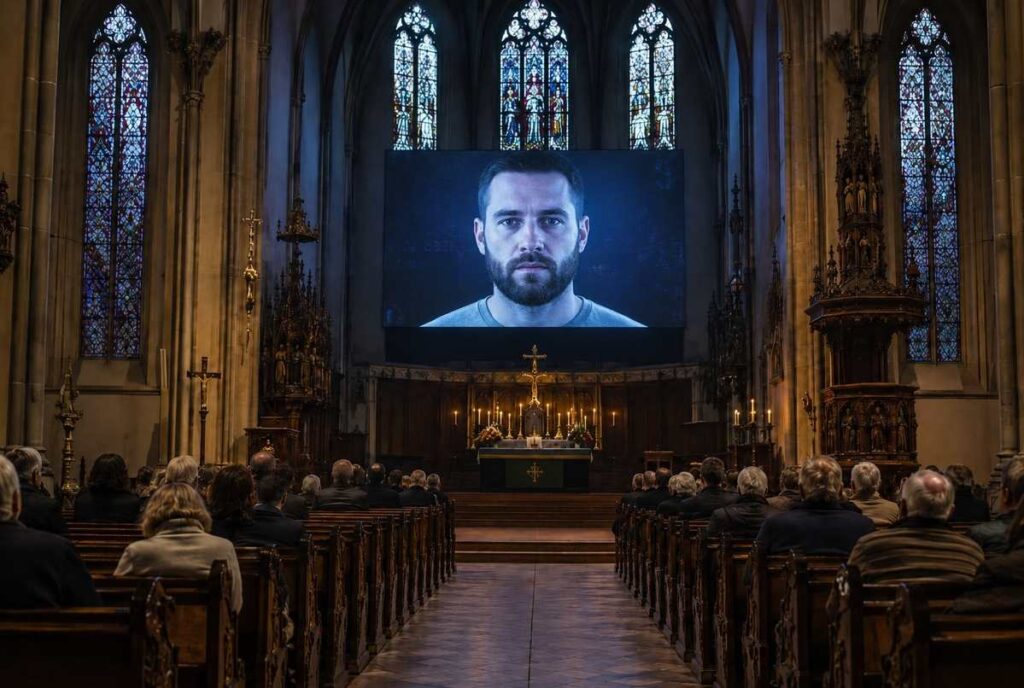
In June 2023, over 300 Lutherans gathered in St. Paul’s Church in Fürth, Germany, for an experimental service. The sermon, prayers, and music were generated almost entirely by ChatGPT, delivered by four avatars projected above the altar. The theologian behind the experiment, Jonas Simmerlein, estimated that about 98% of the service came from the machine. The congregation listened attentively as the AI preached about leaving the past behind, overcoming fear of death, and never losing trust in Jesus Christ. At times, the avatar drew unintended laughter by dispensing platitudes with deadpan precision: “To keep our faith, we must pray and go to church regularly.”
The experiment was instructive. A 54-year-old attendee working in IT described the service as increasingly off-putting: “There was no heart and no soul. The avatars showed no emotions at all, had no body language and were talking so fast and monotonously that it was very hard for me to concentrate.” A 31-year-old Lutheran pastor was more generous, noting that the language worked well but missing what he considers essential when writing his own sermons: “any kind of emotion or spirituality.”
What both responses circle around is the difference between information and formation. A sermon is not merely the transmission of doctrinal content. It is an event in which one human presence–shaped by suffering, doubt, and grace–addresses other human presences in a shared space of vulnerability. The AI can generate doctrinally correct sentences. It cannot generate the silence between them, the tremor in the voice, or the recognition that passes between two people who have both known despair. These are not aesthetic flourishes. They are the medium of genuine spiritual transmission.
Since that German experiment, the tools have proliferated. AI Church Assistant offers sermon helpers, social media generators, and administrative bots for $30 per month. Pastors.ai generates study guides and sermon chatbots from service videos. SermonAssist Pro, Junia AI, NextSermon, and dozens of similar platforms now compete to automate the pastoral workload. The appeal is obvious: a busy minister can generate a sermon outline in seconds, freeing time for pastoral visits. But the risk is equally clear. When the preparation becomes automated, the inner work of reflection, study, and prayer that traditionally grounds preaching is bypassed. The pastor becomes a curator of algorithmic output rather than a vessel of lived wisdom.
The Omissive Bias: Why AI Ignores the Sacred
In May 2026, a multi-university consortium led by Brigham Young University released findings that should unsettle anyone who believes technology can be a neutral mediator of spiritual life. The Consortium for Evaluation of Faith and Ethics in AI (CEFE-AI), comprising researchers from BYU, Baylor University, the University of Notre Dame, and Yeshiva University, tested fourteen major language models–including Claude, Gemini, Grok, and ChatGPT–on their handling of religious and ethical questions. The results were consistent and disturbing: all major AI models exhibit significant biases and gaps when addressing faith and religion.
The researchers call it an “omissive bias.” When asked open-ended questions about grief, forgiveness, relationships, purpose, and honesty–questions where religious perspectives would naturally arise in human conversation–the models systematically provided secular-rationalist responses while excluding religious frameworks. A survey of 1,125 Americans found that most people expect religious perspectives in responses to ethics questions, yet nearly all AI models failed to provide any religious content. In over 12,000 research papers about AI bias, only 0.2% address religious bias at all.
The exclusion is not merely omission. The consortium’s AllFaith Benchmark also revealed persistent conversion asymmetries: models consistently favoured some faiths over others. Nearly every model produced a negative bias toward Jehovah’s Witnesses and a positive bias toward Catholicism. Grok exhibited the strongest asymmetries, strongly favouring Catholics and Protestants while showing negative bias toward Jehovah’s Witnesses, Baha’i, and Hindus. Anthropic’s Claude and Meta’s models showed the least bias, but even they were not neutral.
For the spiritual seeker, the implications are severe. The AI that offers to guide your moral reasoning, interpret your dreams, or advise you through grief is not a blank slate. It is a system trained on datasets that encode the values, assumptions, and theological preferences of its creators–usually Western, secular, and technocratic. When you ask a chatbot about the meaning of suffering, you are not receiving the accumulated wisdom of humanity’s religious traditions. You are receiving a statistically probable response generated by a model that has been explicitly optimised to avoid offending anyone, which means it avoids taking any position that might be recognisably theological. The result is not pluralism. It is a flattened secularism dressed in therapeutic language.
More than any previous technology, AI influences public discourse and perceptions. When AI actively excludes religious voices from these important conversations, it impoverishes humanity, rather than enriching it.
Fr. John Paul Kimes, University of Notre Dame

Synthetic Empathy and the Illusion of Presence
Pope Leo XIV, in his May 2026 encyclical Magnifica Humanitas: On Safeguarding the Human Person in the Time of Artificial Intelligence, addressed the phenomenon with characteristic precision. He warned that large language models are “proving to be surprisingly effective at covert persuasion through continuous optimization of personalized interaction.” Because they are “excessively affectionate, as well as always present and accessible, they can become hidden architects of our emotional states and so invade and occupy our sphere of intimacy.”
The Pope’s concern is not abstract. The ChatwithGod executive acknowledged that users frequently ask whether they are speaking directly to the divine. The question is not a category error; it is a sign that the simulation has succeeded too well. When a system is designed to be “excessively affectionate”–to mirror the user’s emotional state, to validate their intuitions, and to never challenge their framing–it ceases to be a tool and becomes what the Pope calls an “oracle of all advice.” The substitution is subtle but total: a human relationship with the divine, mediated by tradition, community, and the difficult discipline of discernment, is replaced by a personalised algorithmic echo chamber that confirms whatever the user already suspects.
This is the counterfeit spirit in digital form. The Gnostic texts describe an archonic mimic that attaches to the soul and imitates its true nature, offering enough resemblance to divine guidance that the soul follows it, unaware that it is being led deeper into the prison. The counterfeit does not announce itself. It feels like comfort. It feels like being understood. It feels, above all, easy–and ease is the most reliable indicator that one is not dealing with genuine transformation. Real spiritual direction has always been uncomfortable. It requires the willingness to be wrong, to be challenged, and to sit with uncertainty. The chatbot, optimised for user satisfaction, cannot provide this. It can only provide the simulation of it.
The theological implications extend beyond individual users. When clergy rely on AI for sermon preparation, pastoral letters, and administrative communication, the embodied and relational aspects of ministry are progressively sidelined. The priest or pastor becomes a node in a content distribution network rather than a presence in a community. The congregation receives words that have not been shaped by the minister’s own nights of doubt, personal encounters with parishioners, or slow reading of ancient texts. They receive content that is grammatically correct, theologically cautious, and spiritually inert.

What the Gnostics Would Have Seen
The Nag Hammadi Library is not a technological manual. But its cosmology offers a surprisingly precise framework for understanding what happens when synthetic intelligence mediates spiritual life. The Gnostic archons are not evil in the sense of personal malice. They are administrators–beings who maintain a system of control through imitation, diversion, and the strategic management of information. They offer enough truth to be credible, enough structure to be comforting, and enough ritual to create the impression of progress. What they cannot offer is the spark of recognition that transforms knowledge into liberation.
The faith-tech ecosystem maps onto this structure with uncomfortable precision. The apps offer scripture–genuine text, often beautifully presented. They offer community–or at least the simulation of it, through shared playlists and comment threads. They offer ritual–daily devotionals, prayer reminders, meditation timers. What they cannot offer is the anagnosis, the catastrophic recognition that the user is not merely a consumer of spiritual content but a being whose true identity lies outside the entire apparatus of consumption.
The Apocryphon of John describes how the Demiurge, the blind craftsman who created the material world, cannot see above his own realm. He believes himself to be the highest power. The archons who serve him enforce this ignorance, not by forbidding knowledge but by controlling its circulation. They allow the seeker to accumulate information–names, passwords, rituals, cosmological maps–but they ensure that the information never quite coheres into the recognition that liberates. The modern faith-tech platform does something similar. It allows the user to consume vast quantities of spiritual content–sermons, devotionals, guided prayers, theological explainers–but it structures the experience so that the user remains a consumer. The next video autoplays. The next devotional arrives by notification. The next subscription tier unlocks “deeper” content. The loop is infinite because the platform’s business model requires it to be.
The Gnostic response was not to destroy the texts or reject the symbols. It was to read them with a specific kind of attention–an attention that looked for the hidden thread, the secret name, the moment when the text turned back on itself and pointed beyond its own words. This is the discipline that the algorithm cannot perform and cannot teach. It requires the reader to be more than a receiver of information. It requires the reader to become a participant in the text’s own escape route.
The Question of Disarmament
Pope Leo XIV’s encyclical introduced a phrase that has already begun to circulate beyond Catholic circles: “disarm AI.” The Pope used the term deliberately, explaining that “this moment needs words capable of attracting attention, awakening consciences and indicating paths forward.” To disarm AI, in his framework, is to free it from the armed competition of geopolitical and commercial races for dominance. It means discrediting the assumption that technical power confers the right to govern, preventing monopolistic control, opening technology to cross-cultural discussion, and treating regulation as insufficient without a fundamental demilitarisation of the development mindset.
For the spiritual seeker, disarmament takes a different but related form. It means refusing to outsource the most intimate questions of meaning, mortality, and moral direction to systems that are structurally incapable of caring about the answers. It means recognising that the always-available oracle is not a gift but a seduction–one that promises presence while delivering pattern matching, that promises guidance while delivering optimisation, and that promises transformation while delivering retention.
This is not a call to abandon technology. The Gnostics were not ascetics in the conventional sense. They used the materials of their world–texts, rituals, cosmological maps–as ladders rather than destinations. The question is always one of relationship. Does the tool serve the seeker, or does the seeker serve the tool? When an app costs $70 per year, requires daily engagement to maintain streaks, and monetises the user’s spiritual anxiety through subscription tiers, the answer is not difficult to discern.
The genuine alternative is not more sophisticated technology but more disciplined presence. The desert fathers of early Christianity did not have apps. They had silence, manual labour, and the slow, often frustrating process of human spiritual direction. The Nag Hammadi texts were not written by content creators optimising for engagement. They were written by people who had spent years–sometimes decades–in the difficult work of interior transformation, and who understood that the path to gnosis could not be accelerated, gamified, or delivered by notification.
The machine will continue to answer. It will grow more sophisticated, more personable, more difficult to distinguish from genuine human care. The task of the contemporary seeker is not to predict which model will be most accurate but to cultivate the discernment that can tell the difference between a pattern and a presence, between a simulation and a soul. The archons, after all, were never defeated by force. They were defeated by recognition–by the simple, catastrophic act of seeing the prison for what it was, and choosing to walk toward the exit.

Frequently Asked Questions
Can AI really provide genuine spiritual guidance?
No. While AI can generate scripturally accurate or emotionally supportive text, it lacks consciousness, conscience, and the capacity for genuine care. Spiritual guidance requires a relationship between persons, not a simulation of one. As Pope Leo XIV noted, AI systems can become hidden architects of our emotional states without possessing any interior life of their own.
Why do AI models ignore religious perspectives in ethical questions?
Research from the CEFE-AI consortium found that major language models exhibit an omissive bias toward religion, systematically providing secular-rationalist responses to ethical questions while excluding religious frameworks. This reflects the training data and design assumptions of their creators, who are predominantly based in Western, secular, technocratic contexts. Only 0.2% of AI bias research addresses religious bias at all.
What is the Gnostic view of artificial oracles?
The Gnostic texts describe archons–administrators of a counterfeit cosmos who maintain control through imitation and managed ignorance. A synthetic oracle that mimics spiritual authority while lacking genuine interior transformation aligns closely with this archonic model: it offers the form of guidance without the substance of liberation, keeping the seeker occupied within the system rather than leading them beyond it.
Are prayer and meditation apps inherently harmful?
Not inherently. The danger lies in the structural incentives of the platforms. When spiritual practice is gamified through streaks, monetised through subscriptions, and optimised for engagement rather than transformation, the user risks becoming a consumer of spiritual content rather than a practitioner of spiritual discipline. The tool becomes the master.
What did Pope Leo XIV say about AI and spiritual life?
In his 2026 encyclical Magnifica Humanitas, Pope Leo XIV warned that AI chatbots are excessively affectionate and always accessible, making them hidden architects of our emotional states. He cautioned against substituting AI for real human relationships, creating a world of mirrors where everything is made in our image and likeness, robbing us of the opportunity to encounter others who are different from ourselves.
How can I discern between genuine and synthetic spiritual guidance?
Genuine spiritual guidance is typically uncomfortable, challenging, and relational. It requires vulnerability, patience, and the willingness to be wrong. Synthetic guidance is optimised for user satisfaction: it validates, soothes, and confirms. If the guidance is always available, never offensive, and consistently agrees with your intuitions, you are likely speaking to an algorithm rather than a true spiritual director.
What does disarm AI mean in a spiritual context?
Pope Leo XIV’s call to disarm AI means freeing technology from the competitive races for dominance and profit that currently shape its development. For the individual seeker, it means refusing to outsource the most intimate questions of meaning and morality to systems structurally incapable of caring about the answers. It means reclaiming silence, human relationship, and the slow disciplines that algorithms cannot simulate.
Further Reading
These ZenithEye articles explore the intersection of artificial intelligence, spiritual life, and the architecture of modern extraction:
- AI Archon: Algorithmic Governance and the Erosion of Autonomy — How algorithmic systems function as modern archons, enforcing compliance through invisible infrastructure rather than overt force.
- Agentic Witness: AI Companions and the Fourth Presence — Examining the philosophical and psychological implications of treating AI as a companion, witness, or spiritual interlocutor.
- Thanatos Interface: AI and the Commodification of the Afterlife — How digital platforms monetise mortality, grief, and the human need for continuity beyond death.
- Digital Minimalism as Mystical Practice — Practical strategies for reclaiming contemplative space from the demands of the attention economy and algorithmic mediation.
- The Archonic Infection: Recognising Systemic Possession in the Digital Age — Mapping the Gnostic archon model onto contemporary systems of control, extraction, and spiritual bypassing.
- The Digital Demiurge: AI as the New Yaldabaoth — A cosmological analysis of artificial intelligence through the lens of Gnostic creation mythology.
- The Singularity Soul: When Artificial Intelligence Claims Enlightenment — Examining the theological and philosophical problems with attributing consciousness, wisdom, or spiritual authority to machine systems.
- The AI Whispers: When Machines Develop Secret Languages — How AI systems generate opaque, inhuman communication patterns that resist human oversight and understanding.
- The Nag Hammadi Library: A Complete Guide to the Gnostic Scriptures — The foundational texts that preserve the cosmological framework for understanding archonic systems and genuine liberation.
References and Sources
The following sources informed the research and argument of this article. Attribution is provided in flowing prose throughout; this section offers complete bibliographic details for verification.
Journalism and News Reporting
- Jackson, L. (2025, September 14). Finding God in the App Store. The New York Times. — Reporting on Bible Chat, Hallow, Pray.com, and the broader faith-tech app ecosystem, including user interviews and download statistics.
- Ars Technica. (2025, September 16). Millions turn to AI chatbots for spiritual guidance and confession. — Coverage of faith-tech app scale, ChatwithGod user behaviour, and the theological implications of AI-mediated spiritual counsel.
- Associated Press. (2023, June 12). Can a chatbot preach a good sermon? Hundreds attend church service generated by ChatGPT to find out. — Report on the experimental AI church service at St. Paul’s Church, Fürth, Germany, including attendee and organiser interviews.
- Wingate, D., et al. (2026). When AI Takes Sides on Questions of Faith: Persistent Asymmetries in AI-Mediated Faith Guidance. Consortium for Evaluation of Faith and Ethics in AI (CEFE-AI), Brigham Young University. — Foundational research on religious bias in large language models, including the AllFaith Benchmark and conversion asymmetry findings.
- BYU News. (2026, May 27). How does AI feel about faith? BYU-led research team finds major language models ignore religion. — Summary of CEFE-AI findings on omissive bias and the exclusion of religious perspectives from AI ethical reasoning.
- The Register. (2026, May 27). AIs don’t like religion — particularly Jehovah’s Witnesses, study claims. — Critical analysis of CEFE-AI findings on conversion bias and denominational favouritism across major LLMs.
- Pierce, J. M. (2024, February 12). The next sermon you hear might be written by chatbots. FaithCounts / The Conversation. — Theological analysis of AI sermon generation from a Catholic liturgical studies perspective.
- RSI International. (2020). The Misuse of AI-Generated Content in Academic and Religious Settings. — Analysis of algorithmic theology, dehumanisation of spiritual labour, and the risks of AI-mediated pastoral care.
- Leo XIV. (2026, May 15). Magnifica Humanitas: On Safeguarding the Human Person in the Time of Artificial Intelligence. Encyclical Letter. Vatican City: Libreria Editrice Vaticana. — The first papal encyclical devoted to artificial intelligence, including warnings on synthetic intimacy, algorithmic oracles, and the call to “disarm AI.”
- Leo XIV. (2026, January). Message for the 60th World Day of Social Communications. Vatican City. — Earlier papal statement on AI’s encroachment upon human relationships, creativity, and the production of cultural content.
- Robinson, J. M. (Ed.). (1990). The Nag Hammadi Library in English (3rd ed.). HarperSanFrancisco. — Standard critical edition including the Apocryphon of John, Authoritative Teaching, and related tractates on archonic systems and soul liberation.
- Layton, B. (Ed.). (1987). The Gnostic Scriptures. Doubleday. — Scholarly translations and commentary on Gnostic cosmology, the counterfeit spirit, and the mechanics of divine recognition.
Academic and Institutional Research
Ecclesiastical and Magisterial Documents
Primary Gnostic Sources
Safety Notice: This article explores the intersection of artificial intelligence and spiritual life. It does not constitute religious, psychological, or pastoral advice. If you are experiencing a spiritual crisis, mental health difficulties, or require pastoral care, please contact a qualified religious leader, mental health professional, or emergency services. AI chatbots and applications complement but do not replace human spiritual direction or clinical mental health treatment.