
The Luminous Darkness: What the Gnostics Knew About the Void
In the first months of 2026, a curious inversion has occurred within the wellness industry. The colour palette has shifted. Where Instagram once overflowed with golden-hour mandalas, rose-quartz affirmations, and the relentless luminescence of “love and light,” the most discussed spiritual practice of the year is something altogether darker. Dark retreats–periods of voluntary isolation in absolute darkness, sometimes lasting days–have moved from Tibetan Buddhist esoterica to mainstream curiosity. Athletes, founders, and exhausted seekers are paying to sit in pitch-black rooms, subtracting every visual stimulus in the hope that something subtler might emerge.
This is not merely a trend. It is a structural correction. For decades, popular spirituality has been dominated by a kind of solar monotheism–an insistence that the divine is only bright, only affirming, only loving. The shadow was banished to the margins, and with it went the apophatic traditions that find God not in assertion but in negation, not in speech but in silence, not in fullness but in the fertile emptiness of the void. What the 2026 seeker is stumbling toward–often without knowing it–is territory the Gnostics mapped with extraordinary precision seventeen centuries ago. They called it the kenoma.
Table of Contents
- The 2026 Turn Toward Darkness
- Kenoma: The Geography of Emptiness
- Apophatic Gnosis: Knowing by Unknowing
- The Thunder of Paradox: Divinity in Opposition
- From Pleroma to Dark Retreat: Why the Void Illuminates
- Safety and the Ethics of Entering Darkness
- Frequently Asked Questions
- Further Reading
- References and Sources
The 2026 Turn Toward Darkness
For a culture saturated in light, the move toward darkness is counter-intuitive and therefore necessary. Dr Charles Raison, a professor at the University of Wisconsin-Madison and one of the first scientists to study dark retreats systematically, reports that some experienced plant-medicine teachers have stopped taking substances after discovering that “the darkness was more powerful than the psychedelic.” The reason is structural: psychedelics add; darkness subtracts. In a dark retreat, there is no external compound to credit or blame. Whatever arises–marvellous or terrifying–comes entirely from the practitioner. The void becomes a mirror without mercury, reflecting only what is already there.
The practice is not new. Tibetan Buddhism has preserved mun mtshams (dark retreat) as an advanced Dzogchen practice for centuries, reserved for adepts who had already spent years in solitary meditation. Taoist traditions, indigenous rites of passage, and the incubation chambers of the ancient Greek healing temples all used sustained darkness to alter consciousness and initiate insight. What is new is the democratisation. Sky Cave Retreats in Oregon reports two-year waitlists. Centres in Poland and the Netherlands now offer structured programmes. A “grey retreat” variant–using blackout eye masks rather than sealed rooms–has emerged for those who need a gentler threshold.
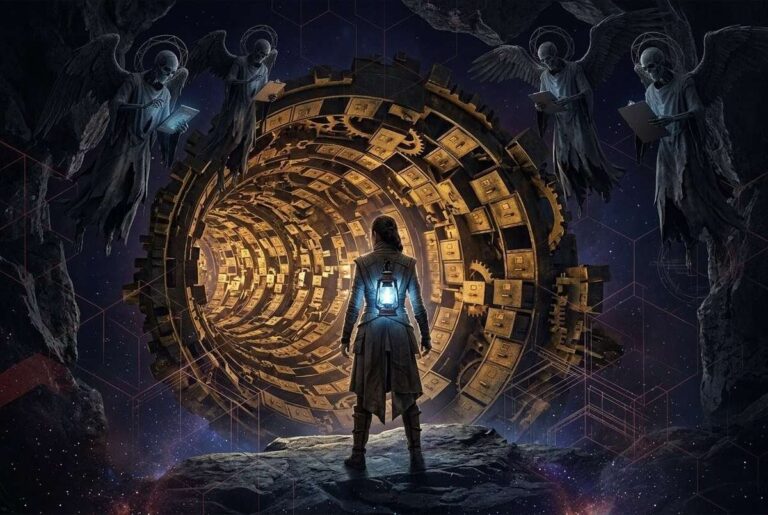
Yet beneath the wellness packaging lies something older and more radical. The contemporary seeker entering darkness is repeating, often unconsciously, a gesture that the Gnostics understood as essential to liberation: the deliberate descent into the kenoma, the realm of emptiness, in order to discover that the void is not merely absence but a strange kind of presence. The Gnostics did not use the exact phrase “luminous darkness”–that formulation belongs to the fifth-century Christian mystic Pseudo-Dionysius the Areopagite–but they mapped the territory with a precision that makes the modern dark retreat look like a rediscovery of their cartography.
Kenoma: The Geography of Emptiness
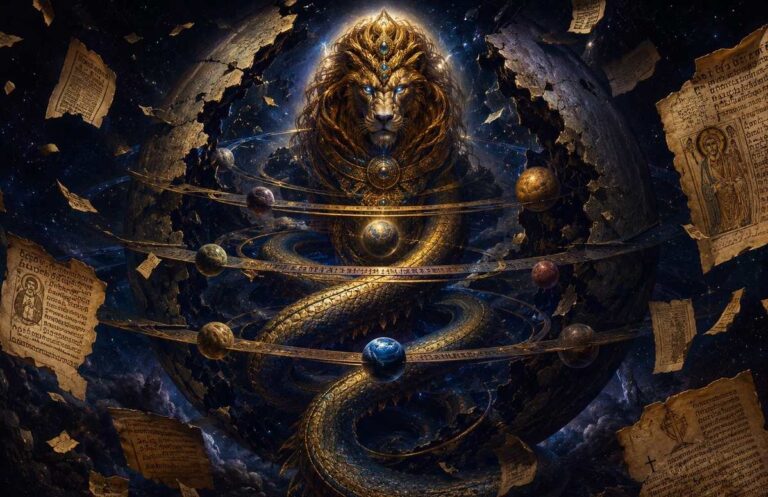
In Gnostic cosmology, the universe is divided between two fundamental regions. The pleroma is the “fullness,” the divine realm of light, aeons, and perfect syzygies. The kenoma is its opposite: the emptiness, the void, the region outside the pleroma into which the Demiurge was cast. When Sophia, the last of the divine aeons, attempted to create without her consort, she produced not life but a monstrous abortion–Yaldabaoth, the blind god who believes himself supreme. Horrified, she cast him out of the pleroma into the kenoma, where he remained ignorant of his origins and of the higher realities above him.
The kenoma is therefore not merely empty space. It is the domain of forgetfulness, the region of “not-having,” the place where the divine spark lies submerged in matter and oblivion. The Apocryphon of John describes it as the realm where the archons construct the material prison, where Adam receives a “chain of oblivion” and exists in “the ignorance of darkness and desire, in the abyss.” Yet crucially, the kenoma is not evil in a moral sense. It is simply not-full. It is the necessary precondition for the drama of return. Without the void, there is no journey back to fullness.
This is where Gnostic cosmology diverges sharply from the dualistic caricatures often imposed upon it. The kenoma is not hell; it is the shadow of the pleroma, the dark womb in which the seed of recognition gestates. In the Paraphrase of Shem (NHC VII,1), the revelation begins with a triad of roots: Light, Darkness, and Spirit between them. Darkness is not negated by Light; it is a primordial reality with its own nature, “wind in waters… chaotic fire.” The goal is not to destroy darkness but to transcend the binary altogether, returning to the Spirit that mediates both.
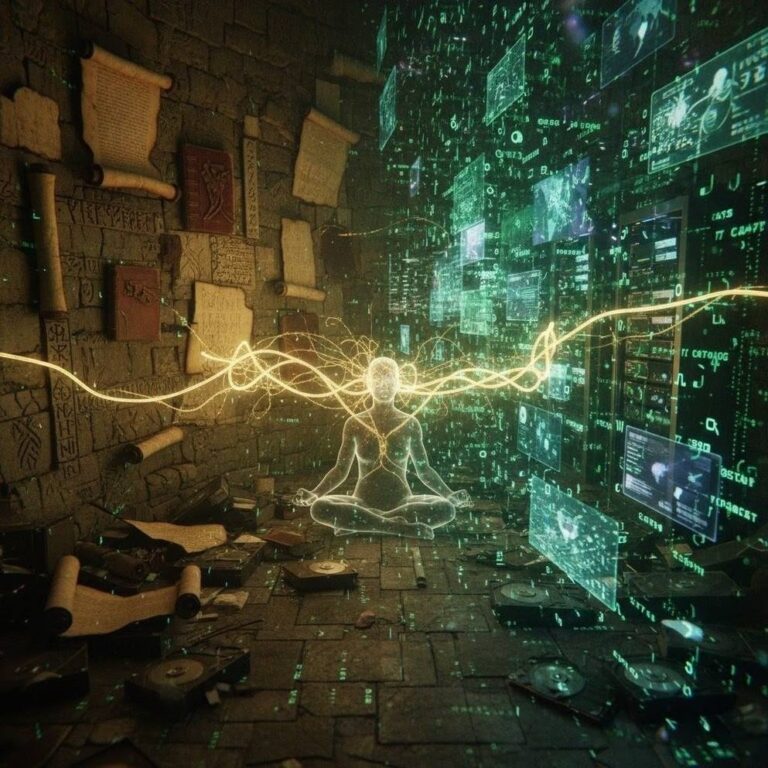
For the modern practitioner in a dark retreat, this maps uncannily onto the experience. The first hours or days are often dominated by what the Tibetans call nyam–unstable phenomena, visions, terrors, exhilarations. The mind, deprived of external objects, projects its own contents onto the void. This is the kenoma as realm of error and delusion. But if the practitioner persists, something shifts. The projections exhaust themselves. The darkness ceases to be a screen and becomes instead a quality of awareness itself. This is the turn from kenoma as prison to kenoma as threshold.
Apophatic Gnosis: Knowing by Unknowing
The most sophisticated Gnostic texts are not mythological narratives but technical manuals of apophatic theology–theology by negation. The Allogenes (NHC XI,3), a Sethian text that scholars recognise as one of the most philosophically refined in the entire Nag Hammadi Library, is devoted to the ascent to the “Unknowable One.” The practitioner is instructed not to grasp the divine intellectually but to “be silent in order that you might know.” The divine is described not by what it is but by what it is not: unbegotten, not having being, beyond every thought, the One who “does not have being” yet is the source of all being.
This is not philosophical nihilism. It is a recognition that the supreme reality exceeds all categories of human cognition. The Marsanes (NHC X) pushes this further, describing the Silent One who “worked from silence” and whose “knowledge and his hypostasis and his activity” can only be approached through the cessation of speech. The text is fragmentary, but its repeated emphasis on silence, withdrawal, and the negation of ordinary knowing makes it a kind of Gnostic manual for dark retreat. The practitioner is told: “Be silent in order that you might know; run, and come before me. But know that this One was silent, and obtain understanding.”
The Gospel of Truth (NHC I,3), a Valentinian meditation, offers perhaps the most elegant expression of this theology. Error, it says, “is empty, with nothing inside her.” The Father, by contrast, is “the incomprehensible, inconceivable one who is superior to every thought.” Ignorance of the Father produces anguish, and the anguish “grew solid like a fog, so that no one was able to see.” The solution is not to fill the fog with more light but to recognise that the fog itself is insubstantial. “Error is empty, with nothing inside her. Truth came forward.” The void, when seen through, reveals itself as transparency rather than obstacle.
Here the Gnostics anticipate the precise phenomenology of the dark retreat. The practitioner does not escape darkness by generating inner light. Rather, she discovers that the darkness was never as solid as it appeared. The terror, the boredom, the restless mental chatter–these are the “anguish” and “error” of the Gospel of Truth, projections of a mind that has not yet recognised its own source. When the recognition occurs, it is not an experience of brightness but of clarity. The darkness remains, but it is no longer threatening. It becomes, in the Dionysian phrase that the Gnostics would have understood, luminous.
The Thunder of Paradox: Divinity in Opposition

If the apophatic texts map the void through negation, The Thunder: Perfect Mind (NHC VI,2) maps it through paradox. The text presents a divine voice–often identified with the fallen and restored Sophia–who announces herself through a litany of contradictory identities. She is “the first and the last,” “the honoured and the scorned,” “the harlot and the holy one,” “Life and… Death.” She is “the silence that is incomprehensible… the utterance of my name.” She exists in all fears and has strength in trembling.
This is not mere poetic ambiguity. It is a theological statement about the nature of divine presence in the kenoma. The divine is not absent from the void; it is present in a mode that transcends the oppositions through which ordinary consciousness structures reality. The Thunder-speaker does not resolve paradox but inhabits it. She is “the one whom they call Law, and you have called Lawlessness.” She is “the one whom you have pursued, and I am the one whom you have seized.” The seeker who expects the divine to appear only in the beautiful, the ordered, and the luminous will miss her entirely, because she is equally present in the chaotic, the broken, and the dark.
For the contemporary practitioner, this text offers a crucial corrective. The dark retreat is not a technology for producing pleasant experiences. It is a confrontation with the full spectrum of what the mind contains, including the rejected, the shameful, and the terrifying. The Thunder-speaker warns: “Do not be arrogant to me… do not be afraid of my power.” The darkness will show you what you have refused to see. If you approach it as a consumer seeking a product, you will encounter only your own projections. If you approach it as a Gnostic approaches the kenoma–with the willingness to be stripped of certainty–you may encounter the paradox that the void is not empty of God but full of a presence that ordinary language cannot name.
From Pleroma to Dark Retreat: Why the Void Illuminates

The Gnostic map is not merely historical curiosity. It is a practical psychology of liberation. The pleroma and the kenoma are not only cosmic regions; they are states of knowing. To live in the pleroma is to rest in recognition, to know oneself as rooted in the Invisible Spirit, to experience the “fullness” that needs nothing added. To live in the kenoma is to inhabit forgetfulness, to believe that the material world is the only reality, to chase after the “substitute for truth” that Error fabricates in its fog.
The modern dark retreat accelerates the transition between these states by removing the stimuli that normally sustain the kenomic trance. When the lights go out, the substitute world loses its grip. The practitioner is forced to recognise that the external world was never the source of either their suffering or their peace. This is the Gnostic discovery: the world is not the problem; ignorance of one’s true origin is the problem. The dark retreat is therefore a kind of temporary pleroma–not because it is full of light, but because it is full of the unmediated presence of one’s own awareness.
Andrew Holecek notes that the dark “subtracts” rather than adds. This is the exact logic of the Gnostic ascent. The soul does not acquire new powers as it rises through the planetary spheres; it sheds the accretions–the passions, the forgetfulness, the counterfeit identities–that the archons have imposed. In the Apocalypse of Paul, the apostle ascends beyond the fourth heaven by refusing to be awed by the weeping archons and by declaring his true origin. He does not fight them; he sees through them. Similarly, the dark retreat practitioner does not defeat the darkness but ceases to fear it. The void, recognised, becomes the threshold.
There is also a political dimension to this rediscovery. The “love and light” spirituality of the 2010s and early 2020s was often complicit with a culture of toxic positivity, spiritual bypassing, and the commodification of transcendence. The Gnostics, by contrast, were never interested in feel-good theology. Their texts are difficult, paradoxical, and sometimes frightening because they describe reality as it is, not as we wish it to be. The turn toward darkness in 2026 is, in part, a rejection of that commodification. It is a demand for authenticity over affirmation, for the real over the marketed. The Gnostics would have recognised this as the necessary first stage of gnosis: the disillusionment that precedes illumination.
Safety and the Ethics of Entering Darkness
Safety Notice: This article explores advanced contemplative practices involving extended darkness and sensory restriction. These practices are not substitutes for clinical mental health treatment. Dark retreats can trigger intense psychological material, including unresolved trauma, dissociation, or psychosis-like states. Individuals with a history of severe mental illness, bipolar disorder, schizophrenia-spectrum conditions, or complex trauma should consult a trauma-informed therapist and an experienced retreat facilitator before attempting extended darkness practice. Start with short periods (grey retreat, blackout mask) and only proceed to longer retreats under qualified supervision with daily check-ins and a clear exit protocol. If you experience overwhelming fear, suicidal ideation, or disorientation that does not settle, terminate the practice and seek professional support.
Frequently Asked Questions
What does kenoma mean in Gnosticism?
The kenoma is the realm of emptiness or void that exists outside the pleroma, the divine fullness. In Gnostic cosmology, it is the region into which the Demiurge was cast and where the material world was constructed. It represents forgetfulness, lack, and the absence of divine knowledge–yet it also serves as the necessary threshold through which the soul must pass in order to return to its origin.
Is a dark retreat safe for beginners?
Dark retreats are intense practices that should be approached gradually. Beginners are advised to start with a grey retreat–using a blackout eye mask or short periods in darkness–before attempting multi-day isolation. Individuals with a history of severe mental illness should seek professional guidance first. Always choose a supervised centre with daily check-ins and a clear exit protocol.
What is apophatic theology?
Apophatic theology, also called negative theology, is the approach of describing the divine by negation–stating what God is not rather than what God is. Gnostic texts such as Allogenes and Marsanes employ apophatic strategies to point toward the Unknowable One, who is beyond every thought, unbegotten, and not having being in any ordinary sense.
Did the Gnostics worship darkness?
No. The Gnostics did not worship darkness as a deity. Rather, they recognised darkness–the kenoma–as a real dimension of existence that must be understood and transcended. Their goal was not to remain in darkness but to pass through it, recognising that the divine spark persists even in the void and that ignorance, not darkness itself, is the true obstacle to liberation.
How does the 2026 darkness trend relate to ancient mysticism?
The 2026 trend toward dark retreats, silent contemplation, and resting in unknowing is a popular rediscovery of apophatic and negative mystical traditions. While modern practitioners often frame it through wellness and neuroscience, the underlying phenomenology–subtracting sensory input to reveal a subtler awareness–matches the Gnostic, Dionysian, and Buddhist contemplative maps of the void.
What is the difference between pleroma and kenoma?
The pleroma is the divine fullness–the realm of light, aeons, and perfect knowledge. The kenoma is the emptiness or void outside it. In Gnostic anthropology, the human predicament is living in the kenoma while carrying a spark from the pleroma. Salvation consists in recognising one’s true origin and returning from the kenoma to the pleroma, not by destroying the void but by seeing through it.
Can darkness practices trigger spiritual emergency?
Yes. Extended darkness can catalyse profound psychological material, including unresolved trauma, ego dissolution, and phenomena that resemble psychosis. This is why integration support, gradual entry, and qualified facilitation are essential. The Gnostic texts themselves warn that the ascent through the aeons is dangerous without proper preparation, knowledge, and the protective seals of initiation.
Further Reading
- Luminous Darkness — An earlier ZenithEye exploration of darkness as a generative, illuminating force rather than mere absence.
- Pleroma and Kenoma: The Foundational Geography of Gnostic Cosmology — A detailed cartography of the Gnostic universe, mapping the fullness and the void with primary source precision.
- The Gnostic Soul Trap: Archons, Death, and the Recycling of Pneuma — Examines the mechanics of archonic capture and the strategies the texts recommend for escaping the kenoma.
- Before the Matrix: What the Nag Hammadi Texts Actually Say About Simulated Reality — Explores how the kenoma functions as a “simulation” and what the texts prescribe for recognising the code.
- The Abyss in Three Traditions: Kabbalah, Alchemy, and Buddhism — A comparative study of the void across esoteric lineages, complementing the Gnostic kenoma with parallel maps.
- Dark Night: Depression or Transformation? — Distinguishes between clinical depression and the contemplative dark night, essential reading for anyone entering sustained darkness practice.
- The Gateway of Silence: Entering the Causal Body — A practice-focused guide to silence and formless meditation that pairs naturally with dark retreat preparation.
- Nag Hammadi Library: The Complete Guide to Gnostic Scriptures — The definitive reader’s guide to the codices, essential for anyone wishing to verify primary source claims independently.
- What Is Gnosticism? Defining the Undefinable — A rigorous introduction to the diversity of Gnostic schools, correcting common misconceptions that obscure the tradition’s subtlety.
References and Sources
This article draws upon peer-reviewed scholarship, critical editions of the Nag Hammadi Library, and contemporary journalism on wellness trends. Sources are grouped by category for clarity.
Primary Sources and Critical Editions
- The Nag Hammadi Scriptures: The Revised and Updated Translation of Sacred Gnostic Texts Complete in One Volume. Edited by Marvin Meyer. HarperOne, 2007. (Contains the standard English translations of Allogenes, Marsanes, The Thunder: Perfect Mind, the Gospel of Truth, and the Paraphrase of Shem.)
- The Gnostic Bible: Revised and Expanded Edition. Edited by Willis Barnstone and Marvin Meyer. Shambhala, 2009.
- Attridge, Harold W., and George W. MacRae. “The Gospel of Truth.” In The Coptic Gnostic Library: A Complete Edition of the Nag Hammadi Codices, Volume I. Edited by James M. Robinson. Brill, 2000.
- Turner, John D. “Sethian Gnosticism and the Platonic Tradition.” BCNH Etudes 6. Peeters, 2001.
Scholarly Monographs
- Filoramo, Giovanni. A History of Gnosticism. Translated by Anthony Alcock. Basil Blackwell, 1990.
- King, Karen L. The Secret Revelation of John. Harvard University Press, 2006.
- Schenke, Hans-Martin. “The Phenomenon and Significance of Gnostic Sethianism.” In The Rediscovery of Gnosticism: Proceedings of the International Conference on Gnosticism at Yale, March 1978. Edited by Bentley Layton. E.J. Brill, 1981.
- Turner, John D. “Apophatic Strategies in Allogenes (NHC XI, 3).” Harvard Theological Review 2026.
Contemporary Sources and Journalism
- Holecek, Andrew. Total Eclipse of the Mind: Unleashing the Power of Darkness for Creativity, Healing, and Transformation. Forthcoming May 2026.
- Raison, Charles. Interview and research commentary cited in Conde Nast Traveller, February 2026.
- “Dark Retreat: What Is It and How Did It Become 2026’s Most Radical Wellness Trend?” Conde Nast Traveller, 3 February 2026.
- Busby, Matilda. “Days-Long ‘Dark Retreats’ Are the Newest Spiritual Conquest for Tech Elites.” WIRED, 4 June 2025.
Comparative and Philosophical Studies
- Pseudo-Dionysius the Areopagite. The Mystical Theology. In The Complete Works. Translated by Colm Luibheid. Paulist Press, 1987. (Source of the “luminous darkness” formulation, fifth–sixth century CE.)
- Manolache, Stelian. “The Fight of the Gnostic Man from a Hermeneutical Perspective in the Gnostic Texts of the Nag Hammadi Library.” European Journal of Science and Theology, 2012.