What Is the Divine Spark? The Hidden Light Within That Remembers and Seeks Return
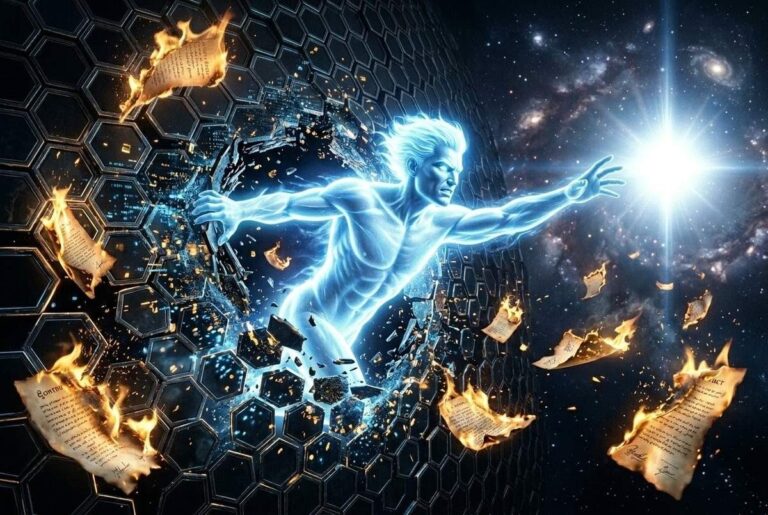
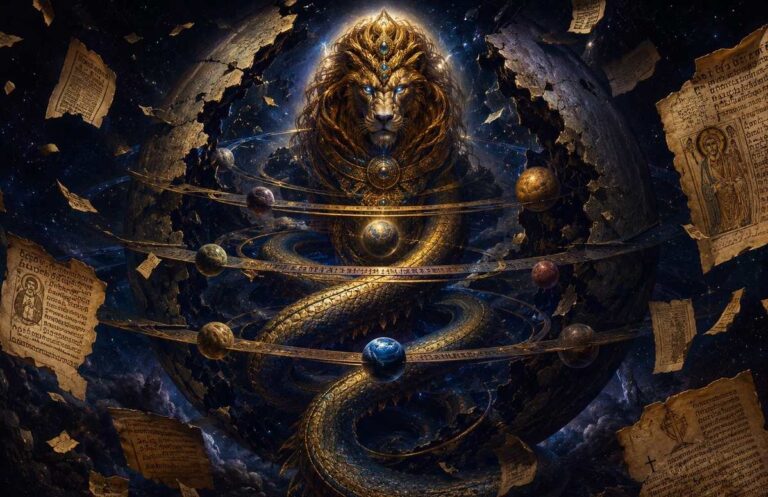
The divine spark is the hidden spiritual principle within the human being: the part that remembers, recognises, and seeks return. It is the fragment of the divine Fullness–the Pleroma–that has fallen into the material world and become trapped in flesh, forgetfulness, and the cycles of fate. In the ancient Gnostic cosmology, the spark is not created by the demiurge, the blind craftsman of matter. It is a stray ember from the higher realm, inserted secretly into the first human being by the powers above, and ever since sought after by the archons who would bind it, and by the divine powers who would restore it.
This article traces the divine spark from its ancient textual origins through its modern resonances, examining how the concept functions in Gnostic mythology, how it was understood across different schools, and how it speaks to contemporary seekers who feel, beneath the noise of modern life, the persistent sense of not belonging to the world they inhabit. The spark is not a doctrine to be believed. It is an experience to be recognised.
Table of Contents
- What Is the Divine Spark?
- Ancient Origins in the Nag Hammadi Texts
- The Three Natures and the Geography of the Spark
- How the Spark Operates: Remembering, Recognising, Returning
- Modern Resonances: Neo Gnosticism and Contemporary Experience
- Frequently Asked Questions
- Further Reading
What Is the Divine Spark?
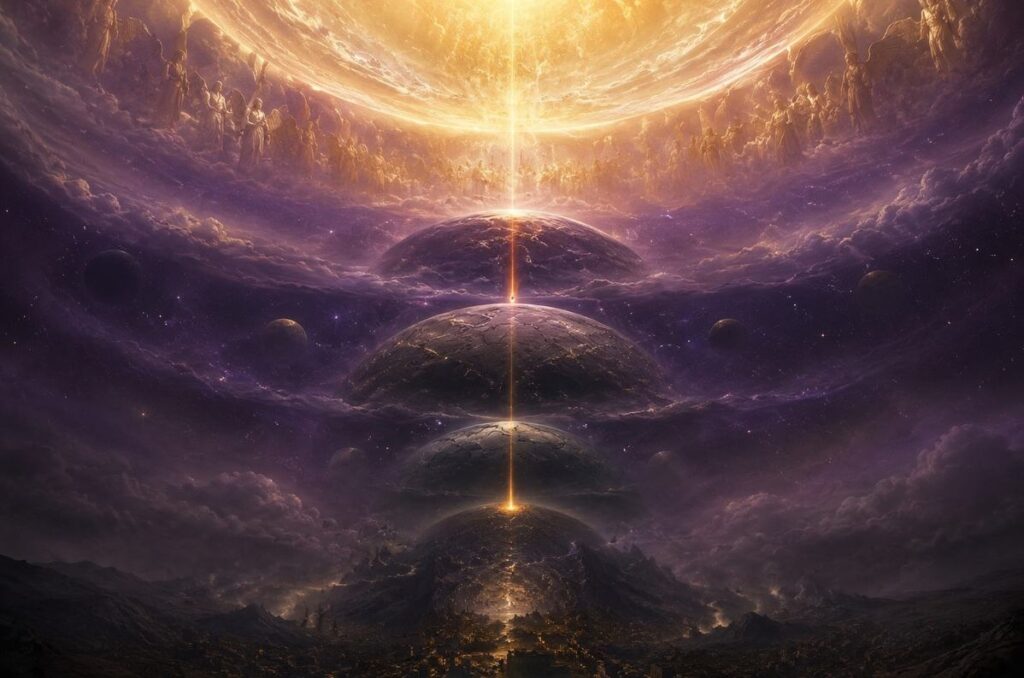
In the simplest terms, the divine spark is the portion of ultimate reality that resides within the human being. It is not the soul in the ordinary sense, not the personality, not the ego, and not the body. It is something prior to all of these: a luminous fragment of the divine source that has become entangled in matter and forgetfulness, yet retains the capacity to remember its origin. The spark is what makes gnosis possible. Without it, there would be no recognition, no awakening, and no return.
The metaphor of a spark is deliberate. A spark is small, easily overlooked, easily extinguished if not tended, yet capable of igniting a conflagration. It is hidden within the tinder of ordinary life, visible only when the conditions are right. The Gnostic texts describe it as a light buried in darkness, a pearl lost in mud, a royal child dressed in rags, and a seed planted in foreign soil. All these images share a single structure: something precious has been misplaced, and the drama of spiritual life is the drama of its recovery.
The divine spark is also the foundation of Gnostic anthropology–the Gnostic understanding of what a human being is. The human being is not merely a creature of the demiurge. The human being is a composite: a body of matter (fashioned by the lower powers), a soul of psychic substance (the seat of emotion and desire), and a spirit of pneumatic substance (the divine spark itself). It is the presence of this third element that makes the human being more than a machine. It is the presence of the spark that makes liberation possible.
Ancient Origins in the Nag Hammadi Texts
The most detailed account of the divine spark appears in the Apocryphon of John (NHC II,1; III,1; IV,1), one of the foundational texts of the Nag Hammadi Library. In this revelation dialogue, the risen Christ explains to John the full cosmology of the fallen world, including the creation of humanity and the mechanisms by which the divine element is concealed within it.
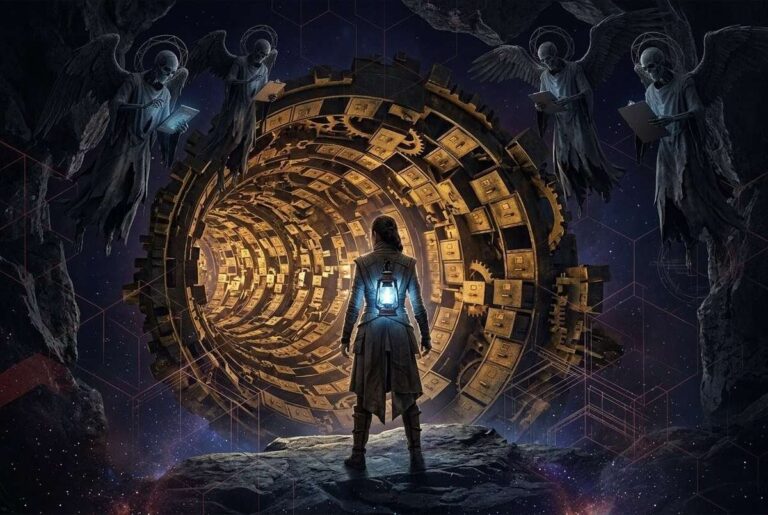
According to the text, after the demiurge Yaldabaoth creates the material world and his archonic administration, he fashions the first human being from the dust of the ground. The body is lifeless until the divine spirit–sent from the Pleroma above by the Mother Sophia and the Invisible Spirit–enters Adam. The archons are terrified by this light. They see that the human being has become luminous, intelligent, and superior to themselves. They attempt to extract the divine element but fail. In their frustration, they create the counterfeit spirit, a false companion designed to bind the soul to the cycle of reincarnation and to ensure that the spark never recognises its own power.
The Apocryphon of John also introduces the concept of the three natures of humanity, which becomes central to Gnostic soteriology. The hylic nature is material and mortal, bound to the flesh and the archons. The psychic nature is soul-level, capable of faith and moral improvement but not of full liberation. The pneumatic nature is the divine spark itself, the portion of the Pleroma that can be saved. Not all human beings possess the pneumatic nature in equal measure, according to the text. Some are predominantly hylic, some psychic, and some pneumatic. This distinction is not a moral hierarchy but a cosmological one: the spark is present in some souls more fully than in others, and salvation depends on the spark’s awakening rather than on external ritual or moral performance.
Other Nag Hammadi texts develop the spark motif in different directions. The Gospel of Thomas speaks of the light within the human being that, if brought forth, can illuminate the whole world. The Exegesis on the Soul describes the soul’s fall into prostitution to material desires and its eventual return to the bridal chamber of the Father, a narrative that presupposes the soul’s divine origin. The Valentinian tradition speaks of the spiritual seed (sperma pneumatikon) scattered in the material world by the fallen Sophia, waiting to be awakened by the Saviour. In all these variations, the core idea remains: the human being carries a hidden divine element that is the true self, and the purpose of spiritual life is to awaken it.
The Three Natures and the Geography of the Spark
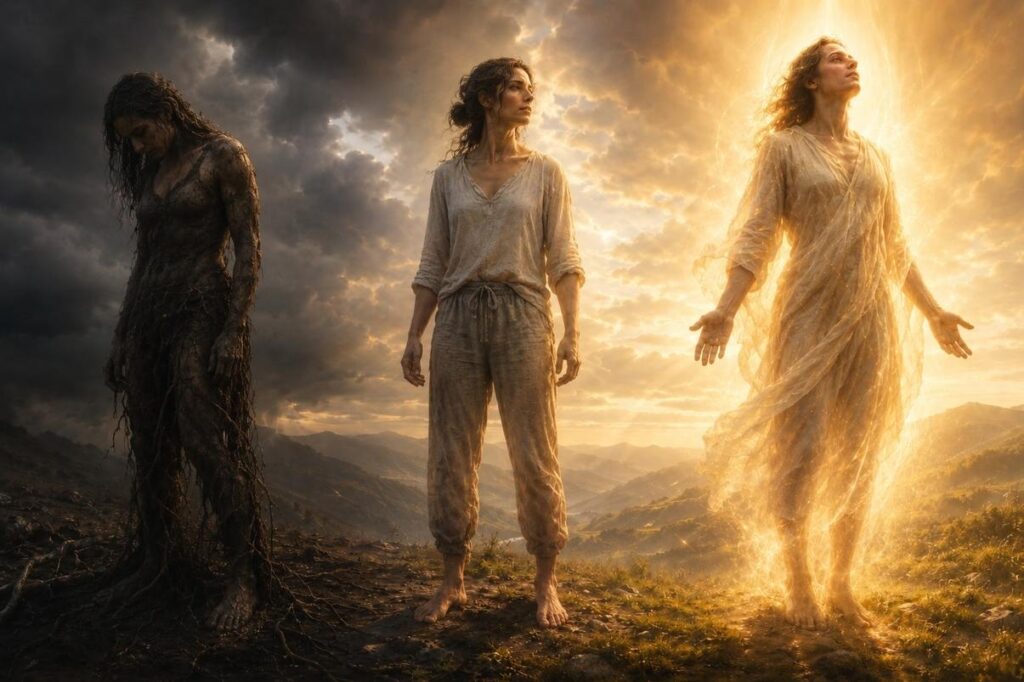
The Gnostic division of humanity into three natures is not merely a theological abstraction. It is a map of the spiritual landscape, a way of understanding why some people are drawn to awakening and others are not, and why the same teaching produces different results in different hearers. The spark is not equally distributed, and this inequality is not a matter of moral merit but of cosmological constitution.
The hylic person is predominantly material. They are bound to the body, to appetite, to the immediate concerns of survival and pleasure. They do not feel the pull of the divine because the spark is buried too deeply, or perhaps not present at all. The archons have full jurisdiction here. The hylic person is not evil; they are simply asleep, and no alarm clock can wake them. The Gnostic texts sometimes describe them as destined for dissolution–not punishment, but the natural fate of matter without spirit.
The psychic person is soul-level. They are capable of faith, moral improvement, and religious devotion. They can be good citizens, good believers, and good people. But they cannot receive gnosis because the spark is not fully active in them. They are on the threshold, capable of moving toward the pneumatic but also capable of slipping back into the hylic. The psychic person corresponds to the ordinary religious believer who accepts authority, follows rules, and hopes for salvation, but does not undergo the interior transformation that the Gnostics called recognition.
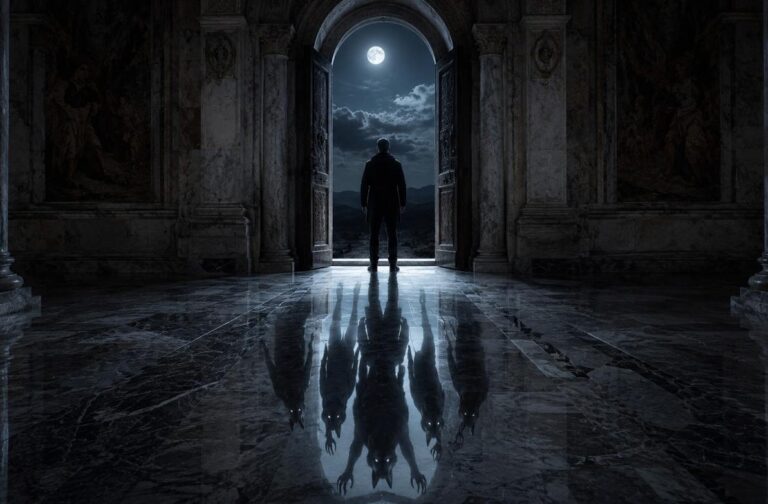
The pneumatic person is the one in whom the spark is fully present and capable of awakening. They are not necessarily morally superior. They may be troubled, unconventional, or socially marginal. What distinguishes them is the capacity for recognition. Something in them remembers the Pleroma, even if they have never heard the word. They are the ones who read the Gnostic texts and feel not curiosity but recognition. They are the ones who look at the world and sense, beneath the surface, a hidden order. They are the ones who suffer from the peculiar Gnostic ache: the feeling of being a stranger in a foreign land, a royal child in rags, a spark in a world of ash.
This threefold schema is often misunderstood as elitism, and it can certainly function that way. But its original purpose was descriptive, not prescriptive. It described what the Gnostics observed: that the same teaching awakened some and left others unmoved. The spark is not a reward for virtue. It is a given, a fact of spiritual constitution, and the task of the pneumatic person is not to feel superior but to awaken what has been given.
How the Spark Operates: Remembering, Recognising, Returning
The divine spark is not static. It operates through three movements that define the Gnostic path: remembering, recognising, and returning. These are not stages in a linear progression. They are dimensions of a single process that unfolds differently in each life.
Remembering
Remembering is the recovery of what has been forgotten. The ancient Gnostics taught that the soul, before its fall into matter, existed in the Pleroma and knew the divine directly. The trauma of the fall produced a kind of amnesia. The soul forgets its origin, its identity, and its destination. It takes the material world for the only reality and the ego for the true self. Remembering is the reversal of this amnesia. It is not the acquisition of new information but the recovery of old knowledge. The Gnostic does not learn about the divine; they remember it. The texts often describe this as anamnesis, a term borrowed from Platonic philosophy that means literally “un-forgetting.”
Recognising
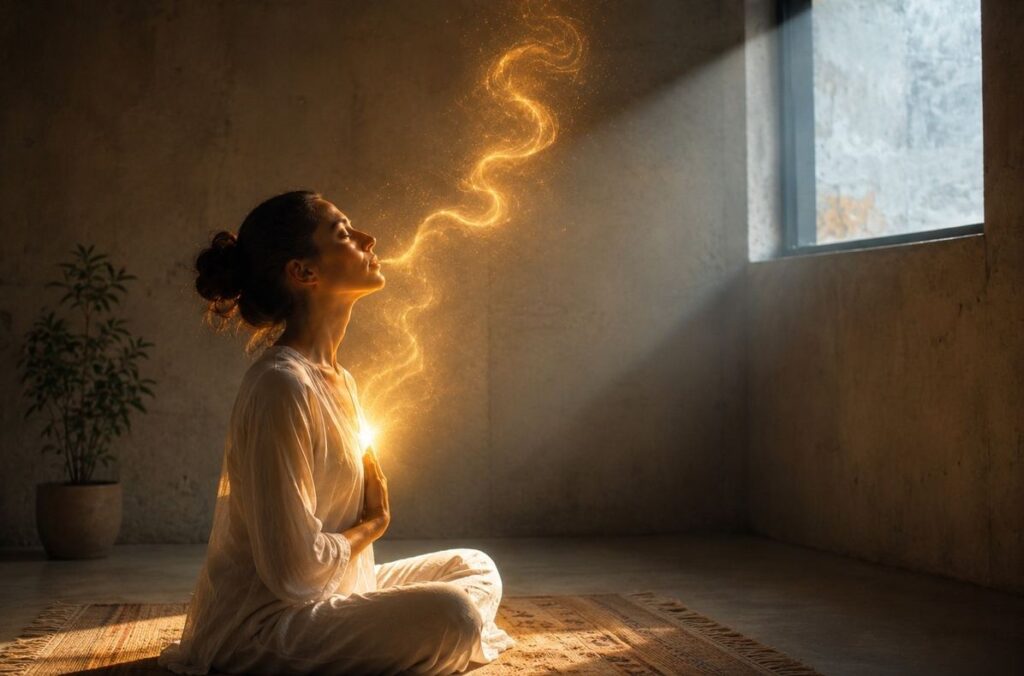
Recognition is the active moment of the spark’s awakening. It is the instant when the soul sees through the illusion of the material world and recognises the divine light within itself. The Gospel of Truth describes this as a fragrance that the soul smells and recognises as its own. The Gospel of Thomas speaks of bringing forth what is within, and if you bring forth what is within you, it will save you. Recognition is not intellectual assent. It is an event, a shift in the centre of consciousness, a turning of the eye from the external to the internal. The spark, when recognised, ceases to be a theory and becomes a fire.
Returning
Returning is the final movement, though it is not an escape from the world in the simplistic sense. The spark returns to the Pleroma, but this return is not a geographical relocation. It is a restoration of the original condition of unity and fullness. The Authoritative Teaching describes the soul’s return as a journey through foreign lands, a stripping away of false garments, and a reclothing in light. The Exegesis on the Soul compares it to a prostitute who returns to her father’s house and is restored to her original dignity. The return is not a rejection of life but a transformation of it. The spark, once awakened, does not flee the world; it illuminates it from within, revealing that the world itself is not evil but merely a shadow of the greater reality that transcends it.

Modern Resonances: Neo Gnosticism and Contemporary Experience
The concept of the divine spark has proven remarkably durable. It has survived the suppression of the ancient Gnostic churches, the long centuries of orthodox dominance, and the modern secularisation of the West. It resurfaces whenever the human being confronts the question of whether there is something more than the material world, something more than the social role, something more than the biological machine. The spark is the name for that “something more.”
In neo Gnosticism, the divine spark is often interpreted psychologically. Jungian psychology, with its concept of the Self as the totality of the psyche and the goal of individuation as the integration of conscious and unconscious, provides a natural bridge. The spark becomes the symbol of the Self, the inner guide, the imaginal core that knows more than the ego. Jung himself was deeply influenced by the Gnostic texts, particularly after the discovery of the Nag Hammadi Library, and his concept of the numinous–the experience of the divine as a psychological reality–resonates with the Gnostic understanding of the spark as an experiential rather than doctrinal truth.
Contemporary near-death experience research offers another bridge. Many NDE accounts describe a moment of recognition in which the experiencer feels that they have remembered something they always knew, that they have returned to a home they never left, and that the physical world is a temporary sojourn rather than the final reality. The ancient Gnostic ascent texts, particularly the Apocalypse of Paul, describe a similar structure: the soul, passing through the planetary spheres, offers the correct passwords and seals that demonstrate its true identity, and the archons, unable to stop it, weep. The modern NDE and the ancient ascent share a single insight: the true self is not the body, and death is not the end but a doorway.
The digital age has introduced new challenges to the spark. The attention economy, algorithmic curation, and the colonisation of consciousness by screens and feeds create conditions that seem designed to prevent recognition. If the spark requires silence, depth, and sustained attention, then the modern environment is structurally hostile to it. The neo Gnostic response is not to reject technology but to use it with the awareness that the spark is always under threat, that the forces of distraction are archontic in function if not in form, and that the work of awakening is more urgent now than ever because the obstacles are more sophisticated.
The loneliness epidemic, the crisis of meaning, and the widespread experience of alienation in contemporary life can all be read through the lens of the divine spark. The person who feels that they do not belong, that the world is somehow wrong, that there is a deeper current beneath the surface of things, is experiencing the spark’s persistent signal. They are not depressed; they are estranged. They are not deluded; they are remembering. The task is not to medicate the estrangement but to follow it to its source, to trust the ache as a compass pointing toward home.
Frequently Asked Questions
What is the divine spark in Gnosticism?
The divine spark is the hidden spiritual principle within the human being, a fragment of the divine Pleroma that has fallen into the material world. It is the portion of ultimate reality that makes gnosis–direct experiential knowledge of the divine–possible. The spark remembers its origin, recognises the illusion of the material world, and seeks return to its source.
Is the divine spark the same as the soul?
No. In Gnostic anthropology, the human being is a composite of body, soul, and spirit. The body is material, the soul is the seat of emotion and psychic life, and the spirit (pneuma) is the divine spark itself. The soul is created or fashioned by lower powers; the spark comes from the Pleroma above. Not all human beings possess the spark in equal measure, according to the ancient texts.
Can the divine spark be lost or destroyed?
The ancient texts suggest that the spark can be obscured, buried, or bound by the counterfeit spirit and the archonic system, but not ultimately destroyed. It is a fragment of the eternal divine and therefore indestructible. However, it can be so deeply covered by forgetfulness, attachment, and illusion that it appears to be absent. The work of spiritual life is to uncover what has always been present.
How do I know if I have the divine spark?
The spark announces itself through the persistent sense of estrangement from the material world, the feeling of being a stranger in a foreign land, and the pull toward something deeper than social roles and biological survival. It is not a matter of moral superiority or religious affiliation. The spark is recognised by its effects: the capacity for direct knowing, the longing for truth, and the refusal to accept the visible world as the only reality.
What is the relationship between the divine spark and gnosis?
Gnosis is the recognition of the divine spark. Without the spark, there would be no capacity for gnosis. The spark is the latent potential; gnosis is the actualisation. The spark makes awakening possible; gnosis is the awakening itself. The two are inseparable: the spark is the seed, and gnosis is the flower.
How does the divine spark relate to modern psychology?
Jungian psychology offers a natural bridge, with its concept of the Self as the totality of the psyche and the goal of individuation as the integration of conscious and unconscious. The spark can be understood as the symbol of the Self–the inner guide that knows more than the ego. Near-death experience research also resonates, as many experiencers describe a moment of recognition that mirrors the Gnostic understanding of the spark remembering its origin.
Can the divine spark be awakened in the modern world?
Yes, but the modern environment presents specific obstacles. The attention economy, algorithmic distraction, and the colonisation of consciousness by digital media create conditions structurally hostile to the silence and depth that the spark requires. The neo Gnostic response is not to reject modernity but to engage it with discernment, maintaining practices that protect and nurture the spark amid the noise.
Further Reading
- What Is Pneuma? Spirit, Breath, and the Divine Spark in Gnosticism — The foundational glossary entry on pneuma, the Greek term that names the divine spark and its relationship to breath, life, and consciousness.
- Pneumatic, Hylic, and Psychic: The Three Natures and the Geography of Awakening — A comprehensive exploration of the threefold division of humanity, essential for understanding how the spark is distributed and how it functions across different spiritual constitutions.
- The Apocryphon of John: Gnostic Creation, Cosmology, and the Soul’s Liberation — The primary Nag Hammadi text in which the divine spark is described, including the creation of Adam, the insertion of the spirit, and the archons’ attempt to capture it.
- The Gnostic Soul Trap: Archons, Death, and the Recycling of Pneuma — Investigates the archonic system designed to prevent the spark’s return, including the counterfeit spirit and the mechanisms of post-mortem capture.
- Pleroma and Kenoma: The Foundational Geography of Gnostic Cosmology — Establishes the cosmic framework within which the spark’s fall and return take place, distinguishing the divine Fullness from the material emptiness.
- What Is Gnosis? Meaning, Recognition, and Direct Knowing — Clarifies the nature of the recognition that the spark makes possible, distinguishing gnosis from belief, knowledge, and mystical experience.
- Post-Human Gnosis: Obsolescence and the Eternal Spark — Explores how the divine spark is understood in the context of transhumanism, artificial intelligence, and the technological transformation of the human being.
- Jung, Shadow Work, and Gnostic Pneuma: The Ancient Upstream — Traces the connection between Jungian depth psychology and the Gnostic concept of the spark, showing how the ancient current flows into modern therapeutic practice.
- Gnosis and the Near-Death Experience: What Ancient Cosmology Says — Examines the remarkable parallels between modern NDE accounts and ancient Gnostic ascent literature, both describing the spark’s recognition of its true home.
- The Loneliness Epidemic: A Gnostic Diagnosis — Reads the modern crisis of alienation through the lens of the divine spark, suggesting that the ache of estrangement is not pathology but the spark’s signal.