Eugnostos the Blessed: The Pagan Source of Divine Wisdom

Among the most fascinating texts in the Nag Hammadi Library stands a document that does not behave like a conventional Christian scripture. Eugnostos the Blessed contains no narrative of Jesus, no passion story, no church instruction and no dramatic fall of Sophia into the lower world. It is a philosophical revelation in the form of a letter, addressed to those capable of receiving deeper knowledge about the structure of divine reality.
That makes Eugnostos especially important for understanding the wider Nag Hammadi archive. It shows that Gnostic thought was not only mythic, apocalyptic or anti-cosmic. It could also be serene, abstract, philosophical and deeply cosmopolitan. Here, divine reality unfolds through the Unbegotten Father, the Self-Begetter, the Immortal Human and the aeons, without the hostile Demiurge or archonic drama found in more severe Sethian texts.
Eugnostos also matters because of its close relationship with The Sophia of Jesus Christ. The latter adapts much of the same metaphysical material into a Christian revelation dialogue spoken by the risen Jesus. Side by side, the two texts show a rare process in motion: philosophical Gnostic wisdom being transformed into Christian Gnostic revelation.
What is Eugnostos the Blessed?
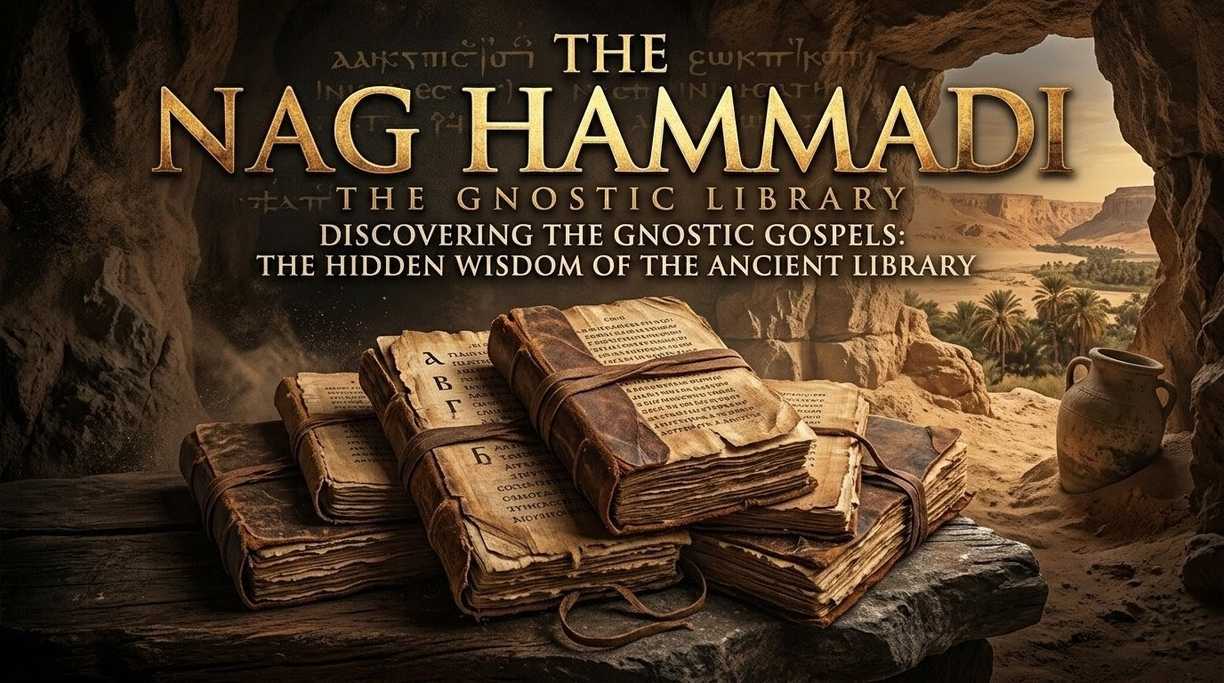
Eugnostos the Blessed is a philosophical Gnostic tractate preserved in two Nag Hammadi witnesses: Codex III and Codex V. It presents the divine realm through orderly emanation rather than mythic catastrophe. Its teaching moves from the Unbegotten Father to the Self-Begetter, the Immortal Human and the aeons.
Unlike many other Nag Hammadi texts, it contains no Jesus narrative, no hostile Yaldabaoth, no archonic prison myth and no dramatic fall of Sophia. Its importance lies in its calm metaphysical map of divine reality and in its close relationship with The Sophia of Jesus Christ, which Christianises similar material through a revelation-dialogue frame.
Table of Contents
- Text and Codex Setting
- Why Eugnostos Matters in the Nag Hammadi Library
- The Teacher and His Letter
- The Structure of the Unbegotten
- The Self-Begetter and the Immortal Human
- The Aeons: Divine Qualities in Ordered Emanation
- The Human Question: Ontology and Origin
- Creation Without Conflict
- Eugnostos and The Sophia of Jesus Christ
- The Letter as Genre: Authority and Intimacy
- Reading Eugnostos Today
- Frequently Asked Questions
- Further Reading
- References and Sources
Text and Codex Setting
Eugnostos the Blessed is preserved in two Nag Hammadi manuscripts, one in Codex III and another in Codex V. Its repetition is significant. This was not a stray philosophical curiosity accidentally gathered into the archive. It was a valued teaching text, copied and preserved in more than one codex.
Its relationship with The Sophia of Jesus Christ is especially important. Eugnostos gives the metaphysical teaching in a philosophical form, while The Sophia of Jesus Christ reworks similar material as a revelation from the risen Jesus. The pairing allows modern readers to see how a non-Christian metaphysical tractate could become part of Christian Gnostic teaching without losing its deeper structure.
This also shows why the Nag Hammadi Library should not be treated as a single doctrinal handbook. It is an archive of related but distinct voices: mythic, philosophical, Christian, Sethian, Valentinian, Hermetic-adjacent and contemplative. Eugnostos belongs to the philosophical wing of that archive.
Codex Note: Eugnostos the Blessed is preserved in Nag Hammadi Codex III and Codex V. It is closely related to The Sophia of Jesus Christ, which adapts similar metaphysical content into a Christian revelation dialogue.
Why Eugnostos Matters in the Nag Hammadi Library
Eugnostos matters because it broadens the reader’s picture of Gnosticism. Many people first encounter Gnostic thought through dramatic myths: Sophia falls, Yaldabaoth boasts, archons imprison, the divine spark awakens. Those myths are central, but they are not the whole landscape.
Eugnostos presents a calmer current. Its concern is not cosmic disaster but divine order. There is no raging Demiurge, no hostile archonic system and no mythic rescue mission. Instead, the text offers a contemplative map of divine emanation: source, self-generation, heavenly humanity and ordered aeonic life.
That makes it a crucial companion to texts such as The Apocryphon of John. Where the Apocryphon dramatises rupture, ignorance and rescue, Eugnostos contemplates origin, hierarchy and divine fullness. One text gives the storm; the other gives the architecture behind the sky.

The Teacher and His Letter
The text is framed as a teaching letter from Eugnostos to “those who are his”. The phrase suggests a circle of disciples, readers or initiates prepared to receive instruction about realities beyond ordinary perception.
The tone is intimate but authoritative. Eugnostos does not argue in the manner of a public debate. He discloses. He writes as one transmitting a vision of the divine realm to those already oriented towards truth. The reader is not being entertained. The reader is being instructed.
Primary Source Theme: The opening distinguishes ordinary earthly humanity from those who belong to truth. The point is not simple moral superiority, but origin: the awakened know themselves in relation to a higher source.
This opening establishes a recognisably Gnostic anthropology in seed form. Human beings are not understood only by their physical birth, social role or visible life. There is a deeper question of origin. Some belong to dust because they identify only with the lower world. Others belong to truth because they recognise a higher root.
The letter therefore becomes more than doctrine. It is a call to recollection. To read Eugnostos properly is to ask where one’s true identity begins: in matter alone, or in a divine pattern that matter cannot exhaust.
The Structure of the Unbegotten
The metaphysical structure begins with the Unbegotten Father. This source is described through apophatic or negative theology: beyond containment, beyond comprehension, beyond visible form, beyond ordinary qualities. The highest reality is not simply a larger object inside the cosmos. It is the unoriginated source from which all reality proceeds.
This kind of language protects mystery. The Unbegotten cannot be reduced to image, category or concept. To speak accurately of the source, the text first says what the source is not. Not limited. Not visible. Not measurable. Not graspable by ordinary thought.
Yet the Unbegotten is not empty nothingness. The source is generative. Divine reality unfolds from it through emanation. What is hidden at the summit becomes expressed through ordered levels of being, not by ceasing to be transcendent, but by producing forms through which it may be contemplated.
Primary Source Theme: The Unbegotten is described by negation: uncontainable, incomprehensible, unchangeable, ineffable, formless and without limit. The theology begins by refusing to imprison the divine source in ordinary language.
The Self-Begetter and the Immortal Human
From the absolute source emerges the Self-Begetter, also called the Self-Father in related traditions. This figure is the first major expression of divine self-manifestation. It is not created from outside. It proceeds from the hidden source as a self-generating divine principle.
The Self-Begetter is androgynous, containing both generative principles. This is important because the text’s highest metaphysics is not simply masculine in a crude sense. Divine reality contains fullness prior to separation into ordinary gendered categories.
From this unfolding comes the Immortal Human, the heavenly archetype of humanity. This is not the earthly human made from dust, but the divine Human, the luminous pattern from which earthly humanity derives its hidden dignity.
This theme links Eugnostos to a wider Gnostic and Platonic current: the human being is not merely biological. Earthly humanity reflects a higher anthropos, a divine pattern. To know oneself is therefore not merely psychological. It is metaphysical recollection.
Primary Source Theme: The Immortal Human is presented as androgynous, root and source, tree and fruit. Humanity is understood through a heavenly archetype rather than through earthly limitation alone.
The Aeons: Divine Qualities in Ordered Emanation
From the Self-Begetter and the Immortal Human unfolds a realm of aeonic qualities. The text speaks of divine attributes such as Grace, Truth, Form, Perception, Memory, Understanding, Love, Idea, Perfection, Peace, Wisdom and Will. These are not merely abstract terms written on a philosophical chart. They are living qualities of divine fullness.
This aeonic structure resembles the ordered divine world found in related Gnostic systems, but here it is presented without dramatic rupture. There is no fall of Sophia, no arrogant Yaldabaoth and no archonic counterfeit of the divine image. The structure appears as a harmonious procession of divine qualities from the highest source.
That gives Eugnostos a contemplative character. The reader is invited to meditate on divine names and relationships, not merely to follow a plot. Each aeonic quality opens a way of thinking about divine life: truth as stability, memory as divine continuity, wisdom as luminous understanding, peace as fulfilled order.

The Human Question: Ontology and Origin
Behind the divine hierarchy lies a human question: what are we? Eugnostos answers by tracing humanity back to a divine archetype. The human being is not finally explained by dust, flesh or earthly circumstance. The human being has a higher origin in the Immortal Human.
This is not the same as saying that ordinary human life is irrelevant. Rather, it means that visible life is incomplete without its invisible root. The earthly human is a partial expression of a higher pattern. Forgetfulness of that pattern is the real poverty of the human condition.
The text’s anthropology is therefore recognitional. Salvation is not framed primarily as escape from a hostile world, but as recovery of true identity. The human task is to remember origin, contemplate divine order and live from a deeper participation in truth.
This makes Eugnostos one of the more philosophically luminous texts in the Nag Hammadi collection. It speaks less through conflict and more through orientation. It turns the reader towards the hidden source behind the visible human form.
Creation Without Conflict
One of the most striking features of Eugnostos is its absence of cosmic conflict. In many Gnostic myths, the lower world emerges through rupture: Sophia falls, Yaldabaoth appears, archons rule and humanity is trapped in ignorance. Eugnostos takes another route.
Here, creation is described through orderly emanation. Divine reality unfolds in stages. Lower levels are more distant from the source, but the text does not describe them as the product of a hostile creator or cosmic mistake. The emphasis falls on procession, not rebellion.
This does not make the text non-Gnostic. Rather, it reveals the breadth of Gnostic metaphysics. Not every Gnostic text must be radically anti-cosmic. Some preserve a more philosophical and contemplative pattern in which the problem is not creation itself, but ignorance of creation’s source.
In this view, matter is not necessarily a prison in the harshest sense. It is a veil, a lower expression, a realm that becomes spiritually dangerous when mistaken for the whole. Gnosis lifts the veil by restoring awareness of the higher order from which all things derive.
Eugnostos and The Sophia of Jesus Christ
The relationship between Eugnostos the Blessed and The Sophia of Jesus Christ is one of the most valuable comparative moments in the Nag Hammadi Library. The two texts share closely related metaphysical content but present it through different frames.
Eugnostos speaks as philosophical instruction. The Sophia of Jesus Christ turns similar teaching into revelation from the risen Jesus. The shift changes the authority of the material. What appears first as contemplative metaphysics becomes, in the Christian adaptation, hidden wisdom disclosed by Christ.
This comparison reveals the porous boundaries of late antique religious thought. Philosophical language, Gnostic cosmology and Christian revelation could be woven together. The Nag Hammadi communities did not always treat wisdom as belonging to one department of tradition only. They preserved what revealed the structure of truth.
Comparative Reading: Read Eugnostos the Blessed beside The Sophia of Jesus Christ. The comparison shows how a philosophical map of divine emanation could be transformed into a Christian Gnostic revelation dialogue.
The Letter as Genre: Authority and Intimacy
The letter form is central to the text’s authority. A letter creates intimacy across distance. It preserves the voice of a teacher for those who cannot sit directly before him. It also marks a circle of reception: these teachings are not thrown into the public square, but addressed to those prepared to receive them.
Ancient philosophical letters often functioned this way. They could condense a school’s teaching, guide a community, correct misunderstanding and preserve the voice of the master. Eugnostos belongs to this world of written instruction and contemplative transmission.
Its authority is not argumentative in a modern academic sense. The text does not spend its energy defending every claim. It presents a vision. The reader is invited to enter the architecture of that vision and contemplate the order it reveals.
In this way, the text is both instruction and meditation. It teaches the structure of divine reality while training the mind to think beyond the visible world.
Reading Eugnostos Today
Read Eugnostos the Blessed slowly. It is not a plot-driven text, and it will not reward the same expectations as the Apocryphon of John or the Hypostasis of the Archons. Its power lies in contemplation, naming and metaphysical orientation.
Approach it as philosophical mysticism. The divine names are not decorative. Each one opens a field of meditation: Unbegotten, Self-Begetter, Immortal Human, Grace, Truth, Understanding, Wisdom, Will. The text invites the reader to think upwards, past the visible order, into the source-pattern behind reality.
Its non-Christian character also deserves respect. It should not be treated merely as a rough draft of The Sophia of Jesus Christ. It has its own integrity. It is a witness to the fact that Gnostic communities could value philosophical wisdom even when it did not carry an explicitly Christian frame.

Then read it beside The Sophia of Jesus Christ. Notice what changes when the same broad metaphysical teaching is placed in the mouth of the risen Jesus. The teacher becomes revealer. Philosophy becomes revelation. Contemplation becomes Christian Gnostic instruction.
Together, the two texts show what the Nag Hammadi Library preserves so well: not a single frozen doctrine, but a living field of transformation. Wisdom moves between languages, schools and religious frames. Eugnostos is one of the archive’s clearest witnesses to that intellectual freedom.
Frequently Asked Questions
What is Eugnostos the Blessed in the Nag Hammadi Library?
Eugnostos the Blessed is a philosophical Gnostic tractate preserved in two Nag Hammadi witnesses, Codex III and Codex V. It describes divine emanation through the Unbegotten Father, Self-Begetter, Immortal Human and the aeons, without presenting Jesus, a hostile Demiurge, archons or the dramatic fall of Sophia.
Why is Eugnostos the Blessed significant?
Eugnostos is significant because it shows a philosophical and non-Christian form of Gnostic metaphysics preserved within the Nag Hammadi Library. It reveals that Gnostic communities valued wisdom across religious boundaries and preserved contemplative teachings on divine emanation even when they were not framed as Christian revelation.
How is Eugnostos related to the Sophia of Jesus Christ?
Eugnostos is closely related to The Sophia of Jesus Christ. Eugnostos presents metaphysical teaching as a philosophical letter, while The Sophia of Jesus Christ adapts similar material into a Christian revelation dialogue spoken by the risen Jesus. Reading them together shows how philosophical Gnostic material could become Christian Gnostic revelation.
Does Eugnostos mention Jesus?
No. Eugnostos contains no Jesus narrative, no Christian scripture frame, no passion story and no resurrection dialogue. Its importance lies partly in this non-Christian form, because it helps reveal the philosophical background behind later Christian Gnostic adaptations.
Does Eugnostos include Yaldabaoth or the archons?
No. Unlike texts such as the Apocryphon of John, Eugnostos does not include a hostile Yaldabaoth, archonic rulers or a dramatic creation error. Its cosmology is calmer and more philosophical, presenting divine reality through orderly emanation rather than cosmic conflict.
What are the aeons in Eugnostos the Blessed?
The aeons in Eugnostos are divine qualities or powers that unfold from the higher source. They include names such as Grace, Truth, Form, Perception, Memory, Understanding, Love, Idea, Perfection, Peace, Wisdom and Will. They represent ordered aspects of divine fullness rather than ordinary created beings.
How should modern readers approach Eugnostos?
Modern readers should approach Eugnostos as philosophical mysticism. It rewards slow reading, contemplation of divine names and comparison with The Sophia of Jesus Christ. Its purpose is not dramatic storytelling, but metaphysical orientation and recognition of the human being’s higher origin.
Is Eugnostos a Christian text?
Eugnostos is not Christian in its own presentation. It contains no Jesus figure or explicit Christian narrative. However, it was preserved by communities associated with the Nag Hammadi Library and closely adapted by The Sophia of Jesus Christ, which gives similar material a Christian revelation frame.
Further Reading
Continue through the related Nag Hammadi source layer and the paired revelation text:
- The Sophia of Jesus Christ: the Christian revelation-dialogue adaptation of related metaphysical teaching.
- The Apocryphon of John: the mythological Sethian creation account featuring Sophia’s fall and the birth of Yaldabaoth.
- What Is Sophia?: the foundation article on Wisdom, fall and restoration in Gnostic myth.
- The Sophia Myth: a comparative study of Sophia across Sethian, Valentinian and Ophite traditions.
- What Is the Pleroma?: the divine fullness and aeonic realm behind Gnostic emanation language.
- Pleroma and Kenoma: the wider map of fullness and deficiency in Gnostic cosmology.
- The Complete Nag Hammadi Reading Order: a guided route through the tractates and codices.
- The Nag Hammadi Library: Complete Guide to the Gnostic Scriptures: the broader archive hub for the codices and their significance.
References and Sources
The following sources support the historical, textual and interpretive claims made in this article.
Primary Sources and Critical Editions
- Robinson, James M., ed. The Nag Hammadi Library in English. Harper & Row / HarperSanFrancisco, revised editions.
- Meyer, Marvin, ed. The Nag Hammadi Scriptures. HarperOne, 2007.
- Layton, Bentley. The Gnostic Scriptures. Doubleday, 1987.
- Parrott, Douglas M., ed. Nag Hammadi Codices III,3-4 and V,1 with Papyrus Berolinensis 8502,3 and Oxyrhynchus Papyrus 1081: Eugnostos and the Sophia of Jesus Christ. Nag Hammadi Studies 27. Brill, 1991.
- Eugnostos the Blessed. Nag Hammadi Codex III and Codex V.
- The Sophia of Jesus Christ. Nag Hammadi Codex III and Berlin Gnostic Codex.
Scholarly Monographs and Specialist Studies
- Turner, John D. Sethian Gnosticism and the Platonic Tradition. Presses de l’Université Laval, 2001.
- Williams, Michael Allen. Rethinking “Gnosticism”: An Argument for Dismantling a Dubious Category. Princeton University Press, 1996.
- King, Karen L. The Secret Revelation of John. Harvard University Press, 2006.
- King, Karen L. What Is Gnosticism? Harvard University Press, 2003.
- Perkins, Pheme. Gnosticism and the New Testament. Fortress Press, 1993.
- Dillon, John. The Middle Platonists. Cornell University Press, revised edition.
- Brakke, David. The Gnostics: Myth, Ritual, and Diversity in Early Christianity. Harvard University Press, 2010.
- Pearson, Birger A. Ancient Gnosticism: Traditions and Literature. Fortress Press, 2007.
Comparative Studies and Context
- Ehrman, Bart D. Lost Scriptures: Books That Did Not Make It into the New Testament. Oxford University Press, 2003.
- Koester, Helmut. Ancient Christian Gospels. SCM Press, 1990.
- Marjanen, Antti. “Eugnostos the Blessed and the Sophia of Jesus Christ.” In studies of the Coptic Gnostic Library and related Nag Hammadi scholarship.
- Smith, Carl B. “The Philosophical Letter in Gnosticism.” In studies of Nag Hammadi and Gnostic revelation discourse.
- Hanegraaff, Wouter J. Western Esotericism: A Guide for the Perplexed. Bloomsbury, 2013.
Reading Note: Eugnostos the Blessed is best read beside The Sophia of Jesus Christ. Together, the two texts show how philosophical Gnostic teaching could be preserved in its own right, then transformed into Christian Gnostic revelation through the voice of the risen Jesus.