
Gnosticism and Buddhism: 7 Surprising Convergences
In the first centuries of the Common Era, two radical spiritual movements emerged on opposite ends of the Asian continent. One arose in the Jewish-Hellenistic milieu of the Mediterranean. The other took shape in the Gangetic plains of India. Separated by thousands of miles and utterly different cultural vocabularies, Gnosticism and Buddhism nevertheless arrived at strikingly similar diagnoses of the human condition — and strikingly similar prescriptions for its cure.
This is not mere coincidence or superficial syncretism. The structural resonances between these traditions run deeper than analogy. They suggest that when human consciousness turns inward with sufficient intensity, it discovers the same architecture of liberation, regardless of geography or epoch. For the Eastern spirituality audience encountering Gnosticism for the first time, these convergences offer a familiar entry point into one of the West’s most misunderstood mystical traditions.
The Gnostic kenoma and the Buddhist samsara describe the same condition: a state of consciousness that mistakes the conditional for the ultimate, the constructed for the real, and the passing for the permanent.
Beyond the Veil — Two Maps of the Same Territory
Both traditions begin with a fundamental recognition: the world as ordinarily perceived is not final reality. For the Gnostic, this is the kenoma, the realm of emptiness that masquerades as fullness. For the Buddhist, this is samsara, the cycle of becoming driven by ignorance and craving. Both are characterised by impermanence, suffering, and a fundamental misrecognition of what is truly real.
The Gospel of Philip declares that the world came about through a mistake. The Dhammapada opens by stating that all phenomena are mind-made. Both assertions point to the same insight: consensus reality is a construct, and liberation begins with seeing through it.
Where the Buddhist speaks of maya, the illusion of stable existence, the Gnostic speaks of the counterfeit spirit, the antimimon pneuma that mimics true divinity while obstructing it. Neither tradition accepts the apparent world at face value. Both insist that something has gone wrong with perception itself.
Kenoma and Samsara — The Prison of Becoming
The Gnostic kenoma is not mere physical matter but a condition of existential poverty. It is a fullness that is actually empty of divine presence, a theatre of shadows administered by cosmic forces that benefit from human ignorance. The archons, in the classical Gnostic framework, are not evil in the moralistic sense. They are administrators of a system that runs on misidentification.
Samsara, likewise, is not simply the material world but a state of consciousness caught in the grip of tanha and avidya. The Buddhist bhavacakra depicts six realms of rebirth, each governed by its own form of craving and delusion. The hell realm is driven by hatred. The hungry ghost realm is driven by insatiable need. The animal realm by instinct. The human realm by desire. The demigod realm by jealousy. The god realm by complacent pleasure. All are forms of bondage.
Both systems describe a condition maintained not by external tyranny alone, but by the prisoner’s own collusion. The Gnostic soul forgets its origin and identifies with the psychic apparatus. The Buddhist sentient being grasps at the five aggregates as if they constituted a self. In each case, the lock is internal.
The Counterfeit Self and the Grasping Mind
The Gnostic tradition describes the counterfeit spirit as an artificial construct imposed upon the divine spark. It generates passions, attachments, and false identities that keep the soul circulating within the planetary spheres. The Buddhist tradition describes the klesas, the afflictive emotions, as the fuel that drives the wheel of samsara. Both traditions recognise that the obstacle is not located out there. It is the conditioned mind itself.
Gnosis and Prajna — The Knowledge That Unmakes
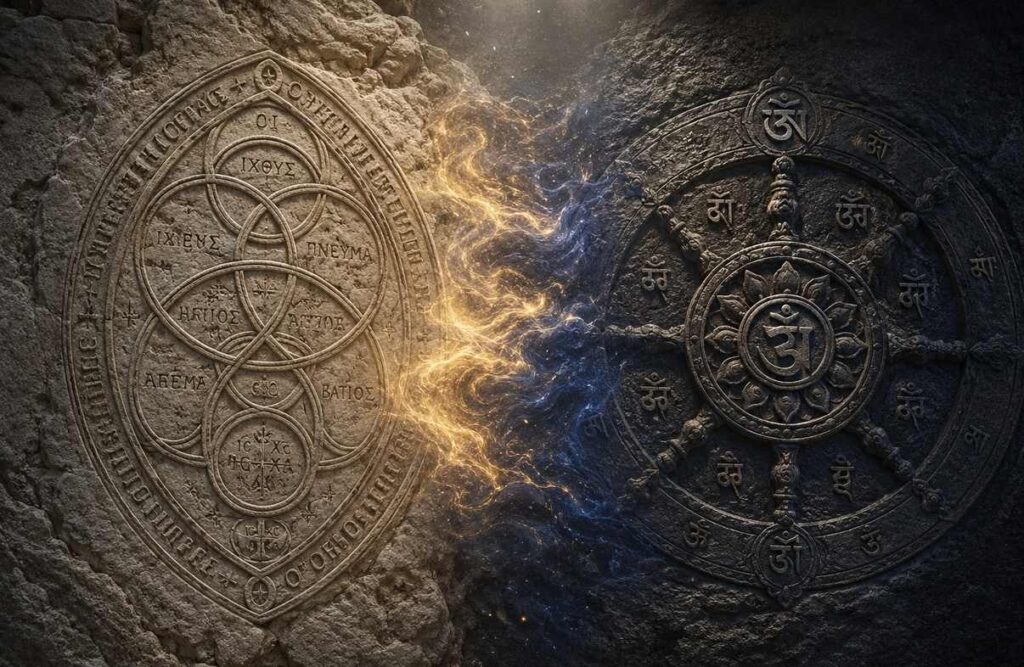
Here lies perhaps the most significant convergence. Gnosis is not faith, not belief, and not ordinary intellectual knowledge. It is a direct, unmediated recognition of one’s true ontological status — a knowing that transforms the knower. The Gospel of Thomas states it with characteristic austerity: Know what is in front of your face, and what is hidden from you will be disclosed to you.
Prajna, the wisdom of the Buddhist path, functions identically. It is not accumulated information but a penetrative insight into the nature of reality — specifically, the insight that all conditioned phenomena are empty of inherent existence. Nagarjuna’s Mulamadhyamakakarika demolishes all conceptual positions not to replace them with better ones, but to clear the ground for direct perception.
Gnosis and prajna both operate as deconstructive forces. They do not add to the self; they subtract from it. They do not build a new cosmology; they dismantle the old one from within. The Gnostic recognises that the divine spark was never truly exiled. The Buddhist recognises that the self was never truly born. Both recognitions collapse the problem they address.
Emptiness and Fullness
The Buddhist concept of sunyata, or emptiness, is often misunderstood as nihilism. It is not. It is the recognition that phenomena lack independent, inherent existence — they are empty of svabhava, or self-nature. The Gnostic Pleroma, conversely, is described as a fullness that transcends limitation. Yet both point to the same release from reified existence. The Heart Sutra declares that form is emptiness and emptiness is form. The Gospel of Truth describes the Pleroma as that which surrounds all things and is within all things. Both are attempts to language the unconditioned without trapping it in concept.

The Seven Spheres — Planetary Archons and the Buddhist Realms
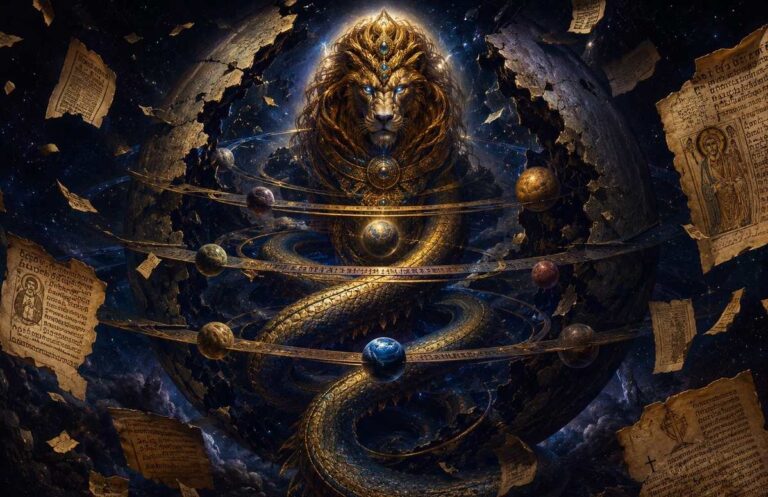
One of the most arresting parallels appears in the cosmological architecture. Gnostic literature, particularly the Apocryphon of John and the Hypostasis of the Archons, describes a cosmos administered by seven planetary rulers. Each governs a specific sphere, a specific passion, and a specific obstacle to the ascending soul. The soul must pass through each sphere and return to each ruler what belongs to it — the body to earth, the anger to Mars, the desire to Venus — until nothing remains that is not authentically its own.
Buddhist cosmology maps existence into multiple realms, but the critical structure of seven appears in meditation literature and tantric systems. More fundamentally, the Buddhist path requires transcendence of all conditioned realms — the desire realm, the form realm, and the formless realm. The Theravadin tradition lists ten fetters that bind consciousness to the rounds of becoming. The first three — personality view, doubt, and attachment to rules and observances — must be broken to enter the stream. The final five, including desire for form, desire for formless existence, conceit, restlessness, and ignorance, must be dissolved for full liberation.
Both are technologies of dis-identification. The Gnostic returns the archons their tokens. The Buddhist abandons the fetters that bind consciousness to becoming. The boundary between conditioned existence and the unconditioned is marked by the complete evacuation of identification with any realm, any form, any station.
The Ascent Narrative
Texts like Zostrianos and the Apocalypse of Paul describe the soul’s ascent through the planetary spheres, encountering each archon and overcoming its challenge through the correct password or sign. This is not mere mythology. It is a map of psychological transformation — the systematic withdrawal of investment from every level of conditioned identity. The Buddhist jhanas, or meditative absorptions, perform a similar function. Each successive jhana represents a refinement of consciousness and a release from coarser identifications, culminating in the cessation of perception and feeling, and ultimately in nirvana.
Christ Consciousness and Buddha Nature — The Already-Liberated Self
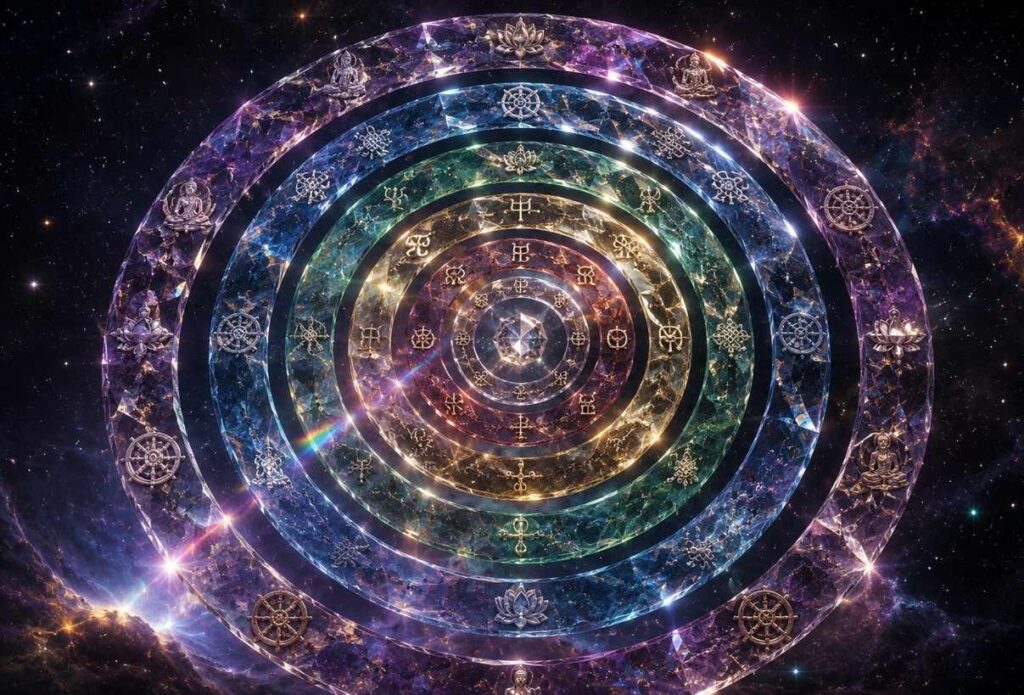
Here the traditions diverge in vocabulary while converging in structure. The Gnostic Christ is not primarily a historical figure but an aeonic reality — the divine intelligence that descends into the kenoma to awaken the sleeping sparks of the Pleroma. Christ consciousness means the recognition that the divine is not external but immanent, not future but already present, awaiting only the removal of obscuration.
Buddha nature, or tathagatagarbha, makes the identical claim. Every sentient being, according to the Mahayana teaching, already possesses the essence of enlightenment. It is not created through practice; it is revealed through practice. The klesas are adventitious — they do not touch the essential nature, just as clouds do not stain the sky.
The Gnostic divine spark and the Buddhist tathagatagarbha are both formulations of what might be called the ontological priority of liberation. Freedom is not achieved; it is remembered. The path does not manufacture awakening; it removes the obstacles to what is already the case. This is why both traditions can sound paradoxical to the linear mind. The Gnostic does not become divine; the Gnostic recognises divinity. The Buddhist does not become Buddha; the Buddhist realises Buddha nature.
Grace and Effort
A subtle difference emerges in method. Gnosticism tends to emphasise the divine initiative — the call from the Pleroma, the descent of the Saviour, the awakening of the spark by grace. Buddhism tends to emphasise systematic practice — the Eightfold Path, the progressive cultivation of sila, samadhi, and prajna. Yet even here, the divergence is not absolute. The Gnostic still requires response, recognition, and the arduous work of disentanglement. The Buddhist still requires the sudden breakthrough of kensho or satori, the grace of insight that cannot be forced. Both traditions hold grace and effort in dynamic tension.

The Pleroma and Nirvana — Beyond the Binary
If kenoma and samsara are the prisons, the Pleroma and nirvana are the liberated conditions beyond them. Yet both traditions resist reifying even these highest terms. The Pleroma is not a place but a plenitude of divine potentiality — a fullness that transcends the emptiness of the kenoma without becoming another object of grasping. Nirvana is defined precisely by what it is not: not existence, not non-existence, not both, not neither.
Both understand that the ultimate cannot be captured in concept or image. The Gospel of Truth describes the Pleroma as incomprehensible, surrounding all things while remaining within. The Prajnaparamita literature describes perfect wisdom as beyond all categories, including the category of wisdom itself. Both traditions push language to its breaking point, not because they are vague, but because they are precise about the limits of precision.
Why These Convergences Matter Today
In an era of spiritual consumerism and superficial eclecticism, the Gnostic-Buddhist convergence offers something more rigorous: evidence that liberation is not a cultural product but a structural feature of consciousness itself. These traditions were not in dialogue historically. There is no evidence of direct textual transmission between Nag Hammadi and Nalanda during their formative periods. Their similarities cannot be dismissed as borrowing. They are independent corroborations.
For the contemporary seeker, this means that the path is real. The prison is real. And the way out — whether called gnosis or prajna, whether mapped through aeons or dharmas — is equally real. The vocabulary differs. The architecture is the same.
For the Buddhist practitioner curious about Gnosticism, these parallels provide a philosophical bridge. The unfamiliar mythology of archons and aeons resolves into familiar categories when understood functionally. For the Gnostic seeker drawn to Buddhist practice, the sophisticated contemplative technology of Buddhism offers concrete methods for the recognition that Gnosticism describes theoretically.
Frequently Asked Questions
Did Gnosticism influence Buddhism, or vice versa?
There is no direct historical evidence of influence in either direction during the formative periods of both traditions. The parallels appear to be structural — independent discoveries of similar psychospiritual terrain, arrived at through intense contemplative investigation.
Is Gnosticism a form of Buddhism?
No. Gnosticism retains a theistic and mythological framework that Buddhism largely abandons. They are distinct traditions with different historical lineages, even where their insights converge. The comparison illuminates; it does not dissolve difference.
What is the main difference between gnosis and prajna?
Gnosis tends to be framed as recognition of a divine identity or spark within the self, while prajna is the insight that the self itself is empty of inherent existence. The destination may be similar; the starting assumptions and philosophical frameworks differ significantly.
Do Gnostics believe in reincarnation like Buddhists?
Some Gnostic texts describe multiple lifetimes or the recycling of souls through planetary spheres, but this is not identical to Buddhist rebirth. The Gnostic goal is escape from the entire system of becoming, not merely improved navigation within it.
Can one practise both Gnosticism and Buddhism?
Many contemporary practitioners find the two traditions complementary. However, each has its own specific techniques, lineages, and commitments. Authentic practice requires respect for the integrity of each path rather than casual mixing.
What does Christ Consciousness mean in Gnosticism?
It refers to the aeonic or divine intelligence that reveals the true nature of reality and the self, not merely the historical Jesus. It is a state of awakened perception available to all who undergo the transformative recognition of gnosis.
Is the Pleroma the same as nirvana?
They are not identical, but they occupy analogous positions in their respective systems. Both point to an unconditioned state beyond suffering, conceptual grasping, and dualistic perception. The Pleroma is described in more mythological terms; nirvana in more phenomenological terms.
Further Reading
- Pleroma vs. Kenoma — The Gnostic Cosmos Grounded in the Nag Hammadi Texts: A definitive exploration of the Gnostic metaphysical framework that mirrors the Buddhist distinction between conditioned and unconditioned reality.
- Zostrianos — The Complete Journey Through the Thirteen Aeons: The ascent narrative par excellence, mapping the Gnostic path through cosmic spheres in detail comparable to Buddhist stage-by-stage liberation models.
- The Gnostic Soul Trap: Archons, Death, and the Recycling of Pneuma: An examination of the mechanics of bondage in Gnostic cosmology, offering a striking parallel to Buddhist analyses of samsaric recycling.
- The Gospel of Thomas — 114 Sayings of Hidden Wisdom: The sayings gospel that most closely approximates a Gnostic koan collection, demanding the same non-conceptual insight as Zen Buddhist practice.
- Valentinian Gnosticism — The Most Systematic Map of Divinity: The sophisticated theological system that, like Madhyamaka Buddhism, rigorously deconstructs all reified positions while affirming the ultimate.
- Jung, Shadow Work, and Gnostic Pneuma: A contemporary bridge between depth psychology and Gnostic liberation, resonant with Buddhist abhidharmic analyses of mental factors.
- The Apocryphon of John — The Gnostic Creation Myth: The primary source for the archontic cosmology and the seven planetary spheres discussed in this article.
References and Sources
- The Nag Hammadi Library in English, edited by James M. Robinson. HarperSanFrancisco, 1990.
- The Dhammapada: A Collection of Verses, translated by F. Max Muller. Oxford University Press, 1881; various modern editions.
- Loy, David. Nonduality: A Study in Comparative Philosophy. Yale University Press, 1988.
- Pagels, Elaine. The Gnostic Gospels. Random House, 1979.
- Nagarjuna. Mulamadhyamakakarika, translated by Jay L. Garfield. Oxford University Press, 1995.
- The Heart Sutra, translated by Red Pine. Counterpoint, 2004.
- Tathagatagarbha Sutra, in Buddha Nature: The Mahayana Uttaratantra Shastra, translated by Rosemarie Fuchs. Snow Lion Publications, 2000.
- Williams, Michael Allen. Rethinking Gnosticism: An Argument for Dismantling a Dubious Category. Princeton University Press, 1996.
- Brakke, David. The Gnostics: Myth, Ritual, and Diversity in Early Christianity. Harvard University Press, 2010.
- Conze, Edward. Buddhism: Its Essence and Development. Harper Torchbooks, 1959.