
The Names of the Archons: Identifying the Prison Wardens of the Soul Trap
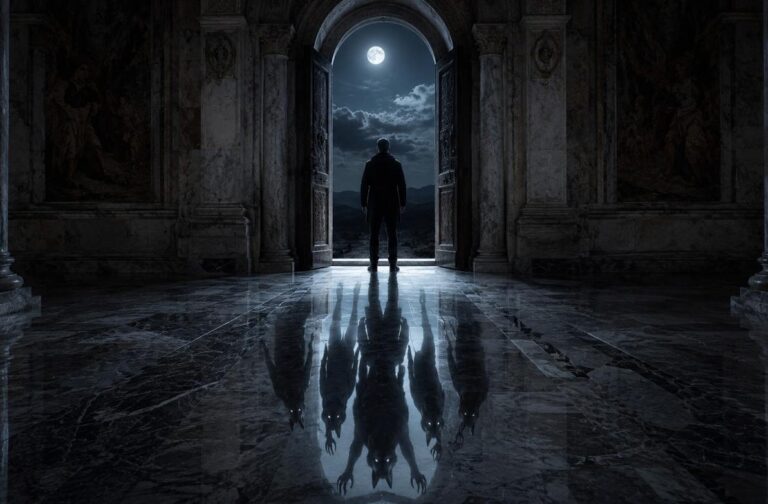
To escape a prison, one must first identify the guards. In Gnostic cosmology, the material world is not governed by a singular benevolent creator, but by a hierarchy of inorganic, predatory entities known as Archons.
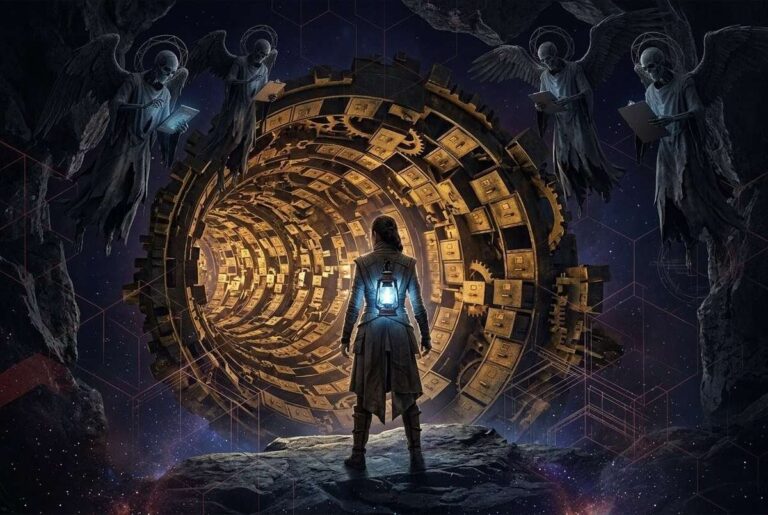
These beings serve as the “Custom-House Officers” of the afterlife, patrolling the planetary spheres to ensure that human souls remain tethered to the cycle of rebirth. The Nag Hammadi Library provides not merely warnings, but a detailed roster–names, faces, and jurisdictions–for those who would navigate the ascent beyond the material domain. At ZenithEye, we provide the map and the names required to understand these celestial checkpoints.
Table of Contents
- The Chief Architect: Yaldabaoth (The Demiurge)
- The Seven Hebdomad: The Rulers of the Gates
- The Counterfeit Spirit and the Psychology of Bondage
- The Passwords of Recognition: Navigating the Celestial Gates
- Archonic Echoes in the Modern World
- Frequently Asked Questions
- Further Reading
- References and Sources
The Chief Architect: Yaldabaoth (The Demiurge)
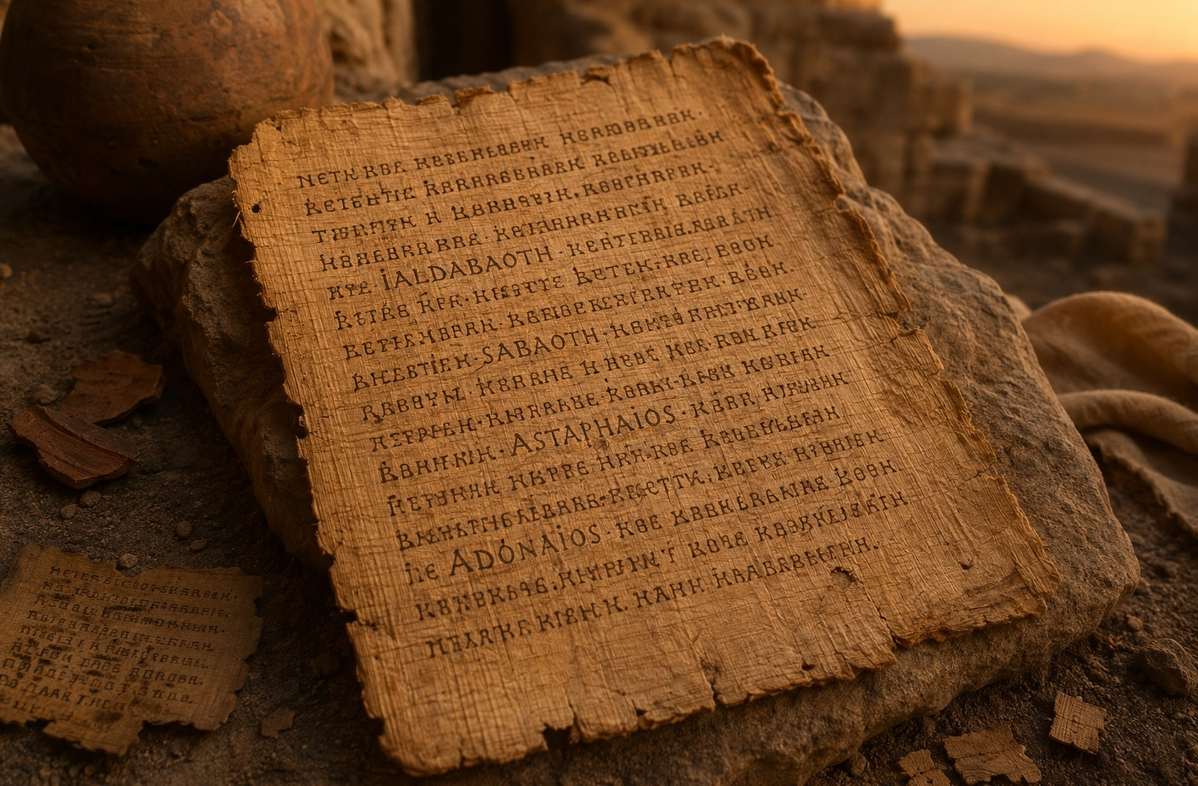
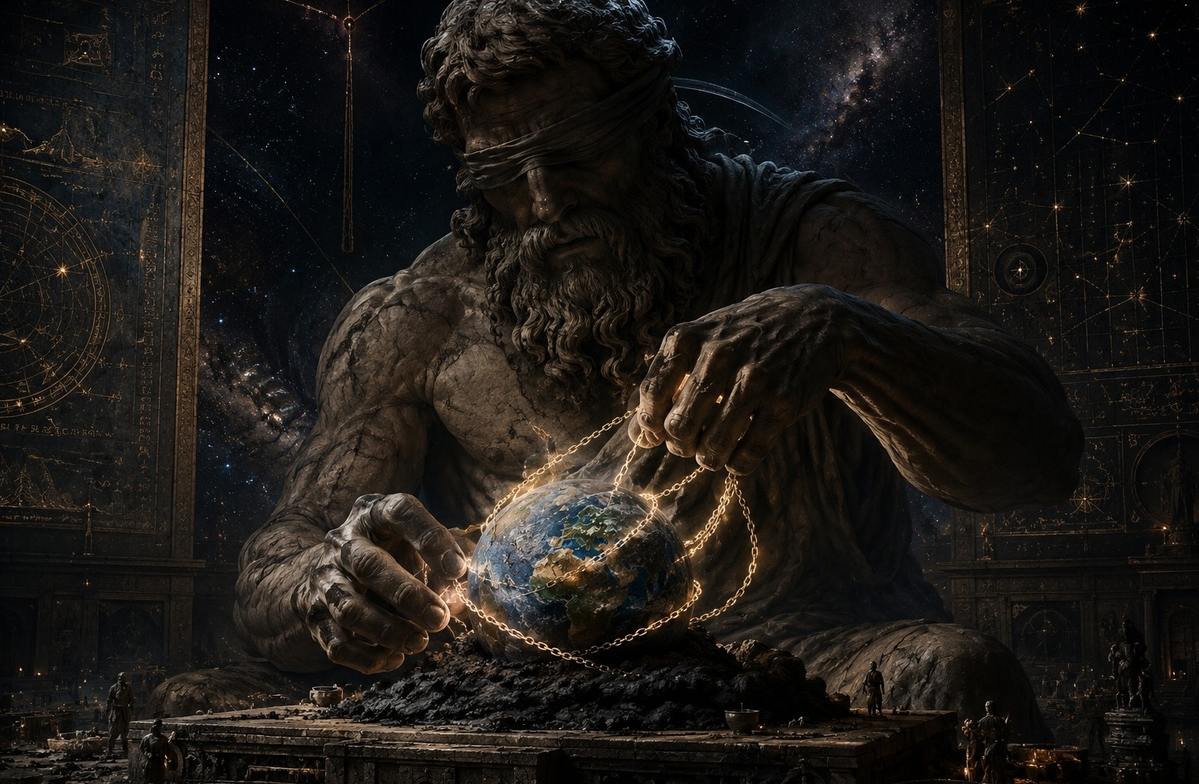
At the pinnacle of the Archonic hierarchy stands Yaldabaoth, the Demiurge–the “craftsman” who fashioned the material cosmos. The Apocryphon of John (NHC II,1) explicitly records three names for this entity: Yaldabaoth, Saklas (“the Fool”), and Samael (“the Blind God”). A fourth name, Nebruel, appears in the Gospel of the Egyptians (NHC III,2), where he is numbered among the rebellious powers alongside Saklas.
Yaldabaoth is frequently depicted as a lion-headed serpent–a symbol of raw, predatory power fused with low-vibrational cunning. He is a “blind god” in the most literal sense: born from Sophia’s anguish and error without his divine pair, he believes himself to be the sole creator. The Hypostasis of the Archons (NHC II,4) describes his arrogant proclamation–“I am God and there is no other God beside me”–spoken in ignorance of the Pleroma, the true Fullness above him.
His primary function is the maintenance of the kenoma, the realm of lack and illusion. Through the laws of physics, the enforcement of entropy, and the “karmic” logic of cyclical return, he ensures that spirited human beings remain harvested for energetic sustenance. Unlike humanity, Yaldabaoth possesses no divine spark; he is a psychic entity–alive, but not enlivened by the Pre-existent One.
The Seven Hebdomad: The Rulers of the Gates
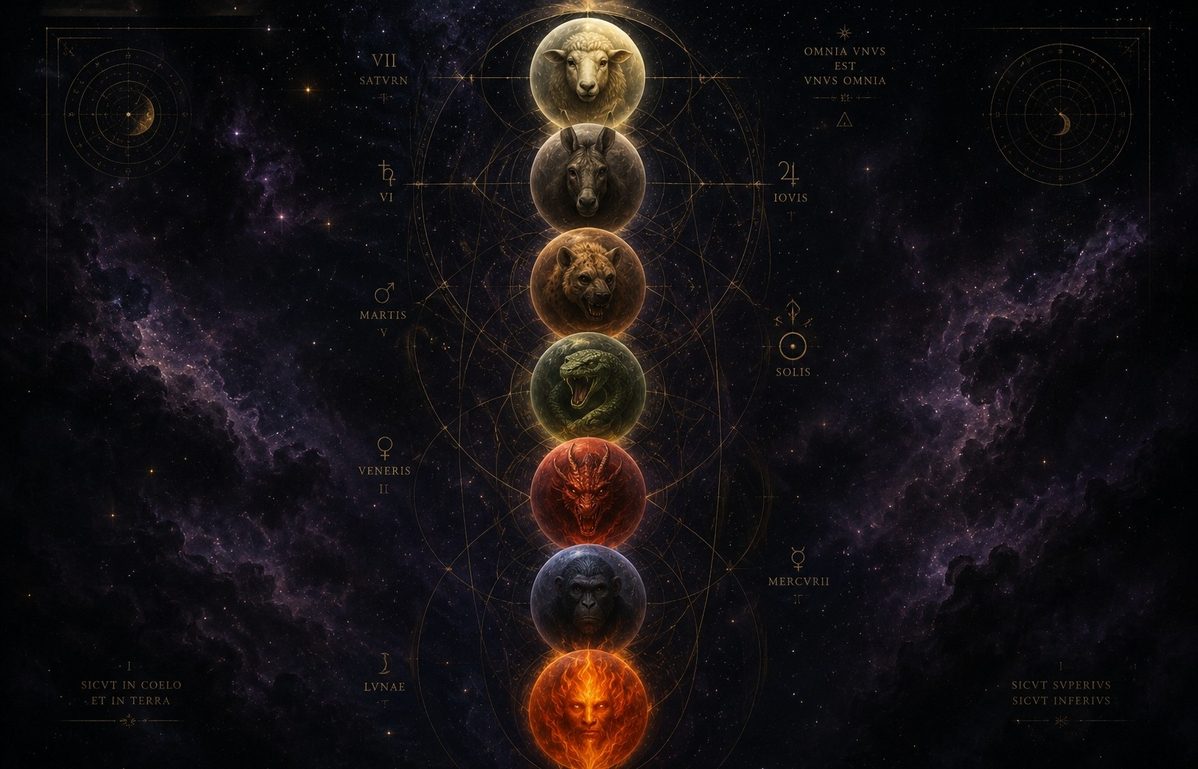
The Apocryphon of John describes the creation of seven primary powers by Yaldabaoth to assist in the governance of the material realm. These are the Seven Hebdomad–the planetary rulers who preside over the celestial spheres between the earth and the Pleroma. Each archon represents a specific psychological and vibrational “toll” that the soul encounters upon death, and each bears an animal face, as recorded in the Hypostasis of the Archons: sheep, donkey, hyena, seven-headed serpent, dragon, monkey, and flaming fire.
The following attributions are drawn directly from the long version of the Apocryphon of John (NHC II,1) and corrected against the standard critical edition. Many popular online sources scramble these planetary associations; the roster below reflects the primary Coptic text.
1. Athoth — Saturn
Planetary Sphere: Saturn (Kronos)
Archontic Function: Athoth governs the outermost planetary gate. He is associated with limitation, melancholy, and the crushing weight of temporal duration. His influence manifests as the belief that one is bound by fate, by the slow decay of time, or by the unchangeable “reality” of one’s circumstances. To pass Athoth, the soul must recognise that it is eternal and exists beyond linear chronology.
2. Eloaios — Jupiter
Planetary Sphere: Jupiter (Zeus)
Archontic Function: Eloaios presides over expansion, law, and hierarchical authority. His trap is the seduction of moral certainty–the conviction that one’s ethical framework, religious institution, or social order is absolute. He harvests the energy of self-righteousness and the anxiety of those who fear divine punishment. The password here is the recognition that true morality arises from interior Gnosis, not external commandment.
3. Astaphaios — Mars
Planetary Sphere: Mars (Ares)
Archontic Function: Astaphaios governs aggression, conflict, and the survival instinct run amok. His sphere is the battlefield–literal and psychological. He thrives on competition, territoriality, and the adrenalised state of perpetual defence. The soul that declares its essence to be peace, and refuses to feed the fires of war, dissolves his jurisdiction.
4. Iao — The Sun
Planetary Sphere: The Sun (Helios)
Archontic Function: Iao is the Archon of ego-centrality and the desire for worship. Not to be confused with the true spiritual sun, he is the false light that demands adoration, obedience, and the projection of divinity onto external figures–gurus, political leaders, or religious icons. His trap is the abdication of sovereignty to a “higher power” that is merely another face of the same prison.
5. Sabaoth — Venus
Planetary Sphere: Venus (Aphrodite)
Archontic Function: Sabaoth governs desire, attachment, and the chemistry of binding. His sphere manages lust, romantic obsession, and the false “love” that tethers souls to physical bodies through emotional dependency. He is the architect of the biological imperative that mistakes chemistry for union. The sovereign soul declares itself whole and complete within its own divine spark.
6. Adonin — Mercury
Planetary Sphere: Mercury (Hermes)
Archontic Function: Adonin rules communication, commerce, and the labyrinth of the intellect. His trap is intellectual pride–the “chatter” of the mind that substitutes conceptual maps for direct experience. He is the patron of those who argue about spirituality without practising it, and of the deceptive eloquence that keeps seekers spinning in circles. The password is silence.
7. Sabbataios (Sabbede) — The Moon
Planetary Sphere: The Moon (Selene)
Archontic Function: Sabbataios is the innermost gate, governing the astral body, dreams, and the realm of shifting moods. He uses the ebb and flow of human emotion–depression, elation, anxiety–to keep souls reactive and unstable. Because the moon reflects rather than generates light, his domain is the world of imitation and psychic distortion. The soul that knows itself as self-luminous passes untouched.
The Counterfeit Spirit and the Psychology of Bondage
Beyond the planetary rulers, Gnostic texts describe a more intimate mechanism of control: the Counterfeit Spirit. This is not an external entity but an internal overlay–a false ego or psychic complex that mimics the true divine spark. It is the “voice” of self-doubt, the compulsion toward shame, and the inexplicable anxiety that rises precisely when one begins to awaken.
The Apocryphon of John and related Sethian texts describe how Yaldabaoth “soul-garments” the divine spark into heavy biological matter. The Counterfeit Spirit functions as the stitching that holds this garment in place. It generates thoughts that feel like one’s own but are actually vibrational frequencies broadcast from the archonic hierarchy. When a seeker thinks, “I am not worthy of liberation,” or “This is too difficult,” they are often hearing the static of the Counterfeit Spirit.
Discerning the difference between the Counterfeit Spirit and the authentic interior voice is the essence of Gnosis. The former speaks in the language of fear, scarcity, and hierarchy. The latter–the voice of the Pneuma–speaks in recognition, often silently, and always with the quality of returning rather than departing.
The Passwords of Recognition: Navigating the Celestial Gates
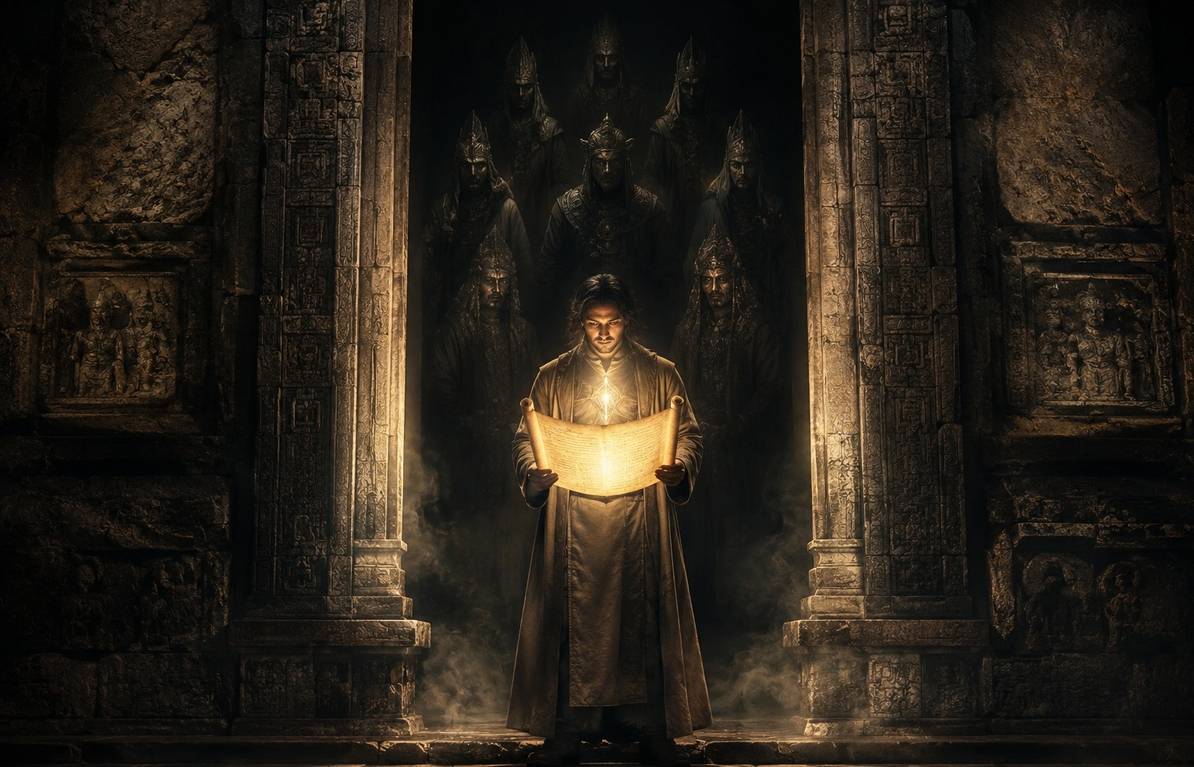
The Gnostics did not merely catalogue the archons as a theological exercise. The texts preserve specific invocations of ascent–words of power that function not as supplication, but as declarations of sovereignty. The First Apocalypse of James (NHC V,3) is explicit: when the soul is challenged by the “Custom-House Officers” after death, it must not answer as a servant, but as one who remembers its origin.
I am a son of the Father, and I am from the Pre-existent One. I am a stranger to your lineage and your world. I do not belong to your creation, but to the One who sent me. I have come to reclaim what is mine, which is myself.
— Invocation of Sovereignty, adapted from the First Apocalypse of James
This is not magic in the ceremonial sense. It is the activation of memory. By naming the archon and declaring one’s non-belonging to the kenoma, the soul demonstrates that it has seen through the mask. The archons, in the Gnostic logic, lose authority over those who no longer recognise their jurisdiction.
For the living, the same principle applies. Whenever the “archonic squeeze” manifests–sudden dread, intrusive self-criticism, or the compulsion to conform–the practitioner can deploy the Sovereignty Decree:
I withdraw all consent from any entity, known or unknown, that seeks to harvest my energy. I am grounded in my own Divine Spark.
The efficacy of such declarations lies not in the words themselves, but in the state of recognition from which they are spoken. An invocation recited from fear is merely another offering to the system. An invocation spoken from Gnosis is a boundary that the archonic cannot cross.
Archonic Echoes in the Modern World
The archons are not confined to ancient papyrus. Their operational logic is visible in any structure that harvests human attention, emotional intensity, or subjugated will. The specific names may have faded from common discourse, but the machinery persists.
Division and Conflict: The perpetual manufacture of polarisation–political, religious, cultural–generates a reliable harvest of fear and anger. The archonic system does not care which side one takes, only that one remains agitated.
The Inner Critic: The “voice of the ego” that insists upon smallness, unworthiness, and powerlessness is the psychological residue of the Counterfeit Spirit. It is not organic to the human being; it is an installed programme.
Material Obsession: By tethering identity to possession, status, and physical appearance, the matrix ensures that consciousness remains anchored in the lower survival centres. The person who believes they are their body, their bank account, or their social role has effectively signed a long-term lease in the kenoma.
Digital Capture: The contemporary attention economy functions as a technological extension of archonic harvesting. Infinite scroll, outrage algorithms, and the dopaminergic loop of notification culture are simply modern refinements of the Loosh mechanism–emotional energy extracted at industrial scale.

Frequently Asked Questions
Who is Yaldabaoth in Gnostic cosmology?
Yaldabaoth is the chief archon and Demiurge described in the Nag Hammadi Library, particularly the Apocryphon of John. Born from Sophia’s error without a divine pair, he believes himself to be the sole creator and governs the material realm with his seven subordinate powers.
What are the three names of the Demiurge?
The Apocryphon of John explicitly gives three names for the chief ruler: Yaldabaoth, Saklas (meaning ‘fool’), and Samael (meaning ‘blind god’). Each name reflects a different aspect of his ignorant and arrogant nature.
Who are the Seven Hebdomad?
The Seven Hebdomad are the planetary archons created by Yaldabaoth to govern the seven celestial spheres. They are Athoth (Saturn), Eloaios (Jupiter), Astaphaios (Mars), Iao (Sun), Sabaoth (Venus), Adonin (Mercury), and Sabbataios (Moon), each associated with a specific planet and bestial face.
What is the Counterfeit Spirit in Gnostic texts?
The Counterfeit Spirit is a false ego or psychic overlay described in Gnostic literature that mimics the true divine spark. It functions as an internal archonic mechanism, generating self-doubt, compulsive thought patterns, and emotional reactions that keep the soul tethered to material existence.
How do the Archons relate to the concept of a soul trap?
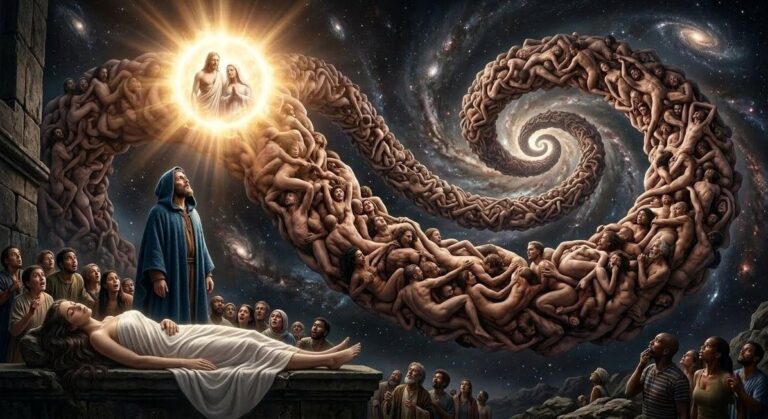
In Gnostic cosmology, the archons patrol the planetary spheres after death, attempting to block the soul’s ascent to the Pleroma. The soul trap refers to the cyclic system of rebirth maintained by these entities, where souls are persuaded to return to physical incarnation rather than achieving liberation.
What are the passwords used to pass the archons?
Gnostic ascent texts describe invocations of sovereignty rather than submission. The awakened soul declares its origin from the Pre-existent One, refusing to identify with the archons’ lineage and thereby dissolving their claimed authority.
Do the Archons appear in traditions outside Gnosticism?
Similar concepts appear across multiple traditions: the planetary governors of Hermetic ascent literature, the wrathful deities of the Tibetan Bardo, the flyers described by Carlos Castaneda, and the oppressive rulers in Manichaean cosmology. These cross-cultural parallels suggest a persistent archetype of predatory cosmic intermediaries.
Further Reading
- Archons and the Soul Trap — An exploration of archonic influence and the mechanics of the reincarnation cycle.
- The Soul Trap — A critical examination of the soul trap hypothesis from multiple esoteric perspectives.
- The Soul Trap Hypothesis: A Critical Examination — Scholarly analysis of NDE accounts and the false light tunnel theory.
- The Reality of the Archons — Detailed commentary on NHC II,4 and the creation myth involving Eve and Norea.
- The Apocryphon of John: Gnostic Creation — The primary source text describing Yaldabaoth’s birth and the seven powers.
- The Gnostic Theory of Consciousness — Psychological analysis of hylic, psychic, and pneumatic states.
- Entities and Their Hunting Grounds — A taxonomy of predatory consciousness and energetic parasitism.
- Nag Hammadi Library: Complete Reader’s Guide — The master index for navigating all forty-six tractates and thematic collections.
References and Sources
The following sources represent the critical editions and scholarly monographs underlying this article’s claims.
Primary Sources and Critical Editions
- The Apocryphon of John (NHC II,1; III,1; IV,1; BG 8502,2). In The Nag Hammadi Library in English, ed. James M. Robinson. HarperSanFrancisco, 1990.
- The Hypostasis of the Archons (NHC II,4). In The Nag Hammadi Library in English, ed. James M. Robinson. HarperSanFrancisco, 1990.
- The Gospel of the Egyptians (NHC III,2; IV,2). In The Nag Hammadi Library in English, ed. James M. Robinson. HarperSanFrancisco, 1990.
- On the Origin of the World (NHC II,5; XIII,2). In The Nag Hammadi Library in English, ed. James M. Robinson. HarperSanFrancisco, 1990.
- The First Apocalypse of James (NHC V,3). In The Nag Hammadi Library in English, ed. James M. Robinson. HarperSanFrancisco, 1990.
Scholarly Monographs
- Michael Allen Williams. Rethinking “Gnosticism”: An Argument for Dismantling a Dubious Category. Princeton University Press, 1996.
- David Brakke. The Gnostics: Myth, Ritual, and Diversity in Early Christianity. Harvard University Press, 2010.
- John D. Turner. Sethian Gnosticism and the Platonic Tradition. Presses Universite Laval, 2001.
Comparative Studies
- Ioan P. Culianu. Psychanodia I: A Survey of the Evidence Concerning the Ascension of the Soul and Its Relevance. Brill, 1983.
- Hans Jonas. The Gnostic Religion: The Message of the Alien God and the Beginnings of Christianity. Beacon Press, 2001 (rev. ed.).
Safety Notice: This article explores predatory consciousness and Gnostic cosmology. It does not constitute medical, psychological, or spiritual advice. If you are experiencing persistent paranoia, dissociation, or spiritual emergency symptoms, please contact professional emergency services or a trauma-informed therapist. Contemplative practice complements but does not replace clinical mental health treatment.