Hermetic Spirituality
The Hermetic tradition—rooted in the Corpus Hermeticum attributed to Hermes Trismegistus—constitutes the most influential current of Western esotericism. This essay presents Hermeticism not as occult curiosity but as a genuine contemplative tradition, offering sophisticated methods of spiritual transformation that parallel Eastern practices while remaining distinctively Western in character.
The Question at Hand
Is there a Western contemplative tradition comparable to the sophisticated spiritual technologies of the East? The Hermetic corpus—texts attributed to the legendary Hermes Trismegistus (“Thrice-Greatest”)—suggests an affirmative answer. These writings, composed in Egypt between the 1st and 3rd centuries CE, present a comprehensive system of spiritual transformation that has influenced every major current of Western esotericism, from alchemy and Kabbalah to Renaissance philosophy and modern occultism.
Yet Hermeticism remains underappreciated in contemporary spirituality, often dismissed as “occult” or confused with New Age eclecticism. This essay reconstructs Hermetic spirituality as a disciplined path of inner transformation, examining its anthropology, cosmology, and contemplative methods with the seriousness afforded to Buddhist or Vedantic traditions.
Historical Context – The Egyptian Synthesis
The Hermetic texts emerged from the cultural ferment of Roman Egypt, where Greek philosophical traditions (Platonism, Stoicism) encountered Egyptian religious symbolism and Jewish wisdom literature. This syncretism was not arbitrary eclecticism but a deliberate “listening to the sources”—a hermeneutical engagement that sought the universal wisdom underlying particular traditions.
The result was a distinctive spiritual vision:
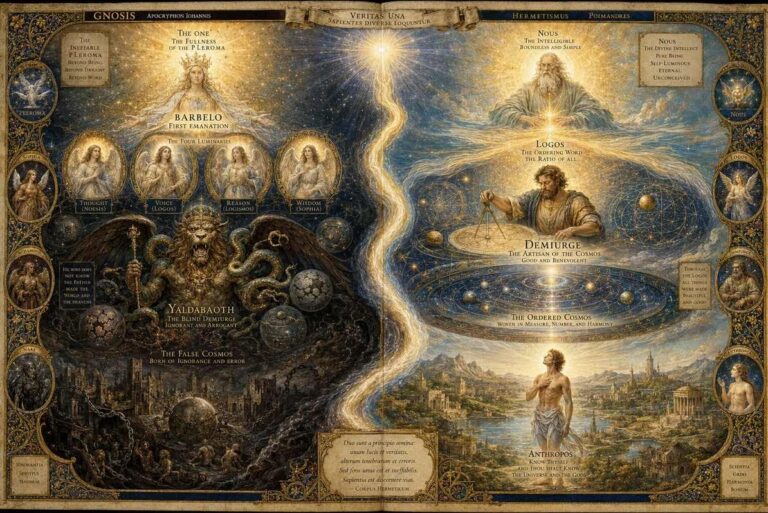
- The Divine Hierarchy: A graduated cosmos extending from the transcendent One (the Good, the Father) through the Nous (Divine Mind) and the Demiurge (craftsman of the sensible world), down to the planetary gods and material nature.
- The Anthropology: Human beings are viewed as microcosms containing all levels of reality—material, vital, psychic, and pneumatic (spiritual). This “vertical” self-structure makes possible both the descent into matter and the ascent to divinity.
- The Soteriology: Salvation is achieved through gnosis—not merely intellectual knowledge, but a transformative recognition of one’s divine identity and the corresponding purification of consciousness.
The Hermetic Contemplative Method
The Corpus Hermeticum presents specific practices for spiritual transformation:
1. The Turnabout (Epistrophe)
The fundamental gesture of Hermetic spirituality is the “turning about” of consciousness from outward to inward—from multiplicity to unity. Corpus Hermeticum I describes this transition:
“Nous appeared to him, and he became wholly Nous… and he saw the Supreme Good, and when he saw, he was transformed by the mercy of the Father.”
This is not merely intellectual conversion but ontological transformation—the metanoia that changes the knower in the very act of knowing.
2. The Ascent Through the Spheres
The Poimandres presents a detailed account of the soul’s ascent through the planetary spheres, shedding at each level the “accretions” of cosmic influence:
- Moon: The energy of increase and decrease (bodily growth and decay).
- Mercury: Evil machination (deceptive thinking).
- Venus: Desire for illusion (sensory craving).
- Sun: The arch of domination (egoic will).
- Mars: Unholy daring and rashness (aggressive impulse).
- Jupiter: Evil strivings arising from wealth (material attachment).
- Saturn: Deceit that ensnares (temporal limitation).
This is not astronomical speculation but a psychological process—the systematic deconditioning of consciousness from cosmic and cultural determinants.
3. The Cultivation of Nous
The practitioner cultivates Nous—divine intellect or intuitive intelligence—through:
- Philosophical Inquiry: The examination of nature and the self to discern the logoi (intelligible patterns) underlying apparent chaos.
- Theurgical Practice: Ritual operations designed to attune the practitioner to celestial harmonies.
- Contemplative Recollection: Sustained attention to the presence of Nous within the human intellect.
The Psychology of Hermetic Transformation
From a psychological perspective, Hermetic spirituality offers:
- A Map of the Soul: An anthropology that accommodates both the ego’s functions and its limitations.
- A Technology of Transcendence: A systematic method for moving from ego-consciousness to transpersonal awareness.
- An Integration of Opposites: The “as above, so below” principle suggests a non-dual synthesis of the spiritual and material.
Distinctive Features of the Tradition
Hermetic spirituality differs from Eastern contemplative traditions in several key respects:
- Cosmic Affirmation: Unlike the world-negation found in certain Hindu and Buddhist schools, Hermeticism affirms the cosmos as inherently beautiful, ordered, and worthy of contemplation.
- The Dignity of the Human: The famous declaration “Man is a great wonder” emphasizes the human potential for divinization (theosis).
- The Role of Nature: The Hermetic contemplative does not flee nature but reads it as scripture—the “Book of Nature” complementing the “Book of Revelation.”
The Hermetic Revival and Contemporary Relevance
The 15th-century recovery of the Corpus Hermeticum by Marsilio Ficino initiated the Renaissance Hermetic revival, influencing Renaissance philosophy, the scientific revolution, and modern esotericism.
Contemporary scholarship has recovered the “Hermetic spirituality” of the sources—their practical concern with inner transformation—against earlier interpretations that emphasized only their “occult” dimensions.
Practical Engagement
For contemporary seekers, Hermetic spirituality offers:
- A Western Vocabulary: Contemplative practice framed in Western philosophical and religious terms, providing a familiar cultural resonance.
- Cosmic Piety: A spirituality that embraces the natural world as inherently revelatory and sacred.
- The Integration of Knowledge: The Hermetic ideal of the philosophus—one who unites theoretical wisdom with practical, lived transformation.
Conclusion
Hermetic spirituality constitutes a genuine contemplative tradition, offering sophisticated methods for the transformation of consciousness within a Western framework. Its recovery by contemporary scholarship and its accessibility to modern practitioners make it a vital resource for those seeking “the Western path.”
The Hermetic promise—”you shall know yourself as divine”—remains as challenging and transformative today as in Roman Egypt. The Corpus Hermeticum is not merely to be read, but to be lived.