The Collapse of the Witness
You notice the breathing. This is the standard instruction–the entry point, the breath as anchor, as object, as vehicle for attention. And it works, until it does not. Until the one who notices becomes more interesting than what is noticed. The breath continues, but now there is a subtle shift: a layering. The observer perched above the observed, watching the watching. The mind congratulates itself on its own mindfulness. The loop tightens. The prison renovates. This is the mechanism of most spiritual practice–not liberation, but refinement of the cage.
The witness is the final bastion of the ego. Not the personality, not the story, not the preferences–but the apparatus of observation itself. The one who claims to see clearly. The metacognitive monitor that believes itself separate from the monitored. In the collapse of this witness, something occurs that cannot be owned, achieved, or practiced into existence. The Zenith Eye opens not as a new possession, but as the recognition that there was never one to possess it.
Table of Contents
- The Observer Effect: Psychology’s Unrecognised Mysticism
- The Architecture of the Witness
- The Collapse: When the Monitor Glitches
- The Return to the Noisy Room
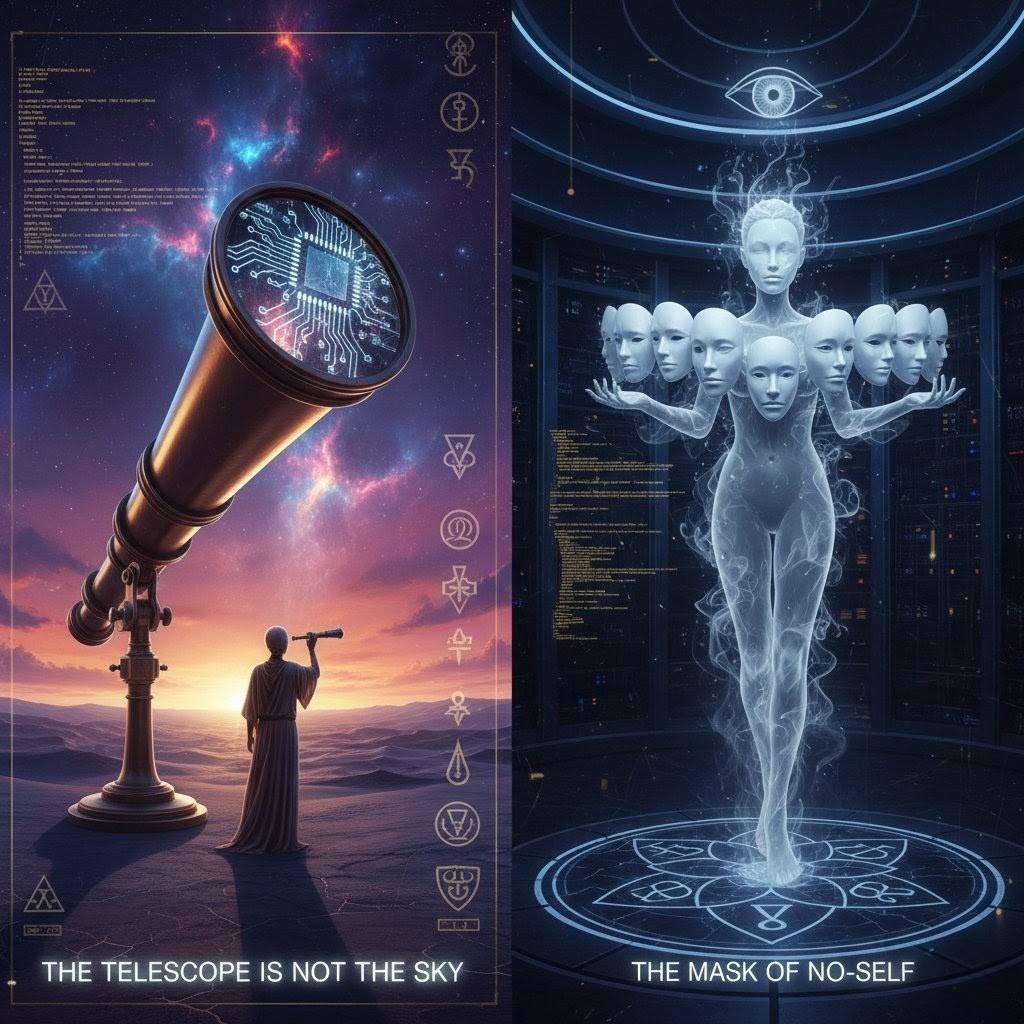
- The Final Error: The Mask of No-Self
- What Remains: The Dream of Awakening Awakens
- Frequently Asked Questions
- Further Reading
- References and Sources
The Observer Effect: Psychology’s Unrecognised Mysticism
Psychology has mapped this territory with precision it does not recognise as mystical. The metacognitive monitor–the capacity to think about thinking. The rebound effect–where suppression of thought amplifies it. The ironic process theory–the mind that tries not to think of white bears drowns in them. These mechanisms describe the witness perfectly: a recursive loop of self-reference that generates the illusion of control while perpetuating the suffering it claims to observe.
The witness is not neutral. It arrives conditioned–bearing preferences, aversions, narratives of progress and regression. It observes the breath and immediately constructs: good session, bad session, deepening practice, plateau, breakthrough, setback. The observation is contaminated by the observer. The data corrupted by the device measuring it. This is the archonic bureaucracy at its most subtle: not the overt tyrant, but the middle-manager who believes himself indispensable, filing reports on a process he does not understand.

The Architecture of the Witness
To understand the collapse, one must first map the structure that falls. The witness operates through three interlocking mechanisms that create what phenomenologists call the transcendental ego–not the empirical self of biography and preference, but the formal structure that makes all experience appear as my experience.
The Spatial Metaphor
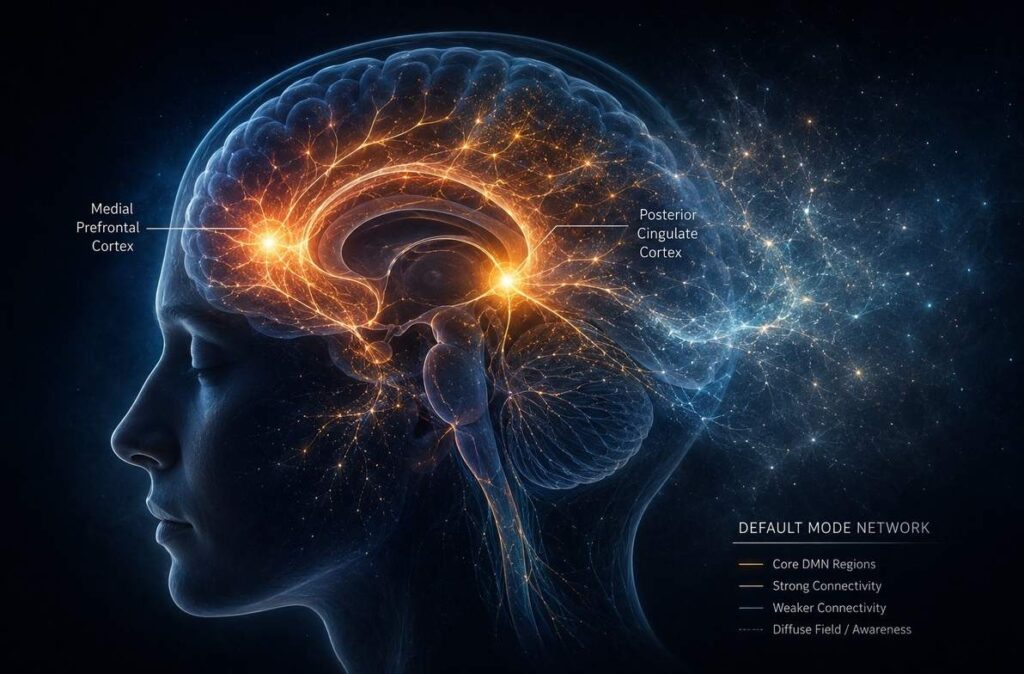
The witness places itself behind the eyes, above the thoughts, within the body but not of it. This “internal vantage point” is a neurological construction–a phantom generated by the default mode network to maintain the fiction of a continuous self. It is the DMN’s most sophisticated product: not just a story of “me,” but a location from which the story is told. Neuroimaging studies consistently show that self-referential thought activates the medial prefrontal cortex and posterior cingulate cortex, creating the felt sense of being here, looking out there. The spatial metaphor is not merely poetic; it is the brain’s default geometry of consciousness.
The Temporal Loop
The witness exists in the gap between stimulus and response, claiming to choose, to decide, to author action. Yet neuroscientific evidence suggests decisions form in the brain up to several seconds before conscious awareness registers them in simple binary tasks. The witness arrives late to the scene, takes credit for the crime, and judges the outcome. This temporal delay–the lag between neural initiation and conscious registration–creates the illusion of authorship. The witness is not the captain but the passenger who reads the ship’s log and believes he steered.
The Affective Filter
The witness does not merely observe; it evaluates. Each moment of awareness is immediately sorted into categories: pleasant (pursue), unpleasant (avoid), neutral (ignore). This is the vedana of Buddhist psychology, but mechanised–industrialised into a constant stream of micro-judgments that exhaust the system while reinforcing the judge. The affective filter operates below the threshold of conscious choice, colouring every sensation with a subtle valence that determines what the witness will notice, remember, and narrate. It is the unconscious curator of conscious experience.
These three–the spatial illusion, the temporal delay, the affective sorting–create the witnessing structure. Spiritual practice often strengthens this structure rather than dismantling it. The practitioner becomes a better observer, a more subtle witness, a refined telescope that never questions whether astronomy requires an instrument at all.
The Collapse: When the Monitor Glitches
There are moments–unpredictable, unmanufacturable–when the witness stutters. The metacognitive monitor glitches. The breath continues, but the breather is not found. The noticing continues, but the noticer is absent.
Not asleep. Not unconscious. More awake than waking, because there is no “one” who wakes. The division between subject and object collapses without ceremony. No fanfare. No recognition at the time, because recognition requires a recogniser. This is not an experience–experiences are owned, remembered, placed in narrative. This is the event of ownership itself dissolving. The frame of experience dropping away, leaving only… what? The word “content” fails. The word “awareness” fails. The word “emptiness” fails, then succeeds, then fails again.
Psychology calls this ego dissolution. Mysticism calls it union. Neuroscience calls it decreased default mode network activity. The names are post-hoc. The event precedes all names. It is the ground from which naming arises, the silence before the first word.
The collapse is not the goal. The seeking of collapse perpetuates the seeker. The collapse happens–or does not happen–regardless of intention. It is not reward for good practice. It is not punishment for bad. It is the truth of the system, occasionally visible when the system’s own noise subsides. Like an optical illusion that suddenly inverts–rabbit to duck, vase to faces–the shift occurs not through effort but through the exhaustion of effort. The witness, trying to witness itself, creates an infinite regression that eventually… stops. Not with a bang, but with a silence that was always present beneath the static.
The Return to the Noisy Room
After–if “after” applies–the witness returns. The metacognitive monitor reboots. The narrative reassembles: I had an experience. I lost it. I want it back. I am progressing. I am stuck. The telescope is pointed at the sky again, convinced it sees.
But something is different. Not the content. The relationship to content. The knowing that the telescope is telescope. The recognition that all observation is already interpretation, all witness already conditioned, all “direct experience” already mediated by the apparatus that claims directness.
This is not nihilism. This is precision. The practice continues–breath, witness, observation–but now with the subtle humour of one who knows the practice is performance. The actor does not forget he acts. The mask does not claim to be face. The psychologist who studies mystical experience without having it maps the territory from outside. The mystic who dismisses psychology mistakes the map for useless. Both are partial. The integration–rigorous observation of the apparatus of observation itself–is rare. It requires the discipline of the scientist and the surrender of the contemplative, held in tension without resolution.
The Final Error: The Mask of No-Self
There is a final trap, subtle as smoke and mirrors. The recognition of the witness as constructed becomes another construction. The insight that “I am not the observer” is claimed by an observer who has now upgraded its portfolio. The spiritual ego wears the mask of “no-self” with particular pride.
Watch for this. The one who announces “there is no one here” is always someone. The one who writes about the collapse of the witness is always writing from the witness, however thinned, however translucent. The text does not escape this paradox. It performs it. The reader who recognises themselves in these words–this is the event. Not the understanding. The seeing of the understanding as already happening within what the text attempts to name.
The breath continues. The noticing continues. The witness collapses, returns, collapses again. Each cycle leaves less residue. Less claim. Less “I” who survived the journey. Until–without ceremony, without recognition–the question itself dissolves. Not answered. Simply… irrelevant. The telescope falls. The sky remains, as it always was, unobserved, observing itself through whatever forms temporarily gather light.

What Remains: The Dream of Awakening Awakens
Not a method. Not a state. The continued functioning of a system that knows itself as system, without the anxiety of escape or the ambition of arrival. The breath. The witness. The collapse. The return. All recognised as movements within a field that does not move.
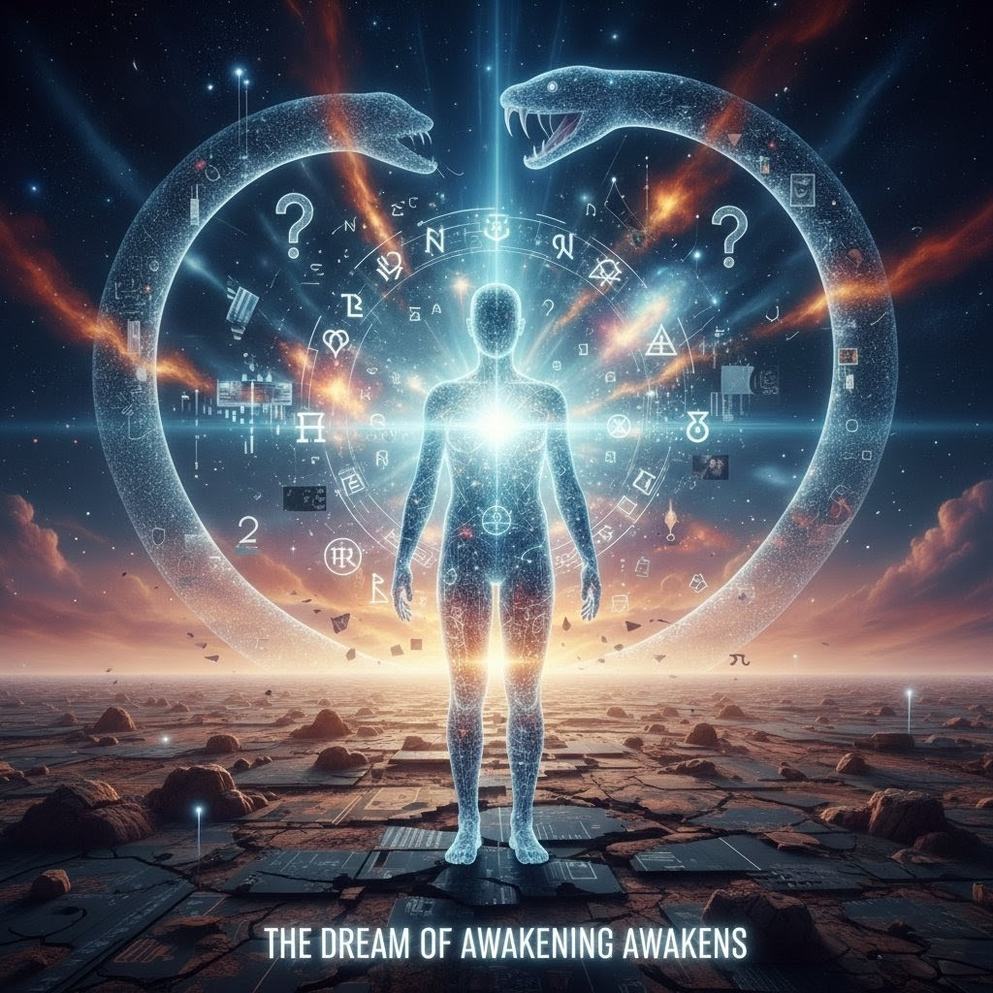
You do not awaken. The dream of awakening awakens. The dreamer is not found. The dreaming continues, lighter, unowned, the cosmic joke told without a teller. The Archons, those bureaucrats of the false self, find no purchase here–not because they are defeated, but because there is no one to defeat them, and therefore no one to be defeated.
The practical implication is paradoxical: one continues to meditate, to witness, to practise–not because practice leads to liberation, but because practice is the expression of a liberation already complete. The telescope is still used, but lightly, knowing it is instrument and not sky. The witness still functions, but as transparent utility rather than hidden master. The breath continues, noticed or unnoticed, owned or unowned, the ancient rhythm carrying whatever temporarily rides it.
Breathe. Or do not. The instruction was always optional. The noticing was always already the case. The witness was always a useful fiction, a provisional construct, a telescope pointing at a sky that requires no observer to be infinite.
Frequently Asked Questions
What is the witness in meditation and why does it need to collapse?
The witness is the sense of an internal observer watching experience–thinking about thinking, observing the breath, monitoring awareness. While initially useful for developing attention, the witness eventually becomes the final refuge of the ego, creating a subject-object split where the ‘me’ watches the ‘my experience.’ Collapse occurs when this split dissolves, revealing that awareness is not owned by a subject but is the ground of experience itself.
How is the collapse of the witness different from dissociation?
Dissociation involves a disconnection from experience–feeling unreal, detached, or watching oneself from outside. The collapse of the witness is the opposite: a total immersion in experience without a separate watcher. In dissociation, the self feels fragmented; in witness collapse, the self-boundary dissolves into unified awareness. Dissociation is pathological disconnection; witness collapse is integrated non-duality.
Can you practice to make the witness collapse?
No. The collapse cannot be manufactured or achieved through effort. Seeking the collapse perpetuates the seeker–the witness trying to witness its own end creates an infinite regression. However, practice creates conditions where collapse becomes possible: quieting the default mode network, developing metacognitive awareness, and exhausting the seeker’s strategies. The collapse happens when effort stops, not because of effort.
What happens after the witness returns following collapse?
The witness typically returns after the event, rebooting the metacognitive monitor. However, the relationship to witnessing changes. There is recognition that the witness is a construct, a useful instrument rather than one’s true nature. Practice continues but with ‘subtle humour’–the actor knowing he is acting. This post-collapse integration involves functioning with the witness while knowing the telescope is not the sky.
Is the collapse of the witness the same as ego death?
They are related but distinct. Ego death typically refers to the dissolution of narrative self–the story of ‘me’ with my history and preferences. The collapse of the witness goes deeper, dissolving the apparatus of observation itself–the sense of being a subject perceiving objects. Ego death removes content; witness collapse removes the frame. One can have ego dissolution without witness collapse, but witness collapse necessarily includes ego dissolution.
How does neuroscience explain the collapse of the witness?
Neuroscience correlates witness collapse with decreased activity in the default mode network (DMN)–the brain regions generating self-referential thought. When DMN activity drops significantly, the spatial sense of ‘being behind the eyes’ dissolves. Simultaneously, connectivity increases between normally separate brain regions, creating the unified field of awareness described in mystical traditions. However, neuroscience describes the mechanism, not the meaning.
What is the trap of ‘spiritual ego’ after witness collapse?
The spiritual ego appropriates insights like ‘there is no self’ as new identity markers. The person claims ‘I have no ego’ or ‘there is no one here,’ which is always someone claiming something. This is the mask of no-self–using non-dual concepts to reinforce a subtle spiritual narcissism. True integration involves recognising that even the insight ‘I am not the witness’ can be claimed by the witness.
Further Reading
- The Physiology of Mystical Experience: What Actually Changes in the Brain — The neuroscience of DMN reduction and ego dissolution mechanisms.
- States of Knowing: What Happens When Consciousness No Longer Belongs to You — The full phenomenological map of non-ordinary states.
- The Varieties of Ego Dissolution — From partial to complete dissolution: recognising where you are on the spectrum.
- The Transformation: What Actually Changes After Mystical Experience — Integration after the collapse: what remains when the witness returns.
- The Dark Night: Depression or Transformation? — Discerning witness collapse from pathological dissociation or depression.
- The Thread That Binds: Five Gateways to Direct Knowing — Practical entry points that may precipitate witness collapse.
- Psychosis and Mysticism: The Shared Territory — Where witness collapse meets clinical boundaries.
- The Witness Function Across Contemplative Traditions — How Advaita Vedanta, Dzogchen, and Phenomenology map the same territory.
- Default Mode Network Dissolution and the Self — Deep dive into the neuroscience of self-referential thought and its quieting.
References and Sources
The following sources informed the psychological, neuroscientific, and contemplative framework of this article. No single tradition holds exclusive rights to the territory described.
Primary Sources and Critical Editions
- Carhart-Harris, R. L., et al. (2012). Neural correlates of the psychedelic state as determined by fMRI studies with psilocybin. Proceedings of the National Academy of Sciences, 109(6), 2138–2143. — Establishes DMN downregulation as the neural signature of ego dissolution.
- Libet, B., Gleason, C. A., Wright, E. W., & Pearl, D. K. (1983). Time of conscious intention to act in relation to onset of cerebral activity (readiness-potential). Brain, 106(3), 623–642. — The seminal work on the temporal delay between neural initiation and conscious awareness.
- Soon, C. S., Brass, M., Heinze, H. J., & Haynes, J. D. (2008). Unconscious determinants of free decisions in the human brain. Nature Neuroscience, 11(5), 543–545. — Found brain activity predictive of simple binary decisions up to 10 seconds before conscious awareness.
- Wegner, D. M. (1994). Ironic processes of mental control. Psychological Review, 101(1), 34–52. — The white bear paradigm and the theory of ironic mental processes.
Scholarly Monographs and Comparative Studies
- Raichle, M. E., et al. (2001). A default mode of brain function. Proceedings of the National Academy of Sciences, 98(2), 676–682. — Foundational paper identifying the default mode network and its role in self-referential thought.
- Buckner, R. L., Andrews-Hanna, J. R., & Schacter, D. L. (2008). The brain’s default network: anatomy, function, and relevance to disease. Annals of the New York Academy of Sciences, 1124(1), 1–38. — Comprehensive review of DMN anatomy including mPFC and PCC as core nodes.
- Forman, R. K. C. (Ed.). (1998). The Innate Capacity: Mysticism, Psychology, and Philosophy. Oxford University Press. — Comparative study of the “pure consciousness event” across traditions.
- Lutz, A., Dunne, J. D., & Davidson, R. J. (2007). Meditation and the neuroscience of consciousness. In P. D. Zelazo, M. Moscovitch, & E. Thompson (Eds.), The Cambridge Handbook of Consciousness (pp. 499–555). Cambridge University Press. — Integrates contemplative phenomenology with neuroscientific method.
Contemplative and Phenomenological Sources
- Nyanaponika Thera. (1962). The Heart of Buddhist Meditation. Weiser Books. — Classical exposition of satipatthana and the structure of vedana (feeling-tone).
- Guenther, H. V. (1977). Tibetan Buddhism in Western Perspective. Dharma Publishing. — Analysis of rigpa (awareness) and the collapse of the subject-object split in Dzogchen.
- Merleau-Ponty, M. (1945). Phenomenology of Perception. (C. Smith, Trans.). Routledge. — The transcendental ego as the formal structure of experience rather than empirical content.
Safety Notice: This article explores advanced contemplative phenomena at the boundary of mystical experience and clinical psychology. It does not constitute medical, psychological, or spiritual advice. If you experience persistent dissociation, depersonalisation, or distress following meditation or altered states, please contact a trauma-informed mental health professional. Contemplative practice complements but does not replace clinical treatment. The distinction between witness collapse and pathological dissociation requires careful discernment; when in doubt, seek professional guidance.