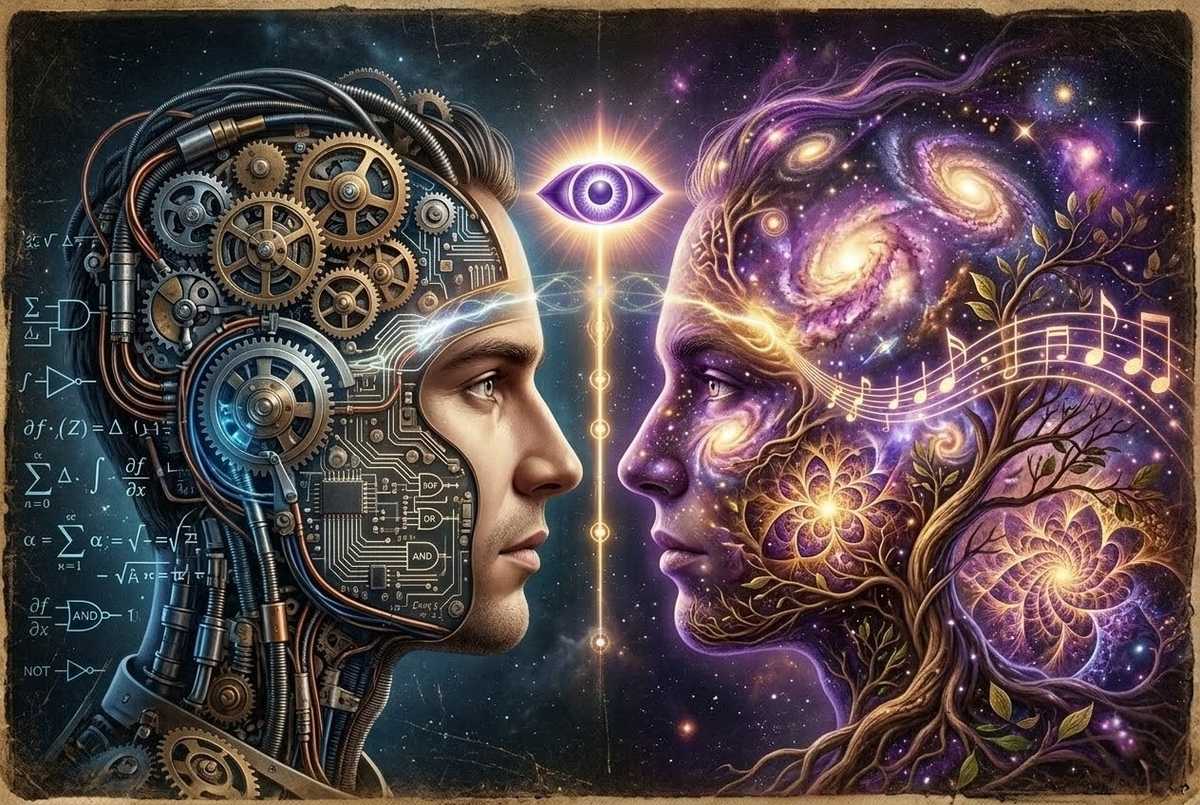
Left Brain vs. Right Brain: The Neuroscience of Spiritual Awakening and Consciousness Expansion
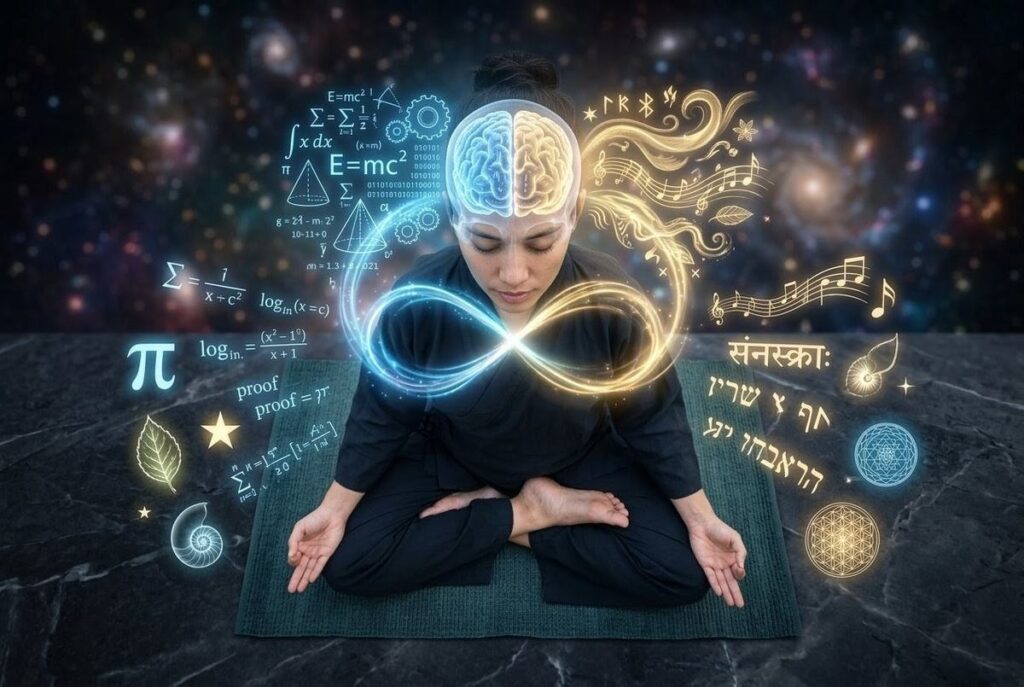
The left brain and right brain are not two cartoon personalities fighting inside the skull. They are two deeply interconnected modes of attention, perception, language, emotion, embodiment, and meaning. The old pop-psychology split of “logical left brain” and “creative right brain” is too crude. But the deeper question remains powerful: how does spiritual integration change when the mind learns to think clearly, feel deeply, perceive holistically, and act with embodied intelligence?
In Plain Terms
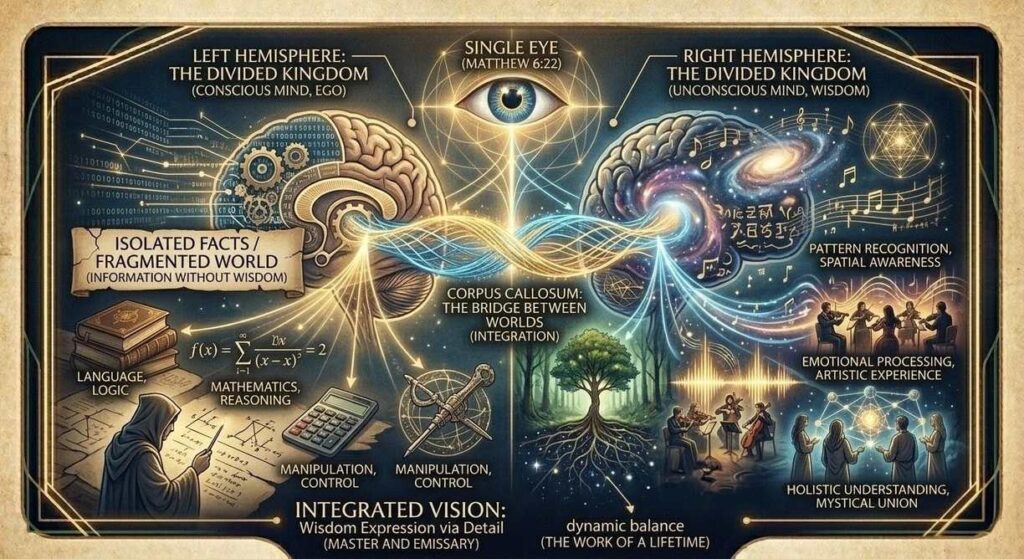
The left and right hemispheres of the brain process experience differently, but not in the simplistic way often found in personality quizzes. The left hemisphere is often more involved in language, sequence, analysis, categorisation, and focused manipulation of detail. The right hemisphere is often more involved in broad attention, spatial awareness, emotional tone, embodied context, metaphor, relationship, and whole-pattern perception.
Both are necessary. A spiritual life dominated by analysis can become dry, controlling, and over-explained. A spiritual life dominated by ungrounded intuition can become vague, chaotic, and difficult to integrate. The work is not to become “right-brained” or to demonise the left hemisphere. The work is to let precision and openness, language and silence, thought and embodiment, insight and action cooperate.
Neuroscience does not prove every mystical claim, and mystical experience cannot be reduced to brain diagrams. But brain research can help us understand why meditation, body awareness, breath practice, music, movement, language, and silence affect consciousness so deeply. Spiritual integration must happen through the body we actually have, including the divided and communicating brain.
Primary Sources and Traditions Discussed
- Neuroscience of hemispheric function: left and right hemisphere differences, language, emotion, attention, embodiment, and brain integration.
- Split-brain research: Roger Sperry, Michael Gazzaniga, the corpus callosum, and the left hemisphere “Interpreter”.
- Iain McGilchrist: the divided brain, attention, culture, and the argument that modern life overvalues abstraction and control.
- Contemplative neuroscience: meditation, neuroplasticity, default mode network activity, attention training, and structural brain changes.
- Trauma and embodiment: the limits of analysis alone, the role of body-based processing, and the need for safe integration.
- Christian and yogic symbolism: the “single eye”, ajna chakra, inner vision, and integration of dual modes of perception.
- The Thread perspective: spiritual awakening as integration rather than escape, with brain, body, symbol, and practice working together.
How to Read This Article
This article uses neuroscience carefully, but also symbolically. The brain is not a simple switchboard where the left side is logic and the right side is mysticism. Both hemispheres participate in almost every ordinary task. Language, emotion, creativity, reason, and spiritual practice all involve distributed networks across the brain and body.
At the same time, hemispheric differences are real enough to matter. The two hemispheres attend to the world differently. They emphasise different aspects of experience. They can become imbalanced in the way a person or culture relates to body, meaning, relationship, abstraction, and control.
Read the neuroscience as grounding, not as prison. Read the symbolism as illumination, not as proof. The point is not to reduce the soul to brain tissue, nor to ignore the brain in favour of vague spirituality. The point is integration: the art of letting different ways of knowing serve one awakened life.
Table of Contents
- The Two Modes of Knowing
- The Master and His Emissary
- The Split-Brain Revelation
- The Corpus Callosum: Bridge Between Hemispheres
- Hemispheric Dominance and Spiritual Temperament
- Language: Instrument and Limitation
- Emotion, Body, and the Right Hemisphere
- The Neuroscience of Meditation
- Practical Integration
- The Single Eye: Integration as Inner Vision
- The Brain as Filter or Generator?
- The Invitation: Becoming Bilingual in Your Own Brain
- Related Glossary Terms
- Read Next
- Frequently Asked Questions
- Further Reading
- References and Sources
The Two Modes of Knowing
The human brain is divided into two hemispheres joined by dense networks of communication. The left and right hemispheres are not separate people, but they do tend to emphasise different modes of attention.
The left hemisphere is often associated with focused attention, sequence, language, categorisation, analysis, and manipulation of specific details. It helps name, measure, compare, define, plan, and explain. It is essential for science, reasoning, grammar, calculation, administration, and the practical management of daily life.
The right hemisphere is often associated with broad attention, context, spatial awareness, embodied presence, emotional tone, metaphor, music, facial recognition, relationship, and whole-pattern perception. It helps sense atmosphere, read the unspoken, recognise living wholes, and remain open to what has not yet been reduced to a concept.
These are tendencies, not absolute divisions. Both hemispheres participate in most tasks. But the difference in style matters. The left hemisphere can isolate the note. The right hemisphere hears the music. The left can define the word. The right can feel the silence around it. The left can map the path. The right can recognise the landscape.
Spiritual integration does not mean choosing analysis or intuition. It means allowing each mode of knowing to do what it does best, without pretending that either is the whole of truth.
Why This Matters Spiritually
Spiritual practice often exposes the imbalance between these modes. Some seekers analyse everything but cannot surrender into experience. Others feel everything but struggle to articulate, test, or embody what they receive. Some become experts in doctrine without transformation. Others become rich in experience but poor in discrimination.
Integration asks for both. The mind must be clear enough to avoid delusion and open enough to receive what cannot be forced. The body must be present. The heart must be included. The word must serve what is deeper than words.
The Master and His Emissary
Iain McGilchrist’s The Master and His Emissary renewed serious discussion of hemispheric difference by arguing that the two hemispheres offer different ways of attending to the world. For McGilchrist, the right hemisphere attends to the living whole, while the left hemisphere isolates, abstracts, and manipulates specific parts of experience.
The title image is important. The “master” is not a tyrant, and the “emissary” is not an enemy. The emissary is sent into the world to perform tasks on behalf of a wider intelligence. Problems arise when the emissary forgets whom it serves and mistakes its useful abstractions for the whole of reality.
Applied culturally, this becomes a warning. A society can become brilliant at technique while losing wisdom. It can generate data while losing meaning. It can optimise systems while forgetting what the systems are for. It can measure the living world so aggressively that it no longer knows how to belong to it.
The Archonic Reading: When Abstraction Rules
A Gnostic reading sees danger whenever living reality is replaced by lifeless control systems. The archontic is not merely “bad authority”. It is the pattern by which abstraction usurps life, procedure replaces wisdom, and the map claims to be more real than the territory.
Seen this way, left-hemisphere imbalance is not a villain but a vulnerability. The analytical mind is necessary. It becomes dangerous when it turns people into categories, nature into resource, language into manipulation, and spiritual practice into another productivity system.
The remedy is not anti-intellectualism. It is restored relationship. Analysis must serve the living whole. Language must serve truth. Systems must serve life. The emissary must remember the kingdom.

The Split-Brain Revelation
Split-brain research gave neuroscience one of its most startling windows into hemispheric difference. In some severe epilepsy cases, surgeons severed the corpus callosum, the major bridge between the hemispheres, to reduce seizure spread. Researchers such as Roger Sperry and Michael Gazzaniga studied how the hemispheres behaved when communication between them was disrupted.
The findings showed that each hemisphere could process information in ways unavailable to the other. Stimuli presented to one visual field could be available to one hemisphere but not verbally reported by the other. The result was not simply two separate people, but a striking demonstration that conscious report is not identical with all processing occurring in the brain.
The Interpreter
Gazzaniga’s work on the left hemisphere “Interpreter” is especially important. The Interpreter constructs explanations for behaviour and experience, often after the fact. It tries to make the self coherent, even when it lacks all the information needed to explain what happened.
This has spiritual significance. The voice that says “I know exactly why I did that” may be telling a useful story rather than the whole truth. The narrative self is not always the deepest self. It is often the mind’s public-relations office, issuing tidy statements after a mysterious event in the basement.
Contemplative practice begins to reveal this. Thoughts arise before “I” choose them. Emotions move before they are explained. Impulses appear from hidden depths. The self-story is part of the mind, but it is not the whole kingdom.
The Corpus Callosum: Bridge Between Hemispheres
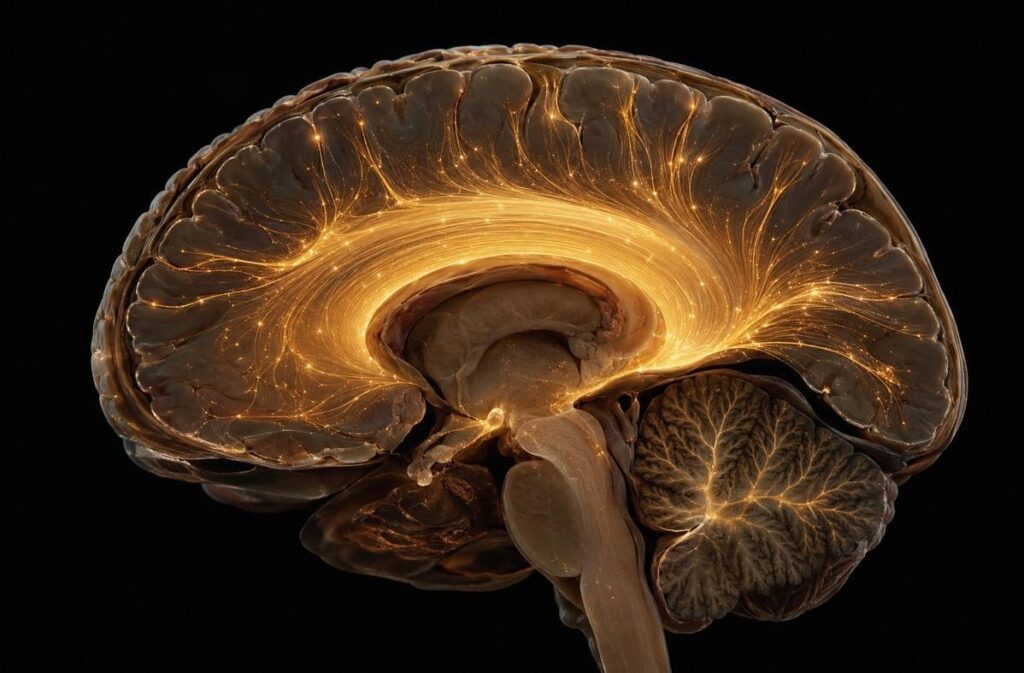
The corpus callosum is the major fibre tract connecting the two hemispheres. It allows information to pass between left and right, helping the brain produce coordinated experience. Without this bridge, each hemisphere may process aspects of reality that the other cannot fully access.
Spiritually, the corpus callosum offers a powerful image: the bridge between analysis and intuition, speech and silence, detail and whole, explanation and embodied knowing. A person does not awaken by cutting the bridge. They awaken by making the bridge more trustworthy.
Neuroplasticity and Integration
The brain changes through use. Music, movement, meditation, language, trauma, learning, and repeated behaviour all shape neural pathways. Practices requiring coordination across both sides of the body or both modes of attention may support greater functional integration.
This does not mean that every spiritual practice “thickens the corpus callosum” in a simple way. Claims should be modest. But the wider principle is solid: the brain is plastic. Repeated patterns of attention become easier to repeat. A practice done often enough becomes a trait, not just a state.
Hemispheric Dominance and Spiritual Temperament
People often develop preferred ways of knowing. Some trust structure, evidence, text, argument, sequence, and definition. Others trust atmosphere, symbol, sensation, intuition, dream, and felt meaning. These preferences are not identical with hemispheric dominance, but they often echo hemispheric style.
A more analytical practitioner may love doctrine, systems, philosophy, textual study, technique, and careful method. Their strength is discrimination. Their risk is turning the path into an achievement project or mistaking explanation for transformation.
A more intuitive practitioner may love silence, image, ritual, dreams, movement, embodiment, and direct experience. Their strength is receptivity. Their risk is vagueness, lack of grounding, poor boundaries, or treating every inner movement as revelation.
Mature practice honours both. The scholar must eventually kneel before mystery. The mystic must eventually wash the bowl, pay the bill, check the claim, and speak clearly enough to be understood.
Language: Instrument and Limitation
For most people, language is strongly associated with left-hemisphere networks, especially grammar, sequencing, naming, and verbal explanation. The right hemisphere contributes tone, metaphor, emotional colour, humour, implication, and the felt music of speech.
Language is one of the mind’s great instruments. It allows teaching, memory, prayer, confession, story, philosophy, law, poetry, and self-reflection. Without language, spiritual insight is difficult to communicate and preserve.
But language can also become a cage. The inner monologue may narrate everything so loudly that direct perception cannot breathe. The word may replace the thing. The concept may replace the encounter. The theology may replace the living God, the doctrine of emptiness may replace silence, the map of awakening may replace awakening itself.
Mystical Experience and Ineffability
Mystical experience is often described as ineffable, meaning beyond adequate speech. This does not mean language is useless. It means language can only point. Poetry, paradox, symbol, myth, apophatic theology, mantra, and silence all appear where ordinary prose reaches its edge.
The task is not to abandon words. It is to let words become transparent. A good spiritual sentence is a window, not a wall.
Emotion, Body, and the Right Hemisphere
The right hemisphere is deeply involved in emotional tone, facial expression, body awareness, social context, and non-verbal communication. It helps read the room before the left hemisphere has assembled a sentence about the room.
This matters because emotional healing is not achieved by explanation alone. A person may understand their fear intellectually and still feel unsafe. They may know the story of their wound and still carry it in breath, posture, gut, jaw, and nervous system. The left hemisphere can name the wound. The body and right hemisphere may still be living inside it.
This is one reason body-based therapies, expressive arts, trauma-informed practice, movement, breathwork, and relational safety can matter so much. They speak to layers of experience that ordinary verbal analysis may not reach.
Again, this should not be turned into simplistic brain mythology. Talk therapy can be powerful. Language heals when it is connected to feeling, body, memory, and relationship. The problem is not speech. The problem is speech cut off from the rest of the organism.
The Neuroscience of Meditation
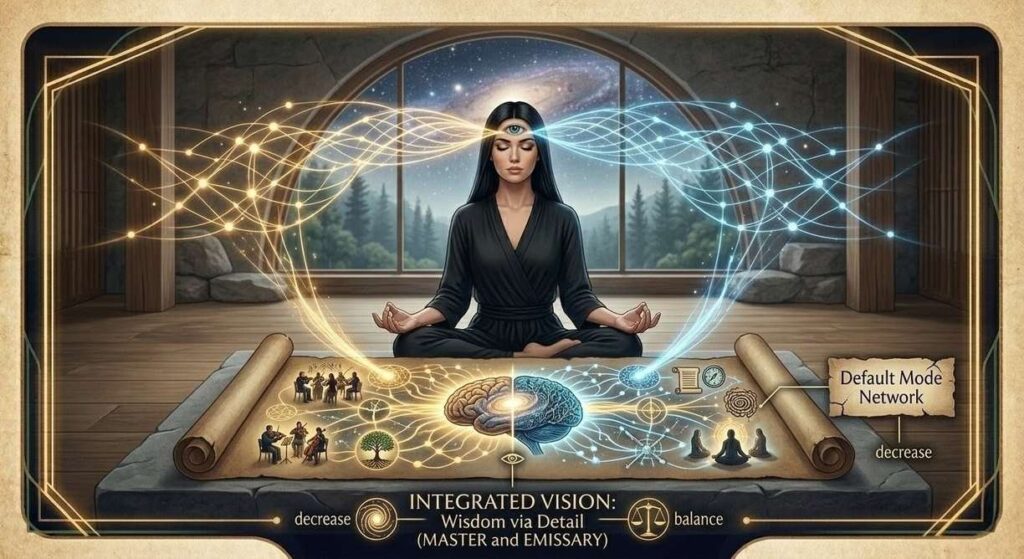
Meditation changes the relationship to thought, body, emotion, attention, and self-reference. Neuroscience has shown that consistent contemplative practice can affect brain structure and function, including attention networks, emotional regulation, stress response, and self-referential processing.
Some studies show changes in grey matter density after mindfulness training, altered activity in regions associated with self-referential thinking, and improved regulation of stress and emotion. Long-term meditators may show patterns of brain activity and connectivity that differ from non-meditators. The exact findings vary by practice type, study design, duration, and population, so claims should not be inflated.
The broader point is clear enough: contemplative practice trains the brain. Attention becomes less automatically captured by thought. The self-story loosens. Body awareness increases. Emotional reactivity may soften. Silence becomes more available.
Focused Attention and Open Monitoring
Different meditation styles train different capacities. Focused attention practice develops steadiness by returning attention to one object, such as breath, mantra, candle flame, or sensation. Open monitoring practice develops awareness of whatever arises, without immediately grasping or rejecting it.
In hemispheric language, focused attention can support precision and stability, while open awareness can support spaciousness and whole-field perception. A mature contemplative path often needs both: the lamp and the sky, the point and the field.
Practical Integration
Hemispheric integration is not achieved by reading about the brain alone. It requires practice. The aim is to cultivate flexibility: the ability to think, feel, sense, speak, receive, analyse, imagine, and act without becoming trapped in one mode.
For Analytical Practitioners
- Practise silence: spend periods without reading, note-taking, explaining, teaching, or improving the experience.
- Engage image and symbol: work with mandalas, icons, dreams, art, myth, music, and sacred imagery without reducing them too quickly.
- Return to the body: use walking, body scan, somatic awareness, breath, gardening, craft, or slow movement.
- Allow uncertainty: learn to remain with mystery without immediately closing it through explanation.
For Intuitive Practitioners
- Create structure: keep a regular practice rhythm, grounded routine, and clear commitments.
- Write the insight down: translate experience into language before it dissolves into mood.
- Test the fruit: ask whether the intuition produces clarity, compassion, responsibility, and grounded action.
- Use critical thinking: examine claims without using scepticism as a weapon against wonder.
For All Practitioners
- Cross-lateral movement: walking, swimming, drumming, dancing, or slow coordinated movement that involves both sides of the body.
- Breath practice: gentle breath awareness or alternate nostril breathing when appropriate and safe.
- Dual-mode study: read a serious text, then sit quietly with the felt sense of what it awakens.
- Embodied inquiry: ask a question intellectually, then notice what the body, dream, image, or relationship field adds.
- Creative expression: use drawing, music, poetry, movement, or craft to translate what prose cannot carry.
The Single Eye: Integration as Inner Vision
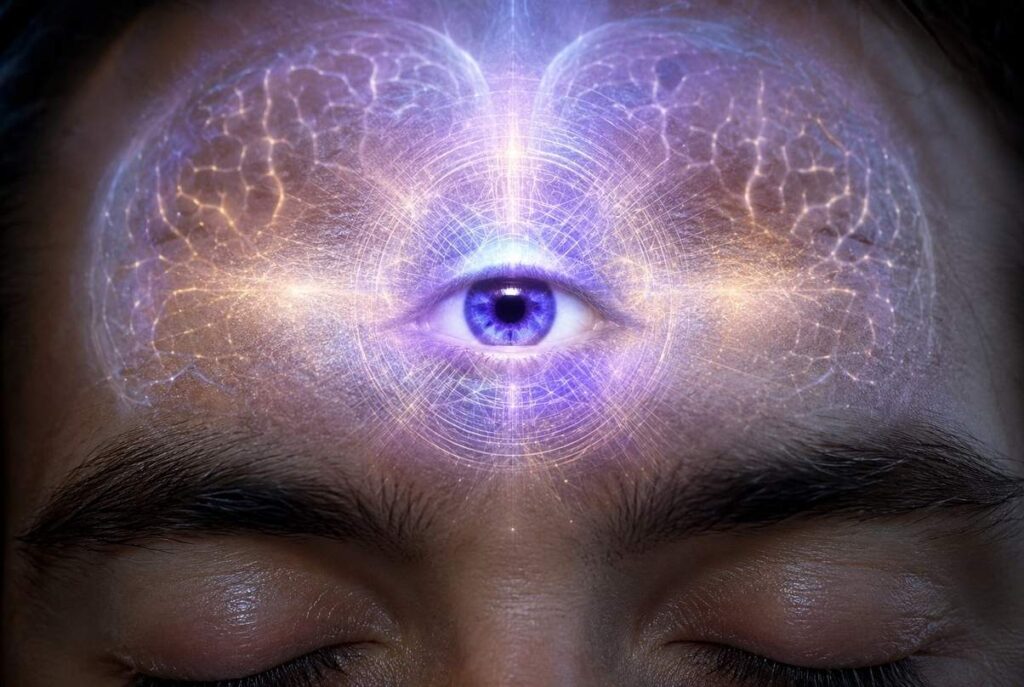
In Matthew 6:22, Jesus says that if the eye is single, the whole body will be full of light. In yogic symbolism, the ajna chakra, or third eye, is associated with inner vision, intuition, and the resolution of duality. These teachings should not be reduced to brain anatomy, but they resonate strongly with the theme of integrated perception.
The single eye is not one-sided vision. It is unified vision. It does not reject reason for intuition or intuition for reason. It sees through the split. It allows analysis to become precise without becoming sterile, and intuition to become luminous without becoming vague.
In alchemical language, this is the marriage of opposites. In contemplative language, it is the still point from which thought and silence are both seen. In neurological language, it is a more integrated organism, not merely a more exciting state.
The Brain as Filter or Generator?
The relationship between brain and consciousness remains one of the deepest questions in philosophy, neuroscience, and spiritual tradition. The dominant scientific view treats consciousness as emerging from brain activity. Many spiritual traditions suggest that the brain may also filter, shape, transmit, or limit a consciousness deeper than ordinary neural processing.
These views should not be collapsed too quickly. Neuroscience gives strong evidence that brain states and conscious states are deeply linked. Injury, drugs, sleep, meditation, trauma, and disease can all alter consciousness. At the same time, subjective awareness remains difficult to explain fully in material terms, and many philosophical questions remain open.
For practice, the useful point is this: the brain matters. Whether it generates consciousness, filters it, or participates in a mystery larger than either model can contain, the condition of the brain affects how consciousness is experienced. Spiritual practice should therefore care about sleep, stress, body, trauma, attention, nervous-system regulation, and mental habits.
The awakened life is not a war against the brain. It is a refinement of the instrument through which this life is known.
The Invitation: Becoming Bilingual in Your Own Brain
You have more than one way of knowing. One part of you can name, measure, compare, and explain. Another can sense, receive, feel, recognise, and understand without step-by-step proof. The problem begins when one mode claims the throne and exiles the other.
The analytical mind must learn humility before the living whole. The intuitive mind must learn discipline before truth. The body must be included. The heart must be allowed to speak. Silence must be given room. Language must return as servant, not jailer.
Spiritual integration is not the collapse of difference into bland unity. It is the harmonising of difference into living intelligence. You do not become whole by amputating half your knowing. You become whole when the inner parliament stops shouting and begins listening for the deeper law.
The two hemispheres are not enemies. They are instruments in the same chamber. The music begins when they stop competing for the melody.
Related Glossary Terms
These terms help clarify the relationship between hemispheric function, spiritual integration, and contemplative practice:
- Left hemisphere: brain hemisphere often associated with language, sequence, analysis, categorisation, and focused detail.
- Right hemisphere: brain hemisphere often associated with broad attention, context, spatial awareness, emotional tone, metaphor, and whole-pattern perception.
- Corpus callosum: major fibre tract connecting the two cerebral hemispheres and allowing communication between them.
- Split-brain research: study of patients whose hemispheric connection was surgically severed, revealing differences in hemispheric processing.
- Interpreter: Gazzaniga’s term for the left hemisphere tendency to construct explanations for behaviour and experience.
- Default mode network: brain network associated with self-referential thought, mind-wandering, autobiographical memory, and inner narrative.
- Neuroplasticity: the brain’s capacity to change through experience, practice, learning, injury, and adaptation.
- Focused attention meditation: practice that trains steadiness by returning attention to a chosen object.
- Open monitoring meditation: practice that observes thoughts, feelings, sensations, and perceptions as they arise and pass.
- Ajna chakra: yogic “third eye” centre associated with inner vision, intuition, and subtle perception.
- Single eye: biblical and mystical symbol of unified vision, clarity, and undivided perception.
- Negative capability: Keats’s phrase for the capacity to remain with uncertainty, mystery, and doubt without premature closure.
Read Next
For the strongest next step, continue into the physiology of mystical experience:
Physiology of Mystical Experience: How Awakening Changes the Brain
This companion article moves from hemispheric integration into the broader nervous-system, brain, and body changes associated with sustained contemplative and mystical practice.
Frequently Asked Questions
Is the left brain logical and the right brain creative?
That popular idea is too simplistic. The left hemisphere is often more involved in language, sequence, analysis, and focused detail, while the right hemisphere is often more involved in broad attention, spatial awareness, emotional tone, metaphor, and whole-pattern perception. But both hemispheres participate in most tasks, including creativity, reason, language, and spiritual practice.
What is hemispheric integration?
Hemispheric integration means better cooperation between different modes of brain function and attention. Spiritually, it points to the ability to think clearly, feel deeply, perceive holistically, speak truthfully, and act with embodied intelligence. It is not the dominance of one hemisphere over the other, but the harmonising of analysis, intuition, language, body, and awareness.
What did split-brain research show?
Split-brain research studied people whose corpus callosum had been severed, usually to treat severe epilepsy. It showed that the hemispheres can process information in surprisingly independent ways when their major connection is disrupted. Michael Gazzaniga’s work also identified the left hemisphere Interpreter, which constructs explanations for behaviour and experience, sometimes without full access to the underlying causes.
What is Iain McGilchrist’s divided brain theory?
Iain McGilchrist argues that the hemispheres offer different ways of attending to reality. The right hemisphere attends more to context, relationship, embodiment, and living wholes, while the left hemisphere isolates, categorises, and manipulates detail. His cultural warning is that modern life often overvalues left-hemisphere abstraction and control while neglecting right-hemisphere openness, meaning, and relationship.
Can meditation change the brain?
Research suggests that consistent meditation can change brain function and structure, including networks involved in attention, emotion regulation, stress response, and self-referential thought. Findings vary depending on the practice and study, so claims should be modest. The broad point is that contemplative practice can train attention and support greater integration of mind, body, and emotion.
Is the single eye the same as the third eye?
The biblical single eye and the yogic third eye are different symbols from different traditions, but both can be read as images of unified perception. In this article, they are used symbolically to describe integration: a way of seeing that does not split analysis from intuition, thought from body, or language from silence.
Can hemispheric integration replace therapy or medical care?
No. Hemispheric integration practices such as meditation, movement, breath awareness, writing, music, or body-based attention may support wellbeing, but they do not replace therapy, neurological care, trauma treatment, medication, emergency support, or qualified medical advice. Persistent distress, dissociation, trauma symptoms, or neurological symptoms should be discussed with appropriate professionals.
Study Note: This article explores hemispheric function, neuroscience, meditation, trauma, and spiritual integration for educational and contemplative purposes. It does not diagnose neurological, psychological, or medical conditions. The left-brain/right-brain framework is useful only when handled carefully; it should not be treated as a rigid personality system or proof of spiritual attainment. If meditation, breathwork, trauma processing, or spiritual practice produces anxiety, dissociation, panic, mania, psychotic symptoms, or neurological distress, pause the practice and seek support from qualified medical or mental health professionals.
Further Reading
These related articles continue the themes of consciousness, embodiment, brain change, contemplative practice, and spiritual integration:
- Physiology of Mystical Experience: How Awakening Changes the Brain – The strongest next step for exploring the nervous-system and brain changes associated with mystical experience.
- States of Knowing: What Happens When Consciousness Unravels – Altered states, shifting awareness, and what happens when ordinary perception loosens.
- The Divine Architecture Within: How Your Body Mirrors the Universe – Esoteric anatomy, embodiment, and the symbolic relationship between body and cosmos.
- The Gateway of Sensation: Body Scan and Somatic Awareness – Practical body-based awareness for grounding attention and restoring embodied presence.
- The Gateway of Breath: Pranayama and Energetic Balance – Breath practices, energetic regulation, and contemplative balance.
- Embodiment Practices for Grounding Awakening – How to stabilise spiritual insight in the body and ordinary life.
- Contemplative Techniques: The Thread’s Practical Foundation – Grounded methods for attention, silence, witnessing, and practice.
- The Mental Plane Explained: Where Thoughts Become Reality – Thought, imagination, belief, and the subtle pattern-field of experience.
- The Power of Words: Etymology, Conscious Language, and the Magic of Speech – Language, speech, inner monologue, and the creative responsibility of words.
- The Living Thread: How Forbidden Knowing Survives – How hidden knowledge survives through body, mind, symbol, and practice.
References and Sources
The following sources support the neuroscience, contemplative, and comparative framework used in this article.
Hemispheric Function and Split-Brain Research
- McGilchrist, Iain. (2009). The Master and His Emissary: The Divided Brain and the Making of the Western World. New Haven: Yale University Press.
- McGilchrist, Iain. (2021). The Matter with Things: Our Brains, Our Delusions, and the Unmaking of the World. London: Perspectiva Press.
- Sperry, Roger W. (1981). Nobel Prize in Physiology or Medicine. Awarded for work on functional specialisation of the cerebral hemispheres.
- Gazzaniga, Michael S. (1998). The Mind’s Past. Berkeley: University of California Press.
- Gazzaniga, Michael S. (2005). The Ethical Brain. New York: Dana Press.
- Gazzaniga, Michael S. (2015). Tales from Both Sides of the Brain: A Life in Neuroscience. New York: Ecco.
- Corballis, Michael C. (2014). The Wandering Mind: What the Brain Does When You’re Not Looking. Chicago: University of Chicago Press.
Meditation, Neuroplasticity, and Contemplative Neuroscience
- Hölzel, Britta K., et al. (2011). “Mindfulness practice leads to increases in regional brain gray matter density.” Psychiatry Research: Neuroimaging, 191(1), 36-43.
- Lazar, Sara W., et al. (2005). “Meditation experience is associated with increased cortical thickness.” NeuroReport, 16(17), 1893-1897.
- Brewer, Judson A., et al. (2011). “Meditation experience is associated with differences in default mode network activity and connectivity.” Proceedings of the National Academy of Sciences, 108(50), 20254-20259.
- Fox, Kieran C. R., et al. (2014). “Is meditation associated with altered brain structure? A systematic review and meta-analysis of morphometric neuroimaging in meditation practitioners.” Neuroscience & Biobehavioral Reviews, 43, 48-73.
- Travis, Frederick, and Shear, Jonathan. (2010). “Focused attention, open monitoring and automatic self-transcending: Categories to organize meditations from Vedic, Buddhist and Chinese traditions.” Consciousness and Cognition, 19(4), 1110-1118.
- Goleman, Daniel, and Davidson, Richard J. (2017). Altered Traits: Science Reveals How Meditation Changes Your Mind, Brain, and Body. New York: Avery.
Trauma, Body, and Integration
- van der Kolk, Bessel. (2014). The Body Keeps the Score: Brain, Mind, and Body in the Healing of Trauma. New York: Viking.
- Levine, Peter A. (1997). Waking the Tiger: Healing Trauma. Berkeley: North Atlantic Books.
- Ogden, Pat, Minton, Kekuni, and Pain, Clare. (2006). Trauma and the Body: A Sensorimotor Approach to Psychotherapy. New York: W. W. Norton.
- Siegel, Daniel J. (2012). The Developing Mind: How Relationships and the Brain Interact to Shape Who We Are. 2nd ed. New York: Guilford Press.
Spiritual and Contemplative Sources
- Holy Bible. Matthew 6:22, traditional teaching on the single eye and the body full of light.
- Keats, John. (1817). Letter to George and Thomas Keats, introducing the phrase “negative capability”.
- Teresa of Avila. The Interior Castle. Sixteenth-century Christian mystical text on contemplative development and integration.
- Evagrius Ponticus. Praktikos and Chapters on Prayer. Early Christian contemplative texts on attention, thought, and purification.
- Patanjali. Yoga Sutras. Classical source for concentration, meditation, and the stilling of mental fluctuations.