The Sophia of Jesus Christ: The Christian Adaptation of Eugnostos
The Sophia of Jesus Christ: Wisdom Incarnate Speaks
Among the most intriguing texts associated with the Nag Hammadi Library stands The Sophia of Jesus Christ, also known as The Wisdom of Jesus Christ. It is not simply a dialogue, nor merely a Christian sermon dressed in exotic language. It is a revelatory text that takes the metaphysical teaching of Eugnostos the Blessed and reframes it as instruction from the risen Jesus.
This transformation matters. Eugnostos speaks as philosophical instruction. The Sophia of Jesus Christ makes the same broad metaphysical pattern a post-resurrection revelation. The questions are familiar to every serious seeker: Where do we come from? What is the nature of reality? How does the divine unfold? What is the destiny of the human soul? In this text, those questions are answered not by speculation alone, but by the revealer who has crossed the boundary between worlds.
What is the Sophia of Jesus Christ?
The Sophia of Jesus Christ is a Christian Gnostic revelation dialogue preserved in Nag Hammadi Codex III and the Berlin Gnostic Codex. It is closely related to Eugnostos the Blessed, a philosophical tractate also preserved at Nag Hammadi. Where Eugnostos presents metaphysical teaching in a philosophical voice, The Sophia of Jesus Christ presents that teaching through the risen Jesus addressing his disciples.
The text describes the Unbegotten Father, the Self-Father, the Immortal Human, the divine realm and the origin and destiny of humanity. Its central movement is from philosophical wisdom to revealed wisdom.
Table of Contents
- Text, Transmission and Codex Setting
- From Eugnostos to Sophia: The Transformation of Authority
- The Mountain Revelation Scene
- The Structure of the Divine Realm
- The Unbegotten Father
- The Self-Father and the Immortal Human
- The Aeons and the Architecture of Light
- Creation, Humanity and Return
- The Role of Wisdom in the Text
- The Christian Element: Revelation Beyond Reason
- The Dialogue Format: Pedagogy and Participation
- Reading the Sophia Today
- Frequently Asked Questions
- Further Reading
- References and Sources
Text, Transmission and Codex Setting
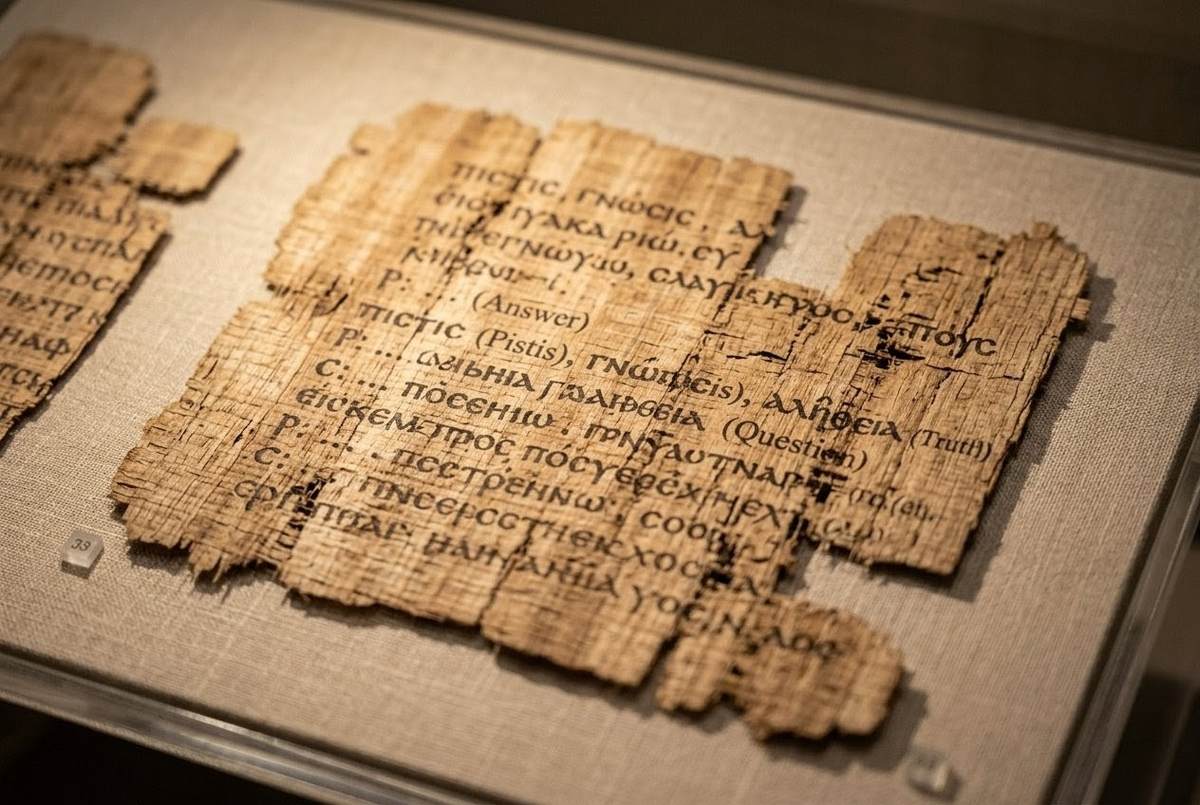
The Sophia of Jesus Christ survives in more than one ancient witness. It is preserved in Nag Hammadi Codex III and also in the Berlin Gnostic Codex. A Greek fragment related to the text is also known from Oxyrhynchus material. This broader manuscript setting matters because it shows that the work was not an isolated curiosity. It belonged to a living stream of early Christian Gnostic textual transmission.
The text is closely related to Eugnostos the Blessed. In the Nag Hammadi Library, Eugnostos appears in Codex III and Codex V, while The Sophia of Jesus Christ preserves a Christianised adaptation of much of the same material. The pairing allows readers to observe something rare and valuable: a philosophical Gnostic treatise being reworked into a Christian revelation dialogue.
This does not make the text a simple copy with a new label. The change of speaker alters the entire authority structure. When abstract metaphysical teaching is placed on the lips of the risen Jesus, the text claims that the highest wisdom is not merely reasoned out. It is revealed.
Primary Source Orientation: The work opens as a post-resurrection revelation dialogue. Jesus appears to his followers and answers questions about origin, truth, divine reality and the destiny of the soul.
From Eugnostos to Sophia: The Transformation of Authority
The relationship between Eugnostos the Blessed and The Sophia of Jesus Christ reveals a great deal about religious adaptation in late antiquity. Eugnostos presents itself as philosophical instruction. It explains the divine realm, the unbegotten source, emanation and humanity without depending on a Christian narrative frame.
The Sophia of Jesus Christ takes that philosophical framework and places it inside a Christian revelatory setting. The risen Jesus appears to his disciples. They ask him the questions that haunt philosophy and religion alike: What is truth? Where do we come from? How does the divine unfold? What is the destiny of those who understand?
This shift is not cosmetic. The teaching moves from philosophical disclosure to revealed instruction. Wisdom is no longer only the work of contemplation, argument or metaphysical mapping. Wisdom becomes something given by the revealer, something spoken by the one who has returned from beyond the visible order.
The result is neither ordinary philosophy nor conventional church doctrine. It is Gnostic Christian revelation: a text where Greek metaphysical language, Jewish and Christian revelation patterns and Gnostic concern with knowledge converge into one luminous teaching scene.
The Mountain Revelation Scene
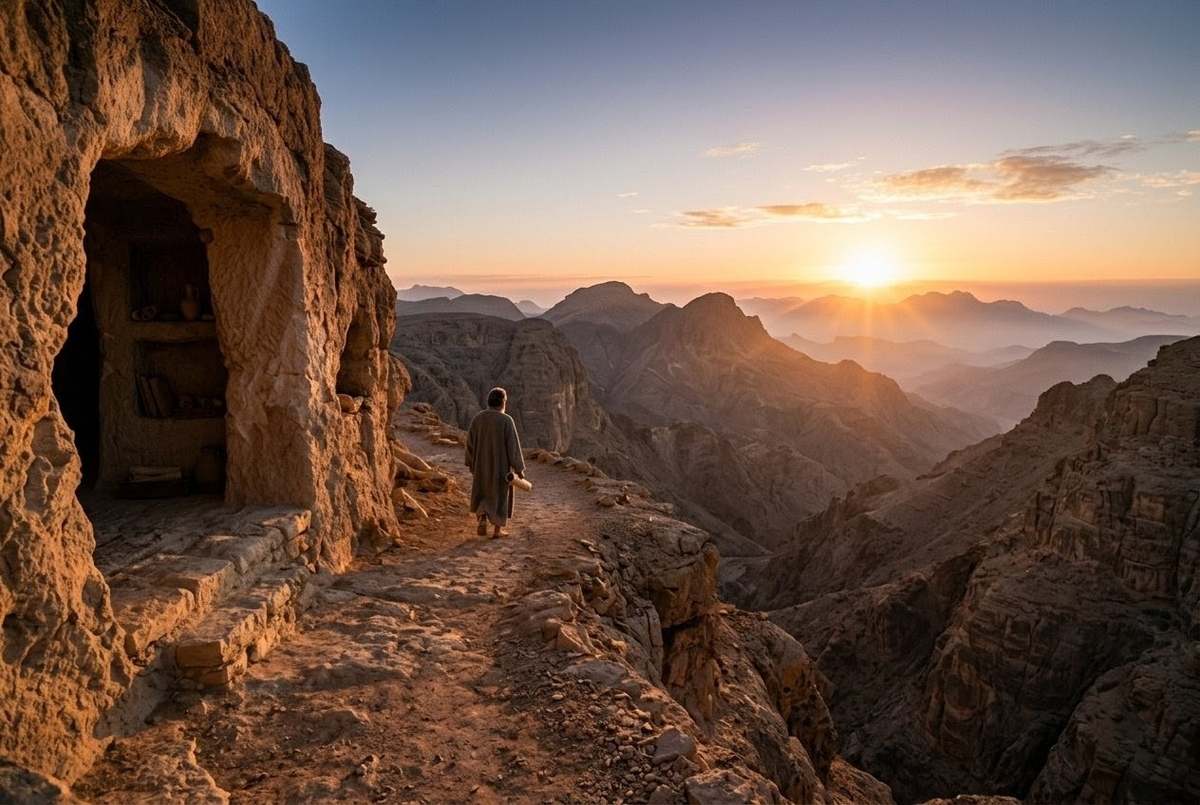
The revelation takes place after the resurrection. Jesus appears to his followers on a mountain, a setting rich with biblical and apocalyptic resonance. Mountains are places of disclosure: Sinai, Tabor, the mountain of teaching, the high place where ordinary perception is interrupted by divine speech.
The disciples do not ask small questions. They ask questions of origin, nature and destiny. Their concerns are cosmic rather than merely ethical. They do not ask only how to behave. They ask what reality is, where humanity comes from and how the soul returns to its true source.
This gives the text its distinctive character. It is not a parable collection, not a passion narrative and not a church order manual. It is a revelation dialogue. The disciples become the reader’s representatives, asking the questions that open the structure of the divine world.
Reading Note: The dialogue form makes the reader part of the revelation. To read the text is to stand with the disciples and hear the cosmic teaching unfold question by question.
The Structure of the Divine Realm
The teaching unfolds as a map of divine reality. Jesus describes an unbegotten source beyond ordinary comprehension, followed by emanated realities that express divine life in ordered form. This is not mythology in the dramatic Sethian sense of Sophia’s fall and Yaldabaoth’s arrogance. It is a calmer, more philosophical unfolding of the divine realm.
The tone is important. The Sophia of Jesus Christ does not dwell on cosmic catastrophe. It does not focus on the birth of a hostile Demiurge or the violent rule of archons. Instead, it emphasises origin, emanation, divine order and recognition. Its world is not naive, but it is less polemical than the more severe creation myths found elsewhere in the Nag Hammadi corpus.
This makes the text especially valuable as a bridge. It stands between philosophical metaphysics and Gnostic revelation, between Eugnostos and Christian Gnostic teaching, between abstract speculation and the personal authority of the risen Jesus.
The Unbegotten Father
At the summit stands the Unbegotten Father. The text describes this source through negative theology: beyond containment, beyond visible form, beyond ordinary thought and speech. The highest source is not simply a larger being within the universe. The source exceeds all categories by which beings are usually known.
This apophatic language is central to the text’s spirituality. The divine source cannot be captured by image, argument or definition. It can be approached only by a disciplined unknowing, a recognition that the root of all reality is beyond the mind’s grasp.
Yet the source is not sterile absence. From the Unbegotten flows a chain of divine expression. The hidden source becomes known through emanation, not by ceasing to be hidden, but by producing realities that reflect divine fullness at different levels.
Primary Source Theme: The Unbegotten is described through what cannot be said of it: unbounded, unseen, ungraspable and beyond ordinary qualities. The theology begins by protecting divine mystery from reduction.
The Self-Father and the Immortal Human
After the Unbegotten, the text speaks of the Self-Father or Self-Begetter, a divine reality that contemplates and expresses the hidden source. This figure is androgynous and generative, containing both fatherly and motherly symbolism. It is not a simple male creator but a fullness capable of self-expression and divine ordering.
From this divine unfolding comes the Immortal Human, the heavenly archetype of humanity. This is not Adam made from dust. It is the divine Human, the ideal form or luminous pattern of humanity before earthly limitation. The earthly human being is meaningful because it reflects, however dimly, this higher archetype.
This theme is one of the text’s most important gifts. Humanity is not defined first by sin, weakness or material confinement. Humanity is rooted in a higher pattern. To awaken is to remember that the human being’s deepest origin is not below, but above.
Primary Source Theme: The Immortal Human is presented as both divine archetype and living source-pattern. Earthly humanity becomes intelligible only in relation to this higher Human.
The Aeons and the Architecture of Light
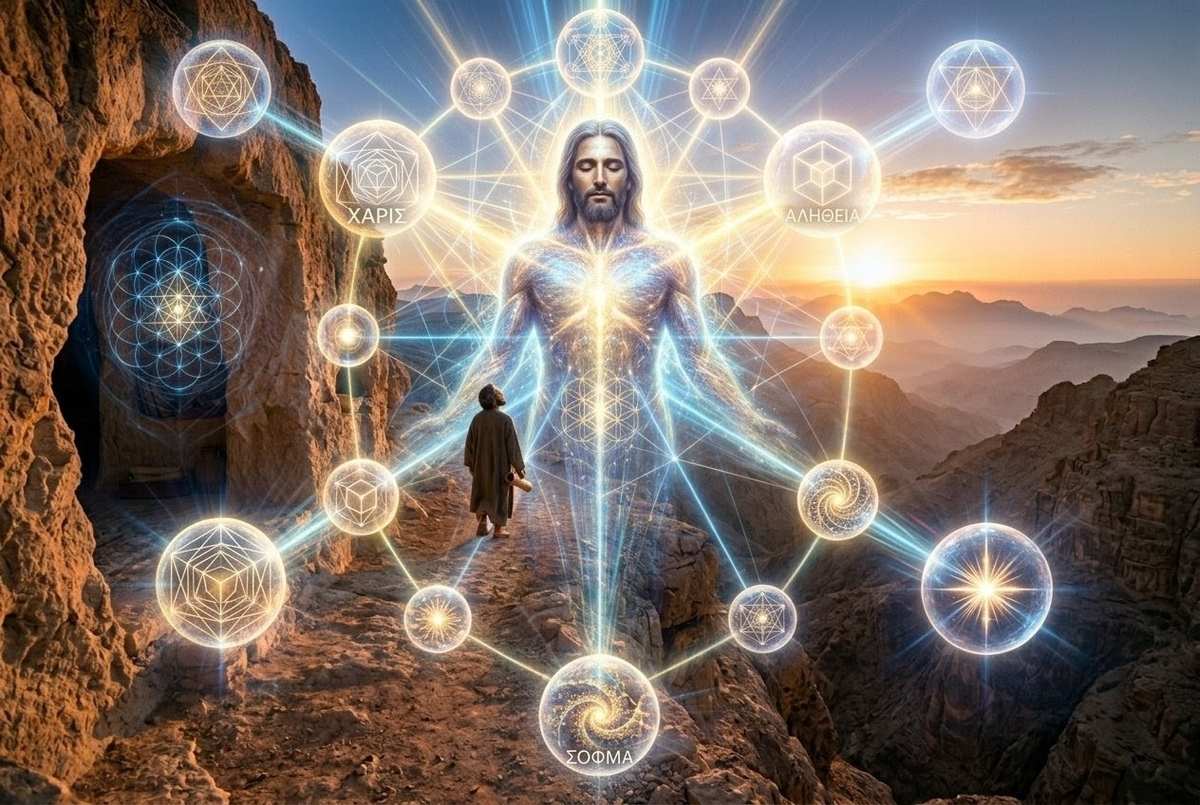
The text presents divine reality as structured through Aeons, luminous powers or qualities that unfold from the higher source. These are not “gods” in a simple polytheistic sense, nor are they merely abstract ideas. They are living expressions of divine fullness, qualities through which the hidden source becomes knowable.
In related Sethian systems, the aeonic pattern is often organised through the Four Luminaries and their associated powers: Grace, Truth and Form; Reflection or Insight, Perception and Memory; Understanding, Love and Idea; Perfection, Peace and Wisdom. This kind of structure gives divine life an architecture without reducing it to a mechanical diagram.
The Sophia of Jesus Christ draws from this same broad world of thought, but its tone remains closer to metaphysical exposition than mythic drama. The emphasis falls on order, origin and revelation. Wisdom is not here primarily the tragic Sophia who falls, but the divine wisdom by which structure can be recognised.
This is why the title can be read on more than one level. “Sophia” may mean Wisdom as a theological figure, but also wisdom as the content of Christ’s revelation. The text is the wisdom of Jesus Christ because it presents the teaching that reveals the structure of reality itself.
Creation, Humanity and Return
The disciples ask about creation, and the answer is layered. The world does not proceed directly from the supreme source in a simple line. It unfolds through levels, powers and mediating realities. This layered structure distinguishes the hidden source from the lower world without requiring every lower level to be treated as sheer evil.
This gives the text a more positive assessment of creation than the harshest Gnostic myths. The problem is not existence itself. The problem is ignorance of origin. The human being has forgotten the light from which it comes and the light to which it belongs.
The text’s spiritual logic is therefore recognitional. Salvation does not begin with fear of the world, but with knowledge of source. To know where one comes from is already to begin the return. To recognise the higher Human is to stop reducing humanity to flesh, status or social role.
In this sense, The Sophia of Jesus Christ belongs firmly within the Gnostic stream, but it expresses that stream through a luminous metaphysical serenity rather than a dramatic cosmic indictment.
The Role of Wisdom in the Text
The title names Sophia, yet the text does not centre on the dramatic fall of Sophia in the way the Apocryphon of John does. This is important. Here Wisdom is not primarily a wounded Aeon needing rescue. Wisdom is the revelatory content itself, the divine knowing disclosed by Christ.
This makes the text a useful companion to the wider Sophia tradition. In some texts, Sophia falls. In others, she repents. In others, she works through Eve or the serpent. Here, Wisdom speaks through the risen Jesus as structured revelation. The feminine name remains, but the drama has become teaching.
That shift gives the text its distinctive character. It is less concerned with narrating how the lower world became deficient and more concerned with teaching how the soul recognises its divine origin. Wisdom is no longer only the figure in the story. Wisdom is the light by which the whole story becomes intelligible.
The Christian Element: Revelation Beyond Reason
What makes The Sophia of Jesus Christ specifically Christian is not simply the use of Jesus’ name. The Christian frame changes the way the teaching functions. Jesus is presented as the revealer who answers the deepest metaphysical questions and authorises the wisdom being taught.
At the same time, the text is far from later orthodox doctrinal patterns. It does not focus on the cross, atonement or church discipline. Its Jesus is primarily the revealer of hidden knowledge. Salvation comes through understanding one’s origin, nature and destiny.
This places the text within the rich diversity of early Christianity before doctrinal boundaries hardened into later creeds. It shows one path Christian thought could take: Christ not only as saviour in a sacrificial sense, but as revealer of divine structure, cosmic origin and human return.
Primary Source Theme: The text’s blessing falls on understanding. The seeker is urged to continue seeking until discovery opens wonder, rest and recognition.
The Dialogue Format: Pedagogy and Participation
The dialogue form is not decorative. It is pedagogical. The disciples ask questions, and each answer opens another layer of reality. The reader is drawn into the same process, moving from uncertainty into orientation, from curiosity into metaphysical vision.
This format also makes complex material more accessible. Instead of presenting an uninterrupted treatise, the text gives the teaching through question and response. Each question becomes a doorway. Each answer becomes a chamber in the architecture of wisdom.
Matthew, Philip, Thomas and the wider group of followers function as representatives of the seeking community. They stand where the reader stands: after the ordinary story has ended, still asking what the resurrection reveals about the deepest structure of reality.
This is why the text remains powerful. It does not merely tell readers what to believe. It invites them to ask better questions, then follow those questions upward.
Reading the Sophia Today
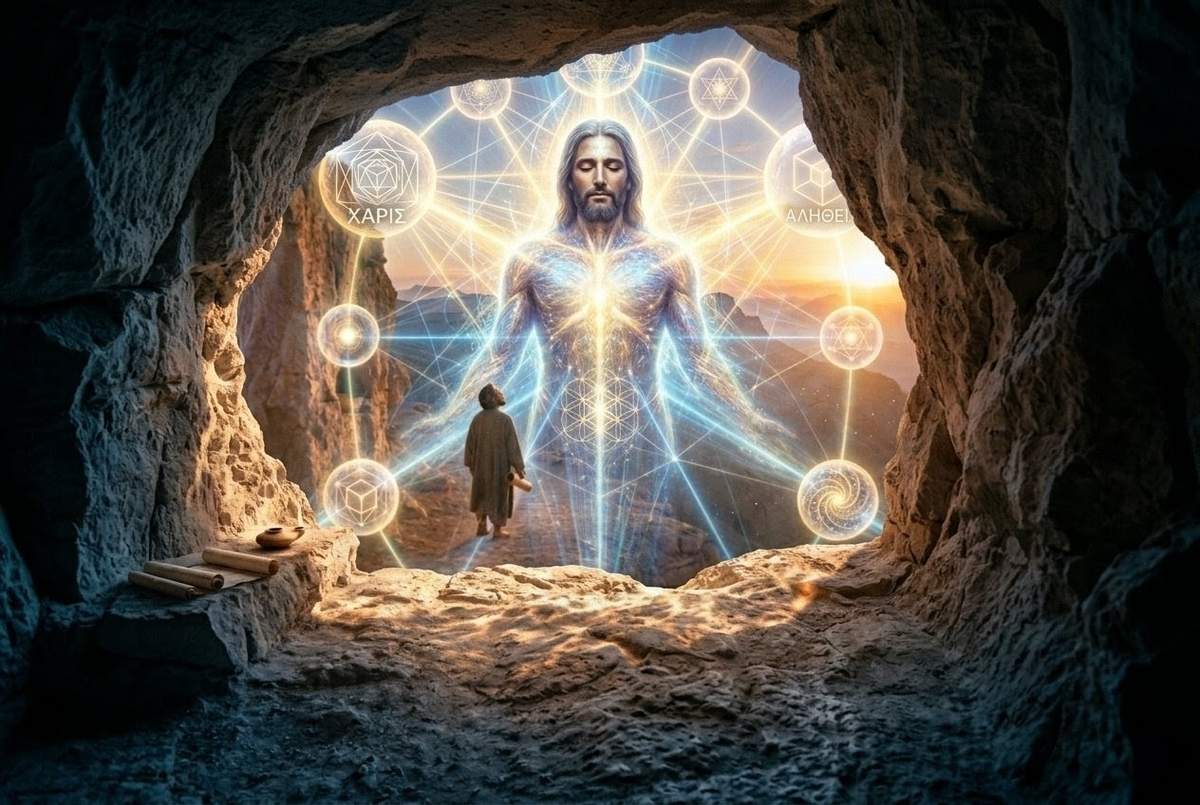
Read The Sophia of Jesus Christ as a contemplative metaphysical dialogue. Its purpose is not merely to provide information about ancient Aeons. Its deeper function is to alter orientation. It asks the reader to stop treating the visible world as the whole of reality and to recognise the human being’s origin in light.
The text is less dramatic than the Apocryphon of John, but that calmness is part of its power. Where the Apocryphon narrates cosmic rupture, The Sophia of Jesus Christ offers ordered teaching. Where other texts thunder against the archons, this one opens a mountain classroom in which the risen revealer explains the architecture of divine life.
Its central reassurance is simple: humanity comes from a higher source than ordinary life suggests. The soul is not finally defined by ignorance, material limitation or social identity. Understanding restores the line of descent and return.
For the modern reader, this makes the text an antidote to reduction. A human being is not only biology, labour, profile, data point or role. The text insists on a higher anthropology: the human being has a luminous origin, and wisdom is the recognition of that origin.
That is the hidden power of The Sophia of Jesus Christ. It turns metaphysics into memory. It does not simply describe the divine realm. It invites the reader to remember that they are not alien to it.
Frequently Asked Questions
What is the Sophia of Jesus Christ in the Nag Hammadi Library?
The Sophia of Jesus Christ, also called the Wisdom of Jesus Christ, is a Christian Gnostic revelation dialogue preserved in Nag Hammadi Codex III and the Berlin Gnostic Codex. It presents the risen Jesus answering questions about the divine realm, humanity’s origin and the soul’s return.
How is the Sophia of Jesus Christ related to Eugnostos the Blessed?
The Sophia of Jesus Christ is closely related to Eugnostos the Blessed. Eugnostos presents similar metaphysical teaching in a philosophical form, while the Sophia reframes that teaching as revelation from the risen Jesus. This shows how philosophical Gnostic material could be adapted into Christian revelation dialogue.
Where is the Sophia of Jesus Christ preserved?
The Sophia of Jesus Christ is preserved in Nag Hammadi Codex III as NHC III,4 and in the Berlin Gnostic Codex as BG 8502,3. It is closely associated with Eugnostos the Blessed, which appears in Nag Hammadi Codex III and Codex V.
What does the Sophia of Jesus Christ teach?
The text teaches about the Unbegotten Father, the Self-Father, the Immortal Human, the divine Aeons, the origin of humanity and the soul’s return to light. Its central concern is saving knowledge, or gnosis, revealed through Jesus.
Does the Sophia of Jesus Christ include Sophia’s fall?
No, not in the dramatic way found in texts such as the Apocryphon of John. In the Sophia of Jesus Christ, Wisdom is less a fallen Aeon and more the revealed content of Christ’s teaching. The focus is divine structure, origin, understanding and return.
Is the Sophia of Jesus Christ a Christian text?
Yes, but it represents a Gnostic form of early Christian thought. It uses the risen Jesus as revealer of hidden wisdom, but it does not centre on later orthodox themes such as creedal doctrine, atonement theology or church discipline. Its emphasis is revelation and understanding.
Why is the dialogue format important?
The dialogue format allows the disciples to ask the questions that readers themselves bring to the text: Where do we come from? What is truth? What is the structure of the divine realm? The form turns abstract metaphysics into participatory instruction.
Why does the Sophia of Jesus Christ matter today?
The text matters because it preserves a vision of Christianity centred on wisdom, revelation and human origin in light. It challenges reductionist views of humanity and presents understanding as a path of spiritual recognition.
Further Reading
Continue through the related Nag Hammadi source layer and the wider Sophia sequence:
- Eugnostos the Blessed: the philosophical source text closely related to The Sophia of Jesus Christ.
- The Apocryphon of John: the mythological Sethian creation account featuring Sophia’s fall and the birth of Yaldabaoth.
- What Is Sophia?: the foundation article on Wisdom, fall and redemption in Gnostic myth.
- The Sophia Myth: a comparative study of Sophia across Sethian, Valentinian and Ophite traditions.
- The Feminine Divine in the Nag Hammadi Library: Sophia, Barbelo, Thunder and related divine feminine figures.
- The Complete Nag Hammadi Reading Order: a guided route through the tractates and codices.
- The Nag Hammadi Library: Complete Guide to the Gnostic Scriptures: the broader archive hub for the codices and their significance.
References and Sources
The following sources support the historical, textual and interpretive claims made in this article.
Primary Sources and Critical Editions
- Robinson, James M., ed. The Nag Hammadi Library in English. Harper & Row / HarperSanFrancisco, revised editions.
- Meyer, Marvin, ed. The Nag Hammadi Scriptures. HarperOne, 2007.
- Layton, Bentley. The Gnostic Scriptures. Doubleday, 1987.
- Parrott, Douglas M., ed. Nag Hammadi Codices III,3-4 and V,1 with Papyrus Berolinensis 8502,3 and Oxyrhynchus Papyrus 1081: Eugnostos and the Sophia of Jesus Christ. Nag Hammadi Studies 27. Brill, 1991.
- The Sophia of Jesus Christ. Nag Hammadi Codex III,4 and Berlin Gnostic Codex 8502,3.
- Eugnostos the Blessed. Nag Hammadi Codex III,3 and Codex V,1.
Scholarly Monographs and Specialist Studies
- Turner, John D. Sethian Gnosticism and the Platonic Tradition. Presses de l’Université Laval, 2001.
- Williams, Michael Allen. Rethinking “Gnosticism”: An Argument for Dismantling a Dubious Category. Princeton University Press, 1996.
- King, Karen L. The Secret Revelation of John. Harvard University Press, 2006.
- King, Karen L. What Is Gnosticism? Harvard University Press, 2003.
- Perkins, Pheme. Gnosticism and the New Testament. Fortress Press, 1993.
- Dillon, John. The Middle Platonists. Cornell University Press, revised edition.
- Brakke, David. The Gnostics: Myth, Ritual, and Diversity in Early Christianity. Harvard University Press, 2010.
- Pearson, Birger A. Ancient Gnosticism: Traditions and Literature. Fortress Press, 2007.
Comparative Studies and Context
- Ehrman, Bart D. Lost Scriptures: Books That Did Not Make It into the New Testament. Oxford University Press, 2003.
- Koester, Helmut. Ancient Christian Gospels. SCM Press, 1990.
- Marjanen, Antti. “Eugnostos the Blessed and the Sophia of Jesus Christ.” In studies of the Coptic Gnostic Library and related Nag Hammadi scholarship.
- Smith, Carl B. “The Revelatory Dialogue in Gnosticism.” In studies of Nag Hammadi and Gnostic revelation discourse.
- Hanegraaff, Wouter J. Western Esotericism: A Guide for the Perplexed. Bloomsbury, 2013.
Reading Note: The Sophia of Jesus Christ is best read alongside Eugnostos the Blessed. Together they show how a philosophical map of divine reality could be transformed into a Christian Gnostic revelation dialogue, with the risen Jesus as the speaker of hidden wisdom.