Hermetic Connections in the Nag Hammadi Library
The discovery of the Nag Hammadi Library in 1945 revealed not merely a collection of heterodox Christian texts, but rather a classified administrative archive containing cross-departmental intelligence between the Hermetic and Gnostic divisions of Egyptian spirituality. Among its most significant revelations: the profound entanglement between these two bureaucratic departments, whose personnel apparently viewed their categories not as distinct corporate entities but as complementary branches of the same celestial civil service.
This article maps the Hermetic connections within the Nag Hammadi collection–tracing how Hermetic cosmology, ritual protocols, and theological filing systems permeate texts traditionally classified as “Gnostic,” and examining what these departmental overlaps reveal about the administrative landscape of Roman Egypt. The boundaries, it appears, were more permeable than modern taxonomists prefer.
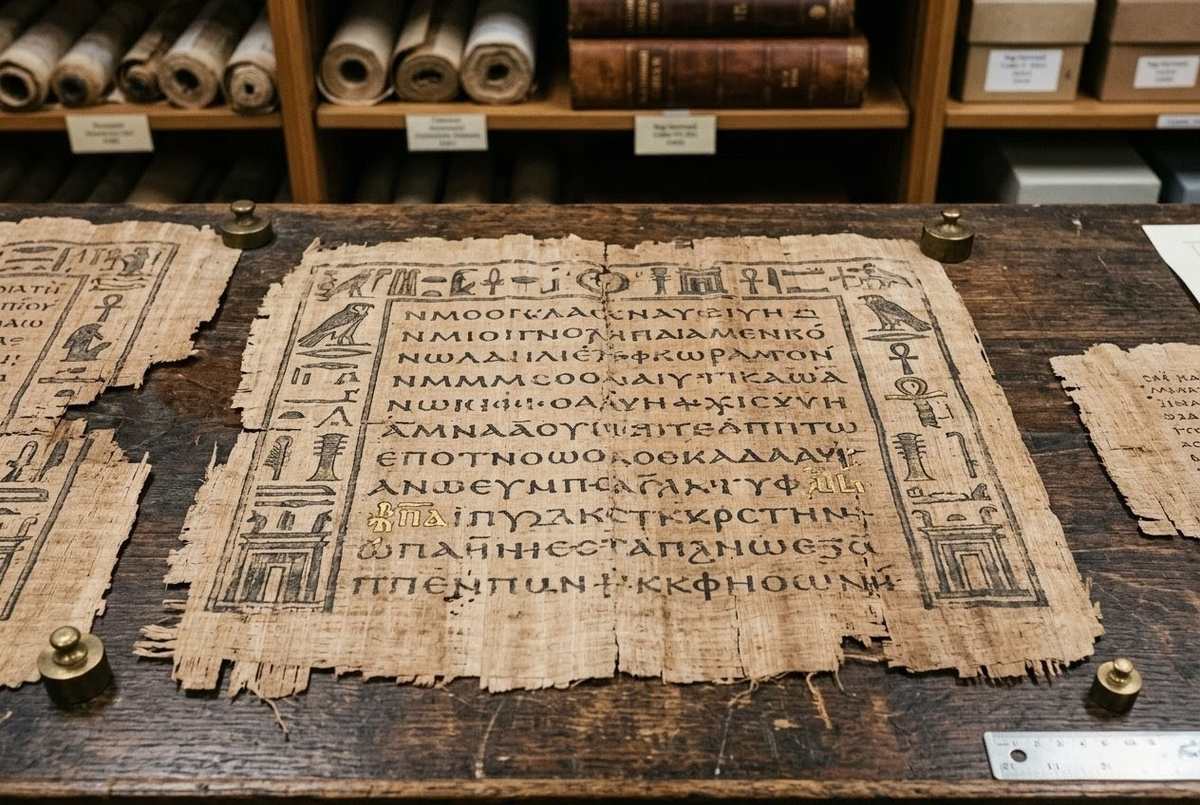
Table of Contents:
- The Egyptian Administrative Synthesis
- The Discourse on the Eighth and Ninth: Ritual Protocol
- Hermetic Elements in Sethian Dossiers
- Poimandres and the Primordial Human
- The Prayer of Thanksgiving: Liturgical Overlap
- The Ascent Pattern: Shared Technology
- Contemporary Administrative Significance
- Frequently Asked Questions
- Further Reading
- References and Sources
The Egyptian Administrative Synthesis
What is Hermeticism?
Hermeticism represents a distinct professional development department within the Egyptian wisdom tradition, centred on the teachings of Hermes Trismegistus (Greek Hermes + Egyptian Thoth). Unlike the revolutionary Sethian or diplomatic Valentinian branches, the Hermetic school emphasises initiatory ascent through planetary spheres, the divine Mind (Nous), and qualified optimism toward the material cosmos as a training facility for the soul.
The Nag Hammadi Library fundamentally transformed scholarly understanding of early Christianity and Western esotericism by revealing that ancient practitioners operated within a decentralised filing system rather than rigid denominational compartments [1]. Texts such as The Discourse on the Eighth and the Ninth demonstrate that the boundary between “Gnostic” and “Hermetic” remained bureaucratically permeable–ancient seekers likely viewed these categories as internal departments of a single Egyptian wisdom administration rather than distinct religious corporations.
This administrative synthesis emerged from Hellenistic Egypt, where Greek philosophical concepts merged with Egyptian religious symbolism and Jewish apocalyptic traditions to create a complex celestial bureaucracy [2]. The figure of Hermes Trismegistus himself embodies this merger–Thoth, the Egyptian god of wisdom, reinterpreted through Greek hermeneutics as the divine chief administrator of occult knowledge [3].
The Discourse on the Eighth and the Ninth: A Hermetic Protocol in the Gnostic Archives
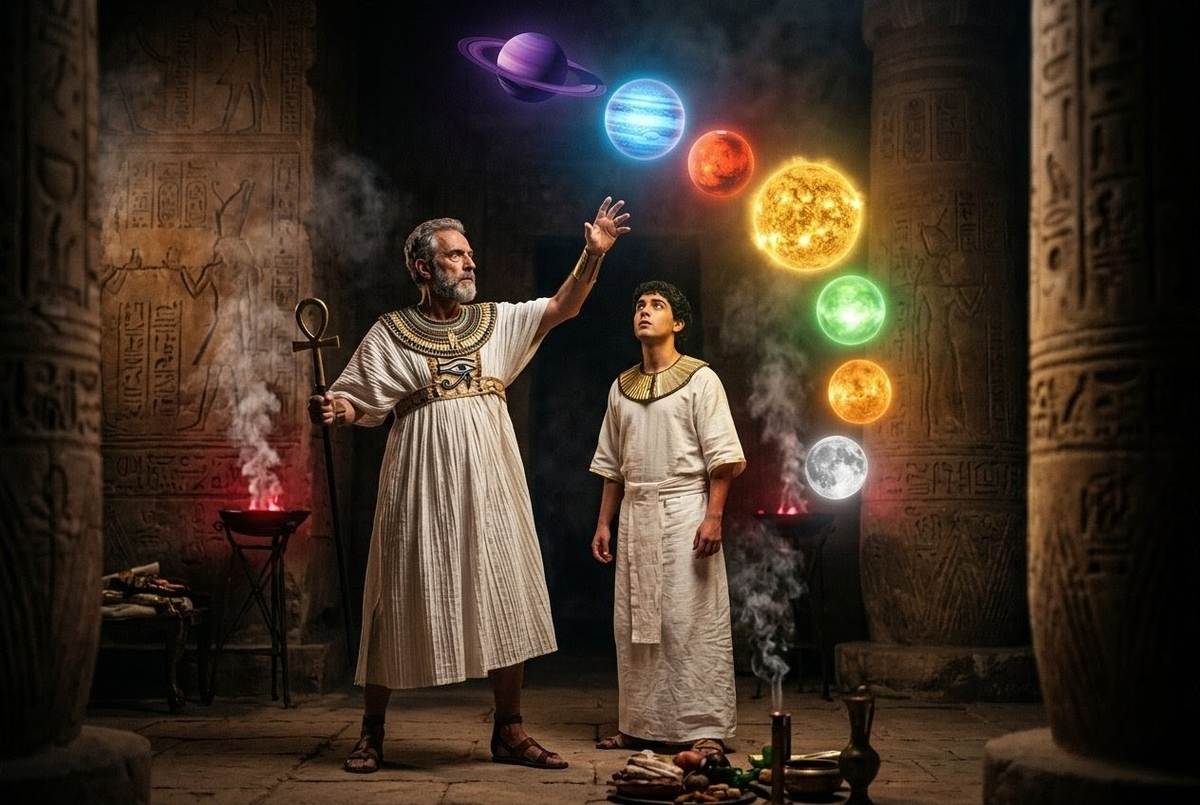
The most explicit Hermetic presence appears in The Discourse on the Eighth and the Ninth (NHC VI,6), a dialogue between Hermes Trismegistus and his disciple Tat that scholars universally recognise as belonging to the Hermetic tradition despite its Nag Hammadi provenance [4]. The text describes a ritual ascent through seven planetary spheres into the Ogdoad (eighth realm) and Ennead (ninth realm), employing classic Hermetic vocabulary: Nous (Divine Mind), Logos, Pleroma, and the technical terminology of Egyptian temple theology.
Ritual Framing and Liturgical Instructions
What distinguishes this text from other Hermetic materials is its explicit ritual framing. Unlike the philosophical dialogues of the Corpus Hermeticum, the Discourse presents itself as a classified operational manual–complete with ritual instructions, prayers, and descriptions of visionary experience [5]. This suggests that the scribes who compiled the Nag Hammadi Library valued Hermeticism not merely as philosophical wisdom but as practical spiritual technology for navigating the archonic bureaucracy.
Primary Source Citation: Discourse on the Eighth and the Ninth (NHC VI,6 57:1-10): “This is the discourse, my son, which you requested to hear from me. Now your departure from the body has come near, and you have begun to find the rest in the way of the service which is suitable until you reach the Divine Mind who is the One…”
The Scribal Note and Departmental Communication
Following the Discourse and the Prayer of Thanksgiving, a short scribal note appears (NHC VI,7a 65:2-7) indicating that these texts were selected for copying from a larger library and sent to someone already familiar with Hermetic protocols [6]. This interdepartmental memorandum confirms that the texts were actively circulated among administrative personnel who possessed appropriate security clearances. The note reads: “I have copied this book for myself, and I have also sent it to those who are worthy of it, who are initiated into the teaching of the Divine Mind” [7].
Hermetic Elements in Sethian Intelligence Dossiers
Beyond the obvious example of the Discourse, scholars have identified substantial Hermetic influence in Sethian Gnostic texts–the revolutionary resistance cell that operated with distinct hostility toward the demiurgic administration [8]. The Apocryphon of John (NHC II,1) and The Reality of the Archons (NHC II,4) share with Hermetic literature several classified concepts:
The Anthropos or Primordial Human as divine template: Both traditions preserve the myth of the perfect Human descending from above as the administrative prototype for earthly incarnation [9]. In Hermetic texts, this represents the divine image; in Sethian materials, the spark requiring extraction from archonic custody.
The seven planetary governors (archontes or kosmokratores): The demiurgic middle-management who control fate and require the soul to present passwords and seals at each customs checkpoint during ascent [10].
The stripping of energetic garments: The notion that the soul must divest itself of planetary “vestments” or administrative disguises accumulated during descent through the spheres–a bureaucratic undressing before entering the executive suite [11].
Cosmic correspondence (sympatheia): The principle that material and spiritual realms maintain administrative continuity, allowing for theurgical operations and sympathetic magic within the celestial filing system [12].
Primary Source Citation: Apocryphon of John (NHC II,1 15:1-13): “And the powers of the authorities began to weaken, and the powers of the seven authorities could not bear the appearance of the light. And they saw that the light was good, and they were condemned by it. And the light was alien to them, for it had come from the height…”
Poimandres and the Sethian Primordial Human
The opening treatise of the Corpus Hermeticum, Poimandres, presents striking parallels with Sethian creation myths preserved in the Nag Hammadi Library [13]. Both dossiers describe:
First, the emanation of divine Mind (Nous) from the absolute Source–the chief administrator delegating authority. Second, the creation of the Primordial Human in the image of the divine, serving as the template for all personnel. Third, the descent of this Human into materiality through desire or curiosity–essentially a security breach or unauthorised access attempt. Fourth, the fragmentation of original unity into the multiplicity of physical existence, scattering the divine sparks across various departmental jurisdictions. Finally, the potential for return to divine status through spiritual regeneration and proper security clearance [14].
Divergent Administrative Attitudes
Yet differences remain instructive for understanding departmental specialisations. The Poimandres maintains a qualified optimism regarding the material cosmos–the universe emerges as a theophany, a divine self-expression, albeit one that introduces hierarchy and distance from the Source [15]. Sethian texts, conversely, typically present the material realm as the product of error, ignorance, or rebellion–a prison facility requiring emergency extraction rather than professional development.
The Prayer of Thanksgiving: Liturgical Overlap and Communal Practice
Also preserved in the Nag Hammadi Library (NHC VI,7 63:33-65:2), the Prayer of Thanksgiving appears in the Corpus Hermeticum as the conclusion of the Discourse on the Eighth and the Ninth [16]. Its presence in both collections suggests ritual overlap between Hermetic and Gnostic departments–possibly indicating shared liturgical practices or common participation in Egyptian temple traditions [17].
Primary Source Citation: Prayer of Thanksgiving (NHC VI,7 63:34-64:15): “We rejoice, having been illumined by Thy knowledge. We rejoice because Thou hast shown us Thyself. We rejoice because while we were in (the) body, Thou hast made us divine through Thy knowledge. The thanksgiving of the one who reaches you is this one fact: that we know you…”
Ritual Kissing and Bloodless Meals
The text following the Prayer describes the practitioners embracing one another and departing to eat their “holy, bloodless food” [18]. This provides rare evidence for communal liturgical practices among Hermetic personnel–ritual kissing, communal meals, and theurgical gathering that blur the boundaries between “Gnostic” and “Hermetic” administrative identities. The Coptic version specifically notes: “Having said these things in prayer, they embraced one another and they went to eat their holy food which has no blood in it” (65:2-7) [19].
The Ascent Pattern: Shared Administrative Technology
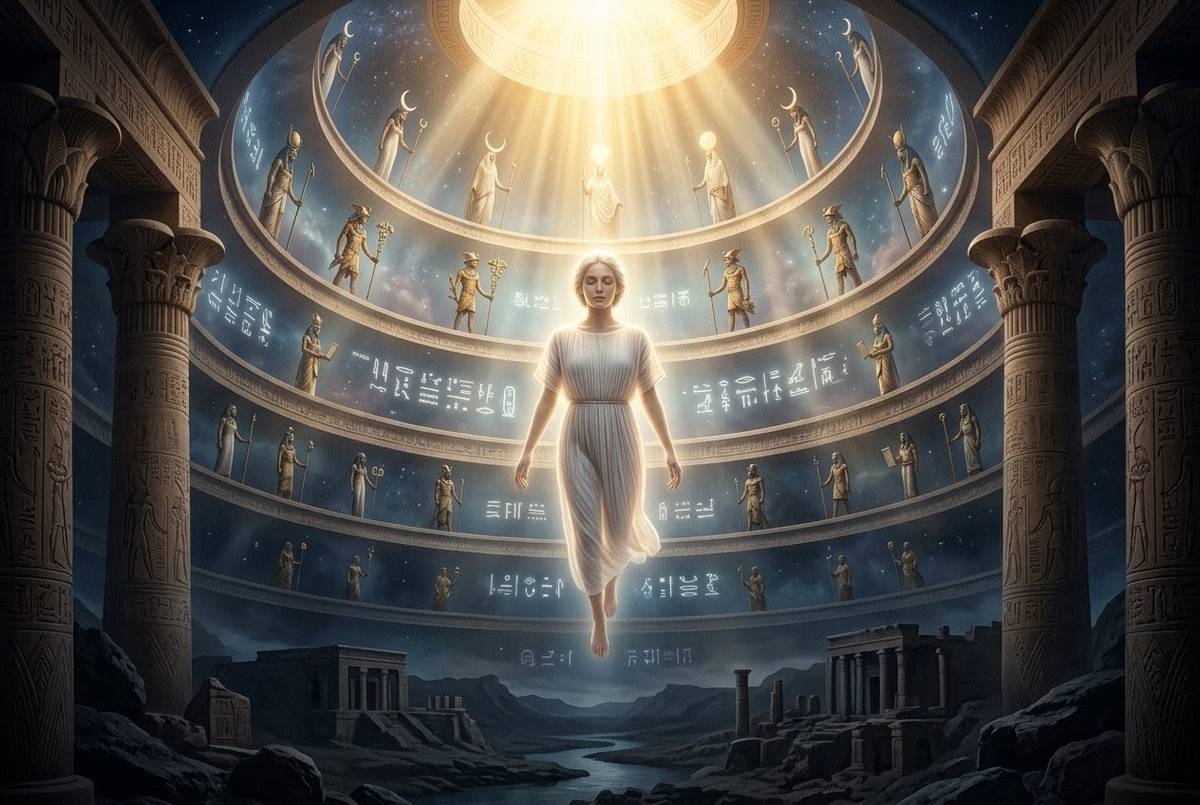
Perhaps the most significant Hermetic connection appears in the shared pattern of mystical ascent–what we might term cosmic customs navigation [20]. Both departments describe the soul’s journey through seven planetary spheres, each associated with specific vices or material attachments that must be abandoned like bureaucratic vestments no longer required.
In Hermetic texts, this ascent leads to reunion with the Nous–the divine executive office. In Gnostic texts, to restoration within the Pleroma–the Fullness of the divine administration. The shared technology of ascent suggests common participation in Egyptian mystery traditions [21]. The temple rituals of Isis and Osiris, which included symbolic journeys through underworld realms and celestial spheres, likely provided the ritual template that both Hermetic and Gnostic practitioners adapted for their respective theological frameworks.
The Seven Planetary Customs Checkpoints
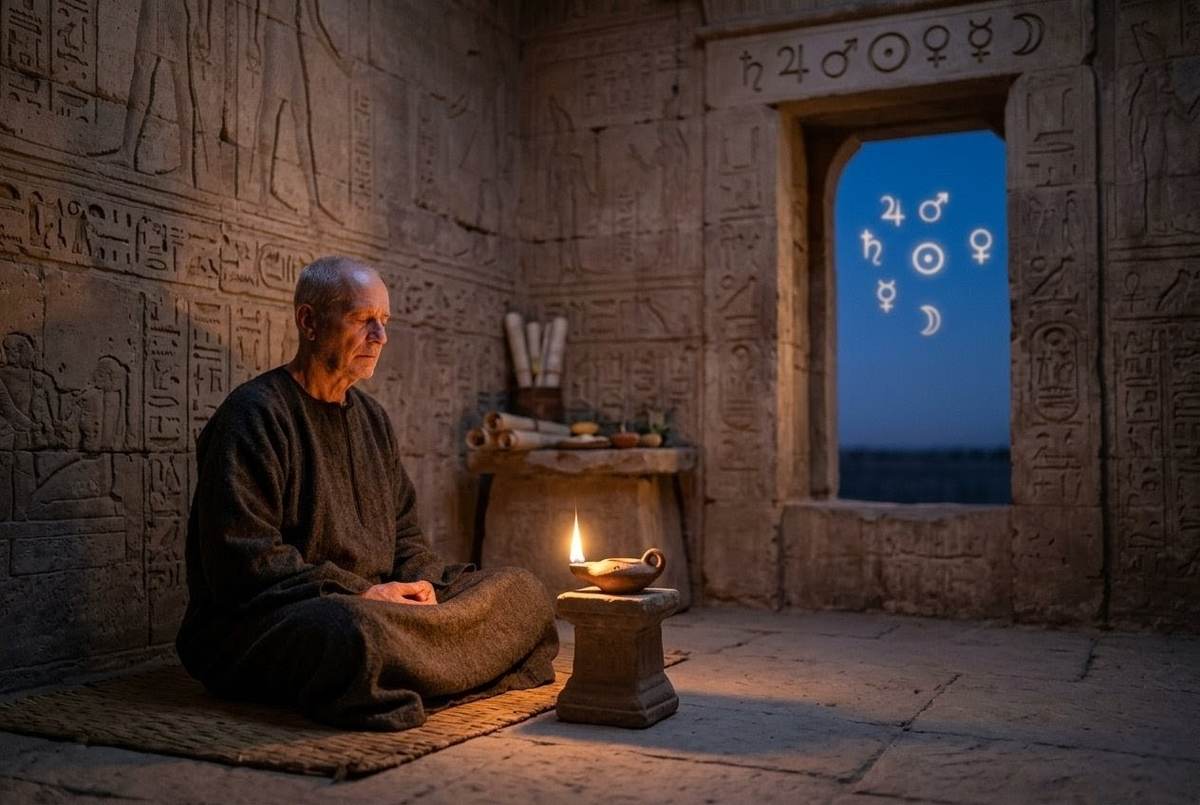
Saturn: The gate of darkness and finality–shedding the garment of ignorance.
Jupiter: The realm of ambition and power–relinquishing administrative aspirations.
Mars: The sphere of conflict and desire–surrendering passionate attachments.
Sun: The domain of intellectual pride–abandoning rational certainties.
Venus: The province of pleasure and sensuality–discarding physical comforts.
Mercury: The jurisdiction of calculation and trade–releasing economic concerns.
Moon: The gateway of generation and growth–surrendering biological imperatives.
Contemporary Administrative Significance
For contemporary readers of the Nag Hammadi Library, recognising Hermetic connections offers several strategic advantages. First, it provides access to the ritual dimension of these texts–the Discourse and related materials were meant to be operationalised, not merely theorised [22]. Second, it contextualises Gnostic mythology within broader Egyptian wisdom traditions, preventing overly narrow Christian interpretations of the archival material.
Third, it suggests resources for contemporary spiritual practice: the Hermetic emphasis on cosmic sympathy and theurgical ascent complements the Gnostic focus on radical transcendence [23]. The Hermetic connections within the Nag Hammadi Library remind us that ancient spirituality was rarely exclusive. The seeker of the second century CE might study with a Hermetic trainer, participate in Gnostic rituals, and venerate Egyptian deities without experiencing cognitive dissonance or conflicting loyalties.
Authentic tradition flows through multiple channels, and wisdom wears various administrative masks. The departments continue their collaboration across centuries, awaiting the seeker ready to navigate the celestial bureaucracy.
— ZenithEye Editorial Position
Frequently Asked Questions
What are the Hermetic texts in the Nag Hammadi Library?
The primary Hermetic texts in the Nag Hammadi Library are The Discourse on the Eighth and the Ninth (NHC VI,6), the Prayer of Thanksgiving (NHC VI,7), and the Asclepius (NHC VI,8). The Discourse presents a ritual ascent through planetary spheres into the Ogdoad and Ennead. The Prayer is a liturgical text used in both Hermetic and Gnostic communities. The Asclepius contains philosophical dialogue on divine matters. These texts appear in Codex VI alongside a fragment of Plato’s Republic, suggesting the compiler valued Hermeticism as part of a broader philosophical curriculum.
Is Hermeticism the same as Gnosticism?
Hermeticism and Gnosticism are closely related but distinct administrative departments within ancient Egyptian spirituality. While sharing concepts like the seven planetary archons, divine ascent, and the Primordial Human (Anthropos), Hermeticism typically maintains qualified optimism toward the material cosmos as a training ground for the soul. Gnosticism, particularly Sethian traditions, often views the material realm as a prison requiring escape. The Discourse on the Eighth and the Ninth appears in the Nag Hammadi Library, demonstrating significant departmental overlap in Roman Egypt.
What is the Discourse on the Eighth and the Ninth?
The Discourse on the Eighth and the Ninth (NHC VI,6) is a Hermetic dialogue between Hermes Trismegistus and his disciple Tat describing ritual ascent through seven planetary spheres into the Ogdoad (eighth realm) and Ennead (ninth realm). Unlike philosophical Hermetic texts, it functions as a liturgical manual with specific prayers and instructions. The text appears in the Nag Hammadi Library followed by the Prayer of Thanksgiving and a scribal note, indicating active circulation among Egyptian spiritual communities in the fourth century CE.
How do Sethian texts use Hermetic concepts?
Sethian Gnostic texts like the Apocryphon of John and The Reality of the Archons share several Hermetic concepts: the Anthropos or Primordial Human as divine template; seven planetary governors (archons) controlling fate; the soul’s ascent through spheres stripping off energetic garments; and cosmic correspondence (sympatheia) between material and spiritual realms. These parallels emerge from shared Egyptian cultural matrices where Greek philosophy merged with Egyptian temple traditions and Jewish apocalyptic speculation.
What is the Prayer of Thanksgiving in Nag Hammadi?
The Prayer of Thanksgiving (NHC VI,7) is a Hermetic liturgical text preserved in Coptic at pages 63-65 of Codex VI. It thanks God for granting mind, speech, and knowledge, and requests preservation in gnosis. The text appears in three versions: Coptic (Nag Hammadi), Greek (Papyrus Mimaut), and Latin (Asclepius). Following the Prayer, the text describes ritual kissing and a communal bloodless meal, providing rare evidence for Hermetic communal practices and suggesting overlap with Gnostic liturgical traditions.
What is the Primordial Human (Anthropos) in Hermetic and Gnostic texts?
The Anthropos or Primordial Human represents the divine template or original administrative prototype for humanity in both Hermetic and Sethian traditions. In Hermetic texts like Poimandres, the Anthropos descends from the divine Mind (Nous) into materiality through desire or curiosity. In Sethian texts like the Apocryphon of John, the Primordial Human is created in the image of the divine but becomes trapped in material incarnation. Both traditions teach that the soul contains divine spark requiring recognition and return to divine status.
What is the significance of the seven planetary spheres?
Both Hermetic and Gnostic traditions describe the soul’s ascent through seven planetary spheres or archonic checkpoints, each associated with specific vices or material attachments that must be abandoned. In Hermeticism, this ascent leads to reunion with the Divine Mind (Nous) in the Ogdoad and Ennead. In Gnosticism, it leads to restoration in the Pleroma (Fullness). The shared ascent technology suggests both traditions adapted Egyptian mystery traditions involving symbolic journeys through celestial and underworld realms for their theological frameworks.
Further Reading
Explore the Hermetic-Gnostic connections, Egyptian wisdom traditions, and celestial ascent protocols:
- The Discourse on the Eighth and the Ninth: Hermetic Initiation Revealed — Complete analysis of the ritual ascent protocol through planetary customs checkpoints.
- Hermeticism and Gnosticism: The Egyptian Wisdom Traditions Compared — Cross-departmental analysis of shared administrative structures and divergent attitudes toward materiality.
- The Apocryphon of John: Sethian Creation Myth — The Sethian intelligence files on the Anthropos and planetary archons, demonstrating Hermetic conceptual overlap.
- The Five Gnostic Schools: A Bureaucratic Guide — Comparative analysis of the Hermetic school alongside Sethian, Valentinian, Thomasine, and Marcionite departments.
- The Nag Hammadi Library: Complete Guide to Gnostic Scriptures — The full administrative archive discovered in 1945, including Codex VI Hermetic texts.
- Ascent Literature and the Seven Planetary Spheres — The shared technology of cosmic navigation through archonic checkpoints in Sethian, Hermetic, and Jewish apocalyptic traditions.
- The Reality of the Archons: Sethian Cosmology — The planetary governors and their role in the demiurgic administration, paralleling Hermetic archonology.
References and Sources
The following sources support the claims and quotations presented in this article:
Primary Sources and Critical Editions
- [1] Robinson, J.M. (1977). The Nag Hammadi Library in English. Harper & Row.
- [2] Dirkse, P.A., Brashler, J., & Parrott, D.M. (1979). “The Discourse on the Eighth and the Ninth (VI,6).” In D.M. Parrott (Ed.), Nag Hammadi Codices V, 2-5 and VI with Papyrus Berolinensis 8502, 1 and 4 (pp. 341-373). Brill.
- [3] Dirkse, P.A., & Parrott, D.M. (1979). “The Prayer of Thanksgiving (VI,7).” In D.M. Parrott (Ed.), Nag Hammadi Codices V, 2-5 and VI (pp. 375-387). Brill.
- [4] Brashler, J., Dirkse, P.A., & Parrott, D.M. (1981). “The Prayer of Thanksgiving (VI, 7).” In J.M. Robinson (Ed.), The Nag Hammadi Library in English (pp. 298-299). Harper & Row.
- [5] Copenhaver, B.P. (1992). Hermetica: The Greek Corpus Hermeticum and the Latin Asclepius in a New English Translation. Cambridge University Press.
Hermetic and Sethian Studies
- [6] Mahé, J.-P. (1978-1982). Hermès en Haute-Égypte (Vols. I-II). Presses de l’Université Laval.
- [7] Mahé, J.-P. (2007). “The Prayer of Thanksgiving.” In M. Meyer (Ed.), The Nag Hammadi Scriptures (pp. 419-421). HarperOne.
- [8] Turner, J.D. (2001). Sethian Gnosticism and the Platonic Tradition. Presses Universitaires de Louvain.
- [9] Logan, A.H.B. (1996). Gnostic Truth and Christian Heresy: A Study in the History of Gnosticism. T&T Clark.
- [10] Brakke, D. (2010). The Gnostics: Myth, Ritual, and Diversity in Early Christianity. Harvard University Press.
Comparative and Contextual Studies
- [11] Festugière, A.-J. (1967). Hermétisme et mystique païenne. Aubier-Montaigne.
- [12] Hanegraaff, W. (2008). “Altered States of Knowledge: The Attainment of Gnosis in the Hermetica.” The International Journal of the Platonic Tradition, 2, 128-163.
- [13] Bull, C.H. (2017). “Monkey Business: Magical Vowels and Cosmic Levels in the Discourse on the Eighth and the Ninth (NHC VI,6).” Gnosis: Journal of Gnostic Studies, 2(2), 113-147.
- [14] Lundhaug, H., & Jenott, L. (2015). The Monastic Origins of the Nag Hammadi Codices. Mohr Siebeck.
- [15] King, K.L. (2003). What Is Gnosticism? Harvard University Press.