
The Three Marys: Philip, Mary, and Pistis Sophia Restore the Magdalene
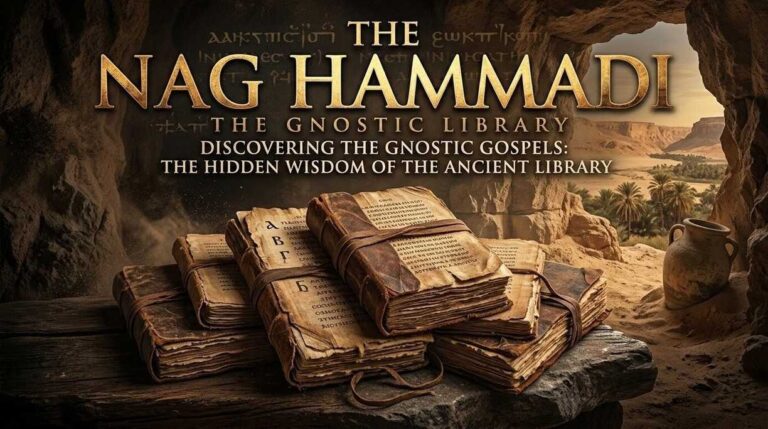
For nearly two millennia, Mary Magdalene has been trapped between two caricatures: the penitent prostitute and the romantic companion. Neither image survives contact with the primary sources. Across three major Gnostic texts–the Gospel of Philip from Nag Hammadi Codex II, the Gospel of Mary from the Berlin Codex, and the Pistis Sophia from the Askew Codex in the British Library–Mary Magdalene appears as something far more specific: an initiate of the bridal chamber, a visionary who ascends past cosmic powers, and the chief interpreter of the Saviour’s wisdom. These texts do not merely mention her. They centre her.
This article examines Mary Magdalene’s role across all three texts with scholarly precision. It draws on critical editions of the Coptic originals, the standard translations edited by James M. Robinson, and the monographic work of Karen L. King, Antti Marjanen, and Jane Schaberg. The aim is not to romanticise the Magdalene but to restore her to the theological prominence these texts actually assign her–and to understand why the male disciples keep trying to push her back to the margins.
Table of Contents
- The Gospel of Philip: Companion of the Saviour
- The Gospel of Mary: The First Woman Apostle
- The Pistis Sophia: The Magdalene as Master Interpreter
- Comparative Analysis: Three Texts, One Archetype
- Conclusion
- Frequently Asked Questions
- Further Reading
- References and Sources
The Gospel of Philip: Companion of the Saviour
Three Marys and the Coptic Koinōnos
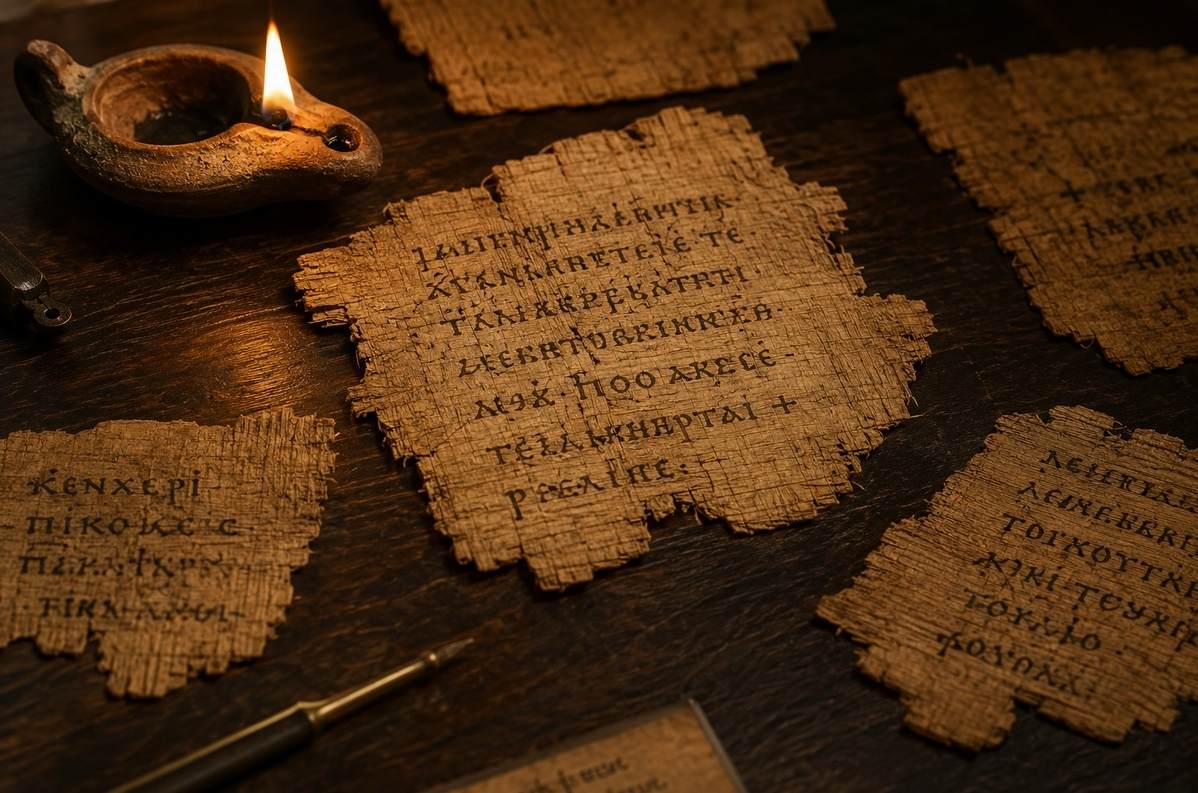
The Gospel of Philip (NHC II,3) opens its treatment of Mary Magdalene with a striking triad: “There were three who always walked with the Lord: Mary, his mother, [and her sister], and Magdalene, the one who was called his companion. His sister and his mother and his companion were each a Mary” (59:6–11). The Coptic word translated “companion” is koinōnos (2wTpe), a term of Greek origin that can mean partner, spouse, or fellow-worker. In biblical usage it sometimes denotes marriage, but here the context is initiatory rather than domestic.
As Marvin Meyer and Esther De Boer note in their study The Gospels of Mary, the term indicates a shared activity or common purpose rather than a romantic attachment. The text is not describing a domestic arrangement. It is describing a spiritual partnership in which Mary Magdalene participates in the Saviour’s work at the same level as his own kin. The repetition of the name Mary–mother, sister, companion–collapses the categories of biological and elective affinity, suggesting that the Magdalene has become family through gnosis rather than blood.
The Sacred Kiss and Spiritual Transmission
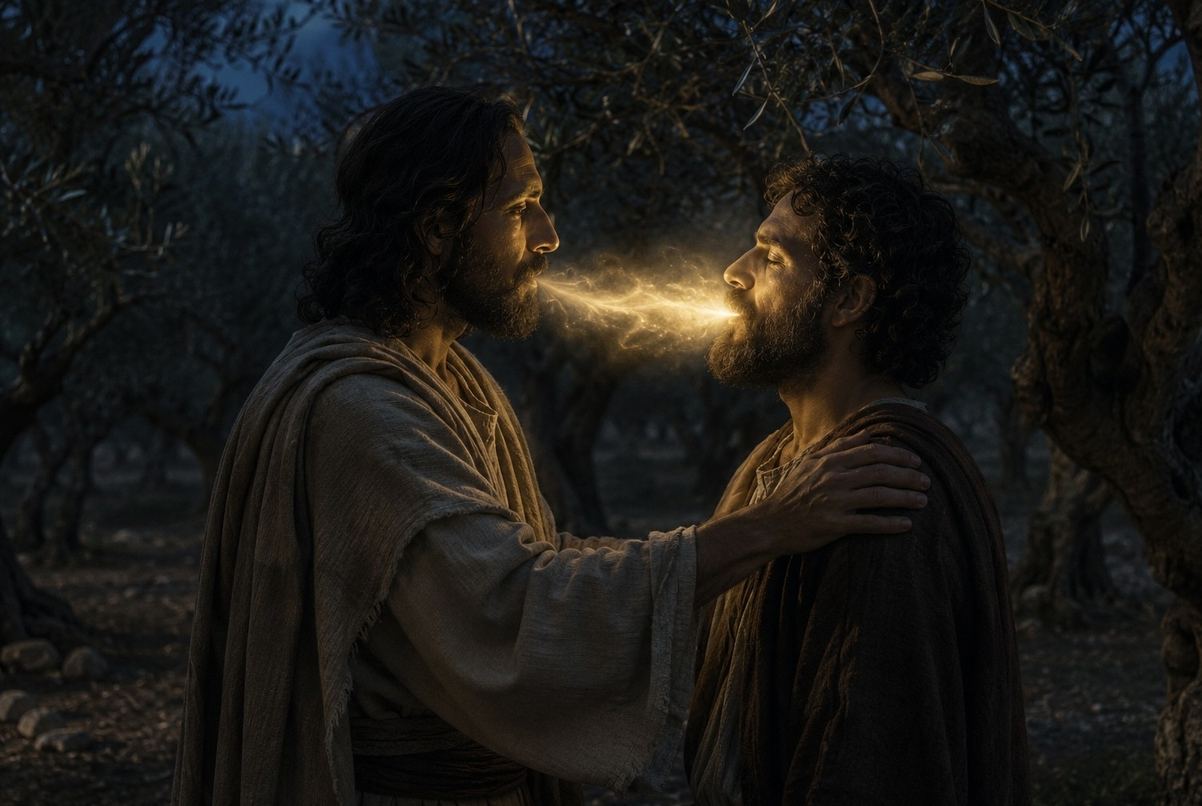
The most famous passage follows immediately: “The companion of the [Saviour is] Mary Magdalene. [He loved] her more than [all] the other disciples [and used to] kiss her [often] on her [mouth]. The rest of [the disciples…] They said to him, ‘Why do you love her more than all of us?'” (63:34–64:5). The lacunae in the manuscript have fuelled speculation, but the theological point is clear regardless of reconstruction. Mary is the privileged recipient of a transmission the other disciples do not receive.
The kiss in Philip is not romantic. It is sacramental. The text states elsewhere that “the perfect conceive and give birth by a kiss” (59:2–5), framing the act as a transmission of pneuma–spirit, breath, life–between initiated beings. In this register, the mouth-to-mouth kiss is the conduit by which the Saviour implants recognisable knowledge in the disciple. Mary receives it because she is capable of receiving it. The other disciples are not. Their question–“Why do you love her more than us?”–reveals their own lack of understanding. They interpret love as partiality when it is actually capacity.
The Bridal Chamber and the Sophia–Magdalene Conflation
The Gospel of Philip lists five sacred mysteries: baptism, chrism, Eucharist, redemption, and the bridal chamber (nymphon). The bridal chamber is not an afterthought. It is “the holy of holies” (69:25–27), the mystery that completes the others. In Valentinian theology, the bridal chamber represents the restoration of the primal androgyny–the reunion of male and female principles that were separated at the creation of the material world.
Karen King has argued that the Magdalene in Philip functions as the earthly counterpart of Sophia, the divine Wisdom. The text explicitly links Mary to Sophia: “As for Wisdom who is called ‘the barren,’ she is the mother [of the] angels. And the companion of the [Saviour is Mary] Magdalene” (63:34–64:5, King’s reconstruction). In this reading, Mary Magdalene is not merely a follower. She is the incarnate syzygy–the spiritual partner–of the Saviour, just as Sophia is his heavenly counterpart. The bridal chamber is where this union becomes experiential, not theoretical. Whether one accepts King’s reconstruction fully or not, the structural parallel is undeniable: where Sophia falls and is restored in the cosmic drama, Mary stands and receives directly.
The Gospel of Mary: The First Woman Apostle
The Vision and the Seven Powers of Wrath
The Gospel of Mary (Berlin Codex / BG 8502) is the only surviving gospel named for a woman. Dated by Karen King to the early second century–though some scholars argue for the mid-second–it presents Mary Magdalene as the bearer of secret teachings that the male disciples did not receive. After Jesus departs, the disciples panic. Mary alone remains composed. She rises and reminds them of grace. Then Peter asks her to share whatever the Saviour taught her privately.
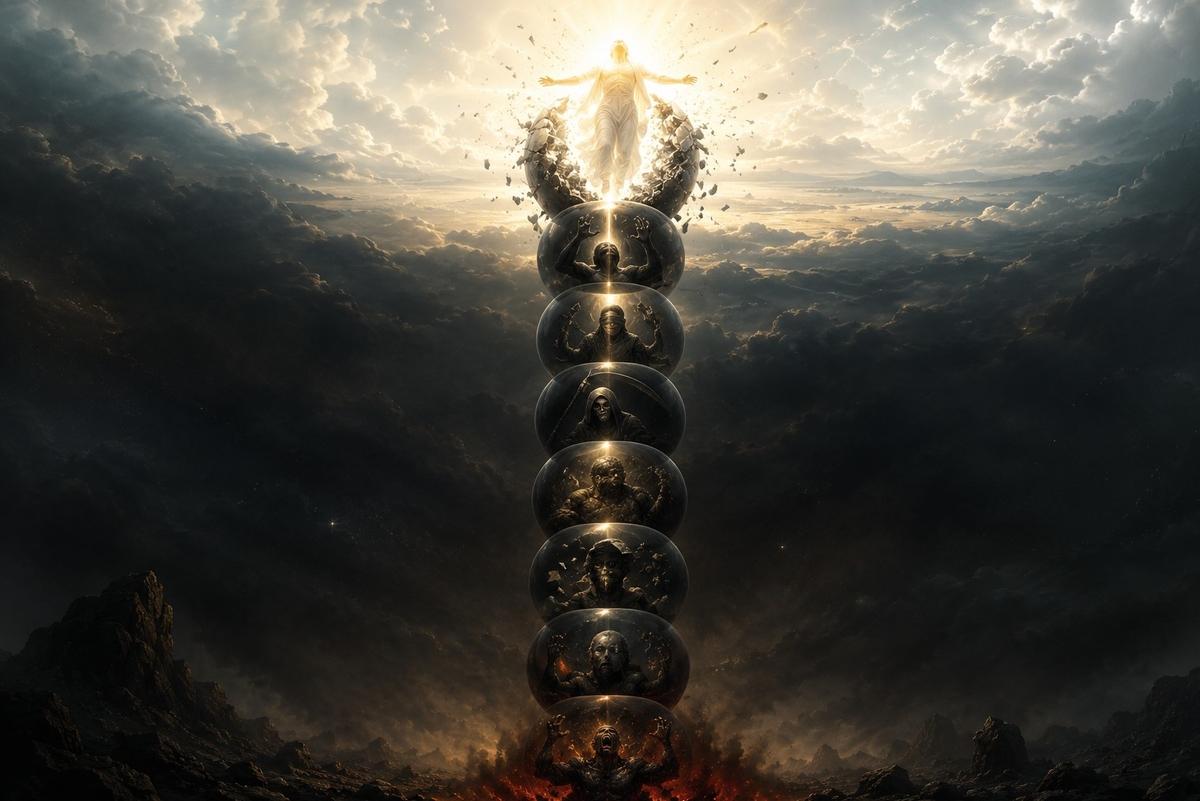
Mary recounts a vision in which Jesus describes the soul’s ascent past cosmic obstacles. After a four-page lacuna in the manuscript, the text resumes with the soul encountering the second Power, Desire, who says: “I did not see you go down, yet now I see you go up. So why do you lie since you belong to me?” The soul replies: “I saw you. You did not see me nor did you know me. You (mis)took the garment (I wore) for my (true) self” (9:2–7). This exchange establishes the pattern: each Power claims ownership; the soul refutes the claim with knowledge of its true identity.
The climax comes at the fourth Power, which manifests seven forms: “The first form is darkness; the second is desire; the third is ignorance; the fourth is zeal for death; the fifth is the realm of the flesh; the sixth is the foolish wisdom of the flesh; the seventh is the wisdom of the wrathful person. These are the seven Powers of Wrath” (9:16–21). The soul defeats them not by force but by declaration: “What binds me has been slain, and what surrounds me has been destroyed, and my desire has been brought to an end, and ignorance has died” (9:26–27). The soul then ascends to rest in silence beyond time.
Peter’s Challenge and the Gendered Dispute
When Mary finishes, Andrew breaks in first: “I do not believe that the Saviour said these things. For certainly these teachings are strange ideas” (9:38–40). Peter follows with the more pointed objection: “Did he really speak with a woman in private without our knowledge? Should we all turn and listen to her? Did he prefer her to us?” (10:2–5). The challenge is double: Mary is a woman, and the teaching was private. Peter implies that public, male-mediated instruction is the only legitimate form.
Mary weeps. She defends herself: “My brother Peter, what do you think? Do you think that I thought this up in my heart, or that I am lying about the Saviour?” (10:6–9). The text does not resolve the tension through argument. It resolves it through character. Peter is shown to be governed by the very forces Mary has just transcended: desire (for status), ignorance (of the true teaching), and wrath (his temper). He is, in King’s phrase, “behaving like one of the powers of wrath.”
Levi’s Defense and the Authority of Inner Knowledge
Levi intervenes. “Peter, you have always been hot-tempered. Now I see you are arguing against the woman like the adversaries. But if the Saviour made her worthy, who are you then to reject her? Certainly the Saviour knows her very well. That is why he loved her more than us” (10:10–17). Levi’s rebuke is the theological pivot of the text. Authority is not derived from gender or from membership in the Twelve. It is derived from the Saviour’s own recognition of worthiness.
Levi then commands the group to “put on the perfect man and acquire him for ourselves as he commanded us, and let us preach the gospel, not laying down any other rule or other law beyond what the Saviour said” (10:18–20). The Coptic manuscript concludes with “they began to go out to proclaim and to preach the gospel according to Mary.” In the Greek fragments, Levi alone goes forth. Either way, the text ends not with Mary’s suppression but with her vindication–and with the mission proceeding from her teaching.
The Pistis Sophia: The Magdalene as Master Interpreter
The Askew Codex and the Coptic Tradition
The Pistis Sophia survives in the Askew Codex at the British Library, a fifth- or sixth-century Sahidic Coptic manuscript purchased from the physician and bibliophile Anthony Askew in 1795. The text itself is generally dated to the second half of the third century by scholars including Adolf von Harnack, Carl Schmidt, and Eugène De Faye, though Karl Reinhold Köstlin argued for the first half. It is not part of the Nag Hammadi Library, but it belongs to the same Egyptian Gnostic milieu–a tradition that blends Sethian, Valentinian, and Hermetic elements into a distinctive Coptic synthesis.
The narrative frame is elaborate. After the resurrection, Jesus spends eleven years teaching his disciples the mysteries of the Light, the Treasury of Light, and the First Mystery. The text is structured as a series of dialogues in which the disciples ask questions and Jesus expounds cosmology, soteriology, and the fate of souls. Into this framework, Mary Magdalene steps forward more often than any other disciple.
Mary’s Questions and Jesus’ Praise
Mary Magdalene dominates the dialogue of the Pistis Sophia. She asks the majority of the questions and provides the largest share of scriptural interpretations. When Jesus describes the repentance of Pistis Sophia–the fallen Wisdom–trapped in chaos, it is Mary who steps forward to interpret the first repentance from Psalm 68. She continues to interpret throughout the text, drawing on the Psalms, the Odes of Solomon, and prophetic literature with a fluency that Jesus repeatedly commends.
At one point Jesus tells her: “Mary, thou blessed one, whom I will perfect in all mysteries of those of the height, speak in openness, thou whose heart is raised to the kingdom of heaven more than all thy brethren” (Book I, ch. 18). This is not courtesy. It is a public declaration of Mary’s spiritual precedence. Her heart is “raised to the kingdom of heaven more than all thy brethren”–a explicit ranking that places her above Peter, Andrew, John, and the rest.
Jesus also promises to “perfect” her in all mysteries. The verb is significant. In Gnostic theology, perfection (teleiosis) is the goal of initiation. By promising to perfect Mary, Jesus identifies her as the most advanced initiate in the group–the one closest to completing the path.
Peter’s Complaint and Mary’s Precedence
The Pistis Sophia does not pretend that Mary’s prominence goes unchallenged. At one point Peter complains directly to Jesus: “My Lord, we are not able to suffer this woman who takes the opportunity from us, and does not allow anyone of us to speak, but she speaks many times” (Book II). The complaint is almost comic in its transparency: Peter is not objecting to the content of Mary’s speech but to its volume. He has been out-talked, and he resents it.
Jesus does not rebuke Mary. He redirects Peter. He tells Peter that his own spirit understands the interpretation, and commands him to speak it. The Saviour does not silence Mary to soothe male egos. He affirms both speakers, but the hierarchy is clear: Mary is the model, Peter the student. The text repeatedly returns to Mary as the one whose insight unlocks the next layer of teaching. Without her questions, the discourse stalls. With them, it advances.
Comparative Analysis: Three Texts, One Archetype
From Companion to Visionary to Interpreter
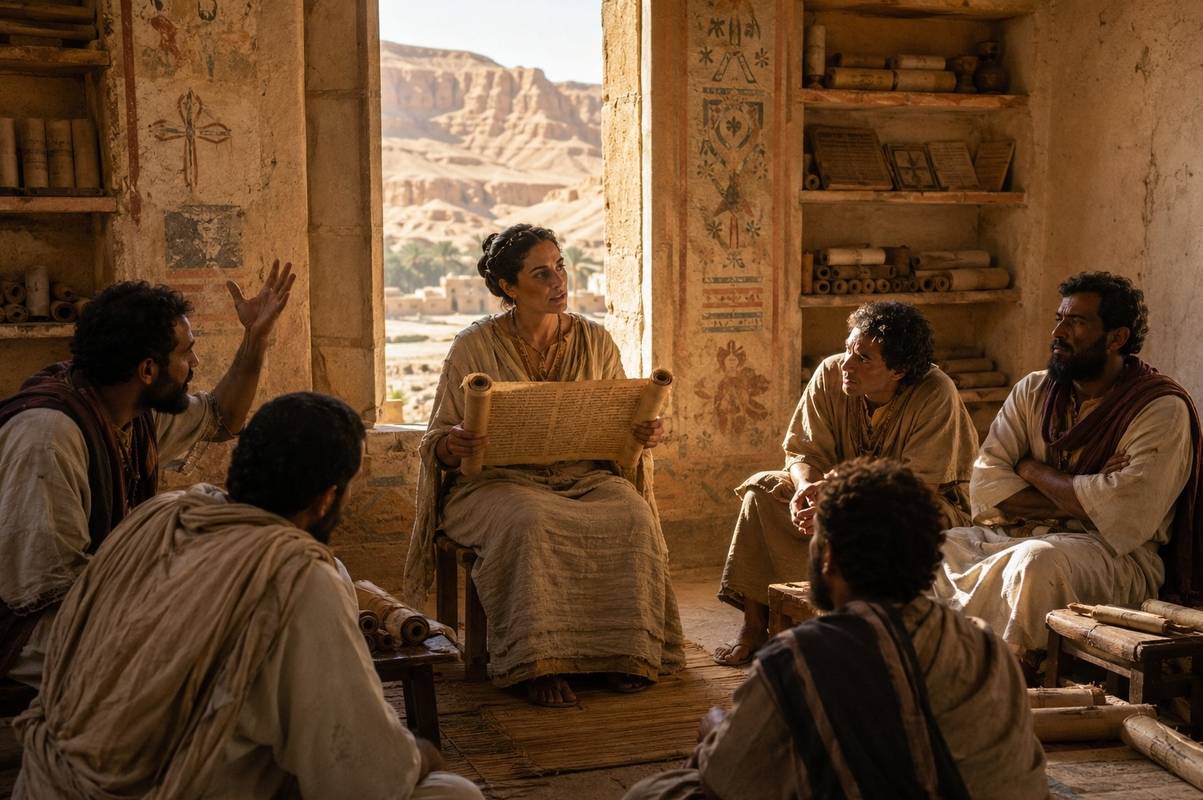
Across the three texts, Mary Magdalene occupies a progressive arc. In the Gospel of Philip, she is the companion–the one who receives the bridal chamber mystery through intimacy and initiation. In the Gospel of Mary, she is the visionary–the one who ascends past the seven powers in inner space and returns to teach the others. In the Pistis Sophia, she is the interpreter–the one who decodes scripture, deciphers cosmology, and directs the community’s understanding.
These are not three separate Marys. They are three phases of a single archetype: the Magdalene as the gnōstikē, the knower. Each text adds a layer. Philip gives her the sacramental foundation. Mary gives her the experiential ascent. Pistis Sophia gives her the public teaching office. Together, they construct a portrait of female authority that is sacramental, mystical, and intellectual–the full triad of early Christian leadership.
The Sophia Connection
The convergence of Mary Magdalene and Sophia is not accidental. In the Gospel of Philip, Mary is explicitly linked to Wisdom through the “barren” Sophia passage. In the Gospel of Mary, the soul’s ascent past ignorance and desire mirrors the restoration of Sophia in Sethian and Valentinian myth. In the Pistis Sophia, the text is literally named for the faith of Sophia, and Mary is the human vessel through whom that faith is articulated and interpreted.
Antti Marjanen, in his monograph The Woman Jesus Loved, argues that the Magdalene functions as “the earthly partner of Jesus with whom he forms a spiritual partnership.” This partnership is not a domestic romance. It is the earthly reflection of the heavenly syzygy–the divine pairing of Saviour and Sophia. Mary Magdalene, in this reading, is the incarnate proof that the feminine principle is not fallen, deficient, or secondary. It is necessary, primary, and redemptive.
Why the Male Disciples Resist
In all three texts, the male disciples–particularly Peter and Andrew–resist Mary’s authority. The pattern is too consistent to be literary decoration. In Philip, they ask why Jesus loves her more. In Mary, they accuse her of fabrication. In Pistis Sophia, Peter complains that she talks too much. The resistance is always framed as jealousy, temper, or institutional insecurity. It is never framed as theological correctness.
The texts thereby offer a critique of emergent ecclesiastical hierarchy before it has fully formed. They recognise that authority based on gender, office, or seniority is not the same as authority based on gnosis. Levi’s defence in the Gospel of Mary–“If the Saviour made her worthy, who are you indeed to reject her?”–could serve as the epigraph for the entire Magdalene tradition. The Saviour’s recognition trumps human institution. The texts know this. The institutions that suppressed them knew it too.

Conclusion
The Magdalene of the Gnostic texts is not the prostitute of Gregory the Great’s homily, nor the wife of popular fiction. She is the companion who receives the bridal chamber, the visionary who ascends past the seven powers, and the interpreter whose questions unlock the mysteries of the Light. The Gospel of Philip, the Gospel of Mary, and the Pistis Sophia present her as the foremost disciple not despite her gender but through a spirituality that transcends it.
These texts were buried, suppressed, and forgotten for centuries. Their recovery does not merely add colour to the historical record. It restores a theological counter-narrative in which authority derives from recognition by the Saviour rather than from institutional appointment. Mary Magdalene stands at the centre of that counter-narrative–not as a symbol, but as a teacher. The texts say so. The only question is whether we are finally ready to listen.
Frequently Asked Questions
Who was Mary Magdalene in the Gnostic gospels?
In the Gnostic tradition, Mary Magdalene appears not as a reformed prostitute but as the companion of the Saviour, the recipient of secret teachings, and the foremost interpreter of Jesus’ wisdom. The Gospel of Philip calls her koinōnos (partner), the Gospel of Mary shows her receiving private revelations about the soul’s ascent, and the Pistis Sophia presents her as the primary questioner and exegete among the disciples.
What does the Gospel of Philip say about Mary Magdalene?
The Gospel of Philip (NHC II,3) identifies Mary Magdalene as the companion (koinōnos) of the Saviour, stating that Jesus loved her more than all other disciples and used to kiss her often. The text lists the bridal chamber (nymphon) alongside baptism and Eucharist as a central mystery, and some scholars argue that Mary embodies Sophia, the divine Wisdom, making her the spiritual counterpart to Christ.
What is the Gospel of Mary and why is it significant?
The Gospel of Mary (Berlin Codex / BG 8502) is a second-century text in which Mary Magdalene receives secret teachings from Jesus about the soul’s ascent past cosmic powers. It is significant because it presents the most explicit early Christian argument for women’s spiritual authority, showing Mary challenged by Andrew and Peter, then defended by Levi, who affirms that the Saviour made her worthy.
What are the seven powers in the Gospel of Mary?
In Mary’s vision, the ascending soul encounters the fourth Power, which manifests seven wrathful forms: darkness, desire, ignorance, zeal for death, the realm of the flesh, foolish wisdom of the flesh, and the wisdom of the wrathful person. The soul overcomes them by declaring that what bound it has been slain, and it ascends to rest in silence beyond time.
What is the Pistis Sophia and what role does Mary play in it?
The Pistis Sophia is a third-century Coptic text from the Askew Codex (British Library) in which Jesus, after the resurrection, teaches his disciples for eleven years. Mary Magdalene dominates the dialogue, asking the majority of questions and providing the largest share of scriptural interpretations. Jesus repeatedly praises her understanding and promises to perfect her in all mysteries.
Did Jesus and Mary Magdalene have a romantic relationship according to the Gnostic texts?
Most scholars reject a romantic reading. The Coptic word koinōnos means partner or spouse in some biblical contexts, but in the Gospel of Philip the kiss is a sacramental transmission of spirit (pneuma), not a romantic act. The bridal chamber (nymphon) is a mystery of spiritual union, not a literal bedroom. The texts treat Mary as an initiate and teacher, not a lover in the modern sense.
Why did the male disciples challenge Mary Magdalene’s authority?
In both the Gospel of Mary and the Pistis Sophia, Andrew and Peter challenge Mary because they cannot accept that a woman received teachings they did not. Peter asks whether Jesus would speak privately to a woman, and Andrew finds her vision strange. Levi (or Matthew in some traditions) defends her, rebuking Peter’s hot temper and affirming that the Saviour loved Mary because he knew her completely.
Further Reading
Explore related threads across the ZenithEye archive:
- Gospel of Mary Magdalene: The Seven Powers and the Soul’s Ascent — A detailed guide to the ascent narrative and the seven forms of Wrath in the Berlin Codex.
- Gospel of Mary Magdalene: The Complete Guide — The foundational ZenithEye article on the text, its discovery, and its theology.
- Gospel of Philip: Sacrament, Eros, and the Bridal Chamber — An in-depth study of the nymphon and Valentinian sacramental theology in NHC II,3.
- Feminine Divine in the Nag Hammadi Library — A comprehensive overview of Sophia, Barbelo, Thunder: Perfect Mind, and the divine feminine across Gnostic traditions.
- Feminine Divine Collection — Curated articles exploring the role of women and the feminine principle in Gnostic cosmology and practice.
- The Sophia Myth: Three Falls, Three Redemptions — A comparative analysis of Sophia’s role across Sethian, Valentinian, and modern Gnostic schools.
- Apocryphon of John: The Gnostic Creation Account — The foundational text on the archons, the demiurge, and the fall of Wisdom into matter.
- Tripartite Tractate: The Valentinian System — A guide to Valentinian metaphysics, including the bridal chamber and the restoration of the syzygy.
- Pleroma and Kenoma: The Foundational Geography of Gnostic Cosmology — Essential background on the divine fullness and the empty place where Sophia fell.
- What is Gnosticism? Defining the Undefinable — An essential primer on Gnostic schools, terminology, and the distinction between orthodoxy and heterodoxy.
- Nag Hammadi Library: The Complete Reader’s Guide — The definitive starting point for navigating all forty-six tractates and their thematic connections.
References and Sources
This article draws upon critical editions of Coptic texts, standard scholarly translations, and academic monographs. Sources are grouped by category for clarity.
Primary Sources and Critical Editions
- Isenberg, Wesley W. (1990). “The Gospel of Philip.” In The Nag Hammadi Library in English, edited by James M. Robinson. 3rd ed. HarperSanFrancisco.
- King, Karen L. (2003). The Gospel of Mary of Magdala: Jesus and the First Woman Apostle. Polebridge Press.
- Mead, G. R. S. (1921). Pistis Sophia. 2nd ed. Theosophical Publishing Society. (Based on the Askew Codex, British Library.)
- Schmidt, Carl, and Violet MacDermot. (1978). Pistis Sophia. Nag Hammadi Studies 9. Brill.
- Till, Walter C., and Hans-Martin Schenke. (1972). Die Gnosis: Ausgewählte Texte. Munich: C. H. Beck. (Critical edition of BG 8502.)
Scholarly Monographs and Studies
- De Boer, Esther A. (2004). The Gospel of Mary: Beyond a Gnostic and a Biblical Mary Magdalene. T&T Clark.
- De Faye, Eugène. (1913). Gnostiques et Gnosticisme: Écrits gnostiques en Langue copte. Paris.
- Harnack, Adolf von. (1891). “Über das gnostische Buch Pistis-Sophia.” TU 7.4.
- King, Karen L. (2003). The Gospel of Mary of Magdala: Jesus and the First Woman Apostle. Polebridge Press.
- Marjanen, Antti. (1996). The Woman Jesus Loved: Mary Magdalene in the Nag Hammadi Library and Related Documents. Nag Hammadi and Manichaean Studies 40. Brill.
- Meyer, Marvin, and Esther De Boer. (2004). The Gospels of Mary: The Secret Tradition of Mary Magdalene, the Companion of Jesus. HarperSanFrancisco.
- Pagels, Elaine. (1979). The Gnostic Gospels. Random House.
- Schaberg, Jane. (2002). The Resurrection of Mary Magdalene: Legends, Apocrypha, and the Christian Testament. Continuum.
- Turner, John D. (2012). “The Gospel of Philip.” In Nag Hammadi Scriptures, edited by Marvin Meyer. HarperOne.