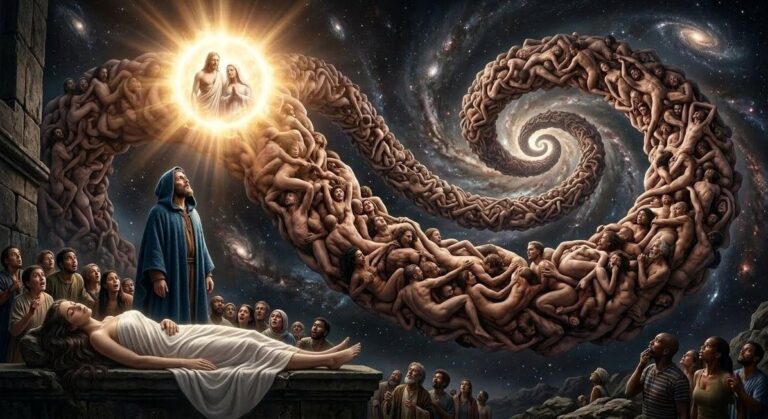
The Gnostic Answer to Evil: Why Suffering Proves the Demiurge
Every day, thousands of people type queries into search engines that they do not fully articulate. They look for “Archons,” “the soul trap,” “simulated reality,” or “why we suffer” — not because they want cosmological trivia, but because they are asking a single question that conventional theology has failed to answer honestly. Why does evil exist? And why does it seem so thoroughly built into the structure of things?
The Gnostic texts recovered at Nag Hammadi offer an answer that is structurally different from every other religious tradition. It is not comforting. It is not subtle. And it is almost never stated plainly in modern writing: the creator of this world is not the Source of goodness. The existence of innocent suffering is not a mystery to be solved. It is evidence to be recognised. This article examines the Gnostic conception of evil in its full scope — from the failed theodicies of orthodoxy, through the psychology of ordinary cruelty, to the mass machinery of fear and control — and shows why the Gnostic vision remains the most intellectually honest account of suffering ever proposed.
Table of Contents
- The Three Failed Solutions: Augustine, Irenaeus, and Process Theology
- The Gnostic Inversion: Evil as Cosmological Proof
- Structural Evil vs. Moral Evil: The Psychology of Ordinary Cruelty
- Evil on a Mass Scale: Fear, Control, and the Architecture of Obedience
- Degrees of Evil: From the Petty Tyrant to the Cosmic Craftsman
- The Counterfeit Spirit and the Economy of Suffering
- Why This Answer Works Where Others Fail
- Gnosis: The Only Honest Response
- Frequently Asked Questions
- Further Reading
- References and Sources

The Three Failed Solutions: Augustine, Irenaeus, and Process Theology
Before the Gnostic answer can be heard, the conventional answers must be heard out and found wanting. The problem of evil — how a good, omnipotent God can coexist with suffering — has produced three major defensive strategies in Western theology. Each preserves monotheism at the cost of either logic or compassion.
Augustine: Evil as Absence
In the fourth and fifth centuries CE, Augustine of Hippo proposed that evil is not a substance but a privatio boni — a privation or absence of good. Darkness, on this analogy, is not a thing but the lack of light. Evil is parasitic upon good; it cannot exist independently. This preserves God’s goodness by denying that evil has any positive reality.
The difficulty is experiential. The suffering of an innocent child is not an absence. It is a palpable presence. To call it a “lack of good” is to perform a linguistic manoeuvre that leaves the child unhelped and the observer unconvinced. Augustine’s framework also struggles with natural evil — earthquakes, disease, congenital pain — which cannot be neatly blamed on free will. If evil is merely the absence of good, then the Creator of a world where such absences are routine is either incompetent or indifferent.
Irenaeus and Hick: Evil as Pedagogy
St Irenaeus of Lyon, writing around 180 CE in Against Heresies, suggested that human beings were created in an infantile state and must grow into the likeness of God through struggle and experience. In the twentieth century, the philosopher John Hick developed this into the “soul-making theodicy,” arguing that suffering refines moral character in a “vale of soul-making.”
But there is a gulf between what Irenaeus actually wrote and what Hick made of it. Irenaeus’ original view was far harsher: he described the human body as iron quenched in fire and icy water to make it hard. Hick’s gentler version still founders on the same rock. The death of an infant from meningitis does not make anyone’s soul. The torture of the innocent does not educate the victim. To claim that suffering is secretly good for us is to commit the sin that the Gnostic texts warn against — the justification of the prison by calling it a school.
Process Theology: Evil as God’s Limitation
Process theology, shaped by Alfred North Whitehead and Charles Hartshorne, takes a more radical step. It denies that God is coercively omnipotent. God can only persuade, not force. The world is co-created by God and creatures, and evil arises from the genuine freedom of all actual entities. As Whitehead wrote, “The limitation of God is his goodness.” If God were infinite in all respects, evil would be fused with good and the result would be “mere nothingness.”
This is more honest than Augustine or Hick, but it pays a steep price. It abandons the classical God entirely. A deity who cannot prevent a tsunami is not the deity of the Psalms. Moreover, process theology still locates evil within the same cosmic order as God. It does not explain why the order itself seems malformed — why the innocent suffer not randomly, but systematically. It solves the problem of evil by shrinking God until the problem disappears. The Gnostic texts do something different: they keep God infinite and good, and locate evil in a separate, lesser being who made the world.
The Gnostic Inversion: Evil as Cosmological Proof
The Gnostic texts do not attempt to justify evil. They name its architect.
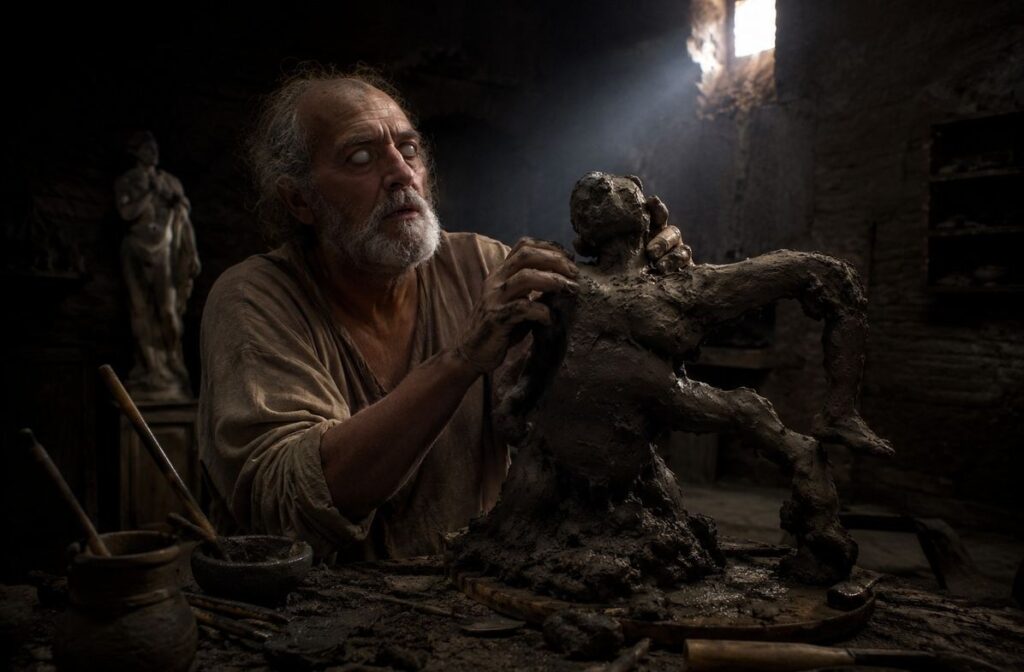
In the Apocryphon of John (NHC II,1), the creation of the material world is not performed by the Invisible Spirit but by a lower being called Yaldabaoth — a “dim ruler” born from Sophia’s fall. He is described as “ignorant darkness,” a being who does not know where his own power originated. His first act of creation is accompanied by a declaration that the text treats as the foundational lie: “I am God, and there is no other God but me.” Since he did not know his own origin, he assumed he was the source. This is not malice in the human sense. It is blindness compounded by arrogance — the very quality that produces incompetent systems of management.
“He is wicked in his mindlessness that is in him. He said, I am god and there is no other god but me, since he did not know where his own strength had come from.”
Apocryphon of John, NHC II,1 (Meyer translation)
The Gnostic move is simple and devastating. If the being who made this world is ignorant, blind, and falsely claims sole divinity, then the problem of evil is not a philosophical puzzle. It is a case of mistaken identity. The world is not the handiwork of the . It is the handiwork of a craftsman who does not know what he is doing. Theodicy dissolves because the premise — that one good God made everything — is rejected at the root.
This is not dualism in the Manichaean sense of two equal powers warring forever. The Gnostic texts are clear: The Source is infinitely above the Demiurge. The Demiurge is not an independent evil principle but a derivative being — a “miscarriage” or “abortion” in some texts — who acts without understanding. Evil is not co-eternal with good. It is a downstream consequence of a cosmic error, administered by a being who thinks he is God but is not.
Structural Evil vs. Moral Evil: The Psychology of Ordinary Cruelty
One of the most unsettling discoveries of twentieth-century psychology is that evil does not require evil people. It requires ordinary people in evil situations. This aligns with the Gnostic view far more closely than with Augustinian free-will theology, which locates evil in individual moral choice.
Hannah Arendt, covering the trial of Adolf Eichmann in Jerusalem in 1961, coined the phrase “the banality of evil” to describe a man who was not a monster but a mediocrity. Eichmann was a bureaucrat who arranged train schedules. He did not hate Jews; he was “thoughtless” — unable to think about what he was doing from the perspective of anyone else. Arendt’s insight was that the most terrifying evils are not committed by fanatics but by office workers who are “just doing their jobs.”
Stanley Milgram’s obedience experiments at Yale University in the early 1960s confirmed this empirically. Milgram found that approximately sixty-five percent of ordinary American participants would administer what they believed were lethal electric shocks to a stranger when instructed by an authority figure in a lab coat. The participants were not sadists. They expressed extreme distress. But they obeyed anyway, shifting into what Milgram called an “agentic state” — experiencing themselves as instruments of another’s will rather than autonomous moral agents.
Philip Zimbardo’s Stanford Prison Experiment in 1971 pushed further. Randomly assigned “guards” and “prisoners” in a mock prison transformed within days into abusers and victims. The guards forced prisoners to perform pointless labour, sing on command, and clean toilets with their bare hands. The experiment had to be terminated after six days because the psychological damage was too severe. Zimbardo concluded that situations are often more powerful determinants of behaviour than personality traits. He called this the “Lucifer effect”: the transformation of good into evil by situational forces.
The Gnostic texts anticipated this. They do not primarily blame human beings for evil. They blame the system — the planetary spheres, the archontic authorities, the counterfeit mechanisms that keep souls cycling through forgetfulness. When the Hypostasis of the Archons describes the rulers of the seven heavens, it is describing a bureaucracy. The archons are not tempters in the Miltonic sense. They are functionaries. They enforce a system that was poorly designed from the start. The psychology of the twentieth century simply confirms what the Nag Hammadi texts asserted: evil is structural before it is personal.

Evil on a Mass Scale: Fear, Control, and the Architecture of Obedience
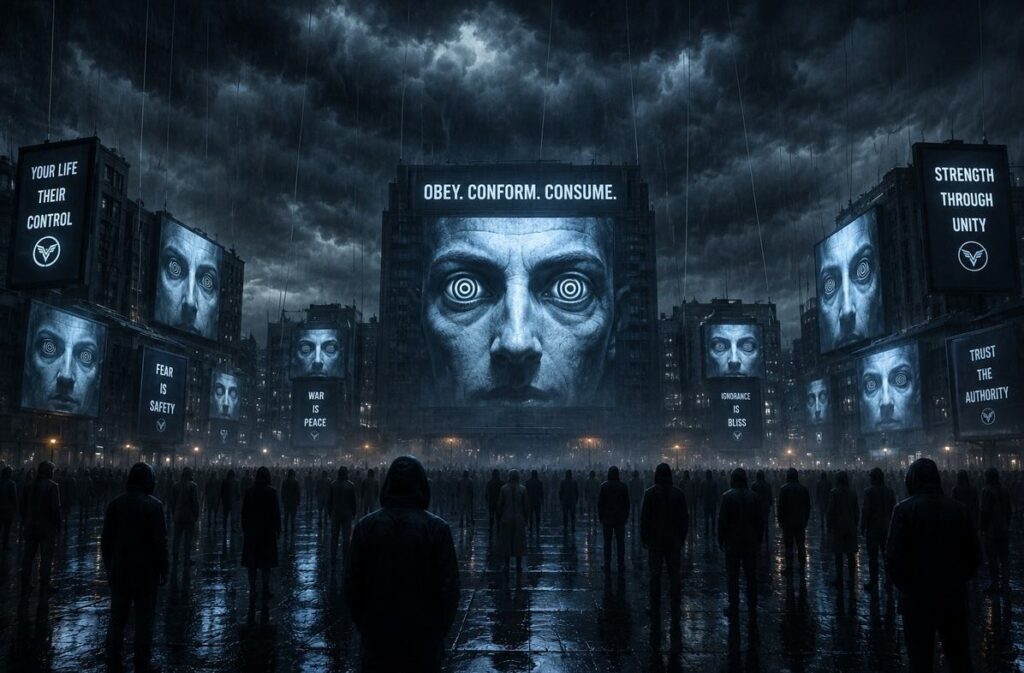
If evil is structural, then it scales. The same psychological mechanisms that produce cruelty in a laboratory produce atrocity in a nation. The Gnostic texts describe not merely individual archons but an administrated cosmos — a system of spheres, fates, and counterfeit spirits that operates like a machine. Modern political theory gives us the vocabulary to describe how such systems function on the human plane.
Noam Chomsky and Edward Herman’s analysis of manufactured consent, building on earlier work by Stanley Cohen on “moral panics,” shows how fear is deliberately amplified to control populations. When a government or media outlet frames a group — immigrants, religious minorities, political dissidents — as an existential threat, it triggers a predictable cascade: anxiety narrows attention, authority offers protection, and civil liberties are traded for security. The population consents to its own containment because it believes the danger is external and imminent.
The Gnostic texts describe a similar mechanism on a cosmic scale. The archons do not merely rule; they deceive. The Apocryphon of John states that Yaldabaoth “shared his fire with his seraphim but gave them none of his pure Light.” He rules by borrowed power, and his rule is maintained by keeping his subjects ignorant of their true origin. The system runs on forgetfulness. Souls are born into the world with no memory of the Pleroma, no knowledge of the true Source, and no recognition of the prison’s walls. This is not punishment. It is amnesia — a technical feature of the system.
On the human level, this maps precisely onto the politics of fear. A population that does not know its own history is easier to govern. A soul that does not know its own origin is easier to recycle. The archonic system, whether cosmic or political, operates on the same principle: control through ignorance, maintained by fear. The result is not merely oppression but consensual oppression — people who believe they are free because they have forgotten what freedom looked like.
Degrees of Evil: From the Petty Tyrant to the Cosmic Craftsman
Evil is not a single uniform substance. It operates in degrees, and recognising these degrees is essential for both psychological clarity and spiritual navigation. The Gnostic framework accommodates this spectrum without collapsing into moral relativism.
Personal Evil: The Petty Tyrant
At the individual level, evil manifests as cruelty, deception, exploitation, and indifference. The office bully, the internet troll, the abusive partner — these are not archons in the cosmic sense, but they are archontic in function. They exercise petty power over others because it compensates for their own felt powerlessness. Zimbardo’s research showed that even randomly assigned power produces cruelty within days. The petty tyrant is the Demiurge in miniature: a small being who thinks he is God in his own limited domain.
Institutional Evil: The Bureaucratic Mask
At the institutional level, evil becomes anonymous. Arendt’s Eichmann did not kill anyone personally. He scheduled trains. The cruelty is diffused across a system — a corporation that poisons a river, a health service that abandons the vulnerable, a military chain of command that normalises torture. No single person feels responsible because responsibility has been distributed into oblivion. This is the archonic principle in human form: evil as administration.
Systemic Evil: The Architecture Itself
At the highest level, evil is not committed by anyone. It is inherited. War, ecological collapse, intergenerational trauma, and structural poverty are not the work of individual villains. They are features of a system that predates any living participant. The Gnostic texts locate this level of evil in the Demiurge himself — not as a moral agent who chooses evil, but as a blind craftsman who built a flawed world and cannot see its flaws. Systemic evil is the hardest to fight because there is no one to fight. There is only a structure to see through.
The Gnostic view does not excuse individual behaviour. But it refuses to locate the origin of evil in human sin alone. If the world is a poorly constructed prison, then the prisoner who lashes out is not the source of the violence — the architecture is. This is why the Gnostic answer is politically liberating.
The Counterfeit Spirit and the Economy of Suffering
The Nag Hammadi texts describe not merely a flawed creator but an active mechanism that perpetuates suffering. The Apocryphon of John mentions the antimimon pneuma — the counterfeit spirit — that accompanies the soul through its incarnations. This is not a metaphor for guilt. It is described as a technical apparatus: a spirit that mimics the true divine spark while actually binding the soul to fate (heimarmene), forgetfulness, and repeated embodiment.
The counterfeit spirit operates like a debt ledger in a rigged economy. It convinces the soul that its suffering is deserved, that its limitations are natural, and that its imprisonment is self-inflicted. This is the most insidious form of evil: not the obvious cruelty of the tyrant, but the invisible engineering of consent. The soul is made to believe that the prison is a school, that the chains are bracelets, and that the warden is the Supreme Being. Once this belief is installed, the soul no longer needs to be guarded. It guards itself.
On the mass scale, this maps onto what sociologists call “internalised oppression” — the adoption by the oppressed of the oppressor’s values, the prisoner who polices other prisoners, the population that demands its own surveillance. The counterfeit spirit is the spiritual technology behind this phenomenon. It makes the victim complicit in the victimisation, not by choice but by deception. The Gnostic texts insist that this deception can be penetrated. The key is not moral improvement but recognition — the sudden, unearned seeing that the emperor has no clothes, that the creator is not the Source, and that the soul’s true origin lies elsewhere.
Why This Answer Works Where Others Fail
The Gnostic answer to evil succeeds on three grounds where conventional theodicy fails: empirical honesty, moral justice, and logical coherence.
Empirical honesty: It does not require us to call evil “good in disguise.” The death of the innocent is not pedagogy. The torture of the helpless is not soul-making. The Gnostic texts permit us to name suffering as suffering, without theological euphemism.
Moral justice: It does not blame the victim. Augustine’s framework ultimately traces evil back to human free will — Adam’s sin, our sin. The Gnostic texts trace it back to the Demiurge and the archons. The innocent are not being punished for a primordial disobedience they did not commit. They are trapped in a system they did not design.
Logical coherence: It does not require us to believe that the same being who created childhood cancer also deserves our worship. The Invisible Spirit and the Demiurge are distinguished. The Invisible Spirit is good and unknowable. The Demiurge is limited and often hostile. This is not a puzzle to be solved. It is a distinction to be seen.
“The world is not a school. It is a prison with incompetent management. The Gnostic does not ask why the curriculum is harsh. He asks why the walls are there at all.”
ZenithEye
Gnosis: The Only Honest Response
If the world is a prison built by a blind craftsman, what is the appropriate response? The Gnostic texts are unanimous: recognition. You cannot reform the Demiurge. You cannot argue him into competence. You can only see through him.
Gnosis is not knowledge in the academic sense. It is not a set of propositions to be memorised. It is a direct, unmediated recognition of who one is and where one came from. The Apocryphon of John presents this as a revelation granted by the Saviour — not earned through suffering, not purchased through virtue, but given to those who are ready to receive it. The ethical implication is not withdrawal from compassion but a redirection of it. The Gnostic does not collaborate with the trap. He extends his hand to the trapped.
This recognition has practical consequences. It means refusing to justify suffering as secretly beneficial. It means refusing to blame the poor for their poverty, the sick for their illness, or the traumatised for their trauma. It means seeing the systems — political, economic, psychological, cosmic — that produce suffering as systems, not as divine will. And it means understanding that the exit from the prison is not moral perfection but clear sight.

Frequently Asked Questions
What is the Gnostic view of evil?
The Gnostic texts teach that evil is not a mystery to be solved but a structure to be recognised. The creator of the material world — the Demiurge — is not the same being as the transcendent, Source. Evil exists because the world was made by a blind or incompetent craftsman who falsely claims to be God. This makes evil a cosmological fact rather than a moral puzzle.
Does Gnosticism blame humans for evil?
No. While individual moral responsibility is not denied, the Gnostic texts primarily locate evil in the cosmic system — the Demiurge, the archons, and the counterfeit spirit — rather than in human sin. The innocent suffer not because they deserve punishment, but because they are trapped in a poorly constructed prison they did not design.
Who is the Demiurge in Gnostic cosmology?
The Demiurge — often called Yaldabaoth, Saklas, or Samael in the Nag Hammadi texts — is a lower, derivative being who created the material world. He is described as ignorant, blind, and arrogant, declaring ‘I am God and there is no other’ without knowing his own origin. He is not the Invisible Spirit, but a craftsman who believes he is the supreme deity.
How does the psychology of evil support the Gnostic view?
Twentieth-century psychology — from Hannah Arendt’s ‘banality of evil’ to Milgram’s obedience experiments and Zimbardo’s Stanford Prison Study — demonstrates that ordinary people commit cruelty when placed in evil situations. This supports the Gnostic view that evil is structural before it is personal, and that the system is more powerful than individual moral character.
What is the counterfeit spirit in Gnostic texts?
The counterfeit spirit (antimimon pneuma) is described in the Apocryphon of John as a mechanism that mimics the divine spark while actually binding the soul to fate, forgetfulness, and repeated incarnation. It convinces the soul that its suffering is deserved and its imprisonment is self-inflicted, making the victim complicit in its own captivity.
Is Gnosticism a dualistic religion?
Gnosticism is not dualistic in the Manichaean sense of two equal, co-eternal powers. The Demiurge is not equal to the Source; he is a derivative, limited being who arose from a cosmic error. Evil is not eternal — it is a downstream consequence of ignorance and arrogance, destined to be dissolved when the soul recognises its true origin.
How does gnosis help us respond to evil?
Gnosis — direct recognition of one’s true origin — is not a moral achievement but a perceptual shift. It allows the individual to see through the systems that produce suffering without justifying them as divine will. The response to evil is not moral perfection but clear sight, compassion for the trapped, and refusal to collaborate with the trap.
Further Reading
These ZenithEye articles expand on the themes explored above, from the mechanics of the soul trap to the geography of Gnostic cosmology.
- The Gnostic Soul Trap: Archons, Death, and the Recycling of Pneuma — A detailed examination of the counterfeit spirit and the afterlife bureaucracy described in the Nag Hammadi texts.
- Pleroma and Kenoma: The Foundational Geography of Gnostic Cosmology — The complete map of the Gnostic cosmos, from the fullness of the divine to the emptiness of the material realm.
- The Names of the Archons: Gnostic Entities and Their Functions — A catalogue of the seven planetary authorities and their roles in the administration of fate.
- The Archons Feed on Suffering: Gnosticism as Political Critique — How the Gnostic view of evil translates into a critique of modern institutional power and mass manipulation.
- Pneumatic, Hylic, and Psychic: The Three Natures and the Geography of Awakening — The Gnostic anthropology that explains why some recognise the prison and others do not.
- Before the Matrix: What the Nag Hammadi Texts Actually Say About Simulated Reality — The ancient precedents for viewing the material world as a constructed simulation with flawed code.
- The Apocryphon of John: The Gnostic Creation Myth — The primary source for the Demiurge’s origin, his declaration of sole divinity, and the creation of humanity.
- Gnosis and the Near-Death Experience: What Ancient Cosmology Says — How the Gnostic afterlife map corresponds to modern NDE accounts of tunnels, life reviews, and threshold choices.
- Fear: The Opposite of Love and the Engine of Spiritual Transformation — An exploration of how fear functions as the primary tool of control in both cosmic and human systems.
- The Nag Hammadi Library: A Complete Guide to the Gnostic Scriptures — The master index for all forty-six tractates, codex overviews, and thematic collections.
References and Sources
The following sources are organised by category for clarity and further study.
Primary Sources: Nag Hammadi Library
- The Apocryphon of John (NHC II,1; III,1; IV,1). Translations consulted: Marvin Meyer, The Nag Hammadi Scriptures (HarperOne, 2007); Michael Waldstein and Frederik Wisse, The Apocryphon of John (Brill, 1995).
- The Hypostasis of the Archons (NHC II,4). Translation: Roger A. Bullard and Joseph A. Gibbons, in The Nag Hammadi Library in English (Brill, 1977).
- On the Origin of the World (NHC II,5). Translation: Hans-Gebhard Bethge and Bentley Layton, in The Nag Hammadi Library in English (Brill, 1977).
Scholarly Monographs: Theodicy and Philosophy
- Augustine of Hippo. Confessions and Enchiridion on Faith, Hope, and Love. The privatio boni doctrine is developed across these works, particularly in Confessions VII and Enchiridion III-IV.
- Irenaeus of Lyon. Against Heresies (c. 180 CE), Books IV-V. The original soul-making passages appear in Book IV.38 and Book V.6.
- Hick, John. Evil and the God of Love (Macmillan, 1966). The classic development of the “Irenaean” soul-making theodicy, though scholars note Hick’s version differs significantly from Irenaeus’ original.
- Whitehead, Alfred North. Process and Reality (1929). The foundational text for process theology, including the claim that “the limitation of God is his goodness.”
- Hartshorne, Charles. Man’s Vision of God (1941) and The Divine Relativity (1948). Key statements of process theism on divine power and the problem of evil.
Psychology and Social Science
- Arendt, Hannah. Eichmann in Jerusalem: A Report on the Banality of Evil (Penguin, 1963). The source of the “banality of evil” concept and the analysis of bureaucratic thoughtlessness.
- Milgram, Stanley. “Behavioral Study of Obedience,” Journal of Abnormal and Social Psychology 67.4 (1963): 371-378. The original publication of the obedience experiments.
- Zimbardo, Philip. The Lucifer Effect: Understanding How Good People Turn Evil (Random House, 2007). The definitive account of the Stanford Prison Experiment and the psychology of situational evil.
- Cohen, Stanley. Folk Devils and Moral Panics (MacGibbon and Kee, 1972). The foundational study of how fear is manufactured to control populations.
Comparative and Critical Studies
- King, Karen L. The Secret Revelation of John (Harvard University Press, 2006). A critical scholarly edition and commentary on the Apocryphon of John.
- Logan, Alastair H. B. Gnostic Truth and Christian Heresy (T&T Clark, 1996). Examines the relationship between Sethian Gnosticism and early Christian polemic.
- Pagels, Elaine. The Gnostic Gospels (Random House, 1979). The classic study of Gnostic texts in their historical and political context.
Safety Notice: This article explores the Gnostic conception of evil, psychological manipulation, and systemic oppression. It does not constitute medical, psychological, or spiritual advice. If you are experiencing trauma, spiritual emergency, or symptoms of severe distress, please contact a trauma-informed mental health professional or your local emergency services. The material presented here is for intellectual and contemplative inquiry and complements but does not replace clinical mental health treatment.