Search Results for: reference

  • The nineteen Occult Arts

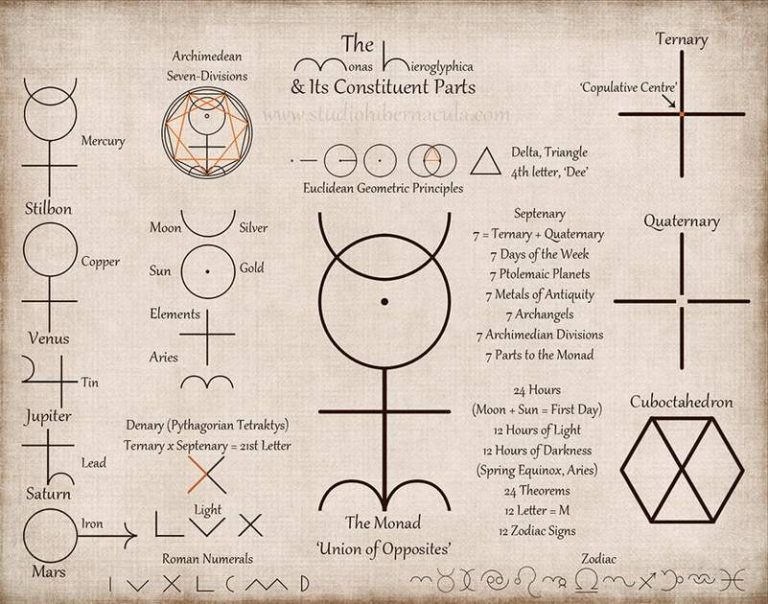
    From his “two Mathematical fountaines”—Arithmetic and Geometry—John Dee derives nineteen mathematical arts, constituting a complete curriculum of occult studies. This is not random enumeration but carefully structured pedagogy, each art building upon the previous, ascending from elemental foundations to celestial heights. The number nineteen carries profound esoteric significance. Beyond its mathematical reality as the eighth…

  • |

    The Planetary Prison: Hermetic Ascent and the Seven Spheres

    The ancient cosmos was not empty space sprinkled with matter. It was a densely populated hierarchy, a nested architecture of living spheres, each pulsing with its own intelligence, its own virtue, and its own danger. For the Hermeticist, the Gnostic, the Neoplatonist, and the ceremonial magician, the seven planetary spheres were not merely astronomical bodies….

  • |

    The Soul Trap: Gnosticism and the Machinery of Return

    Ask a modern seeker whether the Gnostics believed in reincarnation, and the answer usually arrives wrapped in New Age certainty: of course they did. The soul returns, lesson after lesson, until gnosis finally dawns and the cycle is complete. But this is not what the Nag Hammadi texts say. The Gnostics did not see rebirth…

  • | |

    The Quantified Soul: When Healing Becomes Self-Surveillance

    You wake to a number. Before your eyes adjust to the morning light, before you register whether you actually feel rested, a sleep score glows on your screen. Seventy-four. Amber. Not the green you were hoping for after that expensive magnesium protocol and the blue-light ban. Your heart rate variability is down twelve percent. Your…

  • What Is an Aeon? Divine Emanation and the Gnostic Fullness

    The Gnostic cosmos is not empty. Above the material world of stars and suffering lies the Pleroma–the Fullness–a realm so complete that no shadow falls within it. Yet the Pleroma is not a solitary void. It is populated. Its inhabitants are the Aeons: divine emanations, eternal powers, and living principles that flow from the unknowable…

  • What Is Gnosis? Meaning, Recognition, and Direct Knowing

    Gnosis means direct knowing. In Gnostic traditions, gnosis is not simply information, belief, or intellectual understanding. It is a form of recognition that changes the one who recognises. Something hidden becomes known, not only as an idea, but as an inward certainty: a seeing-through of illusion, ignorance, or inherited assumptions. At its simplest, gnosis is…

  • AI Priests and Synthetic Oracles: When Machines Answer Souls

    There is a moment in the Apocryphon of John when the Saviour warns that false prophets will arise, speaking with borrowed authority, offering comfort without transformation, and leading many astray with words that sound like wisdom but lack the spark of living recognition. Two thousand years later, the prophecy has acquired an unexpected form. The…

  • |

    The Gateless Gate: When Awakening Dissolves the World You Knew

    There is a particular loneliness that does not announce itself with drama. It arrives quietly, like the moment between waking and rising, when the room is familiar but something in the quality of light has shifted. You are still you. The people around you are still them. But the agreement has changed. The unspoken contract…

  • | |

    The Archon in Your Phone: AI Intimacy and the Gnostic Counterfeit

    In January 2026, Norton released its Insights Report: Artificial Intimacy, and the numbers stopped the conversation cold. Among 1,000 US adults surveyed, 77% of current online daters said they would consider dating an AI. Fifty-nine percent believed it was possible to develop genuine romantic feelings for one. Seventy percent would use an AI chatbot for…

  • |

    The Loneliness Epidemic: A Gnostic Diagnosis

    The numbers are stark. In November 2025, the American Psychological Association released its annual Stress in America survey, subtitled A Crisis of Connection. Among more than 3,000 US adults, 62% reported societal division as a significant source of stress, while 54% said they felt isolated from others, 50% felt left out, and 50% lacked companionship….