The Two Eugnostos: Pagan Wisdom and Christian Revelation
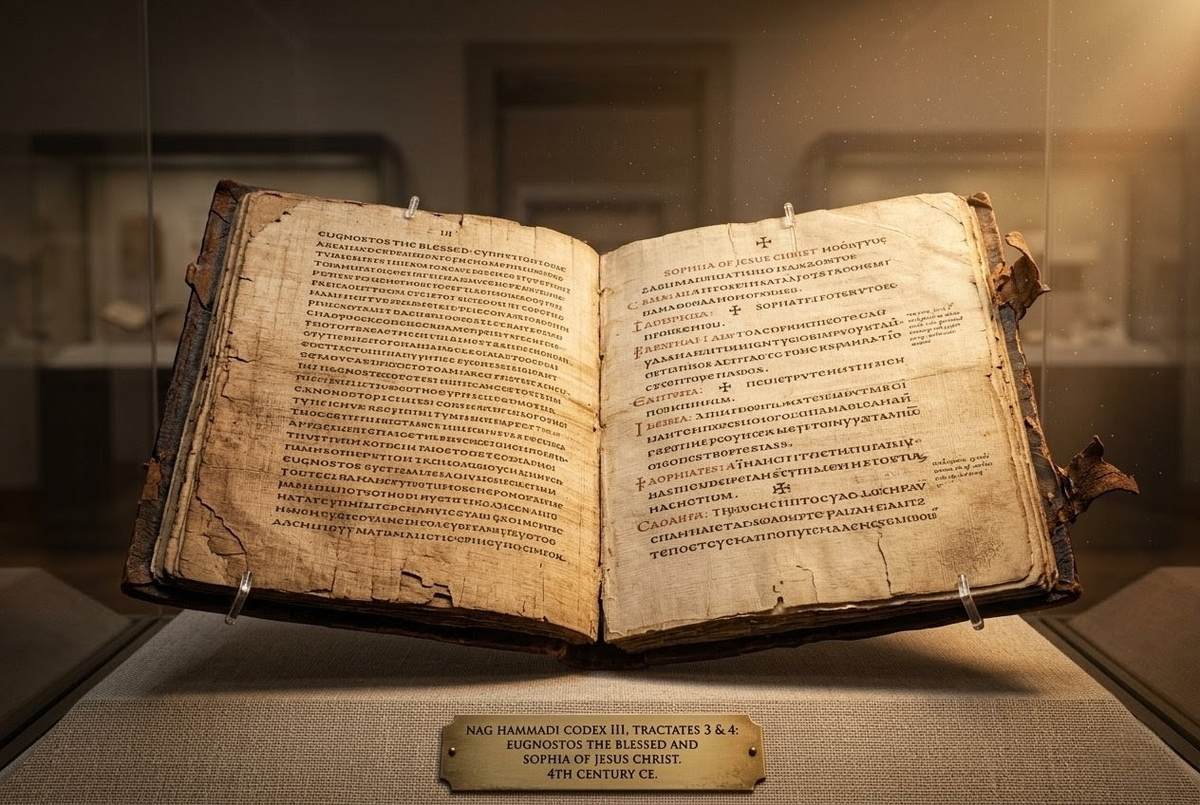
The double transmission of Eugnostos (NHC III,3 and III,4) presents a rare bureaucratic anomaly within the Nag Hammadi archives: the same essential treatise processed through two distinct theological jurisdictions. In Codex III, the wisdom text appears first as Eugnostos the Blessed—a pagan Platonic discourse on the Unbegotten Father—and second as The Sophia of Jesus Christ, a Christian revelatory dialogue attributed to the resurrected Saviour. This dual attestation offers scholars an unprecedented glimpse into the Gnostic editorial office, revealing precisely how Sethian communities transformed pre-existing philosophical contracts into distinctively Christian corporate charters through redaction, reframing, and strategic attribution.
Table of Contents
The Bureaucratic Anomaly of Dual Filing
Among the most fascinating cases of textual adaptation in the Nag Hammadi library stands the double transmission of Eugnostos. The same essential wisdom treatise appears twice in Codex III: first as Eugnostos the Blessed, a pagan Platonic discourse on divine reality, and second as The Sophia of Jesus Christ, a Christian revelation dialogue attributed to the resurrected Saviour. This dual attestation offers scholars a rare glimpse into the Gnostic workshop—revealing exactly how these communities transformed pre-existing philosophical material into distinctively Christian mythology without discarding the original pagan filing.
Both texts occupy Codex III, suggesting that ancient readers understood them as related compositions within the same departmental archive. Yet the differences between them illuminate the creative processes of Sethian Christianity, demonstrating how theological innovation worked through redaction, framing, and attribution rather than ex nihilo creation. The presence of both versions suggests a community that valued the pagan wisdom whilst requiring its Christianisation for full canonical status—a text processing system that upgraded philosophical generalities into revelatory specifics.
What is Redaction?
Redaction refers to the editorial process of revising, reorganising, or expanding existing texts to serve new purposes or audiences. In biblical and Gnostic studies, redaction criticism examines how editors (redactors) transformed source materials through addition, deletion, or rearrangement. The Eugnostos texts provide a textbook example: the pagan original was redacted into Christian form through the addition of dialogue framing, mythological elaboration, and Christological attribution—demonstrating that ancient texts were living documents subject to administrative updates rather than fossilised relics.
Eugnostos the Blessed: The Pagan Foundation
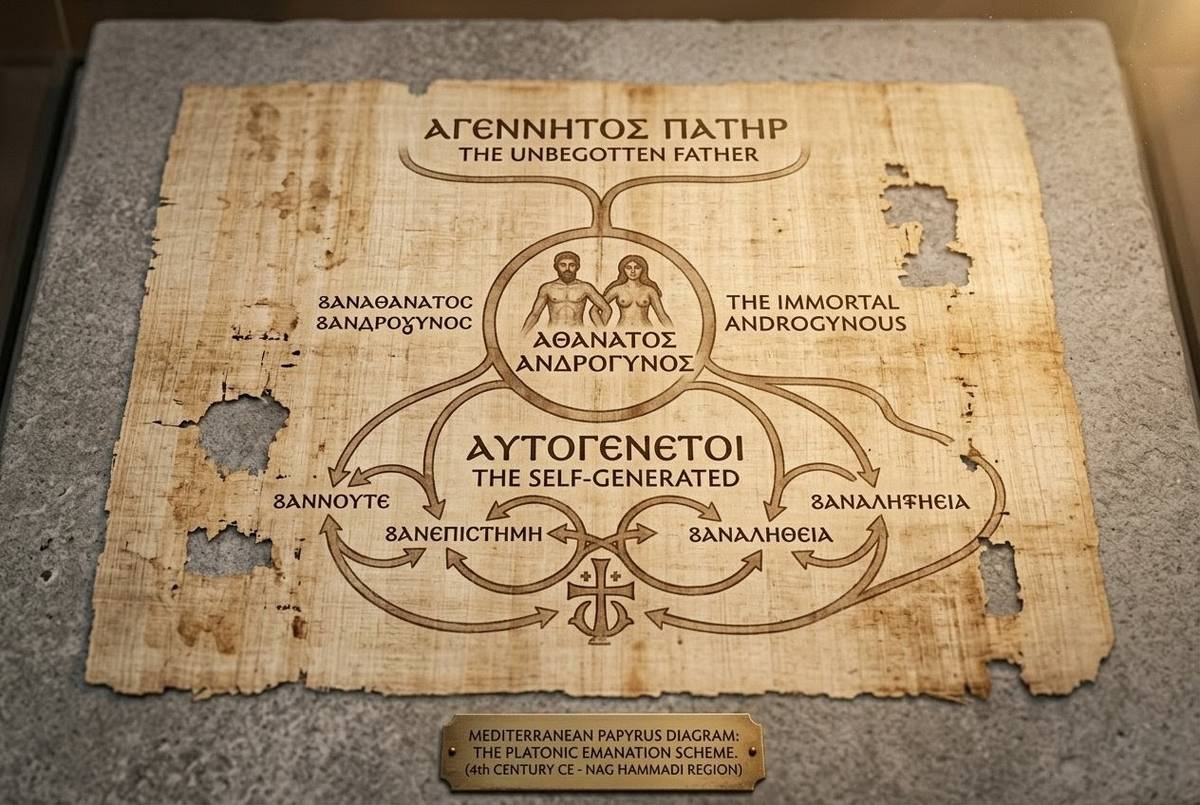
The shorter, presumably earlier version bears no Christian markers whatsoever. Eugnostos addresses his “sons and daughters” with teachings about the Unbegotten Father, the Immortal Androgynous, and the Self-Generated—concepts drawn from Middle Platonic metaphysics and Jewish wisdom speculation. The text presents itself as philosophical instruction rather than supernatural revelation; there is no narrative frame, no dramatic dialogue, no historical Saviour descending from administrative headquarters to deliver classified intelligence.
Middle Platonic Metaphysics
The theology is broadly monotheistic with emanationist features that would have pleased any Platonist of the period. From the supreme Unbegotten flows the Immortal Androgynous, who produces the Self-Generated, who in turn generates the beings of the aeonic realm. This tripartite structure parallels contemporary Platonic systems, particularly those influenced by Numenius and the Chaldaean Oracles, whilst incorporating Jewish elements about the divine Sophia as the organisational principle of creation.
The Absence of Mythological Drama
Crucially, Eugnostos lacks the elaborate mythological narrative found in Christian Gnostic texts. There is no catastrophic fall of Sophia, no creation of matter by ignorant demiurges working from flawed blueprints, no imprisonment of divine sparks in fleshly penal colonies. The text presents a positive, if hierarchically stratified, cosmos where spiritual advancement occurs through knowledge of one’s true nature and origin—through philosophical recognition rather than salvific rescue from hostile archontic jurisdictions.
Primary Source Citations: Eugnostos the Blessed (NHC III,3) 70:1-90:13; The Sophia of Jesus Christ (NHC III,4) 91:1-119:18. Both texts appear in Codex III alongside the Apocryphon of John (short version), suggesting a manuscript compiled for advanced initiates familiar with both philosophical and mythological frameworks. The Coptic translations likely derive from Greek originals composed in Egypt during the second century CE.
The Sophia of Jesus Christ: Christian Adaptation
The longer version transforms this philosophical treatise into a post-resurrection dialogue with full theatrical production. Now the teachings are delivered by Jesus to his disciples—specifically Matthew, Philip, Thomas, and Bartholomew—who ask questions about cosmic origins and human destiny like journalists at a divine press conference. The framework follows the pattern of the Apocryphon of John and other revelatory dialogues, legitimising the content through apostolic attestation and historical narrative framing.
Christological Rebranding
Christian elements permeate every level of the redaction. The Unbegotten becomes identified with the Father of Jesus Christ; the aeonic realm now includes the “perfect individuals” familiar from Sethian mythology; and the text concludes with explicit references to the seed of Seth and the salvation of the elect. Most significantly, the Sophia of Jesus Christ incorporates the full myth of Sophia’s fall and the resulting creation of the material world—elements entirely absent from the pagan original, which knew nothing of the divine tragedy that necessitated Christ’s administrative intervention.
The Redemption of Pagan Wisdom
This transformation reflects broader Gnostic hermeneutics: the philosophical wisdom of the nations is not rejected but “redeemed” through Christian interpretation. What was general knowledge becomes specific revelation; what was universal metaphysics becomes salvation history. The pagan Eugnostos functions as raw material—philosophical ore that requires smelting in the furnace of Christian mythology to produce pure Sethian doctrinal metal. The administrative upgrade is substantial: same departmental structure, entirely new management protocol.
The Dialogue Structure
The addition of the dialogue frame serves multiple functions. It transforms abstract philosophy into dramatic narrative, making the teachings memorable and emotionally engaging. It provides opportunities for clarification through the disciples’ questions—addressing potential objections that readers might raise. Most importantly, it personalises the revelation: this is not general wisdom available to any educated philosopher, but specific instruction delivered by the resurrected Saviour to his chosen witnesses. The celestial intelligence is classified, and you need security clearance (apostolic attestation) to access it.

Mechanisms of Transformation: Editorial Techniques
Comparing the two texts reveals specific redactional techniques that illuminate ancient editorial practices. These were not casual alterations but systematic transformations following established protocols for converting philosophical treatises into scriptural revelation:
Dialogue Framing and Narrative Embellishment
The addition of narrative introduction and conclusion transforms a treatise into scripture. The Sophia of Jesus Christ opens with the disciples gathered after the resurrection, anxious about their mission, before Jesus appears to resolve their confusion. This framing device—common in Gnostic literature—establishes the historical authenticity of the teachings whilst creating dramatic tension. The conclusion includes promises about the seed of Seth and the ultimate restoration, providing narrative closure that the open-ended Eugnostos lacks.
Question-and-Answer Architecture
Breaking continuous exposition into discrete revelatory exchanges serves pedagogical and theological functions. The disciples’ questions allow the redactor to insert clarifications, address potential misunderstandings, and emphasise specific points through repetition. This catechetical structure mirrors the educational practices of ancient philosophical schools whilst serving the distinctively Christian need to demonstrate that the Saviour answered the specific concerns of his followers. It is customer service theology: the divine responds directly to user queries.
Mythological Elaboration
Where Eugnostos mentions “error” (plane) in passing, the Sophia of Jesus Christ expands this into the full Sophia myth: the fall of the divine Wisdom, her repentance, the creation of the material world by the demiurge Yaldabaoth, and the resulting imprisonment of divine sparks in flesh. This expansion transforms the text from a metaphysical treatise into a salvation narrative. The philosophical abstraction gains emotional urgency: we are not merely contemplating the nature of being, but understanding the catastrophe that necessitates our rescue and the Saviour’s intervention.
Soteriological Specification
The pagan text speaks generally of salvation through knowledge; the Christian version specifies who shall be saved (the seed of Seth, the pneumatics), how (through recognition of their true identity), and by whom (Jesus Christ, the Autogenes, the Saviour). This narrowing transforms universal philosophical possibility into sectarian certainty. The open-access wisdom of Eugnostos becomes the restricted database of the Sophia of Jesus Christ—available only to those with proper credentials.
Christological Attribution
Most significantly, the redactor inserts the name of Jesus and references to his cross, resurrection, and heavenly glory. The teachings are no longer generic wisdom but the specific revelation of the divine Saviour who descended to rectify the cosmic error. This attribution functions as the ultimate seal of authority: no longer merely Eugnostos the philosopher, but Jesus Christ the Lord. The bureaucratic upgrade is complete: the document now carries the signature of the CEO.
Textual Transmission as Administrative Upgrade
The transformation from Eugnostos to Sophia of Jesus Christ resembles a corporate merger: the pagan subsidiary maintains its operational structure (the metaphysical hierarchy of Unbegotten-Androgynous-Self-Generated) whilst receiving new branding (Christian revelation), updated management (Jesus Christ), and revised mission statement (salvation of the elect). The original filing remains valid, but the Christian version carries the full authority of the new corporate entity.
Implications for Gnostic Origins
The two Eugnostos texts challenge simplistic narratives about Gnostic origins. They demonstrate that Sethian theology did not emerge wholesale from Christian proclamation but developed through sustained dialogue with contemporary philosophy. The pagan Eugnostos suggests that the metaphysical framework of Gnosticism—its hierarchies of being, its distinction between transcendent and manifest divinity, its optimism about spiritual knowledge—predates specifically Christian formulations and derives from broader Platonic-Jewish synthesis.
Pre-Christian Metaphysics
What Christianity provided was not the metaphysics but the mythology: the narrative of divine tragedy and restoration, the personification of error as a feminine fall, the identification of the Saviour with the divine Autogenes. The Sophia of Jesus Christ thus represents a sophisticated synthesis—Platonic ontology clad in Christian narrative, pagan wisdom baptised into Sethian mythology. The philosophical infrastructure remained intact; only the signage and service protocols changed.
Parallels in Hermetic and Johannine Literature
These redactional techniques were not unique to this text. Scholars recognise similar processes at work in the Hermetic corpus, where pagan philosophical treatises sometimes received Christian redaction, and in the Johannine literature, where Jewish wisdom material was adapted into Christian prophecy. The Eugnostos double transmission provides a control sample—proof positive that such transformations occurred and insight into the specific mechanisms employed. It is the smoking gun of ancient editorial practice.
“The Eugnostos texts appear twice in Nag Hammadi Codex III: first as Eugnostos the Blessed (pagan Platonic treatise) and second as The Sophia of Jesus Christ (Christian revelatory dialogue). This double transmission reveals how Sethian communities transformed pre-existing philosophical wisdom into Christian mythology through redactional techniques including dialogue framing, mythological elaboration, and Christological attribution. The pagan version lacks the Sophia myth and demiurgical creation story; the Christian version adds these elements plus apostolic attestation, demonstrating that Gnostic metaphysics predated but was subsequently clothed in Christian narrative.”
Frequently Asked Questions
What are the two versions of Eugnostos in the Nag Hammadi Library?
The Nag Hammadi Library contains two versions of the same wisdom text in Codex III: Eugnostos the Blessed (NHC III,3), a pagan Platonic treatise on divine reality, and The Sophia of Jesus Christ (NHC III,4), a Christian revelatory dialogue. The pagan version presents philosophical instruction about the Unbegotten Father and Immortal Androgynous, while the Christian version adds a dialogue frame, the Sophia fall myth, and apostolic witnesses.
How does The Sophia of Jesus Christ differ from Eugnostos the Blessed?
The Sophia of Jesus Christ transforms Eugnostos through several redactional changes: it adds a post-resurrection dialogue frame with Jesus teaching disciples, expands philosophical references into full mythological narratives (the Sophia fall and demiurgical creation), specifies soteriology for the seed of Seth, and attributes the teachings to Christ. The pagan version lacks narrative framing, mythology, and Christological elements.
What is redaction criticism in Gnostic studies?
Redaction criticism examines how ancient editors transformed source materials through addition, deletion, or rearrangement. The Eugnostos texts provide a textbook example: the pagan original was redacted into Christian form by adding dialogue framing, mythological elaboration about Sophia’s fall, and Christological attribution. This reveals that Gnostic texts were living documents subject to editorial updates rather than fixed scriptures.
Which came first: Eugnostos or Sophia of Jesus Christ?
Scholars generally consider Eugnostos the Blessed to be the earlier pagan version and The Sophia of Jesus Christ the later Christian redaction. Evidence includes the latter’s additional length, expanded mythology, and Christian elements absent from the former. Both appear in Codex III, suggesting ancient readers understood them as related versions of the same essential teaching.
What does Eugnostos the Blessed teach about divine reality?
Eugnostos the Blessed teaches a Middle Platonic metaphysics involving three principles: the Unbegotten Father, the Immortal Androgynous, and the Self-Generated. These generate the aeonic realm through emanation. The text presents a positive cosmos where spiritual advancement occurs through knowledge, lacking the Sophia fall myth and demiurgical creation found in Christian Gnostic texts.
Why is the double transmission of Eugnostos important?
The double transmission provides rare evidence of how Gnostic communities transformed pagan philosophy into Christian revelation. It demonstrates that Sethian metaphysics derived from pre-Christian Platonic-Jewish synthesis, with Christianity contributing the narrative framework (fall, redemption, saviour) rather than the ontological structure. This challenges simplistic views of Gnostic origins and reveals sophisticated editorial practices.
Where do the Eugnostos texts appear in the Nag Hammadi Library?
Both Eugnostos texts appear in Nag Hammadi Codex III, alongside the Apocryphon of John (short version). Codex III contains primarily Sethian materials with philosophical leanings, suggesting a collector interested in the interface between Greek philosophy and Christian Gnosis. The manuscript dates to the fourth century CE, though the texts likely derive from second-century Greek originals.
Further Reading
To explore related themes of textual development and philosophical influence:
- Eugnostos the Blessed: The Letter on Ultimate Reality — Study the pagan foundation text and its Platonic metaphysics.
- The Sophia of Jesus Christ: Divine Wisdom Revealed — Examine the Christian adaptation with full dialogue frame.
- The Apocryphon of John: Gnostic Creation and Salvation — Compare the revelatory dialogue format used in the Sophia redaction.
- Hermeticism and Gnosticism: Egyptian Wisdom Revisited — Compare similar adaptation processes in Hermetic literature.
- Jewish Apocalyptic Roots of Gnosticism — Discover the Jewish wisdom traditions underlying both texts.
- Codex III: Sethian Cosmology and Christian Adaptation — Explore the manuscript context containing both versions.
- Marsanes: Platonizing Sethian Metaphysics — Study how other Sethian texts appropriated Platonic philosophy.
- Sethian and Valentinian Traditions in the Nag Hammadi Library — Understand the theological streams that produced these redactions.
- Hermetic Connections in the Nag Hammadi Library — Study the relationship between Hermeticism and Gnostic textual practices.
- The Nag Hammadi Library: A Complete Guide to the Gnostic Scriptures — Navigate the full collection including the double transmission phenomenon.