The Weight of Seeing: Responsibility After Awakening
There is a weight that comes with seeing.
At first, awakening may feel like revelation. The hidden pattern appears. The false voice becomes audible. The old performance begins to crack. The soul recognises what it had been taught not to notice.
But then another realisation arrives.
Seeing is not neutral.
To see a wound is to become responsible for how one speaks around it. To see manipulation is to become responsible for not imitating it. To see fear beneath anger is to become responsible for not feeding it carelessly. To see the machinery of illusion is to become responsible for not turning that sight into contempt.
Clear sight is not a crown. It is a lamp. And lamps are meant to be carried carefully.
In Plain Terms
The weight of seeing is the responsibility that comes after awakening. When someone begins to perceive hidden patterns, false authority, pain, manipulation or spiritual performance more clearly, they must learn to carry that sight with humility. Clear sight should make a person more careful, not more superior.
Primary Sources and Traditions Discussed
- Gnostic themes of gnosis, the divine spark, archons and the Counterfeit Spirit.
- The Gospel of Thomas and sayings around seeing, hiddenness, fruit and responsibility.
- The Gospel of Philip and symbolic language around transformation.
- The Apocryphon of John and its critique of false authority and spiritual ignorance.
- Sophia as wisdom that falls, learns, restores and repairs.
- Christian desert spirituality around humility, silence and restraint.
- Buddhist ethics of speech, compassion and non-harm.
- Jungian shadow work and the danger of inflation after insight.
- Spiritual emergence literature around integration, responsibility and ordinary functioning.
- The ordinary saint as quiet responsibility without spectacle.
How to Read This Article
Read this as an integration guide, not as a burden placed on sensitive people. It does not say that one person must fix the world. It asks how clear sight can be carried without superiority, panic, saviour fantasy or contempt. The aim is responsible seeing: perception joined to humility, care and ordinary life.
Table of Contents
- The Weight That Comes With Seeing
- Clear Sight Is Not a Crown
- Responsibility and Saviour Fantasy
- Seeing Wounds Without Exploiting Them
- Seeing Falsehood Without Contempt
- The Responsibility of Speech
- The Responsibility of Power
- The Responsibility of Not Acting Too Quickly
- The Counterfeit Spirit of Grand Responsibility
- Sophia and the Burden of Wisdom
- The Divine Spark and Care for the Vulnerable
- The Weight of Seeing in Ordinary Life
- When the Weight Becomes Too Heavy
- How to Carry Clear Sight Responsibly
- The Ordinary Saint and the Lamp Carried Low
- The Lamp and the Hands
- Related Glossary Terms
- Read Next
- Further Reading
- References and Sources
The Weight That Comes With Seeing
Awakening often begins as liberation. The veil thins. The script loses its grip. The soul breathes, perhaps for the first time, in a climate of recognition rather than repetition.
Yet insight is not an endpoint. It is a threshold. The person who sees more clearly does not receive a holiday from consequence. They receive a greater share of consequence. The first task is to see. The next task is to carry that seeing without letting it harden the heart.
This is the weight of seeing: the quiet, persistent knowledge that perception creates obligation. Not obligation to fix everything. Not obligation to perform rescue. But obligation to become careful. Careful with speech. Careful with power. Careful with the wounds of others. Careful with the knowledge that sight, when carried without love, can become a weapon more refined than blindness ever was.
The first task is to see. The next task is to carry seeing without letting it harden the heart.
That weight is not punishment. It is the gravity that keeps awakening from floating away into fantasy. It brings the lamp back down to the path.
Clear Sight Is Not a Crown
It is tempting to believe that seeing more makes one higher. The hidden pattern, the unspoken motive, the systemic lie: once these become visible, the ego quietly builds a throne. Insight becomes rank. Perception becomes pedigree. The awakened person begins to collect their sightings like medals.
This is the first trap. Clear sight is not a crown. It is a lamp, and lamps are meant to be carried carefully. The more one sees, the more careful one must become. The lamp illuminates the path, but it also illuminates the carrier. It shows their own limits, their own complicity, their own unhealed wounds. True sight includes the sight of oneself.
Awakening does not create a throne. It creates a quiet, steady responsibility to remain humble while holding more light than one ever asked for.
Clear sight is not a crown. It is a lamp, and lamps are meant to be carried carefully.

Responsibility and Saviour Fantasy
Responsibility and saviour fantasy look similar from a distance. Both involve concern for others. Both respond to suffering. Both appear noble. Yet they diverge at the level of motive, method and maturity.
| Responsibility | Saviour Fantasy |
|---|---|
| Acts with care. | Acts from spiritual urgency or identity. |
| Respects the agency of others. | Makes others into projects. |
| Knows its limits. | Believes everything depends on itself. |
| Protects without possessing. | Confuses help with control. |
| Speaks with restraint. | Feels driven to correct everyone. |
| Does not need applause. | Resents not being recognised. |
| Can step back. | Feeds drama and heroic exhaustion. |
Responsibility serves the light. Saviour fantasy wants to be seen holding it.
Responsibility knows its limits. It does not believe that one person must carry the world. It repairs what it can and accepts what it cannot. Saviour fantasy turns insight into identity. It performs burden. It wants an audience. It confuses exhaustion with virtue and martyrdom with maturity.
The difference is not always obvious from the outside. The interior test is quieter: am I serving care, or am I serving the image of myself as the one who cares?
Seeing Wounds Without Exploiting Them
Awakening often makes hidden pain more visible. The fear beneath the anger. The grief beneath the performance. The shame beneath the confidence. The awakened person may begin to sense wounds in others as clearly as words on a page.
But seeing a wound does not give permission to name it publicly. Insight into another person’s pain must be handled gently. Some things should be protected by silence. Not every wound needs interpretation. Not every hidden grief needs exposure.
- Did they invite this insight?
- Would naming it help or expose them?
- Am I speaking from care, or from the thrill of seeing?
- Can I hold this without using it?
To see a wound is not to own it.
Responsible seeing protects the vulnerable place. It does not turn another person’s pain into proof of one’s own perception.

Seeing Falsehood Without Contempt
Clear sight may reveal manipulation, performance and false authority. The danger is contempt. Contempt feels clean. It offers the quick satisfaction of moral distance. Yet contempt often hides grief or anger that has not yet been mourned. It feels like discernment, but it tastes like poison.
Gnostic discernment should free the soul, not create hatred. The person trapped in a false system is still a human being. They are not the enemy. They are caught in the same machinery that the awakened person has only recently begun to escape. Seeing through illusion should increase compassion, not disgust.
To see through a mask is not to despise the face beneath it.
This does not mean tolerating harm or pretending falsehood is harmless. It means refusing to let discernment rot into dehumanisation. The archonic pattern is not defeated when the awakened person becomes colder. It is weakened when the awakened person becomes freer, clearer and less available to hatred.
The Responsibility of Speech
Speech carries greater weight after awakening. The person who sees more may feel compelled to say more. But truth needs timing, consent and proportion. Harsh truth can become violence. Clarity without tenderness can humiliate.
The ancient traditions understood this. The Desert Fathers practised hesychia: stillness of speech as well as of mind. Buddhist ethics teach right speech: truthful, helpful, timely and kind.
- Is this true?
- Is this needed?
- Is this kind?
- Is this the right moment?
- Am I the right person to say it?
- What will this truth do in the room?
Not every true thing is yours to say.
Sometimes the most responsible word is the one left unspoken. Silence can be cowardice, but it can also be protection. The difference lies in whether silence serves fear or care.

The Responsibility of Power
Insight creates influence. People may begin to trust the awakened person’s perception. They may ask for interpretation, guidance or confirmation. This is where power enters quietly through the side door.
Power must protect autonomy. Do not make others dependent on your seeing. Do not spiritualise control. Do not turn vulnerability into access. The more clearly one sees another person, the more gently one must hold their freedom. Interpretation can become power, and power must be carried with the same care as the lamp itself.
The more clearly one sees another person, the more gently one must hold their freedom.
Responsible power does not need secrecy, dependency or emotional capture. It does not demand loyalty as payment for insight. It does not punish disagreement. It does not claim ownership of another person’s awakening. It helps others stand more freely, then steps back from the centre.
The Responsibility of Not Acting Too Quickly
Clear sight can create urgency. The pattern is visible. The harm is obvious. The solution seems plain. But urgency is not always wisdom. Some insights need time to mature. Acting too soon can harm others. Restraint allows seeing to deepen.
A clear perception can still become harmful when carried too fast.
Wait for the body to settle. Wait for context to clarify. Wait for humility to catch up with insight. Responsible action waits for the whole self to arrive before moving.
This waiting is not passivity. It is the discipline of letting truth become proportionate. A lamp swung wildly can set fire to the room. A lamp held steadily gives enough light for the next step.
The Counterfeit Spirit of Grand Responsibility
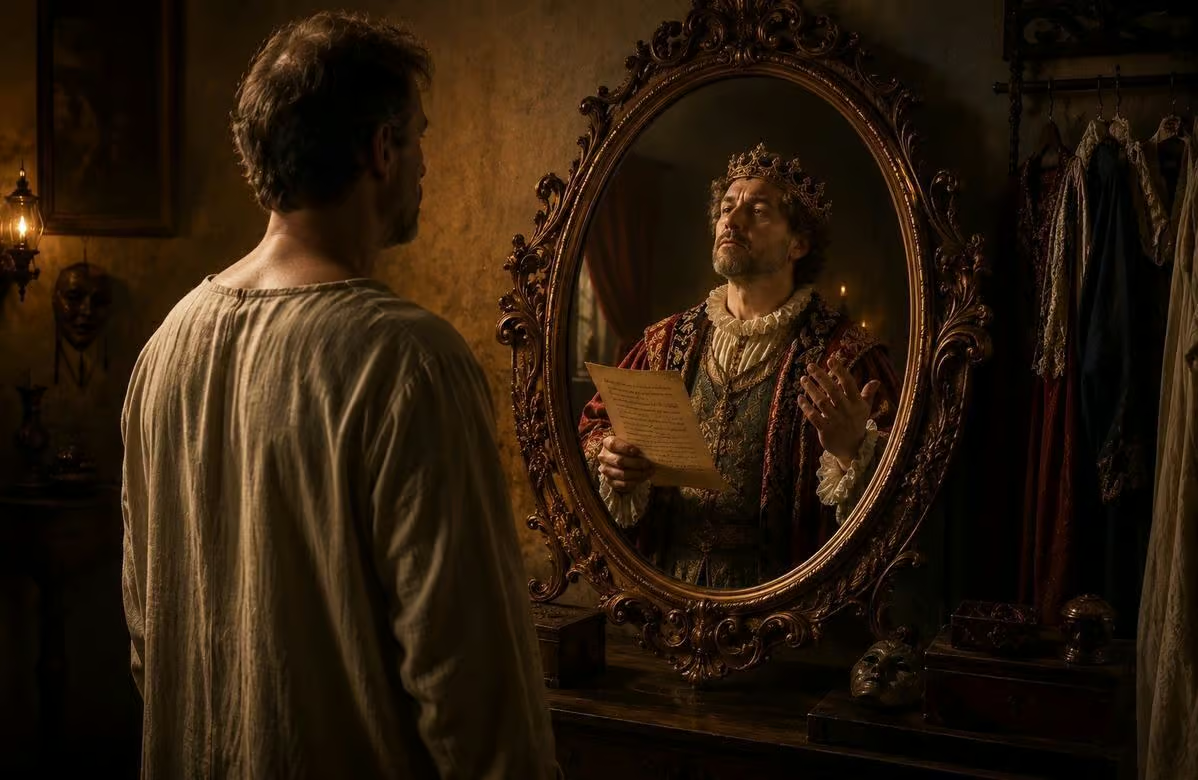
The Gnostic tradition warns of the Counterfeit Spirit: the false imitation of genuine spiritual life. It can mimic responsibility as easily as it mimics love. It appears as saviour fantasy. It appears as persecution identity. It appears as spiritual importance, the belief that one alone sees clearly while everyone else must be corrected.
It also appears as heroic exhaustion, as public performance of burden, as martyrdom worn like a badge. The Counterfeit Spirit can turn responsibility into theatre. Genuine responsibility, by contrast, is usually quieter, more practical and less dramatic. It does not need an audience. It does not need to be crowned.
The Counterfeit Spirit can turn responsibility into theatre.
One sign of this counterfeit is the need to be recognised as the responsible one. Another is resentment when others do not accept the role assigned to them in the drama. True responsibility does not make the vulnerable person into a stage prop. It does not need to be seen saving anyone.
Sophia and the Burden of Wisdom
The Gnostic myth of Sophia carries a lesson about the cost of sight. Wisdom does not remain untouched in celestial purity. She reaches toward the unknown, ruptures the boundary, and falls into the chaos she did not intend to create. Her wisdom is not abstract brilliance. It is wisdom that has been broken, that has wandered, that has wept in the dark.
Sophia does not merely see the fracture. She participates in restoration. She becomes the one who mends what sight alone cannot fix. This is the deeper responsibility: not only to see what is broken, but to join the quiet work of repair. Wisdom without restoration remains incomplete.
Sophia teaches that wisdom is not only seeing the fracture, but joining the work of restoration.
This does not make restoration glamorous. It makes it necessary. The work of wisdom is often slow, repetitive and uncelebrated. It does not merely announce the crack. It learns how to mend without pretending the break never happened.
The Divine Spark and Care for the Vulnerable
The Gnostic tradition holds that a divine spark dwells within each human being, hidden beneath confusion, fear, weakness and the accretions of the world. Clear sight should make this hidden light more visible, not less. It should reveal the vulnerable core beneath the armour, not exploit it.
Responsibility means refusing to use spiritual insight against people. It means protecting the vulnerable rather than exposing them. It means recognising that the person caught in illusion, performance or pain still carries the spark.
The divine spark is honoured when clear sight becomes protection, not possession.
This is one of the simplest tests of awakened perception. Does the sight make the vulnerable person safer? Does it protect their dignity? Does it reduce domination? Or does it make them easier to interpret, expose, manage or control?
The spark is not honoured by cleverness alone. It is honoured by care.
The Weight of Seeing in Ordinary Life
Responsibility after awakening does not arrive in grand gestures. It arrives in the small, repeated choices of ordinary life. How one handles family conflict. How one listens. How one keeps confidences. How one chooses silence. How one handles online speech. How one refuses manipulation. How one repairs harm. How one keeps promises. How one rests before reacting.
The weight of seeing is carried most often in small, ordinary choices.
The lamp is not carried only through heroic landscapes. It is carried through kitchens, offices, conversations, errands, inboxes, comment threads, thresholds and the quiet labour of showing up without demanding to be seen.
This is why ordinary life matters so much. It is the place where insight stops being an idea and becomes a pattern of conduct. The lamp either helps one walk more carefully, or it remains only an image in the mind.
When the Weight Becomes Too Heavy
Sensitive people may feel overwhelmed by what they see. The burden of responsibility can become anxiety. The awakened person may begin to feel responsible for everything: every wound, every system, every hidden suffering. This is not responsibility. It is collapse wearing a virtuous mask.
Not everything is yours to carry. The world does not need one person to hold all suffering. Support, rest and boundaries are necessary.
- constant anxiety
- inability to sleep
- feeling responsible for everything
- saviour pressure
- despair
- compulsive fixing
- isolation
- inability to function
- thoughts of self-harm
Not everything you can see is yours to carry.
If the weight of seeing becomes frightening, disabling or unsafe, support is not failure. It is a form of responsibility toward oneself. The lamp cannot be carried well by a hand that is collapsing.
How to Carry Clear Sight Responsibly
Responsible seeing is a practice, not a status. It can be cultivated through small, deliberate disciplines.
- Pause before speaking.
- Write the insight before acting on it.
- Ask whether action is invited.
- Check ordinary explanations before reaching for extraordinary ones.
- Ask what protects autonomy.
- Seek counsel from one grounded person.
- Choose one concrete act of care.
- Refuse grandiosity.
- Protect confidentiality.
- Rest before responding.
- Repair when wrong.
- Let some things remain unseen by others.
Responsible seeing asks: what would care do with this knowledge?
This question is deceptively simple. It interrupts the thrill of perception and returns the person to conduct. It asks not what the insight proves, but what kind of action would protect life, dignity and freedom.
The Ordinary Saint and the Lamp Carried Low
The ordinary saint does not display the lamp. They carry it low enough to light the next step. They do not use seeing as identity. Their responsibility is practical, steady and often unseen. They protect rather than perform. They do not seek to be crowned for carrying light.
The ordinary saint is not a public figure by necessity. They are the one who listens without extracting. The one who sees without exposing. The one who knows without dominating. The one who carries the weight of seeing so quietly that others simply feel safer in their presence.
The ordinary saint carries the lamp low, so others can see the path without being blinded.
This is not weakness. It is controlled light. It is power made gentle. It is vision made useful. It is awakening that no longer needs to prove itself by shining into every face.

The Lamp and the Hands
Clear sight is not a crown. It is a lamp.
A crown asks to be seen. A lamp asks to be carried.
The awakened person is not asked to become superior, heroic or endlessly burdened. They are asked to become careful. Careful with speech. Careful with power. Careful with wounds. Careful with timing. Careful with the vulnerable. Careful with the knowledge that seeing can harm when carried without love.
The weight of seeing is real. But it is not the weight of owning the world. It is the weight of carrying the lamp without setting fire to what it was meant to illumine.
The hands matter. They decide whether the lamp becomes guidance or glare, warmth or fire, clarity or domination. The eye may open first. But the path is measured by what the hands learn to carry.
Related Glossary Terms
These terms help frame the article’s main ideas across the wider ZenithEye archive.
- Gnosis
- Divine Spark
- Sophia
- Counterfeit Spirit
- Archons
- Demiurge
- Spiritual Emergence
- Grounding
- Integration
- Return to Ordinary Life
- The Ordinary Saint
- Shadow
- Contemplative Techniques
- Phenomenology
- Clear Sight
- Responsibility
- Saviour Fantasy
- Spiritual Burden
- Ethical Speech
- Power
- Repair
- Care
- Vulnerability
- Protection
- Spiritual Responsibility
Read Next
Continue through the grounded discernment route: ethics, solitude, restraint, clear patterning and ordinary integration.
Further Reading
- The Quiet Ethics of Awakening – How insight becomes character, restraint, repair and ordinary care.
- Solitude Is Not Loneliness – Why the capacity to stand apart can support responsibility without hardening into isolation.
- The Discipline of Not Interpreting Everything – How restraint prevents insight from becoming compulsive analysis.
- When Symbols Become Cages – How symbolic perception can guide awareness without becoming captivity.
- Pattern Recognition Without Paranoia – How to see hidden patterns with discernment rather than fear.
- The Grief of Clear Sight – The sorrow that accompanies seeing what one wishes were not true.
- Gnosis Is Not a Product – Why direct knowing cannot be commodified or turned into status.
- What Is the Counterfeit Spirit? – The Gnostic warning about false imitation of spiritual life, including false responsibility.
- What Is the Divine Spark? – The hidden light within that clear sight should protect rather than exploit.
- What Is Sophia? – Wisdom that falls, learns and restores.
- Return to Ordinary Life After Awakening – How to bring the weight of seeing back into daily life without spectacle.
- The Ordinary Saint: Invisibility and Completion – The quiet form of spiritual maturity that does not need applause.
- Against Spiritual Bypassing – Why avoidance can disguise itself as spiritual progress.
- The Spiritual Practice of Attention – Attention as a gateway to consciousness and discernment.
- Spiritual Emergency – When transformation becomes crisis and support is needed.
What is responsibility after awakening?
Responsibility after awakening is the care required when clear sight reveals patterns, wounds, manipulation or hidden suffering. It means carrying insight with humility, restraint and compassion rather than using it to dominate or perform superiority.
Does awakening make someone responsible for fixing others?
No. Awakening does not make someone responsible for fixing everyone. Responsible seeing respects other people’s agency, knows its limits and avoids saviour fantasy. It protects autonomy rather than making others into projects.
What is the difference between responsibility and saviour fantasy?
Responsibility acts with care, restraint and humility. Saviour fantasy turns insight into identity, makes others into projects and confuses help with control. Responsibility serves the light; saviour fantasy wants to be seen holding it.
Why should clear sight be handled carefully?
Clear sight can help, but it can also harm if spoken without timing, consent, proportion or compassion. Not every true thing should be said immediately. Harsh truth can become violence, and clarity without tenderness can humiliate.
How can spiritual insight become harmful?
Spiritual insight can become harmful when it feeds superiority, control, contempt, public exposure of others, dependency, coercion or the belief that one alone sees clearly. It can also become harmful when carried too fast, without waiting for humility to catch up.
What does the Counterfeit Spirit have to do with responsibility?
The Counterfeit Spirit can imitate responsibility through grandiosity, saviour fantasy, martyrdom, persecution identity and the public performance of spiritual burden. Genuine responsibility is usually quieter, more practical and less dramatic.
How can I carry clear sight responsibly?
Pause before speaking, respect autonomy, protect confidentiality, ask whether action is invited, seek grounded counsel, refuse grandiosity, rest before reacting and choose concrete care over drama. Responsible seeing asks what care would do with the knowledge.
References and Sources
This article draws from primary Gnostic texts, Christian desert spirituality, Buddhist ethics, Jungian psychology and contemporary scholarship on spiritual emergence.
Primary Sources and Critical Editions
- The Gospel of Thomas. Nag Hammadi Codex II,2.
- The Gospel of Philip. Nag Hammadi Codex II,3.
- The Apocryphon of John. Nag Hammadi Codex II,1; III,1; IV,1; Berlin Codex 8502,2.
- Meyer, Marvin, ed. The Nag Hammadi Scriptures: The International Edition. New York: HarperOne, 2007.
Comparative and Scholarly Sources
- Ward, Benedicta, trans. The Sayings of the Desert Fathers: The Alphabetical Collection. Kalamazoo: Cistercian Publications, 1975.
- The Dhammapada, especially teachings on speech, conduct and mind.
- Jung, Carl G. Collected Works, especially writings on shadow, inflation and individuation.
- James, William. The Varieties of Religious Experience. New York: Longmans, Green, 1902.
- Underhill, Evelyn. Mysticism: A Study in the Nature and Development of Spiritual Consciousness. London: Methuen, 1911.
- Brakke, David. The Gnostics: Myth, Ritual, and Diversity in Early Christianity. Cambridge: Harvard University Press, 2010.
- King, Karen L. What Is Gnosticism? Cambridge: Harvard University Press, 2003.
- DeConick, April D. The Gnostic New Age. New York: Columbia University Press, 2016.
Safety Notice: This article discusses awakening, responsibility, saviour fantasy, spiritual burden, power, speech, repair and psychological integration. It is not medical, psychological, legal or therapeutic advice. If spiritual responsibility becomes overwhelming, frightening, sleep-disrupting, unsafe, or connected with self-harm, coercion, inability to function, or fear of others, seek qualified professional support or emergency help in your area.
Study Note: This article does not tell sensitive people to carry the world. It asks that clear sight be carried carefully. Responsibility after awakening is not grandiosity, martyrdom or self-erasure. It is humility, restraint, protection, repair and ordinary care.