
Solitude Is Not Loneliness: The Gnostic Value of Standing Apart
There comes a point on many spiritual paths when the noise begins to fall away.
The old conversations no longer fit. The familiar performances feel thin. Crowds that once offered comfort may now feel heavy. The seeker may find themselves drawn to silence, slower rhythms, fewer explanations, and a smaller circle of trust.
From the outside, this can look like loneliness.
Sometimes it is.
But not all aloneness is loneliness. Some aloneness is the soul recovering its own sound after years of echoing other voices. Some solitude is not a punishment, but a chamber of integration.
The danger is that the chamber can become a fortress.
Sometimes the soul steps back not because it hates the world, but because it can no longer hear itself inside the noise.
In Plain Terms
Solitude is chosen space that helps the soul listen, recover and integrate. Loneliness is the pain of unmet connection. Isolation is separation that becomes unsafe, rigid or bitter. Gnostic solitude is not contempt for the world. It is the disciplined space needed to remain clear without losing compassion.
Primary Sources and Traditions Discussed
- Gnostic themes of the solitary one, the stranger and the awakened soul.
- The Gospel of Thomas and sayings about becoming solitary, single or whole.
- The Apocryphon of John and the soul’s recognition amid a world of ignorance.
- The divine spark as inner recognition that may feel alone before it finds language.
- Sophia as longing, rupture and restoration.
- Christian desert spirituality and the discipline of withdrawal.
- Buddhist and contemplative traditions around silence and non-attachment.
- Jungian individuation and the cost of becoming oneself.
- Spiritual emergence literature around integration, isolation and grounding.
- Ordinary life as the test of spiritual maturity.
How to Read This Article
Read this as a guide to mature solitude, not as praise of withdrawal. It does not romanticise loneliness or encourage cutting off healthy relationships. It asks how solitude can become a place of integration, discernment and compassion without hardening into isolation, superiority or despair.
Table of Contents
- Solitude, Loneliness and Isolation Are Not the Same
- Why Awakening Can Feel Lonely
- The Gnostic Value of Standing Apart
- Solitude as a Chamber of Integration
- When Solitude Becomes Spiritual Superiority
- Loneliness Should Not Be Romanticised
- The Difference Between Sacred Solitude and Harmful Isolation
- The Counterfeit Spirit of the Lone Chosen One
- Solitude, Community and the Difficulty of Recognition
- Ordinary Life Keeps Solitude Honest
- How to Practise Healthy Solitude
- When Aloneness Needs Support
- The Ordinary Saint and the Quiet Life
- Conclusion: The Room, the Wound and the Wall
- Related Glossary Terms
- Read Next
- Further Reading
- References and Sources
Solitude, Loneliness and Isolation Are Not the Same
Solitude is chosen or accepted space that restores clarity, prayer, contemplation, creativity and self-honesty.
Loneliness is the ache of unmet connection, the pain of not being seen, held, understood or accompanied.
Isolation is separation that becomes rigid, unsafe, bitter, defensive or cut off from correction and care.
These three can feel similar from the outside, but they move in different directions. Solitude opens. Loneliness aches. Isolation hardens.
Solitude is a room. Loneliness is a wound. Isolation is a wall.
This distinction matters because spiritual language can confuse the issue. A person may call their isolation solitude because it sounds more noble. Another may mistake necessary solitude for failure because it looks lonely from the outside. A third may be genuinely lonely but feel ashamed because their spiritual path has taught them to pretend they need no one.
Solitude is not proven by being alone. Loneliness is not cured by spiritual vocabulary. Isolation is not made holy because it is quiet. Each must be recognised by its fruit.
Why Awakening Can Feel Lonely
Awakening can feel lonely because old identities loosen, inherited beliefs no longer fit, social scripts become visible, spiritual language may not be shared by others, the seeker may become less able to perform normality, clear sight can create grief, restraint may reduce impulsive conversation, and pattern recognition may need grounding before being spoken.
Clear sight can be lonely before it becomes integrated.
The loneliness does not always mean the path is wrong. Sometimes it means the old ways of belonging were held together by performance. When performance falls away, there may be a period of emptiness before a truer form of belonging can appear.
This emptiness can be tender. The seeker may still love people they can no longer imitate. They may still care for communities whose language no longer fits. They may grieve the loss of shared certainty, shared humour, shared outrage, shared denial or shared sleep.
Integration begins when solitude is allowed to hold that grief without turning it into contempt.
The Gnostic Value of Standing Apart
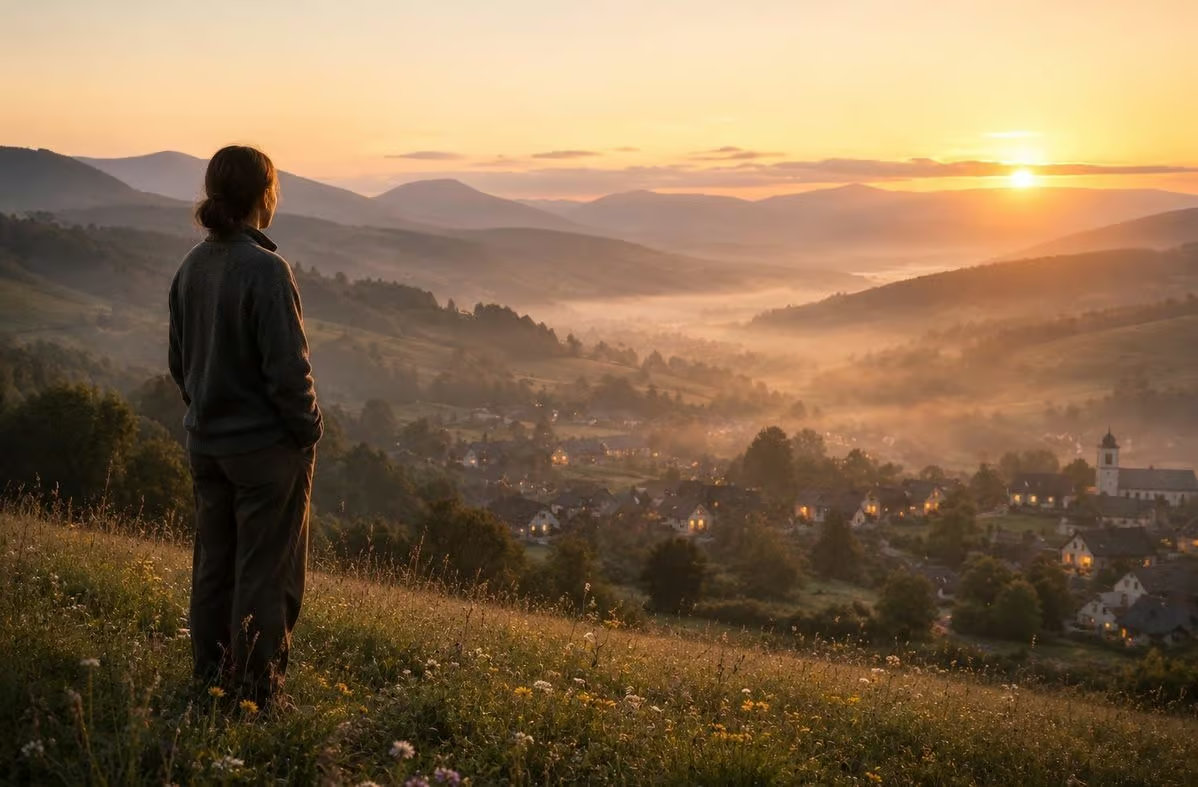
Gnostic texts often speak to those who feel estranged from false systems. The awakened soul may feel like a stranger in a world of imitation. Standing apart can protect discernment from collective sleep. But separation is not the goal. Recognition is. The solitary one is not superior, only less entangled.
The Gospel of Thomas includes sayings about becoming single, whole or solitary. The solitary, in this sense, is one who has become inwardly gathered, not one who has fled the world in contempt.
The Gnostic stranger is not someone who hates the world, but someone who no longer belongs to its sleep.
This is a subtle difference. Standing apart can protect the divine spark from being smothered by collective imitation. It can create room for direct knowing to stabilise. It can allow the seeker to stop echoing the phrases, fears and appetites of the surrounding world.
But the Gnostic stranger is not called to hatred. Estrangement from falsehood is not permission to despise the human beings still entangled in it. A clear eye that cannot bless has not yet become merciful.
Solitude as a Chamber of Integration
Solitude can allow grief to settle, symbols to breathe, the nervous system to calm, borrowed voices to fall away, direct knowing to become clearer, ordinary life to regain proportion, and the soul to stop performing.
Solitude gives the soul a room where it does not have to explain itself before it has understood itself.
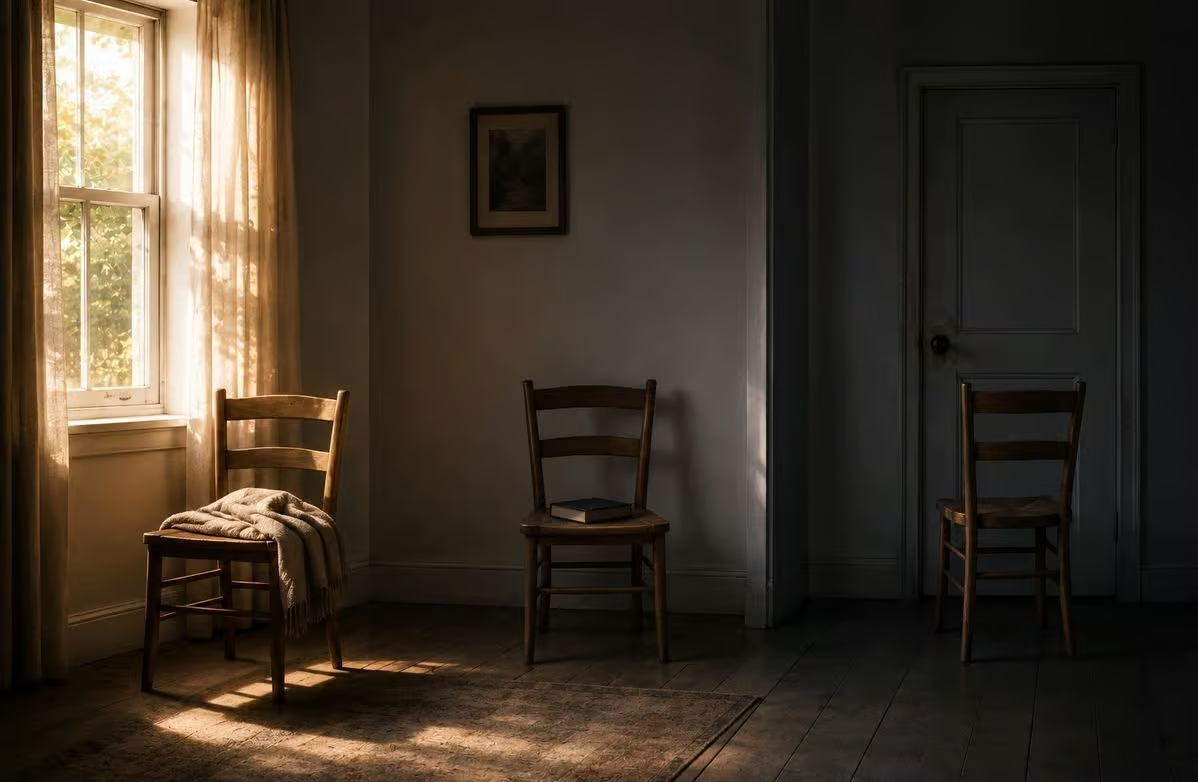
This kind of solitude is not empty. It is quietly inhabited. The cup of tea, the window, the notebook, the field, the fire, the small task, the slow walk, the breathing body: each becomes part of the chamber. The soul is not being abandoned. It is being given enough space to hear itself without the crowd pressing against the door.
Integration often requires such rooms. After grief, the heart needs quiet. After symbolic overload, the mind needs rest. After the collapse of old certainty, the body needs regular rhythms. Solitude becomes medicine when it helps the person return to life with more honesty and less noise.
The chamber is healthy when it has a door that can open.
When Solitude Becomes Spiritual Superiority
Solitude becomes distorted when it turns into contempt for others, belief that everyone else is asleep, refusal to be corrected, disdain for ordinary people, romanticised exile, spiritual identity built around being misunderstood, or pride in not needing anyone.
Standing apart is not the same as standing above.
This distortion can be seductive because it offers meaning for pain. If the person feels unseen, they may decide that being unseen proves superiority. If they feel misunderstood, they may decide that misunderstanding proves election. If they feel lonely, they may decide that all companionship is for the asleep.
But contempt is not clarity. Bitterness is not discernment. A person can stand apart from a false pattern without turning the people inside that pattern into enemies.
The test is simple and difficult: does solitude make the heart cleaner, or merely harder?

Loneliness Should Not Be Romanticised
Loneliness hurts. Not every loneliness is holy. Some loneliness is a sign of unmet need. Some loneliness asks for contact, not deeper withdrawal. Spiritual language should not cover real pain. Needing people is not failure. The body and nervous system need relational safety.
A wound does not become wisdom simply because it is named spiritually.
This matters because spiritual communities sometimes praise solitude without naming the ache of isolation. The solitary mystic becomes an image. The hermit becomes romantic. The quiet person is assumed to be deep. But a person can be silent because they are centred, or silent because they are afraid, unseen, depressed, ashamed or exhausted.
Loneliness should be met with tenderness, not performance. It may ask for a message sent, a walk with someone safe, a conversation without spiritual display, a meal, a shared silence, a counsellor, a doctor, a support line, or simply the admission: I need connection.
There is no shame in that admission. Human beings are not errors because they need one another.
The Difference Between Sacred Solitude and Harmful Isolation
The fruit of solitude is the test of solitude. Sacred solitude restores clarity, deepens compassion, allows rest, remains open to connection, can receive correction, makes ordinary life more humane, and softens the heart. Harmful isolation increases bitterness, feeds superiority, rejects feedback, deepens fear, cuts off care, narrows the world, and makes ordinary life harder.
| Sacred Solitude | Harmful Isolation |
|---|---|
| Restores clarity. | Deepens confusion or suspicion. |
| Softens the heart. | Hardens the heart. |
| Allows rest. | Feeds vigilance. |
| Remains open to connection. | Rejects all connection. |
| Can receive correction. | Treats correction as attack. |
| Makes ordinary life more humane. | Makes ordinary life harder. |
| Deepens compassion. | Feeds superiority or bitterness. |
The fruit of solitude is the test of solitude.
If solitude brings the person back to life with more patience, honesty and care, it is likely serving integration. If it leaves the person more frightened, contemptuous, rigid or unable to live, it may be turning into isolation.
The question is not simply “Am I alone?” The question is, “What is aloneness making of me?”
The Counterfeit Spirit of the Lone Chosen One
False solitude can become a myth of specialness. The person may feel uniquely chosen, uniquely persecuted, uniquely awake. This can mimic spiritual maturity while feeding ego. The Counterfeit Spirit can use isolation as costume. Genuine solitude increases humility, not grandiosity.
The Counterfeit Spirit can turn aloneness into a throne.
This is one of the subtler dangers of solitary practice. The person may stop performing for society only to begin performing for an imagined cosmic audience. They may reject one false identity and replace it with another: the exile, the only awake one, the misunderstood visionary, the solitary elect.
True solitude does not need a throne. It does not require applause, secret rank or the constant confirmation that others are asleep. It is enough for the soul to become quieter, clearer and less enslaved by performance.
The solitary path is safest when it keeps humility near the door.
Solitude, Community and the Difficulty of Recognition
Not every community fits the awakened person. Some communities demand conformity. Some relationships cannot hold change. But this does not mean all community is false. Recognition may come through one person, a small circle, an honest conversation, a shared practice, or quiet companionship. The task is not to belong everywhere, but not to seal the heart.
The seeker may not need a crowd, but the heart still needs truthful contact.
This distinction is easy to lose. When many groups feel false, the person may conclude that all belonging is false. When several relationships fail to understand the change, the person may conclude that no one can understand anything. But the failure of one kind of belonging does not prove that all recognition is impossible.
A single honest conversation can matter. A trusted friend can be enough. A teacher who does not demand ownership can help. A small practice circle may be healthier than a crowd. A quiet companion may carry more grace than an audience.
Solitude and relationship do not need to be enemies. The healthiest solitude returns with enough openness to recognise the rare forms of contact that are true.
Ordinary Life Keeps Solitude Honest
Ordinary life tests solitude through kindness, patience, food, sleep, work, care, promises, tending place, answering honestly, and remaining human.
Solitude becomes sacred only when it returns with gentleness to ordinary life.
This is where the idea of the ordinary saint matters. The point of solitude is not to become rare, dramatic or unreachable. The point is to become more truthful and less performative. If solitude has clarified anything, it should appear in the way a person speaks, listens, cooks, rests, keeps promises, handles conflict and meets the ordinary demands of the day.
A solitude that cannot return to ordinary life may not be integration. It may be avoidance. The quiet room is useful only if it makes the person more capable of kindness beyond the room.
How to Practise Healthy Solitude
Choose quiet intentionally, not as punishment. Keep basic rhythms: food, sleep, movement, daylight. Write without turning solitude into grievance. Limit fear-based content. Do ordinary tasks. Stay open to one grounded person. Let silence soften you. Notice whether solitude increases compassion or contempt. Return to nature or simple physical work. Avoid making isolation part of identity.
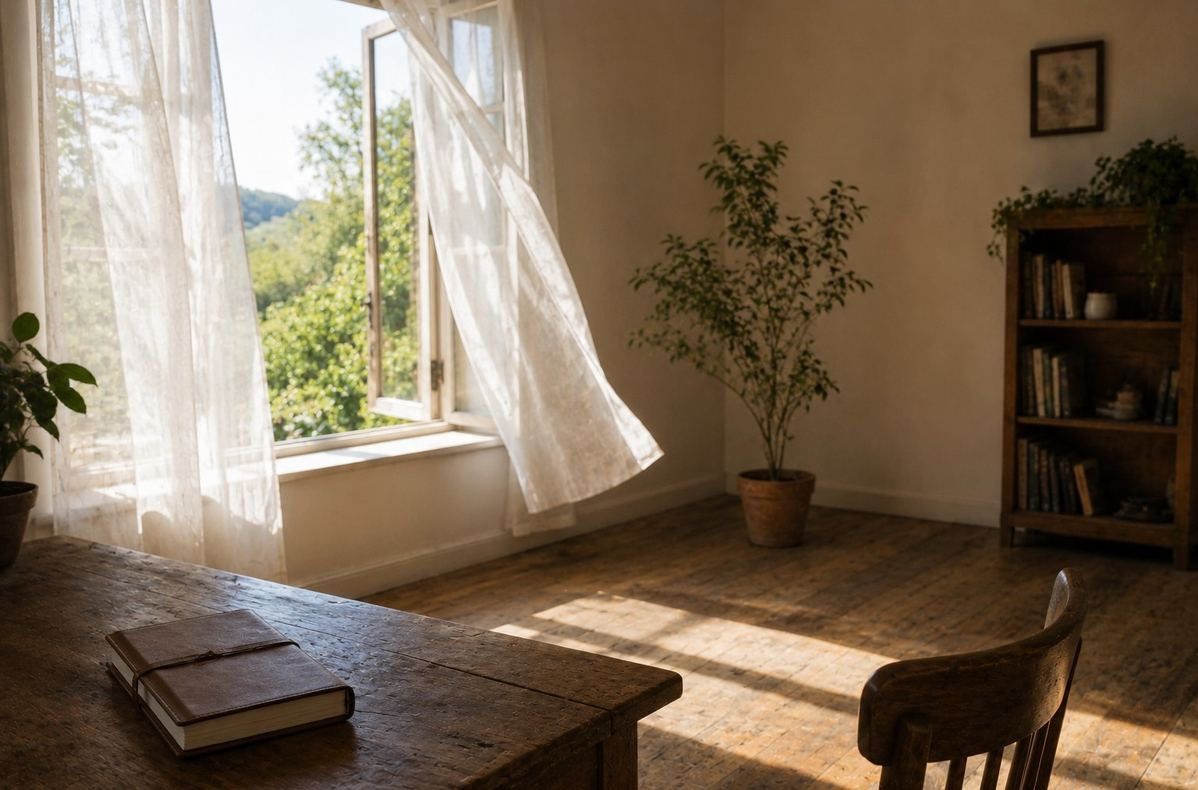
Healthy solitude has windows. Isolation has locks.
- Keep one gentle rhythm each day: food, light, movement or sleep.
- Use quiet as a place of recovery, not a punishment.
- Write honestly without turning every page into grievance.
- Notice whether silence is softening or hardening the heart.
- Stay open to at least one grounded person.
- Reduce fear-based media and communities that flatter exile.
- Do ordinary work with care.
- Return to the body when thought becomes circular.
- Let solitude have windows: nature, fresh air, truthful contact, simple tasks.
Healthy solitude does not need to be impressive. It may look like tea by a window, a quiet walk, an hour without a device, a morning of work without performance, or a day in which the soul is not asked to explain itself to everyone.
The practice is not to vanish. The practice is to become available to truth without being consumed by noise.
When Aloneness Needs Support
Warning signs include persistent despair, inability to function, severe isolation, fear of all people, sleep disruption, paranoia, feeling targeted, thoughts of self-harm, inability to leave the house or contact anyone, and loss of ordinary care.
When aloneness becomes unsafe, the next step is support, not deeper withdrawal.
This point is important. Spiritual language should never prevent care. If solitude becomes frightening, compulsive, despairing or impossible to interrupt, the person does not need a more dramatic story of exile. They need support, warmth, practical help, professional care where appropriate, and a path back towards safety.
Seeking support does not mean solitude was false. It means the person is choosing life over the romance of disappearance.
The Ordinary Saint and the Quiet Life
The ordinary saint does not perform awakening. They may live quietly. They may not be widely recognised. They do not need drama to be faithful to the inner light. Solitude becomes a hidden practice of steadiness. The sacred is carried through ordinary care.
The ordinary saint does not flee the world. They stop asking the world to applaud the soul.
This is not glamorous spirituality. It is not spectacle, brand, spiritual theatre or constant revelation. It is the slow integrity of a life that no longer needs to be witnessed by everyone in order to remain true.
Such a person may still feel lonely at times. They may still long for recognition. They may still grieve the absence of kindred spirits. But the longing no longer rules the centre. The inner life has become stable enough to remain kind without applause.
The quiet life is not a lesser life. It may be the place where the deepest recognition becomes ordinary enough to be real.

Conclusion: The Room, the Wound and the Wall
Solitude is a room. Loneliness is a wound. Isolation is a wall.
The mature path learns the difference.
There are seasons when the soul must stand apart. There are seasons when silence heals what noise has scattered. There are seasons when the seeker must stop performing belonging and allow the inner life to gather itself again.
But solitude is not contempt. It is not superiority. It is not the refusal of love.
At its best, solitude returns us to the world with a quieter heart, a cleaner eye, and a gentler hand.
The one who stands apart must still remain capable of blessing what they no longer belong to.
Related Glossary Terms
These terms help frame the article’s main ideas across the wider ZenithEye archive.
- Gnosis
- Divine Spark
- Sophia
- Counterfeit Spirit
- Archons
- Demiurge
- Spiritual Emergence
- Grounding
- Integration
- Return to Ordinary Life
- The Ordinary Saint
- Contemplative Techniques
- Shadow
- Phenomenology
- Solitude
- Loneliness
- Isolation
- Sacred Solitude
- Spiritual Superiority
- The Stranger
- Standing Apart
- Recognition
- Belonging
- Inner Life
Read Next
Continue with restraint, symbolic sobriety, clear sight and the return to ordinary life.
Further Reading
- The Discipline of Not Interpreting Everything – How sacred restraint protects discernment after awakening.
- When Symbols Become Cages – How symbols can guide awareness without becoming prisons of over-meaning.
- Pattern Recognition Without Paranoia – Discernment without projection, fear or false certainty.
- The Grief of Clear Sight – Why deeper perception can bring sorrow before integration.
- Return to Ordinary Life After Awakening – The integration test after spiritual opening.
- The Ordinary Saint: Invisibility and Completion – The quiet completion of transformation without performance.
- Gnosis Is Not a Product – Why direct knowing cannot be bought, branded or owned.
- What Is the Counterfeit Spirit? – How imitation insight can mimic genuine recognition.
- What Is the Divine Spark? – The hidden light that remembers and seeks return.
- What Is Sophia? – Wisdom, fall and restoration in Gnostic myth.
- Spiritual Emergency – When transformation becomes crisis.
- Dark Night: Depression or Transformation? – How to discern mystical darkness from psychological crisis.
- The Collapse of the Witness – When the observer position becomes another cage.
- Finding the Other: Recognition Without Community – Recognition, isolation and the search for truthful contact.
- Against Spiritual Bypassing – Why avoiding difficult emotions is not the same as spiritual progress.
- The Spiritual Practice of Attention – A gateway practice for stabilising presence.
- The Discipline of Solitude – Extended alone time as a gateway to recognition.
- Community and Integration – The difference between solitary and supported transformation.
What is the difference between solitude and loneliness?
Solitude is chosen or accepted space that can restore clarity, prayer, creativity and self-honesty. Loneliness is the pain of unmet connection, of not feeling seen, held or accompanied.
Can solitude be spiritually healthy?
Yes. Solitude can support discernment, integration and spiritual maturity when it deepens compassion, restores clarity and remains open to ordinary life and healthy connection.
When does solitude become harmful isolation?
Solitude becomes harmful when it increases bitterness, fear, despair, superiority, paranoia, refusal of correction, or disconnection from basic care and trustworthy support.
Why can awakening feel lonely?
Awakening can change old identities, beliefs, conversations and social patterns. The seeker may feel less able to perform normality and may need time to integrate what has changed.
Does Gnosticism value standing apart?
Gnostic traditions often speak to the awakened soul as one who no longer belongs to false systems. But standing apart should serve recognition and freedom, not contempt, superiority or hatred of the world.
How can I practise healthy solitude?
Keep basic rhythms of food, sleep, movement and daylight. Use quiet intentionally, stay open to at least one grounded person, avoid fear-based content, do ordinary tasks and notice whether solitude increases compassion or contempt.
When should I seek support for loneliness or isolation?
Seek support if aloneness becomes unsafe, despairing, frightening, sleep-disrupting, paranoid, or makes you unable to function, care for yourself, leave the house or contact anyone.
References and Sources
This article draws on Gnostic primary sources, desert spirituality, contemplative writing, Jungian psychology, spiritual emergence literature and grounded approaches to integration after awakening.
Primary Sources and Gnostic Texts
- The Gospel of Thomas. Nag Hammadi Codex II,2.
- The Apocryphon of John. Nag Hammadi Codex II,1; III,1; IV,1; Berlin Codex 8502,2.
- The Gospel of Philip. Nag Hammadi Codex II,3.
- The Nag Hammadi Scriptures, edited by Marvin Meyer. HarperOne, 2007.
Solitude, Contemplation and Spiritual Practice
- The Sayings of the Desert Fathers: The Alphabetical Collection, translated by Benedicta Ward. Cistercian Publications, 1975; revised 1984.
- Merton, Thomas. New Seeds of Contemplation. New Directions, 1961.
- Nouwen, Henri J. M. Reaching Out: The Three Movements of the Spiritual Life. Doubleday, 1975.
- Underhill, Evelyn. Mysticism: A Study in the Nature and Development of Spiritual Consciousness. Methuen, 1911.
Psychology, Emergence and Gnostic Scholarship
- Jung, Carl G. Collected Works, especially writings on individuation and the self.
- James, William. The Varieties of Religious Experience. Longmans, Green & Co., 1902.
- Grof, Stanislav, and Christina Grof, eds. Spiritual Emergency: When Personal Transformation Becomes a Crisis. J. P. Tarcher, 1989.
- Brakke, David. The Gnostics: Myth, Ritual, and Diversity in Early Christianity. Harvard University Press, 2010.
- King, Karen L. What Is Gnosticism?. Harvard University Press, 2003.
Safety Notice: This article discusses solitude, loneliness, isolation, spiritual emergence, awakening and psychological distress. It is not medical, psychological or therapeutic advice. If loneliness or isolation becomes frightening, despairing, sleep-disrupting, unsafe, or makes you unable to function, care for yourself, leave the house or contact anyone, seek qualified professional support or emergency help in your area.
Study Note: This article does not romanticise loneliness or withdrawal. It asks that solitude remain humane, grounded and open to love. Sacred solitude should deepen compassion, not harden the heart.