Codex XII: Fragments and the Sentences of Sextus
The Nag Hammadi Library preserves thirteen papyrus codices, yet one stands apart not for its theological brilliance but for its physical devastation. Codex XII is the most fragmentary collection in the entire archive–pages damaged, text barely legible, large sections missing entirely. What survives includes the Sentences of Sextus (a Pythagorean wisdom text not originally Gnostic), fragments of the Gospel of Truth (also preserved complete in Codex I), and other barely identifiable material [1].
Where Codex II dazzles with its crown jewels and Codex XIII delivers the most complete feminine divine theology, Codex XII offers something different: the raw evidence of textual transmission. It is the archive’s damaged dossier–the file that survived burial and smuggling only to deteriorate in the centuries since. For most readers, it is optional reading. But for scholars studying scribal practice, textual redaction, and the reception of non-Gnostic wisdom literature in Gnostic circles, it remains indispensable [2].
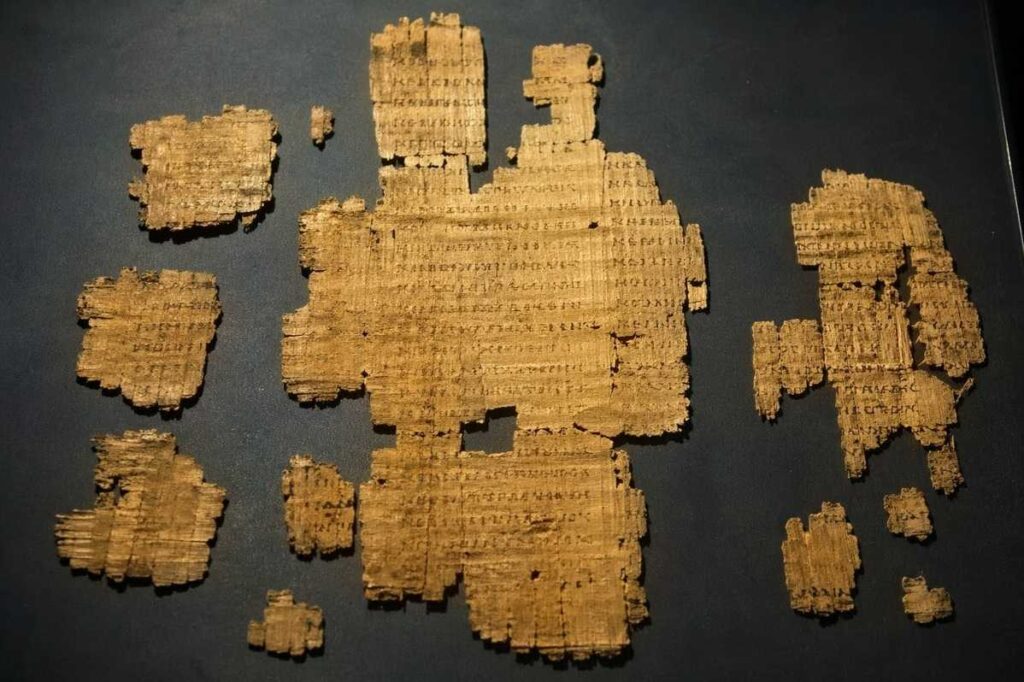
Table of Contents
- What is Codex XII?
- Manuscript Context
- The Tractates of Codex XII
- 1. Sentences of Sextus
- 2. Fragments of the Gospel of Truth
- 3. Unidentified Fragments
- Reading Order for Codex XII
- Why Codex XII Matters
- Comparative Context
- Frequently Asked Questions
- Further Reading
- References and Sources
What is Codex XII?
Codex XII (Nag Hammadi Codex XII) is the most poorly preserved codex in the Nag Hammadi Library, discovered in 1945 near Nag Hammadi, Egypt. It contains three tractates: the Sentences of Sextus (NHC XII,1), a collection of 451 Pythagorean ethical maxims; fragmentary remains of the Gospel of Truth (NHC XII,2), a Valentinian text preserved complete in Codex I; and unidentified fragments too damaged to classify. Despite its poor condition, the codex provides crucial evidence for textual transmission, scribal practice, and the reception of wisdom literature in Gnostic reading communities [1][3].
Manuscript Context
Discovery and Physical State
Codex XII was discovered in December 1945 by Muhammad Ali al-Samman and his brothers, buried alongside the other twelve codices in a sealed jar near the Jabal al-Tarif cliff [4]. From the outset, its physical condition was dire. The papyrus leaves suffered severe deterioration–pages are damaged, ink has faded to near invisibility, and large lacunae interrupt virtually every surviving page. James M. Robinson, director of the Coptic Gnostic Library Project, described Codex XII as “poorly preserved” even by the standards of a collection that had already survived sixteen centuries of burial [5].
The codex originally contained multiple tractates bound together in a single leather volume, yet the ravages of time, moisture, and soil chemistry reduced much of it to illegibility. Unlike Codex I (the Jung Codex), which was acquired early and protected in institutional conservation, Codex XII passed through antiquities markets without proper preservation, accelerating its decay [6].
The Problem of Preservation
The deterioration of Codex XII raises important methodological questions for scholars. Textual reconstruction relies on comparing surviving fragments with parallel versions–the Gospel of Truth in Codex I provides the template for reconstructing the fragments in Codex XII, while the Sentences of Sextus can be compared with Latin, Syriac, and Armenian translations [7]. Yet every reconstruction involves interpretive decisions. Where ink has vanished, scholars must judge whether the missing text matched the parallel version or contained deliberate variation. The damaged codex thus becomes a palimpsest of scholarly inference as much as ancient authorship.
For general readers, this means that Codex XII offers little direct aesthetic or spiritual reward. One cannot sink into its texts as one does with the Gospel of Truth or Thunder: Perfect Mind. Instead, it demands archaeological patience–the willingness to work with fragments, to hold questions open, and to recognise that some archival damage is irreversible [2].
The Tractates of Codex XII
1. Sentences of Sextus (NHC XII,1)
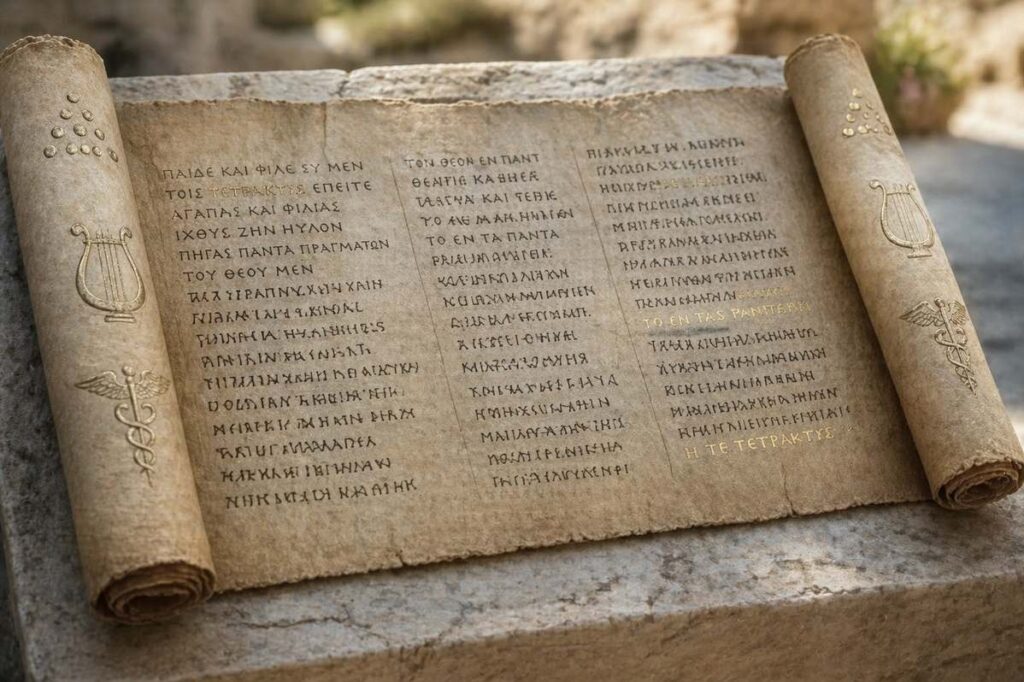
The most complete text in Codex XII is the Sentences of Sextus–a collection of 451 ethical maxims attributed to a Pythagorean sage named Sextus, though the text circulated widely in early Christian and monastic circles. “The sage is a friend of God.” The sayings cover practical topics: self-control, friendship, the pursuit of wisdom, restraint of speech, and the governance of desire. They contain no specifically Gnostic theology–no demiurge, no fallen Sophia, no aeonic ascent [8].
Primary Source Citation: NHC XII,1 — “The sage is a friend of God. That which is given by God is to be preferred to that which is taken from men. Control your tongue; desire what is noble; pursue what is profitable to your soul.” (Translation: Wisse 1990)
Pythagorean Wisdom in a Gnostic Library
The presence of this text in a Gnostic codex is historically significant. It demonstrates that Gnostic readers and compilers valued wisdom literature alongside their more exotic speculative texts. The Sentences of Sextus was apparently read as compatible with Gnostic spirituality–perhaps as ethical preparation for higher teaching, or as practical guidance for maintaining spiritual discipline amid the complexities of daily life [9].
The Coptic version in Codex XII holds special textual importance. It is at least a century and a half older than the oldest previously known copies (two Syriac manuscripts from the mid-sixth century CE) and more than 500 years older than the earliest Greek and Latin witnesses [8]. For textual critics, this makes the Nag Hammadi version a crucial witness for reconstructing the original Greek and understanding how these maxims were transmitted across linguistic boundaries.
The Ethical Programme
The maxims outline a threefold ascetic protocol addressing speech, desire, and cognition. “Let your speech be better than silence, or be silent.” “Desire is the chain of the soul; wisdom is its liberation.” “Drive anger from your soul; it is a thief of wisdom.” These injunctions align with the encratite tendencies visible elsewhere in the library–particularly in the Book of Thomas the Contender–suggesting that the Sentences served communities practicing significant bodily restraint as preparation for receiving higher mysteries [10].
For general readers, the Sentences are accessible but not essential. They offer conventional wisdom rather than the radical perspectives of other Nag Hammadi texts. Yet their very conventionality is instructive: they reveal that Gnostic communities were not exclusively occupied with cosmic rebellion and secret passwords, but also with the mundane work of character formation [9].
2. Fragments of the Gospel of Truth (NHC XII,2)
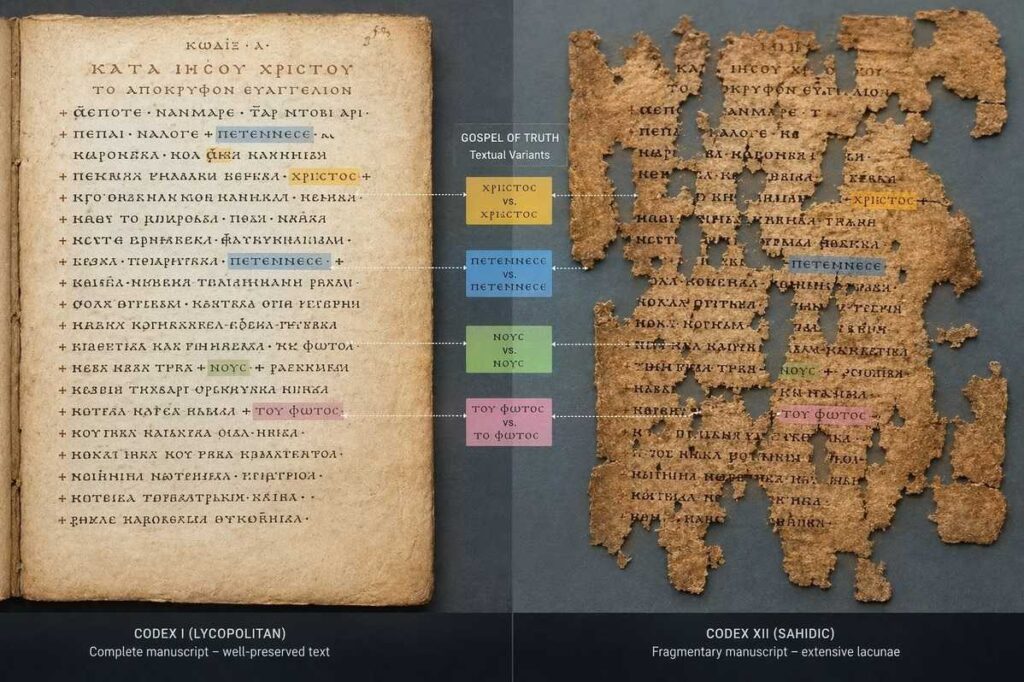
The second tractate preserves damaged portions of the same Gospel of Truth found complete in Codex I. Where Codex I presents a beautiful, nearly intact Valentinian meditation on error and recognition, Codex XII offers only fragments–surviving portions of six originally twenty-nine pages, with the remainder lost to deterioration [11].
Yet these fragments are not merely damaged duplicates. They represent a different Coptic dialect–Sahidic, as opposed to the Lycopolitan (Subachmimic) of Codex I–suggesting independent translation traditions and possibly different Greek exemplars behind each version [12]. The fragments confirm that this important Valentinian text circulated in multiple copies, a fact that attests to its significance in fourth-century Egyptian reading communities.
Primary Source Citation: NHC XII,2 54:25-28 (parallel to NHC I,3 31:35-32:3) — “This is [the shepherd who left behind] the ninety-nine [sheep,] those that were not lost. [He sought] after the one that was lost.” (Translation: Smith 2026, reconstructed)
A Second Copy with a Difference
Comparative analysis reveals that the Codex XII version is consistently shorter than its Codex I counterpart. Where the two texts diverge, the Sahidic fragments almost invariably preserve the more concise reading. For decades, scholars debated whether Codex I had expanded the text or Codex XII had abbreviated it. Frederik Wisse’s transcription (1985, revised 1990) established the basic text, but systematic comparison remained methodologically challenging due to the fragmentary condition [12].
The Anti-Origenist Redaction Hypothesis
Recent scholarship has proposed a striking explanation for the differences between the two versions. A 2026 study in the Harvard Theological Review argues that the Codex XII version underwent deliberate ideological redaction–specifically, the removal of theological elements that fourth- or fifth-century readers would have associated with Origenism [13].
Two passages support this hypothesis. First, where Codex I describes humanity as unable to recognise the Saviour’s “likeness” (echoing Genesis 1:26 and 1 John 3:2), Codex XII eliminates the reference entirely–removing a concept central to the Origenist controversy over whether humans retain God’s image after the fall. Second, where Codex I describes the Logos as “first to come forth” among the divine logoi, Codex XII strips away this protological emanation language, transforming a discussion of primordial generation into a simpler account of revelatory arrival [13].
If persuasive, these findings indicate that apocryphal texts participated actively in late antique theological controversy–not merely as sources for Origenist theology, but as objects of anti-Origenist editorial intervention. The Codex XII Gospel of Truth would represent not an accidental abbreviation but a deliberate sanitisation, produced to render an otherwise compelling text theologically safe for communities opposed to Origenist speculation [13].
3. Unidentified Fragments
The remainder of Codex XII consists of barely legible remains that resist confident identification. These fragments preserve insufficient text to determine whether they represent additional copies of known tractates or entirely lost works. They are of interest primarily to specialists working on codicology and textual reconstruction–scholars who can extract meaning from vestiges of ink where general readers see only damage [1].
The presence of these unidentified fragments reminds us that the Nag Hammadi Library as we have it is not complete. Other texts may have circulated alongside the known tractates, now lost to the same forces that reduced Codex XII to its current state. Every unreadable fragment is a ghost–a hint of theological diversity that can no longer speak [2].
Reading Order for Codex XII
For newcomers: Skip Codex XII entirely. Begin with the complete Gospel of Truth in Codex I, and return to the Sentences of Sextus only if you develop a specific interest in Gnostic ethics or wisdom literature. The fragments here offer nothing that is not available more accessibly elsewhere.
For comparative study: Read the Sentences of Sextus alongside the Teachings of Silvanus (Codex VII) to understand the range of practical ethics in the library. Compare the Gospel of Truth fragments with the complete Codex I version, noting where the Sahidic text diverges and where it simply collapses into lacunae [14].
For advanced study: Examine the Codex XII fragments as a case study in textual transmission. Investigate the anti-Origenist redaction hypothesis, evaluate the methodological challenges of reconstructing damaged texts, and consider what the presence of non-Gnostic wisdom literature reveals about the reading habits of ancient Gnostic communities [13].
Why Codex XII Matters
Evidence of Textual Transmission
For most readers, Codex XII is the least accessible, least rewarding codex in the collection. But for scholars, it offers crucial evidence of how these texts were transmitted, how they deteriorated, and what scribal communities valued enough to copy despite poor material conditions. The Gospel of Truth is one of only six texts in the entire library preserved in multiple copies–a fact that attests to its importance and raises questions about why a community would invest scarce resources in duplicating a text already available [15].
The Reception of Non-Gnostic Wisdom
The presence of the Sentences of Sextus is historically significant. It demonstrates that Gnostic communities did not restrict their libraries to sectarian productions but included broadly circulating wisdom literature that aligned with their ethical commitments. The text’s Pythagorean pedigree–its emphasis on silence, self-examination, and the divinity of the rational soul–resonated with Gnostic anthropology even where its cosmology remained conventional [9].
Codex XII thus preserves a moment of intellectual cosmopolitanism: pagan wisdom naturalised into Christian-Gnostic curricula without violent distortion of its essential character. The compiler who placed the Sentences alongside the Gospel of Truth recognised a kinship between practical ethics and speculative theology–between the discipline of the tongue and the discipline of the mind [10].

Comparative Context: Multiple Copies in the Library
The Gospel of Truth belongs to a small club. Only six texts in the Nag Hammadi Library survive in multiple copies: the Gospel of the Egyptians (Codices III and IV), the Gospel of Truth (Codices I and XII), On the Origin of the World (Codices II and XIII), Eugnostos the Blessed (Codices III and V), the Wisdom of Jesus Christ (Codex III and the Berlin Codex), and the Apocryphon of John (Codices II, III, and IV, plus the Berlin Codex) [15].
This pattern of duplication reveals scribal priorities. Communities copied what they valued most–foundational texts like the Apocryphon of John, liturgically significant works like the Gospel of the Egyptians, and theologically beloved compositions like the Gospel of Truth. The damaged Sahidic version in Codex XII may represent a community’s attempt to possess this Valentinian masterpiece in its own dialect, or it may reflect the circulation of different textual editions through distinct scribal networks [12].
When read alongside these other duplicated texts, Codex XII contributes to our understanding of how Gnostic literature moved through fourth-century Egypt–not as a static canon but as a living tradition, subject to translation, redaction, and the material vulnerabilities of papyrus and ink [6].
“The sage is a friend of God. Control your tongue; desire what is noble; pursue what is profitable to your soul.”
— Sentences of Sextus, NHC XII,1
Frequently Asked Questions
What is Codex XII in the Nag Hammadi Library?
Codex XII is the most poorly preserved codex in the Nag Hammadi Library, discovered in 1945 near Nag Hammadi, Egypt. It contains the Sentences of Sextus (451 Pythagorean ethical maxims), fragmentary remains of the Gospel of Truth, and unidentified fragments too damaged to classify. Despite severe deterioration, it provides crucial evidence for textual transmission and the reception of wisdom literature in Gnostic circles.
What are the Sentences of Sextus?
The Sentences of Sextus is a collection of 451 ethical maxims originally composed in Greek during the 2nd century CE, possibly by a Pythagorean philosopher. The Coptic version in Codex XII is the oldest known witness–at least 150 years older than previously known copies. It covers practical ethics including control of speech, restraint of desire, and self-examination, without specifically Gnostic theology.
What is the Gospel of Truth in Codex XII?
The Codex XII version of the Gospel of Truth is a highly fragmentary Sahidic Coptic copy of the Valentinian text preserved complete in Codex I. Only fragments of six originally twenty-nine pages survive. Recent scholarship suggests this version may have undergone anti-Origenist redaction–systematic removal of theological elements associated with Origenism, including references to divine image and likeness and protological emanation of the Logos.
How does the Codex XII Gospel of Truth differ from Codex I?
The Codex XII version is in Sahidic dialect (vs Lycopolitan in Codex I) and is consistently shorter. Recent research proposes that these differences are not merely stylistic abbreviations but deliberate ideological changes removing Origenist-sounding theology. The Codex I version preserves longer, more theologically complex readings that may have been sanitised in the Codex XII copy.
Why is Codex XII so badly damaged?
Codex XII suffered severe physical deterioration due to soil chemistry, moisture, and inadequate preservation after discovery. Unlike Codex I, which was acquired early by the Jung Institute and professionally conserved, Codex XII passed through antiquities markets without proper protection. The papyrus leaves faded, cracked, and developed extensive lacunae that make large portions illegible.
Should beginners read Codex XII?
No. Codex XII is recommended only for scholars and advanced students interested in textual transmission, codicology, and scribal practice. Beginners should read the complete Gospel of Truth in Codex I and explore the Sentences of Sextus only if specifically interested in Gnostic ethics. The fragments offer little accessible spiritual or literary content for general readers.
What do the unidentified fragments in Codex XII contain?
The unidentified fragments consist of barely legible papyrus remains that resist confident classification. They may represent additional copies of known tractates or entirely lost works now unrecoverable. These fragments are of interest primarily to specialists working on codicology and textual reconstruction, serving as reminders that the Nag Hammadi Library preserves only a portion of what once existed.
Further Reading
The following articles from the ZenithEye archive provide additional context for understanding Codex XII within the broader landscape of Gnostic traditions and textual transmission:
- The Nag Hammadi Library: Complete Index — Return to the master guide for all 46 tractates and 13 codices.
- Codex I: The Jung Codex — Home of the complete Gospel of Truth, the theological counterpart to the fragmentary Codex XII version.
- Gospel of Truth: The Poetics of Recognition — Deep analysis of the Valentinian masterpiece preserved complete in Codex I.
- The Sentences of Sextus — Comprehensive guide to the 451 Pythagorean maxims and their place in Gnostic ethical practice.
- Nag Hammadi Library: Complete Reader’s Guide — Strategic pathways through all 46 tractates for every level of inquiry.
- What is Gnosticism? — Understanding the diverse movements behind these texts and the problem of definition.
- Teachings of Silvanus — Comparative practical ethics from Codex VII, offering Stoic-influenced wisdom alongside the Sentences of Sextus.
- Apocryphon of John — The foundational Sethian text, one of only six duplicated works in the library.
- Book of Thomas the Contender — The ascetic strain of Gnosticism, aligning with the severe ethics of the Sentences of Sextus.
- Nag Hammadi Archive Hub — Central gateway to all codex overviews, thematic collections, and reading paths.
References and Sources
The following sources support the claims and quotations presented in this article. All citations to the Nag Hammadi Library represent direct translations from the Coptic text as established in the standard critical editions.
Primary Sources and Critical Editions
- [1] Robinson, J.M. (Ed.). (1988). The Nag Hammadi Library in English (4th ed.). Brill.
- [2] Turner, J.D. (1990). “Nag Hammadi Codices XI, XII, XIII.” In Nag Hammadi Codices XI, XII, XIII. Brill.
- [3] Emmel, S. (1990). “Nag Hammadi Codices XI, XII, XIII: Introduction.” In Nag Hammadi Codices XI, XII, XIII. Brill.
- [4] Robinson, J.M. (1979). “The Discovery of the Nag Hammadi Codices.” Biblical Archaeologist, 42(4), 206-224.
- [5] Robinson, J.M. (2009). “The Discovery of the Nag Hammadi Codices.” Journal of Coptic Studies, 11, 1-21.
Scholarly Monographs and Commentaries
- [6] Wisse, F. (1990). “The Sentences of Sextus.” In Nag Hammadi Codices XI, XII, XIII. Brill.
- [7] Chadwick, H. (1959). The Sentences of Sextus. Cambridge University Press.
- [8] Poirier, P.H. (1996). “La version copte des Sentences de Sextus.” Le Museon, 109, 19-46.
- [9] Malinine, M., Puech, H.C., & Quispel, G. (1956). Evangelium Veritatis. Zurich.
- [10] Thomassen, E. (2006). The Spiritual Seed: The Church of the Valentinians. Brill.
Comparative Studies and Thematic Analyses
- [11] Lundhaug, H. (2010). Images of Rebirth: Cognitive Poetics and Transformational Soteriology in the Gospel of Philip and the Exegesis on the Soul. Brill.
- [12] Smith, G.S. (2026). “Anti-Origenist Redaction in the Fragments of the Gospel of Truth (NHC XII,2).” Harvard Theological Review.
- [13] Layton, B. (1987). The Gnostic Scriptures: A New Translation with Annotations and Introductions. Doubleday.
- [14] Meyer, M. (Ed.). (2007). The Nag Hammadi Scriptures: The International Edition. HarperOne.
- [15] Pearson, B.A. (2007). Ancient Gnosticism: Traditions and Literature. Fortress Press.