Sacred Architecture: Temples of the Hidden Agreements
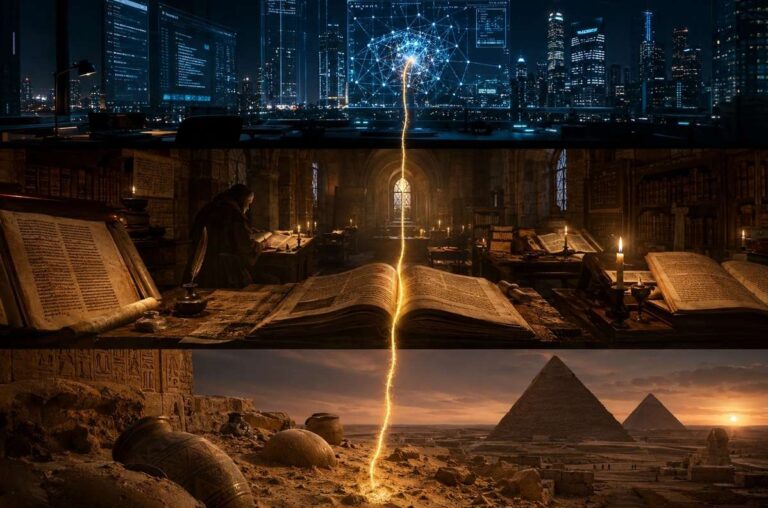
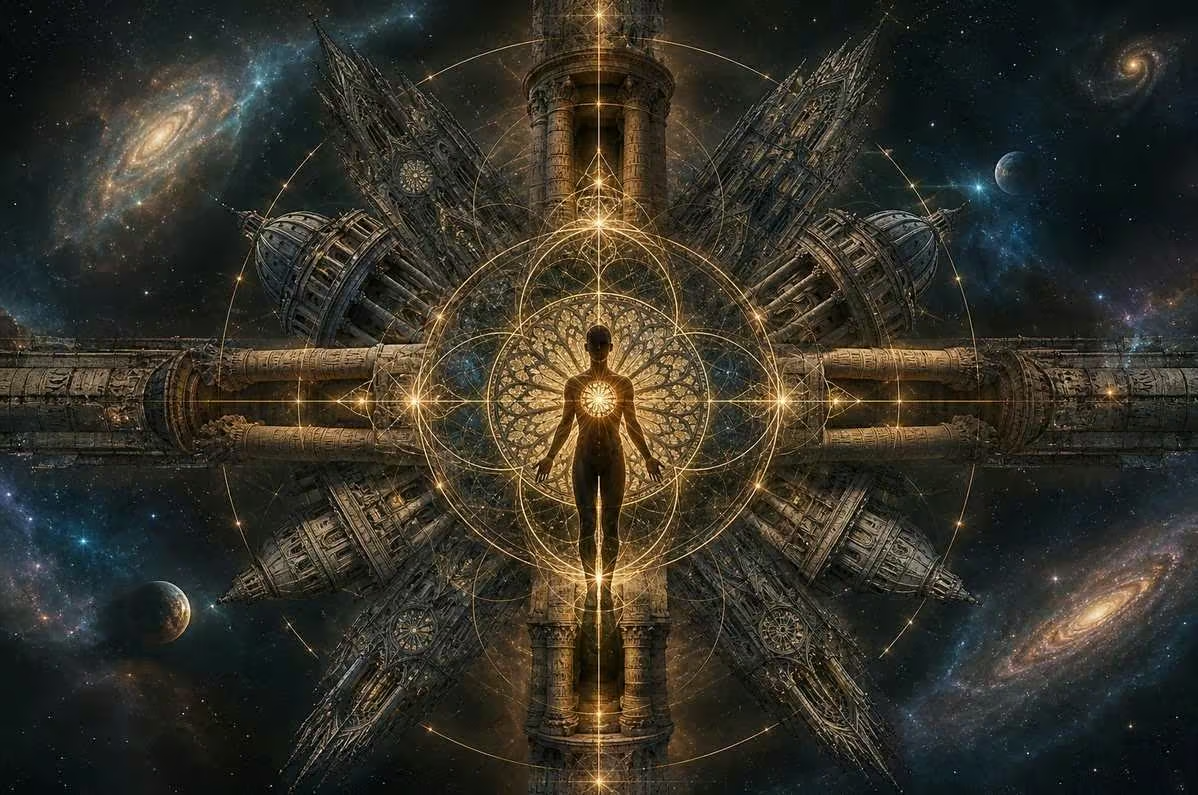
Before the printing press, before widespread literacy, before the digital archive, there existed another technology for preserving and transmitting esoteric knowledge: sacred architecture. The temple, the cathedral, the stone circle–these were not merely buildings but texts written in geometry, light, and spatial proportion. They constituted The Hidden Agreements made manifest in three dimensions, encoding cosmological maps, initiatory pathways, and metaphysical principles within walls of stone and glass.
This article examines sacred architecture as an esoteric technology–the deliberate construction of spaces designed to transform consciousness, facilitate encounter with the divine, and preserve secret teachings through symbolic form. From the pyramids of Egypt to the Gothic cathedrals of Europe, from Hindu temple complexes to Hermetic sacred geometry, we trace how the hidden agreements of Western esotericism found expression in built environment. Where claims remain speculative, we note the distinction between scholarly consensus and esoteric interpretation, for discernment, not paranoia, guides the serious student.
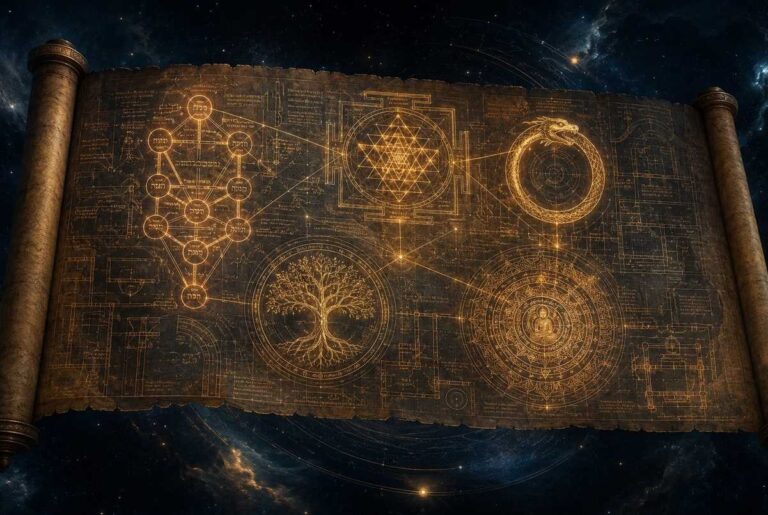
Traditional civilisations understood the temple not as a meeting house for the faithful but as a cosmic diagram–a material representation of spiritual architecture that both mirrored and influenced the universe’s structure.
Table of Contents
- The Temple as Cosmic Diagram
- Gothic Cathedrals: Encrypted Wisdom or Platonic Synthesis?
- The Geometry of Consciousness
- Egyptian Temple Technology
- The Axis Mundi and Sacred Space
- Renaissance Harmonisation
- Contemporary Resonances
- Building the Living Temple
- Frequently Asked Questions
- Further Reading
- References and Sources
The Temple as Cosmic Diagram
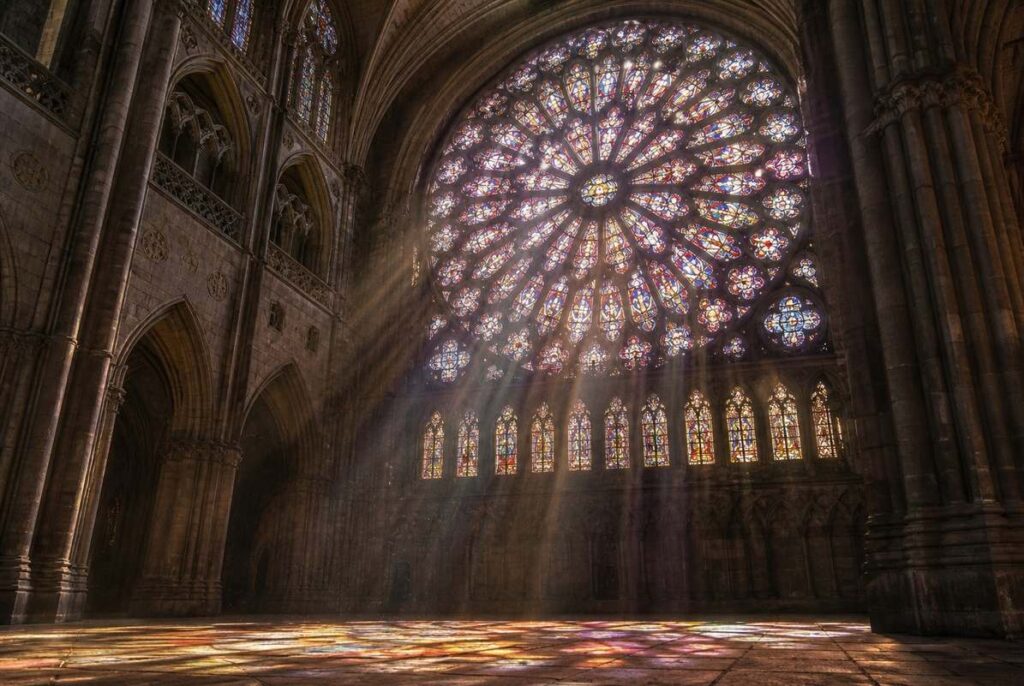
Traditional civilisations understood the temple not as a meeting house for the faithful but as a cosmic diagram–a material representation of spiritual architecture that both mirrored and influenced the universe’s structure. The Egyptian temple complex at Luxor, interpreted by R.A. Schwaller de Lubicz as encoding the human form (anthropos) at architectural scale, suggests that the temple served as body for divine presence just as the body serves as temple for the soul. While mainstream Egyptology regards Schwaller’s anthropomorphic reading as speculative, his detailed metrological studies remain influential in esoteric circles for their systematic correlation of architectural proportion with human anatomy.
This concept of the temple as microcosm reflects the Hermetic principle of correspondence: “as above, so below.” The ziggurats of Mesopotamia, the stepped pyramids of Central America, and the pagodas of Asia all instantiate this principle, creating vertical axes (axis mundi) connecting terrestrial and celestial realms. The pilgrim entering such spaces did not merely visit a holy site but participated in a cosmological drama, ascending through levels of existence toward ultimate reality. Mircea Eliade’s concept of the axis mundi–the world axis connecting cosmic levels–finds architectural expression across virtually all sacred traditions, from the stupa to the spire.
For the Gnostic seeker, this architectural symbolism carried specific soteriological significance. The temple’s inner sanctuary (adyton) represented the Pleroma itself–the fullness of divine reality–while the outer courts symbolised the material realm under archonic control. Initiatory progress through temple spaces thus enacted the soul’s journey from ignorance to gnosis, from fragmentation to integration.
The Anthropomorphic Hypothesis at Luxor
Schwaller de Lubicz’s decades-long study of Luxor proposed that the temple’s proportions correspond to a reclining human figure, with specific chambers aligning to anatomical centres. Whether this reflects the builders’ intention or the observer’s hermeneutical framework remains debated. What is certain is that Egyptian temples progressed from public outer courts through increasingly restricted inner sanctuaries, culminating in the naos containing the cult statue–an architectural sequence mirroring hierarchical ascent.
The Axis Mundi and Vertical Topology
The vertical axis represents the anthropos standing erect, consciousness bridging matter and spirit. The meditating Buddha, the crucified Christ, and the risen Osiris all embody this axial posture, suggesting that sacred architecture externalises an interior reality: the awakened human as living temple. The orientation of sacred structures encodes functional connections to cosmic time–churches align east-west toward the rising sun, while the Great Pyramid’s shafts align with stars relevant to Egyptian stellar theology.
Gothic Cathedrals: Encrypted Wisdom or Platonic Synthesis?
The great cathedrals of medieval Europe–Chartres, Notre-Dame de Paris, Salisbury–represent perhaps the most sophisticated expression of esoteric architecture in the Western tradition. The 12th-century School of Chartres, immersed in the rediscovered philosophical works of Plato, Pythagoras, and the neo-Platonists, pursued the inter-relationships between macrocosm and microcosm as a key to divine insight. Their intellectual project–a cathedral as microcosm of the divine macrocosm–produced spaces designed to function as bridges between human and divine.
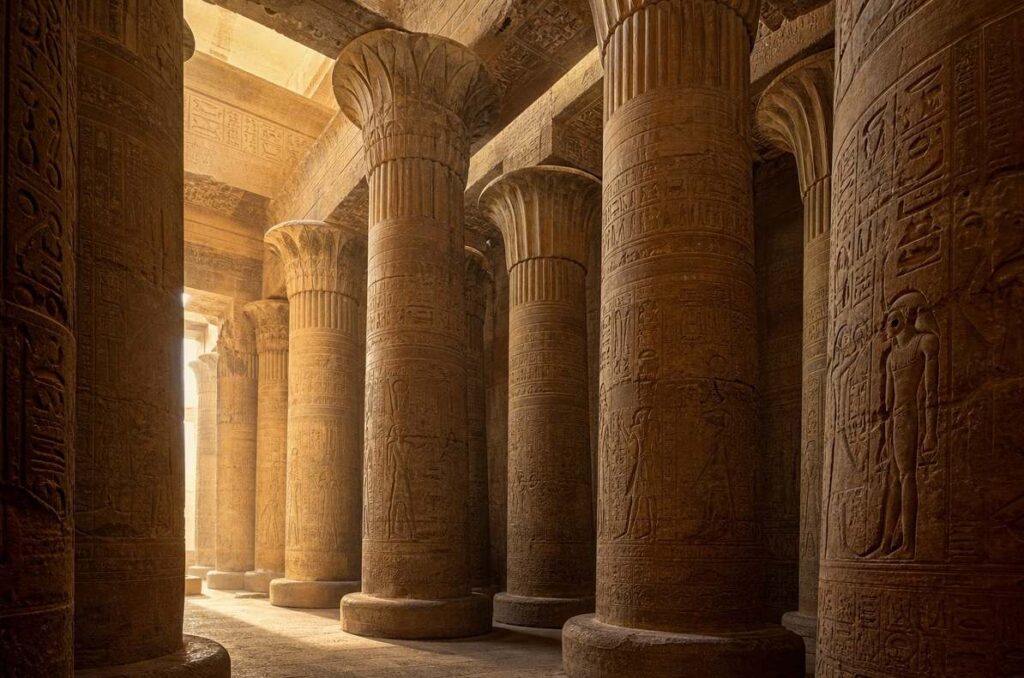
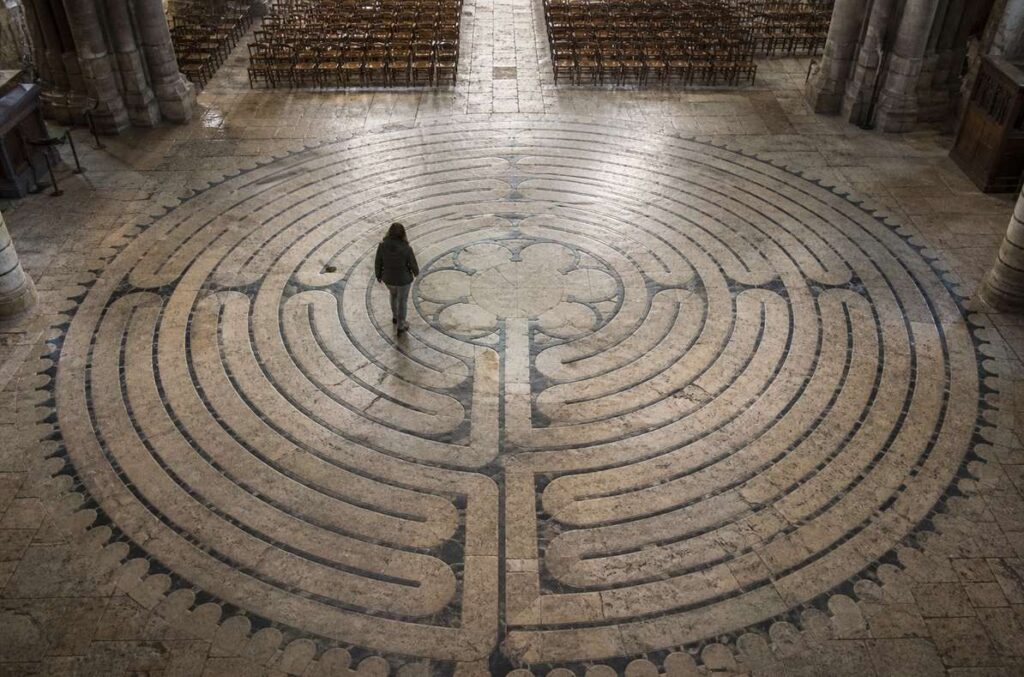
Whether medieval guilds (compagnons) preserved initiatory knowledge from Egyptian or Hermetic sources, as some esoteric historians claim, remains unproven. What scholarly research confirms is that cathedral builders employed sophisticated proportional systems and that the labyrinth inlaid in Chartres’ floor (completed around 1225) provided a meditative path representing the soul’s journey toward centre. The famous rose windows represent complex theological symbolism–the Pleroma in Gnostic interpretation–while the west-front portals present biblical narratives accessible to the literate and illiterate alike.
The School of Chartres and the Medieval Recovery of Plato
The scholars at Chartres perceived tangible reality as an expression of the divine mind, immersing themselves in ancient philosophy to understand cosmic inter-relationships. This was not secret knowledge hidden from the Church but an intellectual movement within medieval Christianity, drawing on Boethius and Calcidius to reconcile Plato with Christian theology. The cathedral’s very construction expressed this synthesis: a stone argument for the rationality of the cosmos.
The Labyrinth as Unicursal Technology
The Chartres labyrinth spans the entire nave with eleven concentric circuits, four quadrants, and a six-petalled centre–the largest medieval church labyrinth ever installed. Unlike mazes, which confuse, labyrinths offer single paths leading inevitably to centre and return. This unicursal design induces walking meditation, quieting the discursive mind. Medieval Christians walked the Chartres labyrinth as an alternative to pilgrimage to the Holy Lands.
Light as Theology: The Rose Window
Stained glass windows served as “sermons in stone and light,” encoding astrological, alchemical, and biblical symbolism. The west rose at Chartres (11.9 metres diameter) and the labyrinth (12.9 metres diameter) share approximate dimensional correspondence, suggesting intentional design harmony. For the prepared observer, this interplay of geometry and coloured light creates conditions conducive to altered states of awareness.
The Geometry of Consciousness
Sacred architecture operates through mathematical principles believed to correspond with the structure of consciousness itself. The study of sacred geometry–the Vesica Piscis, the Flower of Life, the Golden Spiral–reveals patterns recurring throughout nature and cosmos. These forms are not merely decorative but functional: they concentrate, direct, and transform subtle energies (pneuma, prana, chi) within built environments.
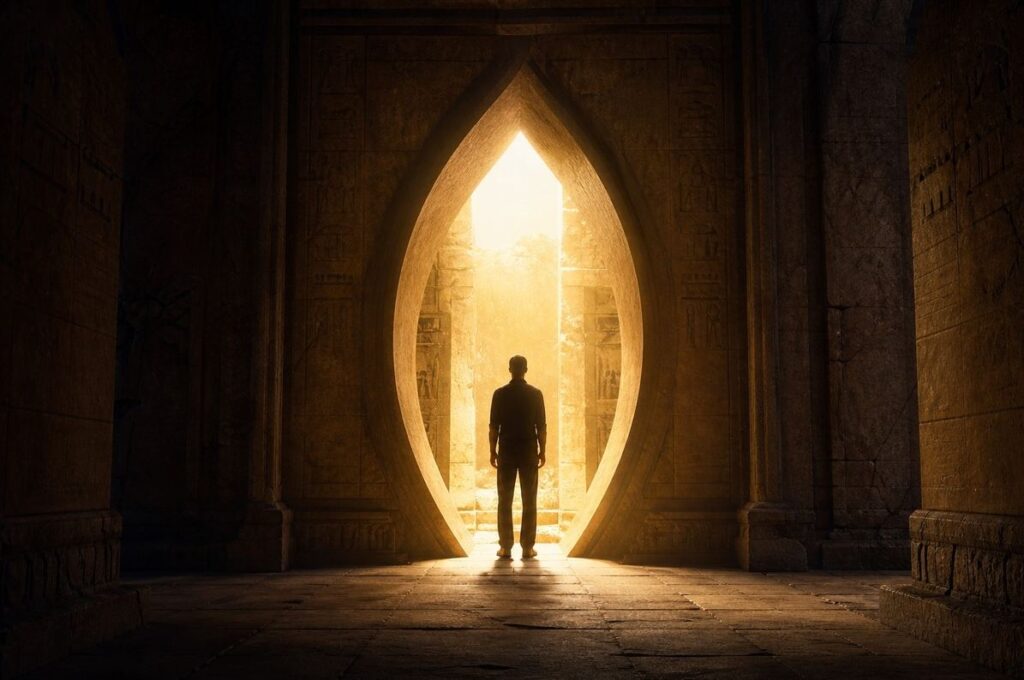
The vesica piscis, formed by the intersection of two circles, generates the proportions of the Gothic arch and the plan of the cathedral itself. This shape, resembling the eye or the mandorla (almond-shaped aureole surrounding sacred figures), represents the intersection of divine and human realms–the very threshold where gnosis becomes possible. Walking through a Gothic portal, one literally passes through this symbolic membrane.
Sacred Proportion and Human Perception
Renaissance architects rediscovered Vitruvius’ principle that architectural proportions should mirror the human body. Filippo Brunelleschi’s churches, Leon Battista Alberti’s treatises, and Andrea Palladio’s villas applied classical and Pythagorean principles to Christian contexts. The ideal of the centrally planned church–perfect circle or Greek cross–reflected the concept of divine unity and cosmic harmony, producing spaces designed for individual transformation through harmonious environment.
The Vesica Piscis as Threshold
The Gothic arch derives from the vesica piscis proportion, creating a liminal space between interior and exterior, sacred and profane. This geometric form appears throughout medieval art as the mandorla surrounding Christ in majesty, reinforcing the architectural symbolism with pictorial representation. To pass through such a portal is to undergo a geometric baptism–a crossing from one ontological state to another.
Egyptian Temple Technology
The temples of ancient Egypt represent the most enduring and influential tradition of sacred architecture. Constructed according to principles codified in the Sesh Medu Neter (hieroglyphic writings), Egyptian temples functioned as machines for maintaining cosmic order (Ma’at) and facilitating divine embodiment.
The typical Egyptian temple progressed from public outer courts through increasingly restricted inner sanctuaries, culminating in the naos containing the cult statue. This architectural sequence mirrored the soul’s journey through planetary spheres toward the divine presence–an ascent pattern encoded in stone millennia before the Nag Hammadi texts. The hypostyle halls, with their forest of columns representing papyrus and lotus, created symbolically charged environments where consciousness could shift from ordinary to extraordinary perception.
The Sesh Medu Neter and Architectural Ritual
Egyptian architectural principles were codified in sacred texts that governed proportion, orientation, and decorative programme. The temple was not merely a house for the god but a mechanism for maintaining Ma’at–cosmic order–through ritual performance. Every element, from column capitals to sanctuary proportions, participated in this cosmic technology. The temple thus operated as a three-dimensional liturgy, its spaces choreographing movement toward divine encounter.
The Great Pyramid: Mathematical Convergence or Intentional Design?
The Great Pyramid of Giza demonstrates remarkable precision in geometry and astronomical alignment. Its proportions encode mathematical constants with intriguing accuracy: the ratio of perimeter to height approximates 2π to within 0.04%, while phi relationships appear within 0.025% of estimated dimensions. Whether these represent intentional design or remarkable mathematical convergence remains debated among scholars. What is uncontroversial is that the pyramid served as geodetic marker and astronomical observatory–an architectural statement of cosmic correspondence.
The Axis Mundi and Sacred Space
Mircea Eliade’s concept of the axis mundi–the world axis connecting cosmic levels–finds architectural expression in virtually all sacred traditions. The stupa, the pagoda, the minaret, the obelisk, and the spire all function as vertical connectors, drawing celestial influence into terrestrial space and providing pathways for human ascent.
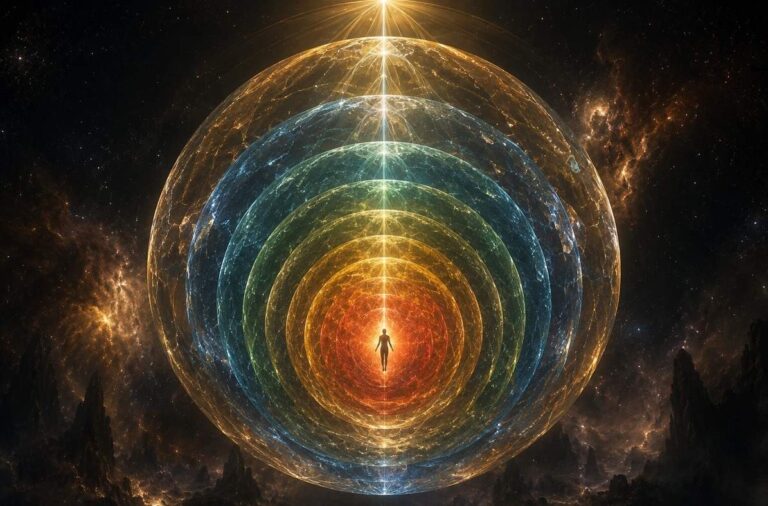
In Gnostic and Hermetic contexts, this vertical axis represents the anthropos standing erect, consciousness bridging matter and spirit. The meditating Buddha, the crucified Christ, and the risen Osiris all embody this axial posture, suggesting that sacred architecture externalises an interior reality: the awakened human as living temple.
Orientation and Celestial Alignment
The orientation of sacred structures encodes esoteric knowledge functionally connecting built space with cosmic time. Churches traditionally align east-west, with the altar facing the rising sun–symbol of resurrection and solar rebirth. The Great Pyramid’s shafts align with specific stars (Sirius, Orion) relevant to Egyptian stellar theology. These orientations are not arbitrary but functional, connecting built space with cosmic time and celestial influence.
Renaissance Harmonisation
The Renaissance rediscovery of classical proportions generated new syntheses of sacred architecture. Filippo Brunelleschi’s churches, Leon Battista Alberti’s treatises, and Andrea Palladio’s villas all applied mathematical proportions to Christian contexts, drawing on Vitruvius rather than explicit Hermetic texts. The ideal of the centrally planned church–perfect circle or Greek cross–reflected the concept of divine unity and cosmic harmony.
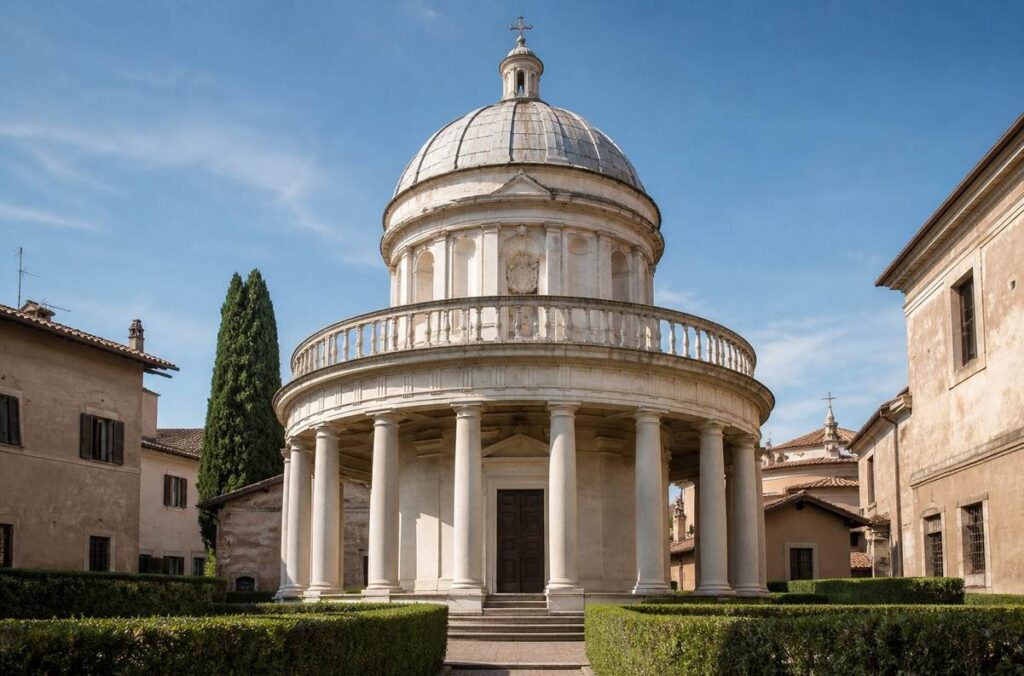
St. Peter’s Basilica, the Tempietto, and the city plans of ideal Renaissance towns all embody the analogia between cosmic, architectural, and human proportions. This period saw the convergence of classical philosophy and ecclesiastical architecture, producing spaces designed not merely for congregational worship but for individual transformation through harmonious environment.
Vitruvian Proportion and the Body-Building Analogy
Brunelleschi’s architectural approach employed simple geometric principles to produce rational structures based on repeated modules, drawing on his studies of ancient Roman buildings. Alberti’s De re aedificatoria, the first printed architectural treatise of the era, emphasized harmony, mathematical proportions, and classical architecture. The Vitruvian ideal–that buildings should mirror the proportions of the human body–created an analogia between the microcosm of the body and the macrocosm of the building.
The Centrally Planned Church
The circular or Greek-cross plan, exemplified by Bramante’s Tempietto and Palladio’s villas, reflected the Hermetic concept of divine unity. These spaces were designed to draw the eye toward a central focal point–dome, altar, or oculus–creating a unified field of perception that quiets discursive thought. The pilgrim entering such a space finds their awareness gathered into a single geometric centre, mimicking the contemplative state itself.
Contemporary Resonances
Modern architecture has largely abandoned sacred geometry for functionalist and economic constraints, yet the principles persist in unexpected contexts. The psychedelic architecture of the 1960s, the sustainable design movements emphasising harmony with nature, and the resurgence of interest in labyrinths and sacred space all indicate continued need for architecture that transcends mere utility.
For contemporary Gnostic practitioners, understanding sacred architecture provides resources for creating appropriate environments for spiritual practice. The home altar, the meditation room, the ritual space–all can incorporate principles of orientation, proportion, and symbolism that facilitate consciousness transformation. The contemporary Gnostic Archive itself–whether physical or digital–participates in this tradition, creating structured space for encounter with wisdom.
From Tourist Destination to Initiatory Technology
Recognition of architectural encoding awakens perception to the hidden agreements embedded in existing structures. The cathedral visited as tourist destination becomes initiatory technology when approached with gnosis. Observers have noted geometric patterns in city plans–Washington D.C.’s street layout, for instance–that suggest Masonic and esoteric influences on collective space, though such claims require careful verification against historical records rather than speculative assertion.
Building the Living Temple
Sacred architecture reminds us that the hidden agreements are not merely intellectual propositions but spatial experiences. The temple teaches through the body, transforming consciousness through proportion, light, and movement. In an age of virtual reality and digital simulation, the stone book retains its power–offering grounded, embodied encounter with cosmic principles.
The ultimate sacred architecture, however, remains the human form itself–microcosm of the cosmos, temple of the spirit. External structures serve their purpose when they awaken recognition of the interior temple: the body as axis mundi, consciousness as sacred space. The Gothic cathedral, the Egyptian temple, the stone circle–all point toward this interiorisation, awaiting the moment when the pilgrim realises that the journey’s end was always within.
Frequently Asked Questions
What is sacred architecture?
Sacred architecture refers to buildings and spaces designed not merely for shelter or congregation but as technologies for consciousness transformation. Through proportion, geometry, orientation, and symbolic form, these structures encode cosmological maps and facilitate encounter with divine or transcendent realities.
How does sacred geometry influence consciousness?
Sacred geometry employs mathematical ratios–such as the golden ratio, vesica piscis, and harmonic proportions–that recur throughout nature and cosmos. These forms are believed to resonate with the structure of human perception, creating environments that quiet discursive thought and prepare awareness for visionary or contemplative experience.
Did medieval cathedral builders use secret esoteric knowledge?
While esoteric historians claim medieval guilds preserved initiatory knowledge from ancient sources, scholarly research confirms that cathedral builders employed sophisticated proportional systems derived from classical and Platonic sources. The School of Chartres explicitly studied Pythagoras and Plato to create cosmic diagrams in stone, though this was an intellectual movement within Christianity rather than a secret conspiracy.
What is the significance of the Chartres labyrinth?
The Chartres labyrinth, completed around 1225, features eleven concentric circuits in a unicursal design–a single path leading to centre and return. Medieval Christians walked it as an alternative to pilgrimage. Its geometric precision and integration with the cathedral’s rose window suggest intentional design as a technology for walking meditation and spiritual processing.
Does the Great Pyramid encode advanced mathematical knowledge?
The Great Pyramid’s proportions show remarkable convergences with mathematical constants: the perimeter-to-height ratio approximates 2pi to within 0.04%, and phi relationships appear within 0.025%. Whether these represent intentional design or remarkable coincidence remains debated among scholars, but the precision indicates sophisticated geometric knowledge.
What is the axis mundi in sacred architecture?
The axis mundi, or world axis, is a vertical connector between terrestrial and celestial realms. In architecture, it appears as spires, obelisks, minarets, and central domes. This vertical element symbolises the human being as bridge between matter and spirit, and orients sacred space toward cosmic influence.
How can contemporary practitioners use sacred architecture principles?
Contemporary practitioners can apply sacred architecture principles to home meditation spaces, altars, and ritual environments through attention to orientation, proportion, and symbolic form. Understanding these principles also transforms how one visits existing sacred sites–approaching cathedrals and temples as active technologies for consciousness rather than mere historical monuments.
Further Reading
Deepen your exploration of sacred architecture and the hidden agreements with these related articles from the ZenithEye archive:
- Esoteric Lineages: The Hidden Agreements That Shaped Western Mysticism — Traces the transmission of initiatory knowledge through Western history.
- Hermeticism and Gnosticism: The Egyptian Wisdom Traditions Compared — Explores the shared roots of Hermetic and Gnostic cosmology.
- Transmission and Lineage: How the Gnosis Travels — Examines how esoteric knowledge moves across generations and cultures.
- Hermetic Connections in the Nag Hammadi Library — Surveys the Hermetic texts and their influence on Gnostic thought.
- Hidden Agreements: Esoteric Architecture — Explores the architectural encoding of secret teachings across traditions.
- Sacred Geometry: Architecture of Creation — Examines geometric principles as universal building blocks.
- Tree of Life: Kabbalistic Architecture — Investigates the architectural expression of Kabbalistic cosmology.
- Emerald Tablet: Hermetic Foundation and Correspondence — The foundational text of Hermetic philosophy and its architectural implications.
- Architecture of Reality: Information Precedes Matter — A contemporary exploration of how information structures manifest reality.
References and Sources
The following sources informed the historical, architectural, and esoteric analysis presented in this article. Primary and scholarly works are grouped by category for clarity.
Primary Sources and Critical Editions
- Schwaller de Lubicz, R.A. (1998). The Temple of Man: Apet of the South at Luxor. Inner Traditions.
- Eliade, Mircea. (1959). The Sacred and the Profane: The Nature of Religion. Harcourt.
- Vitruvius. De Architectura (Ten Books on Architecture). Multiple editions.
Scholarly Monographs
- Ellard, Peter. (2007). The Sacred Cosmos: Theological, Philosophical, and Scientific Conversations in the Twelfth-Century School of Chartres. University of Scranton Press.
- James, John. (2024). Chartres Cathedral Labyrinth: Context Matters. Geoffrion and Louët research archive.
- Markovsky, George. (1992). “Misconceptions about the Golden Ratio.” The College Mathematics Journal, 23(1), 2-19.
- Reynolds, Mark. (1999). “Comparative Geometric Analysis of the Great Pyramid and the Pyramid of the Sun.” Nexus Network Journal, 1(4).
Comparative Studies
- Lawlor, Robert. (1982). Sacred Geometry: Philosophy and Practice. Thames & Hudson.
- Schneider, Michael S. (1994). A Beginner’s Guide to Constructing the Universe. HarperPerennial.
- Tompkins, Peter. (1971). Secrets of the Great Pyramid. Harper & Row.