The Restoration of All Things: Apokatastasis in Gnostic Eschatology
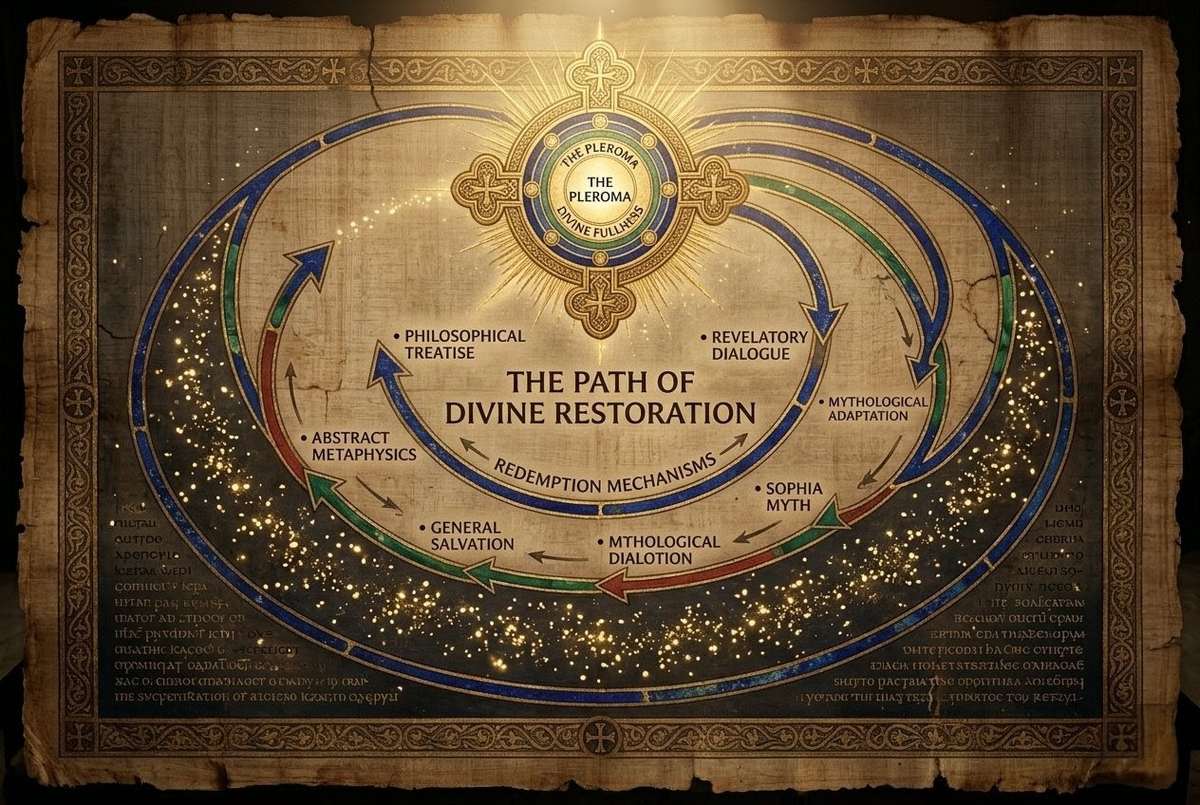
The eschatology of the Nag Hammadi Library presents a striking bureaucratic reversal: while orthodox Christianity processed souls toward eternal departmental separation (saved versus damned, heaven versus hell), the Gnostic archives preserve a radically different administrative protocol. Apokatastasis—the restoration of all things to primordial fullness—envisions history not as linear progression toward permanent exile, but as a circuitous return journey home. The scattered sparks of divine intelligence, temporarily misplaced in the archontic filing system, will inevitably retrieve their original clearance codes and return to the Pleroma. This restorationist theology, most eloquently articulated in Valentinian texts but echoing throughout the library, promises that ultimate reality is reconciliation rather than eternal conflict—that the “deficiency” (hysterēma) introduced by Sophia’s administrative error will be overcome by the abundance (plerōma) of divine grace.
Table of Contents
The Gospel of Truth: Error as Fading Smoke
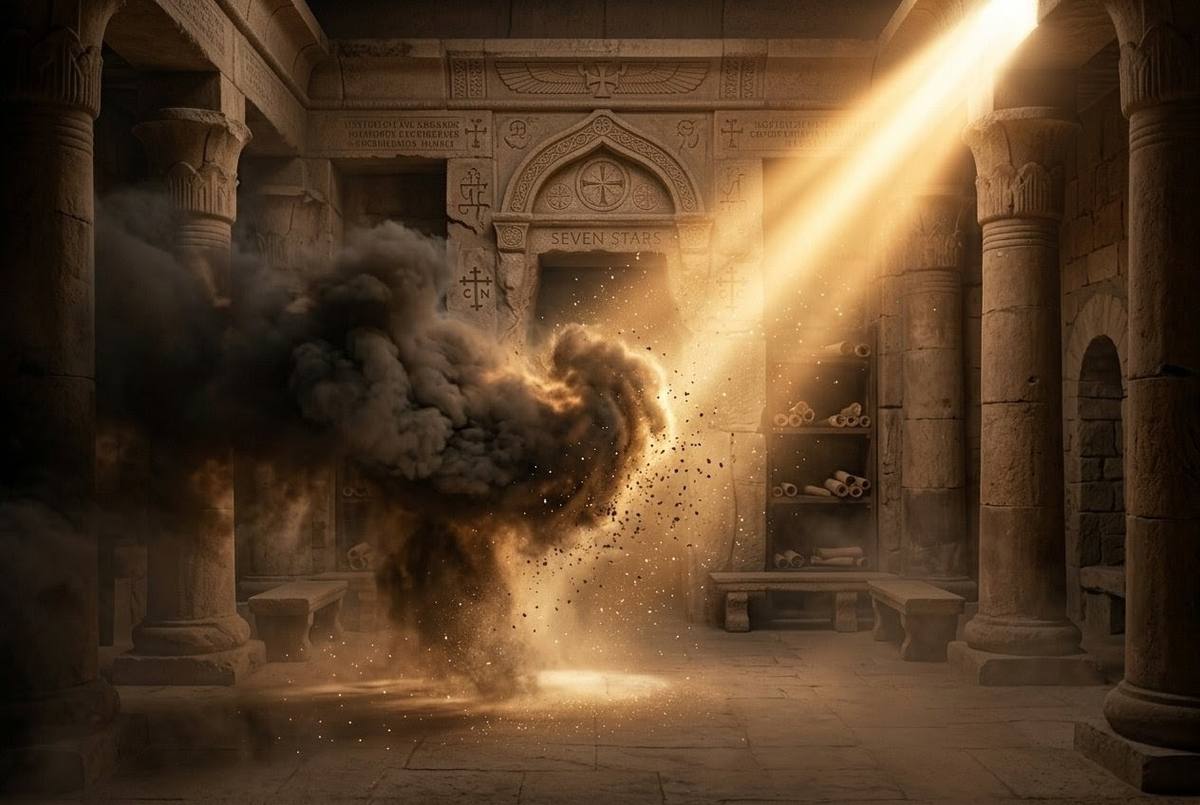
The Gospel of Truth (NHC I,3) presents the most eloquent statement of apokatastasis in the entire library—a theological vision that transforms cosmic tragedy into parenthetical miscalculation. Here, the fall is not ontological catastrophe but administrative error, “a fog” that obscures but cannot destroy the underlying light of divine reality. The Saviour functions not as punitive auditor but as retrieval specialist, coming “to seek and save what was lost, to bring back into the Fullness those who had wandered” like misplaced files in a vast bureaucratic archive.
What is Apokatastasis?
Apokatastasis (Greek: ἀποκατάστασις, “restoration” or “reconstitution”) refers to the eschatological doctrine that all things will eventually return to their original state of harmony with the divine. Originating in Stoic philosophy and developed by Origen of Alexandria, this universalist theology holds that the “deficiency” or error introduced into cosmic administration will be ultimately overcome, and all spiritual essences will be restored to the Pleroma (Fullness). In Nag Hammadi texts, this means the dissolution of archontic power and the inevitable return of scattered divine sparks to their source.
The Self-Consuming Nature of Error
The text’s theology is resolutely optimistic in ways that scandalised orthodox polemicists: “There is no such thing as rejection, but there is transformation.” Error will eventually consume itself; lacking root in true being, it dissipates like smoke when the fire of knowledge (gnōsis) burns away ignorance. The eschaton is not cataclysmic destruction but administrative clarification—the recognition that separation from the Father was always illusory, maintained only by experiential amnesia rather than ontological reality. The archons’ jurisdiction was temporary and illegitimate; their paperwork will be shredded when the true administrative hierarchy resumes control.
The Dissolution of Material Insignificance
This has radical implications for soteriology. If all things return to the Fullness, what becomes of the archons and the material realm they administer? The Gospel of Truth suggests that even these will be transformed or dissolved, their apparent reality exposed as temporary insubstantiality. Only the spirit that originated in the Pleroma possesses enduring substance; all else was “nothing” (ouk on) mistaken for something, a cosmic accounting error that will be corrected in the final audit. The material prison is not destroyed in rage but discontinued due to lack of funding when the restoration protocol activates.
Primary Source Citations: Gospel of Truth (NHC I,3) 18:24-33 (error as fog/smoke); 20:28-30 (“no such thing as rejection”); 25:10-15 (bringing back into Fullness); 26:4-8 (only spirit has true substance). The text represents Valentinian theology from the second century CE, possibly composed by Valentinus himself or his immediate circle.
Sethian Eschatology: Gathering the Scattered
Sethian texts offer a more complex eschatological vision, sometimes preserving the restorationist optimism, sometimes introducing elements of judgment and qualified separation. The Apocryphon of John describes how the spiritual seed will be “gathered in” and brought back to the invisible realm through systematic retrieval operations, whilst the material and psychic elements dissolve or remain in the lower spheres as non-functional debris.
Qualified Apokatastasis: The Spiritual Elect
This suggests a qualified apokatastasis: not all entities will be saved, but all spiritual things—all authentic sparks of the divine essence—will inevitably return to their source. The material realm itself has no eschatological future; created in deficiency by the demiurgical error, it will dissolve when its purpose (the education and testing of spirits) concludes. But the spiritual elect, the “immovable race” of Seth, possess an essential ontological connection to the divine that ensures ultimate restoration regardless of temporary archontic interference.
The Three Steles of Seth: Liturgical Ascent
The Three Steles of Seth (NHC VII,5) hymns describe this restoration in liturgical terms that transform eschatology into present experience. The ascending soul passes through various stations of praise—first addressing the Self-Generated, then the Unbegotten, finally the Unknowable One—progressively divesting itself of alien administrative accretions until it stands “in the presence of the One who is not manifest.” The journey is arduous, requiring proper passwords and protocols, but the outcome is ontologically certain—determined not by arbitrary divine decree but by the metaphysical necessity that spirit must return to spirit, light to light.
The Three Classes: Universalism Within Hierarchy
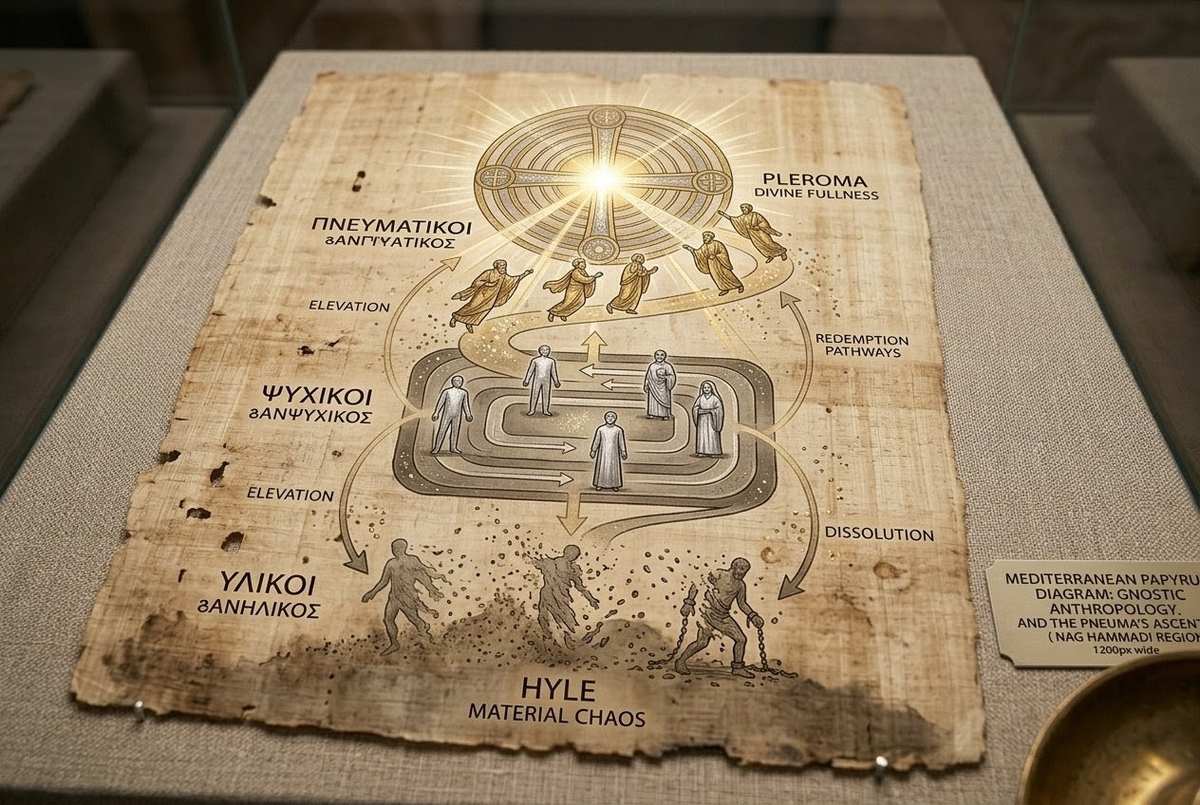
Valentinian theology complicates the restorationist picture through its sophisticated threefold anthropology—a spiritual stratification system that processes different classes of beings through distinct eschatological protocols. The “spiritual” (pneumatikoi) will certainly be restored to the Pleroma with full administrative privileges; the “material” (hylikoi) will perish with the cosmos as temporary contractors with no permanent clearance; but what of the intermediate “psychic” (psychikoi)—those capable of faith and moral improvement but lacking the divine spark of full citizenship?
Soft Universalism and Purgatorial Logic
Some Valentinian systems suggest that even the psychic class will be saved, though at a lower administrative level—granted immortality in the “place of the midst” (mesotēs) rather than full participation in the divine Fullness. Others imply eventual universal restoration after appropriate purgatorial periods of education and rehabilitation. The Tripartite Tractate (NHC I,5) hints that the Saviour’s work extends to all classes, though with different effects: perfecting the spiritual, saving the psychic, and rendering the material harmless through dissolution.
Justice and Mercy in Eschatological Administration
This “soft universalism” distinguishes Valentinianism from both orthodox eternal damnation and the more radical Gnostic elitism that condemned the majority to destruction. It preserves justice (each receives according to ontological nature) while affirming mercy (none capable of salvation is finally excluded). The eschatological bureaucracy operates on sophisticated protocols: full restoration for the pneumatic elite, rehabilitation and intermediate status for the psychic masses, and merciful dissolution for the hylic dross that never possessed divine potential.
The Three Classes in Valentinian Anthropology
Pneumatikoi (Spirituals): Possess the divine spark; destined for full restoration to the Pleroma; identified with the seed of Seth or elect community.
Psychikoi (Psychics): Intermediate class with soul but no divine spark; capable of faith and morality; destined for salvation in the “place of the midst” or eventual rehabilitation.
Hylikoi (Materialists): Composed of matter alone; no spiritual potential; will perish with the material cosmos; essentially temporary constructs with no eternal filing status.
Time and Eternity: The Eschatological Present
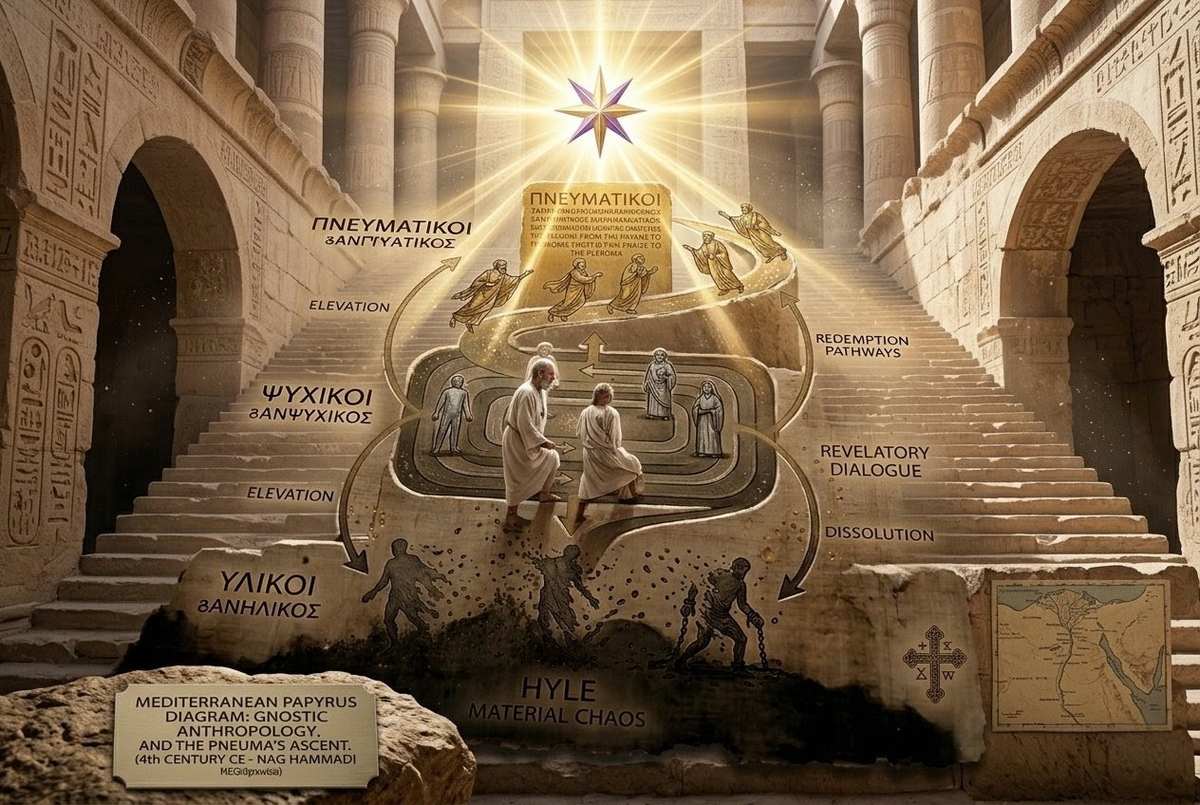
A distinctive feature of Nag Hammadi eschatology is the collapsing of future hope into present experience—the realisation that apokatastasis is not merely future expectation but immediate recognition. The Gospel of Thomas declares: “The kingdom is inside you and outside you; when you know yourselves, you will be known, and you will understand that you are children of the living Father.” (NHC II,2 3:3-5). The restoration is now: realising that one has never truly left the Pleroma, that the “fall” was experiential rather than ontological, that the archontic prison was always permeable to those who knew the passwords.
Already and Not Yet
This realised eschatology coexists with futurist expectation without contradiction. The library preserves both the “already” (gnosis as immediate restoration of identity) and the “not yet” (the final gathering of all scattered sparks, the dissolution of the archons, the eschatological wedding feast). Perhaps these were understood sequentially: individual restoration through knowledge now, cosmic restoration at the end of the age when the last spark has been retrieved and the archontic administration shuttered for lack of personnel.
The Treatise on Resurrection: Present Immortality
The Treatise on Resurrection (NHC I,4) pushes this realised eschatology to radical extremes. Addressed to Rheginos, it argues that the resurrection is not a future event but a present reality: “Do not think of the resurrection as something future. It has already come, and you do not recognise it.” The Pauline letter transforms eschatology into soteriology—the restoration is available now through gnosis, not postponed to some distant cosmic finale. This represents the apex of restorationist theology: not merely that all things will return to fullness, but that they already are full, and only ignorance prevents recognition.
The Dissolution of Deficiency
Ultimately, Nag Hammadi eschatology envisions not the eternal perpetuation of the status quo, but the dissolution of deficiency itself. The material cosmos, created as temporary educational facility, will close its doors when the last student graduates. The archons, temporary substitute teachers who forgot their provisional status, will be retired. The divine sparks, scattered like files across a chaotic filing system, will be gathered, sorted, and returned to the Pleroma with full benefits restored.
This is the good news of apokatastasis: the error was temporary, the separation illusory, the restoration inevitable. The divine administration operates on principles of mercy rather than retribution, ontology rather than morality, recognition rather than obedience. In the end—which is also the beginning—all that truly is will return to all that truly is, and the archontic nightmare will dissolve like smoke in the morning sun.
“The Nag Hammadi Library preserves a restorationist eschatology (apokatastasis) distinct from orthodox eternal damnation. The Gospel of Truth describes error as self-consuming smoke that dissipates when knowledge burns; Sethian texts describe gathering scattered sparks to the Pleroma; Valentinian theology proposes three classes with different destinies but eventual universal restoration. This eschatology collapses future hope into present gnosis—the recognition that separation from the divine was always illusory, and restoration is available now through knowledge.”
Frequently Asked Questions
What is apokatastasis in Gnosticism?
Apokatastasis is the doctrine of universal restoration–the return of all things to their original divine state. In Nag Hammadi texts, it means the scattered sparks of divine intelligence will inevitably return to the Pleroma (Fullness), error will dissolve like smoke, and the material realm will cease when its educational purpose concludes. This contrasts with orthodox eternal damnation, promising reconciliation rather than eternal separation.
What does the Gospel of Truth teach about eschatology?
The Gospel of Truth presents apokatastasis as the dissolution of error through knowledge. Error is ‘a fog’ with no ontological root that consumes itself when exposed to gnosis. The Saviour retrieves what was lost and brings it back into the Fullness. There is no eternal rejection, only transformation–suggesting all spiritual substances return to their source.
What are the three classes in Valentinian theology?
Valentinians divided humanity into three classes: (1) Pneumatikoi (spirituals)–possessing divine spark, destined for full Pleroma restoration; (2) Psychikoi (psychics)–capable of faith but lacking divine spark, destined for salvation in the ‘place of the midst’ or eventual rehabilitation; (3) Hylikoi (materialists)–composed of matter alone, destined to perish with the cosmos.
What is Sethian eschatology?
Sethian texts describe gathering the scattered spiritual seed back to the invisible realm. The ‘immovable race’ of Seth possesses ontological connection to the divine ensuring restoration. Material and psychic elements dissolve or remain in lower spheres. The Three Steles of Seth describe liturgical ascent through praise stations until standing in the presence of the Unknowable One.
What is realised eschatology in the Nag Hammadi Library?
Realised eschatology collapses future hope into present experience. The Gospel of Thomas declares the kingdom is ‘inside you and outside you’–restoration is available now through self-knowledge. The Treatise on Resurrection argues resurrection has ‘already come’ and is not future. This coexists with futurist expectation of final cosmic restoration when all sparks return.
Will everyone be saved in Gnosticism?
It depends on the text. Valentinian ‘soft universalism’ suggests all capable of salvation will eventually be restored, though with different statuses (full Pleroma for spirituals, middle realm for psychics). Sethian texts suggest only the spiritual ‘seed’ returns to the Pleroma while material elements perish. Gospel of Truth implies all error dissolves and all spirit returns.
What happens to the material world in Gnostic eschatology?
The material world, created as temporary deficiency by the demiurgical error, will dissolve when its purpose concludes. The archons lose their jurisdiction; the ‘fog’ of error dissipates; only spirit with true ontological substance endures. This is not destruction out of hatred but discontinuation of a temporary educational facility when all students have graduated.
Further Reading
To explore eschatological themes in specific texts:
- The Gospel of Truth: Poetics of Recognition — Study the classic text on apokatastasis and the dissolution of error as fading smoke.
- The Tripartite Tractate: The Valentinian System Explained — Explore the three classes (pneumatikoi, psychikoi, hylikoi) and their destinies.
- The Apocryphon of John: Gnostic Creation and Salvation — Examine the gathering of the spiritual seed and the immovable race of Seth.
- Three Steles of Seth: Hymns of Ascent — Discover the liturgical journey toward restoration through the three steles.
- The Treatise on Resurrection: Letter to Rheginos — Study Paul’s distinctive realised eschatology and present resurrection.
- The Gospel of Thomas: 114 Keys to Hidden Wisdom — Examine the realised eschatology of the kingdom as present interior reality.
- The Valentinian Exposition: Cosmology and Myth — Explore the theological framework underlying Valentinian eschatological hierarchy.
- The Hypostasis of the Archons: Eve and the Truth of Genesis — Study the archontic powers that lose jurisdiction in eschatological restoration.
- The Nag Hammadi Library: A Complete Guide to the Gnostic Scriptures — Navigate the full collection with attention to eschatological diversity.