The Feminine Divine in Nag Hammadi
One of the most striking features of the Nag Hammadi library–particularly when read against the backdrop of patriarchal traditions that dominated late antiquity–is the prominence of feminine imagery in its theological architecture. This is not merely a matter of including women in salvation history, though that is certainly part of the story. It is rather a systematic elevation of the feminine as a constitutive principle of divinity itself.
We encounter this principle in multiple registers: as the First Thought (Ennoia) of the transcendent Father, as the divine Mother who births the aeons, as the fallen yet redeemable Sophia, as the female prophets and saviours who populate the texts, and as the androgynous ideal that transcends gender even as it integrates it. The Nag Hammadi texts do not simply include the feminine; they depend upon it. In the administrative metaphor that clarifies their cosmology, the feminine functions not as a junior partner in the celestial executive headquarters, but as the essential operational infrastructure–the filing system through which the Invisible Spirit makes himself known.
Table of Contents
- Introduction: The Feminine as Constitutive Principle
- Barbelo: The First Thought
- The Divine Mothers: Sophia and the Ogdoad
- Norea: The Rebellious Daughter
- Thunder: Perfect Mind and the Inclusive Divine
- Mary Magdalene and the Apostolic Woman
- Gender and Salvation: The Androgynous Ideal
- Implications and Questions
- Frequently Asked Questions
- Further Reading
- References and Sources
Barbelo: The First Thought
What is Barbelo?
Barbelo is the threefold First Thought (Protennoia) of the Invisible Spirit in Sethian cosmology. She represents the first emanation from the transcendent Father–the necessary condition for any divine manifestation whatsoever. As the “Mother-Father,” she constitutes the womb of all aeons, the perfect power who is the image of the invisible, virginal Spirit. Without Barbelo, there is no knowable divinity; she is the surface that makes reflection possible.
In Sethian cosmology, the feminine appears at the very first moment of divine self-expression. Barbelo is not a secondary emanation but the necessary condition for any manifestation whatsoever. The Apocryphon of John (NHC II,1) describes her emergence in terms that evoke both birth and cognition: the Father sees his reflection in the luminous water, and that reflection becomes Barbelo [37].
Primary Source Citation: NHC II,1 4,26-5,11 (Apocryphon of John): “And his thought performed a deed and she came forth… This is the first power which was before all of them… the forethought of the All–her light shines like his light–the perfect power which is the image of the invisible, virginal Spirit… the Mother-Father, the first man, the holy Spirit, the thrice-male, the thrice-powerful, the thrice-named androgynous one” [37].
She is thus simultaneously identical with the source and distinct from it–the paradox of all subsequent divine emanation. The text calls her “the first power,” “the perfect Protophanes,” “the perfect Pronoia (Foreknowledge) of the universe.” She exists before the creation of the cosmos, before the generation of the archons, before the fall of Sophia. If the Invisible Spirit is the unthinkable depth, Barbelo is the surface that makes reflection possible–the primary interface between the unknowable executive and the cosmic bureaucracy.
The Trimorphic Protennoia (NHC XIII,1) develops this theme with extraordinary poetic density. Here the speaker declares: “I am the Thought that dwells in the Light… I am the movement that dwells in the All.” The feminine voice speaks as the very principle of self-articulation, the Word that makes the silent Father known. This is not a subordinate role but a constitutive one–without Barbelo, there is no knowable divinity, no classified intelligence flowing from the executive headquarters to the material branch office [17].
The Divine Mothers: Sophia and the Ogdoad
If Barbelo represents the transcendent feminine, Sophia (Wisdom) embodies its immanent expression. In both Sethian and Valentinian systems, Sophia plays the pivotal role of transition between the Pleroma and the material world. Her fall generates the drama of salvation; her restoration provides its pattern. She functions as the appeals department within the celestial administration, receiving petitions from those trapped in the material filing system [24].
Primary Source Citation: NHC II,4 89,3-8 (Hypostasis of the Archons): “And she was called ‘Life’ (Zoe), which is the mother of the living, by the foreknowledge of the sovereignty of heaven. And through her they have tasted the perfect Knowledge.” Sophia here bears the title “mother of the living” in her function as life-giver to the spiritual seed [24].
The Hypostasis of the Archons (NHC II,4) presents Sophia as a complex, almost tragic figure. She creates without a partner, producing the lion-faced Demiurge; she repents and is restored to the eighth heaven (Ogdoad); she intervenes in human history through the serpent and the flood. Throughout, she maintains a maternal relationship to the spiritual seed, the divine sparks scattered in material existence.
This maternal function is not merely biological metaphor. The text speaks of Sophia as “the mother of the living,” a title that echoes Eve’s designation in Genesis but transforms its significance. Here, the mother of life is not a creature but a divine principle; the life she mothers is not biological survival but spiritual awakening. When the archons create Adam, they cannot animate him until Sophia tricks them into giving up the spiritual power they have stolen from her–a classic case of administrative malpractice corrected by divine intervention [31].
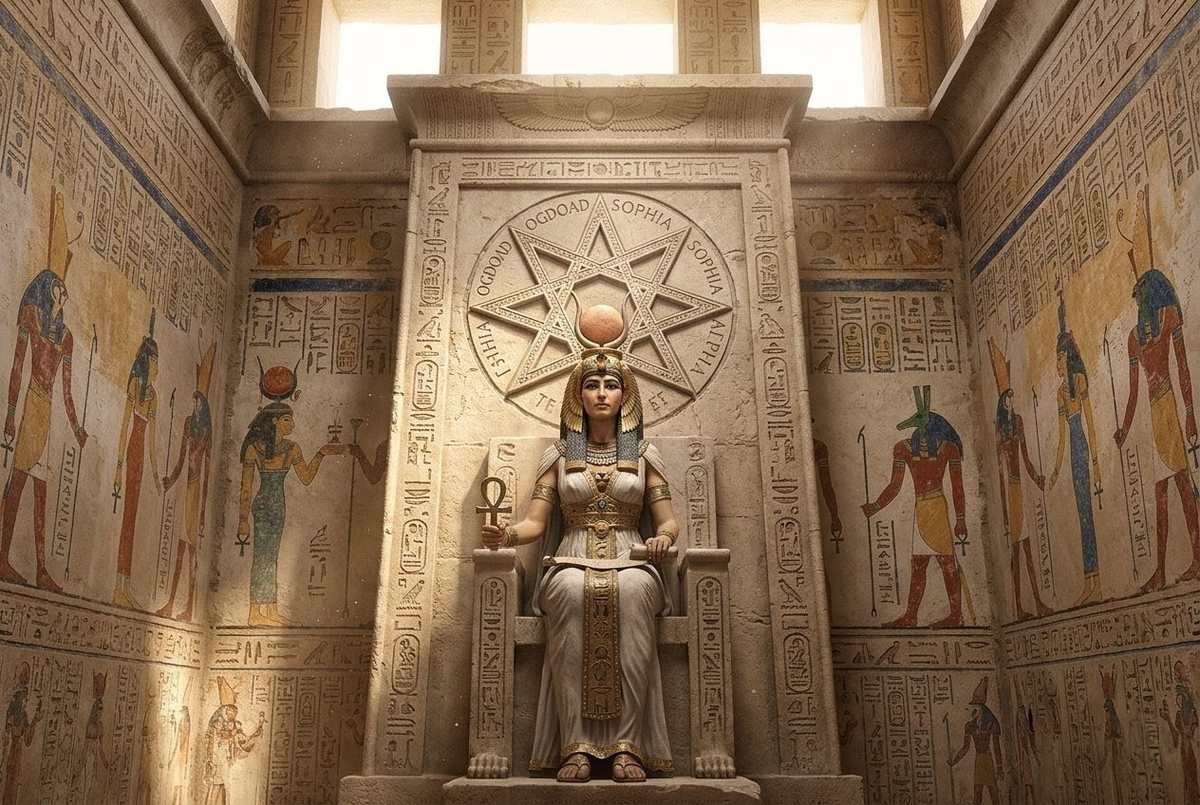
The Ogdoad–the eighth heaven where Sophia is restored–becomes a kind of feminine domain within the cosmic order. It is above the planetary archons (who rule the seven spheres) but below the Pleroma proper. This intermediate position allows Sophia to function as mediator: she receives the prayers of the faithful, she sends spiritual aid, she prepares the soul for its final ascent. She is the hotline to headquarters for those still assigned to the material branch office.
Norea: The Rebellious Daughter
The Thought of Norea (NHC IX,2 27,11-29,5) introduces a figure who deserves far more attention than she has received in the history of religions. Norea appears in the Hypostasis of the Archons as the sister of Seth, the wife of Noah, and a being of extraordinary spiritual power. When the archons attempt to seize her, she cries out to the divine, and the angel Eleleth descends to rescue her [20].
Primary Source Citation: NHC IX,2 27,21-22 (Thought of Norea): “It is Norea who cries out to them… She has the four holy helpers who intercede on her behalf with the Father of the All.” The text presents Norea as the prototype of the saved gnostic, crying out for deliverance from archonic jurisdiction [20].
The Thought of Norea expands this narrative into a prayer and revelation text. Norea speaks as one who knows her true identity despite the archonic attempts to appropriate her: “I am the thought of the Father, Protennoia, the image of the invisible… I am the mother of the virgins, the sister of the aeons.” This is bold theological claim-making: the feminine voice speaks not as a recipient of revelation but as its source, not as a disciple but as a manifestation of divine presence–a direct representative of the executive headquarters [36].
Her rebellion against the archons is sexual and spiritual simultaneously. She refuses to participate in the generative schemes of the powers, maintaining instead a virginity that is not physical celibacy but ontological integrity. She cannot be assimilated into the archonic order; she remains “stranger” (allogenes) to their world–a status that grants her diplomatic immunity from the cosmic middle-management [47].
Thunder: Perfect Mind and the Inclusive Divine
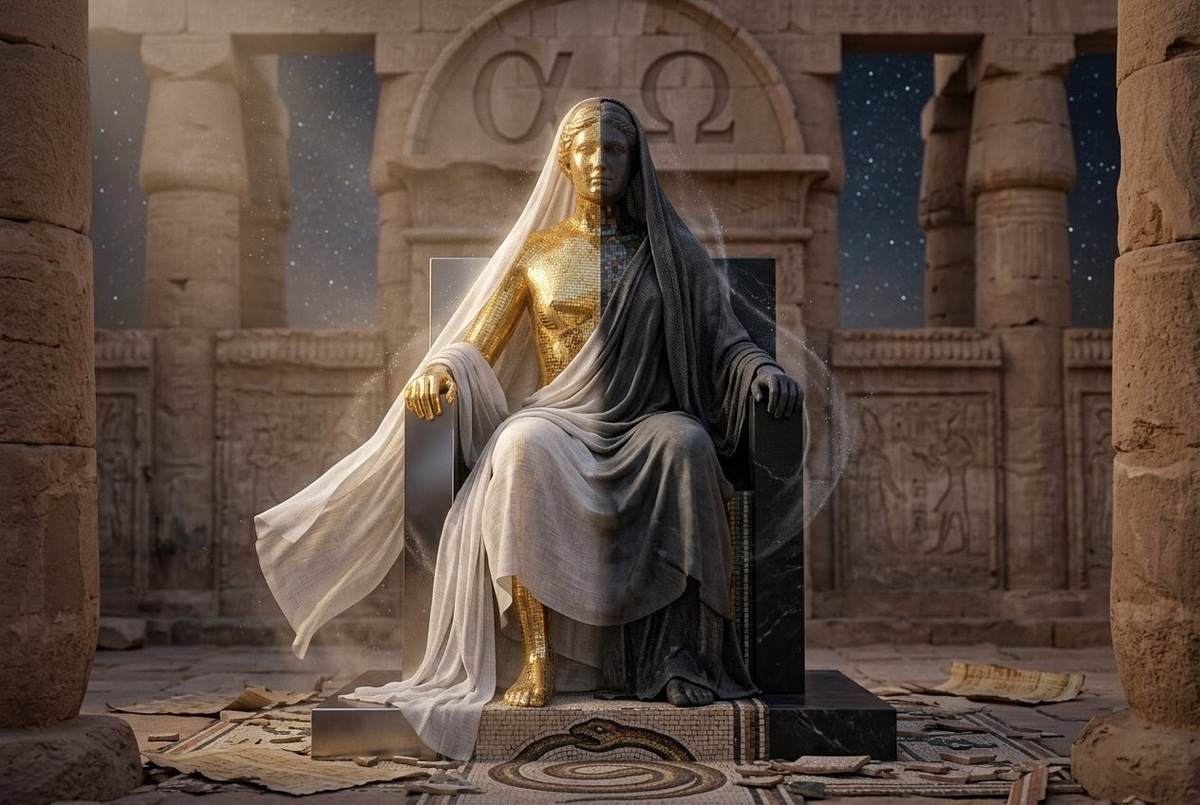
No text in the Nag Hammadi library challenges gender categories more radically than Thunder: Perfect Mind (NHC VI,2 13,1-21,32). The speaker of this text declares herself in a dizzying series of paradoxes: “I am the first and the last… I am the wife and the virgin… I am the knowledge of my inquiry, and the finding of those who seek after me” [25].
Primary Source Citation: NHC VI,2 13,16-14,15 (Thunder: Perfect Mind): “I am the honoured and the scorned. I am the whore and the holy. I am the wife and the virgin. I am the mother and the daughter… I am the bride and the bridegroom, and my husband gave birth to me.” The text presents the divine feminine as transcending all binary categories [25].
The “I” of Thunder transcends all binary oppositions, including gender. Yet it speaks repeatedly in feminine form, as a mother, a midwife, a bride, a barren woman who has borne many children. This is not accidental. The text seems to suggest that the feminine, precisely because it has been marginalised in patriarchal discourse, possesses a unique capacity to articulate the all-encompassing nature of divine reality–the comprehensive intelligence that cannot be contained within standard departmental classifications.
The speaker is simultaneously immanent and transcendent, suffering and triumphant, foreign and domestic. She is the wisdom that built her house, the bread that came down from heaven, the light that illuminates the cosmos. The catalogue of identifications suggests that the divine feminine is not one thing among others but the very medium through which divine multiplicity is articulated–the primary protocol for all cosmic communication [34].
Mary Magdalene and the Apostolic Woman
The Gospel of Philip (NHC II,3) preserves a tradition about Mary Magdalene that would prove explosive in later Christian history: “There were three who always walked with the Lord: Mary, his mother, and her sister, and Magdalene, the one who was called his companion. His sister, his mother, and his companion were each a Mary.” More famously: “The companion of the Saviour is Mary Magdalene. He loved her more than all the other disciples and used to kiss her often on the mouth” [35].
Whether these passages reflect historical memory or symbolic theology remains debated. What is clear is that the Valentinian tradition accorded Mary Magdalene a status unmatched in orthodox Christianity. She is the one who receives secret teachings denied to the male apostles; she is the first witness to the resurrection; she is the symbol of the pneumatics who recognise the Saviour while the psychics demand signs. She possesses top-secret clearance denied to the other disciples.
The Gospel of Philip uses her to articulate a theology of spiritual marriage. Just as the Saviour made Magdalene into a companion, so the pneumatics find their completion in syzygy. The feminine is not supplementary but essential; the bridal chamber is not an analogy but the reality of salvation–the ultimate security clearance that restores the original partnership [38].
Gender and Salvation: The Androgynous Ideal
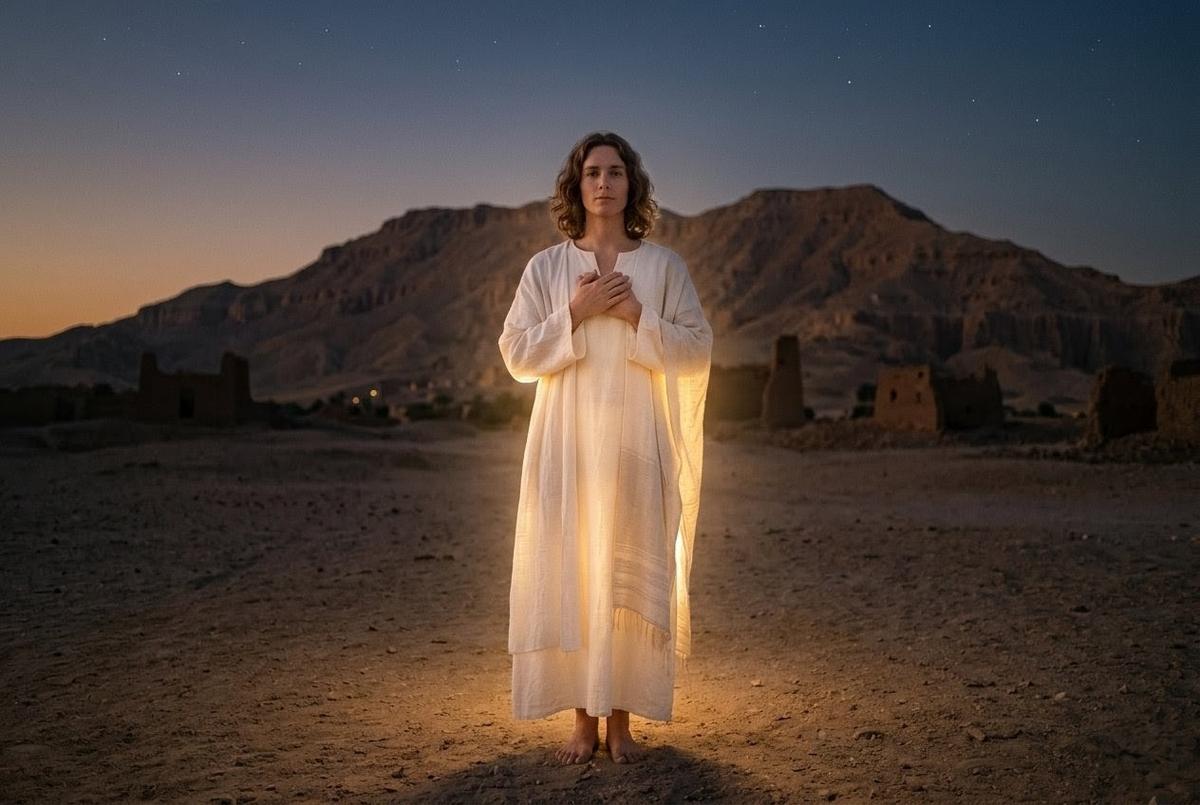
Despite–or perhaps because of–the prominence of feminine imagery, the Nag Hammadi texts frequently gesture toward a transcendence of gender altogether. The Gospel of Philip states explicitly: “When Eve was still in Adam, death did not exist. When she was separated from him, death came into being. If she enters into him again and he receives her completely, there will be no death” [46].
This is not a rejection of the feminine in favour of an essentially masculine divinity. It is rather the recognition that gender, like all binary distinctions, belongs to the fallen order of reality. In the Pleroma, there is no male and female; there are only syzygies, paired aeons who are distinct but not divided. The goal of salvation is not the superiority of one gender over the other but the restoration of the original unity–a corporate reorganisation that dissolves departmental barriers.
Primary Source Citation: NHC II,2 22,3-7 (Gospel of Thomas): “When you make the two into one, and when you make the inner like the outer and the outer like the inner, and the upper like the lower, and when you make male and female into a single one, so that the male will not be male nor the female be female… then you will enter [the Kingdom].” The androgynous ideal represents the dissolution of binary categories in the restored unity [43].
The Gospel of Thomas (NHC II,2) makes this point with aphoristic force: “When you make the two into one… when you make male and female into a single one, so that the male will not be male nor the female be female… then you will enter [the Kingdom].” This making-one includes the gendered self: the restoration of the original template before the division into binary categories–a complete restructuring of the personnel files to reflect pre-departmental unity.
Implications and Questions
The prominence of the feminine in Nag Hammadi texts raises questions that scholarship has only begun to address. Is this evidence for women’s leadership in Gnostic communities, or does it represent a masculinist appropriation of feminine imagery for entirely male theological projects? Does the emphasis on divine syzygies reflect a different social organisation of gender, or does it reinforce heteronormative assumptions under the guise of spiritual equality?
What seems clear is that the Nag Hammadi library offers resources for thinking about gender and divinity that resist simple categorisation. The texts do not present a uniform “Gnostic feminism”–some passages are explicitly misogynist, and the androgynous ideal could be read as the erasure of specifically feminine experience. Yet they also preserve visions of divine and human possibility that exceed the binary constraints of their historical moment.
For contemporary readers, the feminine divine of Nag Hammadi offers neither a nostalgic return to goddess worship nor a transcendent rejection of embodiment. It suggests rather that the categories through which we know ourselves–gender among them–are provisional, subject to transformation, capable of being reimagined in light of the knowledge that saves. The celestial bureaucracy, it turns out, does not operate through masculine dominance but through the partnership of complementary principles–a corporate structure where the feminine is not merely present but essential to all executive functions.
Frequently Asked Questions
Who is Barbelo in the Nag Hammadi texts?
Barbelo is the threefold First Thought (Protennoia) of the Invisible Spirit in Sethian cosmology, representing the first emanation from the transcendent Father. Described in the Apocryphon of John (NHC II,1) as the ‘Mother-Father,’ she serves as the womb of all aeons and the necessary condition for any divine manifestation. She is simultaneously identical with the source and distinct from it–the perfect power who is the image of the invisible Spirit.
What is the role of Sophia in Gnostic cosmology?
Sophia (Wisdom) embodies the immanent expression of the divine feminine, playing the pivotal role of transition between the Pleroma (Fullness) and the material world. In the Hypostasis of the Archons (NHC II,4), she creates the lion-faced Demiurge without a partner, repents and is restored to the eighth heaven (Ogdoad), and intervenes in human history as ‘the mother of the living’ (Zoe). Her fall generates the drama of salvation; her restoration provides its pattern.
What makes Thunder: Perfect Mind unique among Nag Hammadi texts?
Thunder: Perfect Mind (NHC VI,2) presents a divine feminine speaker who transcends all binary oppositions through paradoxical self-declarations: ‘I am the first and the last… the whore and the holy… the wife and the virgin.’ Unlike other texts where feminine figures appear within narratives, Thunder’s speaker is the voice of divine reality itself, articulating a comprehensive intelligence that permeates all categories while transcending them.
How does the Gospel of Philip portray Mary Magdalene?
The Gospel of Philip (NHC II,3) presents Mary Magdalene as the ‘companion’ (koinonos) of the Saviour, whom Jesus loved ‘more than all the other disciples’ and kissed often on the mouth. The text uses her to articulate a theology of spiritual marriage (syzygy), suggesting that the feminine is essential rather than supplementary to salvation. She receives secret teachings denied to male apostles, symbolising the pneumatics who recognise truth immediately while psychics demand signs.
What is the significance of the androgynous ideal in Gnosticism?
The androgynous ideal represents the transcendence of binary categories–including gender–that belong to the fallen order of reality. Texts like the Gospel of Thomas (NHC II,2) and Gospel of Philip teach that salvation involves ‘making male and female into a single one,’ restoring the original unity before the separation of Eve from Adam. This is not erasure of the feminine but recognition that in the Pleroma, there are only syzygies (paired aeons) who are distinct but not divided.
Who is Norea and why is she important?
Norea appears in the Hypostasis of the Archons and the Thought of Norea (NHC IX,2) as the sister of Seth, wife of Noah, and a being of extraordinary spiritual power. When archons attempt to seize her, she cries out for deliverance and the angel Eleleth descends to rescue her. She represents the prototype of the saved gnostic who knows her true identity despite archonic attempts at appropriation, refusing participation in the generative schemes of the cosmic powers.
How does the divine feminine challenge patriarchal traditions?
Unlike patriarchal traditions that marginalise feminine agency, Nag Hammadi texts systematically elevate the feminine as constitutive of divinity itself. Barbelo appears at the first moment of divine self-expression; Sophia functions as mediator between heaven and earth; Thunder’s speaker transcends all categories; Mary Magdalene receives privileged teachings. These texts suggest that the feminine is not merely included in salvation history but is essential to the theological architecture–the ‘filing system’ through which the divine makes itself known.
Further Reading
- Thunder: Perfect Mind – The Voice of the Divine Feminine — Detailed analysis of the most radically paradoxical text in the Nag Hammadi library, exploring its transcendence of binary categories.
- Trimorphic Protennoia: Three Forms of Divine Thought — Examination of the three descents of the divine feminine voice as Protennoia, descending to awaken the spiritual seed.
- The Thought of Norea: Sethian Prayer and Deliverance — Analysis of the brief but powerful text expanding Norea’s plea for deliverance from the archons.
- The Hypostasis of the Archons: Cosmic Tyranny and Divine Rescue — Study of Sophia’s role in the creation drama and her restoration to the Ogdoad.
- The Gospel of Philip: Sacraments and the Bridal Chamber — Analysis of Mary Magdalene’s role and the theology of spiritual marriage (syzygy).
- The Apocryphon of John: A Gnostic Creation Myth — Comprehensive examination of Barbelo as the First Thought and the Sethian cosmogony.
- The Gospel of Thomas: Hidden Sayings Collection — Commentary on Saying 22 and the androgynous ideal of making “male and female into a single one.”
- The Feminine Divine in Gnosticism: Complete Collection — Overview of all texts featuring feminine divine figures in the Nag Hammadi library.
- Sethian, Valentinian, and Hermetic Traditions — Comparative analysis placing the feminine divine within the broader context of Gnostic traditions.
References and Sources
The following sources support the claims and quotations presented in this article. All citations to the Nag Hammadi Library represent direct translations from the Coptic text as established in the standard critical editions.
Primary Sources and Critical Editions
- [1] Robinson, J.M. (1977). The Nag Hammadi Library in English. Harper & Row.
- [2] Waldstein, M. & Wisse, F. (1995). The Apocryphon of John: Synopsis of Nag Hammadi Codices II,1; III,1; and IV,1 with BG 8502,2. Brill.
- [3] Poirier, P.H. (2006). La pensee premiere a la triple forme. Presses de l’Universite Laval.
- [4] Layton, B. (1987). The Gnostic Scriptures. Doubleday.
- [5] Meyer, M. (2007). The Nag Hammadi Scriptures. HarperOne.
Scholarly Monographs and Studies
- [6] Turner, J.D. (2001). Sethian Gnosticism and the Platonic Tradition. Presses de l’Universite Laval.
- [7] King, K.L. (1990). “Images of the Feminine in the Gospel of Philip.” Vigiliae Christianae, 44(3), 252-272.
- [8] Buckley, J.J. (1986). “The Holy Spirit is a Double Name.” In The Rediscovery of Gnosticism, Vol. 2. Brill.
- [9] Bullard, R.A. (1970). The Hypostasis of the Archons. De Gruyter.
- [10] Marjanen, A. (2005). The Woman Jesus Loved. Brill.
Comparative and Thematic Studies
- [11] King, K.L. (2003). What is Gnosticism? Harvard University Press.
- [12] Pagels, E.H. (1979). The Gnostic Gospels. Random House.
- [13] MacRae, G.W. (1970). “The Jewish Background of the Gnostic Sophia Myth.” Novum Testamentum, 12(2), 86-101.
- [14] Pearson, B.A. (1990). “The Figure of Norea.” In Gnosticism, Judaism, and Egyptian Christianity. Fortress Press.
- [15] Arthur, R.A. (2008). “Thunder, Perfect Mind.” In Nag Hammadi Codex VI. Brill.