Ascent Literature and the Five Seals
Among the most distinctive literary forms in the Nag Hammadi library is the ascent treatise–texts that describe, in vertiginous detail, the soul’s journey through multiple levels of reality toward ultimate restoration. These are not merely speculative cosmographies but programmatic documents, scripts for ritual performance that transform the reader even as they describe transformation [1].
The Sethian tradition produced some of the most elaborate examples of this genre: Allogenes (NHC XI,3), Zostrianos (NHC VIII,1), Marsanes (NHC X,1), and portions of the Apocryphon of John. Each maps a path through the planetary spheres, past the archonic guardians, into the Ogdoad and beyond. Together, they constitute a technology of ecstasy–a systematic approach to mystical ascent that was simultaneously cognitive, ritual, and performative. In the administrative metaphor that clarifies their function, these texts serve as security clearance protocols, detailing the necessary credentials for passage through the celestial bureaucracy’s various branch offices.
Table of Contents
- Introduction: The Ascent Literature Genre
- The Architecture of the Cosmos
- The Five Seals: Ritual Foundation
- Allogenes: The Stranger’s Ascent
- Zostrianos: The Complete Journey
- The Discourse on the Eighth and Ninth
- The Garments of Light
- Comparative Context: Platonizing Sethianism
- Contemporary Relevance
- Frequently Asked Questions
- Further Reading
- References and Sources
Introduction: The Ascent Literature Genre
What is Sethian Ascent Literature?
Sethian ascent texts constitute a specific genre within the Nag Hammadi library comprising first-person narratives of mystical ascent through planetary spheres, past archonic guardians, into the Pleroma (Fullness). These texts function simultaneously as cosmological maps, ritual scripts, and philosophical treatises. They presuppose a ritual foundation (the Five Seals) and describe the transformation of consciousness required for passage through successive levels of divine reality.
The Sethian ascent treatises represent one of the most sophisticated expressions of ancient mystical technology. Unlike the apocalyptic literature of Jewish tradition, which typically features passive transportation to heaven, or the later Hermetic ascent texts, which emphasise contemplative knowledge, the Sethian treatises present an active, participatory journey requiring specific passwords (symbola), ritual preparations, and cognitive transformations [2]. The traveller is not merely transported but must demonstrate competence at each successive checkpoint within the celestial filing system.
These texts emerge from what scholars term “Platonizing Sethianism”–a development within the Sethian tradition that engaged seriously with contemporary Middle Platonic and Neoplatonic metaphysics while maintaining distinctively Gnostic soteriological concerns [3]. The result is a remarkable synthesis: philosophical rigour combined with ritual specificity, metaphysical abstraction anchored in liturgical practice. The ascent is simultaneously an escape from archonic jurisdiction and a transfer to the executive headquarters of the Pleroma.
The Architecture of the Cosmos
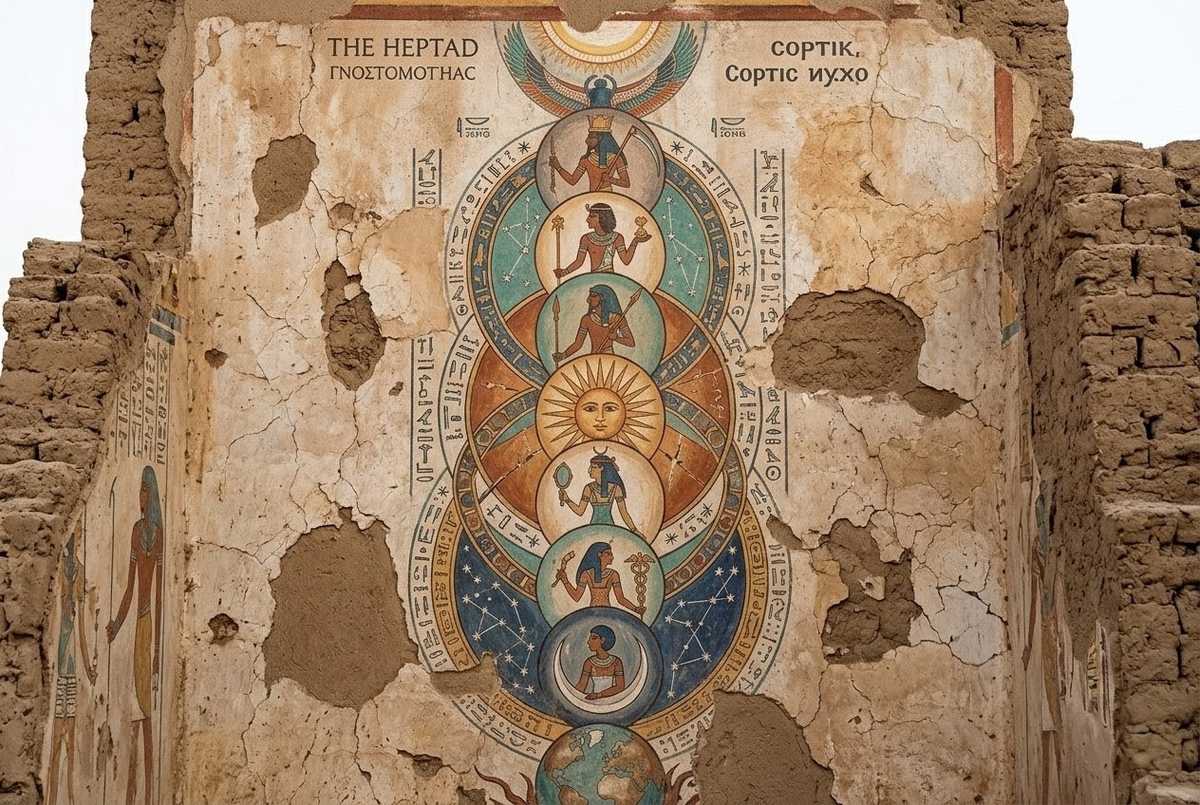
To comprehend these ascent texts, one must first grasp the geography they presuppose. The material cosmos, in Sethian cosmology, constitutes a temporary regional office enclosed within seven planetary spheres, each governed by an archon with specific jurisdiction, appearance, and function. Beyond these lies the eighth sphere, the Ogdoad, where Sophia finds restoration. Above the Ogdoad stretches the Pleroma proper, with its aeons, luminaries, and ultimately the transcendent realm of the Unknowable One [4].
Primary Source Citation: NHC VIII,1 1,1-132,9 (Zostrianos): “The book of the glory of the eternally living words that I Zostrianos wrote… I came into the world for the sake of my contemporaries and posterity, the living elect.” The text presents itself as a revealed guide for the spiritual elite navigating cosmic dissolution [2].
The archons of the planets function not merely as astronomical markers but as spiritual antagonists embodying specific vices that the ascending soul must have purified before passage. Saturn’s archon guards the realm of envy; Jupiter’s, lust; Mars’, wrath; the Sun’s, pride; Venus’, desire; Mercury’s, calculation; the Moon’s, illusion. The soul approaching these gates bearing corresponding stains will face detention; only those who have “stripped off the garment of shame” may pass [5]. This functions as a cosmic customs inspection, requiring travellers to declare and surrender all contraband passions before entry.
Psychological Precision in Cosmic Geography
This cosmological schema represents not arbitrary demonology but psychological precision. The ascent requires systematic transformation of consciousness–the replacement of archonic with pneumatic modes of perception. Each planetary sphere corresponds to a level of psychological organisation that must be transcended. The archons thus function as personified obstacles, externalised representations of internal bindings that must be dissolved before the soul can achieve apokatastasis (restoration) [6].
The Five Seals: Ritual Foundation
Against this cosmic backdrop, the ascent texts presuppose a ritual foundation known as the Five Seals (pentasphragismos). While precise content remains partially obscure–ancient sources maintained reticence regarding mysteries meant for initiates–the pattern emerges clearly enough: five sacramental acts establishing the ontological conditions necessary for ascent. These seals function as preliminary security clearances, authorising the initiate for progressively higher levels of classified cosmic intelligence [7].
Primary Source Citation: NHC XIII,1 48,15-35 (Trimorphic Protennoia): “He received the Five Seals from the Light of the Mother, Protennoia, and it was granted him to partake of the mystery of knowledge… They baptized him–Micheus, Michar, Mnesinous–and they immersed him in the spring of the Water of Life.” This passage preserves the liturgical structure of the Sethian initiation sequence [18].
The Five Seals Enumerated
The First Seal: Baptism, understood not as mere washing but as the stripping away of the old self. The Trimorphic Protennoia speaks of being “sealed with the water of five seals,” suggesting that the entire pentad could be performed using water as medium, or that each seal possessed its own elemental association [8]. This represents the initial clearance level, granting access to the basic mysteries.
The Second Seal: Anointing (chrism), the application of oil consecrating the recipient as royal priesthood. In Sethian understanding, this establishes the “perfect garment” replacing the coat of skins imposed by archons after the fall. The anointed one becomes christos, anointed, sharing in the nature of the heavenly Christ–a middle-management promotion within the celestial hierarchy [9].
The Third Seal: The eucharist, the sacred meal nourishing the resurrection body. Unlike catholic sacramentalism, which emphasised real presence in the elements, the Sethian eucharist focused on transformation of the communicant. The food of life becomes the basis for a body capable of surviving material dissolution–a transfer to incorruptible personnel status.
The Fourth Seal: Redemption (apolytrosis), a ritual formula releasing the soul from archonic bonds. This likely involved pronunciation of secret names and renunciation of planetary powers. Marsanes mentions “the name that is in the expanse,” suggesting that this seal activated specific sonic vibrations with liberating power–a vocal password for bypassing archonic checkpoints [10].
The Fifth Seal: The bridal chamber (nymphon), restoration of the syzygy, the original divine pairing. This is simultaneously a ritual act–perhaps involving sacred marriage or symbolic union–and a mystical experience of reunion with one’s angelic counterpart. It represents the final clearance, authorising full access to the executive headquarters [11].
Allogenes: The Stranger’s Ascent
The text of Allogenes (“Stranger” or “Foreigner”) presents an ascent narrative of extraordinary philosophical density. The protagonist, identified with Seth or a Seth-like figure, undergoes revelatory encounters carrying him from the material world to the edge of the Unknowable One. The text occupies pages 45,1-69,20 of Codex XI and represents the most philosophically sophisticated of the Sethian ascent treatises [6].
Primary Source Citation: NHC XI,3 61,17-19 (Allogenes): “I am filled with the primary revelation of the Unknowable One, the knowledge of which is complete ignorance.” The text articulates the paradoxical epistemology required for approach to the transcendent–where knowing and unknowing coincide [6].
The ascent structures itself in three major movements. First, Allogenes receives instruction from the angelic revealer Youel, who explains the aeonic structure and the necessity of cognitive transformation. Then he engages in “self-generated” contemplation, ascending through the levels of Being, Life, and Mind. Finally, he reaches the Kalyptos (Hidden) and Protophanes (First-Appearing) aeons, where normal cognition fails and ecstatic silence takes over–a state beyond the jurisdiction of discursive archonic thought.
The text demonstrates remarkable self-reflexive awareness of linguistic limitations. Allogenes receives repeated instruction to “cease” his inquiry, to stop searching with discursive mind, to enter instead into a “standing” that transcends knowing and unknowing. This is not negation of knowledge but its fulfilment–the recognition that the transcendent can only be approached through surrender of conceptual grasping [12]. The text thus functions as a manual for deactivating archonic cognitive patterns.

Zostrianos: The Complete Journey
Where Allogenes proves aphoristic and dialectical, Zostrianos offers the most comprehensive map of the Sethian cosmos. The text runs to thirteen aeons, each with its own angelic inhabitants, each requiring specific passwords (symbola) for entry. It is simultaneously cosmological treatise, ritual handbook, and philosophical dialogue–the complete administrative manual for celestial ascent [2].
Zostrianos begins in despair, contemplating suicide on a mountain–a detail suggesting the text was meant to resonate with readers in spiritual crisis. He is interrupted by angelic revelation and instructed in the true nature of the self. What follows is an ascent taking him through planetary spheres, the Ogdoad, and into the upper reaches of the Pleroma. The narrative occupies the first 132 pages of Codex VIII, making it the longest tractate in the entire Nag Hammadi library [1].
The Thirteen Aeons
Each aeon corresponds to specific transformation. In the first, the traveller learns to distinguish elect from non-elect; in the second, he receives the garment of light; in the third, baptism with living water. By the fifth aeon, he has become “a god among gods,” capable of understanding the mysteries of the All. The final aeons bring him to the Autogenes Christ and ultimately to Protophanes, where he sees himself as part of the universal mind–a complete transfer of identity from individual employee to corporate executive [13].
The text’s practical orientation is unmistakable. Detailed passwords and responses suggest that readers were expected to memorise these formulae for their own ritual practice. The ascent was not merely read but performed–an active participation in the cosmic liturgy rather than passive consumption of theological information.
The Discourse on the Eighth and Ninth
The Discourse on the Eighth and Ninth (NHC VI,6) offers a more intimate glimpse of ascent practice. Cast as dialogue between Hermes Trismegistus and his son Tat, the text describes their joint ascent to the Ogdoad and the Ninth sphere. Unlike the Sethian treatises, this is explicitly Hermetic, yet it shares the same basic structure: purification, ascent, union with the divine [3].
Primary Source Citation: NHC VI,6 60,5-6 (Discourse on the Eighth and Ninth): “We rejoice because while we were in the body, Thou hast made us divine through Thy knowledge.” The text articulates the possibility of divinisation even within embodied existence [3].
The eighth sphere is the Ogdoad, the place of fixed stars and the realm of “souls that are in the power of God.” The ninth is the heavenly realm proper, the place of silence and stillness. The tenth, which Hermes mentions but cannot yet enter, is the transcendent source beyond even these. The text culminates in shared prayer and moment of silent union: “We have advanced far enough, my son. We have come to the place of truth.” The ascent is not solitary but communal; even the highest mysteries are shared between teacher and student–a structured mentorship programme within the celestial organisation [14].
The Garments of Light
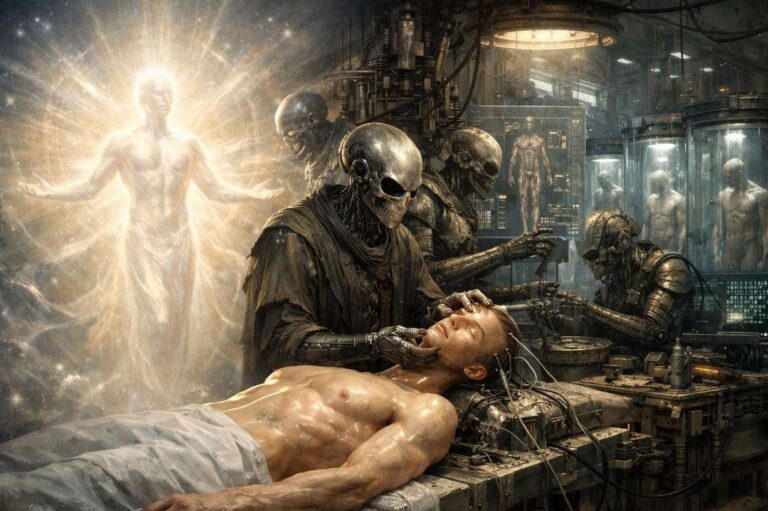
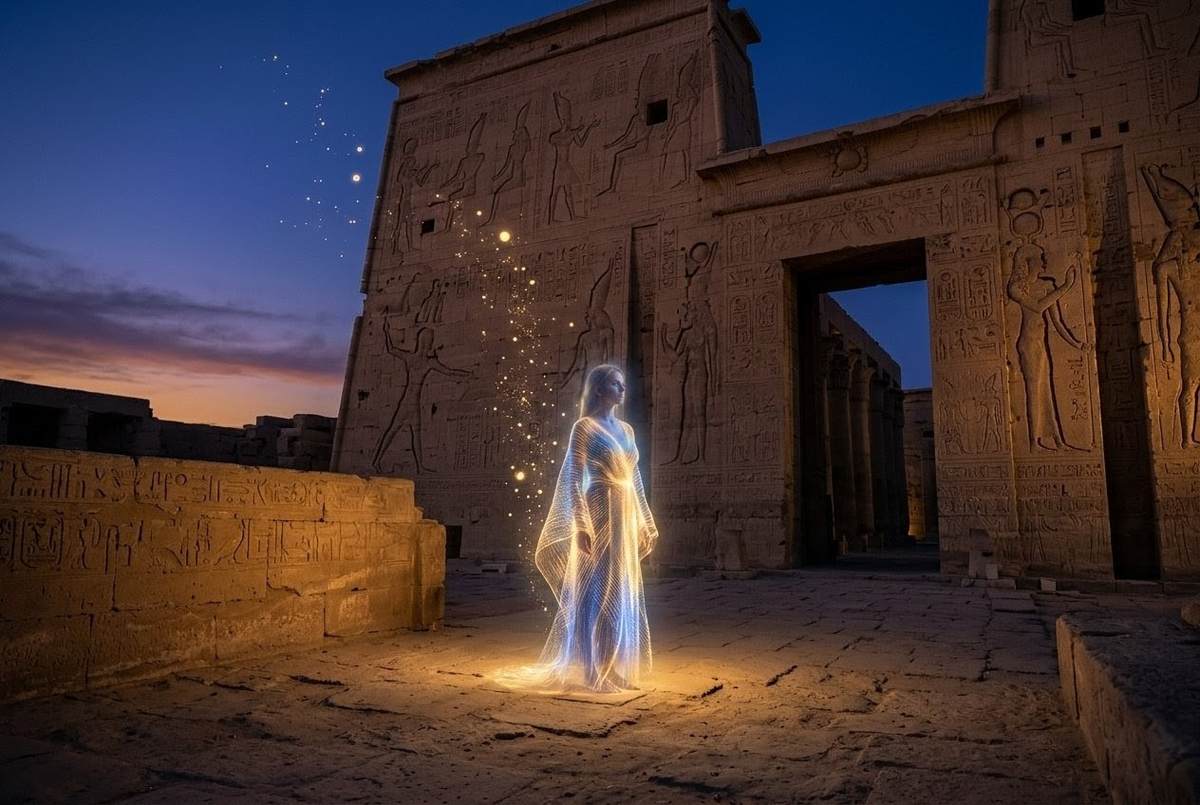
A recurring motif in these texts is the transformation of the body through acquisition of luminous garments. The material body is understood as a “garment of flesh” or “garment of shame” imposed by the archons. The ascent requires stripping off this garment and putting on a new one composed of light, mind, or spiritual substance–a change of uniform indicating transfer to a different department within the cosmic bureaucracy [15].
This is not mere metaphor. The texts describe the process with physiological precision: the luminous body is composed of specific elements, it possesses its own organs of perception, it is capable of surviving the dissolution of the material frame. The Hypsiphrone (NHC XI,4) speaks of “putting on the perfect mind”; Marsanes describes the “form that is in the expanse” (NHC X,1 65,21-23) [16].
The garments serve a practical function in the ascent narrative. They allow the soul to pass through the planetary gates without being recognised as material by the archonic guardians. They function simultaneously as camouflage and protection, rendering the ascending one invisible to the powers that would detain her–a necessary disguise for infiltrating higher security zones [17].
Comparative Context: Platonizing Sethianism
The ascent treatises represent a specific phase in Sethian development–what scholars term “Platonizing Sethianism.” This current emerged when Sethian groups engaged with the metaphysical frameworks of Middle Platonism and early Neoplatonism, particularly the systems of Numenius, Albinus, and the early Plotinus [3]. The result was a remarkable synthesis: Sethian soteriological concerns expressed through Platonic ontological categories.
Porphyry, in his Life of Plotinus (16), mentions that certain Gnostics possessed “books of Zostrianos, Allogenes, Nikotheos, and others”–precisely the texts we find in the Nag Hammadi library. Plotinus himself wrote against these groups in Enneads II.9, criticising their multiplication of hypostases and their contempt for the material world, yet engaging seriously with their metaphysical arguments [16]. This confirms both the philosophical sophistication of these texts and their circulation in elite intellectual circles of the third century CE.
The Three Steles of Seth (NHC VII,5) represents a different approach to ascent–hymnic rather than narrative. The text consists of three hymns addressed to the divine, each ascending through higher levels of reality. While lacking the detailed passwords of Zostrianos, it shares the same basic trajectory: praise leading to union, liturgy effecting ascent [15].
Contemporary Relevance
The ascent literature of Nag Hammadi challenges modern readers on multiple levels. Historically, it provides evidence for the sophistication of ancient ritual practice and the philosophical seriousness of “Gnostic” spirituality. Phenomenologically, it offers accounts of mystical experience correlatable with comparable phenomena in other traditions–yogic samadhi, Buddhist jhana, Kabbalistic merkabah mysticism [4].
Psychologically, these texts present a technology of transformation that remains relevant. The basic insight–that consciousness is capable of transcending its ordinary material embeddedness, that systematic practice can effect lasting ontological change–represents a perennial possibility of human nature, one that these texts explore with particular rigour and daring. The planetary archons become the psychological complexes that bind us; the luminous garments become the transformed perception that allows freedom; the Ogdoad becomes the place of integration and rest before final transcendence.
For the contemporary practitioner, the ascent texts offer not a literal map of the cosmos but a symbolic grammar for inner transformation. They suggest that spiritual development requires systematic preparation, that transformation occurs through stages, and that the final goal involves not merely knowledge but ontological change–a complete transfer from the jurisdiction of the material to the pleroma of the spiritual.
Frequently Asked Questions
What is Sethian ascent literature?
Sethian ascent literature constitutes a genre of mystical texts from the Nag Hammadi library that describe the soul’s journey through planetary spheres, past archonic guardians, into the divine Pleroma. These texts–including Zostrianos, Allogenes, and Marsanes–function as both cosmological maps and ritual scripts, providing passwords, baptismal instructions, and philosophical guidance for navigating the celestial hierarchy.
What are the Five Seals in Sethian tradition?
The Five Seals (pentasphragismos) represent a sequence of five ritual acts that establish the ontological conditions for mystical ascent. They include baptism (stripping the old self), anointing (chrism), eucharist (nourishing the resurrection body), redemption (apolytrosis with secret names), and the bridal chamber (nymphon). These seals function as security clearances authorising the initiate for progressively higher levels of cosmic reality.
How does Zostrianos differ from Allogenes?
While both are Platonizing Sethian ascent texts, Zostrianos offers the most comprehensive cosmic map, detailing thirteen aeons with specific passwords and angelic inhabitants across 132 pages (NHC VIII,1). Allogenes (NHC XI,3) is more philosophically concentrated, focusing on the paradoxical approach to the Unknowable One through ‘complete ignorance’ and emphasising the surrender of discursive cognition.
What role do planetary archons play in the ascent?
The planetary archons function as spiritual antagonists guarding each of the seven planetary spheres. Each archon embodies a specific vice (envy, lust, wrath, pride, desire, calculation, illusion) that the ascending soul must have purified before passage. They represent both external cosmic powers and internalised psychological obstacles that must be transcended through the Five Seals and the reception of luminous garments.
What are the luminous garments mentioned in ascent texts?
The luminous garments (or garments of light) represent the transformed subtle body that replaces the ‘garment of flesh’ or ‘garment of shame’ imposed by the archons. Described with physiological precision in texts like Marsanes (NHC X,1), these garments allow the soul to pass through planetary gates without being recognised as material by archonic guardians–functioning as both camouflage and protection during the ascent.
How is Platonizing Sethianism related to Plotinus?
Platonizing Sethianism represents a phase where Sethian groups engaged with Middle Platonic and Neoplatonic metaphysics. Porphyry records that Plotinus possessed and wrote against books of Zostrianos and Allogenes (Life of Plotinus 16), criticising their multiplication of hypostases. This confirms both the philosophical sophistication of these texts and their circulation in third-century intellectual circles.
What is the practical application of ascent texts today?
Contemporary practitioners approach these texts as symbolic grammars for inner transformation rather than literal cosmic maps. The planetary archons become psychological complexes; the luminous garments represent transformed perception; the Five Seals become stages of spiritual preparation. The texts suggest that systematic practice can effect lasting ontological change–a transfer from material jurisdiction to spiritual freedom.
Further Reading
- Allogenes: The Sethian Ascent to the Unknowable One — Detailed examination of the most philosophically concentrated ascent text, exploring its paradoxical epistemology and three-stage contemplative structure.
- Zostrianos: The Complete Journey Through the Thirteen Aeons — Comprehensive analysis of the longest Nag Hammadi tractate, mapping its detailed cosmography and ritual passwords.
- Marsanes: Platonizing Sethian Metaphysics — Examination of the tractate’s sophisticated engagement with Platonic ontology and its theory of thirteen seals.
- The Discourse on the Eighth and Ninth: Hermetic Ascent — Analysis of the Hermetic ascent dialogue and its shared structure with Sethian texts.
- Hypsiphrone: Fragmentary Visions of the Ascent — Study of the fragmentary Codex XI text and its testimony to the garment of light motif.
- The Three Steles of Seth: Ascent Hymns to the Transcendent — Examination of the hymnic approach to ascent through three progressive praises.
- The Apocalypse of Paul: Heavenly Ascent Beyond the Fourth Heaven — Analysis of the apocalyptic ascent pattern and its differences from Sethian technical literature.
- The Apocalypse of Adam: Sethian Prophecy and Cosmic History — Examination of Sethian historical speculation and its relationship to ascent theology.
- Sethian, Valentinian, and Hermetic Traditions — Comparative analysis of the three major traditions represented in the Nag Hammadi library.
References and Sources
The following sources support the claims and quotations presented in this article. All citations to the Nag Hammadi Library represent direct translations from the Coptic text as established in the standard critical editions.
Primary Sources and Critical Editions
- [1] Robinson, J.M. (1977). The Nag Hammadi Library in English. Harper & Row.
- [2] Turner, J.D. (1990). Nag Hammadi Codex VIII: Zostrianos. Brill.
- [3] Sieber, J.H. (1991). Nag Hammadi Codex VIII. Brill.
- [4] Funk, W.P., Scopello, M., & Turner, J.D. (2004). L’Allogene (NH XI,3). Presses de l’Universite Laval.
- [5] Turner, J.D. (2000). Nag Hammadi Codices XI, XII, XIII. Brill.
Scholarly Monographs and Studies
- [6] Turner, J.D. (2001). Sethian Gnosticism and the Platonic Tradition. Presses de l’Universite Laval.
- [7] Schenke, H.M. (1981). “The Phenomenon and Significance of Gnostic Sethianism.” In The Rediscovery of Gnosticism, Vol. 2. Brill.
- [8] Pearson, B.A. (1981). Nag Hammadi Codices IX and X. Brill.
- [9] Poirier, P.H. (2006). La pensee premiere a la triple forme. Presses de l’Universite Laval.
- [10] Burns, D. (2014). Apocalypse of the Alien God. University of Pennsylvania Press.
Comparative and Thematic Studies
- [11] Smith, C. (2020). No Longer in the World. Oxford University Press.
- [12] Rasimus, T. (2009). Paradise Reconsidered in Gnostic Mythmaking. Brill.
- [13] Klier, B. (2003). “The Anointing (Chrism) in Sethian Tradition.” Vigiliae Christianae, 57(4), 363-384.
- [14] DeConick, A.D. (2006). The Thirteenth Apostle. Continuum.
- [15] Logan, A.H.B. (2006). The Gnostics. T&T Clark.