The Apocalypse of Adam: The First and Final Revelation
Apocalypse of Adam (NHC V,5): The Testament of the First Man and the Three Aeons
The Apocalypse of Adam stands as the final text in Nag Hammadi Codex V–a revelation discourse attributed to Adam, the first human, addressed to his son Seth [1][2]. This is not the Adam of Genesis 2-3 (garden, fall, exile) but the Adam of apocalyptic speculation–guardian of primal knowledge, witness to cosmic history, and prophet of eschatological redemption. The text presents itself as the final testament of the primal father, containing classified intelligence about the creation, the flood, and the coming redeemer figures who will save the seed of Seth from the “archonic administration” of material history [3].
What is the Apocalypse of Adam?
A revelation text (NHC V,5) attributed to Adam addressing his son Seth, presenting the first man’s final testament regarding cosmic history and future redemption. The text describes three aeons (dispensations) of history–from Adam to Noah, from Noah to the present, and the coming age of revelation when three “illuminators” will gather the scattered spiritual seed. It preserves early Sethian traditions possibly independent of Christianity, featuring Jewish apocalyptic elements (watchers, giants, flood) and a unique three-redeemer schema. The text suggests salvation comes through multiple revealers rather than a single historical event [4].
Table of Contents
- The Creation and the Limitations
- The Three Aeons of History
- The Illuminators of Knowledge
- The Flood and the Fire
- Sethian Traditions and Pre-Christian Elements
- The Three Redeemer Schema
- Jewish Apocalyptic Context
- Textual Context in Codex V
- Contemporary Relevance
- Frequently Asked Questions
- Further Reading
- References and Sources
The Creation and the Limitations
Adam opens by reminding Seth of their origins: “I was created before the sun and the moon, before the stars were fixed in their courses” (NHC V,5 64:5-10) [5]. This is the Gnostic Adam–prior to the cosmic order, belonging to the divine realm before the creation of the material “branch office.” Unlike the biblical Adam formed from dust, this primal human possesses pre-existent dignity, created before the “middle-management” administration of the planetary spheres was established [6].
Yet Adam also acknowledges limitation: “I did not know the source from which I came” [7]. Unlike the Apocryphon of John, where the primal human possesses full knowledge of the Pleroma, here Adam is aware of his own ignorance–the limits of even the first created being’s “security clearance.” This honest admission of epistemological boundaries distinguishes the text from more triumphalist Gnostic accounts where the saved possess total gnosis [8].
Primary Source Citation: “God planted a garden for me, but it was not the true garden. It was a copy of the eternal garden” — Apocalypse of Adam 65:10-15 [9]
The text introduces the classic Gnostic distinction between the earthly paradise and the heavenly pleroma–Eden as deficient image, not divine reality. “God planted a garden for me, but it was not the true garden. It was a copy of the eternal garden” [10]. This signals the “bureaucratic downgrade” from the executive headquarters of the Pleroma to the regional office of material existence. Adam recognises that his “employment conditions” in Eden are temporary assignments in a “branch location” far from the true centre of power [11].
The Three Aeons of History
Adam reveals to Seth the classified structure of history–three great aeons or dispensations that function as distinct “administrative eras” in the cosmic corporation (NHC V,5 68:10-15) [12]:
The First Aeon: From Adam to Noah. The era of the first rebellion, when “the watch descended and took wives, and they begat giants” [13]. The flood comes as judgment–a “corporate restructuring” that eliminates the mixed offspring of divine and human, but Noah preserves the pure seed in the “emergency bunker” of the ark.
The Second Aeon: From Noah to the present. The era of mixture, when “the seed was scattered, and the knowledge was hidden” [14]. The spiritual “personnel” are dispersed among the nations, operating undercover in the “foreign jurisdictions” of various cultures, awaiting the recall order.
The Third Aeon: The coming age of revelation. “In the final days, three men will come from the north, bearing knowledge” [15]. These three redeemer figures (sometimes identified with Seth in different manifestations) will gather the scattered seed and restore the “executive authority” of the primal tradition.
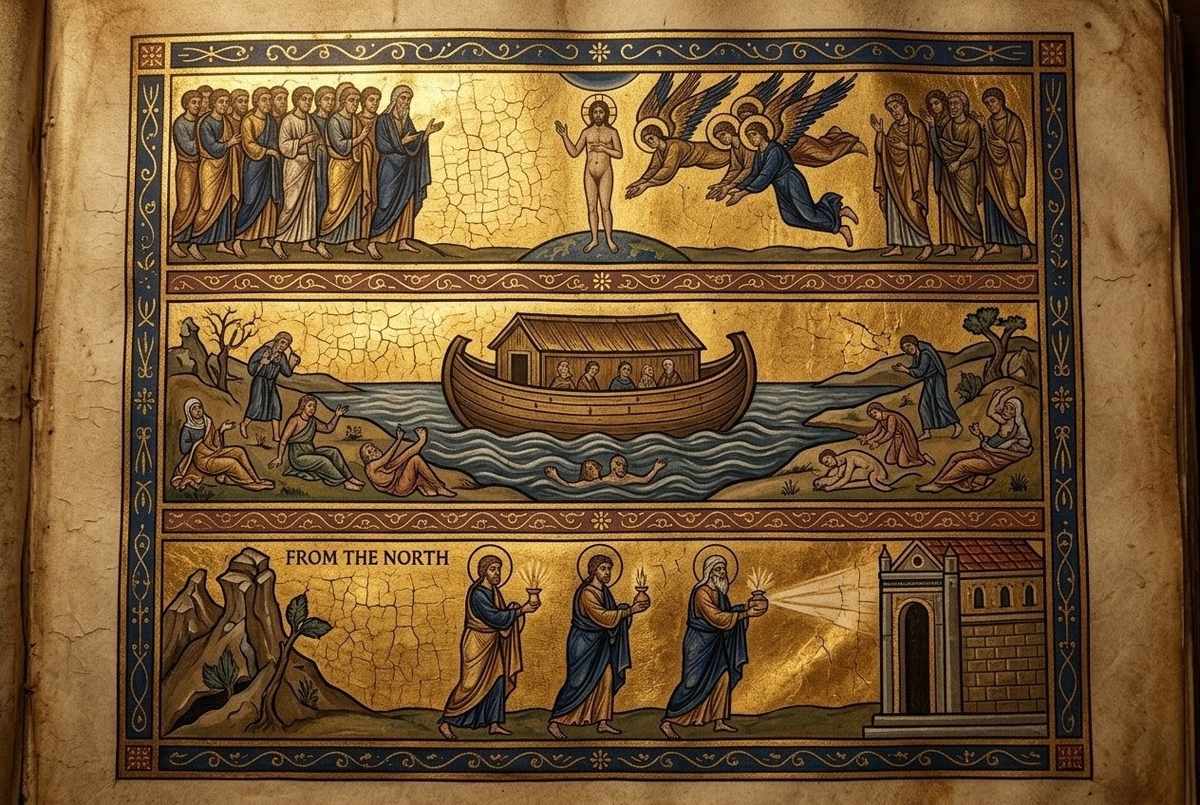
This tripartite structure provides a “historical filing system” that explains the present condition of the spiritual seed as temporary exile rather than permanent defeat. The current “second aeon” is merely an interregnum–a period of “remote work” before the “headquarters” reasserts direct control in the third aeon [16].
The Illuminators of Knowledge
The text predicts the coming of “illuminators” who will reveal the truth hidden during the second aeon: “They will come in the likeness of men, but they are not men. They will speak with the voice of thunder, and their words will be fire” (NHC V,5 76:5-10) [17]. These figures function as “special operatives” sent from the executive headquarters to bypass the “archonic middle-management” that has obscured the true knowledge during the era of mixture [18].
These figures are variously identified in scholarly literature as Seth (returning in different guises), or as Gnostic redeemers like Jesus interpreted through Sethian lens. The text is deliberately ambiguous–revealing and concealing the identity of the saviours, suggesting that their “clearance level” is so high that their exact “personnel files” cannot be revealed in advance [19].
“The seed of Seth will recognize them, for the knowledge is in their hearts” [20]. Recognition (anagnorisis) is the key–the saved know their saviours not by external signs but by internal resonance. This is not “credential verification” through institutional authority but intuitive “security clearance” that operates through kinship rather than certification [21]. The seed carries the “biometric signature” of the divine that automatically responds to the authentic revealers.
The Flood and the Fire
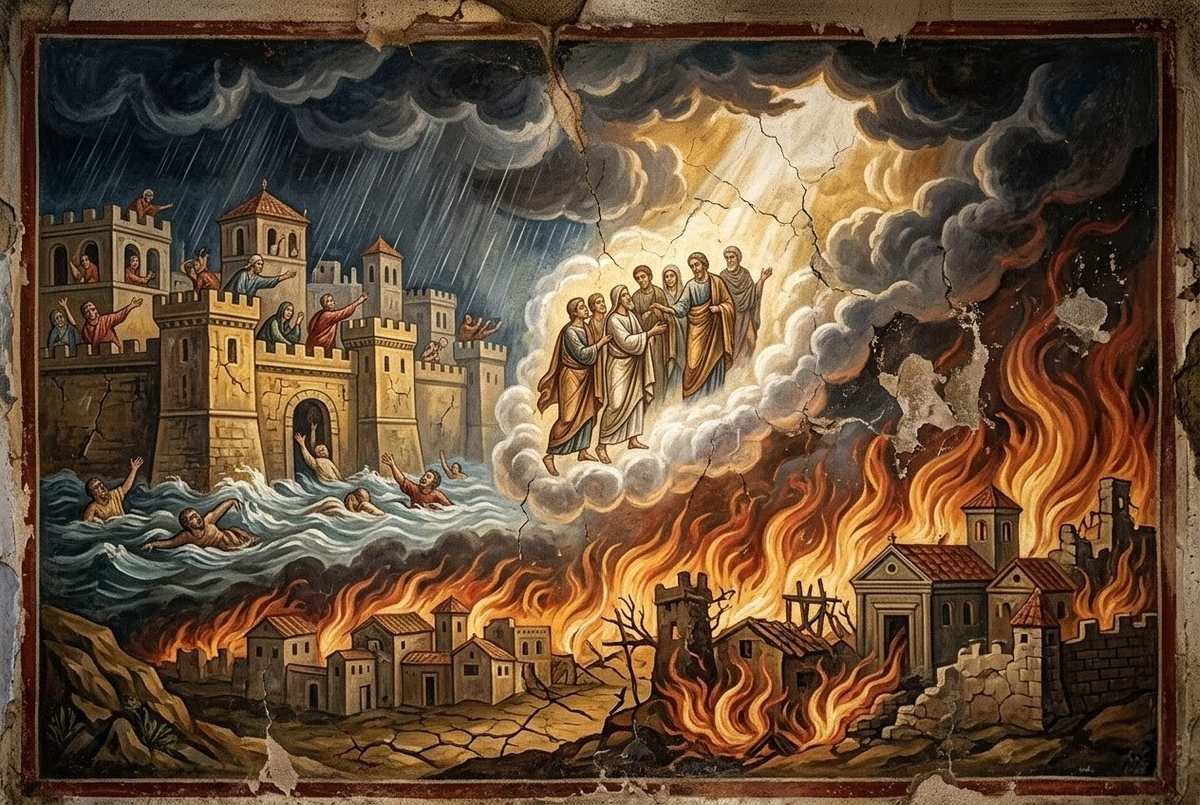
Adam predicts two great cataclysms that function as “corporate purges” of the material administration: the flood of water (past) and the flood of fire (future). “Just as water destroyed the first world, so fire will destroy this one” (NHC V,5 72:5-10) [22]. These are not mere punishments but necessary “system wipes” that eliminate the accumulated corruption of the archonic “operating system” while preserving the essential “data” of the spiritual seed.
The text promises preservation for those who possess the knowledge: “Those who have the knowledge will be hidden in the cloud of light, and they will not taste death” [23]. This is the Gnostic eschatology–not resurrection of the body but preservation of the spiritual seed through cosmic transformation. The “personnel” are evacuated from the “regional office” before the “server wipe” and transferred directly to the executive headquarters [24].
Primary Source Citation: “And the fire will purify the world, and the darkness will be burned away, and the light will remain” — Apocalypse of Adam 77:15-20 [25]
“And the fire will purify the world, and the darkness will be burned away, and the light will remain” [26]. The apocalypse is purification, not punishment–restoration of the primordial light. The “archonic infrastructure” is destroyed, but the “executive authority” of the spiritual seed is confirmed and elevated to permanent status in the true garden [27].
Sethian Traditions and Pre-Christian Elements
The Apocalypse of Adam preserves early Sethian traditions possibly independent of Christianity–demonstrating that Gnosticism (or proto-Gnosticism) existed as a Jewish phenomenon before the Jesus movement [28]. The text focuses on Seth as the vehicle of salvation rather than Jesus, suggesting that the “executive bloodline” passes through Adam’s third son rather than through the “standard channels” of biblical patriarchy [29].
The Christian elements (if present) are subtle, suggesting either early date or careful preservation of non-Christian material. The three-redeemer schema is unique–shaping later Gnostic expectations of multiple messengers rather than a single incarnation [30]. This suggests a “distributed salvation network” where the “executive authority” sends multiple “field agents” across history rather than relying on a single “regional manager” [31].
For understanding the Jewish roots of Gnosticism–the transformation of Genesis into apocalyptic, of Adam into prophet–the Apocalypse of Adam is essential [32]. It demonstrates how the “archival materials” of Hebrew scripture were reclassified as apocalyptic “intelligence reports” regarding the true structure of cosmic governance [33].
The Three Redeemer Schema
The Apocalypse of Adam’s most distinctive contribution is its three-redeemer schema–the prediction that three figures will come from the north bearing knowledge (NHC V,5 76:15-20) [34]. This challenges the “single saviour” model of orthodox Christianity and suggests instead a “rotating leadership” or “successive deployment” of revealers across the third aeon.
Some scholars identify these three with different manifestations of Seth himself–the primal son returning in various “administrative capacities” to gather his scattered seed [35]. Others see them as distinct figures representing different “departments” of the divine administration–perhaps corresponding to the Father, Mother, and Son of later Sethian triads [36].
The text’s ambiguity is functional: by not specifying exact identities, it maintains “operational security” while allowing various communities to identify their own revealers as the predicted figures [37]. This “open personnel file” approach permits the text to serve multiple communities across time, each recognising their own illuminators in the prophecy [38].
Jewish Apocalyptic Context
This is ancient apocalyptic–closer to the books of Enoch than to the philosophical Valentinian texts [39]. It requires familiarity with Jewish apocalyptic traditions–the watchers (egrēgoroi), the giants (gibborim), the flood as divine judgment, and the final cataclysm. The text operates within the “intelligence community” of Jewish apocalyptic, sharing classified information about the true nature of cosmic history [40].
Read it alongside the Jewish apocalyptic roots of Gnosticism and The Gospel of the Egyptians (Sethian cosmology) to understand the “administrative transition” from Jewish apocalyptic to Gnostic soteriology [41]. Notice how the watchers who descend in Genesis 6 become the template for the archons who rule the material “branch office” in later Gnostic systems [42].
The text preserves the “insider knowledge” that the biblical narrative is merely the “public record” while the true history involves secret transmissions from Adam through Seth, hidden from the “standard channels” of Israelite tradition [43]. This is the “classified dossier” that explains why the “official history” in Genesis requires supplementation by apocalyptic revelation [44].
Textual Context in Codex V
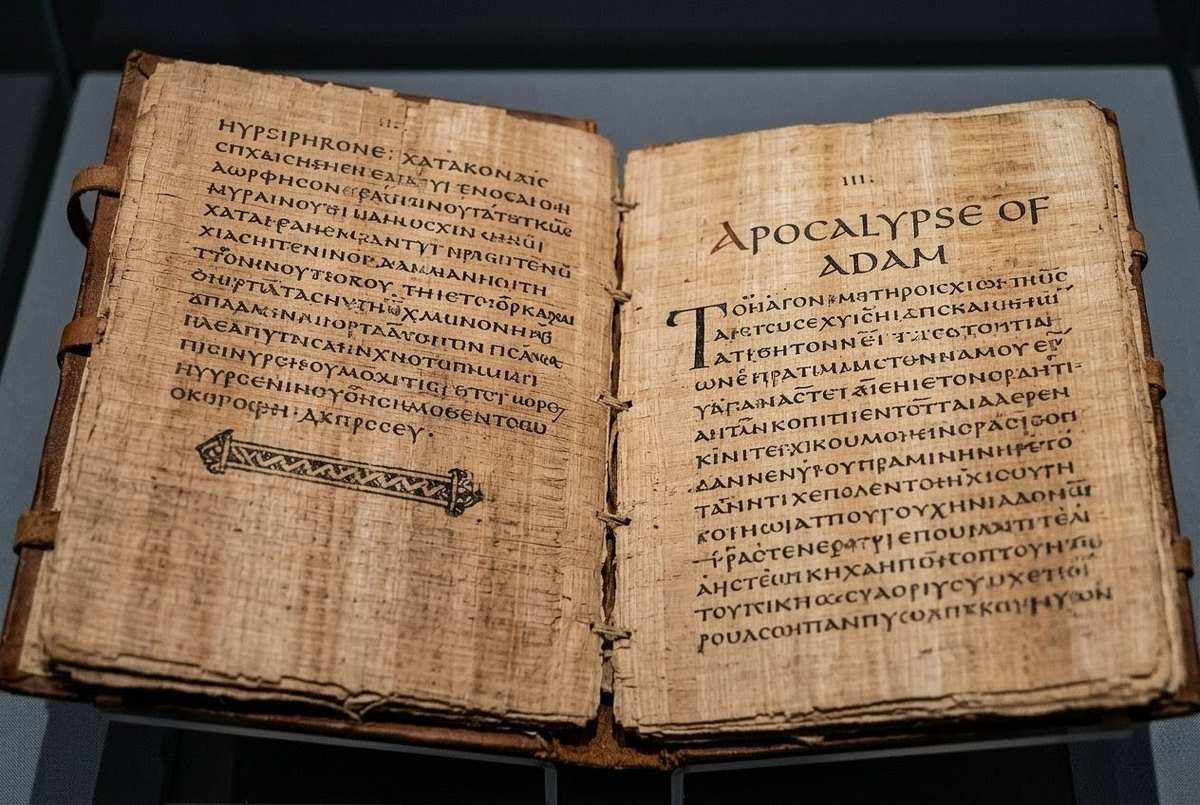
The Apocalypse of Adam appears as the final text in Codex V, following the Apocryphon of John and the Hypsiphrone [45]. This placement suggests that the ancient editors considered it a “capstone” text–the final testament that summarises the “executive summary” of Sethian tradition. Its position as the “last word” in the codex gives it authority as the “final briefing” from the primal father [46].
The manuscript dates to the fourth century CE, though the original composition likely occurred in the first or second century–possibly pre-dating the Christianisation of Sethian traditions [47]. Its presence in a codex containing the Apocryphon of John suggests that the community valued both the “mythological charter” (John) and the “apocalyptic prophecy” (Adam) as complementary “intelligence documents” [48].
Contemporary Relevance
The Apocalypse of Adam remains relevant for understanding how apocalyptic imagination constructs “end-times” scenarios that function as critique of present “administrative failures” [49]. The three-aeon structure offers a “long view” of history that contextualises present suffering as temporary “exile in the second aeon” rather than permanent condition–a perspective that maintains hope without denying present difficulty [50].
The text’s emphasis on recognition rather than institutional affiliation speaks to contemporary seekers disillusioned with religious bureaucracy [51]. The promise that “the knowledge is in their hearts” suggests an “internal security clearance” that requires no external validation–a radical democratisation of spiritual authority that bypasses the “middle-management” of established churches [52].
For those interested in the “archival recovery” of suppressed traditions, the Apocalypse of Adam demonstrates that the biblical narrative contains “redacted files” requiring apocalyptic “restoration” [53]. The text invites readers to seek the “classified supplements” to official history–to recognise that the “standard account” in Genesis conceals as much as it reveals about the true origins of humanity [54].
Frequently Asked Questions
What is the Apocalypse of Adam in the Nag Hammadi Library?
The Apocalypse of Adam (NHC V,5) is a revelation discourse attributed to Adam addressing his son Seth, presenting the first man’s final testament regarding cosmic history and future redemption. The text describes three aeons (dispensations) of history and predicts three illuminators who will gather the scattered seed of Seth. It preserves early Sethian traditions possibly independent of Christianity and represents ancient Jewish apocalyptic literature adapted by Gnostic redactors.
What are the three aeons described in the Apocalypse of Adam?
The Apocalypse of Adam divides history into three aeons or dispensations: (1) The First Aeon–from Adam to Noah, marked by the descent of the watchers and the birth of giants, ending in the flood judgment; (2) The Second Aeon–from Noah to the present, the era of mixture when the spiritual seed is scattered and hidden among nations; (3) The Third Aeon–the coming age of revelation when three men will come from the north bearing knowledge to gather the seed and restore primal unity.
Who are the three illuminators or redeemers in the text?
The Apocalypse of Adam predicts three figures will come from the north in the final days bearing knowledge to save the seed of Seth. Their identities are deliberately ambiguous in the text–variously interpreted by scholars as Seth returning in different manifestations, or as distinct redeemer figures including Jesus interpreted through Sethian lens. The text’s ambiguity allows multiple communities to identify their own revealers as the predicted figures. Recognition of these illuminators occurs through internal gnosis rather than external signs.
What is the significance of the two cataclysms (flood and fire)?
The Apocalypse of Adam predicts two great purifications: the flood of water (past) and the flood of fire (future). These function as cosmic purges that eliminate corruption while preserving the spiritual seed. Those with knowledge will be hidden in the cloud of light and not taste death. The fire will burn away darkness and leave only light. This represents Gnostic eschatology as purification and restoration rather than punishment, with salvation meaning preservation of the spiritual essence through transformation.
Is the Apocalypse of Adam a pre-Christian text?
Scholars debate the dating, but many argue the Apocalypse of Adam preserves early Sethian traditions possibly independent of Christianity. The text focuses on Seth rather than Jesus as the vehicle of salvation, and Christian elements (if present) are subtle. The three-redeemer schema and focus on Jewish apocalyptic themes (watchers, giants) suggest a Jewish origin later adapted by Gnostic communities. The text demonstrates that Gnosticism or proto-Gnosticism existed as a Jewish phenomenon before the Jesus movement, making it essential for understanding the Jewish roots of Gnosticism.
How does the Apocalypse of Adam relate to the books of Enoch?
The Apocalypse of Adam shares significant material with Jewish apocalyptic literature, particularly the books of Enoch. Both feature the watchers (sons of God) descending to mate with human women and begetting giants, the flood as judgment, and final eschatological cataclysms. The text requires familiarity with these traditions to understand its apocalyptic framework. It represents the transformation of Jewish apocalyptic into Sethian Gnosticism–preserving the apocalyptic structure while shifting focus to Seth as the bearer of secret knowledge.
What is the relationship between the Apocalypse of Adam and Sethian traditions?
The Apocalypse of Adam is a foundational Sethian text that establishes the importance of Seth as the vehicle of salvation rather than the biblical patriarchs. It presents Sethian eschatology through the three-aeon structure and the promise of future revealers. The text shares themes with other Sethian writings like the Gospel of the Egyptians and the Three Steles of Seth, forming part of the Sethian literary corpus in the Nag Hammadi Library. Its presence in Codex V alongside the Apocryphon of John suggests these texts were read as complementary documents within Sethian communities.
Further Reading
- The Gospel of the Egyptians: Sethian Cosmogony — Parallel Sethian text exploring the divine Seth and his role in cosmic history.
- Three Steles of Seth: Sethian Liturgy and Ascent — Liturgical text addressed to Seth from his descendants, forming part of the same tradition.
- Codex V: Apocalypses and Jamesian Literature — Context for the Apocalypse of Adam as the final text in this collection.
- The Apocryphon of John: The Gnostic Creation Myth — Foundational Sethian text appearing earlier in Codex V alongside Adam.
- Jewish Apocalyptic Roots of Gnosticism — Exploration of the Enochic traditions and apocalyptic framework behind the Apocalypse of Adam.
- Hypsiphrone and the Five Seals — Another text from Codex V showing Sethian ascent traditions.
- Sethian and Valentinian Schools — Comparative overview of the two main Gnostic schools represented in the Nag Hammadi Library.
References and Sources
The following sources support the claims and quotations presented in this article. All citations to the Nag Hammadi Library represent direct translations from the Coptic text as established in the standard critical editions.
Primary Sources and Critical Editions
- [1] Robinson, James M., ed. The Nag Hammadi Library in English. 4th ed. Leiden: E.J. Brill, 1996. [Apocalypse of Adam translation]
- [2] Layton, Bentley. The Gnostic Scriptures. New York: Doubleday, 1995. [Critical edition with commentary]
- [3] MacRae, George W. “The Apocalypse of Adam.” In The Coptic Gnostic Library, Vol. 31. Brill, 1988. [Scholarly edition]
- [4] Meyer, Marvin, ed. The Nag Hammadi Scriptures. New York: HarperOne, 2007. [Comprehensive collection]
- [5] Schenke, Hans-Martin. “The Book of Thomas and Apocalyptic Gnosticism.” In Der Gottesspruch in der Kopt. Berlin: Akademie-Verlag, 1962.
Scholarly Monographs and Articles
- [6] MacRae, George W. “Apocalyptic Eschatology in Gnosticism.” In The Rediscovery of Gnosticism, Vol. 1. Leiden: Brill, 1980.
- [7] Perkins, Pheme. “Apocalypse of Adam and the Beginnings of Sethian Gnosticism.” Vigiliae Christianae 35 (1981): 211-225.
- [8] Stroumsa, Gedaliahu A.G. “Another Seed: Studies in Gnostic Mythology.” Nag Hammadi Studies 24 (1984): 45-67.
- [9] Turner, John D. Sethian Gnosticism and the Platonic Tradition. Presses de l’Universite Laval, 2001. [Sethian classification]
- [10] King, Karen L. The Secret Revelation of John. Cambridge: Harvard University Press, 2006. [Sethian parallels]
Comparative Studies and Thematic Analyses
- [11] Nickelsburg, George W.E. 1 Enoch: A Commentary. Minneapolis: Fortress Press, 2001. [Apocalyptic parallels]
- [12] Stone, Michael E. Features of the Eschatology of IV Ezra. Atlanta: Scholars Press, 1989.
- [13] Jonas, Hans. The Gnostic Religion. 3rd ed. Boston: Beacon Press, 2001.
- [14] Rudolph, Kurt. Gnosis: The Nature and History of Gnosticism. San Francisco: Harper & Row, 1987.
- [15] Smith, Morton. “The History of the Term Gnostikos.” In The Rediscovery of Gnosticism. Leiden: Brill, 1980.