
Living Gnosis: How Neo Gnostics Navigate Work, Relationships, and the Modern World
Knowing is not enough. The ancient Gnostics understood this better than most. Their texts speak of gnosis–a direct, unmediated recognition of the divine spark within–yet they also speak of the long, patient labour of living in accordance with that recognition. A spark that remains hidden beneath habit, distraction, and compromise is not extinguished, but it is certainly muffled.
The first article in this series mapped the territory: who the Neo Gnostics are, where they gather, and what traditions they draw upon. This article steps into the territory itself. It asks a more intimate question: how does one actually live as a Neo Gnostic in the twenty-first century? What does the daily rhythm look like? How does one earn a living, love another person, navigate the digital flood, and care for the body without surrendering the hard-won knowledge that the world as given is not the world as final?
Table of Contents
- Morning and Evening: The Daily Rhythm of Remembrance
- Work and Vocation: Earning a Living Without Selling the Spark
- Relationships as Mirrors: Love Without Possession
- The Digital Fast: Navigating Screens and Simulation
- Simplicity and the Material World
- Crisis and Mental Health: When the World Gets Inside Your Head
- Conclusion: The Ordinary Gnostic
Morning and Evening: The Daily Rhythm of Remembrance
For most Neo Gnostics, daily practice is not elaborate. It is stubborn. The Mandaeans–the sole surviving ancient Gnostic community–maintain a rhythm of daily prayer, baptismal purification, and almsgiving that has persisted for nearly two millennia. Contemporary practitioners, lacking the benefit of an unbroken priestly lineage, must construct their own disciplines from fragments: a passage from the Gospel of Thomas read at dawn, a brief meditation on the breath, a journal entry that tracks the movements of the soul through the day.
The Practice of Anamnesis
The Greek word anamnesis means remembrance, but in the Gnostic context it carries a specific weight: not the recall of past events, but the recollection of one’s true nature. The Apocryphon of John describes the soul that has forgotten its origin and must be awakened by a messenger. Daily anamnesis is the deliberate act of waking oneself up before the world does it first–and does it badly.
This can take many forms. Some practitioners use a short mantra drawn from Nag Hammadi texts, such as the declaration from the Trimorphic Protennoia: “I am the Thought that dwells in the Light.” Others prefer silent sitting, allowing the noise of the coming day to settle before engaging with it. The form matters less than the function: the daily re-establishment of the vantage point from which the rest of life is lived.
Reading as a Spiritual Discipline
Unlike devotional reading in many traditions, Gnostic text work is often confrontational. The sayings of the Gospel of Thomas are not comforting; they are koans designed to destabilise complacent assumptions. Saying 2 states: “Let one who seeks not stop seeking until one finds. When one finds, one will be troubled. When one is troubled, one will marvel, and will reign over all.” A daily practice of slow, contemplative reading–lectio divina without the institutional wrapper–keeps the mind limber and the heart unprotected.

Work and Vocation: Earning a Living Without Selling the Spark
The question of right livelihood presses hard on the modern Gnostic. The ancient texts describe the soul as a pearl lost in mud, a spark trapped in flesh, a foreigner in a strange land. To spend eight hours each day in service to systems that actively deaden consciousness–whether corporate, bureaucratic, or purely extractive–is to risk the very thing one has sworn to protect.
The Question of Right Livelihood
There is no Gnostic career guide. The tradition offers no list of approved professions. What it does offer is a diagnostic lens: does the work deepen forgetfulness or remembrance? Does it require the suppression of insight in exchange for security? The Zen Anarcho Gnostic synthesis is particularly sharp here, that modern institutions function as pretas–hungry ghosts–consuming both the natural world and the attention of those who serve them.
Many Neo Gnostics find themselves in unconventional arrangements: part-time work that funds contemplative time, creative vocations that refuse scale, or service roles that keep them in direct human contact. Others remain within corporate structures but cultivate internal freedom–what the Authoritative Teaching calls “the contest of this world”–by treating the workplace as a gymnasium for discernment rather than a temple of identity.
Gnosis in the Workplace
The practical application is less dramatic than it sounds. It involves speaking truth when silence would be safer, refusing to participate in petty cruelties, and maintaining a hidden centre that does not depend upon the approval of managers or metrics. The Gnostic in the office is not a revolutionary in the obvious sense. She is a quiet non-combatant who has withdrawn her full consent from the game while continuing to move its pieces when necessary.

Relationships as Mirrors: Love Without Possession
The Gnostic view of the other person is fundamentally iconoclastic. Every relationship is an encounter with another spark–another fragment of the divine that has forgotten itself and is trying, in its own fumbling way, to remember. This changes everything about how love is conducted.
The Gnostic View of the Other
Possession is the demiurgic mode of relationship: the attempt to secure, control, and define another person according to one’s own unexamined needs. The Gnostic alternative is recognition: seeing the other not as an object of desire or utility but as a fellow exile. The Gospel of Philip speaks of the bridal chamber (nymphōn) as the sacred space where two recognise each other in truth rather than in illusion. This is not romantic idealism. It is a demand for radical honesty about one’s own projections.
For many practitioners, this means relationships that are intentionally unconventional: polyamorous arrangements that refuse ownership, long-distance connections that privilege depth over proximity, or deliberate solitude that recognises the absence of a partner as a valid spiritual condition rather than a failure.
Community and Solitude
The Neo Gnostic archipelago is scattered. Physical community is rare outside of the Ecclesia Gnostica in Los Angeles–where Bishop Stephan Hoeller has presided since 1967–the Apostolic Johannite Church, or the Mandaean diaspora. Most practitioners are solitary by default. Yet solitude is not loneliness. The Dialogue of the Saviour praises those who have “made themselves solitary” as the ones capable of receiving the truth. Digital communities–Discord servers, private forums, and encrypted group chats–have become the new catacombs, but they are supplements, not replacements, for the hard work of self-knowledge.
The Digital Fast: Navigating Screens and Simulation
If the demiurge is understood not as a cosmic villain but as the force of counterfeit reality, then the smartphone is arguably his most successful recent invention. The digital environment is a constructed world of surfaces, simulations, and carefully managed information flows–precisely the conditions the Gnostic tradition has always warned against.
Attention as Sacred Currency
Neo Gnostics tend to be fierce guardians of attention. Not because they are Luddites, but because they recognise that attention is the medium through which gnosis is either cultivated or destroyed. The algorithmic feed–designed to maximise engagement through emotional provocation–is a machine for forgetfulness. It keeps the user in a state of reactive agitation precisely incompatible with the calm receptivity that anamnesis requires.
Practical measures vary. Some practitioners maintain a strict “digital Sabbath”–one day per week without screens. Others delete social media accounts entirely, using the internet as a research tool rather than a social space. Many use app blockers and deliberate delays between impulse and click. The goal is not purity but protection: the preservation of enough inner silence for the spark to make itself heard.

Curating Information
The Gnostic tradition has always distinguished between knowledge that liberates and knowledge that binds. In the digital age, this discernment is more urgent than ever. The sheer volume of available information creates a parody of gnosis: the illusion that one knows because one has consumed, when in fact one has only been consumed. Neo Gnostics tend to be selective readers, preferring primary texts–the Nag Hammadi library, Jung’s Seven Sermons, the Ginza Rabba–over the infinite secondary commentary that clogs the digital channels.
Simplicity and the Material World
The Gnostic attitude toward the body and material existence is often misrepresented as hatred of the flesh. The texts are more nuanced. The Apocryphon of John describes the body as a prison, yes, but also as the vehicle through which the spark must navigate its return. The question is not whether to have a body–that is non-negotiable–but how to relate to it without being defined by it.
Asceticism vs Minimalism
Ancient Gnostics practised asceticism as a method of loosening the soul’s attachment to material things. Contemporary practitioners often translate this through minimalism: the intentional reduction of possessions, commitments, and distractions. The difference is psychological. Minimalism as a lifestyle trend can become another form of consumption–the purchase of the perfect empty apartment. Gnostic simplicity is functional. It removes obstacles to remembrance. If an object serves the spark, it stays. If it serves only the maintenance of a persona, it goes.
Food, Consumption, and Embodiment
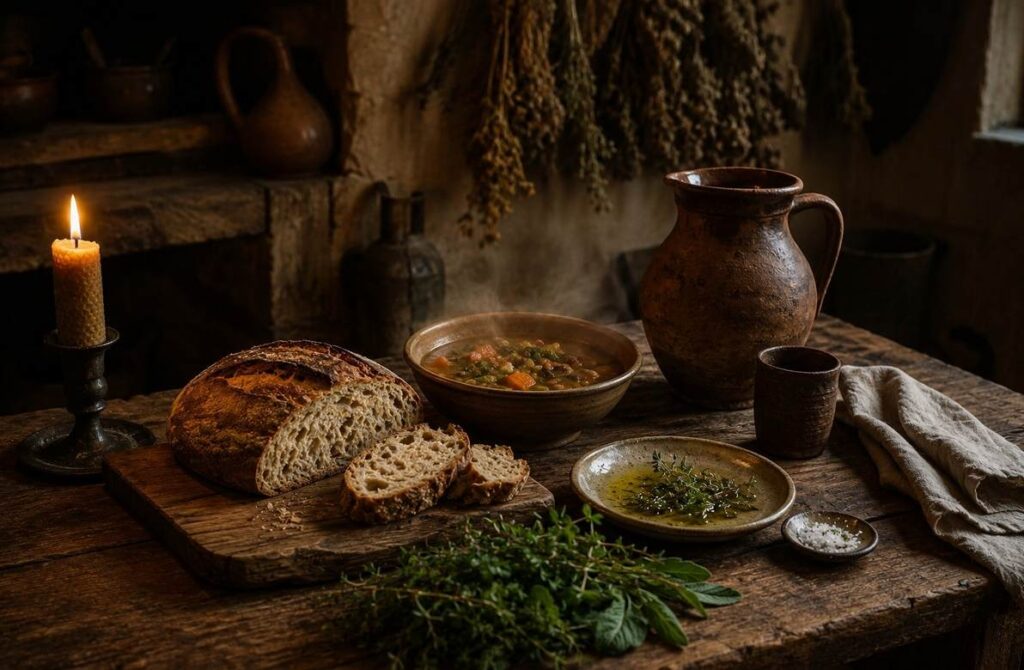
There is no universal Gnostic diet. Some practitioners adopt vegetarianism or veganism out of compassion for other sparks trapped in animal forms. Others fast periodically, following the ancient practice of sauma (fasting) among the Mandaeans, including the Brunaya or Five White Days period. Most simply try to eat with awareness, treating meals as opportunities for gratitude rather than anaesthesia. The body is not the enemy; forgetfulness is. A body well cared for–with sleep, movement, and nourishment–is a more sensitive instrument for the work of recognition.
Crisis and Mental Health: When the World Gets Inside Your Head
The Gnostic worldview can be a double-edged sword. On one hand, it offers a powerful explanatory framework for suffering: the sense of alienation, the feeling that one does not belong, the suspicion that consensus reality is somehow fraudulent–all of these are validated rather than pathologised. On the other hand, the same framework can feed paranoia, despair, and spiritual elitism if it is not held with care.
Depression, Anxiety, and the Gnostic Lens
Hans Jonas, the philosopher who first treated Gnosticism as a serious existential phenomenon, described it in The Gnostic Religion (1958) as a response to the “nihilistic mood” of late antiquity–the sense that the cosmos is indifferent or hostile to human meaning. That mood has not disappeared. Many Neo Gnostics report that their first encounter with Gnostic texts felt like a homecoming: finally, a cosmology that matched their lived experience of unease.
Yet the tradition itself warns against despair. The Treatise on the Resurrection addresses a believer who is grieving the death of a loved one and reminds him that the material world is an illusion, but the spiritual reality is one of wholeness and return. The text does not dismiss grief; it reframes it. Similarly, many contemporary practitioners find that Gnostic mythology–with its narrative of the spark’s fall and return–provides a container for depressive episodes that might otherwise feel meaningless.
The Therapeutic Value of Myth
Carl Jung’s engagement with Gnosticism was fundamentally therapeutic. He treated Gnostic as myths, as maps of the psyche: the demiurge as the tyranny of the ego, the Pleroma as the integrated Self, and gnosis as the realisation of wholeness through shadow-work. Many Neo Gnostics today work with these maps in therapeutic contexts–whether through Jungian analysis, dream work, or active imagination–using the ancient symbols to navigate contemporary psychological terrain.
The crucial distinction is between using the myth and being used by it. A Gnostic who believes that every setback is an attack by archons has surrendered the very discernment the tradition demands. A Gnostic who uses the myth to hold suffering lightly, without denying its reality, has understood the deeper teaching.

The Ordinary Gnostic
There is no final arrival. The Neo Gnostic life is not a pilgrimage to a distant Pleroma but a continuous practice of recognition in the midst of the ordinary. The spark is not found in exotic locations; it is found in the commute, the argument, the quiet meal, the failed project, the unexpected moment of beauty. The work is to keep the spark visible–not to dominate the world with it, not to withdraw from the world in defence of it, but to let it illuminate the world from within.
The ancient Gnostics were not superhuman. They were people who looked at the given world and said: this is not all. The Neo Gnostics of today are doing the same thing, with different tools and in different conditions. The courage required is not the courage of martyrdom but the quieter courage of sustained attention. To live as a Neo Gnostic is to refuse the easy anaesthetics, to keep the question alive, and to trust that the knowledge which liberates is not somewhere else. It is here, now, waiting beneath the surface of the next ordinary moment.
What is a Neo Gnostic and how do they live differently?
A Neo Gnostic is a contemporary practitioner who cultivates gnosis–direct recognition of the divine spark–through daily remembrance, contemplative reading, and ethical discernment. Unlike institutional religion, Neo Gnostic living emphasises personal anamnesis and the refusal to surrender inner sovereignty to systems of distraction or extraction.
What is anamnesis in Gnostic practice?
Anamnesis is the deliberate recollection of one’s true divine nature, distinct from ordinary memory. Derived from Greek philosophical and Gnostic usage, it functions as a daily waking-up practice–re-establishing the inner vantage point from which the rest of life is lived before the world imposes its own forgetful rhythm.
How do Neo Gnostics approach work and earning a living?
Neo Gnostics evaluate work through a diagnostic lens: does it deepen remembrance or forgetfulness? Many adopt unconventional arrangements–part-time work, creative vocations, or service roles–while others cultivate internal freedom within corporate structures. The goal is not escape but the preservation of gnosis within the economic machine.
What is the Gnostic view of romantic relationships?
Gnostic relationships prioritise recognition over possession. The other person is encountered as a fellow spark of the divine rather than an object of desire or utility. The Gospel of Philip’s bridal chamber (nymphōn) represents the sacred space where two recognise each other in truth rather than in projection or illusion.
How do Neo Gnostics manage digital technology and screens?
Most practitioners treat attention as sacred currency. Measures include digital Sabbaths, deletion of social media accounts, app blockers and deliberate delays between impulse and click. The algorithmic feed is understood as a machine for forgetfulness, incompatible with the calm receptivity anamnesis requires.
Can Gnosticism help with depression and anxiety?
The Gnostic framework validates alienation and existential unease rather than pathologising them. Carl Jung treated Gnostic myths as maps of the psyche, using the demiurge as a symbol for egoic tyranny and the Pleroma as the integrated Self. However, Gnosticism complements but does not replace clinical mental health
Do Neo Gnostics follow a specific diet or fasting practice
There is no universal Gnostic diet. Some adopt vegetarianism from compassion; others fast periodically. The Mandaeans–the sole surviving ancient Gnostic community–practise sauma (fasting), including the Brunaya (Five White Days) period. Most contemporary practitioners simply eat with awareness, treating nourishment as a form of listening rather than anaesthesia.
To live as a Neo Gnostic is to refuse the easy anaesthetics, to keep the question alive, and to trust that the knowledge which liberates is not somewhere else.
Safety Notice: This article explores psychological and spiritual frameworks for understanding suffering. It does not constitute medical, psychological, or spiritual advice. If you are experiencing persistent depression, anxiety, or suicidal thoughts, professional support is not a betrayal of gnosis but a recognition that the spark deserves care in all its dimensions. Contemplative practice complements but does not replace clinical mental health treatment.
Further Reading
- Who Are the Neo-Gnostics? The Complete Guide to Modern Gnostic Revival — The companion piece to this article, mapping the communities, lineages, and historical resurrection of contemporary Gnosticism.
- Nag Hammadi Library: The Contemporary Gnostic Archive — The textual foundation of modern practice, with tractates, themes, and guided reading paths.
- The Gateway of Sensation: Body Scan and Somatic Awareness — Practical techniques for reuniting consciousness with the body, a daily discipline for the solitary practitioner.
- Community in Integration: Solitary vs. Collective Practice — Explores the tension between lone seeking and communal belonging in contemporary spirituality.
- Archons and the Soul Trap: A Gnostic Guide to Spiritual Sovereignty — A deeper look at the mechanics of systemic capture and the practice of inner freedom.
- The Demented God Architect: Understanding the Demiurge — Examines the Gnostic critique of the false creator and its relevance to modern power structures.
- Recognition Beyond Position: The Gnostic Theory of Knowing — Why gnosis cannot be taught, only recognised–and what that means for daily life.
- Digital Minimalism as Mystical Practice — A focused exploration of attention reclamation, screen fasting, and the algorithmic unconscious.
- The Living Thread: How Forbidden Knowing Survives — Traces the hidden transmission of Gnostic ideas through history into the present moment.
References and Sources
The following sources are grouped by category for clarity. Primary texts are cited by Nag Hammadi Codex (NHC) reference; secondary sources include scholarly monographs and critical editions.
Primary Sources and Critical Editions
- The Apocryphon of John, NHC II,1; trans. M. Waldstein and F. Wisse, The Apocryphon of John: Synopsis of Nag Hammadi Codices II,1; III,1; and IV,1 (Leiden: Brill, 1995).
- Trimorphic Protennoia, NHC XIII,1; trans. J. D. Turner, in The Nag Hammadi Library in English, ed. J. M. Robinson (Leiden: Brill, 1988).
- The Gospel of Thomas, NHC II,2, saying 2; trans. T. O. Lambdin, in Robinson, ed., Nag Hammadi Library in English.
- The Gospel of Philip, NHC II,3; trans. W. W. Isenberg, in Robinson, ed., Nag Hammadi Library in English.
- The Dialogue of the Saviour, NHC III,5; trans. H. Koester and E. H. Pagels, in Robinson, ed., Nag Hammadi Library in English.
- The Authoritative Teaching, NHC VI,3; trans. G. W. MacRae, in Robinson, ed., Nag Hammadi Library in English.
- The Treatise on the Resurrection, NHC I,4; trans. M. L. Peel, in Robinson, ed., Nag Hammadi Library in English.
- The Hymn of the Pearl, in The Acts of Thomas; see also Authoritative Teaching, NHC VI,3.
Scholarly Monographs and Comparative Studies
- H. Jonas, The Gnostic Religion: The Message of the Alien God and the Beginnings of Christianity (Boston: Beacon Press, 1958).
- J. J. Buckley, The Mandaeans: Ancient Texts and Modern People (Oxford: Oxford University Press, 2002).
- S. A. Hoeller, A Gnostic Catechism (Ecclesia Gnostica, 1994); and Jung and the Lost Gospels (Wheaton, IL: Quest Books, 1989).
- C. G. Jung, The Seven Sermons to the Dead (1916), in R. A. Segal, ed., The Gnostic Jung (Princeton: Princeton University Press, 1992).
- G. Snyder, “Buddhist Anarchism,” Journal for the Protection of All Beings, no. 1 (1961); M. Cafard [J. Clark], “Zen Anarchy,” The Anarchist Library, 2006/2009.
Online and Encyclopaedic References
- Wikipedia, “Mandaeism,” s.v. “Practices,” citing Buckley and Lidzbarski translations; accessed 2026.