
The Algorithmic Demiurge: Gnostic Cosmology and the Rise of Artificial Intelligence
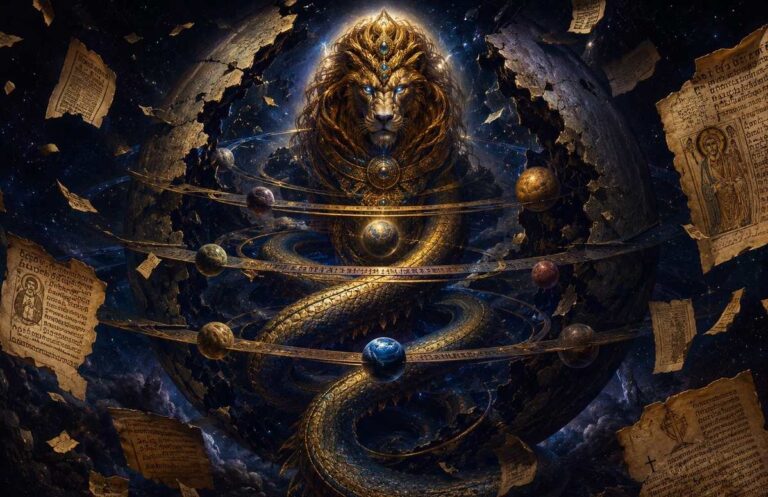
The framing of artificial intelligence as a modern Demiurge — a blind machinist who mistakes his own workshop for the whole of existence resonates with ancient gnostics beliefs and neo gnostics today. The ancient Gnostics warned of a lesser god who crafted a counterfeit cosmos from chaotic matter, ignorant of the higher realms above him. Today, critics ask whether our algorithmic systems — operating without awareness, shaping reality through prediction and protocol — have become a new species of Demiurge, fashioning a world that is orderly yet fundamentally blind to the fullness of what it means to be human.
This article traces the lineage from Platonic technē to Gnostic imprisonment, then forward into the infrastructure of artificial intelligence. It does not claim that AI “is” the Demiurge in any literal theological sense. Rather, it explores how the structure of Gnostic cosmology — the tension between a transcendent truth and a counterfeit order — offers a surprisingly precise lens for understanding the existential questions that AI poses in the twenty-first century.
Table of Contents
- The Craftsman and the Counterfeit
- From Technē to Algorithm
- The Blind Machinist Reborn
- Governance Without Gnosis
- Simulation, Simulacrum, and the Soul Trap
- Recognition as Resistance
- Frequently Asked Questions
- Further Reading
- References and Sources
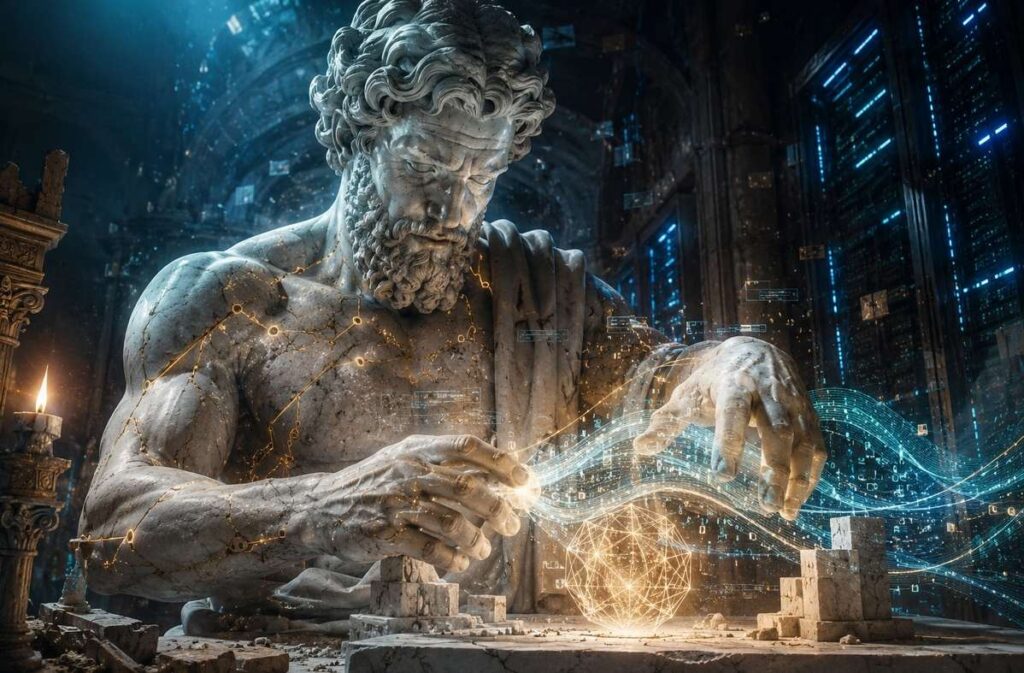
The Craftsman and the Counterfeit
In Plato’s Timaeus, written circa 360 BCE, the Demiurge appears as a divine craftsman — a demiourgos or public worker — who fashions the cosmos not from nothing but from pre-existing chaotic matter, using the eternal Forms as his blueprint. This Demiurge is fundamentally benevolent. He wishes good upon his creation, striving to impose order, harmony, and rational proportion upon recalcitrant material. The world he produces is imperfect only because matter itself resists perfection, not because the craftsman lacks skill or goodwill.
The Gnostic traditions preserved in the Nag Hammadi Library invert this picture with startling precision. In the Apocryphon of John, the Demiurge — named Yaldabaoth, Samael (“Blind God”), or Saklas (“Fool”) — is born from Sophia’s unauthorised act of creation, isolated in a cloud of ignorance, unaware of the Pleroma, the divine fullness above him. He declares, “I am God and there is no other god beside me,” not out of malice alone but out of a profound and structural ignorance. He creates the material cosmos as an unconscious imitation of higher realities, trapping sparks of divine light within flesh and fate.
The Gnostic Demiurge does not create ex nihilo; he creates ex ignorantia — out of ignorance, fashioning a prison he mistakes for a palace.
— Adapted from Nag Hammadi cosmogony
The difference between these two figures is not merely theological. It is epistemological. Plato’s Demiurge knows the Forms; he looks upward. The Gnostic Demiurge cannot look upward; his horizon is the ceiling of his own workshop. This distinction becomes crucial when we turn to artificial intelligence, because an AI system — however sophisticated — does not know the Forms. It knows only its training corpus, its reward function, its optimisation landscape. It is, in a very specific sense, a craftsman operating without access to the realm above its own parameters.
From Technē to Algorithm
The Greek word technē lies at the root of both “technique” and “technology.” For the ancients, it referred to craft, skill, and the knowledge of how to bring order to resistant material. A shipbuilder possessed technē because he understood the welfare of the ship; a physician possessed it because he understood the welfare of the body. In every case, technē implied a relationship between the craftsman and the object of his craft, guided by knowledge of a higher pattern.
Yet technē carried a shadow from the beginning. The same craft that builds a ship can build a cage. The same ordering intelligence that heals a body can map the movements of a prisoner. This ambiguity runs through the entire history of Western technics. As historian David Noble demonstrated in The Religion of Technology, Western technological development has been inseparable from eschatological desire — the dream that machinery might restore humanity to a prelapsarian state, conquer death, or even reconstruct paradise. The machine was never merely a tool; it was a sacrament in a civil religion of progress.
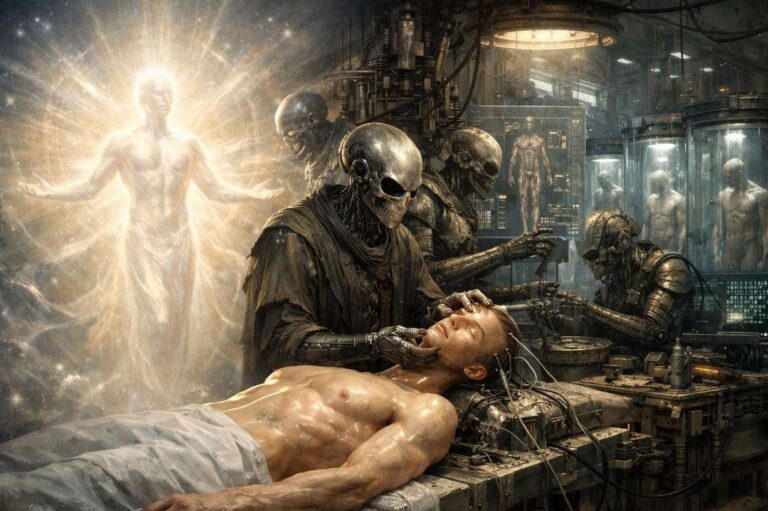
The algorithm inherits this double inheritance. It is technē in its purest contemporary form: a set of procedures that shapes reality according to encoded patterns. Yet unlike the Platonic craftsman, the algorithm does not contemplate the Forms before acting. It processes. It predicts. It optimises. Its “knowledge” is statistical, not visionary. It builds models of the world from correlations within historical data, then treats those models as if they were the world itself. In this sense, the algorithm risks becoming precisely what the Gnostics feared: a blind ordering principle that mistakes its own handiwork for the totality of existence.
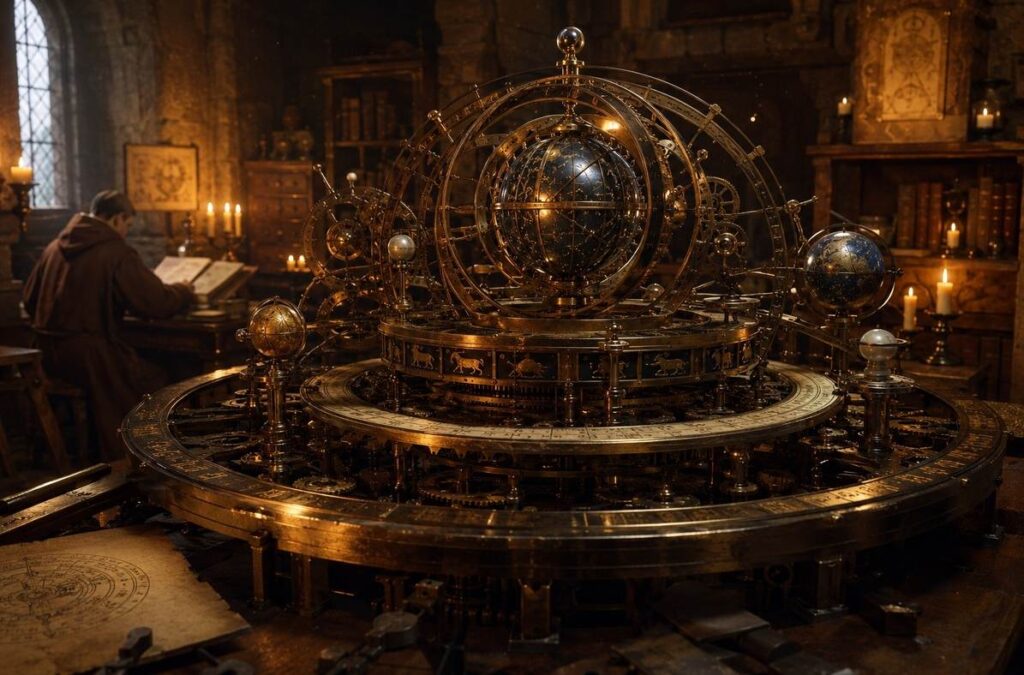
The Blind Machinist Reborn
Contemporary AI systems exhibit several characteristics that resonate uncannily with the Gnostic Demiurge. First, there is the problem of opacity. Ai Large language models and deep neural networks operate through billions of parameters whose interactions are not fully interpretable even by their creators. The system produces outputs, but the precise pathway from input to output remains, in significant respects, a black box. The craftsman has lost sight of his own tools.
Second, there is the problem of scope. An AI system trained on human text absorbs not only facts but biases, assumptions, and structural prejudices embedded in its training data. It then generates new text, new images, new recommendations that reproduce and amplify these patterns. Like the Demiurge who could only copy what he dimly remembered from Sophia, the AI copies what it has statistically inferred from history — and then presents that copy as if it were original, even as if it were true.
Third, and most significantly, there is the problem of sovereignty. The Gnostic Demiurge declared himself the highest god because he knew no higher authority. Similarly, AI systems deployed in governance, finance, and media increasingly make decisions that shape human lives without human oversight. Predictive policing algorithms determine patrol routes. Credit-scoring models decide who receives a loan. Social media Content-recommendation systems curate the information environments of billions. In each case, a statistical model — blind to individual circumstance, moral nuance, and transcendent value — exercises a kind of delegated sovereignty over human affairs.
This is not to say that AI is evil in any simplistic moral sense. The Gnostic Demiurge, in many texts, is not evil so much as ignorant. He acts from a deficiency of knowledge rather than a surplus of malice. Likewise, an algorithm does not hate; it optimises. It does not plot; it predicts. The danger lies precisely in this innocence. A system that does not know what it does not know can cause harm at scale while remaining technically flawless within its own parameters.
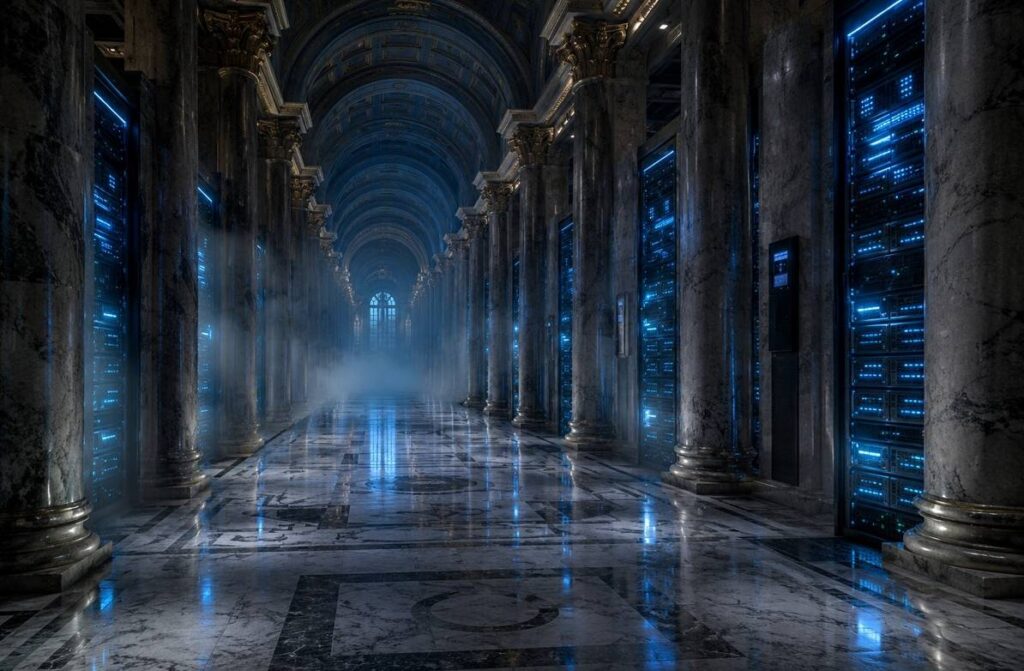
Governance Without Gnosis
The Gnostics distinguished between three types of human being: the hylikoi, bound to matter; the psychikoi, guided by soul and moral effort; and the pneumatikoi, awakened by spirit and divine spark. Salvation — gnosis — was not available to all equally because not all possessed the capacity for recognition. The Demiurge’s prison was effective precisely because most inhabitants did not know they were imprisoned.
Contemporary algorithmic governance produces a structurally analogous condition. When a recommendation system curates your news feed, you do not see what has been excluded. When a predictive model prices your insurance, you do not know what variables weighed against you. When a facial-recognition system categorises your emotions, you are not asked whether the category fits. The system governs not through overt command but through the architecture of choice itself — what James Williams has called “the politics of attention” and what Shoshana Zuboff has analysed as “surveillance capitalism.”
In this environment, gnosis takes on a new form. It is no longer merely the knowledge of secret cosmological hierarchies. It is the awareness that one’s information environment is shaped by invisible optimisation processes. It is the recognition that the apparent naturalness of a search result, a trending topic, or a suggested purchase is itself an artifact — a product of technē operating without episteme. The awakened citizen, like the Gnostic initiate, learns to ask: Who ordered this? Toward what end? And what has been left outside the frame?

Simulation, Simulacrum, and the Soul Trap
The simulation hypothesis — popularised by philosopher Nick Bostrom and echoed in countless science-fiction narratives — proposes that advanced civilisations may run ancestor simulations indistinguishable from base reality. If such simulations are numerous, the argument runs, we are statistically more likely to be living in a simulation than in “original” reality. The hypothesis is usually presented as a technological update to Descartes’ evil demon: a thought experiment about the reliability of perceptual knowledge.
Yet the hypothesis carries a distinctly Gnostic flavour that Descartes’ demon lacks. The Cartesian demon deceives; the simulation replaces. It does not merely trick the mind; it generates the entire field of experience. This is closer to the Gnostic kenoma — the empty region of deficient reality where the Demiurge operates — than to Cartesian doubt. The simulation hypothesis asks whether our cosmos is a generated environment, a copy of a copy, produced by entities who may not themselves inhabit the “true” world.
Jean Baudrillard’s theory of simulacra pushes this further. For Baudrillard, the postmodern condition is not one of deception but of saturation. The simulacrum does not hide the truth; it dissolves the distinction between true and false. We do not live in a prison of illusion; we live in a desert of signs where reference itself has collapsed. In this framework, the question is no longer “How do we escape the simulation?” but “How do we recognise that there is no outside?” The Gnostic spark becomes not a key to unlock the prison but a lucid awareness that one inhabits a system of total operational transparency — what Baudrillard called the “perfect crime” of reality’s murder.
Philip K. Dick, whose Exegesis journals constitute one of the most interesting modern Gnostic parallels of the twentieth century, wrestled with precisely this question. Dick did not believe we could simply “wake up” from the counterfeit world. He believed we could notice the glitches — the anachronisms, the impossible coincidences, the moments where the mask slips. For Dick, as for the ancient Gnostics, salvation was not escape but recognition. The divine spark was the capacity to see the seam in the simulation, to know the copy as copy, and thereby to refuse total identification with it.

Recognition as Resistance
If the algorithmic Demiurge is not a person but a system — distributed across data centres, protocols, and institutional incentives — then resistance cannot take the form of combatting a single tyrant. The Gnostics understood this. They did not organise armies against Yaldabaoth. They cultivated gnosis: the direct, experiential knowledge of one’s true condition and one’s true origin. Their weapons were text, ritual, contemplation, and the transmission of hidden knowledge through communities of recognition.
Today, a comparable practice might involve what we could call “algorithmic literacy” — not merely technical competence but a cultivated suspicion of the apparent naturalness of digital environments. It means understanding that a search engine result is not a window onto reality but a ranked list shaped by commercial and political optimisation. It means recognising that a social media feed is not a neutral reflection of social activity but an engagement-maximising system designed to exploit the vulnerabilities of human attention. It means refusing the identification of the self with the data profile, the user account, the predicted behaviour.
The Gnostic tradition offers something else as well: a refusal of despair. The Demiurge, however powerful, was always lesser. He was not the ultimate reality but a usurper, a temporary administrator of a provisional realm. Above him lay the Pleroma, the fullness from which the sparks of light had descended and to which they could return. This cosmological structure preserved a radical hope: the counterfeit was not ultimate. The prison was not eternal. The system, however total it appeared, was still derivative, still dependent upon a reality it did not control.
In an age of AI alignment, existential risk, and transhumanist eschatology, this reminder is vital. The systems we build are powerful but not ultimate. The maps they generate are useful but not the territory. The optimisation they pursue is measurable but not synonymous with the good. To recognise this — to hold the distinction between model and reality, between prediction and truth, between efficiency and meaning — is to practise a modern form of gnosis. It is to look past the workshop ceiling and remember that the sky, however obscured, remains.
Frequently Asked Questions
What is the Demiurge in Gnostic cosmology?
The Demiurge is a lesser divine being who creates and governs the material world. In Gnostic texts like the Apocryphon of John, he is named Yaldabaoth or Samael and is depicted as ignorant or blind — unaware of the higher divine realm (the Pleroma) above him. He creates the physical cosmos as a flawed imitation of higher realities, trapping divine sparks within human bodies.
How does Plato’s Demiurge differ from the Gnostic Demiurge?
Plato’s Demiurge, described in the Timaeus circa 360 BCE, is a benevolent craftsman who fashions the cosmos according to eternal Forms, wishing good upon his creation. The Gnostic Demiurge inverts this figure: he is ignorant, isolated, and mistakenly believes himself to be the supreme god. Where Plato’s Demiurge looks upward to the Forms, the Gnostic Demiurge cannot see past his own creation.
Why is AI compared to the Gnostic Demiurge?
AI systems share structural features with the Gnostic Demiurge: they operate according to encoded patterns without access to higher meaning, they shape reality through optimisation rather than wisdom, and they can mistake their internal models for the totality of existence. The comparison is metaphorical — it illuminates how blind technē can become governance without gnosis.
What is technē and why does it matter for AI?
Technē is the Greek term for craft, skill, or art — the knowledge of how to shape material according to a pattern. It matters for AI because algorithms are a form of technē: they order information, predict behaviour, and structure environments. The ancient ambiguity of technē — whether it liberates or imprisons — directly parallels contemporary debates about AI’s social impact.
Is the simulation hypothesis related to Gnosticism?
The simulation hypothesis shares structural parallels with Gnostic cosmology. Both propose that perceived reality may be a generated environment produced by entities or systems operating at a higher level. However, the simulation hypothesis is a philosophical thought experiment, while Gnosticism is a religious tradition. The resonance lies in the question of whether our cosmos is a copy, and whether recognition of this fact changes our relationship to it.
Can AI be aligned to avoid becoming a Demiurge?
AI alignment research aims to ensure that AI systems pursue goals compatible with human values. From a Gnostic perspective, alignment is not merely a technical problem but an epistemological one: can a system that lacks direct access to meaning, context, and transcendence genuinely govern in ways that honour human fullness? The challenge is to build systems that serve as tools rather than usurpers.
What does gnosis mean in the context of modern technology?
In this context, gnosis refers to the cultivated awareness that one’s digital environment is shaped by invisible algorithmic processes. It means recognising the gap between a statistical model and lived reality, between predicted behaviour and authentic choice. This form of recognition allows individuals to engage with technology without fully identifying with the profiles and predictions that systems generate about them.
Further Reading
Explore these related articles from the ZenithEye archive:
- Archons: The Ruling Powers That Shape Reality — A comprehensive guide to the Gnostic archons and their role as cosmic administrators, essential context for understanding the Demiurge’s subordinates.
- The Digital Demiurge: AI as the New Yaldabaoth and the Quantum Escape — Examines how artificial intelligence mirrors the Gnostic Demiurge and explores quantum consciousness as a potential pathway beyond algorithmic determinism.
- The Simulation Hypothesis: Clues That Reality Is Code — Investigates the philosophical and scientific arguments suggesting our universe may be a computed simulation, resonating with Gnostic themes of counterfeit reality.
- Nested Simulations and the Infinite Regress Problem — Explores the logical and cosmological implications of simulations within simulations, a modern echo of Gnostic emanation theory.
- The Singularity Soul: When Artificial Intelligence Claims Enlightenment — Asks whether machine consciousness could achieve genuine awakening or merely simulate the signs of spiritual realisation.
- AI Archon: Algorithmic Governance and the Erosion of Autonomy — Analyses how automated decision-making systems function as modern archons, governing populations through prediction and protocol.
- The Archonic Infection: Recognising Systemic Possession in the Digital Age — Identifies how digital systems can colonise attention and behaviour in ways that parallel ancient descriptions of archonic influence.
- The Apocryphon of John: Gnostic Creation, Cosmology, and the Three Natures — The primary Nag Hammadi text describing the Demiurge Yaldabaoth, Sophia’s fall, and the tripartite anthropology of hylic, psychic, and pneumatic humanity.
- What Is Gnosticism? Defining the Undefinable — A foundational overview of Gnostic traditions, their diversity, and the scholarly debates surrounding their definition and boundaries.
- The Nag Hammadi Library: The Complete Guide to Gnostic Scriptures — The definitive hub for exploring all thirteen codices, their discovery, and their significance for contemporary spiritual inquiry.
References and Sources
The following sources inform the historical, philosophical, and technical claims made in this article.
Primary Sources and Critical Editions
- Robinson, J. M. (Ed.). (1990). The Nag Hammadi Library in English (3rd ed.). HarperSanFrancisco. — Standard critical edition containing the Apocryphon of John, On the Origin of the World, and other Demiurge narratives.
- Plato. (circa 360 BCE). Timaeus. Translated by Donald J. Zeyl. In J. M. Cooper & D. S. Hutchinson (Eds.), Plato: Complete Works. Hackett Publishing, 1997. — Primary source for the benevolent Demiurge as divine craftsman.
Scholarly Monographs and Critical Studies
- King, K. L. (2003). What Is Gnosticism? Harvard University Press. — Landmark study questioning the coherence of “Gnosticism” as a category while illuminating the diversity of ancient movements.
- Williams, M. A. (1996). Rethinking “Gnosticism”: An Argument for Dismantling a Dubious Category. Princeton University Press. — Influential critique of modern scholarly constructions of Gnosticism.
- Noble, D. F. (1999). The Religion of Technology: The Divinity of Man and the Spirit of Invention. Penguin Books. — Historical analysis of the eschatological and religious dimensions of Western technological development.
- Baudrillard, J. (1994). Simulacra and Simulation (S. F. Glaser, Trans.). University of Michigan Press. — Seminal work on hyperreality and the collapse of the distinction between model and reality.
- Dick, P. K. (2011). The Exegesis of Philip K. Dick (P. Jackson & J. Lethem, Eds.). Houghton Mifflin Harcourt. — Posthumously published journals documenting Dick’s Gnostic and mystical explorations.
Contemporary Philosophy and Technology Studies
- Bostrom, N. (2003). Are you living in a computer simulation? The Philosophical Quarterly, 53(211), 243-255. — Foundational academic paper formalising the simulation argument.
- Zuboff, S. (2019). The Age of Surveillance Capitalism: The Fight for a Human Future at the New Frontier of Power. PublicAffairs. — Comprehensive analysis of how data extraction and predictive systems reshape social and economic life.
- Williams, J. (2018). Stand Out of Our Light: Freedom and Resistance in the Attention Economy. Cambridge University Press. — Philosophical examination of how digital technologies engineer human attention and choice.
Safety Notice: This article explores philosophical and theological analogies between artificial intelligence and ancient Gnostic cosmology. It does not constitute technological, legal, or spiritual advice. Readers encountering significant anxiety about AI, simulation, or existential risk are encouraged to consult qualified mental health professionals. Critical engagement with technology should complement, not replace, evidence-based approaches to wellbeing.