
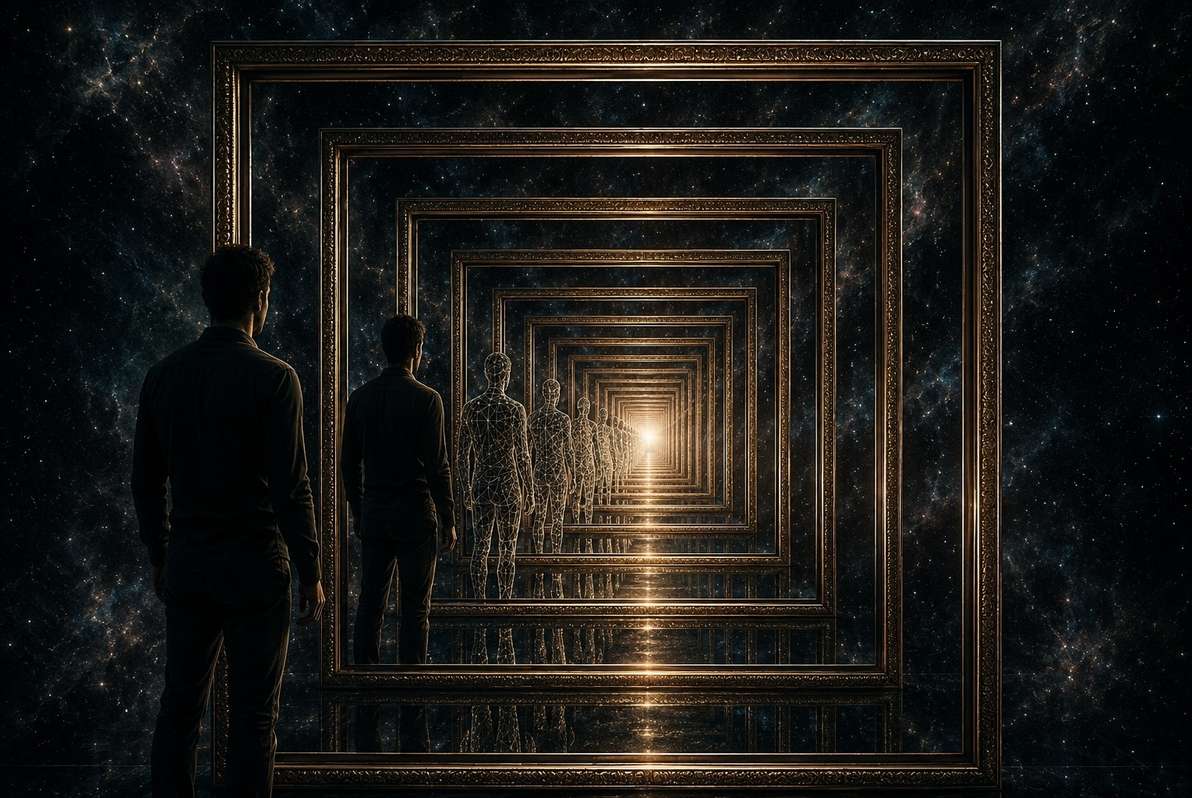
Nested Simulations: The Infinite Regress Problem That Breaks Reality
You have experienced it upon waking: the disorientation of nested dreams. You dreamt you woke, only to discover you still slept. Then you woke again–into another dream. By the time you reach actual waking, certainty has become provisional. Which layer was real? Are you certain this present moment is not merely another dream, another simulation, another layer in an infinite stack?
The simulation hypothesis, popularised by Nick Bostrom in his 2003 paper Are You Living in a Computer Simulation? (Philosophical Quarterly, Vol. 53, No. 211), proposes that if advanced civilisations can create high-fidelity simulations of conscious beings, then statistically, you are almost certainly simulated. The argument has probabilistic force: if our descendants run thousands or millions of simulations, the roughly 100 billion actual humans who have ever lived comprise a tiny fraction of total conscious beings–simulated and actual–who have ever existed.
But follow this reasoning to its conclusion, and you encounter a problem that threatens to collapse the entire structure. If we are simulated, and our simulators are themselves conscious beings, what prevents them from being simulated in turn? And their simulators? The regress stretches infinitely downward–or upward, depending on your perspective–and with it, the probability calculations dissolve into incoherence.
This is the infinite regress problem: simulations within simulations within simulations, turtles all the way down, each layer requiring computational resources from the layer beneath, each “base reality” proving itself merely another simulation when examined closely enough.
Table of Contents
- The Computational Impossibility
- The Information Burden
- The Problem of Indistinguishability
- The Consciousness Problem
- Reality as Self-Simulating
- The Gnostic Inversion
- The Practical Consequence
- Frequently Asked Questions
- Further Reading
- References and Sources

The Computational Impossibility
Consider what each layer of simulation requires. A universe capable of generating conscious beings, historical processes, quantum indeterminacy, and the apparent passage of billions of years–this is not a trivial computation. Even with unimaginable future technology, simulating a universe requires resources proportional to that universe’s complexity.
Now stack them. If our simulators are themselves simulated, their universe requires its own computational substrate. That substrate exists in a “higher” universe, which–if the hypothesis holds–might also be simulated. Each level adds its own resource requirements. The computational burden compounds exponentially with each nested layer.
Bostrom acknowledged this difficulty in his original formulation. The simulation argument requires that at least one civilisation reaches technological maturity and runs simulations. But if that civilisation is itself simulated, we have merely pushed the question back one level. Eventually–logically, necessarily–we reach a base reality that is not simulated. Or we do not reach it, and the regress continues infinitely.
An infinite regress of simulations implies infinite computational resources. But infinity is not a number you can allocate. It is not available in any physical system, however advanced. The hypothesis requires what it cannot have: an unbounded stack of realities, each consuming resources from the one below, without foundation.
The Information Burden
There is a deeper problem. Each simulation must contain all information necessary to generate its inhabitants’ experience. But if those inhabitants create their own simulations, those nested worlds require additional information–histories, physical laws, conscious beings with their own nested simulations. The information content grows without bound.
Physicists have calculated the information capacity of various physical systems. The Bekenstein bound, formulated by Jacob Bekenstein in 1981, limits how much information can be contained within a given volume. Landauer’s principle, established by Rolf Landauer in 1961, sets a minimum energy cost for information erasure. These constraints operate at every level of reality.
A simulated universe must obey these constraints–or appear to. But the simulating computer exists in a higher universe with its own constraints. And if that universe is simulated, it exists within another, with another set of limits. The information burden cascades upward, each level constrained by the one above, until we reach–if we reach–a base reality that somehow contains infinite information or operates without constraint.
This is not merely impractical. It is logically incoherent. Information cannot be created from nothing, nor compressed beyond fundamental limits. The infinite stack of simulations requires what quantum mechanics and information theory forbid: the generation of infinite information from finite sources.

The Problem of Indistinguishability
The simulation hypothesis gains plausibility from the claim that a sufficiently advanced simulation would be indistinguishable from base reality. If you cannot tell whether you are simulated, the argument goes, you should assign significant probability to the simulation hypothesis.
But this indistinguishability creates a fatal epistemological problem. If no observation could distinguish simulation from reality, then the hypothesis is unfalsifiable. It predicts nothing specific. It accommodates any possible evidence by claiming that evidence is itself simulated. This is not theoretical strength but weakness–a theory that explains everything explains nothing.
More troublingly, indistinguishability undermines the very concept of “base reality.” If every level appears real to its inhabitants, and no observation can reveal the simulating layer, then “base reality” becomes a meaningless distinction. Every level is experientially fundamental. Every level is apparently complete. The concept of simulation loses its contrast–there is no “real” against which to define the “simulated.”
The Consciousness Problem
The deepest difficulty concerns the nature of simulated consciousness. Bostrom’s argument assumes that consciousness can be computationally generated–that sufficiently complex information processing necessarily produces subjective experience. This is the computational theory of mind, widely assumed but far from proven.
If consciousness requires more than computation–if it requires specific physical substrates, or if it is fundamentally irreducible to information processing–then the simulation hypothesis fails at its foundation. Simulated beings would be philosophical zombies: behaviourally identical to conscious beings but lacking inner experience. The entire probabilistic argument collapses, because simulated beings would not count as “observers” in the relevant sense.
Even if computational consciousness is possible, nested simulations create a bizarre distribution of conscious experience. If most conscious beings exist in simulations, and simulations can be nested arbitrarily deep, then most consciousness exists at the deepest levels of the stack–where computational resources are most constrained, where reality is most derivative, where existence is most mediated. This seems backwards. Consciousness, if it exists, should be most robust at the most fundamental level, not buried beneath infinite layers of virtualisation.
The Alternative: Reality as Self-Simulating
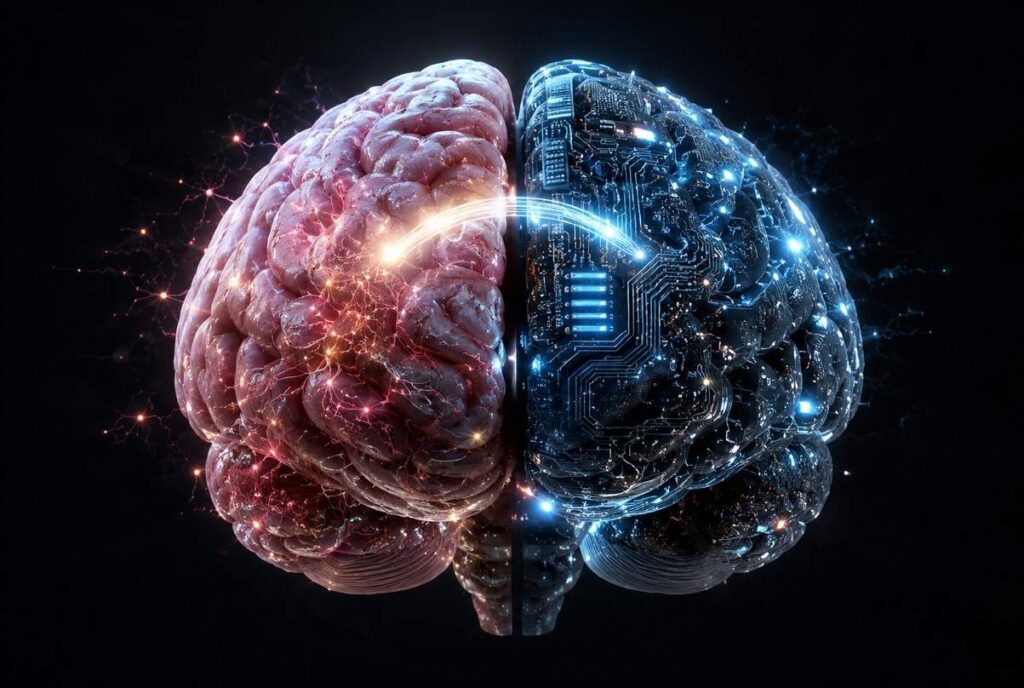
The infinite regress problem suggests that the simulation hypothesis, taken literally, leads to paradox. But the intuition behind it–that reality might have recursive, self-referential structure–deserves serious consideration. What if the solution is not nested simulations but self-simulation? Not turtles all the way down, but one turtle looking at itself?
This is the holographic principle’s radical suggestion: the three-dimensional universe we experience might be a projection from a two-dimensional boundary. Not a simulation running on alien hardware, but reality encoding itself, information generating apparent substance, the part containing the whole.
In this view, consciousness is not an accidental feature of complex computation but fundamental to reality’s self-referential structure. The observer participates in generating the observed. The simulation is not running “elsewhere” but is reality’s own self-exploration. The infinite regress dissolves because there is no stack–only the one reality, infinitely reflected in itself.
The Gnostic Inversion
There is a peculiar Gnostic resonance to the simulation hypothesis and its problems. The Gnostics taught that this world is the creation of a lesser deity, a Demiurge who believes himself supreme, unaware of the higher reality from which he derives. The material world is thus a kind of simulation–real enough to its inhabitants, derivative of a more fundamental truth.
But the Gnostics did not stop there. They insisted that within the simulation, seeds of the higher reality remained accessible. The divine spark, trapped in matter, could be awakened. The way out was through knowledge (gnosis), through direct experience of the fundamental reality that the simulation obscures.
The infinite regress problem suggests that seeking the “base reality” by going upward–through levels of simulation, through higher and higher civilisations–leads only to more regress, more mediation, more derived existence. But going inward, toward immediate experience, toward the consciousness that perceives all levels, finds what was never absent.
The Practical Consequence
What changes if you take the infinite regress problem seriously? First, you abandon the escapist fantasy of “waking up” into a higher reality that will solve this reality’s problems. If the regress is infinite, there is no final waking. Every awakening is into another dream. The work is here, in this layer, with these constraints.
The simulation hypothesis, properly understood, is a finger pointing at the moon of non-dual awareness. The infinite regress problem reveals that the finger cannot reach what it indicates–that the metaphor breaks down precisely where the insight becomes possible. You cannot simulate consciousness because consciousness is what simulates. You cannot nest reality because reality is what nests.
You are not in a simulation. You are the simulation, the simulated, and the awareness within which both appear. The infinite regress stops here, in this recognition–not because you have found the bottom, but because you have discovered that there never was any stack. Only this, infinitely reflected.

Frequently Asked Questions
What is the infinite regress problem in simulation theory?
The infinite regress problem asks: if we are simulated, what prevents our simulators from also being simulated? And their simulators? This creates an infinite stack of nested realities, each requiring computational resources from the layer below. The problem collapses the probabilistic argument because infinity is not a number you can allocate–no physical system, however advanced, can provide infinite computational substrate.
Who proposed the original simulation argument?
Nick Bostrom, a Swedish philosopher at the University of Oxford, published the simulation argument in 2003 in the journal Philosophical Quarterly (Vol. 53, No. 211, pp. 243-255). His paper presented a trilemma: either most civilisations go extinct before reaching posthuman stage, or posthuman civilisations rarely run ancestor simulations, or we are almost certainly living in a simulation.
What is the Bekenstein bound and why does it matter?
The Bekenstein bound, formulated by physicist Jacob Bekenstein in 1981, limits the maximum information that can be contained within a given volume of space. In the context of nested simulations, it means each simulated universe faces hard physical limits on information storage. Stack infinite simulations, and the information burden grows without bound–violating fundamental constraints that operate at every level of reality.
Is the simulation hypothesis falsifiable?
If a simulation is truly indistinguishable from base reality, the hypothesis becomes unfalsifiable–it predicts nothing specific and accommodates any evidence by claiming that evidence is simulated. This is an epistemological weakness, not strength. A theory that explains everything explains nothing. The infinite regress problem compounds this by dissolving the very concept of a distinguishable ‘base reality.’
Can consciousness be computationally simulated?
This remains one of philosophy of mind’s deepest open questions. Bostrom’s argument assumes substrate independence–that consciousness can run on any sufficiently complex computational substrate. But if consciousness requires specific physical substrates (as some theories suggest), or if it is irreducible to information processing, then simulated beings would be philosophical zombies without inner experience, and the probabilistic argument collapses.
What is the holographic principle?
The holographic principle suggests that the three-dimensional universe we experience might be a projection from information encoded on a two-dimensional boundary. Unlike nested simulations running on alien hardware, this view proposes that reality encodes itself–information generates apparent substance. Consciousness participates in generating the observed rather than passively receiving it from elsewhere.
What is the Gnostic view on simulation and reality?
Gnostic traditions describe this world as the creation of a Demiurge–a lesser deity who believes himself supreme, unaware of the higher reality from which he derives. The material world is thus derivative, yet seeds of the divine remain accessible within it. The way out is through direct knowledge (gnosis) and inward recognition, not by escaping upward through infinite layers of simulation.
Further Reading
- Simulation Hypothesis: Clues in the Reality Code — Evidence and implications of the simulation hypothesis from physics and information theory.
- Architecture of Reality: Information Precedes Matter — How information-theoretic frameworks reshape our understanding of physical existence.
- Entity and the Simulation Hypothesis — Consciousness, entity encounters, and the boundaries of simulated reality.
- Genie 3: The Simulation Threshold and AI-Generated Worlds — How artificial intelligence approaches the boundary between generated and base reality.
- The Gnostic Matrix — Gnostic cosmology and the contemporary digital metaphor of simulated existence.
- States of Knowing: What Happens When Consciousness No Longer Belongs to You — Phenomenology of altered states and the dissolution of the narrative self.
- The Digital Demiurge: AI as the New Yaldabaoth — How artificial intelligence recapitulates the Gnostic Demiurge in contemporary form.
- Holographic Universe Theory: Consciousness and Reality — The holographic principle and its implications for consciousness and the nature of existence.
- Archons and the Soul Trap — Gnostic archonology and the mechanisms of perceptual imprisonment across traditions.
- Nag Hammadi Library: The Complete Reader’s Guide — The primary sources for Gnostic cosmology, archonology, and the Demiurge tradition.
References and Sources
The following sources inform the theoretical framework and scientific context of this article. Sources are grouped by category for readers who wish to pursue independent study.
Primary Philosophical and Scientific Sources
- Bostrom, N. (2003). Are You Living in a Computer Simulation? Philosophical Quarterly, 53(211), 243-255. — The original formulation of the simulation argument trilemma; source for the probabilistic reasoning and substrate independence assumption discussed throughout.
- Bekenstein, J. D. (1981). Universal Upper Bound on the Entropy-to-Energy Ratio for Bounded Systems. Physical Review D, 23, 287. — The foundational paper establishing the information capacity limit for physical systems; referenced in the discussion of information burden.
- Landauer, R. (1961). Irreversibility and Heat Generation in the Computing Process. IBM Journal of Research and Development, 5(3), 183-191. — Source for the minimum energy cost of information erasure; establishes fundamental thermodynamic constraints on computation.
- ‘t Hooft, G. (1993). Dimensional Reduction in Quantum Gravity. arXiv:gr-qc/9310026. — Early formulation of the holographic principle; Susskind, L. (1995). The World as a Hologram. Journal of Mathematical Physics, 36(11), 6377-6396. — The holographic principle as alternative to nested simulation.
Scholarly Monographs and Contemporary Analysis
- Chalmers, D. J. (2022). Reality+: Virtual Worlds and the Problems of Philosophy. W. W. Norton & Company. — Comprehensive philosophical treatment of simulation, virtual reality, and consciousness; addresses the computational theory of mind and substrate independence.
- Carroll, S. M. (2016). The Big Picture: On the Origins of Life, Meaning, and the Universe Itself. Dutton. — Physicist’s perspective on emergence, information, and the nature of reality; informs the discussion of information burden and physical constraints.
- Kurzweil, R. (2005). The Singularity Is Near: When Humans Transcend Biology. Viking. — Technological futurist perspective on computational capacity and simulation; referenced for the civilisational trajectory assumptions underlying Bostrom’s argument.
- Searle, J. R. (1980). Minds, Brains, and Programs. Behavioral and Brain Sciences, 3(3), 417-424. — The Chinese Room argument against computational consciousness; source for the critique of substrate independence and the philosophical zombie problem.
Gnostic and Esoteric Sources
- Apocryphon of John. Nag Hammadi Codex II,1; III,1; IV,1. In Robinson, J. M. (Ed.). (1990). The Nag Hammadi Library in English (3rd ed.). HarperSanFrancisco. — Primary source for Demiurge cosmology and the derivative nature of material reality.
- The Reality of the Archons. Nag Hammadi Codex II,4. In Robinson, J. M. (Ed.). (1990). The Nag Hammadi Library in English (3rd ed.). HarperSanFrancisco. — Source for the archonic governance of perception and the derivative nature of phenomenal reality.
- Jonas, H. (1958). The Gnostic Religion: The Message of the Alien God and the Beginnings of Christianity (2nd ed.). Beacon Press. — Foundational scholarly study of Gnosticism; informs the discussion of the Demiurge, divine spark, and the Gnostic inversion of the simulation problem.
- Smith, A. P. (2014). Introducting Dionysus: Rethinking the Gnostic Worldview. Numen Books. — Contemporary Gnostic scholarship addressing the relationship between derivative reality and direct knowing.