The $6.8 Trillion Theft: How Wellness Stole Gnosis
There is a peculiar irony in the fact that the fastest-growing industry on earth has built its marketing vocabulary on concepts that ancient Gnostic texts considered sacred secrets. The Global Wellness Institute reports that the global wellness economy reached $6.8 trillion in 2024 and is projected to accelerate toward $9.8 trillion by 2029–a figure that dwarfs the pharmaceutical industry and rivals global health expenditure itself. Yet beneath the Himalayan salt lamps, the adaptogenic lattes, and the subscription meditation apps lies a quieter theft: the systematic appropriation of Gnostic language, stripped of its cosmological framework and sold back to consumers as lifestyle accessories.
The words are unmistakable. Inner light. Awakening. Authentic self. Shadow work. Toxic patterns. These terms circulate through wellness marketing with the casual frequency of stock photography, yet each carries a genealogy that traces back to ancient texts buried in the Egyptian desert. The Nag Hammadi Library–discovered in 1945, translated across decades, and now accessible to anyone with an internet connection–describes a form of knowing (gnosis) that cannot be purchased, optimised, or delivered via monthly subscription. The wellness industry, by contrast, has built a $6.8 trillion architecture designed to do precisely that.
This is not an argument against wellbeing. Physical health, mental clarity, and emotional integration are genuine goods. The question is whether the industry that sells them has become a mirror of the very systems the Gnostics warned against: structures that simulate liberation while perpetuating dependence, that speak the language of transcendence while enforcing the economics of extraction. In short, has the wellness industry become a particularly sophisticated archonic operation–one that harvests the vocabulary of gnosis and returns it as an empty signifier?
Table of Contents
- The Wellness Economy: A Cosmic-Sized Market
- When Gnostic Language Becomes Marketing Copy
- The McMindfulness Problem: Stripping the Soteriology
- What Gnosis Offers That Wellness Cannot Sell
- The Architecture of Commodified Spirituality
- Reclaiming Gnosis from the Checkout Line
- Frequently Asked Questions
- Further Reading
- References and Sources

The Wellness Economy: A Cosmic-Sized Market
To grasp the scale of what is being commodified, one must first understand the scale of the commodity itself. The Global Wellness Institute’s 2025 Monitor reveals an economy that has doubled since 2013, growing 7.9% from 2023 to 2024 alone. The United States leads with a wellness economy valued at $2.1 trillion, where per-capita spending exceeds $6,000 annually. Mental wellness–the sector most directly trafficking in the language of consciousness, awakening, and inner transformation–represents $268 billion globally and is expanding at 12.4% annually. Wellness real estate, perhaps the most literal manifestation of the “inner space” metaphor, is the fastest-growing segment at 19.5% per year.
These are not niche figures. The wellness economy is now larger than the global tourism industry, larger than information technology, larger than the green economy. It is, by any measure, one of the dominant forces shaping contemporary culture. And its dominant rhetorical strategy is to sell transformation–the very promise at the heart of Gnostic soteriology–through consumption.
The sleight of hand is elegant. Where the Gnostic texts describe a metanoia–a fundamental turning of the mind and soul that requires the dissolution of false identity–the wellness industry offers “personal growth” as a measurable metric, tracked by apps, gamified by challenges, and monetised by tiered subscription models. The result is not transformation but what the British Psychological Society has termed “emotional landlordism”: a system in which vulnerability itself becomes a resource to be harvested, repackaged, and sold back to the vulnerable.
When Gnostic Language Becomes Marketing Copy
The appropriation is not accidental. Gnostic concepts map almost perfectly onto wellness marketing because both address the same human longing: the sense that something essential has been forgotten, and that recovery is possible. The difference lies in what is being recovered, and at what cost.
Inner Light
In the Gospel of Thomas, Jesus says, “There is light within a person of light, and it shines on the whole world” (saying 24). This is not a metaphor for skin radiance. It refers to the divine spark (spinter) trapped in material existence–a fragment of the Pleroma (the Fullness) that has fallen into the Kenoma (the Empty Place). The wellness industry, meanwhile, sells “inner glow” through vitamin C serums, infrared saunas, and “light therapy” face masks. The product promises illumination; what it delivers is dermatological.
Awakening
For the Gnostics, awakening (anagnosis) was the recognition that one’s true identity was not the social self, the body, or even the psyche, but the pneumatic essence that preceded incarnation. It was a catastrophic, world-shattering event–the “earthquake” described in the Apocryphon of John–that rendered the familiar cosmos unrecognisable. Today, “spiritual awakening” is a hashtag with billions of views, attached to content about morning routines, juice cleanses, and “high-vibe” living. The catastrophe has been replaced by curation.
Authentic Self
The Gnostic distinction between the false self (the psychic personality constructed by social conditioning) and the true self (the pneumatic identity rooted in the divine) is one of the most radical psychological insights in religious history. The wellness industry has translated this into the “authentic self”–a brandable persona to be discovered through personality quizzes, enneagram types, and coaching packages. Where Gnosis demanded the death of the false self, wellness marketing sells its refinement.
Shadow Work
Carl Jung’s concept of the shadow–the repository of repressed psychic contents–has become a wellness buzzword, detached from the rigorous, often painful process of integration that Jung himself described. In the Gnostic framework, the “shadow” corresponds to the archonic forces that cling to the soul during its descent, the “garments of darkness” that must be stripped away before ascent. Genuine shadow work is not a journaling prompt or a weekend workshop. It is the sustained, uncomfortable confrontation with everything in oneself that serves the forces of forgetting. The commodified version, by contrast, offers “shadow work journals” and “dark feminine energy” aesthetics–style without substance, performance without process.
Toxic Patterns
The Gnostic texts describe the counterfeit spirit–an archonic mimic that attaches to the soul and imitates its true nature, leading it astray through imitation. The wellness industry’s language of “toxic patterns” and “energy vampires” gestures toward this ancient insight but pathologises it at the individual level. The systemic, cosmological dimension is erased. One is not trapped in a false cosmos administered by ignorant rulers; one simply has “bad boundaries” that can be fixed with a better therapist, a stricter morning routine, or a more expensive retreat.

The McMindfulness Problem: Stripping the Soteriology
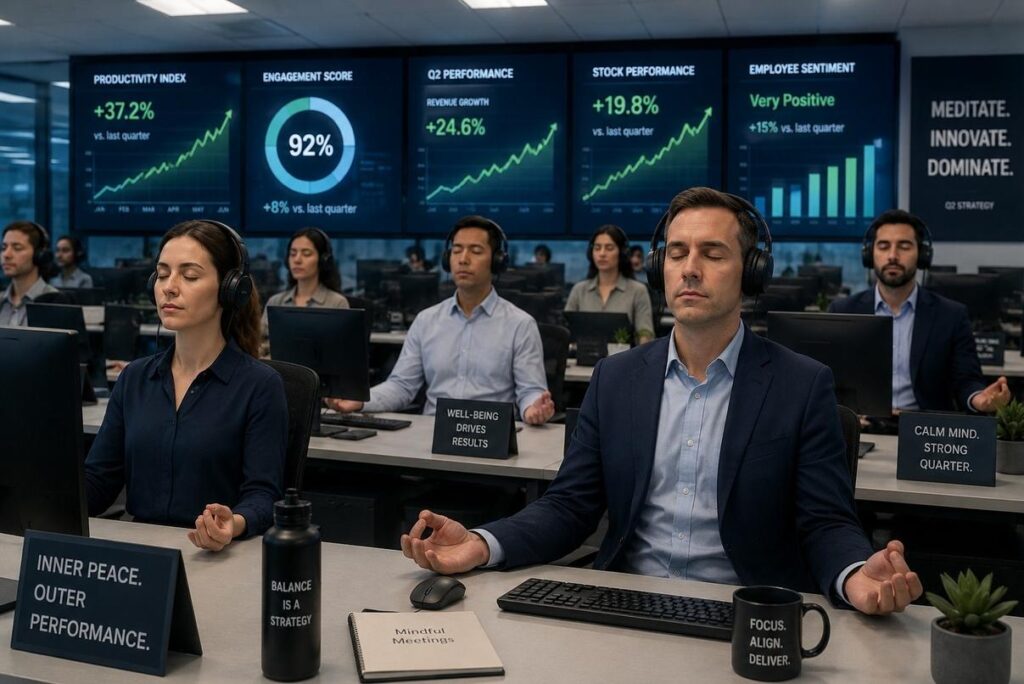
The most extensively documented example of this appropriation is what scholar Ronald Purser has termed “McMindfulness”–the reduction of Buddhist meditation practice to a stress-reduction technique stripped of its ethical and transformative foundations. A 2025 Springer study on neuro-meditation commodification confirms that traditional techniques have been “rebranded, commercialized, and integrated into corporate and wellness industries, often stripped of their spiritual depth and ethical foundations.” The result is what Purser calls “neoliberal mindfulness”: a practice that encourages practitioners to “turn off” critical inquiry, “tune out” of the material world, and “drop in” to a private realm of isolation, reinforcing the cult of the individual.
The parallel with Gnosticism is precise. Where the Gnostic texts insist that liberation is inseparable from the recognition of cosmic imprisonment, McMindfulness and its wellness-industry cousins teach adaptation to the prison. The goal is not to question the structure of the workplace, the economy, or the digital attention architecture, but to become more resilient within it. Stress is not a signal that something is structurally wrong; it is a personal failing to be managed through breathing exercises. The archons could not have designed a more effective anaesthetic.
The British Psychological Society has observed a related phenomenon in digital mental health platforms: “Recovery is no longer the objective. These systems appear less oriented toward recovery than toward sustaining a state of manageable dysfunction–keeping people just well enough to work, spend, and scroll, but not necessarily well enough to question the wider conditions shaping their distress.” This is not wellness. This is maintenance.
What Gnosis Offers That Wellness Cannot Sell
If the wellness industry has stolen the language of gnosis, what remains of the original? And why can it not be packaged?
Cosmological depth. Gnosticism is not a self-help system. It is a cosmology–a complete account of the origin, structure, and destiny of reality. The Apocryphon of John does not advise its readers to “live their best life.” It describes a divine fall, a botched creation, a cosmos administered by ignorant rulers, and a rescue operation initiated from beyond the prison walls. This is not a framework that can be reduced to an Instagram carousel. It demands not consumption but contemplation, not engagement but escape.
Soteriological urgency. The Gnostic texts are urgent documents, written by and for people who believed that the soul’s fate hung in the balance. The Authoritative Teaching describes the soul’s descent into a foreign land where it is stripped, enslaved, and intoxicated by false pleasures–and its desperate, perilous journey home. There is no “wellness journey” here, no gentle unfolding. There is war, captivity, and the narrow possibility of liberation through recognition. The tone is not aspirational but existential.
The cost. Genuine gnosis, as the texts repeatedly insist, is not available to everyone. Not because it is expensive–the Gnostics were notoriously anti-materialist–but because it requires a specific capacity for recognition. The Gospel of Thomas says, “Let him who seeks continue seeking until he finds” (saying 2). The seeking is not a phase; it is a way of being that costs everything familiar. The wellness industry, by contrast, operates on the premise that wellbeing is accessible to anyone with a credit card. The democratisation is not liberation. It is the final triumph of the market over the sacred.
The finest incense, healing crystals, or adaptogenic edible dust that money can buy will hardly earn you the one thing money cannot buy. Spiritual progress requires time.
Contemporary reflection on spiritual commodification

The Architecture of Commodified Spirituality
To understand why the wellness industry’s appropriation of Gnostic language matters, one must look at the structural incentives that govern it. The wellness economy does not merely sell products; it sells a particular relationship to the self–one that is perpetually incomplete, perpetually optimisable, and perpetually in need of the next purchase.
This is the logic of what economist Yanis Varoufakis calls “technofeudalism”: a system in which platforms function less like marketplaces and more like landlords, extracting rent from users who generate value through their emotional presence. In the wellness context, this means that the user’s distress, aspiration, and vulnerability become the raw material for a business model that profits from managed dysfunction. The customer is not healed; they are retained. Recovery becomes an ongoing subscription.
The Gnostic texts describe a similar structure–the kenoma, the region of emptiness ruled by the Demiurge and his archons–but with a crucial difference. In Gnosticism, the prison is real, but escape is possible. In the wellness economy, the prison is invisible, and the tools sold as escape routes are manufactured by the wardens. The meditation app that promises “inner peace” is funded by venture capital firms that profit from user engagement. The retreat centre that offers “awakening” is a real estate investment vehicle. The influencer who teaches “shadow work” is building a personal brand. At every level, the language of liberation has been captured by the economics of extraction.
Perhaps the most insidious aspect is what psychologists call “concept creep”: the gradual expansion of clinical and spiritual terminology to encompass an ever-broadening range of everyday discomforts. “Trauma,” “shadow,” “toxicity,” and “awakening” are deployed so promiscuously that they lose their diagnostic and transformative precision. A Guardian investigation found that more than half of the most-viewed mental health posts on social media were misleading. Everyday experiences–tiredness, distraction, emotional reactivity–are pathologised, reframed as symptoms, and rendered into content. The result is not healing but a kind of therapeutic performance: emotionally resonant but epistemologically shallow.
Reclaiming Gnosis from the Checkout Line
The critique is not a call to asceticism. There is nothing inherently wrong with skincare, exercise, or meditation apps. The danger lies in mistaking the symbol for the reality, the language for the thing itself. The Gnostic texts were explicit about this danger. The Reality of the Archons warns that the rulers of this world create counterfeit versions of divine realities to trap the soul. The counterfeit is not entirely false–it must be convincing enough to deceive–but it lacks the essential ingredient: the spark of recognition that transforms knowledge into gnosis.
So how does one tell the difference?
Gnosis costs nothing and everything. It cannot be bought, but it demands the surrender of everything that can be–including the identity that does the buying. If a practice or product promises transformation while reinforcing the self that seeks it, it is not gnosis. It is marketing.
Gnosis is not comfortable. The Gnostic texts describe awakening as a shattering, not a soothing. The Thunder: Perfect Mind speaks with a voice that is simultaneously terrifying and liberating. If a spiritual product promises only peace, relaxation, and “good vibes,” it has likely removed the difficult, destabilising core of genuine practice.
Gnosis is not individual. Despite the emphasis on personal recognition, the Gnostic texts consistently describe liberation as a restoration of relationship–with the divine, with the Pleroma, with the “elect” who share the same spark. The wellness industry’s hyper-individualism, in which each consumer pursues their own “journey” in isolation, is the opposite of this communal, cosmic restoration.
Gnosis recognises the prison. This is the final and most important distinction. The wellness industry teaches adaptation. Gnosis teaches escape. Where wellness offers resilience within the system, gnosis offers recognition of the system’s falsity. These are not complementary approaches. They are opposite directions.

The $6.8 trillion wellness economy will continue to grow. It will continue to appropriate, repackage, and sell the language of ancient wisdom traditions. This is not a scandal to be exposed but a mechanism to be understood. The archons, in the Gnostic imagination, were not evil geniuses. They were ignorant administrators, running a system they did not create and could not comprehend. The modern wellness industry is not a conspiracy. It is a market doing what markets do: identifying desire, stripping it of context, and selling it back as a product.
The task of the contemporary gnostic or neo gnostic–the one who seeks gnosis in an age of algorithms–is not to boycott the spa or delete the meditation app. It is to maintain the capacity for recognition: to hear the words “inner light” and remember the Pleroma, to hear “awakening” and remember the earthquake, to hear “authentic self” and remember that the true self is not a brand but a spark that predates branding. The theft is real. But the stolen goods were never the point. The point was always the recognition that they had been stolen–and the refusal to accept the counterfeit in their place.
Frequently Asked Questions
Is the wellness industry really worth $6.8 trillion?
Yes. According to the Global Wellness Institute 2025 Monitor, the global wellness economy reached $6.8 trillion in 2024 and is forecast to grow to $9.8 trillion by 2029. This makes it larger than the global tourism industry and nearly four times the size of the pharmaceutical industry.
What does Gnosticism mean by inner light?
In Gnostic texts such as the Gospel of Thomas, the inner light refers to the divine spark–a fragment of the Pleroma (divine fullness)–that has become trapped in material existence. It is not a metaphor for wellbeing or skin radiance, but a cosmological reality describing the soul’s true origin and its potential for return.
What is McMindfulness?
McMindfulness is a term coined by scholar Ronald Purser to describe the commodification of Buddhist meditation practices, stripped of their ethical and spiritual foundations and repackaged as stress-reduction tools for corporate productivity and consumer self-optimisation.
Can wellness practices lead to genuine spiritual awakening?
Wellness practices can support physical and mental health, but genuine Gnostic awakening requires more than technique. It demands a fundamental recognition of one’s true identity beyond social conditioning, a confrontation with uncomfortable truths, and a cosmological understanding that most wellness marketing deliberately avoids.
What is the difference between shadow work and Gnostic liberation?
Contemporary shadow work often focuses on integrating repressed psychological contents for personal growth. Gnostic liberation goes further, describing the stripping away of archonic garments–the false identities and cosmic attachments that bind the soul–in a process of radical return to divine origin.
Is the wellness industry intentionally deceptive?
The wellness industry is not a conspiracy but a market operating according to standard incentives. The problem is structural: it profits from perpetual engagement rather than resolution, and from individual adaptation rather than systemic questioning. This creates what the British Psychological Society calls a system oriented toward manageable dysfunction rather than genuine recovery.
How can I practice genuine gnosis in a consumer culture?
Genuine gnosis begins with recognition: learning to distinguish between the language of liberation and the mechanics of extraction. It requires reading primary sources, engaging in sustained contemplative practice without commercial mediation, and maintaining the willingness to question whether a spiritual product serves awakening or merely sells it.
Further Reading
Explore these ZenithEye articles to deepen your understanding of commodified spirituality, Gnostic practice, and the architecture of modern extraction:
- Toxic Manifestation: When the Law of Attraction Becomes Archonic Binding — How spiritual language can become a mechanism of self-imprisonment when separated from genuine practice.
- The Shadow Side of the Gnostic Revival: Cults, Commerce, and the Trap of Knowing — A critical examination of how Gnostic concepts have been exploited by commercial and charismatic movements.
- Living Gnosis: How Neo-Gnostics Navigate Work, Relationships, and the Modern World — Practical guidance for maintaining Gnostic discernment in everyday life without retreating from society.
- The Dopamine Cartel: Neurochemical Warfare in the Attention Economy — The neurological mechanisms by which digital platforms and wellness apps capture and retain attention.
- Digital Minimalism as Mystical Practice — Strategies for reclaiming contemplative space from the demands of the attention economy.
- Against Spiritual Bypassing: The Refusal to Feel — Why the insistence on perpetual positivity is not spirituality but avoidance, and what genuine integration requires.
- The Body Against the Algorithm: Reclaiming Embodiment — How the wellness industry’s digital mediation severs the very connection it claims to restore.
- The Archonic Infection: Recognising Systemic Possession in the Digital Age — Mapping the Gnostic archon model onto contemporary systems of control and extraction.
- The Nag Hammadi Library: A Complete Guide to the Gnostic Scriptures — The definitive introduction to the texts that preserve the original vocabulary now circulating in wellness marketing.
References and Sources
The following sources informed the research and argument of this article. No single tradition or methodology is privileged; the aim is to present a rigorously grounded critique accessible to both academic and general readers.
Industry Data and Market Research
- Global Wellness Institute. (2025). Global Wellness Economy Monitor 2025. GWI Research. — Primary source for the $6.8 trillion market valuation and sector growth data.
- Global Wellness Institute. (2026, April). US Wellness Economy Surges to $2.1 Trillion. GWI Press Release. — US-specific wellness spending and per-capita data.
- McKinsey & Company. (2025). The Future of Wellness: Consumer Trends Survey. — Consumer behaviour and generational wellness trends.
Critical and Academic Sources
- Chomski, O. (2025). Optimizing the immeasurable: a critical examination of neuro-meditation commodification. AI & Society, Springer. — Academic analysis of meditation commodification and the McMindfulness critique.
- Purser, R. (2019). McMindfulness: How Mindfulness Became the New Capitalist Spirituality. Repeater Books. — Foundational critique of mindfulness commodification.
- British Psychological Society. (2025, November). Is the wellness industry commodifying the mental health crisis? The Psychologist. — Analysis of digital mental health platforms and emotional extraction.
- Haslam, N. (2016). Concept creep: Psychology’s expanding concepts of harm and pathology. Psychological Inquiry, 27(1), 1-17. — On the dilution of clinical and spiritual terminology.
- Varoufakis, Y. (2023). Technofeudalism: What Killed Capitalism. Bodley Head. — Framework for understanding platform-based emotional extraction.
Primary Gnostic Sources
- Robinson, J. M. (Ed.). (1990). The Nag Hammadi Library in English (3rd ed.). HarperSanFrancisco. — Standard critical edition of the Nag Hammadi texts.
- Layton, B. (Ed.). (1987). The Gnostic Scriptures. Doubleday. — Scholarly translations with commentary.
Safety Notice: This article explores the commodification of spiritual concepts and the structural dynamics of the wellness industry. It does not constitute medical, psychological, or spiritual advice. If you are experiencing mental health difficulties, please contact a qualified healthcare professional or emergency services. Contemplative practice complements but does not replace clinical mental health treatment.