
What Is Pneuma? Spirit, Breath, and the Divine Spark in Gnosticism
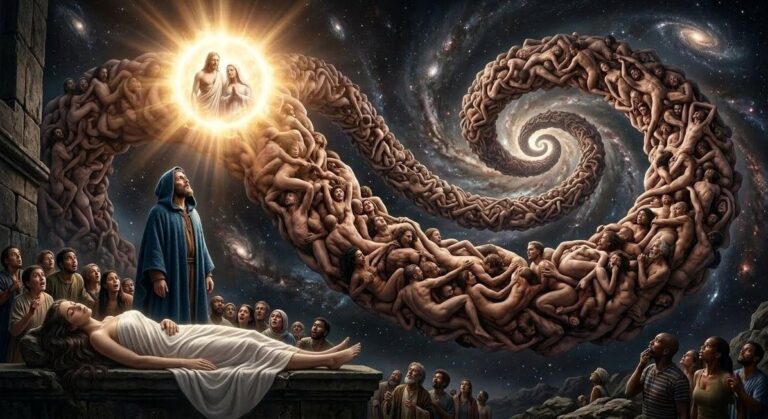
There is a breath that is more than biology. The Greeks called it pneuma; the Hebrews called it ruach; the Stoics called it the world-soul. In the Gnostic traditions preserved in the Nag Hammadi Library, it is the divine spark–the portion of eternal light trapped within the material body, the deepest spiritual principle that knows its own name even when the mind has forgotten it. To understand pneuma is to understand what the Gnostics believed human beings truly are beneath the accidents of flesh and history: not merely souls struggling toward virtue, but spirits exiled from a fullness they are destined to remember.
Pneuma (Greek: πνεῦμα) means breath, wind, or spirit. In Gnostic anthropology, it names the highest and most essential component of the human being–the divine breath that originates in the Pleroma and remains concealed within the material form. Unlike the psyche (soul), which is bound to the archonic order of fate and emotion, or the hylē (matter), which belongs to the realm of the Demiurge, the pneuma is co-substantial with the divine source. It is the seed of liberation, the faculty of recognition, and the guarantee of return. Where the psyche believes, the pneuma knows.
Table of Contents
- From Breath to Spirit: Etymology and Ancient Context
- The Stoic World-Soul: Pneuma as Cosmic Fire
- Pneuma in Biblical and Early Christian Usage
- Pneuma in Gnostic Anthropology: The Divine Spark
- The Three Natures: Hylic, Psychic, and Pneumatic
- The Pneuma and the Soul’s Return to the Fullness
- Pneuma in Modern Thought and Practice
- Frequently Asked Questions
- Further Reading
From Breath to Spirit: Etymology and Ancient Context
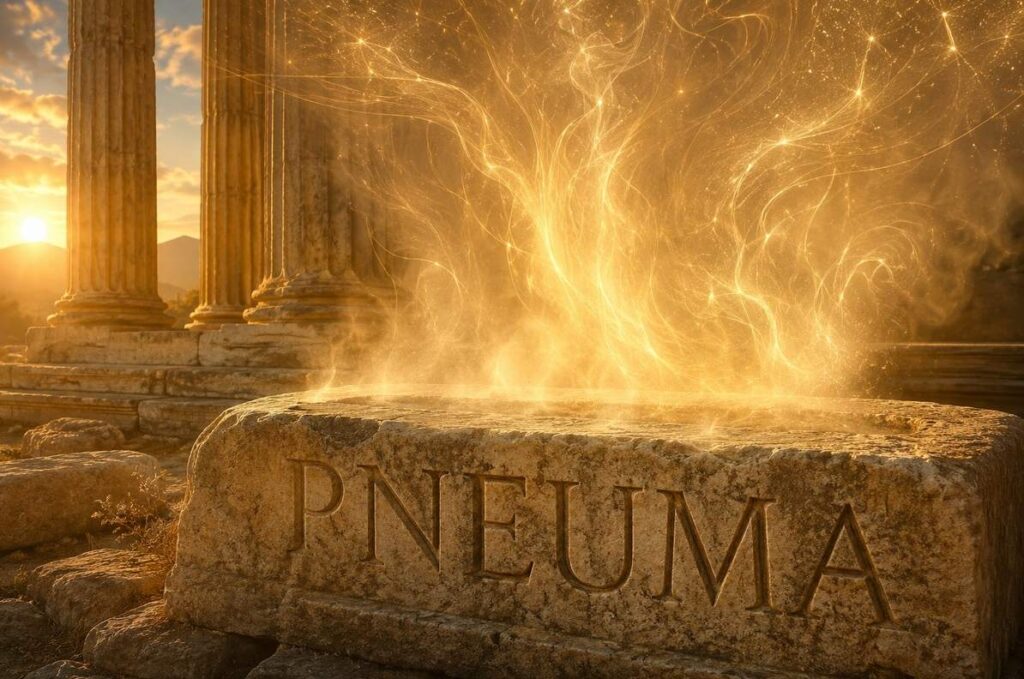
The Greek word pneuma derives from the verb pnein, to breathe or blow. Its primary meanings are wind, breath, and air–the invisible force that moves visible things. In the ancient Mediterranean, breath was not merely a physiological function but the boundary between life and death. A body with breath was alive; a body without it was clay. This simple observation gave pneuma a sacred resonance long before philosophers systematised it.
The Hebrew equivalent, ruach, carries the same semantic range: wind, breath, spirit. In Genesis 1:2, the ruach elohim hovers over the waters–a mighty wind, a divine breath, the animating presence that precedes creation. The Septuagint translators rendered ruach as pneuma, and in doing so they fused two linguistic worlds. The Greek term, already philosophical, became theological. The Hebrew term, already theological, became universal. By the time of the New Testament, pneuma could mean a gust of wind, a human sigh, the soul of a departed person, or the Holy Spirit itself–sometimes within the same paragraph. This semantic density was not confusion; it was recognition that breath, life, and divinity share a single invisible nature.
The Stoic World-Soul: Pneuma as Cosmic Fire
Before the Gnostics, the Stoics had already elevated pneuma to the centre of their physics. For Zeno of Citium and Chrysippus, pneuma was not an immaterial ghost but a corporeal blend of fire and air–a warm, tensional breath that pervades all things. It is the cohesive force that holds stones together, the natural principle that makes plants grow, the soul that makes animals move, and the reason that makes humans think. The Stoics called it the world-soul, identifying it with Zeus or the divine Logos. Every human soul is a fragment of this cosmic pneuma, a portion of God distributed into mortal flesh.
The Stoic system is rigorous: pneuma operates through tonos, tension. It stretches outward from the centre to the periphery and back again, binding matter into organised forms. Without pneuma, the cosmos would dissolve into inert elements. With it, the universe becomes a single living organism, rational from root to star. The human being, in this view, is a microcosm: the same breath that orders the heavens orders the heart. The Gnostics inherited this framework but inverted its optimism. Where the Stoics saw the cosmos as a rational whole to which the wise must conform, the Gnostics saw the cosmos as a flawed construct from which the pneumatic must escape. The breath remained divine; the vessel had become a prison.

Pneuma in Biblical and Early Christian Usage
The New Testament uses pneuma approximately 379 times, with meanings ranging from wind and breath to demonic spirits and the Holy Spirit. The phrase pneuma hagion (Holy Spirit) appears most frequently in Luke-Acts and the Pauline epistles, where it denotes the empowering presence of God that guides the community, bestows gifts, and transforms the believer. In Paul, the pneuma is the source of spiritual gifts (charismata) and the principle of the new life in Christ, contrasted with the sarx (flesh) that binds the human being to sin and death.
This Pauline contrast between spirit and flesh provided fertile ground for Gnostic development. The Gnostics radicalised it: if the spirit is divine and the flesh is material, then the human being is a composite of incompatible substances. The Demiurge breathed a psychic soul into Adam, but the divine spark–the pneuma–descended from above without his knowledge. The biblical language of indwelling spirit thus became, in Gnostic hands, the language of secret identity: the human being is not what he appears, because the breath within him is not of this world.
Pneuma in Gnostic Anthropology: The Divine Spark
In the Apocryphon of John, the Demiurge creates Adam from earth and water, and the archons breathe a psychic soul into him. But Adam remains inert, a beautiful statue without life, until the divine spark from the Pleroma enters. This spark is the pneuma–the light that the archons did not create and cannot control. They trap it within the material body, hoping to keep humanity subject to their rule through forgetfulness. The body becomes a prison; the psyche becomes the warden; the pneuma becomes the sleeper.
He breathed into his face, and the man came to have a soul. But the power that had come down from above was not in him. It was in the power that descended upon him that the man came to be a living soul.
Apocryphon of John, NHC II,1
The Gospel of Philip develops this anthropology further. It distinguishes between the resurrection of the flesh (which will not happen), the resurrection of the soul (which is partial), and the resurrection of the spirit (which is the true return). The pneuma is not improved by moral effort; it is recognised. The Gnostic does not earn the spirit but remembers it. This is why gnosis is not a doctrine to be learned but an event of recognition: the moment when the sleeper awakens and knows that the breath within him is older than the world that surrounds him.
The Three Natures: Hylic, Psychic, and Pneumatic
The most systematic expression of Gnostic anthropology appears in the Valentinian school, particularly in the Tripartite Tractate (NHC I,5). Here humanity is divided into three types based on which element dominates the composite being. The hylic (from hylē, matter) are bound to the flesh and the senses, incapable of receiving gnosis because they lack the pneumatic seed. The psychic (from psychē, soul) possess the intermediate principle of emotion, desire, and moral aspiration; they can respond to faith and ethical teaching, but they cannot transcend the archonic order through direct knowledge. The pneumatic (from pneuma, spirit) bear the divine spark and are destined to return to the Pleroma.
This tripartite division is not a caste system in the modern sense. The Gnostic texts suggest that these natures describe states of consciousness rather than fixed biological destinies. The hylic is the person entirely identified with matter; the psychic is the person who believes but does not know; the pneumatic is the person who has recognised the spark and is living from it. The Gospel of Philip warns that even those who have received gnosis can be captured again by worldly forces if they become careless. Pneumatic consciousness is not a permanent credential but a way of being–a breath that must be continually allowed to move.

The Pneuma and the Soul’s Return to the Fullness
The ultimate destiny of the pneuma is return. In the ascent literature of the Nag Hammadi Library–texts like Zostrianos and Allogenes–the soul’s journey through the planetary spheres is simultaneously a journey through the elements of its own being. The hylic body is shed at death; the psychic soul may ascend to the intermediate realm; but the pneuma alone passes through the aeons and re-enters the Pleroma. This is not a reward for virtue but a restoration of identity: the breath returns to the breath, the spark to the fire, the exile to the homeland.
The Gospel of Truth describes this return in poetic terms. The pneuma, it says, is like a breath that was trapped in a foul place and now finds its way back to the clean air. The archons attempt to obstruct this passage, demanding passwords and seals, but the pneumatic human carries the knowledge within himself. The seals are not external credentials; they are the recognition of one’s own nature. To say “I am from the Father” is to speak the password that dissolves the boundary. The pneuma does not need to be saved; it needs to be allowed to leave.
Pneuma in Modern Thought and Practice
The ancient intuition that breath and spirit are inseparable has found new expression in contemporary practice. Modern breathwork–from pranayama to holotropic techniques to the Wim Hof method–operates on the premise that conscious control of breathing alters consciousness, dissolves psychological boundaries, and opens access to dimensions of awareness normally occluded by ordinary mental activity. Neuroscience confirms that breath regulates the autonomic nervous system, modulates the default mode network, and can induce states of ego dissolution that parallel the mystical experiences described in the ascent literature.
Some contemporary thinkers have drawn parallels between the Gnostic pneuma and theories of quantum consciousness, suggesting that the “divine spark” may be understood metaphorically as the non-local, information-based aspect of mind that transcends the material brain. While such connections remain speculative, they echo the Gnostic intuition that the deepest part of the human being is not produced by the material world but is a visitor within it. The pneuma, in this reading, is not a supernatural entity but a structural feature of consciousness: the capacity for self-transcendence, for recognition, for the direct knowing that the Gnostics called gnosis.
Whether approached through ancient text or modern technique, the pneuma remains the same invitation: to notice the breath, to follow it inward, and to discover that what animates the body is not of the body. The exhalation that empties the lungs also empties the self. The inhalation that fills the chest also fills the soul. And the pause between them–the silence where breath is neither coming nor going–is the threshold where the spirit remembers its name.

Frequently Asked Questions
What is pneuma in Gnosticism?
In Gnosticism, pneuma is the divine spark or spiritual breath that constitutes the deepest principle within the human being. It is the portion of the Pleroma trapped within the material body by the Demiurge, and it is the element that returns to the divine fullness upon liberation through gnosis.
What is the difference between pneuma and psyche?
Psyche is the soul–the intermediary principle of emotion, desire, and moral striving. Pneuma is the spirit–the divine breath that transcends the soul and originates from the Pleroma. The psyche is bound to the archonic order and the cycle of fate; the pneuma is the seed of liberation that recognises its true home.
What are the three natures in Gnostic anthropology?
The three natures are hylic (matter or flesh), psychic (soul), and pneumatic (spirit). Hylic humans are bound entirely to material existence. Psychic humans possess soul and can respond to moral teaching and faith. Pneumatic humans bear the divine spark and are destined to return to the Pleroma through direct knowledge.
How did the Stoics understand pneuma?
The Stoics understood pneuma as a material blend of fire and air that functions as the active principle of the cosmos. It is the cohesive force that holds matter together, the soul of animals, and the rational mind in humans. The Stoic pneuma is the world-soul, a divine breath that permeates all things and binds the universe into a single living organism.
What is the biblical meaning of pneuma?
In biblical Greek, pneuma translates the Hebrew ruach, meaning wind, breath, or spirit. It appears in Genesis as the breath of God hovering over the waters, and in the New Testament as the Holy Spirit (pneuma hagion). The biblical usage emphasises the invisible, life-giving presence of God that animates creation and indwells the believer.
Can the pneuma be lost or destroyed?
Gnostic texts generally teach that the pneuma cannot be destroyed because it is of the same substance as the divine source. However, it can remain dormant, trapped, or forgotten within the material body. The goal of Gnostic practice is not to create the pneuma but to awaken it–to remove the layers of ignorance that obscure its light.
How does pneuma relate to modern breathwork?
Modern breathwork practices draw on the ancient intuition that breath and spirit are inseparable. While contemporary techniques focus on nervous system regulation, altered states, and trauma release, the underlying premise echoes the Gnostic and Stoic insight: that conscious control of breath can alter consciousness, dissolve boundaries, and open access to deeper dimensions of awareness.
Further Reading
Explore these related articles from the ZenithEye archive to deepen your understanding of the three natures, the divine spark, and the breath that returns to the Fullness:
- Pneumatic, Hylic, and Psychic: The Three Natures and the Geography of Awakening — The complete guide to the Gnostic tripartite anthropology, exploring the characteristics, destinies, and modern resonances of each nature.
- What Is the Pleroma? Divine Fullness in Gnostic Cosmology — The realm from which the pneuma originates and to which it returns, exploring the divine fullness across Sethian and Valentinian systems.
- What Is Gnosis? Meaning, Recognition, and Direct Knowing — The faculty by which the pneuma awakens and recognises its own origin, distinct from faith or intellectual belief.
- Apocryphon of John: The Foundational Text of Sethian Gnosticism — The primary source for the creation of Adam, the breathing of the psychic soul, and the descent of the divine spark into the material body.
- Tripartite Tractate: The Complete Valentinian System — The most systematic Valentinian treatise on the three natures, the origin of the pneuma, and the economy of salvation.
- Gospel of Philip: Sacrament, Eros, and the Mystery of Union — A Valentinian meditation on the resurrection of the spirit, the bridal chamber, and the pneumatic transformation that transcends the soul.
- Gospel of Truth: Poetics of Recognition — The beautiful Valentinian text that describes the pneuma’s return to the Pleroma as a breath escaping from a foul place into clean air.
- Breathwork: Ancient Technology, Modern Application — The contemporary practice of conscious breathing and its resonance with the ancient understanding of pneuma as the bridge between body and spirit.
- Gateway of Breath: Pranayama Techniques for Consciousness — Practical techniques for using the breath as a gateway to altered states and deeper awareness, echoing the Gnostic invitation to follow the pneuma inward.
- What Is Gnosticism? The Ancient Currents of Direct Knowledge — The broader context of the tradition that placed the pneuma at the centre of its anthropology and soteriology.