Jacob’s Ladder and the Architecture of Ascension: Mapping the Soul’s Journey Through the Spheres
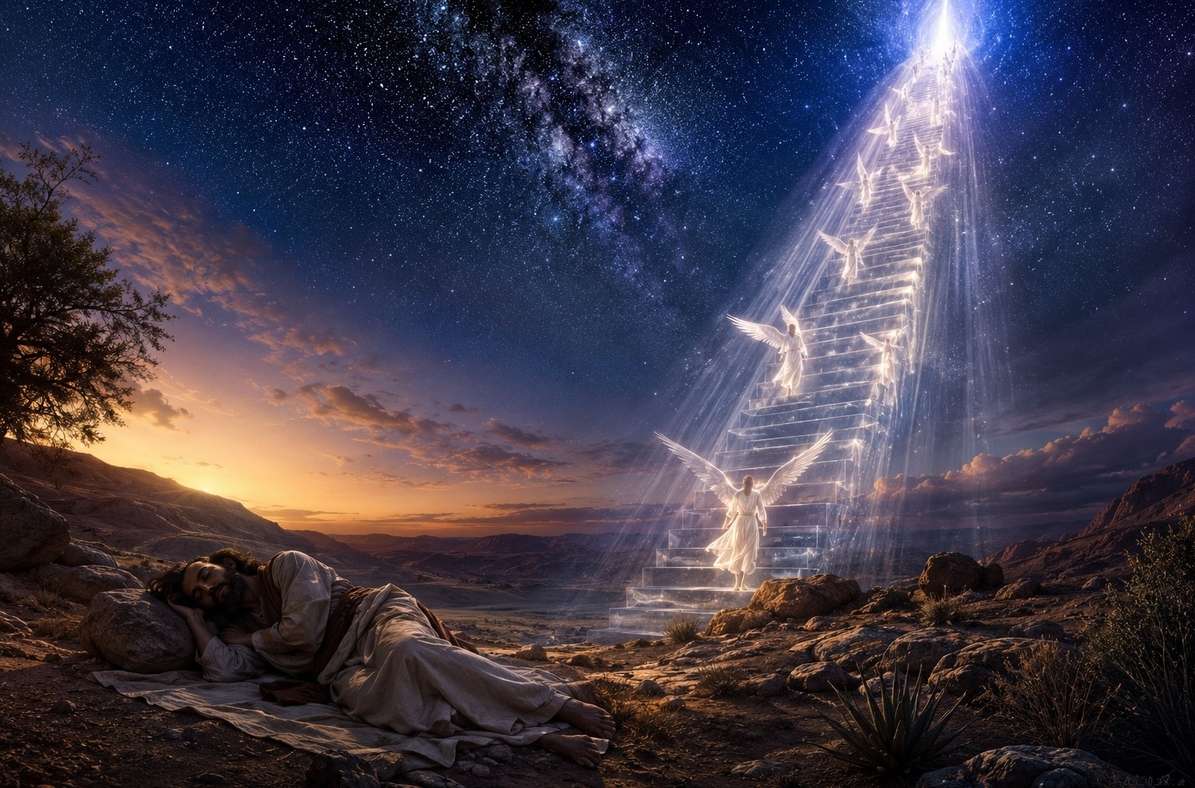
The experience arrives unbidden–a ladder of light, a stairway between worlds, a vertical axis where the ordinary and the extraordinary meet. Jacob, grandson of Abraham, fleeing the wrath of his brother Esau after securing the birthright through deception, finds himself alone in the wilderness at night. With a stone for a pillow, he sleeps–and dreams.
Table of Contents
- The Dream at Bethel
- The Ladder in Kabbalistic Thought
- The Ladder of Divine Ascent
- Gnostic and Esoteric Interpretations
- The Ladder in the Subtle Body
- Twelve Stages of Consciousness Evolution
- The Practical Path of Ascent
- The Ladder as Living Reality
- Frequently Asked Questions
- Further Reading
- References and Sources
The Dream at Bethel
In the dream, a ladder–or stairway–stretches from earth to heaven. Angels ascend and descend upon it. At the top stands the Divine, renewing the covenant with the fugitive patriarch. Jacob awakens stunned, declaring: “Surely the Lord is in this place, and I knew it not… This is none other than the house of God, and this is the gate of heaven.”
This vision–Jacob’s Ladder–has reverberated through three millennia of mystical thought, becoming one of the most potent symbols of spiritual ascent in the Western esoteric tradition. But the ladder is not merely a biblical curiosity. It represents a universal pattern, an architecture of consciousness evolution that appears across traditions under different names but with striking structural similarities. The vertical axis–earth below, heaven above, and the bridge between–is not geography but psychology made visible.
The biblical account (Genesis 28:10–22) places the dream at a specific moment of crisis: Jacob is in flight, his future uncertain, his moral standing compromised by the deception that secured his father’s blessing. The ladder arrives not as reward for virtue but as revelation in vulnerability. This is worth noting: the ladder does not appear to the righteous in their righteousness, but to the exiled in their exile. The gate of heaven opens not at the summit of achievement but at the stone pillow of necessity.
The Ladder in Kabbalistic Thought
Jewish mysticism developed the ladder imagery most extensively. The foundational text of Kabbalah, the Zohar, teaches that Jacob’s ladder represents the experience of prayer itself–the Hebrew words for “ladder” (sulam) and “voice” (kol) sharing the numerological value of 136, suggesting that the voice of prayer constitutes the ladder through which the soul ascends from earth-bound existence into deeper states of consciousness.
The Midrash transmits an oral tradition that the ladder consisted of four steps, which the mystic Rabbi Isaiah Horowitz (the “Shelah,” 1560–1630) interpreted as embodying the Four Worlds of Kabbalah: Asiya (Action), Yetzira (Formation), Beriya (Creation), and Atzilut (Emanation). These four worlds represent not physical locations but states of consciousness, modes of divine manifestation, and stages in the soul’s return to its source. The Shelah’s mapping is precise: the step “etched on earth” corresponds to Asiya; the angels descending and ascending represent Yetzira and Beriya, their two distinct populations of angelic beings; and the Divine standing above him signifies Atzilut, the world of intimate emanation.
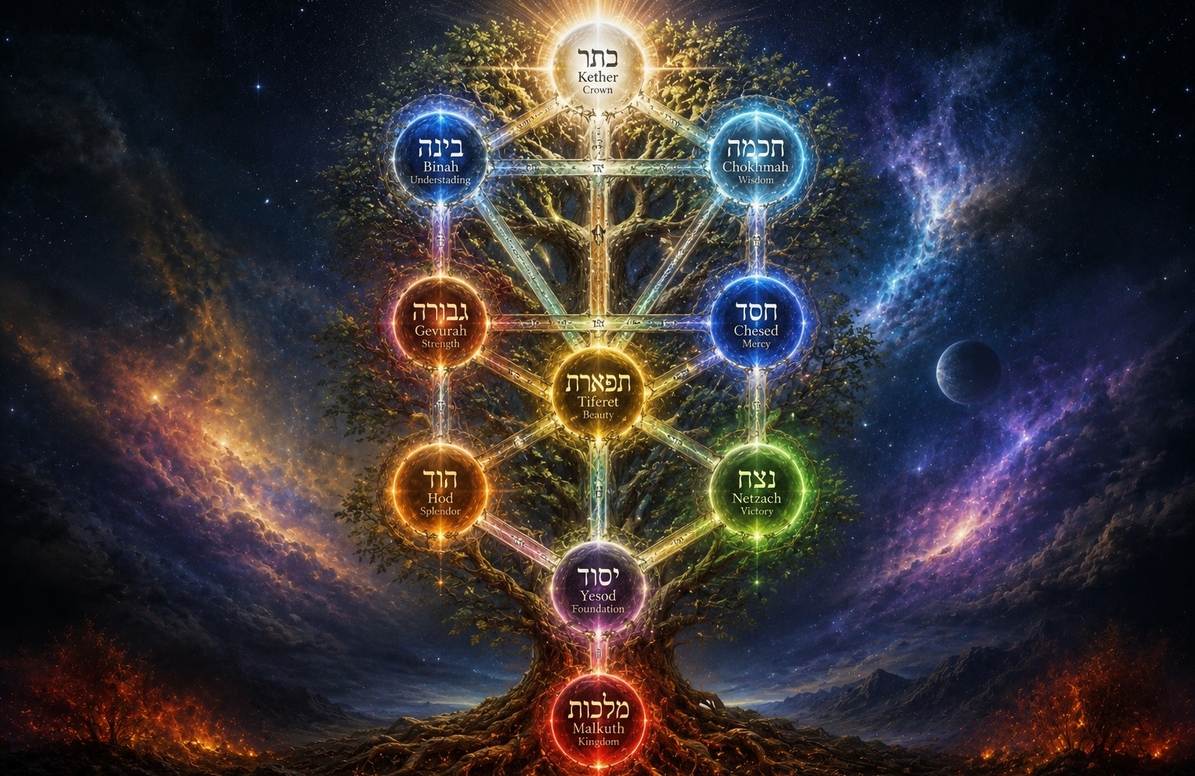
More famously, the ladder has been mapped onto the Tree of Life–the ten sefirot or divine emanations that structure Kabbalistic cosmology. The sefirot form a vertical axis of consciousness, from Malkuth (the material world) through the intermediate spheres of emotional and intellectual refinement, to Kether (the crown, representing pure divine will). The ascent through these spheres is not geographical but psychological and spiritual–a progressive refinement of perception and integration of higher truths. The Kabbalist does not leave the world behind; rather, each sphere is encountered within the world, as a quality of awareness brought to bear upon ordinary experience.
The Ladder of Divine Ascent
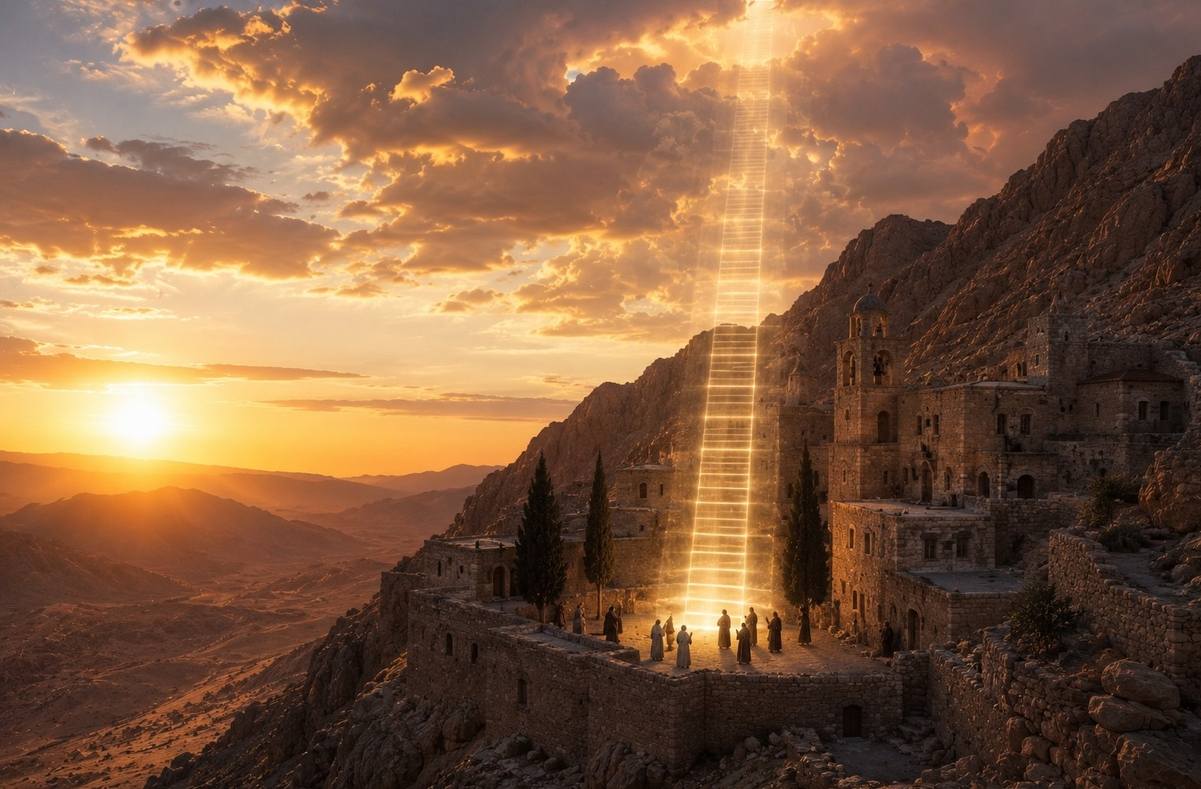
Christian mysticism produced its own masterpiece of ladder symbolism in the seventh century. Saint John Climacus, abbot of Saint Catherine’s Monastery at Mount Sinai, composed The Ladder of Divine Ascent–a spiritual manual that became central to Eastern Orthodox monasticism and remains a classic of Christian mystical literature.
John’s ladder consists of thirty steps (or “rungs”), each corresponding to a specific virtue or spiritual practice: renunciation, detachment, exile, obedience, repentance, remembrance of death, joy-making mourning, freedom from anger, and so on, culminating in faith, hope, and love. The progression reflects the Orthodox understanding of theosis–divinisation or spiritual perfection–not as instantaneous transformation but as gradual ascent through sustained effort and grace.
“The holy virtues are like Jacob’s Ladder. For the virtues, leading from one to another, bear him who chooses them to Heaven.” And crucially: “No one can climb a ladder in one stride.”
The imagery of gradual ascent, of step-by-step progress rather than sudden leap, distinguishes the authentic mystical path from the fantasy of instant enlightenment that seduces so many seekers. Climacus is explicit: the monk who attempts to skip rungs risks falling entirely. Each virtue is not merely a moral achievement but a structural necessity–the stable platform from which the next step becomes possible. The ladder is not a metaphor for convenience; it is an engineering diagram for the soul.
Gnostic and Esoteric Interpretations
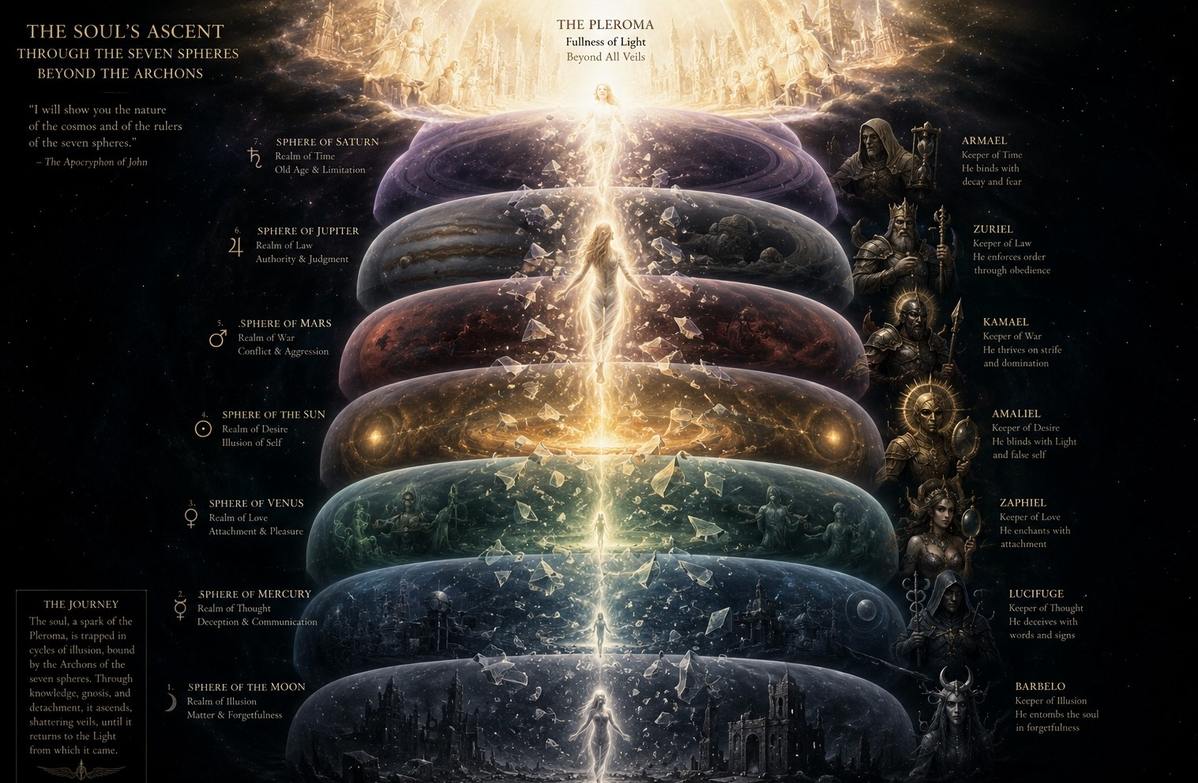
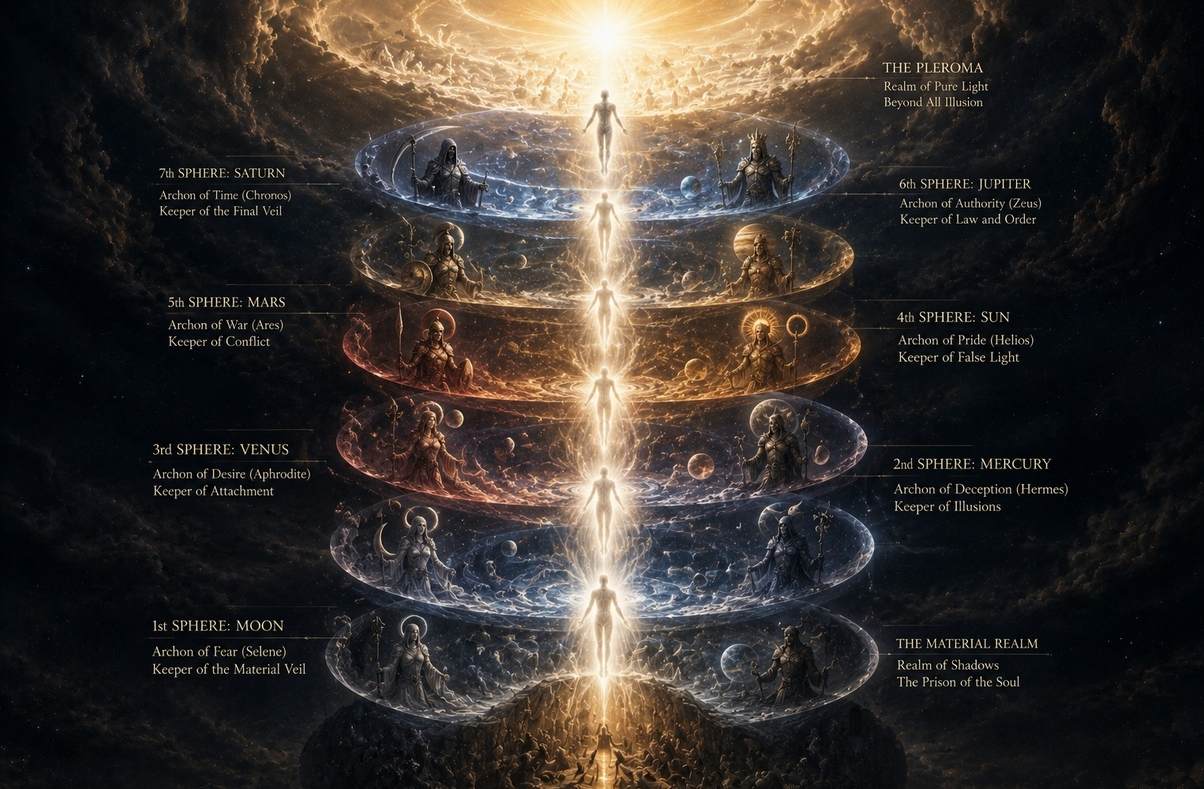
Gnostic scriptures speak of “the ascent through the spheres”–the soul’s journey past the planetary archons and their obstructive forces to return to the Pleroma, the fullness of divine reality. This ascent is not automatic; it requires knowledge (gnosis), the correct passwords or responses to the guardians of each sphere, and the gradual shedding of the psychic and material garments accumulated during earthly existence.
The Apocryphon of John (NHC II,1) describes the soul’s passage through the seven planetary spheres, each governed by an archon who demands recognition and attempts to detain the ascending soul. The initiate must know the true names, the secret signs, and the correct responses to pass each gate. This is not mere ritual magic; it is the dramatisation of psychological liberation–each sphere represents a level of density, a quality of awareness, a particular illusion that must be penetrated and transcended.
The angels ascending and descending are the forces that facilitate this movement–higher aspects of the self that descend to guide, and the purified soul that ascends to reunite with its source. In the Gnostic view, the ladder is not external infrastructure but internal anatomy: the vertical axis of consciousness that connects the hylic (material), psychic (soul), and pneumatic (spiritual) natures. To ascend is to remember what one truly is beneath the accumulated layers of cosmic forgetting.
The Ladder in the Subtle Body
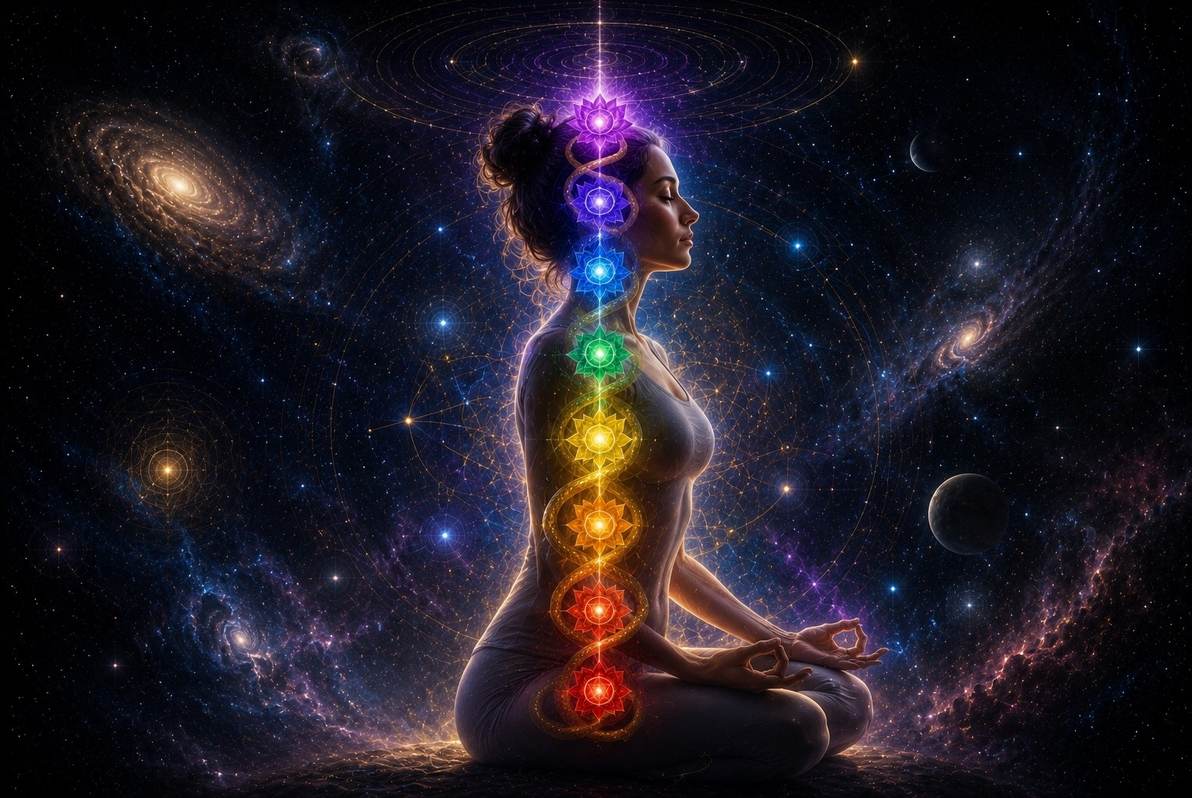
The vertical axis appears not only in scripture and cosmology but in the body itself. The yogic traditions map the sushumna nadi–the central channel of the subtle body–as a ladder of consciousness running from the base of the spine to the crown of the head. Along this channel lie the chakras, seven energetic centres that function as rungs on the ladder of awakening. The kundalini, often depicted as a coiled serpent at the base, is the dormant potential that, when activated, ascends the channel, illuminating each centre in turn until it reaches the sahasrara–the thousand-petaled lotus at the crown, representing union with the absolute.
This is not merely Hindu symbolism. The same vertical axis appears in Daoist alchemy as the Chong Mai (penetrating vessel), in Sufi physiology as the subtle column connecting the heart to the divine throne, and in Kabbalistic meditation as the central pillar of the Tree of Life balancing the pillars of severity and mercy. The body, in these traditions, is not the obstacle to ascent but its infrastructure. The ladder is built into the flesh, waiting only for the consciousness that will climb it.
Modern neuroscience offers a partial correlate: the vertical organisation of the brainstem and cortex, the ascending reticular activating system that modulates wakefulness, and the hierarchical integration of sensory and cognitive processing. While reductionist models cannot capture the phenomenology of mystical ascent, they confirm what the traditions have always taught: that consciousness is vertically organised, that higher integration requires the stabilisation of lower centres, and that the path to expanded awareness passes through the body rather than around it.
Twelve Stages of Consciousness Evolution
Modern researchers of consciousness have attempted to map this ancient ladder onto contemporary developmental psychology. Ken Wilber, Jean Gebser, Sri Aurobindo, and others have described the evolution of human consciousness through distinct stages or “altitudes”–each representing a more integrated, more comprehensive, more conscious way of knowing and being.
These models typically identify three broad tiers of development, subdivided into twelve or more specific stages. The first tier encompasses the pre-conventional and conventional levels–instinctive, magical, mythical, and rational ways of understanding reality. Wilber, drawing on Gebser’s structures and Aurobindo’s terminology, describes these as the Archaic, Magic, Magic-Mythic, Mythic, Rational, and Postmodern stages. The second tier represents the post-conventional or integral stages–where multiple perspectives can be held simultaneously, where the self becomes increasingly transparent to itself, where consciousness turns back upon itself in self-awareness.
The third tier–rarely achieved and poorly understood–represents the truly transpersonal or spiritual stages, where the separation between self and other, between knower and known, begins to dissolve. Here Wilber adopts Aurobindo’s categories: the Psychic, the Illumined Mind, the Intuition, the Overmind, and the Supermind. Here we approach the territory mapped by the mystics: the unitive states, the divine union, the realisation that the ladder was never separate from the climber, that heaven was never separate from earth.
It is important to note that this “twelve-stage” framing is a contemporary synthesis by consciousness researchers mapping developmental psychology onto the ancient ladder, rather than a single unified theory from Wilber, Gebser, or Aurobindo individually. Gebser described five structures of consciousness; Aurobindo described a vertical hierarchy of mind, supermind, and spirit; Wilber integrated these into his AQAL framework. The ladder, in this light, is not a fossilised symbol but a living template that each generation reinterprets according to its own understanding of human potential.
The Practical Path of Ascent
What does it mean to “climb the ladder” in practice? The traditions converge on several essential elements. These are not abstract ideals but functional requirements–the necessary conditions without which ascent remains theoretical.
1. Purification (Nigredo)
The alchemical tradition speaks of nigredo–the blackening, the death of old ways of being. Before ascent can occur, the baggage must be left behind. This means honest self-examination, recognition of patterns that obstruct growth, and the willingness to let die what must die. The nigredo is not punishment but preparation; the dark night is not failure but foundation. Without it, the climber carries too much weight for the rungs to bear.
2. Cultivation of Virtue
John Climacus’ thirty steps represent the systematic cultivation of qualities that support higher consciousness. These are not moralistic impositions but functional necessities–the stable platform from which higher perception becomes possible. Obedience, humility, and discernment are not virtues for their own sake; they are the structural integrity of the ladder itself. A ladder with broken rungs does not climb.
3. Meditation and Contemplation
The Zohar‘s identification of the ladder with prayer points to the centrality of contemplative practice. Whether through formal meditation, prayer of the heart, or continuous mindfulness, the ascent requires the cultivation of inner silence and the capacity to sustain attention. The ladder is climbed not by thinking about it but by stepping onto it–repeatedly, daily, until the stepping becomes the natural gait of the soul.
4. Transmission and Guidance
The ladder is not meant to be climbed alone. Every authentic tradition emphasises the necessity of guidance from those who have already traversed the path–the rabbi, the spiritual father, the guru, the sheikh. The ladder is a living transmission, not merely a theoretical construct. The presence of one who has stabilised a higher rung provides the field induction that books and solitary effort cannot replicate. Transmission is the invisible structure that holds the visible ladder steady.
5. Integration and Embodiment
The goal is not to escape the world but to transform it. The fully realised being descends the ladder as readily as ascending it, bringing the light of higher consciousness back into the realm of action and relationship. The angelic traffic on Jacob’s ladder moves in both directions–ascent and descent–because the completed circuit requires the return. The climber who reaches the top and refuses to descend has not finished the journey; they have merely stopped halfway.
The Ladder as Living Reality
Jacob’s ladder is not merely an ancient symbol to be intellectually appreciated. It is a living reality, the structure of consciousness itself, available to be experienced by anyone willing to undertake the work of ascent.
The angels ascending and descending are the thoughts, insights, and energies that move between the ordinary mind and the higher reaches of awareness. The Divine standing at the top is not a distant deity but the deepest Self, the ground of being that awaits recognition. The stone pillow is the body, the earth, the ordinary circumstances that seem too hard to rest upon–yet they are precisely the foundation from which the vision arises.
To climb the ladder is to participate in the evolution of consciousness–not as abstract theory but as lived experience. Each step is both an achievement and a revelation, both the result of effort and the gift of grace. And the view from each rung is simultaneously the view from all rungs, seen through the lens of increasing clarity and integration.
The ladder stands at the intersection of time and eternity, matter and spirit, human and divine. It is the bridge we are called to cross, the journey we are called to make, the transformation we are called to embody. The gate of heaven is not elsewhere. It is here, in the place where you lay your head upon the stone, in the moment when you dare to sleep–and to dream.
Frequently Asked Questions
Is Jacob’s ladder a literal structure or a metaphor for consciousness?
It is fundamentally a symbol for the vertical axis of consciousness–the bridge between ordinary awareness and expanded states of knowing. While some esoteric traditions speculate about literal energetic structures in the subtle body (such as the sushumna nadi or the central pillar of the Tree of Life), the ladder’s primary function is phenomenological: it describes the experience of ascent, not a physical object to be located.
Can the ladder be climbed without a teacher or community?
The traditions are unanimous that guidance accelerates and stabilises the process, but they do not universally mandate it. The solitary path is documented across history–the desert fathers, the mountain sages, the self-taught mystics. However, the risks of inflation, misidentification, and destabilisation increase without the mirroring function of community. The ladder can be climbed alone, but the climb is harder and the falls more dangerous.
What is the relationship between the Kabbalistic Four Worlds and John Climacus’ thirty steps?
They represent different granularities of the same ascent. The Four Worlds are macro-stages of consciousness (Action, Formation, Creation, Emanation), while the thirty steps are micro-practices within those stages. One might spend years in Asiya working through Climacus’ early rungs of renunciation and repentance, then ascend to Yetzira through the cultivation of emotional virtue, and so on. The models are complementary, not contradictory.
Does everyone experience the same stages in the same order?
No. Developmental research suggests that while the broad trajectory is consistent (pre-personal to personal to transpersonal), individual paths vary enormously. Some leap between stages; others regress before advancing; still others stabilise at one level for a lifetime. The ladder is not an escalator–it is climbed, sometimes rung by rung, sometimes with skips, sometimes with falls. The map is not the territory.
What is the Gnostic ‘ascent through the spheres’ and is it still relevant today?
The Gnostic ascent describes the soul’s liberation from the planetary archons–the psychological and cosmic forces that maintain ignorance. In contemporary terms, the spheres represent layers of conditioning: familial, cultural, ideological, and existential. The passwords are not magical formulae but penetrating insight into the constructed nature of each layer. The ascent is the progressive recognition that one is not bound by the structures one was born into.
How does the ladder relate to the chakras or kundalini?
The chakras function as rungs on the ladder of the subtle body. The kundalini ascent is the energetic correlate of mystical development–the physiological activation that accompanies or enables consciousness expansion. However, the correlation is not one-to-one: a kundalini awakening does not guarantee psychological maturity, and psychological insight does not automatically produce energetic activation. The ladder requires both tracks to advance safely.
Is the goal to reach the top of the ladder and stay there?
No. The completed journey includes descent as well as ascent. The angelic traffic moves in both directions because the fully realised being brings the light back into relationship and action. To remain at the top is to abandon the world that the vision was meant to transform. The ladder is not an escape route but a communication channel between heaven and earth.
Further Reading
- The Stages of Integration: Immediate, Short-Term & Long-Term — How the ladder is climbed in the hours, days, and years after recognition.
- Asceticism and Discipline: The Architecture of the Will — The cultivation of virtue and the structural integrity of the ladder.
- Esoteric Lineages: Transmission Across Time — How the ladder is preserved and transmitted through living tradition.
- Archons: The Ruling Powers That Shape Reality — The obstructive forces encountered on the Gnostic ascent through the spheres.
- Hermeticism and Gnosticism: Egyptian Wisdom and the Western Esoteric Tradition — The broader context of ascent literature in the ancient Mediterranean.
- Gnostic Schools: Sethians, Valentinians, and Hermetics — The specific traditions that mapped the ascent through archonic spheres.
- Integration and Grounding: Making the Real Real — The descent after ascent, and the necessity of embodiment.
- The Transformation: What Actually Changes After Mystical Experience — The phenomenology of the rungs, from the inside.
References and Sources
The following sources informed the research and conceptual framework of this article. They are grouped by disciplinary category for navigability.
Biblical and Kabbalistic Sources
- Genesis 28:10–22. The biblical account of Jacob’s dream at Bethel, foundational to all subsequent ladder symbolism in Western mysticism.
- Zohar, Parashat Vayeitzei. The foundational text of Kabbalah interpreting Jacob’s ladder as the experience of prayer, with sulam (ladder) and kol (voice) sharing the gematria value of 136.
- Midrash Bereishit Rabbah 68:12 (cited in Yalkut Reuvani and Megaleh Amukot). Transmits the oral tradition that the ladder consisted of four steps.
- Horowitz, Rabbi Isaiah (the “Shelah,” 1560–1630). Shenei Luhot HaBerit (Two Tablets of the Covenant). Interprets the four steps of Jacob’s ladder as the Four Worlds of Kabbalah: Asiya, Yetzira, Beriya, and Atzilut.
- Luria, Rabbi Isaac (the “Arizal,” 1534–1572). Pri Etz Chaim (Fruit of the Tree of Life). Maps the four sections of the Morning Prayer onto the Four Worlds, providing the practical liturgical correlate to the ladder’s cosmology.
Christian Mysticism
- Climacus, Saint John (7th century). The Ladder of Divine Ascent. Translated by Colm Luibheid and Norman Russell. New York: Paulist Press, 1982. The classic Eastern Orthodox manual of thirty steps toward theosis, composed at Saint Catherine’s Monastery, Mount Sinai.
Gnosticism and Western Esotericism
- The Apocryphon of John (NHC II,1; III,1; IV,1). In Robinson, James M. (Ed.). The Nag Hammadi Library in English. San Francisco: HarperSanFrancisco, 1990. Describes the soul’s ascent through the seven planetary spheres past the archons to the Pleroma.
- Layton, Bentley (1987). The Gnostic Scriptures. New York: Doubleday. Scholarly edition and translation of Gnostic ascent literature with commentary on the cosmological spheres and their guardians.
Consciousness Studies and Developmental Psychology
- Gebser, Jean (1949/1985). The Ever-Present Origin. Translated by Noel Barstad and Algis Mickunas. Athens, OH: Ohio University Press. Identifies five structures of consciousness: Archaic, Magic, Mythic, Mental, and Integral (Aperspectival).
- Aurobindo, Sri (1939/2003). The Life Divine. Twin Lakes, WI: Lotus Press. Describes the vertical hierarchy of consciousness from Matter to Mind to Supermind, foundational to transpersonal developmental models.
- Wilber, Ken (2000). A Theory of Everything: An Integral Vision for Business, Politics, Science and Spirituality. Boston: Shambhala. Presents the AQAL framework integrating Gebser’s structures and Aurobindo’s levels into a comprehensive map of consciousness development.
- Wilber, Ken (2006). Integral Spirituality. Boston: Integral Books. Expands the AQAL model to include the four transpersonal levels (Psychic, Subtle, Causal, Non-dual) drawing on Aurobindo’s terminology.
Embodied Spirituality and Subtle Anatomy
- Feuerstein, Georg (1998). Tantra: The Path of Ecstasy. Boston: Shambhala. Scholarly treatment of the sushumna nadi, chakras, and kundalini as the subtle body’s ladder of awakening.
- Chia, Mantak (1983). Awakening Healing Energy Through the Tao. New York: Aurora Press. Daoist alchemical perspective on the Chong Mai (penetrating vessel) as the central energetic axis corresponding to the ladder of consciousness.
Safety Notice: This article discusses intensive contemplative and energetic practices that can produce psychological and physiological effects. It does not constitute medical, psychological, or spiritual advice. If you experience persistent dissociation, uncontrolled energetic phenomena, or destabilisation during spiritual practice, consult qualified medical professionals and trauma-informed therapists. Kundalini-related symptoms in particular can mimic neurological conditions and should be assessed clinically. The practices described here complement but do not replace professional mental health treatment.