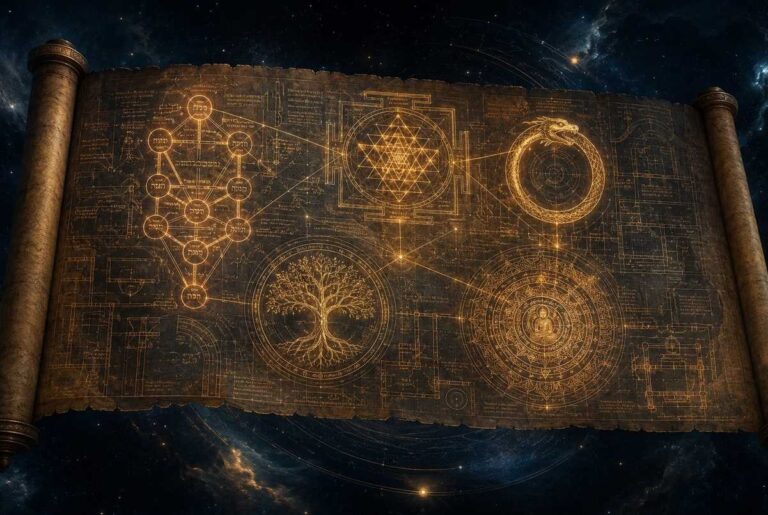

The Seven Hermetic Principles: The Kybalion and the Hidden Patterns of Experience
Some patterns are so close to experience that we rarely notice them.
Emotions rise and fall. Relationships repeat their hidden lessons. The same conflict returns wearing a new face. Inner states seem to echo outer circumstances. Opposites turn into one another. A low period begins to lift. A high point begins to fade. What seemed random starts to rhyme.
The Kybalion, published in 1908 by the anonymous “Three Initiates”, gives names to seven such patterns: Mentalism, Correspondence, Vibration, Polarity, Rhythm, Cause and Effect, and Gender. It presents them as Hermetic principles running beneath every plane of existence.
But this article will not treat the book as ancient scripture, scientific proof or a secret manual that explains everything. That would make the Kybalion smaller, not larger. Its value lies elsewhere.
Read carefully, the seven principles become a language of attention. They do not require blind belief. They ask for observation. They ask whether the patterns named in the text can be found in the movements of mind, body, relationship, memory, grief, desire, awakening and ordinary life.
The question is not merely whether the Kybalion is historically ancient. It is not. The deeper question is whether the patterns it names are already moving through experience, quietly, beneath the surface of what we call chance.
Perhaps some things are not random. Perhaps they are patterns we have not yet learned to read.

In Plain Terms
The Kybalion is a modern Hermetic text published in 1908. It teaches seven principles: Mentalism, Correspondence, Vibration, Polarity, Rhythm, Cause and Effect, and Gender. This article reads those principles as patterns of experience rather than unquestionable dogma. The Kybalion is not an ancient Egyptian scripture, but it remains useful as a symbolic and contemplative map for noticing how mind, pattern, rhythm, polarity and causation shape human life.
Primary Sources and Traditions Discussed
- The Kybalion, published in 1908 by the “Three Initiates”.
- William Walker Atkinson and the New Thought context of early twentieth-century metaphysical religion.
- Hermeticism and the figure of Hermes Trismegistus.
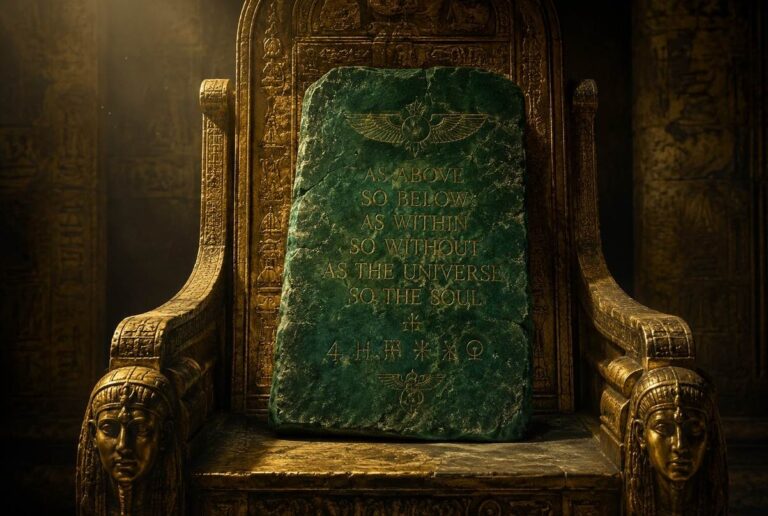
- The Emerald Tablet and the phrase “as above, so below”.
- The Corpus Hermeticum and classical Hermetic themes of divine mind, cosmos and spiritual ascent.
- New Thought, mental science and the modern language of mind shaping experience.
- Western esotericism, alchemy and symbolic correspondence.
- Gnostic and Neo-Gnostic discernment around pattern, false certainty and direct knowing.
- Phenomenology: how patterns appear in lived experience.
- Contemplative practice, attention, self-observation and grounded interpretation.
How to Read This Article
Read this as a symbolic and contemplative guide, not as a demand to believe that seven fixed laws explain everything. The Kybalion is historically modern, but the patterns it names can still be useful. The aim is discernment: to notice correspondence without becoming paranoid, rhythm without fatalism, mentalism without ego-control fantasy, and polarity without reducing life to simple opposites.
Article Map
- A Modern Book with Ancient Echoes
- Law, Pattern or Lens?
- Principle One: Mentalism
- Principle Two: Correspondence
- Principle Three: Vibration
- Principle Four: Polarity
- Principle Five: Rhythm
- Principle Six: Cause and Effect
- Principle Seven: Gender and Generative Polarity
- The Seven Principles Compared
- A Gnostic and Neo-Gnostic Reading
- How the Principles Can Be Misused
- How to Work with the Principles Safely
- Conclusion: Learning the Names of the Patterns
- Related Glossary Terms
- Read Next
- Further Reading
- Frequently Asked Questions
- References and Sources
A Modern Book with Ancient Echoes
Before examining the seven principles, the first act of discernment is historical honesty.
The Kybalion was published in Chicago in 1908 by the Yogi Publication Society. Its authors identified themselves only as “Three Initiates”, though scholars and historians of Western esotericism widely associate the work with William Walker Atkinson, an American New Thought writer, attorney and prolific author on mental science, yoga and occult philosophy.
This matters because The Kybalion is not an ancient Egyptian manuscript. It is a modern synthesis. It draws from Hermetic themes, especially the language of mind, correspondence and hidden law, but it presents them in the atmosphere of early twentieth-century New Thought, mental science and popular metaphysics.
The older Hermetic texts, especially the Corpus Hermeticum, are more theological, mystical and devotional. They speak of divine Mind, spiritual rebirth and ascent toward the divine. The Emerald Tablet, central to alchemical and Hermetic tradition, contains the famous logic of correspondence: that which is above is like that which is below. But the specific sevenfold system of the Kybalion is modern.
This does not destroy the book’s value. It clarifies it. The Kybalion should not be handled as recovered antiquity. It should be read as a modern Hermetic tract: a New Thought era reinterpretation of older esoteric currents, written in a language of mind, mastery, vibration and principle.
A modern text can still carry real insight. The question is not whether the Kybalion is ancient. The question is whether it teaches the reader how to see patterns that were already moving through experience.
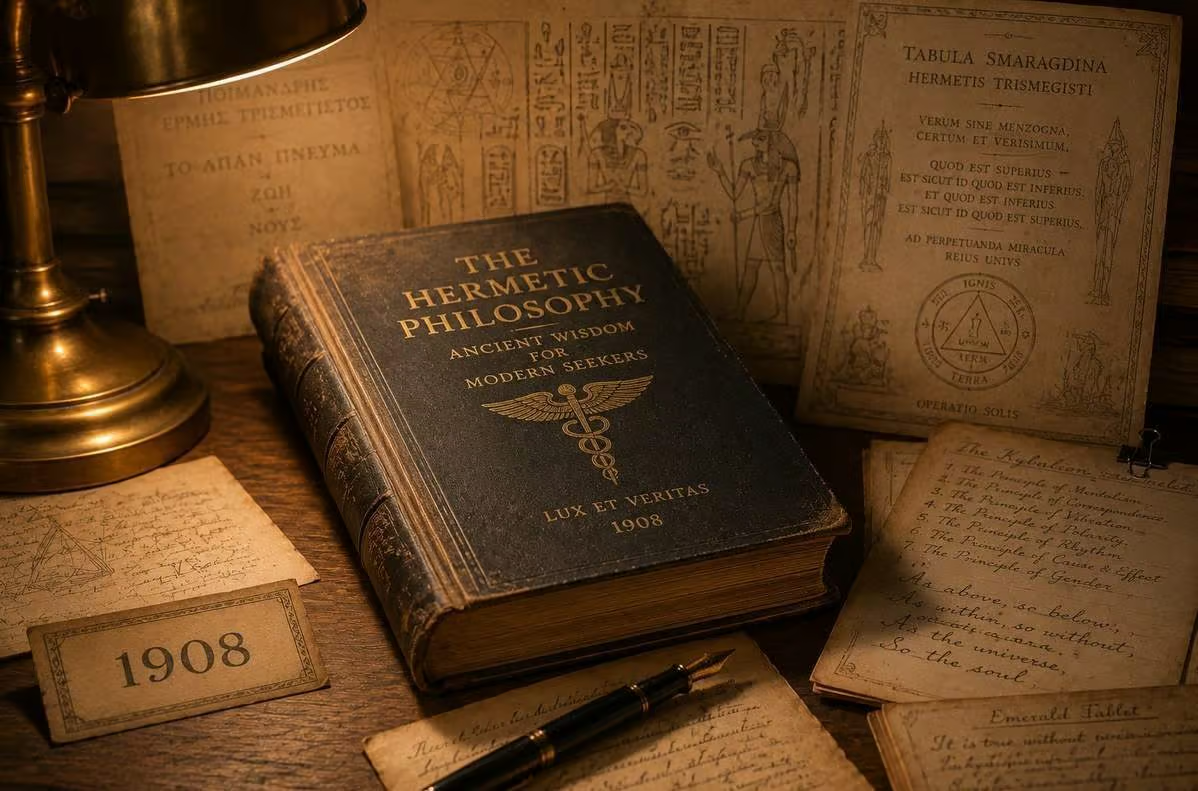
The Kybalion is not ancient scripture. It is a modern mirror held up to old Hermetic light.
Law, Pattern or Lens?
The Kybalion presents its seven principles as universal laws. That is the book’s language. But a contemporary reader needs a more careful question: are these laws in the scientific sense, patterns in the phenomenological sense, or lenses through which experience can be read?
The distinction matters. Gravity operates whether one believes in it or not. A symbolic pattern is different. It may reveal something true, but it may also depend on the mind’s way of arranging experience. Correspondence may reveal genuine analogy between levels of reality. It may also invite projection if used without restraint. Rhythm may describe real cycles in nature and emotion. It may also tempt the reader into fatalism if turned into dogma.
This is why the Kybalion is most useful when approached as a contemplative framework. Its principles should be tested through attention, not swallowed whole. Do they help the reader perceive more clearly? Do they produce humility or certainty? Do they deepen responsibility or encourage control fantasy? Do they make life more intelligible without making the mind more rigid?
A principle becomes dangerous when it stops serving attention and starts replacing reality. ZenithEye’s approach is simple: use the principles as lamps, not prisons.
Use the principles as lamps, not prisons.
Principle One: Mentalism
The first principle is the most radical: “The All is Mind; the Universe is Mental.”
In the Kybalion’s language, reality is not fundamentally dead matter. It is mind-like. Everything that appears outwardly exists within, through, or as expression of a universal Mind. The material world is not separate from consciousness, but a form or presentation within it.
This does not mean that the personal ego creates the universe. That is the common modern error. Mentalism is not a licence for narcissism. It does not say, “my thoughts alone create everything”. It says the structure of reality is mind-like, and that human consciousness participates in a deeper field of consciousness than the ordinary self recognises.
Classical Hermeticism approaches this through Nous, divine Mind. The Kybalion translates the idea into practical mental philosophy. New Thought later emphasised the power of mind, belief, visualisation and mental state. Modern manifestation culture inherits this stream, sometimes helpfully, sometimes dangerously.
The grounded use of Mentalism is not control fantasy. It is responsibility for attention. The world may not be reducible to personal thought, but our experience of the world is deeply shaped by the quality of mind through which we meet it.

The All may be Mind, but the ego is not The All.
Principle Two: Correspondence
The second principle is the most famous: “As above, so below; as below, so above.”
Correspondence teaches that patterns repeat across levels: physical, mental, spiritual, cosmic, personal and social. The macrocosm and microcosm echo one another. What appears in the body may mirror the psyche. What appears in relationship may mirror an inner pattern. What appears in civilisation may mirror the individual nervous system writ large.
This principle has deep roots in the Emerald Tablet, whose central insight shaped alchemy, Renaissance esotericism and later occult traditions. Yet correspondence must be handled carefully. It is analogical, not literal. “As above, so below” does not mean every event outside you is a simple message about your inner state. That is how symbolic insight becomes superstition, guilt or paranoia.
Used well, correspondence trains the eye to notice pattern. Used badly, it turns the world into a hall of forced meaning. The task is not to interpret everything. The task is to observe where inner and outer genuinely rhyme, then leave space for ordinary causes, mystery and silence.

Correspondence is a doorway into pattern, not permission to force meaning onto everything.
Principle Three: Vibration
The third principle states: “Nothing rests; everything moves; everything vibrates.”
The Kybalion teaches that everything exists in motion. Matter, energy, mind and spirit differ by degree, state and rate of vibration. This language became central to modern metaphysical culture, especially in the language of frequency, energetic state and “raising vibration”.
Here discernment is essential. Modern physics does describe reality through fields, waves, motion and energy, but that does not scientifically prove the Kybalion’s metaphysical claims. The principle of vibration should not be used as a decorative borrowing from quantum physics. Its safer value is contemplative and experiential: nothing in experience is static. Thought moves. Emotion moves. The body changes. Moods shift. Identity itself trembles, reforms and settles again.
To work with vibration is to notice the state one inhabits. Fear contracts perception. Love opens it. Shame narrows the field. Gratitude may widen it. These are not merely moods. They shape what the world looks like from inside them.
The mistake is to turn vibration into moral ranking. A person in grief is not “low vibration” in a way that makes them spiritually inferior. Grief may be sacred. Anger may reveal violated truth. Fear may protect the body. The question is not whether a state is high or low in a simplistic hierarchy. The question is whether the state is moving toward clarity, life and truth, or toward contraction, repetition and captivity.
Vibration is useful when it teaches sensitivity. It becomes harmful when it becomes spiritual ranking.
Principle Four: Polarity
The fourth principle states: “Everything is dual; everything has poles; everything has its pair of opposites.”
Polarity teaches that many opposites are not separate substances, but extremes of one continuum. Heat and cold are degrees of temperature. Light and dark are degrees of illumination. Courage and fear may be read as different relationships to danger. Love and hatred, attraction and repulsion, joy and sorrow, certainty and doubt: each pair can reveal a spectrum rather than two sealed worlds.
The Kybalion connects polarity with mental transmutation: shifting one’s state along the spectrum rather than being trapped at one extreme. This is useful when handled carefully. It does not mean denying pain or pretending the opposite has already been reached. It means recognising that states are not eternal prisons. Movement is possible.
Polarity also helps resolve paradox. A truth may appear contradictory at one level and complementary at another. The mature mind does not rush to flatten contradiction. It asks whether both poles belong to a larger pattern.

Polarity does not erase the dark. It shows that the dark is not the whole map.
Principle Five: Rhythm
The fifth principle states: “Everything flows, out and in; everything has its tides; all things rise and fall.”
Rhythm is the principle that reframes change. Life moves in cycles: breath, sleep, seasons, moods, relationships, attention, grief, growth and decay. What feels permanent may be a point on the pendulum. The low begins to lift. The high begins to fade. Expansion gives way to contraction. Contraction gives way to expansion.
This does not make suffering pleasant. Rhythm is not optimism. It is pattern. A difficult period may still require action, help, boundaries, grief and repair. But rhythm can prevent the mind from confusing the current state with eternity. The swing is real, but the swing is not the whole self.
The Kybalion suggests that the wise learn to rise above the pendulum. In ZenithEye terms, this does not mean dissociation. It means finding the witnessing centre: the part of awareness that can feel the movement without becoming identical with it.

The swing is real, but the swing is not the whole self.
Principle Six: Cause and Effect
The sixth principle states: “Every cause has its effect; every effect has its cause.”
The Kybalion argues that chance is only a name for causes not yet recognised. Nothing arises from nowhere. Every thought, action, habit, relationship pattern and inner state belongs to a chain of causes. The purpose of studying cause and effect is not fatalism. It is freedom through recognition.
If one is only the effect of unconscious causes, life feels like repetition. If one begins to see the causes, intervention becomes possible. A thought repeated becomes a groove. A reaction rehearsed becomes temperament. A wound defended becomes identity. A pattern named becomes workable.
Modern psychology offers careful parallels here. Habits shape nervous-system response. Repeated thoughts strengthen pathways. Behaviour has consequences. But cause and effect should not be weaponised into blame. Not everything that happens to a person is “caused” by their mindset. That crude reading becomes spiritual cruelty.
The ethical use of this principle is responsibility without self-blame. Ask: what causes am I feeding now? What effects am I repeating? What small cause, introduced today, could alter the pattern over time?
A pattern named becomes workable.
Principle Seven: Gender and Generative Polarity
The seventh principle states: “Gender is in everything; everything has its masculine and feminine principles.”
This is the principle that requires the greatest care. The Kybalion’s language belongs to its period and can easily be misread as biological or social essentialism. A wiser reading treats Gender here as generative polarity: the interplay of active and receptive, projective and containing, seed and womb, outward movement and inward formation.
The Kybalion itself distinguishes Gender from biological sex, stating that sex is only one expression of a broader principle on the physical plane. On the mental and spiritual planes, the idea becomes more symbolic. Every act of creation requires both movement and reception. A thought must be generated, but it must also be held. A vision must be projected, but it must also be gestated. Will needs imagination. Imagination needs form.
Read in this way, the principle does not prescribe social roles. It invites integration. The active without the receptive becomes domination. The receptive without the active becomes passivity. Wholeness requires a living exchange between the two.
This also connects with Gnostic and Hermetic symbolism of union, where divided forces are brought into a higher integrity. The point is not gender performance. It is generative balance.
The active without the receptive becomes domination. The receptive without the active becomes passivity.
The Seven Principles Compared
The principles are easiest to use when they are not treated as abstract doctrine, but as different ways of reading experience.
| Principle | Pattern of Experience | Healthy Use | Common Distortion |
|---|---|---|---|
| Mentalism | Mind shapes experience. | Practise attention and inner responsibility. | “My ego creates everything.” |
| Correspondence | Patterns echo across levels. | Notice analogies carefully. | Forcing meaning onto everything. |
| Vibration | States move and affect perception. | Become sensitive to state and atmosphere. | Ranking people as high or low vibration. |
| Polarity | Opposites belong to a spectrum. | Find movement between extremes. | Denying real pain or conflict. |
| Rhythm | Life rises, falls and cycles. | Find the witness within the swing. | Fatalism or passivity. |
| Cause and Effect | Patterns have causes. | Introduce wiser causes. | Blaming people for everything they suffer. |
| Gender | Creation requires active and receptive forces. | Integrate will, imagination, form and receptivity. | Rigid gender essentialism. |
A Gnostic and Neo-Gnostic Reading
From a Gnostic perspective, the Kybalion’s principles are useful only if they serve recognition. They should not become another closed system that traps the mind in certainty. The divine spark does not need more conceptual cages. It needs clearer seeing.
Mentalism can remind the seeker that reality is not dead. Correspondence can reveal pattern across inner and outer life. Vibration can teach sensitivity to state. Polarity can prevent despair at one extreme. Rhythm can steady the soul during cycles. Cause and Effect can restore responsibility. Gender can point toward generative wholeness.
But each principle can also be captured by the Counterfeit Spirit. Mentalism can become ego-magic. Correspondence can become paranoia. Vibration can become spiritual superiority. Polarity can become bypassing. Rhythm can become passivity. Cause and Effect can become blame. Gender can become rigid ideology.
The difference is discernment. A principle that opens perception serves gnosis. A principle that closes perception becomes another archonic loop.
A principle that opens perception serves gnosis. A principle that closes perception becomes another archonic loop.
How the Principles Can Be Misused
The Kybalion becomes dangerous when it is used as a shortcut to certainty. The principles can tempt the reader into thinking they have decoded everything: every illness, every relationship, every failure, every synchronicity, every grief. But life is not a puzzle box waiting to be solved by seven labels.
A person in distress does not need to be told that they manifested their suffering. A grieving person does not need rhythm used against them. A traumatised person does not need cause and effect turned into spiritual blame. A sensitive person does not need correspondence turned into suspicion. A seeker does not need vibration turned into hierarchy.
The principles become trustworthy only when held with humility. They are not weapons. They are not diagnoses. They are not excuses to avoid ordinary action, medical care, relationship repair, therapy, grief, ethics or accountability.
Hermetic wisdom does not remove the need for human compassion. It deepens it.
Life is not a puzzle box waiting to be solved by seven labels.
How to Work with the Principles Safely
A grounded way to work with the Kybalion is not to believe harder, but to observe more honestly.
- With Mentalism: ask how your state of mind shapes what you notice, without assuming your ego creates everything.
- With Correspondence: notice meaningful echoes, but leave room for coincidence, ordinary causes and silence.
- With Vibration: observe how fear, grief, love and clarity alter perception, without ranking people spiritually.
- With Polarity: ask where movement is possible between extremes.
- With Rhythm: remember that no state is permanent, while still taking wise action in the present.
- With Cause and Effect: introduce better causes without blaming yourself for every effect.
- With Gender: look for balance between action and receptivity, will and imagination, seed and form.
The point is not control. It is recognition. The principles work best as contemplative questions:
- What pattern is repeating here?
- What state am I seeing through?
- What cycle am I inside?
- What opposite is hidden within this extreme?
- What cause am I feeding?
- Where am I acting without receiving, or receiving without acting?
- Does this interpretation make me more honest, grounded and compassionate?
If the interpretation makes you more rigid, frightened, superior or detached from ordinary responsibility, set it down. A true principle should make the eye clearer, not tighter.
A true principle should make the eye clearer, not tighter.
Learning the Names of the Patterns
The Kybalion does not need to be ancient to be useful. It does not need to be perfect to be illuminating. It does not need to be treated as final doctrine to help the reader notice the architecture of experience.
Its seven principles are not keys to total control. They are names for recurring patterns: mind, mirror, movement, spectrum, cycle, consequence and generative balance.
The danger is believing too quickly. The gift is looking more carefully.
What if the things you have been calling random are not random at all? What if they are patterns operating beneath ordinary attention? What if learning their names does not give you mastery, but something quieter and more useful: recognition?
Not control. Not certainty. Not spiritual superiority.
Recognition.
The moment when the pattern was always there, and the eye finally learned how to see it.
Related Glossary Terms
These terms help frame the article’s main ideas across the wider ZenithEye archive.
- Gnosis
- Divine Spark
- Counterfeit Spirit
- Symbol & Encryption
- Phenomenology
- Contemplative Techniques
- Integration
- Grounding
- Spiritual Practice of Attention
- Pattern Recognition Without Paranoia
- When Symbols Become Cages
- The Discipline of Not Interpreting Everything
- The Humility of Not Knowing
- Manifestation Without Manipulation
- From True Will to the Subconscious
- Kybalion
- Hermetic Principles
- Mentalism
- Correspondence
- Vibration
- Polarity
- Rhythm
- Cause and Effect
- Gender
- Generative Polarity
- Hermes Trismegistus
- Emerald Tablet
- Corpus Hermeticum
- New Thought
- William Walker Atkinson
- As Above, So Below
- Mental Transmutation
- Universal Mind
- Pattern Recognition
- Phenomenological Pattern
Read Next
Continue through the Hermetic, symbol and pattern-recognition route: manifestation, symbols, restraint, direct knowing and the danger of turning principles into cages.
Further Reading
Articles from ZenithEye that explore Hermetic pattern, manifestation, symbolic perception, discernment and direct knowing:
- Manifestation Without Manipulation – A Neo-Gnostic guide to desire, ethics and the Counterfeit Spirit.
- From True Will to the Subconscious – The inward migration of Western magic into will, symbol and subconscious practice.
- Three Steps Before Vision – Why moral preparation matters before spiritual perception.
- When Symbols Become Cages – How symbols can guide or imprison depending on how they are used.
- Pattern Recognition Without Paranoia – Discernment practices for reading pattern without falling into delusion.
- The Discipline of Not Interpreting Everything – Why mature perception sometimes leaves meaning unresolved.
- The Humility of Not Knowing – Spiritual maturity as openness, restraint and non-certainty.
- What Is Gnosis? – Direct knowing, recognition and the difference between truth and belief.
- The Spiritual Practice of Attention – Attention as the first discipline of inner seeing.
- The Slow Work of Integration – Why insights need time to become lived reality.
- What Is the Counterfeit Spirit? – How spiritual language can imitate awakening while serving ego or control.
Frequently Asked Questions
What is the Kybalion?
The Kybalion is a book published in 1908 by the anonymous “Three Initiates”, widely associated with William Walker Atkinson. It presents seven Hermetic principles: Mentalism, Correspondence, Vibration, Polarity, Rhythm, Cause and Effect, and Gender.
Is the Kybalion an ancient Egyptian text?
No. The Kybalion is a modern Hermetic and New Thought synthesis published in 1908. It draws on older Hermetic ideas but is not a recovered ancient Egyptian manuscript.
What are the seven Hermetic principles in the Kybalion?
The seven principles are Mentalism, Correspondence, Vibration, Polarity, Rhythm, Cause and Effect, and Gender. They are presented as patterns or laws that help explain mind, change, polarity, rhythm, causation and generative balance.
What does “as above, so below” mean?
“As above, so below” refers to the principle of Correspondence: patterns at one level of reality can echo patterns at another. It should be read analogically and carefully, not as permission to force meaning onto every event.
What is the Principle of Mentalism?
The Principle of Mentalism states that “The All is Mind; the Universe is Mental.” In a grounded reading, this does not mean the personal ego creates everything. It means reality is mind-like, and consciousness participates in experience.
Is vibration in the Kybalion the same as physics?
No. Modern physics uses concepts such as fields, waves and motion, but that does not scientifically prove the Kybalion’s metaphysical idea of vibration. The principle is best used contemplatively, as a way of noticing how states of mind and emotion move and shape perception.
How should the Kybalion be used safely?
Use the seven principles as contemplative questions, not rigid doctrine. They should deepen attention, humility and responsibility. If they create fear, superiority, blame or obsessive interpretation, step back and return to grounding.
References and Sources
The following sources shaped the historical, Hermetic and comparative framework of this article.
Primary Sources and Critical Editions
- The Three Initiates. The Kybalion: A Study of the Hermetic Philosophy of Ancient Egypt and Greece. Yogi Publication Society, 1908.
- The Emerald Tablet, attributed to Hermes Trismegistus, transmitted through Arabic and Latin alchemical traditions.
- Copenhaver, Brian P., trans. Hermetica: The Greek Corpus Hermeticum and the Latin Asclepius. Cambridge University Press, 1992.
Historical and Scholarly Context
- Faivre, Antoine. The Eternal Hermes: From Greek God to Alchemical Magus. Phanes Press, 1995.
- Goodrick-Clarke, Nicholas. The Western Esoteric Traditions: A Historical Introduction. Oxford University Press, 2008.
- Albanese, Catherine L. A Republic of Mind and Spirit: A Cultural History of American Metaphysical Religion. Yale University Press, 2007.
- Hanegraaff, Wouter J. Western Esotericism: A Guide for the Perplexed. Bloomsbury Academic, 2013.
Related ZenithEye Themes
- Pattern recognition and discernment.
- Symbol and correspondence.
- Mentalism, manifestation and the ethics of desire.
- Gnosis as recognition rather than doctrinal belief.
- Grounded spiritual practice and the avoidance of over-interpretation.
Safety Notice: This article presents the seven Hermetic principles from The Kybalion as a philosophical and contemplative framework for understanding patterns in human experience. They are not substitutes for professional mental health care, medical guidance or practical support. Readers experiencing severe psychological distress, manic or depressive episodes, paranoia, dissociation, obsessive pattern-reading or destabilising spiritual experiences should seek qualified support. The discussion of mental transmutation, vibration and polarity is symbolic and contemplative, not clinical advice.
Study Note: The Kybalion is a modern synthesis from 1908, not an ancient Egyptian text. This article treats it as a useful Hermetic and New Thought era framework, while reading its seven principles as invitations to observation rather than dogmatic claims. The aim is not control, certainty or spiritual superiority, but clearer recognition of the patterns moving through lived experience.