Spiritual Alchemy: The Seven Stages of Inner Transformation
The medieval alchemists inscribed above their laboratory doors a cryptic formula that has echoed across the centuries: Solve et coagula–“dissolve and coagulate.” This was never merely a chemical instruction. It was a psychological key, a description of the transformative process that turns the lead of ordinary consciousness into the gold of spiritual realisation. Spiritual alchemy is the art of inner transmutation. While popular imagination associates alchemy with the crude attempt to turn base metals into gold, the true alchemists were always engaged in a subtler work: the refinement of consciousness, the liberation of spirit from its entrapment in matter, and the achievement of wholeness that they termed the Magnum Opus.
The physical operations of the laboratory were simultaneously psychological processes, encoded in symbolic language to protect the knowledge from the unready while communicating it to those with eyes to see. The vessel was the alchemist; the fire was awareness; the prima materia was the unexamined self. What follows is a map of that Great Work–its four chromatic stages, its seven operations, and its surprising relevance to the contemporary seeker navigating crisis, shadow, and the longing for integration.
Table of Contents
- The Origin of Solve et Coagula
- The Four Stages of the Magnum Opus
- The Seven Operations Unfolded
- Jung and the Psychology of Alchemy
- Cross-Cultural Parallels
- The Alchemical Attitude in Contemporary Life
- Frequently Asked Questions
- Further Reading
- References and Sources
The Origin of Solve et Coagula
Solve et coagula–“dissolve and coagulate” or “separate and join together”–emerged as a foundational motto of medieval European alchemy between the 12th and 15th centuries. The phrase captures the essential rhythm of all alchemical work: nothing new can be built until the old is broken down. The alchemists understood that transformation requires both destruction and reconstruction, a cyclical pulse that mirrors biological metamorphosis and psychological renewal alike.
In the laboratory, solve referred to the dissolving of hardened substances–the reduction of ore to ash, the dissolution of calcined material in water, the breaking of fixed forms into fluid potential. Coagula referred to the gathering of dispersed elements into a new, integrated whole–the coagulation of purified mercury, the crystallisation of the philosopher’s stone. Psychologically, this pair describes the necessary alternation between ego dissolution and integrative grounding, between the chaos of the dark night and the structure of renewed identity. The formula appears throughout alchemical literature, from the Rosarium Philosophorum to the writings of Paracelsus, always pointing to the same truth: transformation is not a single event but a rhythmic process of death and rebirth.
The Four Stages of the Magnum Opus
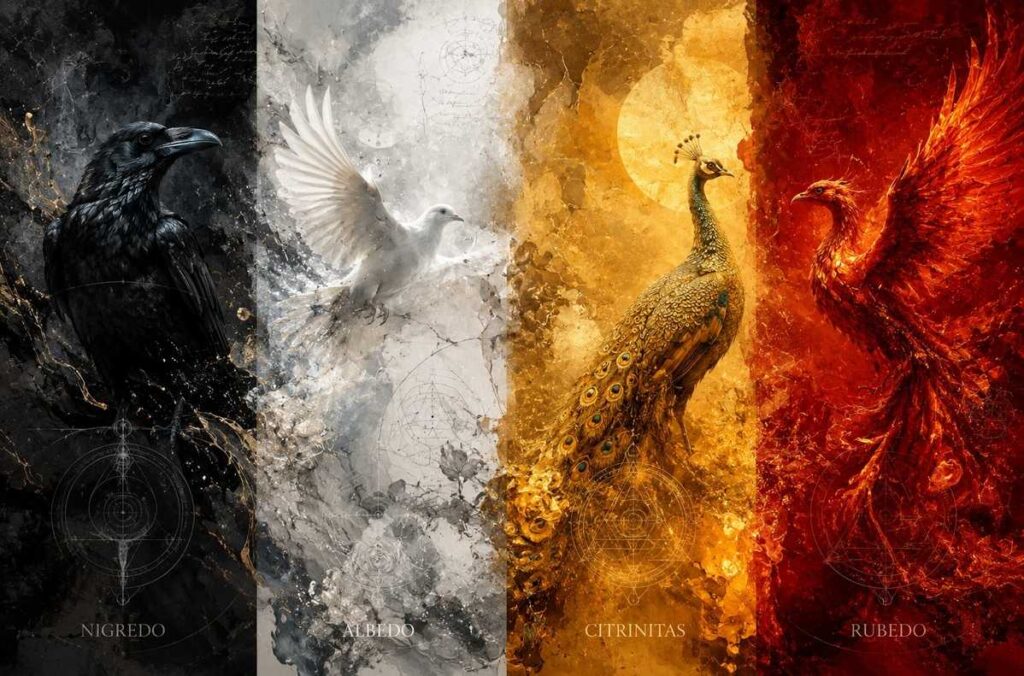
Traditional alchemy describes the Great Work in four primary stages, each associated with a colour and a distinct psychological state. These stages appear in the earliest extant alchemical texts, including the Physika kai Mystika attributed to Pseudo-Democritus and the writings of Zosimus of Panopolis, who recorded that these colours were known to Mary the Jewess, a pioneering figure in the tradition. The four stages are not linear checkpoints but cyclical phases through which the practitioner spirals repeatedly, each circuit refining the work further.
Nigredo (Blackening)
The first stage, associated with the colour black and the symbol of the raven or crow, represents the death of the old self. This is the experience of the “dark night of the soul,” the confrontation with the shadow, the recognition of one’s limitations, illusions, and unconscious patterns. Without this death, transformation cannot occur. The vessel must be emptied before it can be filled with new wine. In laboratory terms, nigredo manifests as putrefaction, calcination, and decay–the blackening of matter through fire or decomposition. Psychologically, it is the collapse of meaning systems, the shattering of comfortable self-images, and the painful emergence of repressed material into awareness.
Albedo (Whitening)
Following the blackening comes the whitening, associated with the colour white and the symbol of the dove or swan. This is the stage of purification, the washing away of impurities, the emergence of clarity after the darkness. The soul, having confronted its shadow, begins to recognise its true nature beneath the accumulated debris of conditioning. Albedo corresponds to the moment when unconscious contents are brought to light, when the fog begins to lift and the outline of what is becomes visible beneath the ruins of what was. The alchemists described this as the albedo tincture–a white elixir that purifies but does not yet perfect.
Citrinitas (Yellowing)
The yellowing or golden stage, associated with the peacock and the dawn of solar light, represents the dawning of wisdom, the integration of insight, and the development of spiritual maturity. This stage, sometimes omitted in post-15th-century texts (where it was frequently merged into rubedo), represents the consolidation of gains and the embodiment of understanding. Citrinitas is the philosophical dawn–the moment when new archetypes and energies emerge and the practitioner begins to perceive the world through transmuted eyes. It is delicate; the insights are fresh, and old habits still beckon. Yet the light has been seen, and it cannot be entirely forgotten.
Rubedo (Reddening)
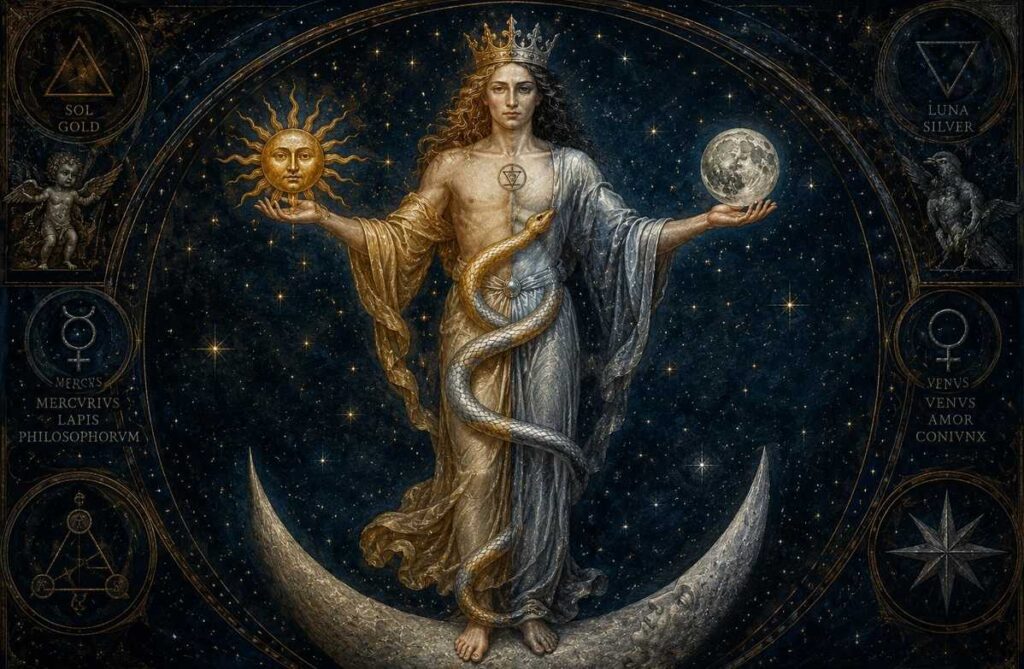
The final stage, associated with the colour red and the symbols of the phoenix and the red lion, represents the completion of the work–the philosopher’s stone, the alchemical gold, the fully realised self. This is not escape from the world but transformation within it. Rubedo is the coniunctio, the sacred marriage of opposites, the union of heaven and earth, masculine and feminine, conscious and unconscious. The alchemists called the resulting entity the rebis–a hermaphroditic figure standing upon the crescent moon, crowned with gold and silver, holding the sun in one hand and the moon in the other. The work is complete when the stone is both fixed and volatile–stable enough to endure, fluid enough to adapt.
The Seven Operations Unfolded
The four stages can be further elaborated into seven operations, each representing a specific phase of the transformative process. While different traditions enumerate these operations with slight variations, the standard septenary recognised across Western esotericism is: Calcination, Dissolution, Separation, Conjunction, Fermentation, Distillation, and Coagulation. These seven do not map neatly one-to-one onto the four colours; rather, they describe the technical sequence by which the prima materia is progressively purified and elevated.
1. Calcination (Calcinatio)
Element: Fire
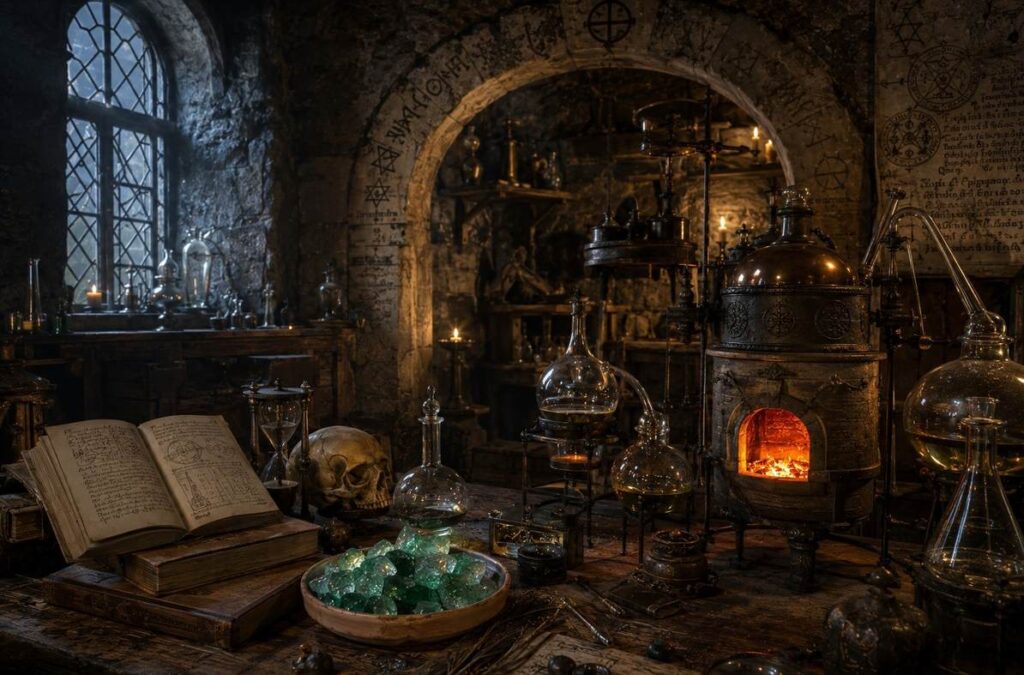
Calcination is the first operation, corresponding to the nigredo stage. The term refers to the heating of a substance until it is reduced to ash–the breaking down of existing structures through the fire of awareness. Psychologically, this is the burning away of ego, the recognition of one’s illusions, the shattering of comfortable self-images. In practice, calcination occurs through experiences that challenge our fundamental assumptions: crisis, loss, failure, the collapse of meaning systems we have relied upon. It is uncomfortable, even terrifying, but necessary. The fire that burns is the fire of truth, and only by enduring it can we be purified. The alchemists performed calcination in the athanor, a furnace designed to maintain steady, controlled heat–a reminder that the fire of transformation must be sustained, not explosive.
2. Dissolution (Solutio)
Element: Water
Following calcination comes dissolution–the dissolving of the calcined material in water. Where calcination was dry and fiery, dissolution is wet and fluid. The rigid structures broken by fire are now dissolved, allowing the substance to flow, to become permeable, to enter new combinations. Psychologically, dissolution is the processing of emotions, the allowing of feeling to flow rather than be dammed up or denied. It is the dissolution of boundaries, the opening to the unconscious, the willingness to not know, to be in the chaos that precedes new order. The alchemists dissolved ashes in mercury–the universal solvent–symbolising the need for a fluid, adaptable consciousness to receive transformation.
3. Separation (Separatio)
Element: Air
Separation is the discernment of truth from falsehood, the cutting away of what does not belong, the discrimination between the essential and the inessential. The alchemical sword separates the pure from the impure, the gold from the dross. Psychologically, this is the development of discernment–the capacity to distinguish between authentic insight and spiritual inflation, between genuine shadow material and mere mood. Separation requires clarity, and clarity is only possible after the washing of albedo. Without this operation, the practitioner risks carrying forward the very impurities that calcination was meant to destroy.
4. Conjunction (Coniunctio)
Element: Earth
Conjunction is the gathering together of purified elements into a new synthesis. After separation, the scattered components must be recombined. This is the stage of grounding, of embodiment, of making real what has been discovered. Psychologically, conjunction is the integration of insights into daily life, the establishment of new habits and structures that support the transformed self. The alchemists performed conjunction in the philosophical egg–a sealed vessel in which opposites could unite without escaping. The symbol is the chymical wedding, the marriage of Sol and Luna, King and Queen, sulphur and mercury.
5. Fermentation (Fermentatio)
Element: Spirit
Fermentation is the introduction of the ferment–a catalytic agent that transforms the conjunction into something alive. In the laboratory, this is the stage where matter begins to bubble, rise, and breathe, animated by an invisible spirit. Psychologically, fermentation is the awakening of the higher self, the infusion of spiritual energy into the integrated personality, the moment when the work becomes autonomous and self-sustaining. It is the descent of grace, the arrival of the anima mundi into the personal vessel. The alchemists associated this stage with the peacock’s tail–the iridescent display of colours that signals the presence of the living spirit within matter.
6. Distillation (Distillatio)
Element: Purity
Distillation is the repeated purification of the fermented substance by vaporising it and allowing it to condense in a purer form. The impure elements remain in the vessel below; the pure rises to the alembic above. This operation is performed again and again, each cycle producing a more refined tincture. Psychologically, distillation is the capacity to see one’s issues and patterns from a higher vantage point, to not be completely identified with them, to hold them in perspective. It is the refinement of consciousness through repeated practice, meditation, and self-examination. The alchemists knew that one distillation is never enough; the work must be cycled until the tincture is incorruptible.
7. Coagulation (Coagulatio)
Element: Stone
Coagulation is the final operation, the solidification of the distilled spirit into a permanent, incorruptible body. This is the philosopher’s stone–fixed, dense, and yet capable of transmuting whatever it touches. Psychologically, coagulation is the full embodiment of realisation, the point at which insight has become substance, when the transformed self is stable enough to endure the pressures of the world without reverting to old patterns. The stone is both medicine and poison–it heals the sick and destroys the impure. In the same way, the fully integrated self does not merely survive; it transforms every environment it enters.
Jung and the Psychology of Alchemy
Carl Gustav Jung, the Swiss founder of analytical psychology, devoted three volumes of his Collected Works to the study of alchemy, convinced that the alchemists were unwittingly projecting their inner psychic dramas onto their laboratory vessels. For Jung, the Magnum Opus was a symbolic representation of individuation–the process by which the psyche moves toward wholeness by integrating unconscious contents into conscious awareness.
Jung mapped the four alchemical stages onto his model of psychological development. Nigredo corresponded to the confrontation with the shadow–the disowned aspects of the personality that must be acknowledged before growth can occur. Albedo represented the integration of the anima or animus–the contrasexual soul image that enlivens the psyche and connects it to the collective unconscious. Citrinitas marked the emergence of the wise old man or wise woman archetype–the inner guide that directs the work toward completion. Rubedo signified the realisation of the Self archetype, the totality of the conscious and unconscious psyche, which Jung described as a lapis invisibilitatis, a stone of invisibility that transcends egoic identification.
Jung also applied the four stages to the psychoanalytic process, renaming them Confession (Nigredo), Elucidation (Albedo), Education (Citrinitas), and Transformation (Rubedo). These stages, he insisted, were not linear but spiralic–each circuit of the process refining the personality further, each return to darkness illuminated by the light already integrated. As Jung wrote in Memories, Dreams, Reflections, “Only after I had familiarized myself with alchemy did I realize that the unconscious is a process, and that the psyche is transformed or developed by the relationship of the ego to the contents of the unconscious.”
Cross-Cultural Parallels
The logic of solve et coagula is not unique to the Western Hermetic tradition. Comparable maps of inner transformation appear across cultures, suggesting that the structure of consciousness change is universal even when the symbols differ.
Taoist Internal Alchemy (Neidan)
In Chinese neidan, the practitioner works with jing (essence), qi (energy), and shen (spirit)–roughly analogous to body, vitality, and consciousness. The process involves refining jing into qi, qi into shen, and shen into xu (emptiness). This is a solve et coagula in Eastern dress: the dissolution of ordinary bodily fixation into energy, the coagulation of energy into spiritual substance, and the final dissolution of spirit into the Tao itself.
Tantric Rasayana
In Indian alchemical traditions, rasayana (the path of mercury and mineral elixirs) parallels the Western Magnum Opus. The practitioner refines mercury through successive stages of killing and reviving it–dissolving its ordinary toxicity and reconstituting it as a life-giving ras (essence). The body becomes the laboratory; the senses become the retorts; the bindu (drop) becomes the stone.
The Sufi Path of Polishing the Heart
The Sufi mystics speak of tasawwuf as the polishing of the heart–removing the rust (zang) of worldly attachment to reveal the mirror of divine reflection. The stages of nafs (ego) refinement–from the commanding self to the inspired self–mirror the alchemical progression from lead to gold. The dhikr (remembrance) is the fire; the shaykh is the vessel; the fana (annihilation) and baqa (subsistence) are the solve and coagula of Islamic mysticism.
The Alchemical Attitude in Contemporary Life
Spiritual alchemy is not merely a historical curiosity but a living tradition, a map for transformation that remains relevant in the contemporary world. The stages described are not merely theoretical but observable in the process of psychotherapy, spiritual practice, and personal growth. The key is the alchemical attitude: the recognition that all experience, even the most difficult, is material for transformation. The lead of suffering can become the gold of wisdom. The darkness of the nigredo is not failure but necessary preparation. The work proceeds through cycles of dissolution and coagulation, breakdown and breakthrough, until the stone is perfected.
In an age of spiritual bypassing and quick-fix transcendence, alchemy offers a sobering corrective. There is no shortcut around calcination. There is no app for dissolution. The stone is earned through repeated cycling of the operations, through the willingness to remain in the fire until the work is complete. The alchemists knew that ars longa, vita brevis–art is long, life is short. Yet they also knew that the stone, once achieved, transmutes not only the practitioner but everything it touches.

Frequently Asked Questions
What does solve et coagula mean in spiritual alchemy?
Solve et coagula is a Latin alchemical motto meaning dissolve and coagulate. It describes the essential rhythm of inner transformation: breaking down old psychological structures (solve) and reconstituting them into a more integrated whole (coagula). The process repeats cyclically until the philosopher’s stone–symbolising spiritual realisation–is achieved.
What are the four stages of the alchemical Magnum Opus?
The four stages are Nigredo (blackening/death of the old self), Albedo (whitening/purification), Citrinitas (yellowing/dawning of wisdom), and Rubedo (reddening/union and completion). These correspond to the colours observed in laboratory processes and the psychological progression from shadow confrontation to integrated wholeness.
How did Carl Jung interpret alchemical symbolism?
Jung viewed alchemy as a Western proto-psychology describing individuation–the process of becoming whole. He mapped Nigredo to shadow integration, Albedo to anima-animus encounter, Citrinitas to the emergence of the inner teacher, and Rubedo to the realisation of the Self archetype. He considered the stages cyclical rather than linear.
What are the seven operations of alchemy?
The standard seven operations are: Calcination (breaking down by fire), Dissolution (dissolving in water), Separation (discerning pure from impure), Conjunction (recombining purified elements), Fermentation (animating with spirit), Distillation (repeated refinement), and Coagulation (solidifying into the incorruptible stone).
Is spiritual alchemy related to modern psychology?
Yes. The alchemical stages closely parallel processes observed in depth psychology, particularly Jungian analysis and transpersonal psychotherapy. Concepts such as shadow work, ego death, integration, and self-realisation map directly onto the alchemical operations, making the tradition a valuable symbolic framework for contemporary therapeutic practice.
Can alchemical transformation occur without a teacher or tradition?
While traditional alchemy was transmitted through lineages and guided practice, the psychological principles of solve et coagula are accessible through disciplined self-examination, contemplative practice, and–where necessary–therapeutic support. The tradition itself warns that the work is dangerous without proper preparation, suggesting that guidance is advisable but not always mandatory.
What is the philosopher’s stone in psychological terms?
In psychological terms, the philosopher’s stone represents the realised Self–a state of integrated wholeness where conscious and unconscious contents are reconciled. It is not a static achievement but a dynamic condition of balance, resilience, and creative authenticity that continues to deepen through ongoing inner work.
Further Reading
- Shadow Work: Meeting the Disowned Self — Explores the nigredo stage of confronting unconscious material and integrating the shadow.
- Spiritual Emergency and the Transformation Crisis — Examines the dark night of the soul and the containment necessary during alchemical breakdown.
- The Stages of Integration: Immediate, Short-Term, and Long-Term — Maps the coagulation phase onto practical grounding after peak experiences.
- The Abyss in Three Traditions: Kabbalah, Alchemy, and Buddhism — Compares the dissolution stage across Western and Eastern esoteric frameworks.
- The Alchemical Couple: Gnosis in the Mirror of Relationship — Investigates the coniunctio oppositorum and the sacred marriage of Sol and Luna.
- Hermeticism, Gnosticism, and Egyptian Wisdom — Traces the lineage of alchemical thought from Alexandria to the medieval scriptoria.
- The Emerald Tablet: Hermetic Foundation and Correspondence — Examines the core Hermetic axiom “as above, so below” that underpins all alchemical operation.
- Against Spiritual Bypassing: The Refusal to Feel — A necessary corrective for those who would skip calcination and rush toward false rubedo.
- Embodiment Practices: Grounding the Awakening — Practical methods for the coagulation stage, ensuring insight becomes substance.
- Esoteric Lineages: The Subterranean Currents of Western Wisdom — Situates alchemy within the broader map of Western inner traditions.
References and Sources
The following sources represent the primary scholarly, psychological, and esoteric materials consulted in the preparation of this article.
Primary Alchemical Texts and Critical Editions
- Anonymous. (c. 1550). Rosarium Philosophorum. Frankfurt edition.
- Pseudo-Democritus. (1st–3rd c. CE). Physika kai Mystika. In M. Berthelot, Collection des Anciens Alchimistes Grecs (1888). Paris: Steinheil.
- Zosimus of Panopolis. (c. 300 CE). On Apparatus and Furnaces. In F. Sherwood Taylor, “The Alchemical Works of Zosimos,” Ambix (1937).
- Paracelsus. (c. 1530). Aurora of the Philosophers (De Philosophia Occulta).
Psychological and Scholarly Monographs
- Jung, C. G. (1968). Psychology and Alchemy (Collected Works, Vol. 12). Princeton University Press.
- Jung, C. G. (1967). Alchemical Studies (Collected Works, Vol. 13). Princeton University Press.
- Jung, C. G. (1970). Mysterium Coniunctionis (Collected Works, Vol. 14). Princeton University Press.
- Jung, C. G. (1963). Memories, Dreams, Reflections. Edited by A. Jaffe. Pantheon Books.
- Edinger, E. F. (1994). Anatomy of the Psyche: Alchemical Symbolism in Psychotherapy. Open Court.
- Johnson, R. A. (1989). Inner Work: Using Dreams and Active Imagination for Personal Growth. Harper & Row.
Comparative and Esoteric Studies
- Aromatico, A. (2000). Alchemy: The Great Secret. Harry N. Abrams.
- Komjathy, L. (2014). The Way of Complete Perfection: A Quanzhen Daoist Anthology. SUNY Press.
- White, D. G. (1996). The Alchemical Body: Siddha Traditions in Medieval India. University of Chicago Press.
- Chittick, W. C. (1989). The Sufi Path of Knowledge: Ibn al-Arabi’s Metaphysics of Imagination. SUNY Press.
Safety Notice: This article explores intense psychological and spiritual transformation processes that can destabilise ordinary functioning. It does not constitute medical, psychological, or spiritual advice. If you are experiencing crisis, dissociation, or the collapse of meaning systems that endangers your wellbeing, please contact professional emergency services or a trauma-informed therapist. Inner alchemical work complements but does not replace clinical mental health treatment. Do not attempt advanced contemplative or energetic practices without adequate preparation, support, and grounding.