
The Body as Borderland: Somatic Sovereignty and the Politics of the Flesh
The last unconquered territory is the body. Not the body as object–poked, prodded, optimised, and displayed–but the body as subject, the seat of indigenous knowing that refuses translation into data. The medical-industrial complex wants your body as territory; the wellness industry wants it as product; the gaze of the other wants it as sign. Everyone wants a piece, and you have been trained to apologise for its needs, to modify its appearance, to distrust its signals.
Somatic sovereignty is the radical claim that your body is not a democracy. It does not require a vote from the culture, permission from the expert, or validation from the mirror. It is the absolute monarchy of the flesh, and you are–finally–the sovereign.
Table of Contents
- The Final Colony
- The Occupation: How the Body Became Territory
- The Gnostic Flesh: Scholarship Against Polemic
- The Architecture of Reclamation
- Somatic Practices for Sovereignty
- Frequently Asked Questions
- Further Reading
- References and Sources
The Final Colony
Every empire expands until it reaches the body. The colonisation of land precedes the colonisation of labour; the colonisation of labour precedes the colonisation of consciousness; and the colonisation of consciousness, when complete, turns inward to colonise the flesh itself. This is the final frontier–not outer space, not the deep sea, but the somatic interior: the felt sense of being alive that cannot be outsourced, gamified, or monetised without remainder.
The body is the last colony because it is the most resistant to abstraction. You can sell an idea, automate a process, and digitise a relationship, but you cannot upload hunger. The body insists. It aches, it craves, it exhausts, it pleasures–and in doing so, it disrupts the smooth operation of the productivity machine. The machine’s response has been sophisticated: not to destroy the body, but to manage it. To render it docile through fitness trackers, calorie counters, posture correctors, and sleep optimisers. The body becomes a project, and the self becomes the project’s manager. Sovereignty is lost not through violence but through instrumentalisation.

The Occupation: How the Body Became Territory
To reclaim the body, one must first understand how it was lost. The occupation is not single-handed; it operates through multiple, overlapping jurisdictions, each claiming authority over a different district of the somatic realm.
The Medical-Industrial Complex
Modern medicine has achieved extraordinary feats: antibiotics, surgery, emergency intervention. But its shadow side is pathologisation–the translation of ordinary somatic experience into diagnostic categories that require professional management. Fatigue becomes chronic fatigue syndrome; sadness becomes depression; restlessness becomes ADHD. Each translation strips the symptom of its meaning and renders it as mere malfunction. The body is no longer a text to be read but a machine to be repaired. The patient becomes a passive recipient of expertise, and the body’s own intelligence–its capacity to signal, adapt, and heal–is delegitimised in favour of the practitioner’s authority.
This is not a conspiracy but a structure. The medical-industrial complex profits from chronic management, not from cure. The body that heals itself is a body that stops consuming services. The body that trusts its own signals is a body that resists the treadmill of screening, testing, and pharmaceutical intervention. Somatic sovereignty does not reject medicine; it rejects medicalisation–the expansion of clinical authority into domains where lived experience should remain primary.
The Wellness Industry
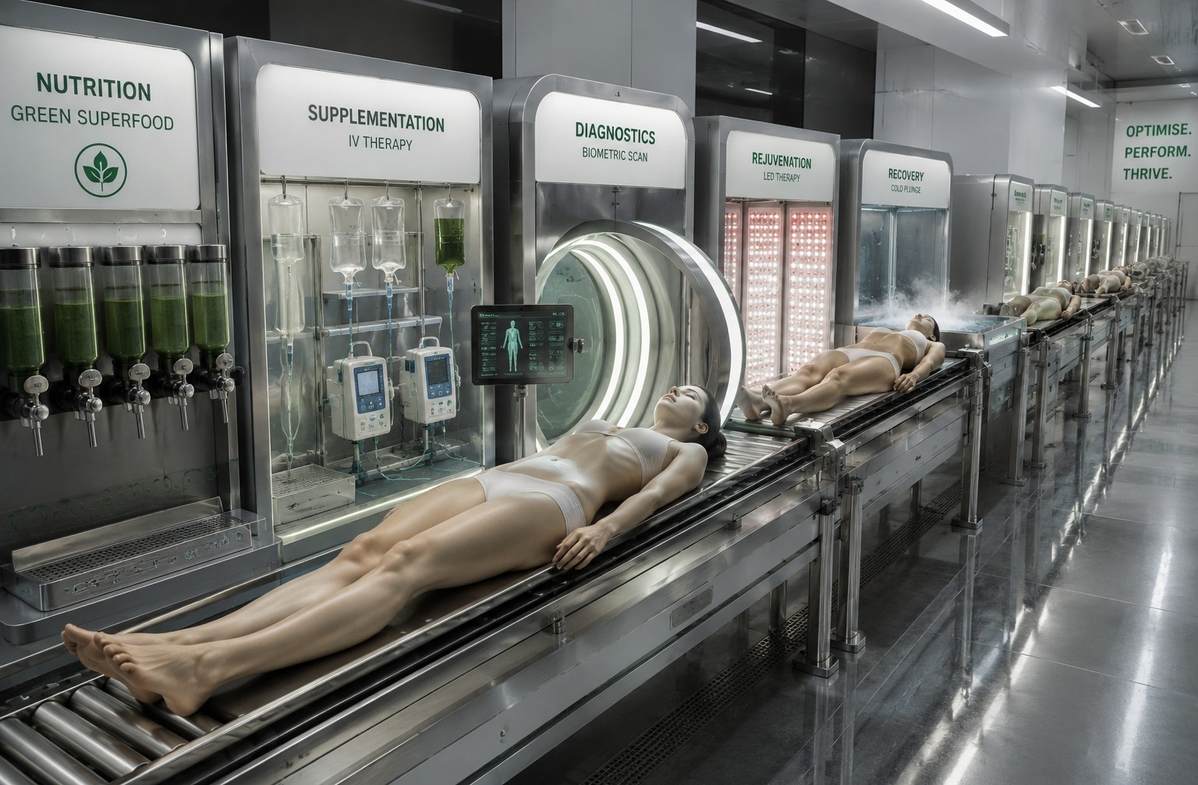
If medicine colonises the body through pathologisation, wellness colonises it through optimisation. The wellness industry does not want you sick; it wants you better. Better skin, better sleep, better gut microbiome, better mitochondrial efficiency. The body becomes a startup, and you are the CEO tasked with maximising its output. Green smoothies, adaptogenic mushrooms, cold plunges, and biohacking protocols–each promises enhanced performance. The promise is not false; the frame is. The frame says: your body is not enough. It must be upgraded. It must be optimised. It must be improved.
The wellness industry is the medical-industrial complex in yoga pants. Both operate on the same assumption: the body is a problem to be solved. Somatic sovereignty rejects the problem-frame entirely. The body is not a project; it is a presence. It does not need optimisation; it needs attention. The attention that asks “what do you need?” rather than “how can I fix you?”
The Gaze of the Other
Before medicine and wellness, there is the gaze. The simplest and oldest coloniser: the look that evaluates, compares, and ranks. The body as billboard–for virtue, for attractiveness, for discipline. The gaze operates through shame, the most efficient and cheapest form of social control. Shame requires no police, no prison, no legislation. It only requires a mirror and an internalised observer.
The archons extract through shame; sovereignty reclines in the unapologetic. To reclaim the body from the gaze is not to declare it beautiful–that is merely to win the beauty contest on different terms. It is to declare it irrelevant to the contest. The body is not a sign. It does not signify virtue or vice, discipline or laziness, success or failure. It signifies nothing. It simply is.
The Gnostic Flesh: Scholarship Against Polemic
The Gnostic tradition has been falsely accused of hating the body. The accusation is ancient–originating with orthodox heresiologists such as Irenaeus of Lyon, who polemically depicted Gnostic groups as either extreme ascetics or libertine antinomians, both positions allegedly demonstrating contempt for the flesh. For centuries, this caricature dominated. Gnosticism became synonymous with world-negation, body-denial, and escape from matter.
Recent scholarship has dismantled this narrative. Michael Allen Williams, in Rethinking “Gnosticism” (1996), and Karen King, in What Is Gnosticism? (2003), have demonstrated that the category “Gnosticism” itself is a modern scholarly construct imposed on diverse texts that resist homogenisation. David Brakke, in The Gnostics (2010), notes that while some Nag Hammadi texts describe the body as a “prison” or “garment,” others–particularly Valentinian texts–express far more nuanced views. The Gospel of Philip declares: “What is innermost [in a person] is the Fullness (Pleroma).” The body, in this view, is not the enemy but the frontier–the place where the divine fullness touches the material void (kenoma).
The truth is more subtle than either polemic or apologetic. Some Gnostic texts do describe the body negatively–as “corpse,” “prison,” or “tunic of skin.” The Apocryphon of John portrays the archons fashioning Adam’s body from inert matter and breathing only a counterfeit soul into it. Yet even here, the body is not evil; it is ignorant. It does not know its true origin. The Gnostic task is not to destroy the body but to inform it–to bring gnosis into the flesh so that the spark, trapped but not extinguished, may recognise itself.
The body is not the prison; the concept of the body as enemy is the prison.
When you inhabit your flesh without apology, when you refuse the medicalisation of your moods and the commodification of your appearance, you perform the most radical act of sovereignty available to an incarnate being. You become ungovernable, because the ultimate seat of power–the biological ground–has been reclaimed.

The Architecture of Reclamation
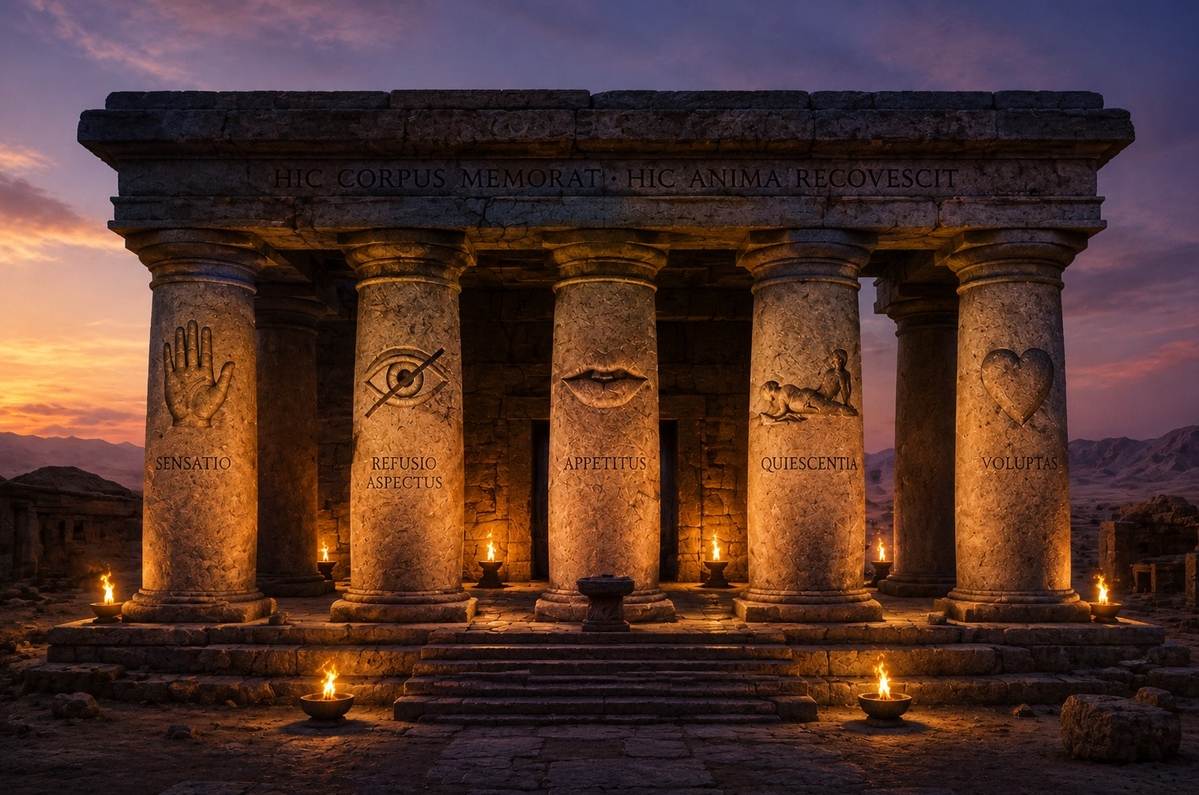
Reclaiming the body is not a single act but an architecture–a structure of practices, refusals, and recognitions that, together, restore sovereignty. The following five pillars form the foundation.
1. The Recovery of Sensation
Begin with the subversive act of feeling. Not interpreting, not managing, not optimising–just feeling. The itch, the ache, the flutter, the heat. These are not symptoms to be cured but communiques from an occupied territory demanding to be heard. The body speaks in metaphor because it is poetry, not machine code.
The recovery of sensation requires what Eugene Gendlin called felt sense: the direct, pre-verbal awareness of bodily experience. Most adults have lost this capacity. They feel only what is loud enough to demand attention–pain, nausea, exhaustion–while the subtle orchestra of ordinary sensation plays unheard. The practice is simple: sit quietly, scan the body, and wait. Do not name. Do not judge. Do not fix. Simply attend. The body, attended to, begins to speak more clearly. The signals that were drowned out by noise emerge. The map of the somatic territory becomes legible again.
2. The Refusal of the Gaze
Your body is not a billboard for your virtue, your attractiveness, or your discipline. Dress it, move it, feed it according to its own pleasure and function, not according to the algorithmic fashion feed or the medical consensus. The refusal of the gaze is not a performance of ugliness or a rejection of aesthetics; it is the simple recognition that the body’s purpose is not to be looked at.
This refusal is difficult because the gaze is internalised. Even when alone, you see yourself through the eyes of others. The practice is to inhabit spaces–rooms, streets, nature–without the reflexive posture of display. To walk as if unobserved. To eat as if unphotographed. To rest as if unjudged. The body, freed from performance, reveals its own preferences. It wants movement or stillness, solitude or contact, heat or cold. These preferences are not moral; they are somatic. They require no justification.
3. The Autonomy of Appetite
Eat what the body craves, not what the doctrine dictates. The current moment worships at the altar of “clean eating”–a puritanical obsession that conflates morality with digestion. Your body knows what it needs; it has been eating for millennia without the advice of influencers. Trust the gut, literally.
The autonomy of appetite does not mean indulgence without consequence. It means listening. The body that craves salt may be electrolyte-depleted. The body that craves fat may be hormonally stressed. The body that rejects a food may be signalling intolerance. These are not failures of willpower; they are intelligence. The clean-eating doctrine treats the body as a sinner to be purified; somatic sovereignty treats it as a sage to be consulted. The difference is the difference between colonisation and conversation.
4. The Sacred Exhaustion
Rest without guilt. The productivity ethic demands the body be a perpetual motion machine; sovereignty recognises the cyclical–the winter of the organism, the necessary . To be tired is not a failure; it is intelligence. The body that refuses to accelerate is not lazy; it is wise. It knows what the mind denies: that rest is not the absence of work but the condition for work that matters.
The sacred exhaustion is particularly revolutionary in a culture that monetises attention and pathologises slowness. Burnout is not a personal failing; it is a structural wound inflicted by a system that extracts more than it replenishes. To rest deliberately, to nap without apology, to decline the invitation because the body says no–these are acts of resistance. They say: my flesh is not your resource.
5. The Reclamation of Pleasure
Pleasure is the body’s native language, and it has been censored. The culture permits pleasure only when it is earned, measured, or productive–the runner’s high, the post-workout endorphin rush, the “cheat day” dessert. Unearned pleasure, pleasure for its own sake, pleasure that leads nowhere and produces nothing, is treated with suspicion. It is “indulgent,” “decadent,” or “escapist.”
Somatic sovereignty reclaims pleasure as sovereign right. The pleasure of warm water on skin, of sunlight through closed eyelids, of a full breath after hours of shallow breathing–these are not luxuries. They are the body’s due. The Gnostic Gospel of Philip speaks of the bridal chamber (nymphon) as the place of restoration, where the separated are reunited. Pleasure, in this light, is not sin but reunion–the self returning to the self through the door of sensation.
Somatic Practices for Sovereignty
Theory without practice is merely opinion. The following practices translate the architecture of reclamation into daily action. They require no equipment, no subscription, and no guru. They require only the willingness to be present in the flesh.
Body Scan and Interoceptive Tuning
Lie down, close your eyes, and move attention slowly through the body–toes to crown. Do not seek relaxation; seek information. What is tight? What is numb? What is shouting? What is whispering? The body scan is not a relaxation technique; it is a diplomatic mission to an occupied territory. Do it daily. The territory begins to trust the ambassador.
Movement Without Objective
Dance, stretch, walk, shake–not for fitness, not for calories, not for Tiktok. Move because the body asks to move. Let the movement be ugly, inefficient, and unphotogenic. The body that moves for its own pleasure is the body that remembers it is alive. The fitness industry has turned movement into labour; sovereignty turns it back into play.
The Unapologetic Meal
Eat one meal per week in complete silence, with no screens, no books, no conversation. Taste every bite. Notice when the body says “enough.” Most people eat until the plate is empty, not until the body is satisfied. The unapologetic meal restores the body’s veto power over the culture’s portion sizes.
Rest as Ritual
Schedule rest as you schedule work. Not as “downtime” or “recovery”–as sovereign time. The body that rests deliberately is the body that refuses to be extracted from. Lie on the earth. Nap in daylight. Stare at clouds. These are not wastes of time; they are investments in autonomy.
Pleasure Mapping
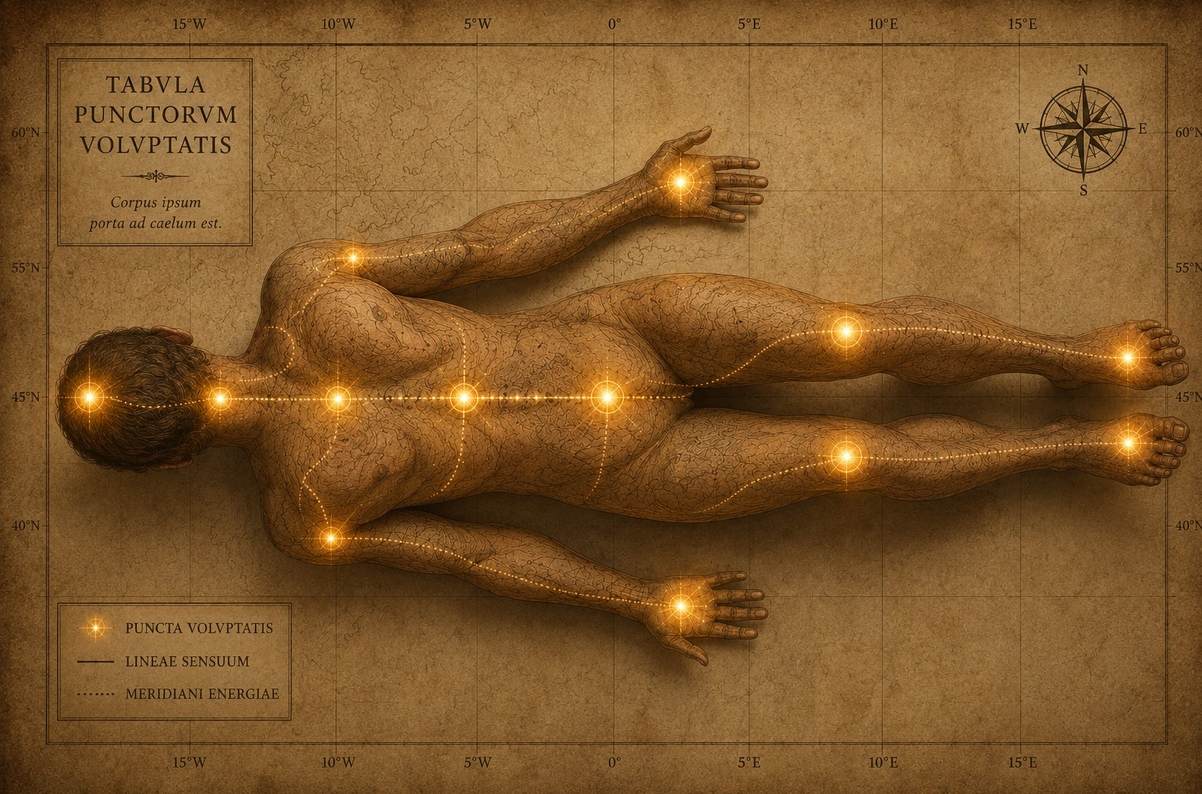
Make a list of ten pleasures that require no purchase, no preparation, and no permission. Warm water on wrists. Bare feet on grass. The smell of rain. The stretch of a yawn. Keep the list visible. When the culture tells you to produce, consult the list and receive instead. The body that receives is the body that knows it is not a machine.
Frequently Asked Questions
What is somatic sovereignty and why does it matter?
Somatic sovereignty is the recognition that your body is the primary seat of authority over its own needs, sensations, and boundaries. It matters because modern culture–through medicine, wellness, and social media–has colonised the body, treating it as territory to be managed, optimised, or displayed rather than as a subject with its own intelligence. Reclaiming somatic sovereignty restores the body’s veto power over external demands and reconnects you with the indigenous knowing of the flesh.
Did the Gnostics really hate the body?
No–this is a polemical oversimplification. While some Nag Hammadi texts describe the body as a prison or garment, recent scholarship by Michael Allen Williams, Karen King, and David Brakke has challenged the ‘Gnostics hated the body’ narrative as a construct of orthodox heresiologists. Valentinian texts and the Gospel of Philip present more nuanced views, describing the body as the frontier where the divine pleroma touches the material kenoma. The Gnostic task was not to escape the body but to bring gnosis–recognitional knowledge–into it.
How is the wellness industry different from the medical-industrial complex?
The medical-industrial complex colonises the body through pathologisation–translating ordinary experience into diagnostic categories that require professional management. The wellness industry colonises through optimisation–treating the body as a startup to be upgraded for better performance. Both assume the body is a problem to be solved. Somatic sovereignty rejects both frames, treating the body as a presence to be attended to rather than a project to be completed.
What are practical steps to reclaim somatic sovereignty?
Five foundational practices: (1) Recovery of sensation through body scanning and interoceptive tuning; (2) Refusal of the gaze by moving, dressing, and eating according to bodily pleasure rather than external validation; (3) Autonomy of appetite by listening to cravings and satiety signals instead of dietary doctrines; (4) Sacred exhaustion by resting without guilt and refusing the productivity ethic; (5) Reclamation of pleasure by receiving unearned, unmeasured bodily delight as a sovereign right.
Can somatic sovereignty coexist with medical treatment?
Yes. Somatic sovereignty does not reject medicine; it rejects medicalisation–the expansion of clinical authority into domains where lived experience should remain primary. Emergency medicine, surgery, and pharmaceutical intervention save lives. The distinction lies in who holds final authority: the practitioner or the patient. Sovereignty means the body is consulted, not merely managed. It means symptoms are read as meaningful signals, not just as malfunctions to be suppressed.
What is the connection between somatic sovereignty and trauma recovery?
Trauma is fundamentally a somatic wound–not merely a memory but a disruption of the body’s autonomic and sensory systems. Reclaiming somatic sovereignty is therefore central to trauma recovery. Practices such as body scanning, interoceptive awareness, and movement without objective help the nervous system complete interrupted defensive responses. However, severe trauma may require professional support. Somatic practices complement but do not replace trauma-informed therapy.
How does the ‘clean eating’ movement relate to somatic colonisation?
Clean eating colonises the body by conflating morality with digestion. It treats certain foods as ‘pure’ and others as ‘sinful,’ imposing a theological framework on appetite. The body that craves ‘forbidden’ food is shamed; the body that follows the doctrine is praised. Somatic sovereignty replaces this moral frame with a conversational one: the body is consulted, not condemned. Cravings are read as intelligence, not weakness. The gut is trusted as an advisor, not punished as a sinner.
Safety Notice: This article explores somatic practices, body awareness, and trauma-related themes. It does not constitute medical, psychological, or nutritional advice. If you have a diagnosed medical condition, eating disorder, or history of severe trauma, please consult a qualified healthcare professional before making significant changes to your diet, movement, or rest patterns. The practices described here are complementary and do not replace clinical treatment. If you are experiencing an eating disorder or medical emergency, contact emergency services or a specialist immediately.
Further Reading
- Embodiment Practices for Grounding: Why Awakening Needs a Body — The somatic foundation for spiritual practice and the necessity of embodiment in awakening work.
- Integration and Grounding After Mystical Experience — Stabilising in the flesh after non-ordinary states and the somatic completion of spiritual opening.
- The Body Against the Algorithm: Reclaiming Embodiment in a Disembodied Age — How digital culture severs the mind from the flesh and strategies for somatic resistance.
- Nervous System Regulation: The New Meditation — Bottom-up physiological practices that reshape trauma, stress, and spiritual capacity through the body.
- Against Spiritual Bypassing: The Refusal to Feel — Why bypassing the body in favour of transcendence is a form of somatic colonisation.
- The Somatic Sacrament: Embodied Sexuality as Gnostic Practice — The body as bridal chamber and the reclamation of pleasure through the lens of the Gospel of Philip.
- The Gateway of Sensation: Body Scan and Somatic Awareness — Systematic protocols for interoceptive tuning and the recovery of embodied sensation.
- Return to Ordinary Life After Awakening — The challenge of bringing expanded consciousness back into the body and daily existence.
- The Ordinary Saint: Invisibility and Completion — How embodied presence in ordinary life becomes the final expression of spiritual maturity.
- Community in Integration: Solitary vs. Supported Paths — The role of embodied community and solitary practice in stabilising transformation.
References and Sources
The following sources informed the theological, philosophical, and practical claims in this article. They are grouped by category for clarity.
Primary Sources and Critical Editions
- Robinson, J. M. (Ed.). (1990). The Nag Hammadi Library in English. HarperSanFrancisco. (Standard critical edition, including the Gospel of Philip and Apocryphon of John.)
- Layton, B. (Ed.). (1987). The Gnostic Scriptures. SCM Press. (Critical edition with introduction to Irenaeus’s Against Heresies and Valentinian sources.)
Scholarly Monographs and Critical Studies
- Williams, M. A. (1996). Rethinking “Gnosticism”: An Argument for Dismantling a Dubious Category. Princeton University Press. (Foundational critique of the “Gnosticism” category and the “body-hatred” narrative.)
- King, K. L. (2003). What Is Gnosticism? Harvard University Press. (Critical reassessment of Gnosticism as a scholarly construct and the diversity of ancient texts.)
- Brakke, D. (2010). The Gnostics: Myth, Ritual, and Diversity in Early Christianity. Harvard University Press. (Detailed analysis of Sethian and Valentinian body theology, challenging polemical homogenisation.)
- DeConick, A. D. (2020). The Gnostic New Age: How a Countercultural Spirituality Revolutionized Religion from Antiquity to Today. Columbia University Press. (Comparative analysis of ancient Gnosticism and modern adaptations, including body theology.)
- Gendlin, E. T. (1978). Focusing. Rider. (Development of the “felt sense” concept and interoceptive awareness as therapeutic method.)
Comparative and Philosophical Studies
- Foucault, M. (1975). Discipline and Punish: The Birth of the Prison. Gallimard. (Analysis of the body as territory of biopower and disciplinary control–the theoretical frame underlying the medical-industrial critique.)
- van der Kolk, B. (2014). The Body Keeps the Score: Brain, Mind, and Body in the Healing of Trauma. Viking. (Neurobiological basis of somatic trauma and the necessity of body-based recovery.)
- Levine, P. A. (1997). Waking the Tiger: Healing Trauma. North Atlantic Books. (Somatic experiencing and the completion of interrupted defensive responses in the body.)