
The Enochian Cipher: Occult Cryptography and the Language of Angels
Among the many curiosities that occupy the attic of Western esotericism, few possess the peculiar resonance of Enochian. This is not merely a cipher in the conventional sense–no simple substitution of symbol for letter. Rather, it represents something far more ambitious: an attempt to reconstruct the very language spoken by angels to the Patriarch Enoch, that mysterious antediluvian figure who, according to Genesis, “walked with God” and vanished without dying.
What emerged from the candle-lit parlours of Elizabethan England was a system that straddles linguistics, cryptography, and contemplative technology. At ZenithEye, we examine Enochian not as a quaint historical curiosity, but as a case study in how consciousness interfaces with symbol–and how the encryption of perception might serve as both map and key for those navigating the architecture of reality.
Table of Contents
- The Dee Renaissance: Politics, Magic, and the Search for Primordial Speech
- The Reception of the Angelic Tongue
- The Architecture of Enochian
- From the Elizabethan Court to the Golden Dawn
- Cryptography as Contemplative Technology
- The Encryption of Consciousness
- Frequently Asked Questions
- Further Reading
- References and Sources
The Dee Renaissance: Politics, Magic, and the Search for Primordial Speech
Our story begins in the late sixteenth century, at the turbulent intersection of Elizabethan statecraft and Renaissance magic. Dr John Dee (13 July 1527–December 1608 or March 1609) was, by any measure, one of the most learned men of his age. Mathematician, astronomer, astrologer, and consultant to Queen Elizabeth I, he had lectured to crowded halls at the University of Paris in his early twenties and is credited with coining the term “British Empire” in his 1577 work on navigation and maritime expansion.
Yet Dee grew dissatisfied with the limits of natural philosophy. He believed that the wisdom of antiquity–particularly the primordial knowledge possessed by Adam before the Fall–had been fragmented and concealed across centuries of political and religious upheaval. In 1581, he noted in his private journals that God had sent “good angels” to communicate directly with prophets. The following year, he teamed up with Edward Kelley (1555–1597), a seer and scryer of questionable reputation but undeniable visionary capacity, to establish lasting contact with these intelligences.
Their “actions,” as Dee termed the spirit workings, were conducted across years and produced thousands of pages of diary entries. Sessions took place in various Continental locations–Krakow, Prague, Trebon–partly to escape the persecution that angelic magic attracted in England, and partly to secure patronage from European nobility. It was during these sessions that the angels revealed their tongue: not as a gift, precisely, but as a tool–a technology of consciousness that could, in Dee’s view, unlock the doors of perception and predict the fate of nations.
The Reception of the Angelic Tongue
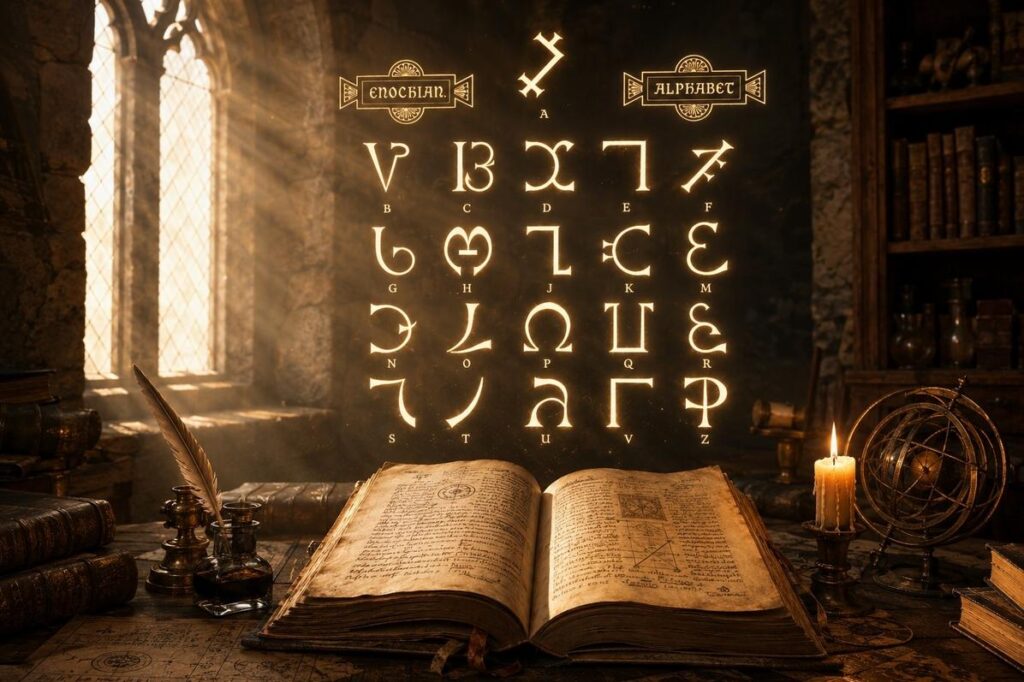
The reception began on 26 March 1583, when Kelley reported visions in the crystal of a 21-letter alphabet. A few days later, the angels began dictating what would become the Liber Loagaeth (“Book of Speech from God”). This text consists of 49 great letter tables, each a 49-by-49 square of letters, filling the recto and verso of 49 leaves. Dee and Kelley maintained that the angels never provided a direct translation of this material; it remained, in their account, a raw celestial database awaiting the proper keys.
Those keys arrived later, during their time in the court of King Stephen Bathory of Poland, in the form of the Claves Angelicae–the 48 Angelic Keys (or Calls). Unlike the Liber Loagaeth, these 48 verses were accompanied by English translations. Dee believed they corresponded to the 49 magic squares and could be used to “open the 49 Gates of Wisdom.” The angels reportedly told them that the complete system would open the gates of heaven and allow direct communion with the Divine.
Dee referred to the language as “Adamical” because he believed it was the original tongue spoken in the Garden of Eden before the confusion of Babel. He further claimed it was the root of Hebrew and, by extension, the world’s oldest language. Modern scholars classify Enochian as an occult constructed language–a system built with deliberate symbolic intent rather than one that evolved organically through human usage. Whether it is “natural” or “invented” may, in the end, be less important than what it does to the consciousness that engages with it.
The Architecture of Enochian
What distinguishes Enochian from the various “angelic alphabets” that populated Renaissance occultism is its startling internal coherence. This is not a random collection of barbarous names; it possesses an alphabet, a phonological system, and a corpus of texts that resist simple dismissal as fraud or automatic writing.
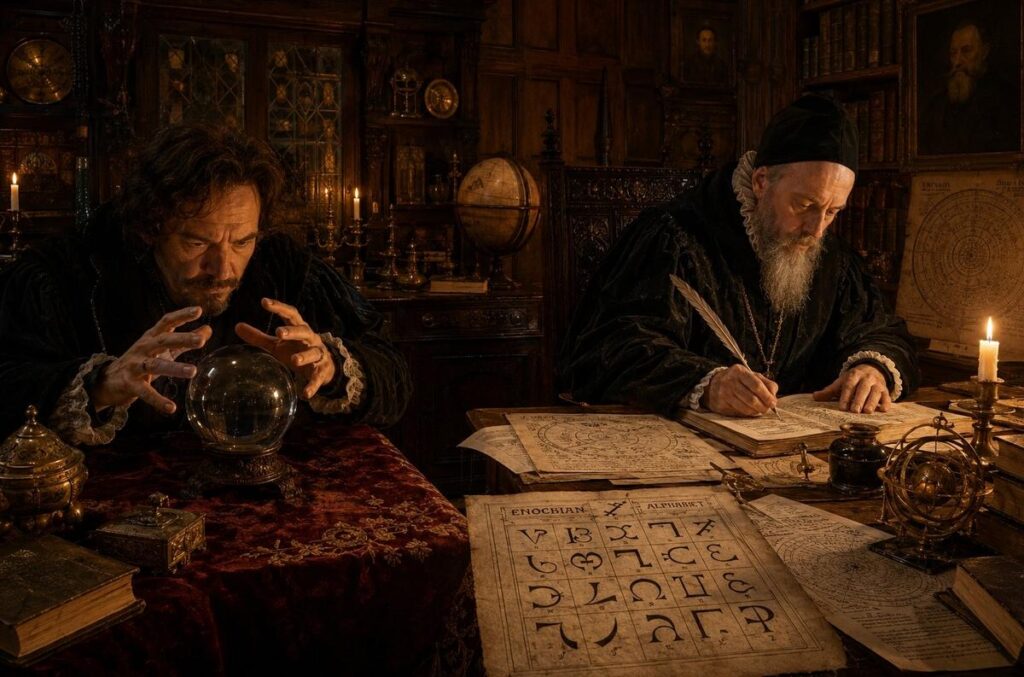
The Adamical Alphabet
The Enochian script comprises 21 letters, each with a specific name: Un, Pa, Veh, Gal, Graph, Or, Ged, Na, Gon, Ur, Tal, Drux, Med, Mals, Ger, Don, Fam, Gisg, Win, Kax, and Van. Dee mapped these onto 22 letters of the English alphabet, treating U and V as positional variants (standard practice in Early Modern English) and omitting J, K, and W. The script was written from right to left in Dee’s diary, and different manuscripts show slight graphical variations.
Each letter carries associations that Dee recorded, though the elemental, planetary, and zodiacal correspondences commonly cited today were largely developed by the Hermetic Order of the Golden Dawn in the late nineteenth century. The original Dee material assigns letter names and English sound equivalents, but stops short of the elaborate kabbalistic mapping that later occultists imposed upon it.
Phonology and the English Connection
Linguist Donald Laycock, who produced the most rigorous academic study of Enochian, demonstrated that its phonology is “thoroughly English” in its underlying structure. The orthography follows Early Modern English conventions: soft and hard C and G, digraphs such as CH, PH, SH, and TH. When mapped to sound, the language “makes it sound much more like English than it looks at first sight.”
Yet this English foundation does not preclude strangeness. The texts contain difficult consonant clusters–bdrios, excolphabmartbh, longamphlg–that require specific mouth positions, breathing patterns, and resonant frequencies to pronounce. Laycock observed that such strings resemble what one gets by joining arbitrary letters from a text together, but practitioners counter that these very difficulties force the speaker out of ordinary linguistic habit and into altered states of vocalisation.
The Calls as Operative Technology
The 48 Angelic Keys are the most frequently used portion of the Enochian corpus. Each Key is an invocation intended to open specific gates or address particular classes of angelic intelligences. The First Key addresses the “mighty sounds” and “unspeakable names” that govern the elements. Subsequent Keys progress through hierarchical ranks of spirits, territories, and functions.
Importantly, the Keys are not prayers of supplication. They are commands–declarations of authority that assume the operator has the right to address these forces. This tonal quality reflects the broader Elizabethan context in which Dee operated: a world of imperial expansion, navigational mastery, and the belief that the right knowledge conferred legitimate dominion.
From the Elizabethan Court to the Golden Dawn
Despite scholarly dismissal and the obvious problems of its provenance–Kelley’s reputation for fraud and his later alchemical claims being the most glaring–Enochian refused to vanish. The system persisted through manuscript copies, eventually passing into the hands of Elias Ashmole, who preserved Dee’s papers and made them available to subsequent generations.
The Golden Dawn Synthesis
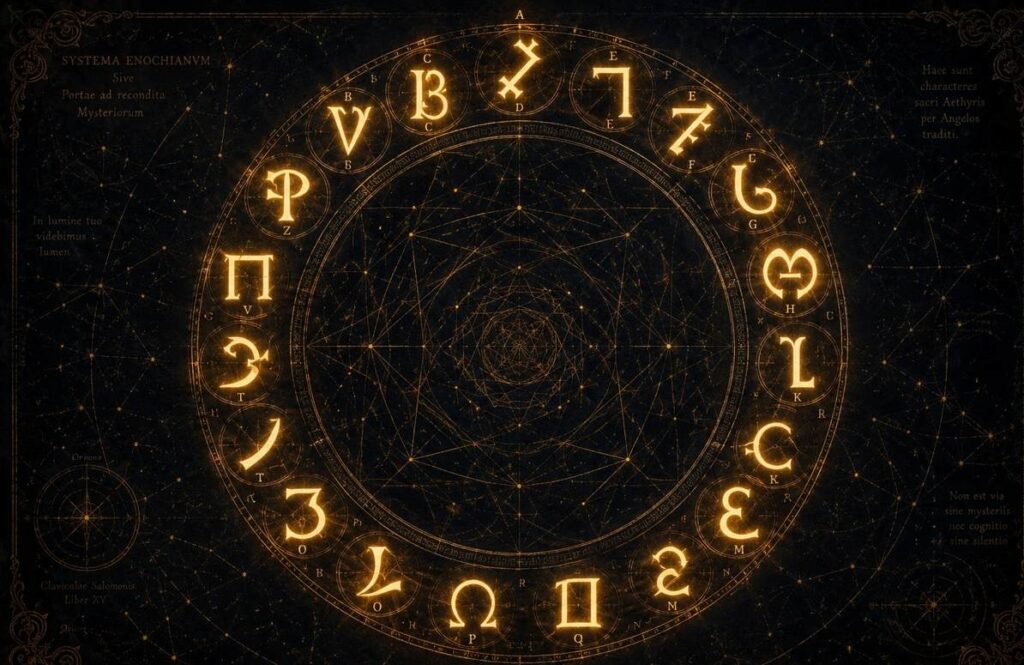
In 1888, the Hermetic Order of the Golden Dawn was founded in London by William Wynn Westcott, Samuel Liddell MacGregor Mathers, and William Robert Woodman. Drawing upon Kabbalah, Rosicrucianism, and Hermeticism, the Order created a graded system of initiation that incorporated Enochian material at multiple levels. The Practicus grade (3°=8°), associated with the element of Water and the planet Mercury, explicitly employs the Enochian Water Tablet in its temple setup and ritual structure.
The Golden Dawn expanded Dee’s relatively spare system into an elaborate correspondence network, mapping Enochian letters to tarot cards, astrological signs, and paths on the Tree of Life. Whether this enrichment clarified or complicated the original material remains a matter of debate among practitioners. What is certain is that the Golden Dawn made Enochian accessible to a broader audience of occultists who might never have encountered Dee’s crabbed manuscript hand.
Crowley and the Cairo Working
Aleister Crowley (1875–1947), who had advanced through Golden Dawn grades before departing to found his own magical order, devoted considerable attention to Enochian practice. In 1904, while in Cairo with his wife Rose, Crowley conducted what became known as the Cairo Working. During this period, in which he was actively engaged in Enochian operations alongside other magical work, he received The Book of the Law from the entity Aiwass. The text, transmitted over three days in April 1904, became the foundational scripture of Crowley’s religious philosophy, Thelema.
Crowley published extensive Enochian material in The Equinox, including his own phonetic pronunciations of the Keys and commentaries on the Aethyrs. His interpretation tended to emphasise Enochian as a system of psychological transformation rather than a literal angelic postal service–a shift that aligned the language with emerging twentieth-century understandings of the unconscious.
Chaos Magic and Techno-Occultism
In the late twentieth and early twenty-first centuries, Enochian found new life among chaos magicians and techno-occultists. For these practitioners, the historical question of whether Kelley genuinely saw angels in the crystal is less relevant than the functional question of whether the system produces reproducible results. The “systematic strangeness” of Enochian–its combination of rigorous structure and inexplicable content–makes it an ideal framework for psychonautical exploration.
Contemporary practitioners have adapted Enochian calls for digital performance, electronic voice phenomena experiments, and algorithmic sigil generation. The language that began in candle-lit Continental parlours now echoes through synthesised vocal tracks and virtual ritual spaces. The medium has changed; the underlying premise–that specific configurations of sound and symbol can alter consciousness–remains constant.
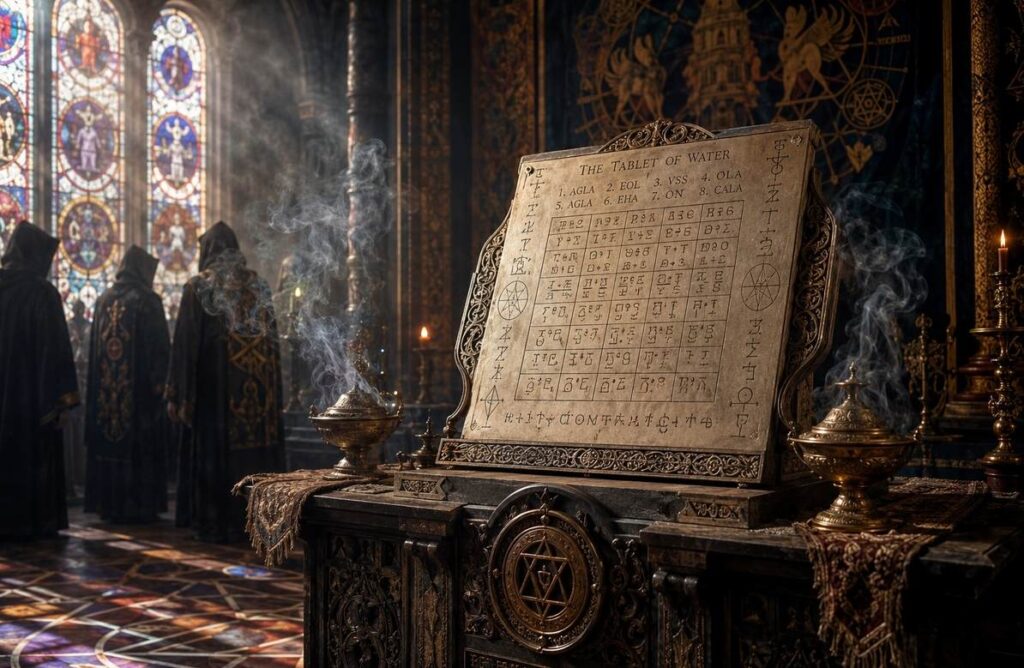
Cryptography as Contemplative Technology
To treat Enochian as merely a code to be broken is to miss its function entirely. For Dee and subsequent practitioners, the language served as what we might term a “psycho-technological” device. The act of pronouncing these words–vibrating syllables that seem to bypass the rational mind and speak directly to the body–produces measurable shifts in attention and awareness.
Modern phonetic analysis reveals patterns consistent with other sacred languages: Sanskrit, with its precise mouth positions and resonant overtones; Biblical Hebrew, in which the shape of the letter is said to encode the shape of the sound; and the barbarous names of evocation in the Greek Magical Papyri, where unintelligibility was itself a marker of divine origin. Enochian, in this company, is not an anomaly but a late entry in a persistent tradition: the belief that certain sound configurations operate as keys to non-ordinary states.
The “yoga of the tongue” is not merely metaphor. Practitioners report that sustained Enochian recitation alters breathing patterns, heart rate variability, and the sense of bodily boundaries. Whether these effects are “angelic” or “neurological” depends on the explanatory framework one prefers. The experience itself remains.
The cipher functions not because it conceals information from unauthorised readers, but because it transforms the authorised reader–changing the consciousness that engages with it into something capable of receiving communication from non-human intelligences.
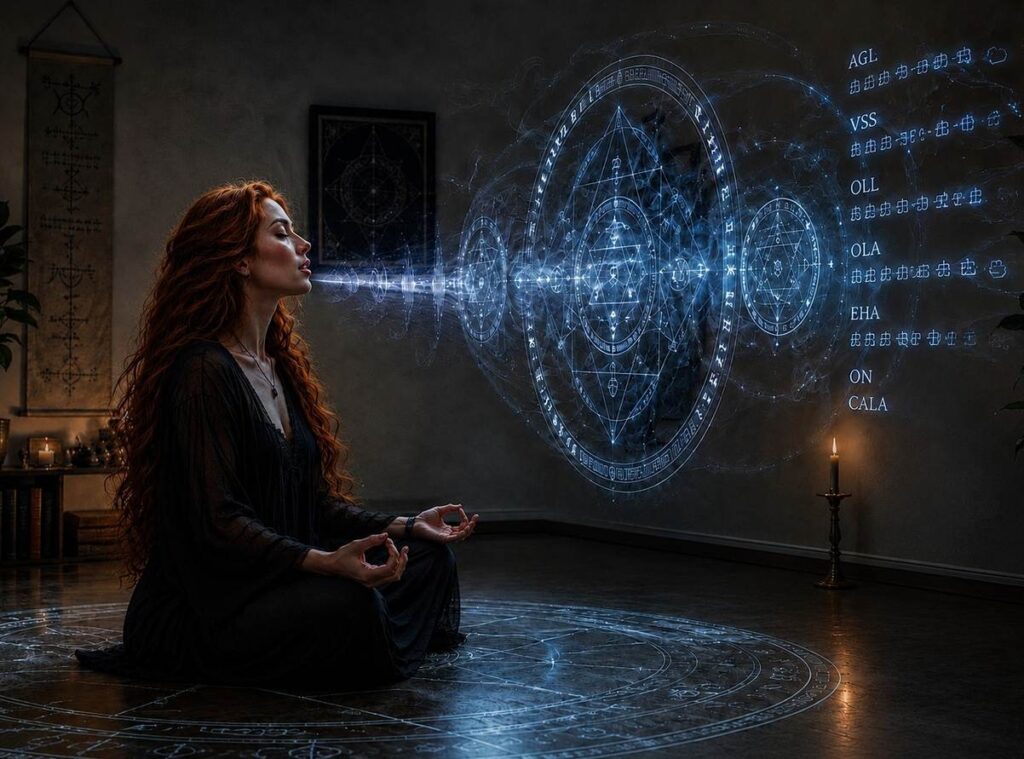
The Encryption of Consciousness
In our age of digital surveillance and algorithmic prediction, Enochian offers a peculiar form of privacy. Not the privacy of hidden data–the encryption that protects your banking details–but the privacy of transformed perception. To learn this language is to install new operating software on the mind: one that renders the speaker simultaneously more transparent to the celestial and more opaque to the forces that would bind human attention in material distraction.
The angels, if that is what they were, gave Dee a technology for liberation disguised as a diplomatic code. The Liber Loagaeth and the 48 Keys were presented as tools for national prophecy and imperial expansion, but their deeper function was the expansion of the operator’s own cognitive boundaries. The same system that could, in theory, predict the outcome of wars could also, in practice, dismantle the operator’s identification with the ordinary self.
This dual use–mundane and mystical, political and psychological–is characteristic of esoteric systems throughout history. The alchemist’s laboratory produced both gold and transformation; the astrologer’s chart served both king and soul. Enochian is no exception. Its value lies not in whether the angels were “real” in some objective sense, but in whether the system reliably produces the transformation it promises.
For the contemporary seeker, the question is practical: does engaging with Enochian shift your perception in useful ways? Does it reveal patterns in consciousness that ordinary language conceals? Does it function as a gnostic technology–a tool for direct knowing that bypasses the mediating institutions of religion, science, and state?
The evidence suggests it can. Not because the angels dictated it, but because the human nervous system responds to structured strangeness. Enochian is strange enough to break habitual cognition, structured enough to provide a repeatable method, and ancient enough to carry the weight of tradition. These three qualities–strangeness, structure, and lineage–are the hallmark of any effective contemplative technology.

Frequently Asked Questions
What is Enochian and who created it?
Enochian is an occult constructed language recorded in the private journals of Dr John Dee and Edward Kelley between 1582 and 1607. Dee, a mathematician and advisor to Queen Elizabeth I, believed it was the original angelic language spoken by Adam in Eden. Kelley served as the scryer who relayed the angelic communications through crystal visions.
How many letters are in the Enochian alphabet?
The Enochian alphabet consists of 21 letters, first received by Kelley on 26 March 1583. Dee mapped these to 22 English letters, treating U and V as positional variants and omitting J, K, and W. Each letter has a specific name and sound value recorded in Dee’s manuscripts.
What are the 48 Angelic Keys or Calls?
The 48 Angelic Keys (Claves Angelicae) are invocations received by Dee and Kelley during their Continental workings. They were intended to unlock the 49 letter tables of the Liber Loagaeth. Unlike the Liber Loagaeth, the Keys were accompanied by English translations and function as operative commands for contacting specific classes of angelic intelligences.
Is Enochian a real language or a fraud?
Linguist Donald Laycock demonstrated that Enochian has strong English phonological and orthographic foundations, classifying it as a constructed language rather than a naturally evolved one. Whether it is an elaborate invention, a form of glossolalia, or something else entirely remains debated. Its functional value for practitioners lies in its capacity to alter consciousness through structured vocalisation.
How did the Golden Dawn use Enochian?
The Hermetic Order of the Golden Dawn, founded in 1888, incorporated Enochian tablets into their graded initiation system. The Practicus grade (3 degrees = 8 square) explicitly employs the Enochian Water Tablet. They expanded Dee’s original correspondences into elaborate networks connecting Enochian letters to tarot, astrology, and the Tree of Life.
What is the connection between Enochian and Aleister Crowley?
Crowley advanced through Golden Dawn grades before founding Thelema. He published extensive Enochian material in The Equinox and practised Enochian operations during his 1904 Cairo Working. During this period he received The Book of the Law from the entity Aiwass, which became the foundational scripture of Thelema.
Can Enochian be used for modern contemplative practice?
Contemporary practitioners use Enochian recitation as a psycho-technological device for altering consciousness. The unusual phonetic clusters require specific mouth positions and breathing patterns that can shift awareness out of ordinary linguistic habit. Modern adaptations include digital performance, electronic voice experiments, and integration with chaos magic techniques.
Further Reading
- Scrying the Enochian Aethyrs: An Astral Gnosis Guide — Practical methods for navigating Dee’s thirty Aethyrs through visionary meditation.
- Heptarchia Mystica: John Dee’s Planetary Kings — Dee’s system of seven planetary angels and their role in Elizabethan magical politics.
- John Dee’s Mathematical Preface: The Occult Foundation — Dee’s 1570 introduction to Euclid and the philosophical bridge between mathematics and magic.
- The Nineteen Occult Arts of John Dee — The complete curriculum of Dee’s magical and scientific system.
- The Language of the Birds: 7 Traditions on Divine Speech — Cross-cultural perspectives on angelic, Adamic, and initiatory languages.
- The Gnostic Matrix — Simulation, archonic influence, and the technology of spiritual liberation.
- Gnosis in the Digital Age: Algorithmic Sovereignty — Contemporary strategies for maintaining cognitive autonomy in an attention-harvesting economy.
- Digital Minimalism as Mystical Practice — Reducing external noise to make space for interior revelation.
- Contemplative Techniques — A survey of methods for stabilising awareness and developing direct perception.
- The Living Thread: How Forbidden Knowing Survives — The historical transmission of suppressed esoteric knowledge across centuries.
References and Sources
The following sources represent the primary manuscripts and scholarly works underlying this article.
Primary Manuscripts
- British Library, Sloane MS 3188, 3189, 3191. The Dee-Kelley spirit diaries, including the Liber Loagaeth and the Claves Angelicae (48 Angelic Keys).
- British Library, Cotton MS Appendix XLVI. The diary of Dee and Kelley’s Continental actions, 1583–1587.
- Meric Casaubon, ed. A True and Faithful Relation of What Passed for Many Yeers between Dr. John Dee and Some Spirits. London, 1659. (Note: Casaubon’s edition contains transcription errors and was published to discredit Dee.)
Scholarly Monographs
- Donald Laycock. The Complete Enochian Dictionary: A Dictionary of the Angelic Language as Revealed to Dr. John Dee and Edward Kelley. Askin Publishers, 1978.
- Deborah E. Harkness. John Dee’s Conversations with Angels: Cabala, Alchemy, and the End of Nature. Cambridge University Press, 1999.
- Jason Louv. John Dee and the Empire of Angels: Enochian Magick and the Occult Roots of the Modern World. Inner Traditions, 2018.
- Geoffrey James, ed. The Enochian Magick of Dr. John Dee: The Most Powerful System of Angel Magick Ever Revealed. Llewellyn Publications, 1994.
- Israel Regardie. The Golden Dawn: The Original Account of the Teachings, Rites, and Ceremonies of the Hermetic Order. Llewellyn Publications, 1982 (6th ed.).
Comparative Studies
- Tobias Churton. The Golden Builders: Alchemists, Rosicrucians, and the First Freemasons. Weiser Books, 2005.
- Frances Yates. The Occult Philosophy in the Elizabethan Age. Routledge, 2001.
- Henrik Bogdan and Martin P. Starr, eds. Aleister Crowley and Western Esotericism. Oxford University Press, 2012.
Safety Notice: This article discusses historical ceremonial magic and contemplative vocalisation practices. It does not constitute medical, psychological, or spiritual instruction. If you experience dissociation, paranoia, or spiritual emergency symptoms during or after intensive vocal or meditative practice, please contact professional emergency services or a trauma-informed therapist. Esoteric experimentation complements but does not replace clinical mental health support.