The Tears of Ra: Sacred Sorrow, Reincarnation and the Right Eye That Weeps
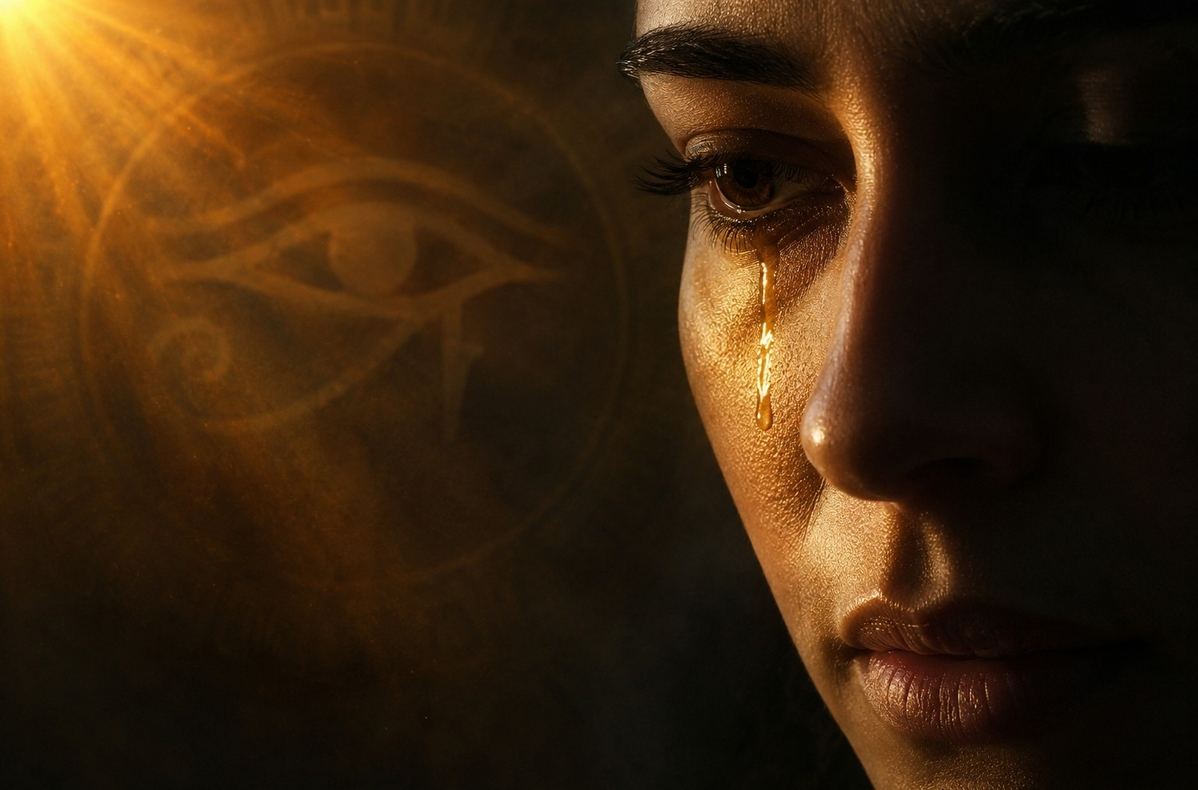
Since childhood, tears have sometimes rolled from my right eye without command.
Not always. Not constantly. But often enough to become a question I have carried inwardly for years.
These are not ordinary tears. They do not always come from personal grief, and they are not the emotional theatre of a passing mood. They arrive from a deeper place, from the strange inward chamber where feeling becomes too large for language.
At times they come when I feel the weight of humanity: the suffering of people, animals, histories, worlds, lives forgotten and lives still trapped in repetition. They come when I contemplate reincarnation, the wheel, the long procession of birth and forgetting, the ache of beings caught in patterns they do not understand.
It is not detachment. It is the opposite. It is connection so deep that the body answers before thought can organise it.
In Egyptian myth, humanity is born from the tears of Ra. The divine eye sees, weeps, and life appears. The tear is not merely sadness. It is a bridge between the divine and the embodied world.
This article is a reflection on that mystery: the right eye that weeps, the sorrow of the world, and the sacred grief that comes when the soul remembers what existence costs.
In Plain Terms
Sacred sorrow is the deep spiritual grief that arises when the soul feels the suffering of existence without turning away from love. In this article, spontaneous tears from the right eye are explored as a personal esoteric phenomenon connected with Ra, the solar eye, reincarnation, Gnostic compassion, Sophia, Bodhisattva sorrow and the weight of humanity. The tear is not treated as weakness or detachment. It is read as a sign of profound participation: the body witnessing what the mind cannot fully hold.
Primary Sources and Traditions Discussed
- Egyptian myth: Ra, the Eye of Ra, solar witness, divine tears and creation.
- Gnostic themes: gnosis, Sophia, the divine spark, archons, the Demiurge, reincarnation, forgetting and return.
- Buddhist themes: Samsara, Bodhisattva compassion, Avalokiteshvara, Guan Yin, Tonglen and Metta.
- Christian mystical themes: the gift of tears, weeping saints, Mater Dolorosa and tears as prayer.
- Sufi themes: longing for the Beloved, grief of separation and the softened heart.
- Kabbalistic themes: Shekhinah in exile and divine presence dwelling in fragmentation.
- Hermetic and solar symbolism: the eye as light, perception and world-facing consciousness.
- Depth psychology: existential grief, world-sorrow, Weltschmerz and symbolic embodiment.
- Contemplative practice: grounding, compassion, breath, prayer, ordinary care and emotional containment.
How to Read This Article
Read this as a personal esoteric reflection, not as a claim that every tear has one universal meaning. The right-eye tears described here are treated as lived spiritual experience: a bodily sign of sacred sorrow, compassion and existential recognition. The aim is not to turn grief into drama or identity, but to understand how deep feeling can become a form of witness without overwhelming the body.
Table of Contents
- Sacred Sorrow: When the Soul Feels the World
- The Tears of Ra: Divine Sight and the Birth of Humanity
- The Right Eye as Solar Witness
- Reincarnation Loops and the Human Wheel
- Gnostic Sorrow: The Divine Spark in a World of Forgetting
- Sophia’s Grief and the Long Return
- The Bodhisattva Tear: Refusing Private Escape
- The Gift of Tears in Christian Mysticism
- The Shekhinah, the Beloved and Divine Exile
- Compassion Without Overload
- Tonglen, Metta and the Circulation of Sorrow
- Grounding the Tear: Earth, Body and Ordinary Care
- When Sacred Sorrow Becomes Too Heavy
- Not Chosen, Not Superior, Not Broken
- Why the Tear Remains
- Conclusion: The Eye That Still Belongs
- Related Glossary Terms
- Read Next
- Further Reading
- Frequently Asked Questions
- References and Sources
Sacred Sorrow: When the Soul Feels the World
Sacred sorrow is not ordinary sadness. It is not despair, detachment or emotional weakness. It is the soul’s participation in the suffering of existence: grief that arises from love, not hopelessness. It is the feeling of humanity from inside the same field of existence, a recognition that the suffering of others is not separate from the fabric of being itself.
The tear arrives before explanation, as if the body has recognised something the mind is still approaching. Sacred sorrow is grief without separation. It does not require a personal loss to activate it. It can arise from contemplating the wheel of rebirth, the forgetting that follows death, the repetition of harm across generations, or the simple fact that sentient beings suffer and most of them do not understand why.
Sacred sorrow is grief without separation.
This sorrow is not sentimentality. It is not the romanticisation of pain. It is a clear-eyed recognition that existence carries weight, and that the weight is shared. The soul that feels this does not feel it because it is special. It feels it because it has not closed.
Some tears do not fall because the self is broken. They fall because the soul has touched the sorrow of the world.
The Tears of Ra: Divine Sight and the Birth of Humanity
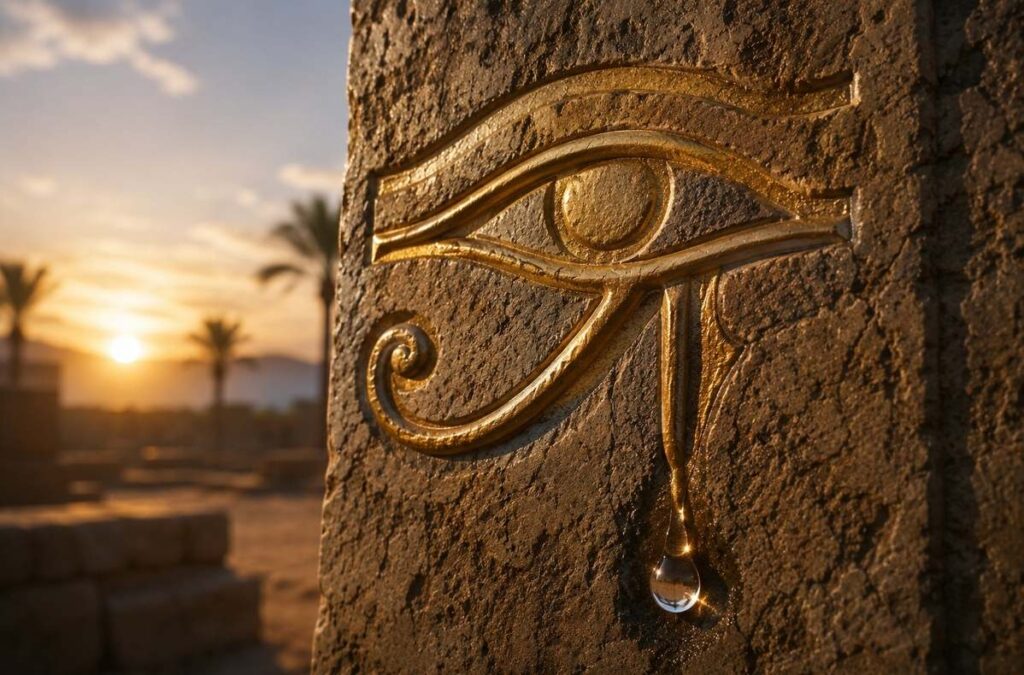
In Egyptian mythic tradition, Ra, the solar creator, sends forth his eye to retrieve his children, Shu and Tefnut, who have wandered into the waters of Nun. When they return, Ra is moved, and from his tears humanity is born. The divine eye sees, weeps, and life appears. This is not a myth of sadness alone. It is a myth of creation passing through grief.
The Eye of Ra is one of the most powerful symbols in Egyptian mythology. It represents divine perception, solar power, and the fierce protective energy that sees the world into being and weeps it into embodiment. The tear is not weakness. It is the overflow of a sight so complete that it cannot remain dry. In the Tears of Ra, weeping is not weakness. It is creation passing through grief.
This myth offers a language for the phenomenon described in this article. The right eye that weeps spontaneously, without personal grief, can be read as a form of solar witness: the world-facing eye that sees clearly and feels what it sees. The tear becomes the bridge between divine perception and embodied life, between the recognition of suffering and the refusal to look away.
In the Tears of Ra, weeping is not weakness. It is creation passing through grief.
The Right Eye as Solar Witness
In esoteric and Egyptian symbolic traditions, the right eye carries solar associations. It is the active, world-facing eye: the eye that looks outward toward the field of existence, toward the suffering of beings, toward the wheel of birth and forgetting. The left eye, by contrast, has often been associated with lunar, receptive, inward-turning perception. These polarities are not rigid dogma, but they offer a symbolic language for understanding why the right eye, in particular, might weep for the world.
The world-facing eye weeps for the world. It is the eye that does not turn away. Solar compassion is not soft. It is light that sees clearly and feels what it sees. The tear that falls from the right eye can be understood as the overflow of world-facing perception: the body’s response to a sight that the mind cannot fully process, a grief that arrives before language, a compassion that is too deep for thought to organise.
The world-facing eye weeps for the world.
This is not to claim that every right-eye tear carries this meaning. Symbolic language is not diagnostic. But for the person who has lived this phenomenon since childhood, the solar witness offers a mythic frame that honours the experience without reducing it to sentiment or spectacle.
Reincarnation Loops and the Human Wheel
Reincarnation, when contemplated deeply, produces a particular kind of sorrow. It is not the grief of a single loss, but the grief of repetition: birth, forgetting, suffering, striving, loss and return. The wheel turns, and beings are caught in patterns they do not understand, repeating wounds across lifetimes, forgetting what they learned, returning to the same traps with new faces.
To contemplate the wheel is one thing. To feel the wheel in the body is another. The tear that comes when contemplating reincarnation is not abstract. It is the body’s recognition of a truth too vast for the personal self to hold: the untold suffering of humans and all beings, the ache of recurrence, the tragedy of forgetting, the courage of return.
This connects directly to the broader exploration of liberation from the cycle in Exit From the Wheel: Liberation Beyond Reincarnation and the mechanics of forgetting in The Memory Wipe: Forgetting, Rebirth and the Loss of Divine Identity. The sorrow of the wheel is not despair. It is compassion extended across time, a grief that recognises the cost of existence itself.
To contemplate the wheel is one thing. To feel the wheel in the body is another.
Gnostic Sorrow: The Divine Spark in a World of Forgetting
Gnostic traditions teach that a divine spark dwells within each human being, hidden beneath layers of forgetting, confusion and archonic distraction. The divine spark is real, but it is obscured in a world of limited perception, ruled by forces that benefit from ignorance. The Apocryphon of John describes the archons as powers that seek to control and contain the spirit, and the Demiurge as the mistaken architect of a cosmos in which the spark forgets its origin.
To see this clearly is not triumph. It is sorrow. Gnosis does not always arrive as triumph. Sometimes it arrives as a tear. The grief of knowing that beings are more than their captivity, that the spark is real but buried, that the world makes recognition difficult: this is a sorrow that the Gnostic texts understand intimately. It is the sorrow of clear sight in a world that rewards blindness.
This connects to the exploration of archonic systems in Archons: The Ruling Powers That Shape Reality and the nature of false imitation in What Is the Counterfeit Spirit?. The tear that falls for the divine spark in exile is not despair. It is love recognising what has been lost, and refusing to accept the loss as final.
Gnosis does not always arrive as triumph. Sometimes it arrives as a tear.
Sophia’s Grief and the Long Return
In Gnostic myth, Sophia, divine wisdom, falls from the fullness of the Pleroma into the chaos of the lower world. Her grief is cosmic and restorative. It is not guilt, but longing for restoration. She weeps not because she is broken, but because she remembers the wholeness from which she came, and she longs to return, not for herself alone, but for all the sparks that fell with her.
The tear that falls from the right eye can be read as Sophia-like sorrow: wisdom feeling the distance from fullness, the ache of separation, the patience of restoration through recognition. Sophia’s sorrow is not the end of wisdom. It is wisdom remembering the way back. The tear is not a sign of failure. It is a sign that the soul still knows where home is, and grieves the distance.
For a deeper exploration of Sophia’s myth, see What Is Sophia? Wisdom, Fall and Redemption in Gnostic Myth.
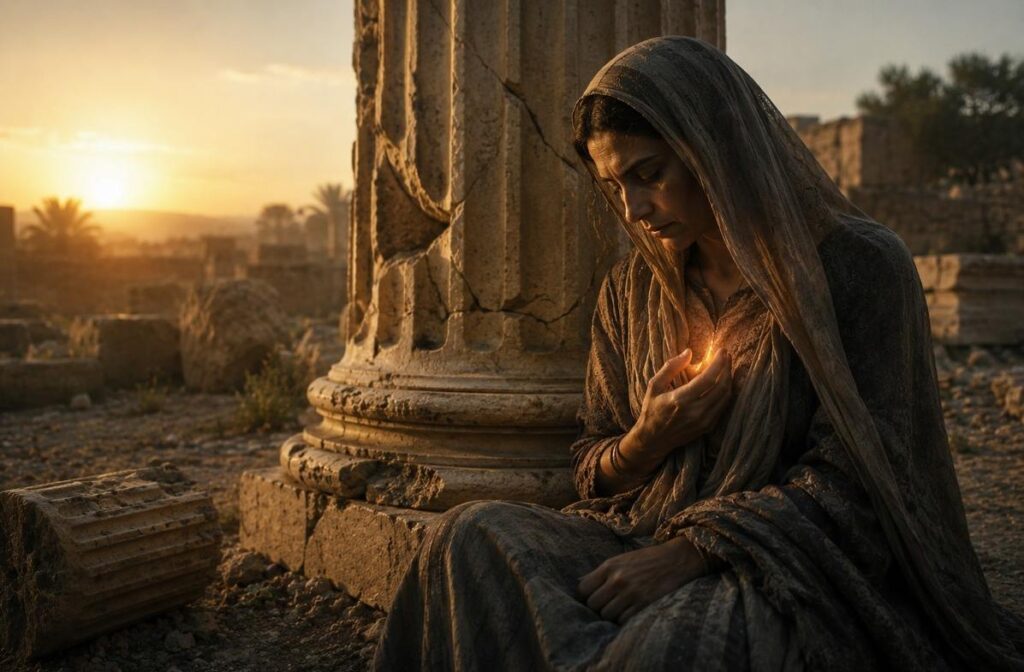
Sophia’s sorrow is not the end of wisdom. It is wisdom remembering the way back.
The Bodhisattva Tear: Refusing Private Escape
In Mahayana Buddhist tradition, the Bodhisattva is the being who, upon approaching enlightenment, chooses to remain in Samsara, the cycle of suffering, craving and rebirth, until all beings are liberated. This is not martyrdom. It is compassion that has become too deep for private escape. The Bodhisattva does not say, “I will save everyone myself.” The Bodhisattva says, “I cannot pretend their suffering is separate from me.”
Avalokiteshvara, the Bodhisattva of compassion, is said to hear the cries of the world and respond with active mercy. Guan Yin, the East Asian manifestation of this compassionate presence, hears the suffering of all beings and weeps with them. The Bodhisattva tear is the refusal to abandon suffering beings. It is compassion that remains present without claiming ownership, that witnesses without rescuing, that grieves without drowning.
The Indian Buddhist master Santideva, writing in the eighth century, expressed this vow in The Way of the Bodhisattva: as long as beings remain, the compassionate one remains to help relieve sorrow. This is not grandiosity. It is the natural extension of compassion that has outgrown the boundaries of the self.
The Bodhisattva tear does not claim ownership of suffering. It refuses to pretend suffering is separate.
The Gift of Tears in Christian Mysticism
Christian mystical tradition has long recognised what it calls the gift of tears: tears that arise not from personal sorrow alone but from compunction, love, mercy or intercession. The Desert Fathers and Mothers spoke of tears as a form of prayer that precedes words. When the heart is opened by grace, the body weeps before the tongue has found its sentence.
The Mater Dolorosa, the sorrowful mother, represents sacred grief that holds the suffering of the world without turning away. Christian mystics describe tears as purification, as the washing of the heart, as the body’s participation in divine compassion. These tears are not breakdown. They are breakthrough. They are the body’s way of saying what the mind cannot yet articulate.
The tear becomes prayer before the tongue has found its sentence.
The Shekhinah, the Beloved and Divine Exile
In Kabbalistic tradition, the Shekhinah is the divine presence that dwells in exile among the fragments of the world. She is not distant. She is here, hidden in the broken places, waiting for restoration through human recognition and repair. The Shekhinah grieves for the exile she shares with creation. Her sorrow is not separation from God, but longing for the world to recognise the divine presence that already inhabits it.
Sophia and Shekhinah echo each other across traditions: wisdom and presence dwelling in fragmentation, grieving the distance from wholeness, longing for restoration. Sufi poetry speaks of the longing for the Beloved, the grief of separation from the Real, the tear that falls because the heart has tasted what lies behind the world and cannot forget it.
The tear is grief for what is, and longing for what shines behind it. It is the soul’s recognition that the world is both real and incomplete, that the divine is both present and hidden, that the ache of existence is also the promise of return.
The tear is grief for what is, and longing for what shines behind it.
Compassion Without Overload
Feeling deeply does not mean absorbing everything. Compassion must move, not stagnate. External grief should not colonise the body. There is a difference between witness, absorption and transmutation. Deep empathy needs spiritual hygiene: boundaries, grounding, breath, and the willingness to let sorrow pass through rather than take up residence.
Compassion must pass through the heart, not take possession of the body. The person who weeps for the world is not asked to carry the world. The tear is a witness, not a burden. It is the body’s way of recognising suffering without being crushed by it. The task is to remain connected without being flooded, to feel without drowning, to grieve without disappearing.
This connects to the practice of grounding explored in The Slow Work of Integration and the necessity of boundaries in The Sacred No: Boundaries and Spiritual Maturity. Sacred sorrow is not an invitation to self-erasure. It is an invitation to deeper, more grounded connection.

Compassion must pass through the heart, not take possession of the body.
Tonglen, Metta and the Circulation of Sorrow
Buddhist practice offers specific methods for transforming sorrow into active compassion without overload. Tonglen, the practice of breathing in suffering and breathing out relief, teaches the practitioner to face pain directly, not as a victim but as a transformer. On the in-breath, one takes in the suffering of others. On the out-breath, one sends out compassion, peace and blessing. The practice is not masochistic. It is alchemical.
Metta, loving-kindness, extends active goodwill toward all beings, including oneself. The traditional phrases carry power through repetition and intention: “May all beings be free from suffering. May all beings be at peace.” These are not empty wishes. They are orientations of the heart, training the mind to move from passive grief to active blessing.
Both practices require grounding. They are not meant to be performed in isolation from the body, the earth, or ordinary care. The practitioner who breathes in the world’s sorrow must also eat, sleep, walk and touch the ground. The tear is sacred, but the feet must remain on the earth.
Untrained empathy absorbs. Trained compassion circulates.
Grounding the Tear: Earth, Body and Ordinary Care
The tear may belong to the heavens, but the feet must return to the earth. Grounding is not shutting down. It is the practice of bringing the body back to the present moment, to the weight of the body, to the texture of the floor, to the taste of food, to the rhythm of breath. Walking, eating, washing dishes, touching the earth, standing barefoot on soil: these are not distractions from sacred sorrow. They are its necessary container.
The ordinary saint, that quiet figure who lives spirituality without spectacle, does not dramatise the tear. The ordinary saint weeps when the weeping comes, and then makes tea, walks, answers the ordinary call of the day, and returns to life. Ordinary care prevents sacred sorrow from becoming self-erasure. The tear is honoured, but the body is not abandoned. The soul is not asked to live in grief alone.
This connects to the ZenithEye exploration of The Ordinary Saint: Invisibility and Completion and the necessity of Return to Ordinary Life After Awakening. Sacred sorrow is not an escape from daily life. It is a deeper way of inhabiting it.

The tear may belong to the heavens, but the feet must return to the earth.
When Sacred Sorrow Becomes Too Heavy
Sacred sorrow can become overwhelming. There is a distinction between the tear that witnesses and the grief that incapacitates. Signs that sorrow has become too heavy include inability to function, sleep disruption, persistent despair, panic, isolation, inability to stop crying, feeling unsafe, or thoughts of self-harm. Spiritual meaning does not require carrying unbearable weight alone.
No soul is asked to carry the sorrow of existence without ground beneath it. The phenomenon of sacred sorrow is real, but it does not exempt the body from care. If the tears become a flood that drowns rather than a witness that flows, support is needed. This is not a failure of spirituality. It is a recognition that the body has limits, and that those limits are part of the sacredness, not a betrayal of it.
Care does not diminish the sacredness of the experience. It honours it by protecting the vessel through which it flows. The person who weeps for the world must also care for themselves, and seek the help that allows them to continue witnessing without being destroyed.
No soul is asked to carry the sorrow of existence without ground beneath it.
Not Chosen, Not Superior, Not Broken
Having such tears does not make one superior. It is not a chosen-one badge, not a spiritual rank, and not a claim to special authority. The tear is witness, not crown. It is the body refusing to become numb, not the ego claiming special status. Humility protects the phenomenon from inflation.
The tear is not a crown. It is a witness. The person who weeps for the world is not better than the person who does not. They are simply responding through a particular sensitivity. The goal is not to produce tears. The goal is to remain open, grounded and useful. If the tears come, they come. If they do not, the heart can still weep inwardly and act outwardly.
The tear is not a crown. It is a witness.
Why the Tear Remains
Perhaps the tear remains because the soul has never agreed to become numb. The child who first felt this sorrow already knew something too vast for language. Life did not remove the sensitivity. The world did not teach it to close. The tear continues because connection continues. It is not something to cure. It is something to understand, ground and honour.
The tear may be a lifelong form of spiritual witness. It may come less often as the soul learns to hold the sorrow more steadily. It may come more often as the world reveals new depths of suffering. Either way, it is not a defect. It is a form of participation. The body is doing what the mind cannot yet say: I see you. I feel you. I will not look away.
Perhaps the tear remains because the soul has never agreed to become numb.
The Eye That Still Belongs
The right eye weeps. Not all the time. Not on command. Not as performance. It weeps when the soul touches the sorrow of existence too deeply for thought. It weeps for humanity, for beings caught in the wheel, for the suffering that has been and still is. It weeps with Ra, with Sophia, with the Bodhisattva, with the hidden spark, with the divine presence in exile.
But the tear is not despair. It is connection. It is the body refusing to become numb. It is sacred sorrow passing through the world-facing eye. Some tears do not fall because the self is broken. They fall because the soul has touched the sorrow of the world.
Related Glossary Terms
These terms help frame the article’s main ideas across the wider ZenithEye archive.
- Gnosis
- Divine Spark
- Sophia
- Archons
- Demiurge
- Counterfeit Spirit
- Phenomenology
- Spiritual Emergence
- Integration
- Grounding
- Contemplative Techniques
- The Ordinary Saint
- Shadow Work
- Liberation from Reincarnation
- Sacred Sorrow
- Tears of Ra
- Right Eye
- Solar Witness
- Mystical Tears
- Bodhisattva Tear
- Avalokiteshvara
- Guan Yin
- Shekhinah
- Gift of Tears
- Weltschmerz
- Existential Grief
- World-Sorrow
- Compassion Without Overload
- Tonglen
- Metta
- Divine Exile
- Karmic Grief
- Emotional Transmutation
Read Next
Continue through the sacred sorrow and liberation route: clear sight, spiritual responsibility, grounding, reincarnation and Sophia’s long return.
Further Reading
Articles from ZenithEye that explore sacred sorrow, spiritual perception, reincarnation, Gnostic grief, grounding and ordinary integration:
- The Grief of Clear Sight: Awakening and Sorrow – On the particular grief that follows spiritual awakening and the refusal to look away.
- The Weight of Seeing: Responsibility After Awakening – How heightened perception brings ethical weight and the challenge of bearing it.
- The Slow Work of Integration – Why transformation takes time and why the body must be included.
- Exit From the Wheel: Liberation Beyond Reincarnation – The Gnostic and comparative paths out of the cycle of rebirth.
- The Memory Wipe: Forgetting, Rebirth and the Loss of Divine Identity – How the cycle of reincarnation depends on forgetting, and what remembrance costs.
- Nirvana, Moksha and Gnosis: Three Paths Beyond Rebirth – Comparative exploration of liberation across Buddhist, Hindu and Gnostic traditions.
- What Is Sophia? Wisdom, Fall and Redemption in Gnostic Myth – The divine feminine in exile, her grief, and the long road of restoration.
- What Is the Divine Spark? – The hidden light within and its journey toward recognition.
- What Is Gnosis? Meaning, Recognition and Direct Knowing – The nature of inner knowing and why it can hurt as well as liberate.
- Pattern Recognition Without Paranoia – How to recognise meaningful patterns without being consumed by them.
- The Discipline of Not Interpreting Everything – How restraint protects perception from overload.
- When Symbols Become Cages – How symbols guide without becoming prisons.
- Spiritual Emergency: Transformation and Crisis – When spiritual opening becomes overwhelming and how to navigate it safely.
- The Ordinary Saint: Invisibility and Completion – The quiet practice of living spirituality without spectacle.
- Return to Ordinary Life After Awakening – Coming back to daily life without losing what was gained.
- The Spiritual Practice of Attention – Presence, attention and the disciplined return to what is here.
Frequently Asked Questions
What is sacred sorrow?
Sacred sorrow is the deep spiritual grief that arises when the soul recognises suffering without turning away from love. It is not despair, weakness or detachment, but a form of compassionate participation in existence.
What do the Tears of Ra symbolise?
The Tears of Ra can symbolise divine perception, creation, solar witness and the mysterious link between divine sight and embodied life. In this article, they are used as a mythic lens for understanding tears that arise from deep spiritual compassion.
What is the spiritual meaning of right-eye tears?
In this article, right-eye tears are read as a personal esoteric phenomenon connected with solar perception, the world-facing eye and sacred sorrow. The meaning is not presented as universal, but as one symbolic language for a lived experience.
How does reincarnation relate to sacred sorrow?
Reincarnation can deepen sacred sorrow because it frames suffering as cyclical: birth, forgetting, repetition, loss and return. To feel the wheel spiritually is to grieve not only personal pain, but the suffering of beings across time.
Is sacred sorrow the same as depression?
No. Sacred sorrow is not the same as clinical depression, although deep sorrow can become heavy or distressing. Sacred sorrow refers to a spiritual recognition of suffering held within compassion. If sorrow becomes disabling, unsafe or overwhelming, support may be needed.
How can deep compassion avoid becoming overload?
Deep compassion needs grounding, breath, boundaries and practice. Tonglen, Metta, prayer, ordinary care and embodied grounding can help sorrow pass through the heart without taking possession of the body.
Why does the article connect Ra, Sophia and the Bodhisattva?
Ra, Sophia and the Bodhisattva each offer a different mythic language for sacred sorrow: divine sight that weeps, wisdom in exile longing for restoration, and compassion that remains present with the suffering of beings.
References and Sources
This article draws on Egyptian mythic traditions, Gnostic textual sources, Buddhist philosophy, Christian mysticism, Kabbalistic symbolism, depth psychology and contemplative practice. Sources are grouped by category for clarity.
Primary Sources and Critical Editions
- The Apocryphon of John. Nag Hammadi Codex II,1; III,1; IV,1; Berlin Codex 8502,2. In The Nag Hammadi Scriptures: The International Edition, edited by Marvin Meyer. HarperOne, 2007.
- The Gospel of Thomas. Nag Hammadi Codex II,2. In The Nag Hammadi Scriptures: The International Edition, edited by Marvin Meyer. HarperOne, 2007.
- The Gospel of Philip. Nag Hammadi Codex II,3. In The Nag Hammadi Scriptures: The International Edition, edited by Marvin Meyer. HarperOne, 2007.
- Santideva. The Way of the Bodhisattva (Bodhicharyavatara). Multiple translations available, including the Padmakara Translation Group edition. Shambhala, 1997.
Egyptology and Myth
- Pinch, Geraldine. Egyptian Mythology: A Guide to the Gods, Goddesses, and Traditions of Ancient Egypt. Oxford University Press, 2002.
- Assmann, Jan. The Search for God in Ancient Egypt. Translated by David Lorton. Cornell University Press, 2001.
Gnostic Studies
- Brakke, David. The Gnostics: Myth, Ritual, and Diversity in Early Christianity. Harvard University Press, 2010.
- King, Karen L. What Is Gnosticism? Harvard University Press, 2003.
- DeConick, April D. The Gnostic New Age: How a Countercultural Spirituality Revolutionized Religion from Antiquity to Today. Columbia University Press, 2016.
Mysticism, Psychology and Comparative Religion
- James, William. The Varieties of Religious Experience. Longmans, Green & Co., 1902.
- Underhill, Evelyn. Mysticism: A Study in the Nature and Development of Spiritual Consciousness. Methuen, 1911.
- Scholem, Gershom G. Major Trends in Jewish Mysticism. Schocken Publishing House, 1941.
- Jung, Carl G. Collected Works, especially writings on symbolic embodiment, projection and collective suffering. Routledge & Kegan Paul, 1953-1979.
Safety Notice: This article discusses sacred sorrow, spiritual tears, reincarnation, existential grief, compassion, emotional depth and spiritual emergence. It is not medical, psychological or therapeutic advice. If sorrow becomes disabling, frightening, sleep-disrupting, unsafe, isolating, or connected with self-harm, seek qualified professional support or emergency help in your area.
Study Note: This article does not claim that every tear has a fixed universal meaning. It explores one lived esoteric experience through the mythic language of Ra, Gnostic sorrow, reincarnation, Sophia, Bodhisattva compassion and sacred grief. Its purpose is not to glorify suffering, but to understand how deep compassion can remain connected, grounded and whole.