

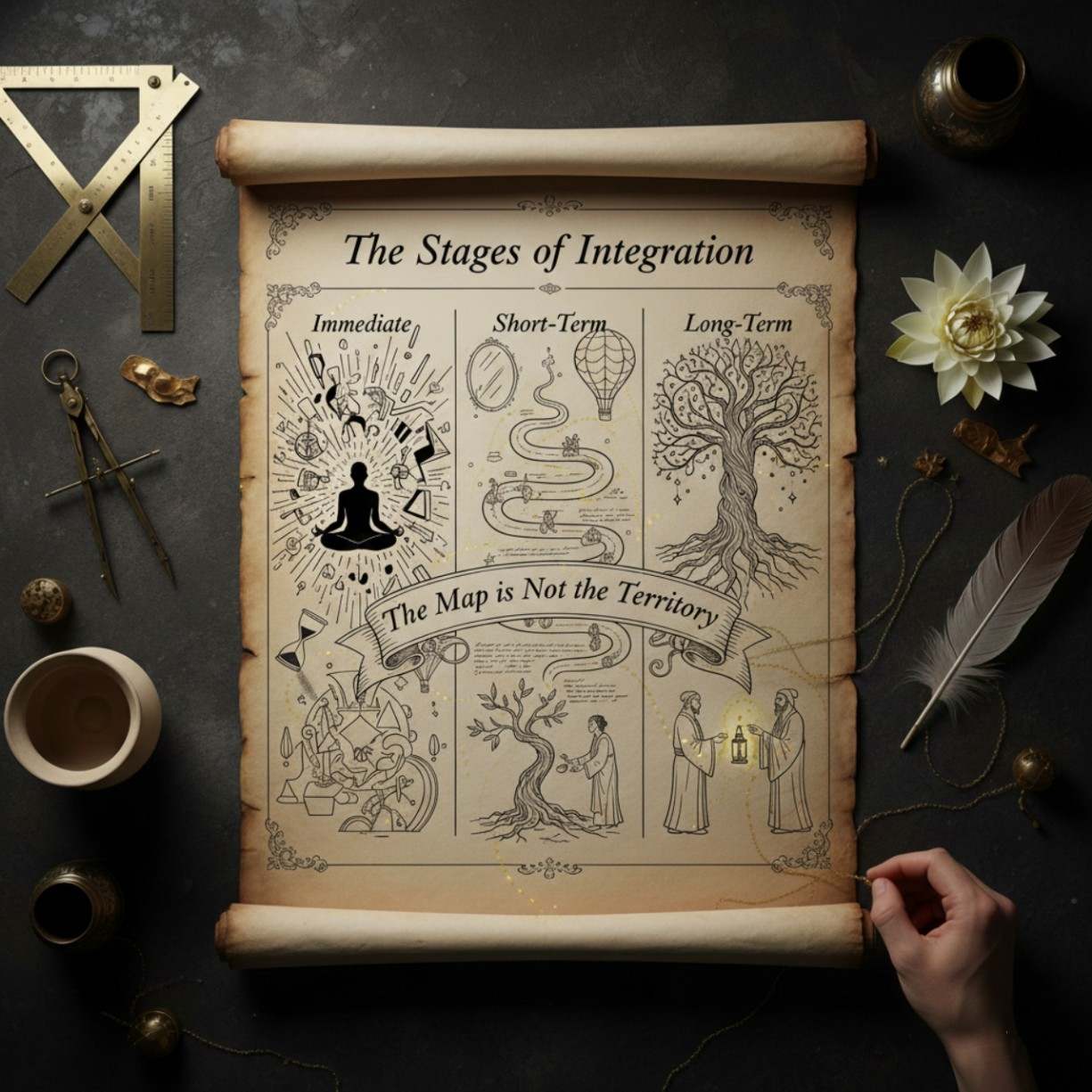
The Stages of Integration: Immediate, Short-Term & Long-Term After Awakening
The experience ends. The recognition fades. The return begins. But return to what? And how? The integration of mystical experience unfolds in stages–not linear, not predictable, but patterned. Without a map, the territory can feel hostile: ordinary life appears thin, relationships strain under the weight of unshareable insight, and the body itself may protest the sudden influx of reorganising energy. The pattern, recognised, enables navigation. The navigation, skilful, produces transformation rather than fragmentation.
The stages are temporal–immediate (hours to days), short-term (weeks to months), long-term (years to decades). They are also functional–stabilisation, meaning-making, behavioural change, identity reconstitution. The temporal and functional intersect differently for each individual, like threads crossing at angles to weave a cloth whose final pattern cannot be predicted from any single strand. The map is not the territory. But the map, consulted, prevents wandering into confusion without proper orientation.

Table of Contents
- Immediate Stage: The Hours and Days After
- Short-Term Stage: The Weeks and Months After
- Long-Term Stage: The Years and Decades After
- The Functional Architecture: Four Dimensions of Integration
- The Temporal Architecture: Where Are You?
- Frequently Asked Questions
- Further Reading
- References and Sources
Immediate Stage: The Hours and Days After
The Raw State: Afterglow or Agitation
The first stage is raw. The experience, vivid, produces afterglow–clarity, peace, love, certainty. Or it produces agitation–energy ungrounded, sleep disrupted, ordinary function impaired. Or both, alternating, as though the nervous system cannot decide whether it has received a gift or a shock. Physiologically, this state resembles the aftermath of profound trauma or profound joy: cortisol and oxytocin may circulate simultaneously, producing a body that trembles with exhaustion yet feels electrically alive.
The immediate stage is unstable, like a weather system that has not yet chosen between storm and clear sky. Sleep architecture often fragments; dreams may be unusually vivid or disturbingly empty. Appetite can vanish or surge. The practitioner may feel an urgent need to speak, to write, to contact everyone they know–or an equally urgent need to hide, to silence the phone, to pull the curtains. Neither impulse is wrong, but neither should be obeyed without question. The first requirement is simply to notice that the system is in flux.
The Task of Containment
The task is containment. Not interpretation. Not application. Simply holding–allowing the experience to settle without forcing meaning, without premature action, without dramatic announcement. The containment requires support–solitude or company, depending on the individual. Some need the mirror of a trusted friend; others need the silence of an empty room. The support, available, prevents dissipation or damage. Think of it as quarantine protocol: you have encountered something potent; the first requirement is isolation from major life decisions until the initial charge subsides.
If you experience severe agitation, insomnia, or dissociation lasting more than 48 hours, seek support from experienced practitioners or mental health professionals. Spiritual emergency is real and treatable.
The Danger of Acting Out
The danger is acting out–decisions made in altered state, relationships ended or begun, commitments abandoned, identities declared. The action, premature, produces consequences that complicate integration for years. The restraint, exercised, preserves optionality. You may feel certain that you must quit your job, leave your partner, or move to the mountains. That certainty is suspect. The clarity of the peak state is not designed for spreadsheet analysis; it is designed for recognition, not for logistics.
Stanislav Grof, whose clinical work mapped the territory of spiritual emergency, observed that the most dangerous period is often the first 72 hours, when the ego–temporarily dethroned–attempts to reassert control through dramatic life changes rather than through inner accommodation. The wisdom of containment is the wisdom of doing nothing conspicuous until the system re-equilibrates.
The Opportunity of Impression
The opportunity is impression–the experience, fresh, imprints deeply. The practices begun immediately–meditation, journaling, body awareness, connection with guide or community–establish patterns that persist. The impression, made, shapes trajectory. Like fresh clay, the psyche retains footprints; step carefully, for these initial marks set the course for all subsequent construction. A single hour of grounded body practice in the first 24 hours can establish a somatic anchor that prevents months of dissociative drift.
Short-Term Stage: The Weeks and Months After
The Contrast Effect: Dysphoria, Inflation, or Bypass
The afterglow fades. The ordinary returns. The contrast, stark, produces dysphoria–the sense that ordinary life is thin, that others do not understand, that the experience is lost. Or it produces inflation–the sense that one is special, chosen, advanced, suddenly promoted to a station of cosmic significance. Or it produces bypass–the use of spiritual concepts to avoid emotional work. These three form a treacherous triad; many a seeker has vanished into one of these vertices, spending years polishing a single insight while the rest of the garden grows wild.
Dysphoria is perhaps the most common. The world, viewed from the memory of peak clarity, appears grey, mechanical, and strangely distant. Relationships that once felt nourishing now feel superficial. Work that once provided purpose now feels like costume jewellery. This is not depression, though it resembles it; it is contrast dysphoria, a perceptual after-effect that typically resolves as the nervous system recalibrates its baseline. Jack Kornfield, writing on the aftermath of intensive practice, noted that this period demands “the laundry”–the mundane, repetitive work of daily life that grounds illumination into fabric.
The Task of Working Through
The task is working through–the psychological processing of what emerged, the behavioural experimentation with new patterns, the social negotiation of changed identity. The working through requires dual attention–the spiritual, maintained, and the psychological, addressed. Neither alone suffices. You cannot meditate your way out of childhood trauma; you cannot therapise your way to gnosis. Both departments must operate simultaneously, ideally with some cross-communication between them. The short-term stage is where most integration either succeeds or fails, and the difference is usually whether the practitioner can tolerate the discomfort of holding both dimensions at once.

The Danger of Fixation
The danger is fixation–on the experience itself (chasing repetition), on the interpretation (doctrinal certainty), on the identity (spiritual persona). The fixation arrests development. The experience, instead of seed, becomes terminus. You become the person who tells the same story of their awakening at every opportunity, polishing the memory until it gleams while the present withers. Fixation is subtle because it masquerades as devotion. The difference is movement: devotion deepens and changes; fixation repeats and stagnates.
The Opportunity of Establishment
The opportunity is establishment–the new patterns, repeated, become habits. The habits, established, produce stable transformation. The transformation, grounded, is less dramatic but more reliable than peak experience. This is the difference between the flash flood and the river–one makes headlines, the other makes valleys. Establishment requires patience that the immediate stage does not: the willingness to show up for practice when the afterglow has departed and the only reward is the practice itself.
Long-Term Stage: The Years and Decades After
The Invisible Transformation
The experience, distant in time, becomes reference point rather than present reality. The transformation, complete, is invisible–the person functions ordinarily, without performance of spirituality, without declaration of attainment. The long-term stage is ordinary. You have become, in the eyes of the casual observer, unremarkable–just another citizen who pays taxes and waters their plants. This is victory, not defeat. The highest integration is indistinguishable from ordinary competence. The awakened plumber fixes pipes with full attention; the awakened parent changes nappies with patience that does not require transcendence to sustain it.
The Task of Ripening
The task is ripening–the continued deepening that produces wisdom, the transmission to others that extends thread, the acceptance of limitation that produces humility. The ripening has no terminus. The transformation continues until death. You are no longer the acolyte seeking breakthrough; you are the elder stewarding continuity, the custodian who knows where the keys are kept. Ripening is not accumulation but distillation: the same insight, held for decades, becomes denser, more potent, more quietly transformative in its influence.

The Danger of Complacency
The danger is complacency–the assumption that early attainment suffices, the cessation of practice, the gradual regression to pre-experience patterns. The complacency is subtle because the person, once transformed, maintains appearance without substance. They speak the language fluently but no longer remember the meaning. Complacency is the long-term shadow of establishment: what was once a stable platform becomes a comfortable cage. A garden untended returns to wilderness; the work of integration, like the work of gardening, is never finished.
The Opportunity of Completion
The opportunity is completion–the life, reviewed, reveals consistent direction. The thread, extended through decades, produces legacy. The completion is not achievement but availability–the person, present, enables recognition in others. You become, simply by existing in your transformed state, a mirror in which others might glimpse their own possibility. This is transmission without teaching, influence without intention. The completed life does not end with a certificate; it ends with a quiet room in which someone else suddenly understands what they have always known.

The Functional Architecture: Four Dimensions of Integration
Beyond the temporal stages, integration operates across four functional dimensions that intersect at every point in the journey. Understanding these dimensions helps explain why some practitioners stabilise quickly while others struggle for years, and why the same experience can produce radically different outcomes in different individuals.
Stabilisation: The Nervous System First
Before meaning can be made, before behaviour can change, the body must settle. Stabilisation is the somatic foundation of integration: sleep must restore, appetite must normalise, the autonomic nervous system must return to a range that permits ordinary function. This is not merely “grounding” in the popular sense; it is the biological prerequisite for all subsequent work. Practices that support stabilisation include regular sleep hygiene, somatic tracking, gentle movement, and–paradoxically–the willingness to do nothing at all until the system signals readiness. The body is not a vehicle for the spirit; it is the spirit’s first and most insistent teacher.
Meaning-Making: Narrative Reconstruction
The human mind cannot tolerate experience without story. Meaning-making is the cognitive dimension of integration–the construction of a narrative that places the experience within a coherent life trajectory. The danger here is premature closure: the interpretation, fixed too early, becomes a cage. The meaning that serves at six months may strangle at six years. Healthy meaning-making remains provisional, revisable, and ultimately willing to surrender its own conclusions when deeper understanding arrives. The story is a raft, not the shore.
Behavioural Change: Embodying Insight
Insight without behavioural change is entertainment. Behavioural change is the dimension where the abstract becomes concrete: the recognition that anger is empty translates into pausing before speech; the realisation of non-separation translates into listening without preparing a response. These changes are small, repeated, and often invisible to others. They do not require dramatic renunciation; they require the discipline of noticing. A single kind act, performed consciously, embodies more transformation than a thousand hours of conceptual analysis.
Identity Reconstitution: Who Are You Now?
The deepest and slowest dimension is identity reconstitution. The self that had the experience is not the self that integrates it. The old identity–constructed from memory, role, and social reflection–must dissolve and reform around a new centre. This is not self-improvement but self-transcendence, and it carries grief. The person you were is not coming back. The person you are becoming cannot be known in advance. Identity reconstitution is the long-term work of allowing the organism to reorganise at the most fundamental level, until the question “who am I?” loses its urgency because the answer is simply “this.”
The Temporal Architecture: Where Are You?
You are somewhere in the stages. The recognition, applied, enables navigation. Perhaps you are in the immediate aftermath, holding the charge like a live wire. Perhaps you are in the short-term dysphoria, wondering if you have lost something precious. Perhaps you are in the long-term ripening, invisible and content. Wherever you stand, the pattern continues: containment, then working through, then ripening. The thread continues through time toward timelessness.
The question is not “how fast can I move through the stages?” but “how thoroughly can I inhabit the stage I am in?” Each stage has its own intelligence, its own gifts, its own necessary suffering. To rush is to miss. To resist is to stall. To inhabit is to transform. The map is not the territory, but the territory, walked with attention, becomes the map for the next traveller.
Frequently Asked Questions
How long does each stage of integration typically last?
The immediate stage lasts hours to days; the short-term stage extends from weeks to months; the long-term stage spans years to decades. However, these are not rigid boundaries but fluid territories. Some practitioners move through immediate stabilisation in days, while others require weeks. The short-term working through typically takes 6-18 months for substantial behavioural change. The long-term ripening, by definition, continues until death.
Can I get stuck in one stage?
Yes. Many seekers become fixated in the short-term stage, chasing repetition of peak experiences or building spiritual personas that never mature into long-term ripening. Others attempt to bypass the immediate stage through premature interpretation, forcing meaning before containment has occurred. Each stage has its characteristic obstacles; recognition of your location is the first step toward movement.
What if I experience dysphoria months after the experience?
Dysphoria–sense of loss, alienation from ordinary life, feeling that others do not understand–is characteristic of the short-term stage, but it can persist if integration is incomplete. If dysphoria lasts beyond six months, seek support from experienced practitioners or therapists familiar with spiritual emergence. The condition is treatable through body-based practices, community connection, and meaning-making work.
How do I know if I am experiencing inflation or genuine transformation?
Inflation feels urgent, grandiose, and separative–you feel special, chosen, advanced relative to others. Genuine transformation produces humility, patience, and connection. The test is relational: inflation makes you less available to others, more demanding of recognition; transformation makes you more present, less concerned with status. If your awakening produces arrogance, you are experiencing inflation, not integration.
Is it normal to feel like I have lost the experience?
Yes. The fading of afterglow is physiological and inevitable. The experience moves from present reality to reference point–that is the natural trajectory. What matters is not the retention of peak state but the integration of insight into behaviour. You have not lost the experience; you have digested it. The meal does not remain on the table to nourish you; it must be metabolised.
What does successful long-term integration look like?
Successful long-term integration is invisible. The person functions ordinarily–works, relates, ages, faces death–without performance of spirituality or declaration of attainment. They may or may not maintain formal practice; the transformation has become characterological rather than behavioural. The test is stability under pressure: do they remain present when challenged, compassionate when threatened, clear when confused?
How do I navigate the stages if I have no teacher or community?
The solitary path through the stages requires enhanced self-honesty and discipline. In immediate stage, prioritise physical containment and avoid major decisions. In short-term, read extensively to provide mirroring that community would otherwise offer. In long-term, find ways to serve others–transmission does not require formal teaching. Document your experience through journaling to maintain continuity. Consider periodic consultation with professionals, even if remote.
Safety Notice: This article explores the psychological and spiritual dimensions of post-awakening integration. It does not constitute medical, psychological, or spiritual advice. If you experience severe agitation, dissociation, or suicidal ideation following a mystical experience, please contact emergency services or a trauma-informed mental health professional. Contemplative practice complements but does not replace clinical mental health treatment.
Further Reading
- The Transformation: What Actually Changes After Mystical Experience — The overview of post-awakening process and what to expect.
- Integration Practices: What to Do After the Peak Experience — Specific techniques for each stage of integration.
- Spiritual Emergency: When Transformation Becomes Crisis — When stages go wrong and how to recognise spiritual emergency.
- The Ordinary Saint: Invisibility and Completion — The long-term stage of return, functional restoration, and invisible ripening.
- Spiritual Inflation: How to Recognise Yourself — Discerning inflation from genuine transformation in the short-term stage.
- Against Spiritual Bypassing: The Refusal to Feel — How bypass operates as a short-term obstacle and what to do about it.
- The Role of Community in Integration: Solitary vs. Supported Transformation — How community needs shift across the stages.
- The Body Against the Algorithm: Reclaiming Embodiment — Somatic approaches for immediate and short-term stabilisation.
- Finding the Other: Recognition Without Community — Strategies for the solitary practitioner navigating the stages alone.
- Dark Night: Depression or Transformation? — Discerning clinical depression from the dysphoria and contrast effects of the short-term stage.
References and Sources
This article draws upon transpersonal psychology, contemplative traditions, and clinical research into spiritual emergence.
Primary Sources and Foundational Texts
- Grof, S. & Grof, C. (1989). Spiritual Emergency: When Personal Transformation Becomes a Crisis. Tarcher.
- Kornfield, J. (2000). After the Ecstasy, the Laundry: How the Heart Grows Wise on the Spiritual Path. Bantam.