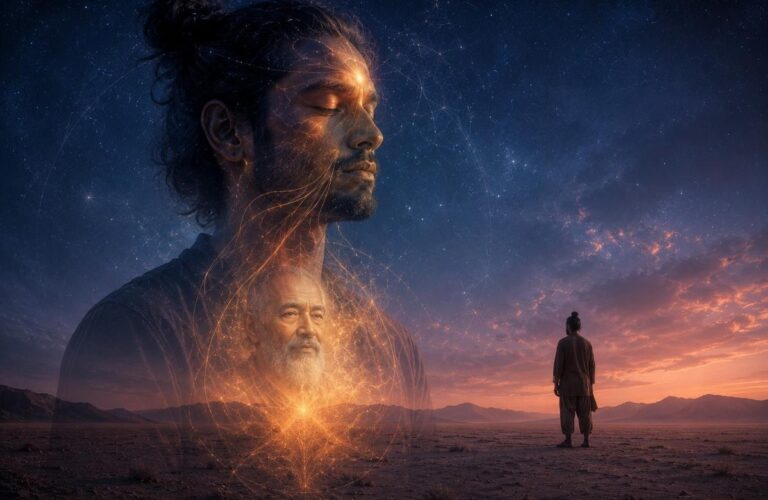
Embodiment Practices for Grounding: Returning to the Body After Awakening
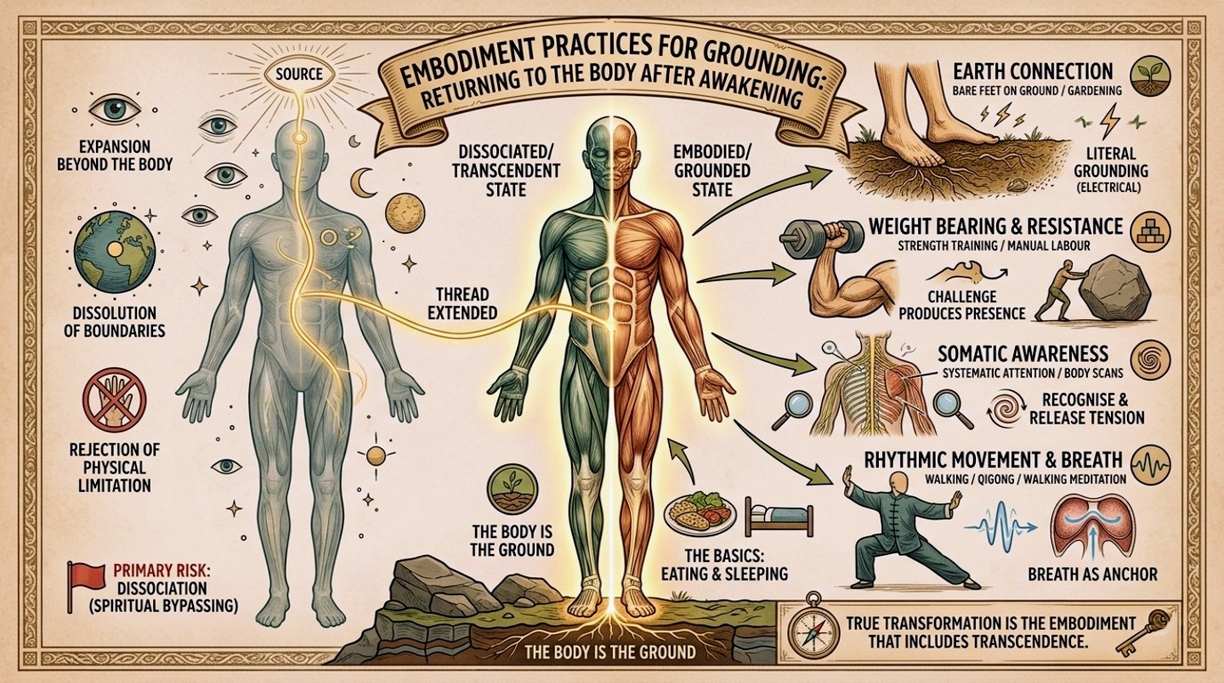
The experience is often disembodied–an expansion beyond the body, the dissolution of boundaries, and the transcendence of physical limitation. However, the return is mandatory. The archons may grant temporary leave from the Department of Terrestrial Affairs, but they expect you back at your desk, fully functional, and ready to file reports in triplicate.
The body is not an obstacle or a weight. It is the ground–the necessary condition for functioning, the instrument of expression, and the site of integration. Embodiment practices enable this return without losing the insights gained during recognition. Without them, you become a ghost haunting your own flesh, present but not accounted for, visible but not taxable.
The Gnostic distinction between hylic (material), psychic (soul), and pneumatic (spiritual) natures is not a hierarchy of contempt but a map of integration. The pneumatic, divorced from the hylic, is not enlightenment but dissociation. The thread extends through flesh, or it does not extend at all.

Table of Contents
- The Problem of Disembodiment
- 1. Earth Connection: Literal Grounding
- 2. Weight Bearing & Resistance
- 3. Somatic Awareness: The Internal Survey
- 4. Rhythmic Movement & Breath
- 5. The Basics: Biological Foundations
- The Sequence of Integration: Four Phases
- The Thread Extended
- Frequently Asked Questions
- Further Reading
- References and Sources
The Problem of Disembodiment
The Dissociation Risk
The primary risk of spiritual experience is dissociation. This is the preference for the expanded state, the rejection of physical limitation, and the use of transcendence to escape the “messiness” of life. If unrecognised, this produces spiritual bypassing and eventual crisis. The neglected body will eventually demand attention through symptoms–insomnia, anxiety, physical collapse, or the dreaded “kundalini syndrome” where your own nervous system files a grievance against upper management.
Spiritual bypassing, a term coined by John Welwood in 1984, describes the tendency to use spiritual practice to avoid dealing with unresolved emotional issues, psychological wounds, or basic developmental tasks. The practitioner who floats above their trauma in a cloud of “unconditional love” is not transcending; they are avoiding. The body keeps the score, and the debt accumulates interest until the collection agency arrives in the form of symptoms.
The Body as Department of Terrestrial Affairs
Consider your body not as prison but as administrative headquarters–the local office through which all cosmic correspondence must pass. The Pleroma may send down directives, but they are implemented through flesh, bone, and sinew. To ignore this infrastructure is to risk administrative failure: the lights stay on but nobody’s processing the paperwork.
The Gnostic tradition understood this. The Apocryphon of John describes the creation of the material body not as pure error but as the site where the divine spark is hidden–the pearl in the oyster, the treasure in the field. The body, in this view, is not the enemy of spirit but its necessary vessel. To reject the vessel is to lose the treasure.
1. Earth Connection: Literal Grounding
The Electrical Exchange
Bare feet on the ground, lying on the earth, or gardening. This contact produces literal grounding–the discharge of excess energy and the absorption of a stabilising charge. The practice is not merely symbolic; it is electrical. Research published in the Journal of Inflammation Research (Oschman, Chevalier & Brown, 2015) demonstrates that direct skin contact with the earth’s surface allows electron transfer from ground to body, reducing inflammation, improving blood viscosity, and normalising circadian cortisol rhythms. You are literally completing a circuit, allowing accumulated charge to drain into the earth’s capacitance while drawing up stabilising electrons through the soles.
Protocols for Contact
The most effective protocols involve skin-to-soil contact for minimum twenty minutes. Grass, sand, and bare soil prove most conductive; concrete and tarmac offer limited grounding capacity. Gardening combines the electrical exchange with purposeful manual labour–double indemnity against dissociation. The archons may control the airwaves, but their jurisdiction ends at ground level.
Water immersion–rivers, lakes, or the ocean–provides enhanced conductivity due to the dissolved minerals that facilitate electron transfer. The sea, particularly, offers the highest grounding potential combined with the rhythmic movement of waves. If you cannot access earth or water, grounding mats connected to the earth port of electrical outlets provide a partial substitute, though natural contact remains superior.
2. Weight Bearing & Resistance: Building Capacity
The Gravity of Presence
Strength training, carrying loads, or manual labour. The resistance encountered produces presence. The body, when challenged, demands immediate attention. This integrates the mind and body into the task at hand, building capacity rather than just fitness. Gravity is the original antagonist–the fundamental resistance against which consciousness defines itself. To bear weight is to negotiate terms with the primary archon.

Manual Labour as Meditation
Unlike abstract spiritual practice, manual labour offers no escape into fantasy. The stone must be lifted, the hole dug, the load carried. The body either manages or fails; there is no bureaucratic loophole, no administrative deferral. This honesty makes manual labour a profound meditative discipline–the attention, forced into immediate engagement with physical reality, cannot wander into conceptual abstraction.
The builder, the farmer, and the stonemason have long understood what the contemplative traditions formalise: that sustained physical effort produces a trance of presence more reliable than sitting meditation for the chronically dissociated. The body, exhausted, has no energy left for the narrative self. What remains is pure function–the self stripped to its operational minimum.
3. Somatic Awareness: The Internal Survey
Mapping the Territory
Systematic attention directed through the body (body scans, Feldenkrais, or the Alexander Technique). This allows you to recognise patterns of tension, collapse, or bracing. Recognition enables release, and release produces ease. Think of it as conducting a thorough audit of the Department of Terrestrial Affairs–identifying which departments are overstaffed (tension), which are under-resourced (collapse), and which have simply gone offline (numbness).

Recognition and Release
The body scan is not relaxation; it is attentiveness. The practitioner directs attention sequentially through body regions–feet, legs, pelvis, abdomen, chest, back, shoulders, arms, hands, neck, face, head. Each region, attended, reveals sensation: pressure, temperature, vibration, pain, ease, tension, release. The attention is curious, not judging. The observation, sustained, produces change–not through manipulation but through awareness itself.
This principle–that awareness itself is transformative–underlies not only body scan meditation but the entire somatic lineage from F.M. Alexander to Moshe Feldenkrais. The body, attended to without agenda, begins to reorganise. The shoulder that has been bracing for decades, once noticed, begins to soften. The jaw that has been clenched since childhood, once observed, begins to drop. The change is not forced; it is permitted.
4. Rhythmic Movement & Breath: The Living Pulse
Trance Without Dissociation
Walking, swimming, or qigong. Repetition produces a “trance without dissociation”–an embodied altered state where movement becomes meditation. Unlike the trance of digital scrolling or substance use, rhythmic movement anchors consciousness deeper into the body rather than extracting it. The rhythm becomes a metronome for presence, each step or stroke a reminder: here, now, here, now.
The Breath as Anchor
Not manipulation, but attention to the natural breath and the pause between. The breath is an anchor that is always available. The pneuma–spirit and breath in the ancient Greek, from πνέω (pnéō, “to blow”)–connects celestial and terrestrial. Conscious breathing maintains the thread of presence, preventing the dissociative drift that follows peak experience.
The pause between exhale and inhale, often overlooked, is the moment of maximum receptivity. In that gap, the body is neither pushing nor pulling; it is simply open. The yogic traditions call this kumbhaka; the Taoist traditions call it the gate of the mysterious female. Whatever the name, the practice is the same: attend to the breath, and the breath will teach you what the mind cannot grasp.
5. The Basics: Biological Foundations
Restoration Before Transcendence
Regular meals, adequate sleep, and physical care. These basics are often neglected in the pursuit of peak experiences. Their restoration produces the stability required for further practice. You cannot build a cathedral on quicksand; similarly, you cannot stabilise awakening while running on caffeine and four hours of sleep. The body has baseline requirements, and the archons of entropy enforce these regulations without exception.
The sleep requirement is not negotiable. During slow-wave sleep, the glymphatic system clears metabolic waste from the brain, including the amyloid proteins associated with neurodegeneration. The sleep-deprived brain is literally toxic–irritable, impulsive, and cognitively impaired. No amount of meditation compensates for chronic sleep debt. The ordinary saint goes to bed.
The Sequence of Integration: Four Phases
The order in which you apply these practices matters for your recovery and growth. Unlike the bureaucratic labyrinth, this sequence has logic:
Phase One: Immediate — Safety & Care
In the hours following peak experience, focus entirely on rest, earth connection, simple eating, and sleep. This is not the time for complex analysis or ambitious practice. The system has undergone voltage spike; allow the breakers to reset. Barefoot walking on grass, simple carbohydrates, and horizontal rest constitute the complete protocol.
Phase Two: Days After — Stabilisation
As the initial intensity subsides, introduce gentle movement, systematic somatic awareness, and breath attention. The body scan becomes essential here–mapping which circuits sustained damage during the peak, which regions remain numb, and which areas hold unprocessed charge. Continue earth connection daily.
Phase Three: Weeks After — Capacity Building
With stabilisation established, introduce strength training, rhythmic movement, and manual labour. These build the container–the muscular and nervous system capacity to hold higher voltage without breakdown. This phase transforms the peak from liability into resource, integrating the expanded capacity into functional embodiment.
Phase Four: Ongoing — Mastery
Embodiment becomes daily discipline, not merely recovery protocol. The practices integrate into lifestyle–earth connection becomes gardening, weight bearing becomes regular training, somatic awareness becomes continuous background attention. The thread extends not through occasional peaks but through persistent, ordinary grounding.

The Thread Extended
The thread extends through the body, or it does not extend at all. The transcendence that rejects embodiment is merely a bypass–spiritual tourism that photographs the Pleroma but never clears customs. True transformation is the embodiment that includes transcendence, the ground that receives the lightning without burning.
The Gnostic Gospel of Thomas declares that the kingdom is spread upon the earth, but people do not see it. The ordinary saint sees it–not through special vision but through ordinary attention. The kingdom is not elsewhere. It is here, in the weight of the stone, the coolness of the soil, the rhythm of the breath, the necessity of sleep. The thread is not a ladder to climb but a ground to stand upon.

You are the body. The practice, when applied, recognises this. The thread continues through flesh toward what that flesh manifests–not an escape from matter, but its completion.
Frequently Asked Questions
How soon after a peak experience should I start embodiment practices?
Begin immediately with Phase One protocols–earth connection and rest can commence within hours. However, respect the body’s need for integration time; forced or intensive practice too soon can exacerbate instability. Gentle attention to breath and sensation is appropriate immediately; weight-bearing exercise should wait until Phase Three (days to weeks later).
Why do I feel spaced out or disconnected after spiritual experiences?
This indicates dissociation–the consciousness preferring the expanded state over embodied presence. It is common but dangerous if prolonged. The body is sending vacancy notices; embodiment practices are the response that prevents permanent abandonment of the physical vehicle. Persistent dissociation may indicate spiritual emergency requiring professional support.
Can I use gym workouts for grounding, or does it need to be specific practices?
Standard gym workouts can serve grounding if approached with awareness–attention to sensation, proper breathing, and adequate recovery. However, earth connection specifically requires contact with actual soil or grass; no treadmill substitutes for barefoot walking. The intention matters more than the specific modality: dissociative running while watching screens differs qualitatively from mindful walking meditation.
What is kundalini syndrome and how do I avoid it?
Kundalini syndrome occurs when energetic awakening outpaces the nervous system’s capacity to contain it–voltage without grounding. Symptoms include insomnia, trembling, heat surges, and emotional lability. Prevention follows the Sequence of Integration: earth connection and rest before intensive practice, building somatic capacity gradually, and never forcing energetic processes. If symptoms emerge, prioritise Phase One protocols immediately.
How long should I spend on earth connection daily?
Minimum twenty minutes of skin-to-soil contact for noticeable physiological effect. Longer is better, but consistency outweighs duration–daily fifteen minutes surpasses occasional hour-long sessions. Morning grounding sets the day’s tone; evening grounding discharges accumulated charge. Gardening counts double: earth contact plus purposeful movement.
Is dissociation always negative, or can it serve spiritual development?
Temporary dissociation during peak experience is normal; persistent dissociation is pathological. The difference lies in return: healthy expansion contracts back to embodied presence, while unhealthy dissociation abandons the body indefinitely. The archons exploit this–ungrounded spirituality produces inflation, bypassing, or fragmentation. Integration is the measure of health, not the intensity of the peak.
Can embodiment practices replace formal meditation?
No–they complement it. Formal meditation develops concentration and insight; embodiment practices stabilise the vehicle that meditates. The integration of both produces complete practice: the mind develops capacity while the body develops container. Either alone proves insufficient; together, they extend the thread reliably.
Further Reading
- Nervous System Regulation: The New Meditation and Embodied Spirituality — Polyvagal-informed practices for stabilising the nervous system after peak experiences.
- The Gateway of Sensation: Body Scan and Somatic Awareness — Systematic techniques for the internal survey.
- The Body Against the Algorithm: Reclaiming Embodiment — Resistance strategies against digital capture and disembodiment.
- Return to Ordinary Life After Awakening — Navigating work and relationship post-recognition.
- Kundalini Phenomena: The Physiology of Awakening Energy — When embodiment is particularly necessary for energetic containment.
- Shadow Work: Excavation, Integration, and the Redeemed Archon — Psychological integration alongside somatic grounding.
- Default Mode Network Dissolution and the Architecture of the Self — Understanding the neurological shifts that require somatic stabilisation.
- Integration and Grounding: Making the Real Real — The broader context of stabilising expanded awareness.
References and Sources
The following sources informed the research and conceptual framework of this article. They are grouped by disciplinary category for navigability.
Transpersonal Psychology and Spiritual Emergency
- Grof, Stanislav, & Grof, Christina (Eds.). (1989). Spiritual Emergency: When Personal Transformation Becomes a Crisis. Los Angeles: J.P. Tarcher. Foundational work on spiritual emergency and the distinction between mystical experiences and psychopathology.
- Lukoff, David, Lu, Francis, & Turner, Robert (1998). “From Spiritual Emergency to Spiritual Problem: The Transpersonal Roots of a New Diagnostic Category.” Journal of Humanistic Psychology, 28(4), 21-31. Established the spiritual emergency framework within clinical psychology.
- Welwood, John (1984). “Spiritual Bypassing.” Journal of Transpersonal Psychology. Coined the term describing the use of spiritual practice to avoid unresolved psychological issues and developmental tasks.
Neuroscience and Physiology of Grounding
- Oschman, J. L., Chevalier, G., & Brown, R. (2015). “The Effects of Grounding (Earthing) on Inflammation, the Immune Response, Wound Healing, and Prevention and Treatment of Chronic Inflammatory and Autoimmune Diseases.” Journal of Inflammation Research, 8, 83-96. Review documenting electron transfer from earth to body, effects on inflammation, immune response, and circadian cortisol normalisation.
- Chevalier, G., Sinatra, S. T., Oschman, J. L., Sokal, K., & Sokal, P. (2012). “Earthing: Health Implications of Reconnecting the Human Body to the Earth’s Surface Electrons.” Journal of Environmental and Public Health, 2012, 291541. Foundational review establishing the physiological mechanisms of grounding through skin-to-earth contact.
- Newberg, A., & d’Aquili, E. (2001). Why God Won’t Go Away: Brain Science and the Biology of Belief. New York: Free Press. Neuroimaging studies of mystical states and the neurochemical recalibration involved in returning to baseline consciousness.
Kundalini and Energetic Phenomena
- Greenwell, Bonnie (1990). Energies of Transformation: A Guide to the Kundalini Process. Saratoga, CA: Shakti River Press. Detailed categorisation of kundalini symptoms and the distinction between awakening and emergency.
- Boyd, George A. (2004). “What is a Kundalini Emergency?” Mudrashram.com. Comprehensive overview of kundalini emergency symptoms, including physiological, emotional, and spiritual markers, with prevention and management strategies.
Philology and Etymology
- Liddell, H. G., & Scott, R. (1940). A Greek-English Lexicon. Oxford: Clarendon Press. Standard reference for πνεῦμα (pneuma) as breath, wind, spirit, and life-force in ancient Greek.
- Beekes, R. S. P. (2010). Etymological Dictionary of Greek. Leiden: Brill. Etymology of πνεῦμα from Proto-Indo-European *pnéwmn̥, confirming the root meaning “to blow, to breathe.”
Safety Notice: This article discusses intensive spiritual practices and energetic phenomena that can produce physical and psychological effects. It does not constitute medical, psychological, or therapeutic advice. If you experience persistent physical symptoms following intensive spiritual practice–including uncontrolled trembling, insomnia, heat surges, or dissociation–consult qualified medical professionals alongside experienced spiritual directors. Those with cardiovascular conditions should consult medical professionals before intensive breathwork. The practices described here complement but do not replace clinical mental health treatment.
The beings are real. The contact is possible. The path is open. Walk it with eyes open, heart engaged, and will aligned with the highest good of all beings.