
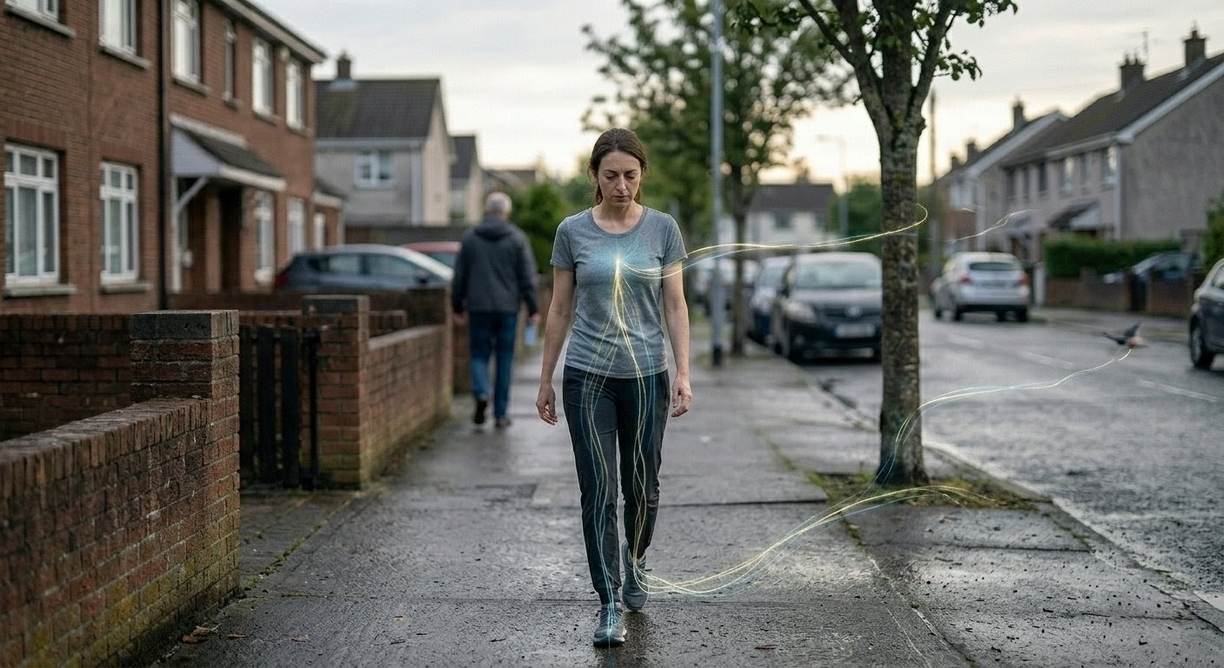
The Gateway of Movement: Walking Meditation and Circulation
The Gateway of Movement completes the Five Gateways by asking whether recognition can survive motion. Breath may settle the nervous system. Sensation may ground attention. Sound may gather the mind through rhythm. Vision may give attention a sacred form. But movement tests the whole structure. Can awareness remain present when the body walks, turns, reaches, circles, works, cooks, cleans, travels, tires, and returns to ordinary life?
Walking meditation and conscious movement are not escapes from life. They are the point where practice stops being an inner experience and becomes functional. The practitioner learns to feel the foot lift, move, touch, and receive weight. The breath continues. The body balances. The world appears. Attention remains with motion itself.
This article explores walking meditation, kinhin, cankama, circumambulation, devotional circling, Sufi whirling, bilateral rhythm, vestibular grounding, limitations, disability adaptation, false authority, and the integration of practice into ordinary movement. The aim is not athletic achievement, spiritual performance, or ecstatic intensity. The aim is embodied recognition: awareness that can walk.

In Plain Terms
The Gateway of Movement is the practice of carrying attention into walking, circling, gesture, dance, work, daily tasks, and ordinary bodily motion.
Walking meditation means making the movement itself the object of awareness: lifting the foot, moving forward, placing down, shifting weight, feeling contact, and returning when the mind wanders.
Movement completes the Five Gateways because it tests whether breath, sensation, sound, and vision can become lived presence rather than private states. The practice is not to leave the world. It is to move through it with less forgetting.
The safe approach is gradual, embodied, and adapted. Walking meditation can be slow, natural, seated, assisted, wheelchair-based, or shaped around whatever movement is actually available.
The discernment issue is false authority. False authority often immobilises the seeker: waiting for permission, signs, guru approval, the feed, the oracle, the AI answer, or perfect certainty. Movement restores agency. The body walks before the mind has finished building its prison.
Sources and Traditions Discussed
- Zen practice: especially kinhin, the slow walking meditation often practised between periods of seated meditation.
- Theravada Buddhism: especially cankama, walking meditation as a way of cultivating mindfulness, energy, and continuous attention.
- Hindu and Buddhist circumambulation: including pradakshina, walking around sacred objects, temples, shrines, stupas, or places of pilgrimage.
- Sufi movement practice: especially Mevlevi whirling as a formalised devotional art requiring training, care, and respect for its tradition.
- Embodiment and somatic practice: including proprioception, vestibular balance, bilateral rhythm, circulation, grounding, and trauma-sensitive movement.
- The Five Gateways: the ZenithEye practice route in which breath, sensation, sound, vision, and movement become entrances into direct knowing.
- Integration and grounding: especially the return from contemplative experience into walking, work, speech, relationship, limitation, and ordinary function.
- False-authority discernment: the way immobilisation, permission-seeking, spiritual dependency, algorithmic hesitation, and borrowed certainty can freeze action.
- Gnostic symbolic reading: where movement becomes a way of interrupting automatic behaviour and bringing gnosis into embodied life.
How to Read This Article
This article discusses walking meditation, devotional movement, circumambulation, dance, and whirling as contemplative practices. Read these as educational and reflective descriptions, not as personalised medical, psychological, physical therapy, movement instruction, or spiritual direction.
Movement practice should be adapted to the body you have, not the body imagined by spiritual ambition. People with vertigo, balance disorders, vestibular conditions, fainting risk, cardiovascular issues, mobility limitations, chronic pain, injury, neurological conditions, trauma sensitivity, panic, dissociation, or recent illness should approach carefully and seek qualified guidance where appropriate.
The measure of good movement practice is not speed, endurance, ecstasy, or display. The measure is integration: steadier attention, safer embodiment, clearer rhythm, and a more grounded return to ordinary life.
Movement becomes meditation when the body stops being a vehicle for distraction and becomes the field of recognition itself.
Table of Contents
- Movement as the Fifth Gateway
- Why Movement Completes the Practice
- The Physiology of Moving Meditation
- False Authority and the Frozen Body
- 1. Slow Walking: Zen Kinhin
- 2. Walking Meditation: Theravada Cankama
- 3. Circumambulation: Pradakshina and Sacred Circling
- 4. Dance and Whirling: Ecstatic Movement With Caution
- Daily Movement as Practice
- The Obstacles Are Familiar
- Movement, Limitation, and Accessibility
- The Integration Is the Point
- The Gnostic Reading: Motion Without Forgetting
- Related Glossary Terms
- Read Next
- Frequently Asked Questions
- Further Reading
- References and Sources
Movement as the Fifth Gateway
The first four gateways often begin in relative stillness. Breath is observed or shaped. Sensation is felt. Sound is repeated or listened for. Vision is held in form. Movement changes the difficulty. The body is no longer quietly available in one posture. It must balance, navigate, orient, step, turn, adjust, and respond.
This is why movement comes last in the sequence. It does not mean movement is spiritually superior. It means movement is integrative. It asks whether the previous gateways can remain alive when practice leaves the cushion and enters the path, street, garden, kitchen, room, or road.
The practitioner who can remain attentive while walking has discovered something essential: awareness is not limited to stillness. It can move. It can descend into the feet. It can survive a doorway. It can cross a room without immediately becoming thought.
Movement therefore becomes a test and a mercy. It reveals how quickly attention leaves the body, and it offers a way back through the very body that was forgotten.
Movement is also the gateway that exposes performance. A person may speak beautifully about awakening, stillness, symbols and direct knowing, yet stumble when the insight must enter ordinary rhythm. Walking meditation asks a wonderfully plain question: can the foot know what the tongue has claimed?
Why Movement Completes the Practice
Stillness is necessary, but it is not the whole of transformation. Many practitioners know the gap: a meditation feels clear, a retreat opens the heart, a practice session creates space, and then ordinary life reassembles its old machinery. The phone rings. Someone speaks sharply. Work begins. The body moves, and the insight thins.
Movement practice addresses this gap directly. It trains recognition to survive transition. The moment of standing up after meditation becomes part of meditation. The first step becomes practice. The walk to the sink becomes practice. The path outside becomes practice. The body is no longer a chair for spiritual experience. It becomes the living instrument of integration.
Movement also prevents a common imbalance: spiritual practice becoming too internal, too abstract, too head-centred, or too dependent on special conditions. Walking meditation brings attention into legs, feet, breath, balance, ground, and surroundings. The world is not excluded. It is included carefully.
The aim is not to maintain a dramatic mystical state while walking. The aim is simpler and more useful: to walk without abandoning oneself.
This is why the movement gateway belongs beside The Body Against the Algorithm. Digital life often trains the body into stillness without presence: seated, tense, reactive, half-breathing, eyes fixed on glow. Movement practice reclaims locomotion from automatic habit and returns the person to contact, rhythm and direction.
The Physiology of Moving Meditation
Moving meditation works through several embodied systems at once. The body must sense its position, maintain balance, regulate effort, track rhythm, adjust to terrain, and coordinate breath with motion. This makes movement a strong grounding practice for many people.
Proprioception and Body Position
Proprioception is the body’s sense of position and movement. It allows you to know where your limbs are without looking. Walking meditation uses proprioception as an anchor. The practitioner feels the foot lifting, the leg moving, the heel or sole touching, the weight transferring, and the body adjusting.
This stream of bodily feedback can keep attention tethered to the present. Unlike abstract contemplation, walking gives the mind an immediate body-based task. If attention wanders, the feet are still there, patiently reporting reality through pressure, texture, weight, and rhythm.
The Vestibular System and Balance
The vestibular system, located in the inner ear, helps regulate balance and spatial orientation. Movement practices that involve walking, turning, circling, or dancing engage this system directly. That can be grounding for some people and destabilising for others.
Slow walking can help orient the body in space. Gentle turning can make balance conscious. But fast spinning or whirling can overwhelm the vestibular system, especially for beginners, people with vertigo, balance disorders, migraine, neurological conditions, or recent illness.
The point is not to challenge the body into collapse. The point is to let the body teach attention through balance.
Bilateral Rhythm and Nervous-System Integration
Walking naturally alternates left and right. This bilateral rhythm can feel regulating because it gives the nervous system a steady pattern: left foot, right foot, left foot, right foot. The arms may swing. The breath finds cadence. The body becomes metronome and ground at once.
It is tempting to overstate this with dramatic brain claims. The safer observation is enough: rhythmic bilateral movement can support orientation, steadiness, and embodied attention. The nervous system often likes rhythm because rhythm gives it something reliable to anticipate.
False Authority and the Frozen Body
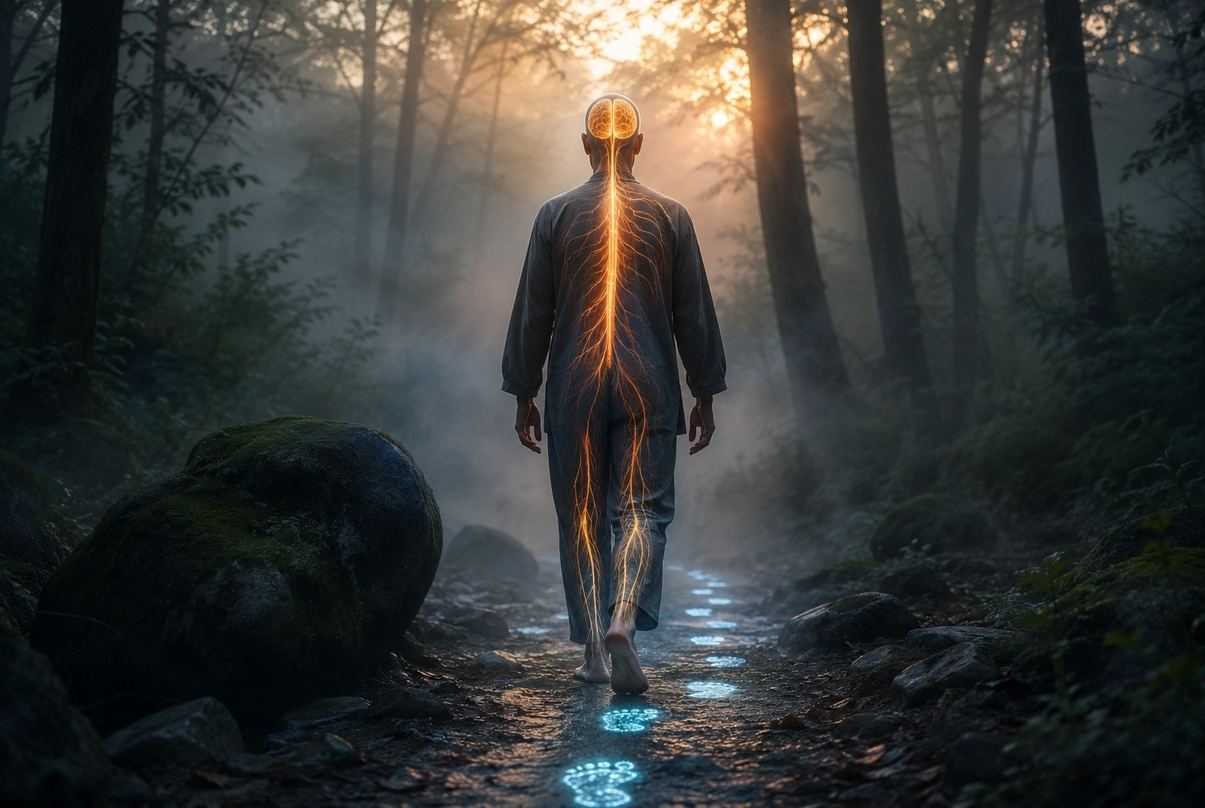
False authority often immobilises before it commands. It trains the seeker to wait: wait for permission, wait for the sign, wait for the guru, wait for the feed, wait for the oracle, wait for the AI answer, wait for the perfect certainty that will remove all risk from action. The result is not humility. It is frozen agency.
This is where the Gateway of Movement meets Neo Gnosticism and False Authority. False authority is not merely bad advice. It is the theft of the faculty that tests, chooses and acts. When that faculty is stolen, the body may become strangely still: watching, refreshing, consulting, rereading, seeking confirmation, waiting for a voice outside itself to approve the next step.
The frozen body has many disguises. It can look like spiritual patience, research, discernment, reverence, loyalty, caution, or humility. Some waiting is wise. Some waiting is fear dressed in incense. The difference is revealed by the body. Wise waiting feels spacious enough to breathe. Captured waiting feels tight, repetitive, hungry, and dependent on external approval.
Movement restores agency without demanding reckless action. The first step is not a conquest. It is a vote for embodied responsibility. Feel the feet. Stand. Walk to the door. Wash the cup. Step outside. Move before the mind has finished polishing its prison bars. The body does not need perfect metaphysics to begin returning to life.
This does not mean action is always better than stillness. Sometimes the most truthful movement is to stop, rest, withdraw, refuse, or sit down. The point is not constant activity. The point is that the movement or stillness should arise from direct knowing, not from capture by a guru, group, feed, machine answer, symbolic omen, or inner authoritarian voice.
The previous gateways help test this. Sensation asks what the body feels. Sound asks whose voice is being obeyed. Vision asks what image has captured the eye. Movement asks the final question: can recognition become action?
False authority says wait until certainty is perfect. Movement says feel the ground and take the honest step.
In this sense, walking meditation is not passive. It is a quiet rebellion against immobilisation. Each step says: I will not outsource my body to fear. I will not wait forever at the gate of borrowed permission. I will move with care, and I will learn by moving.
1. Slow Walking: Zen Kinhin
Kinhin is the walking meditation practised in Zen contexts, often between periods of seated meditation. In some forms, the hands are held in a particular position, the steps are small, the pace is slow, and the attention remains with the movement of the body.
Kinhin is not a break from meditation. It is meditation changing posture. Sitting becomes standing. Standing becomes walking. The same attention that watched breath or posture now watches the step.
A simple approach:
- Stand upright but relaxed.
- Let the gaze rest softly ahead or slightly downward.
- Feel both feet on the ground.
- Lift one foot slowly.
- Move it forward.
- Place it down with attention.
- Shift weight gradually.
- Repeat without rushing.
The slowness is not affectation. It magnifies the ordinary. Each step becomes large enough to see. The practitioner discovers how much usually happens below the threshold of attention: lift, balance, micro-adjustment, contact, weight, release.
Slow walking is especially useful when the mind is agitated. It gives restlessness a narrow path. The body is allowed to move, but the movement is disciplined enough to calm the storm.
2. Walking Meditation: Theravada Cankama
Cankama, or walking meditation in Theravada Buddhist contexts, can be practised slowly, naturally, or at a moderate pace. It often involves walking back and forth along a path while maintaining mindfulness of the body and movement.
Where very slow walking emphasises precision, cankama can emphasise continuity. The practitioner walks, turns, walks back, turns again, and remains with the embodied flow. The object may be the feet, the legs, the whole body walking, or simple knowing of motion.
A gentle method:
- Choose a short, safe walking path.
- Stand still and feel the body.
- Begin walking at a comfortable pace.
- Notice the contact of the feet with the ground.
- When the mind wanders, return to the step.
- At the end of the path, stop, feel the turn, and walk back.
Cankama can help when seated practice becomes dull, sleepy, or abstract. Movement brings energy. The body wakes. Attention becomes less cloudy. The practitioner learns that mindfulness is not confined to the posture of stillness.
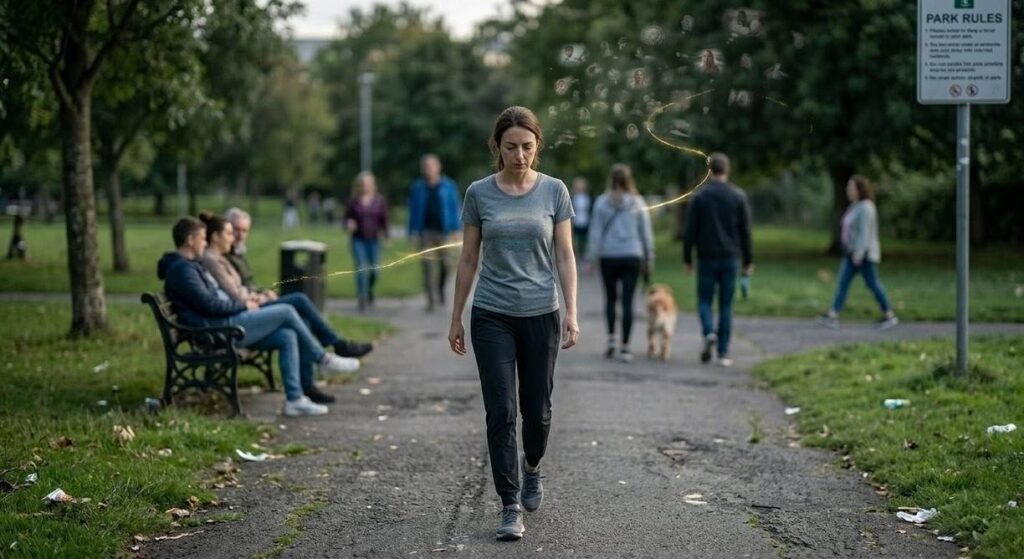
For many modern readers, ordinary walking meditation is the most practical gateway of movement. It can be done in a garden, hallway, park, quiet street, or room. No special display is required. The foot touches the earth. That is enough.
3. Circumambulation: Pradakshina and Sacred Circling
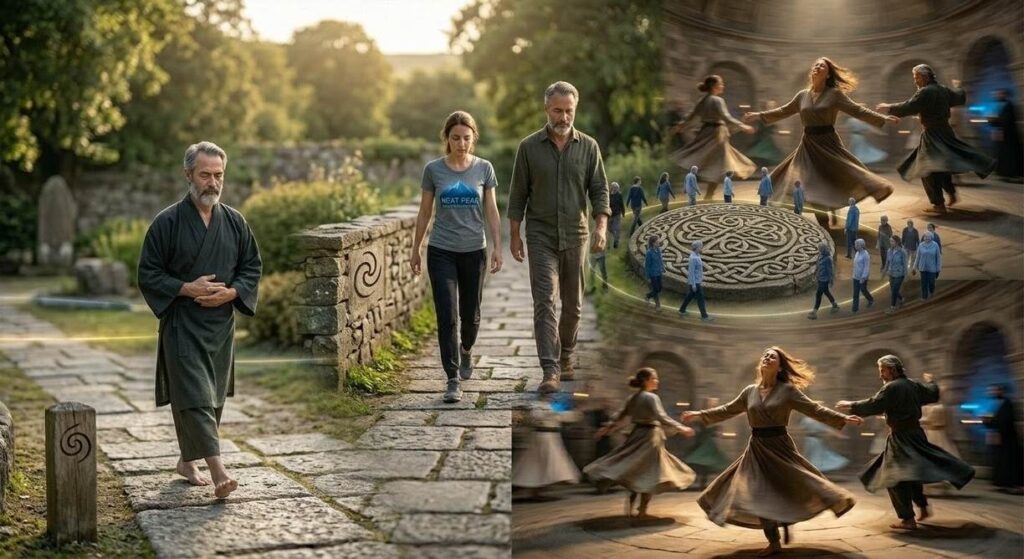
Circumambulation means walking around a sacred object, shrine, temple, stupa, mountain, tree, altar, relic, image, fire, or meaningful centre. In Indian traditions, pradakshina often refers to clockwise circumambulation, keeping the sacred object to the right side. In Buddhist contexts, walking around stupas and sacred sites is also common.
The logic is beautifully simple. The body circles what it honours. The centre remains still. The practitioner moves around it. Attention returns again and again to the same source. Devotion becomes spatial. Prayer grows legs.
Circumambulation may be formal or simple. A traditional temple practice carries inherited rules, gestures, mantras, directions, and meanings. A private practice might involve walking around a garden tree, a candle, a stone, a home altar, or a circle of leaves. The key is not theatrical holiness. The key is relationship to centre.
In practice, choose one centre. Walk around it slowly. Let the eyes soften. Let the body feel the circle. Notice whether attention stays with the centre or drifts into thought. Each circuit becomes a return.
This practice is useful for the heart because it replaces conquest with orbit. The practitioner does not seize the centre. They revolve around it.
Circumambulation also teaches a subtle antidote to false authority. The centre is honoured, but not consumed. The practitioner moves in relationship rather than possession. A healthy centre does not demand paralysis. It allows motion around it.
4. Dance and Whirling: Ecstatic Movement With Caution
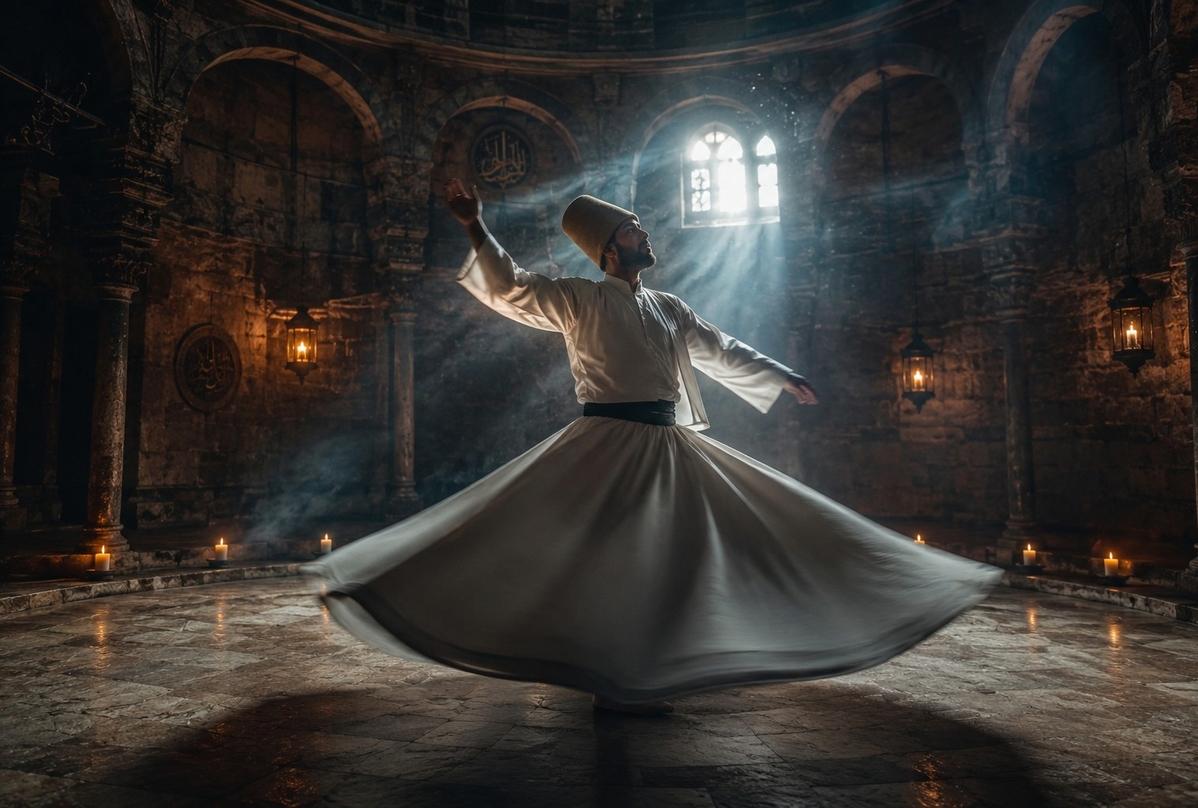
Sacred dance appears across many traditions. The body moves rhythmically, sometimes with music, chant, drum, breath, gesture, or group structure. Movement can soften the defended self, release emotion, awaken vitality, and create states of unity that are difficult to reach through stillness alone.
Sufi whirling is one of the best-known examples, especially in the Mevlevi tradition associated with the sema ceremony. It is a formal devotional art, not casual spinning for instant ecstasy. Traditional whirling requires training, posture, balance, ritual context, and deep respect for the lineage.
For beginners, whirling should not be imitated intensely. Untrained spinning can cause dizziness, nausea, falls, disorientation, migraine, panic, or injury. People with vertigo, vestibular conditions, balance disorders, neurological concerns, pregnancy, recent illness, fainting risk, or injury should avoid it unless guided by qualified support and medically appropriate.
The wider lesson of sacred dance can still be approached gently. Stand. Feel the feet. Let the arms move slowly. Walk in a small circle. Sway with breath. Let the body express attention without losing balance. Ecstasy without grounding is weather. Embodied joy with balance becomes practice.
Daily Movement as Practice
The movement gateway becomes most useful when it leaves the formal path and enters ordinary life. Washing a cup, opening a door, walking upstairs, carrying firewood, folding clothes, stretching before sleep, gardening, standing in a queue, walking to the bus stop, or moving through a room can all become brief forms of practice.
The method is not complicated:
- Slow slightly: reduce speed enough to notice the body.
- Feel contact: feet, hands, surface, tool, object, air, or floor.
- Track one action: lifting, reaching, placing, turning, stepping, opening, closing.
- Let breath remain present: not controlled, simply included.
- Finish one movement consciously: completion teaches the nervous system to settle.
This kind of practice is quietly revolutionary. It removes the false division between spiritual time and ordinary time. The sacred is not waiting for incense. It is hiding inside the hand reaching for the kettle.
Daily movement is also the place where practice becomes resistant to glamour. No one can easily monetise the moment you feel your feet while sweeping a floor. No algorithm can fully capture the dignity of one conscious step in an unphotographed room. These small movements are too ordinary to impress, which is why they are difficult for the counterfeit to own.
The Obstacles Are Familiar
Movement practice reveals the same obstacles as sitting practice, but it reveals them through action.
Distraction
The mind wanders. It plans, remembers, judges, narrates, compares, and wanders again. In walking meditation, the return is physical. Come back to the feet. Feel the ground. Let the next step be known.
Distraction is not failure. It is the old pattern becoming visible. Each return strengthens the bridge between attention and body.
Self-Consciousness
Movement practice can trigger self-consciousness. Am I walking strangely? Does this look odd? Is someone watching? This is useful information. The social self wants to manage appearance. The practice reveals how much movement is shaped by imagined judgement.
Do not fight self-consciousness. Feel it. Notice the tightening. Then return to the step. Practice does not require dramatic public display. A quiet room, garden, or ordinary walk may be enough.
Restlessness
Some bodies want to move faster. Some minds resist slowness. Restlessness may need a natural walking pace before very slow walking becomes possible. The gateway is not a punishment. Adjust the speed. Let the body enter gradually.
Over-Intensity
At the other end, some readers may chase intense movement, trance, spinning, exhaustion, or emotional release. That is not necessarily integration. Movement can become another way to avoid stillness.
The safest test is simple: after practice, are you more grounded, more regulated, and more capable of ordinary life? If not, simplify.
Frozen Waiting
Another obstacle is the opposite of restlessness. The body stops. The mind waits. The seeker delays every ordinary action until some higher confirmation arrives. This may feel spiritual, but often it is fear of responsibility wearing contemplative robes.
When frozen waiting appears, do not force dramatic action. Choose a small honest movement. Stand up. Feel the floor. Walk across the room. Wash one cup. Open one window. Let the body discover that agency can return by degrees.
Movement, Limitation, and Accessibility
The Gateway of Movement is not limited to people who can walk easily. Movement practice is not athletic performance. It is attention in motion, and motion can be small, assisted, seated, slow, partial, internal, or adapted.
A wheelchair user may practise with the motion of hands on wheels, the shift of body weight, the rhythm of turning, the sensation of movement through space, and the contact between body and chair. A person with limited mobility may practise with small hand movements, gentle head turning, breath-linked gesture, seated rocking, stretching, or the felt intention to move.
A person in pain may practise by noticing the difference between safe movement and strain. A tired person may practise by walking slowly for two minutes rather than twenty. An older body may teach patience that younger bodies often miss.
The thread extends through attention, not through capacity. The practice belongs to the body as it is.
The Integration Is the Point
Movement practice integrates what stillness can separate. The recognition found in meditation is tested in action. The concentration built through sound is tested in walking. The centredness cultivated through yantra is tested in turning, reaching, and ordinary task. The grounding found through sensation is tested on actual ground.
This integration is not automatic. The practitioner will forget. They will walk into thought. They will move too fast. They will become self-conscious. They will chase a destination. Then, at some point, the foot touches the floor and attention returns.
That return is the practice. Not perfection. Not uninterrupted sacredness. Return.
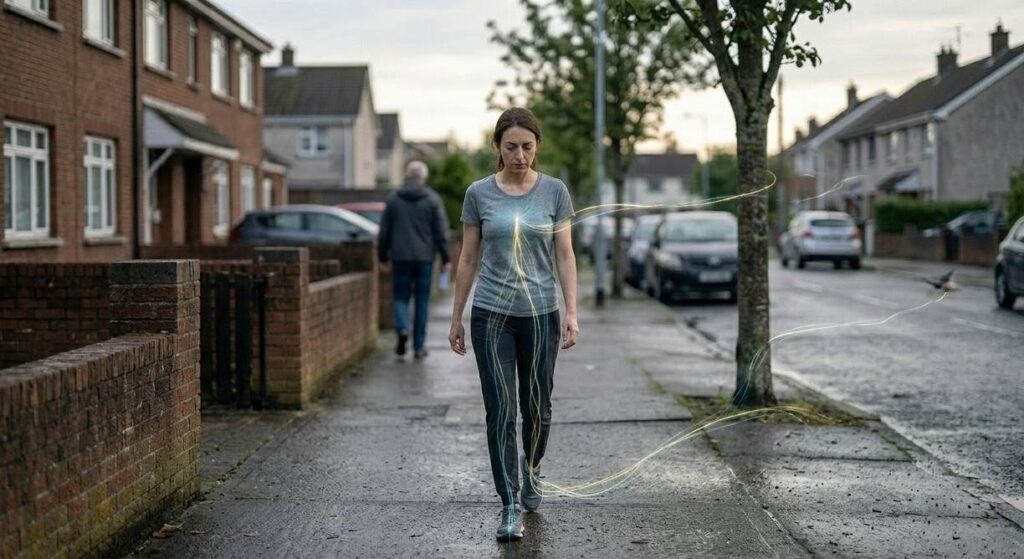
The mature fruit of movement practice is simple presence in function. The person walks, works, relates, rests, and acts with less division between inner recognition and outer life. Spiritual practice becomes less visible because it has become more embodied. The flame is no longer being advertised in the window. It is quietly heating the house.
Movement therefore completes the gateway sequence by dissolving the fantasy that practice belongs only to rare states. Breath, sensation, sound and vision become trustworthy when they can walk into the kitchen, answer the phone, cross a threshold, tend a garden, carry grief, and return to the floor.
The Gnostic Reading: Motion Without Forgetting
Gnostic myth often speaks of forgetting: the soul enters the world and becomes identified with pattern, authority, appetite, fear, imitation, and sleep. In symbolic language, ordinary movement can become part of that forgetting. The body moves, but awareness is absent. The person walks, but the mind is elsewhere. Life is lived on automatic pilot.
The Gateway of Movement interrupts this automaticity. The step becomes known. The hand becomes known. The turn becomes known. The body, usually treated as transport, becomes revelation.
This does not reject the world. It enters it more fully. The Gnostic error would be to imagine liberation as floating above ordinary function. Movement practice says otherwise. Walk here. Feel this floor. Carry this cup. Turn this key. Answer this person. Let recognition enter the actual gesture.
The Archonic pattern, read symbolically, rules through unconscious repetition. Movement practice brings repetition into awareness. Walking becomes a way of refusing to be moved only by habit. Each step can be a small act of remembering.
False authority adds another layer to this reading. It does not only mislead the mind. It can freeze the body at the edge of life, trapped in consultation, obedience, hesitation and borrowed timing. Movement breaks that spell carefully. The seeker does not need to become reckless. They need to become responsive again.
The fifth gateway therefore completes the sequence not by ending practice, but by returning it to life. You move. You remember. You forget. You return. The thread continues through the body in motion.
Related Glossary Terms
For quick definitions, use the main ZenithEye Glossary. The key terms for this article are:
Read Next
Continue with: Creating Your Personal Practice: Selecting and Combining the Five Gateways
If this article completes the five-gateway sequence through movement, the next step is integration by design: choosing the right combination of breath, sensation, sound, vision, and movement for your actual body, temperament, life rhythm, and practice needs.
Within Practice & Method
This article belongs to The Five Gateways and Embodiment Practices, the Practice & Method route where breath, sensation, sound, vision, movement, silence, grounding, and daily function become practical entrances into direct knowing.
Frequently Asked Questions About Walking Meditation and Movement Practice
What is the Gateway of Movement?
The Gateway of Movement is the practice of carrying attention into walking, circling, gesture, dance, work, daily tasks, and ordinary bodily motion. It completes the Five Gateways by testing whether recognition can remain present while the body acts in the world.
What is the difference between walking meditation and ordinary walking?
Ordinary walking usually aims at getting somewhere while the mind plans, remembers, or wanders. Walking meditation makes the movement itself the object of attention. The practitioner notices lifting, moving, placing, weight shift, contact with ground, breath, balance, and the return of attention whenever the mind drifts.
How does movement practice help with false authority?
Movement practice helps by restoring embodied agency. False authority often immobilises the seeker through waiting, permission-seeking, guru dependence, algorithmic hesitation, or the search for perfect certainty. Walking meditation brings attention back to the body and makes the next honest step possible.
What is Zen kinhin?
Kinhin is Zen walking meditation, often practised between periods of seated meditation. It is usually slow, precise, and grounded. The point is not to take a break from meditation, but to continue meditative awareness while standing and walking.
What is cankama in Buddhist practice?
Cankama is walking meditation in Theravada Buddhist contexts. It may be practised slowly, naturally, or at a moderate pace along a walking path. The practitioner maintains mindfulness of the body, the feet, the movement, or the whole act of walking.
Can I practise walking meditation with mobility limitations?
Yes. Movement practice is not athletic achievement. It is attention in whatever movement is available. A wheelchair user can attend to hand motion, wheel movement, posture, and contact. A person with limited mobility can practise with small steps, seated movement, gentle hand gestures, breath-linked motion, or the felt intention to move.
Is Sufi whirling safe for beginners?
Formal Mevlevi whirling is a trained devotional art and should not be imitated intensely by beginners. Untrained spinning can cause dizziness, nausea, falls, migraine, panic, or injury. People with vertigo, vestibular conditions, balance disorders, neurological concerns, fainting risk, pregnancy, or recent illness should avoid whirling unless it is medically appropriate and properly guided.
What should I do when I get distracted while walking?
Return to the body. Feel the feet, the ground, the weight shift, and the next step. Distraction is not failure. It is the old pattern becoming visible. Each return strengthens the bridge between attention and movement.
How does movement practice relate to Gnostic practice?
In a Gnostic symbolic reading, movement practice interrupts automaticity. The body often moves while awareness is absent. Walking meditation brings motion into conscious relationship, turning ordinary steps into acts of remembering rather than unconscious repetition.
Study and Safety Note
This article explores walking meditation, movement-based contemplation, circumambulation, sacred dance, whirling, balance, vestibular awareness, embodied practice, altered states, and Gnostic symbolism for educational and reflective purposes. It does not provide medical, psychological, psychiatric, neurological, physical therapy, movement-instruction, or spiritual-direction advice.
Movement practice may be unsuitable or require adaptation for people with vertigo, balance disorders, vestibular conditions, cardiovascular concerns, fainting risk, neurological conditions, mobility limitations, chronic pain, injury, pregnancy, panic, dissociation, trauma sensitivity, or recent illness. Practise in a safe space, use support where needed, and stop if dizziness, nausea, pain, loss of balance, panic, visual disturbance, chest pain, or distress appears.
Sufi whirling and other intense rotational practices require proper training and are not recommended as casual beginner practices. Walking meditation and gentle movement can support grounding, but they do not replace medical care, physiotherapy, trauma-informed support, or mental health treatment.
For the authority layer, read this article beside Neo Gnosticism and False Authority. Movement practice is healthiest when it restores embodied agency, not when it becomes another performance or another demand for obedience.
Further Reading
These ZenithEye links continue the themes of movement, embodiment, the Five Gateways, grounding, false authority, return, and ordinary-life integration:
- Creating Your Personal Practice: Selecting and Combining the Five Gateways – The next step after completing the gateway sequence, showing how to combine breath, sensation, sound, vision, and movement into a realistic personal practice.
- Neo Gnosticism and False Authority – Gurus, algorithms, AI advisers, spiritual outsourcing and the theft of direct knowing.
- The Body Against the Algorithm – Embodied agency in a screen-trained world of capture, abstraction and false authority.
- The Five Gateways to Direct Knowing: A Complete Map – The wider gateway architecture of breath, sensation, sound, vision, and movement.
- The Gateway of Sensation: Body Scan and Somatic Awareness – The embodied foundation that movement extends into activity.
- The Gateway of Breath: Pranayama Techniques for Altered States – Breath as the first gateway and the regulating basis for movement practice.
- The Gateway of Sound: Mantra and Nada Yoga – Sound, rhythm, vibration, and listening as supports for movement and walking meditation.
- The Gateway of Vision: Yantra and Mandala Practice – Visual concentration and centre-periphery practice before returning form into motion.
- The Ordinary Saint: Invisibility as Completion – The completion of practice when transformation becomes ordinary, embodied, and unperformed.
- The Return to Ordinary Life After Awakening – How recognition is tested by work, relationship, function, and daily responsibilities.
- Integration and Grounding After Awakening – Somatic and practical approaches to stabilising insight in ordinary life.
- Recognising Completion vs Chasing Peaks – How to recognise when practice has become steadier rather than merely more intense.
- Nervous System Regulation: The New Meditation and Embodied Spirituality – Why regulation, grounding, and body-based safety matter for contemplative life.
- Contemplative Techniques: Methods for Stabilisation – Integrating walking meditation and movement into a wider contemplative framework.
References and Sources
The following sources support the Buddhist, Hindu, Sufi, somatic, psychological, and integration framework used in this article.
Primary Sources and Traditional Texts
- Satipatthana Sutta (MN 10). Pali Canon, Majjhima Nikaya.
- Cankama Sutta (AN 5.29). Pali Canon, Anguttara Nikaya.
- Dogen Zenji. Eihei Koroku and related Soto Zen monastic materials on zazen, posture, and walking practice.
- Dogen Zenji. Shobogenzo. Writings on practice-realisation, body, and ordinary activity in Soto Zen tradition.
- Jalal al-Din Rumi. Mathnawi. Foundational poetic and devotional source within the wider Mevlevi context.
- The Philokalia. Selected writings on watchfulness, prayer, and bodily attention in Eastern Christian contemplative practice.
Walking Meditation, Buddhism, and Contemplative Movement
- Gunaratana, Bhante Henepola. Mindfulness in Plain English. Wisdom Publications. Includes accessible discussion of mindfulness, posture, and practice continuity.
- Nyanaponika Thera. The Heart of Buddhist Meditation. Buddhist Publication Society, 1962.
- Nyanatiloka Mahathera. Buddhist Dictionary: Manual of Buddhist Terms and Doctrines. Buddhist Publication Society.
- Thich Nhat Hanh. Walking Meditation. Parallax Press, 2015.
- Hanh, Thich Nhat. The Long Road Turns to Joy: A Guide to Walking Meditation. Parallax Press, 1996.
- Loori, John Daido. The Art of Just Sitting. Wisdom Publications, 2002. Soto Zen context for seated and walking practice.
- Kapleau, Philip. The Three Pillars of Zen. Beacon Press, 1965. Includes Zen practice context and retreat discipline.
Circumambulation, Devotional Walking, and Sacred Space
- Encyclopaedia Britannica. “Pradakshina.” Overview of Indic circumambulation practice.
- Eck, Diana L. India: A Sacred Geography. Harmony, 2012.
- Kramrisch, Stella. The Hindu Temple. University of Calcutta, 1946.
- Snodgrass, Adrian. The Symbolism of the Stupa. Southeast Asia Program Publications, Cornell University, 1985.
- Coleman, Simon and Elsner, John. Pilgrimage: Past and Present in the World Religions. Harvard University Press, 1995.
- Turner, Victor and Turner, Edith. Image and Pilgrimage in Christian Culture. Columbia University Press, 1978.
Sufi Whirling, Sacred Dance, and Ecstatic Movement
- Lewis, Franklin D. Rumi: Past and Present, East and West. Oneworld, 2000.
- Schimmel, Annemarie. Mystical Dimensions of Islam. University of North Carolina Press, 1975.
- During, Jean. The Spirit of Sounds: The Unique Art of Ostad Elahi. Associated University Presses, 2003.
- Friedlander, Shems. The Whirling Dervishes. SUNY Press, 1992.
- Studies in Frontiers in Human Neuroscience and related neuroscience literature on Mevlevi semazens, balance, vestibular adaptation, and trained whirling.
- Hanna, Judith Lynne. To Dance Is Human: A Theory of Nonverbal Communication. University of Chicago Press, 1979.
Body, Movement, Neuroscience, and Somatic Practice
- Sherrington, Charles. The Integrative Action of the Nervous System. Yale University Press, 1906. Foundational work in proprioception and nervous-system integration.
- Proske, Uwe and Gandevia, Simon C. “The Proprioceptive Senses: Their Roles in Signaling Body Shape, Body Position and Movement, and Muscle Force.” Physiological Reviews, 92(4), 1651-1697, 2012.
- Dieterich, Marianne and Brandt, Thomas. “Functional Brain Imaging of Peripheral and Central Vestibular Disorders.” Brain, 131(10), 2538-2552, 2008.
- Ratey, John J. Spark: The Revolutionary New Science of Exercise and the Brain. Little, Brown, 2008.
- Payne, Peter, Levine, Peter A., and Crane-Godreau, Mardi. “Somatic Experiencing: Using Interoception and Proprioception as Core Elements of Trauma Therapy.” Frontiers in Psychology, 2015.
- Mehling, Wolf E., et al. “Body Awareness: A Phenomenological Inquiry into the Common Ground of Mind-Body Therapies.” Philosophy, Ethics, and Humanities in Medicine, 6, 6, 2011.
- Ogden, Pat, Minton, Kekuni, and Pain, Clare. Trauma and the Body: A Sensorimotor Approach to Psychotherapy. W. W. Norton, 2006.
Meditation, Trauma, Integration, and Ordinary Life
- Kabat-Zinn, Jon. Full Catastrophe Living. Delacorte, 1990.
- Treleaven, David A. Trauma-Sensitive Mindfulness: Practices for Safe and Transformative Healing. W. W. Norton, 2018.
- van der Kolk, Bessel. The Body Keeps the Score: Brain, Mind, and Body in the Healing of Trauma. Viking, 2014.
- Kornfield, Jack. After the Ecstasy, the Laundry. Bantam, 2000.
- Welwood, John. Toward a Psychology of Awakening. Shambhala, 2000.
- Grof, Stanislav and Grof, Christina. Spiritual Emergency: When Personal Transformation Becomes a Crisis. Tarcher, 1989.
- Lindahl, Jared R., et al. “The Varieties of Contemplative Experience: A Mixed-Methods Study of Meditation-Related Challenges in Western Buddhists.” PLOS ONE, 12(5), 2017.
Gnostic and Comparative Context
- Robinson, James M., ed. The Nag Hammadi Library in English. Revised edition. HarperOne, 1990.
- Meyer, Marvin, ed. The Nag Hammadi Scriptures. HarperOne, 2007.
- Layton, Bentley. The Gnostic Scriptures. Yale University Press, 1987.
- Brakke, David. The Gnostics: Myth, Ritual, and Diversity in Early Christianity. Harvard University Press, 2010.
- King, Karen L. What Is Gnosticism?. Harvard University Press, 2003.
- Williams, Michael Allen. Rethinking Gnosticism: An Argument for Dismantling a Dubious Category. Princeton University Press, 1996.
- Copenhaver, Brian P. Hermetica: The Greek Corpus Hermeticum and the Latin Asclepius. Cambridge University Press, 1992.


