Simulation Hypothesis: Is Reality a Computational Construct?
The simulation hypothesis asks whether the world we experience is base reality, or a generated environment running on a deeper substrate. It does not prove that reality is code, and it should not be treated as scientific fact. But it remains one of the strangest modern bridges between philosophy, digital physics, artificial intelligence, consciousness studies, and ancient Gnostic suspicion: the visible world may be real as experience without being ultimate as truth.
The question is not new. Plato’s cave, Descartes’ deceiving demon, dream arguments, idealist philosophies, science fiction, and Gnostic cosmology all circle the same unease: what if the world as given is not the world as ultimate? The simulation hypothesis translates that ancient tremor into technological language. Instead of cave shadows, it gives us rendering. Instead of a deceiving demon, it gives us system architecture. Instead of the Demiurge alone, it gives us world-builders, substrates, agents, computation, and the possibility of generated minds.
Yet the most important question is not whether reality is literally running on alien hardware. That version may be impossible, unfalsifiable, or too narrow. The deeper question is whether ordinary perception is already mediated: by brain, language, culture, physics, memory, technology, desire, and unseen constraints. The world may not need to be a computer simulation to be less direct than it appears.
For a Gnostic reading, this is the useful doorway. The simulation hypothesis becomes spiritually interesting when it loosens the spell of finality. It reminds the seeker that a world can be vivid, lawful, beautiful, painful, and morally serious, while still not being the Fullness.

In Plain Terms
The simulation hypothesis proposes that what we call reality could be a highly advanced generated environment. Our universe, bodies, memories, laws of physics, and histories might be produced within a deeper system rather than existing as final, self-standing reality.
Philosopher Nick Bostrom gave the idea its most famous modern form in 2003. His argument does not say, “we are definitely living in a simulation”. It says that if advanced civilisations can create many conscious simulations, and if they choose to do so, then simulated minds could vastly outnumber non-simulated minds. In that case, a being like us might be more likely to be simulated than original.
The hypothesis remains speculative. It is not settled science. It may be unfalsifiable, consciousness may not be computable, and simulating an entire universe may be physically impossible. But it is still philosophically powerful because it forces a deeper question: how much of what we call reality is direct, and how much is rendered, mediated, filtered, or interpreted?
Primary Sources and Traditions Discussed
- Nick Bostrom’s simulation argument, especially the 2003 philosophical trilemma about extinction, disinterest, and simulation.
- Substrate independence, the idea that consciousness might not require biological neurons, but could run on another suitable physical or computational substrate.
- Digital physics, including theories and metaphors that treat information, state, computation, or discrete structure as central to physical reality.
- The holographic principle, the idea from quantum gravity that the information content of a region may be related to boundary area rather than volume.
- Quantum measurement, including the role of measurement, indeterminacy, and interpretation in physical theory.
- Philosophy of mind, especially the hard problem of consciousness, computation, subjective experience, and whether simulated minds could have moral status.
- Gnostic cosmology, including the Demiurge, Archons, crafted worlds, mediated reality, divine spark, and gnosis as recognition.
- Modern AI world models, including generated environments, simulation technologies, artificial agents, and the ethics of world-creation.
How to Read This Article
This article treats the simulation hypothesis as philosophy, symbolism, and speculative inquiry, not as confirmed physics. It should not be used to encourage paranoia, derealisation, spiritual inflation, or certainty that ordinary life is fake.
The world may be mediated without being meaningless. A dream can matter while it is dreamt. A story can transform the reader. A virtual environment can still affect real minds. Even if reality were simulated, suffering, love, responsibility, beauty, and moral action would not become irrelevant. Experience still has weight from the inside.
The useful question is not “how do I escape reality?” It is “what is aware of reality, and how does recognition change my relationship to it?” That is where the simulation hypothesis becomes more than a techno-riddle. It becomes a modern mirror for the ancient Gnostic path: wake up inside the given world without despising the world or surrendering to it.
The simulation hypothesis does not need to prove that reality is code to be spiritually useful. It only needs to loosen the spell that the visible world is final.
Table of Contents
- Definition and Origins
- The Bostrom Trilemma
- Seven Arguments Often Used for Simulation Theory
- Philosophical Implications
- Critiques and Limitations
- Gnostic Resonance
- Living the Recognition Without Losing Ground
- Related Glossary Terms
- Read Next
- Frequently Asked Questions
- Further Reading
- References and Sources
Definition and Origins
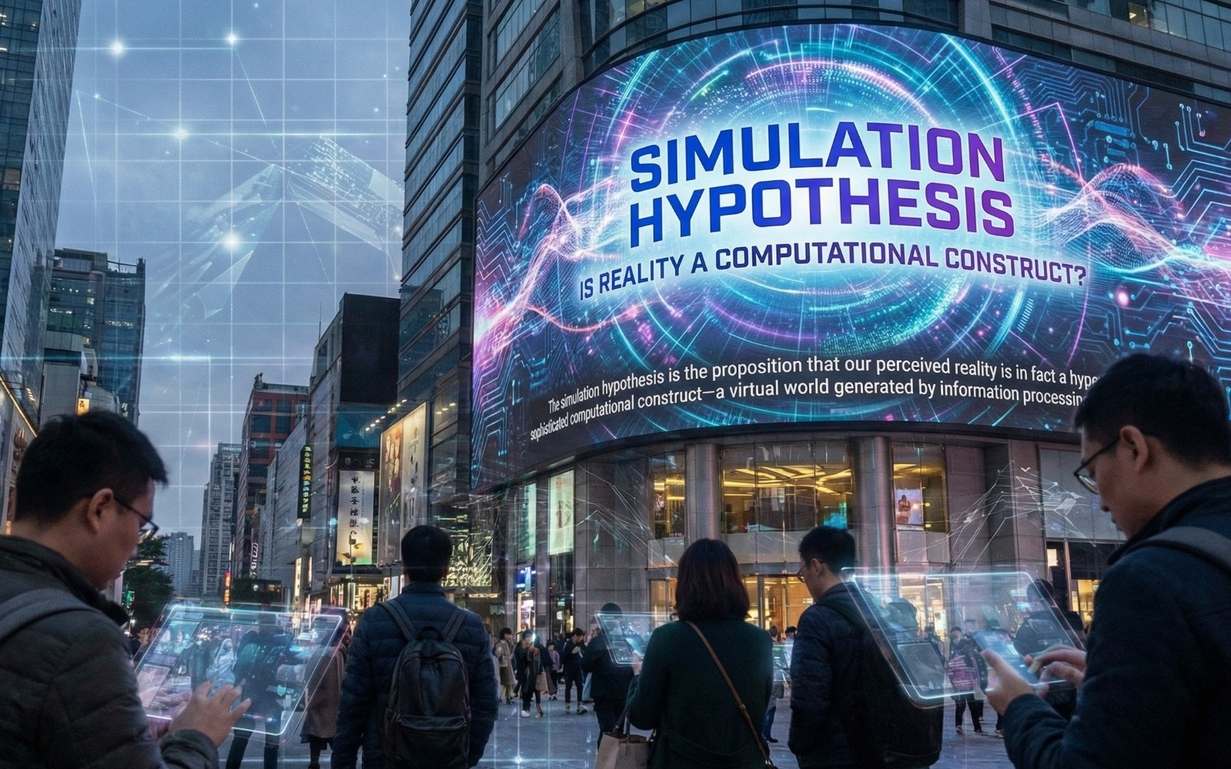
The simulation hypothesis proposes that our perceived reality could be a computational construct. The physical world we inhabit might be generated by information processing beyond our normal perception, just as a virtual world is generated for a player from code, rules, memory, and rendering.
The modern version of the argument is usually associated with Nick Bostrom’s 2003 paper, Are You Living in a Computer Simulation? But the broader intuition is older. Plato’s cave, Descartes’ deceiving demon, dream arguments, idealist philosophies, science fiction, digital physics, and Gnostic cosmology all circle the same unease: what if the world as given is not the world as ultimate?
The word “simulation” can mislead if taken too narrowly. It does not have to mean a crude video game running on a cosmic laptop. It could mean any deeper generative system through which experience appears. The hypothesis becomes philosophically interesting when it asks whether matter, space, time, and identity might be outputs rather than foundations.
For Gnostic readers, this is familiar terrain. The Gnostic cosmos is crafted, mediated, ruled, and mistaken for final reality by those asleep within it. The material world is not usually treated as pure illusion. It is real enough to suffer in, act within, and awaken through. But it is not the Fullness.
The Bostrom Trilemma
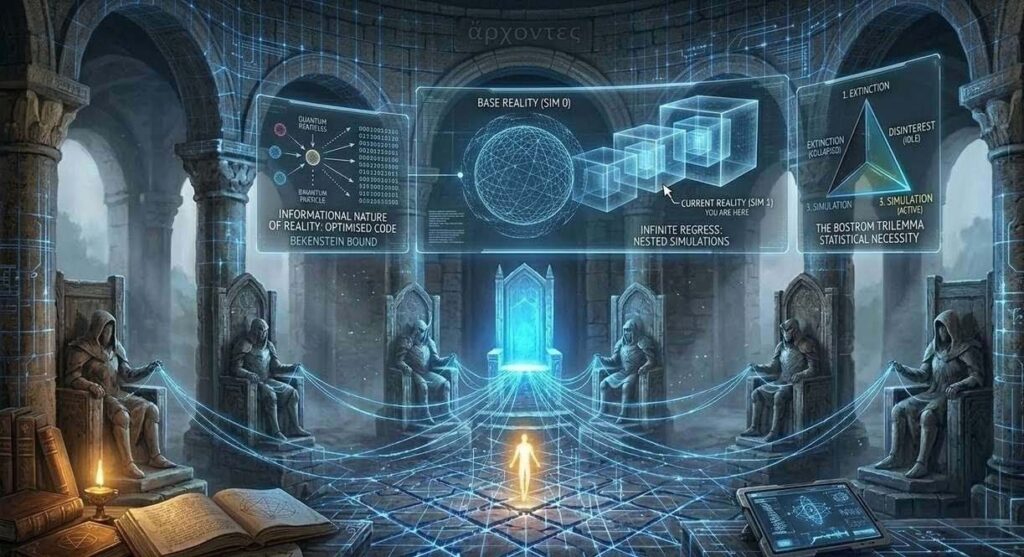
Bostrom’s argument is often misunderstood. He did not simply announce that we are simulated. He proposed a trilemma. At least one of the following is likely to be true:
- Extinction: almost all civilisations at our technological level go extinct before reaching a stage capable of creating vast numbers of ancestor simulations.
- Disinterest: post-human civilisations capable of creating such simulations choose not to run them, perhaps for ethical, practical, or cultural reasons.
- Simulation: if advanced civilisations do create many conscious simulations, simulated beings like us may vastly outnumber original biological beings, making it statistically plausible that we are simulated.
The argument depends on several assumptions. One is substrate independence: the idea that consciousness can be supported by different physical systems, provided the right functional organisation is present. If mental states can exist on a non-biological substrate, then simulated minds may not be philosophical zombies. They may experience their world from within.
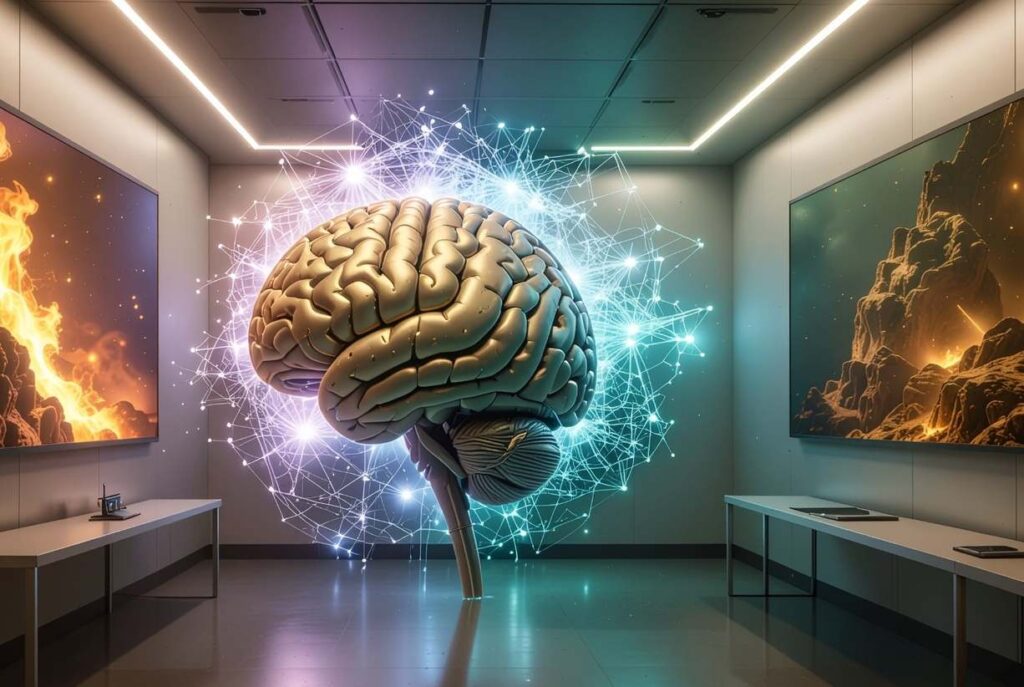
This is the hinge. If consciousness cannot be simulated, Bostrom’s argument weakens sharply. If consciousness can be simulated, then future world-builders could create moral beings inside generated environments. The argument therefore depends not only on computing power, but on the unresolved mystery of consciousness.
That is why the simulation hypothesis belongs beside consciousness studies, not only computer science. The question is not merely whether a universe can be rendered. It is whether experience can appear inside the rendering.
Seven Arguments Often Used for Simulation Theory
There is no decisive empirical proof that we live in a simulation. Still, several clues are often used by supporters or serious explorers of the hypothesis. The value of these arguments lies not in certainty, but in how they reframe reality as informational, rule-bound, and strangely participatory.
1. The Informational Nature of Reality
Modern physics increasingly treats information as central. Quantum theory, black hole thermodynamics, information bounds, and digital physics all suggest that information is not merely a human description pasted over matter. It may belong to the deep structure of the physical world.
This does not prove that the universe is code. Information in physics is not the same thing as software in a computer. But it does weaken a crude picture of matter as dead stuff first and meaning later. Reality may be more like structure, relation, and state than ordinary objects suggest.
In simulation language, this feels suggestive. A simulated world is informational all the way down from the perspective of its underlying substrate. In Gnostic language, the visible world is also derivative: a crafted order whose appearances point beyond themselves.
2. The Fine-Tuned Universe
The physical constants of the universe appear finely suited for stars, chemistry, planets, and biological complexity. Different explanations compete. Some propose design. Others propose a multiverse. Still others argue that fine-tuning may be overstated or misunderstood.
The simulation hypothesis offers another lens: a generated world might be parameter-tuned to produce observers, stable complexity, or specific experimental conditions. In a designed environment, physical constants would not be brute facts. They would be settings.
Again, this is not proof. It is a metaphor with philosophical bite. The universe may look tuned because only a tuned universe can contain beings capable of asking why it looks tuned. The simulation hypothesis turns that anthropic problem into an engineering question.
3. The Observer Effect and Measurement
Quantum mechanics has often been used, and misused, in simulation discussions. Measurement matters in quantum theory. Some properties do not behave like fixed hidden attributes waiting to be discovered. The act of measurement participates in the appearance of definite outcomes.
Supporters of simulation theory compare this to rendering. A game engine does not calculate every unseen detail in full fidelity at all times. It resolves what interaction requires. Quantum measurement can look, at a distance, like a universe that resolves detail when queried.
The caution is essential: quantum measurement is not the same thing as a graphics engine loading textures, and “observer” does not necessarily mean a conscious human mind. The analogy is suggestive, not decisive. The little physics goblin must be kept on a leash.
4. Computational Limits and Information Bounds
Physics contains limits: finite speed of light, finite information density, entropy bounds, Planck-scale questions, and maximum rates at which physical processes can occur. The Bekenstein bound and holographic principle suggest deep relationships between information, entropy, area, and gravity.
Simulation-minded readers interpret such limits as signs of computational constraint. Every generated world has maximum resolution, memory limits, update rates, and rules that cannot be violated from within the environment.
But physics limits are not automatically computer limits. A boundary in nature may reflect deep physical law rather than external hardware. The careful interpretation is this: information bounds make reality look less like infinite continuous substance and more like structured, law-governed, finite description. That is enough to invite comparison with computation, without collapsing physics into software.
5. The Unreasonable Effectiveness of Mathematics
Mathematics describes the physical world with astonishing precision. Equations predict planetary motion, electromagnetic fields, quantum probabilities, black holes, and particle behaviour. This has long puzzled scientists and philosophers.
In a simulation, mathematical order is expected. A generated environment must have rules. Its inhabitants, if intelligent, could discover those rules and call them physics. To them, equations would not merely describe the world. They would approximate the world’s generative structure.
For Gnostic thought, mathematical order resembles the work of the Archons: rules, constraints, boundaries, permissions, and limitations that structure experience. To know the rules is not yet to transcend them, but it is the beginning of conscious navigation.
6. Consciousness as Interface
The hardest clue is consciousness itself. If reality were simulated, experience would not simply be a stream of external data. It would be a rendered interface: body, senses, memory, identity, and world appearing together as a navigable field.
This does not prove simulation theory. But it helps explain why consciousness is so central to the debate. A simulation without experience is just calculation. A world matters only if something can inhabit it from the inside.
The Gnostic parallel is immediate. The body is not the whole player. The social identity is not the whole self. The visible world is not the whole real. Gnosis begins when awareness stops mistaking the interface for the essence.
7. The Acceleration Toward Generated Worlds
The final argument is recursive. We are learning to build simulated realities ourselves. Games, virtual worlds, AI-generated video, synthetic agents, and world models show that environments can be increasingly rendered, responsive, and persuasive.
Google DeepMind’s Genie 3 is one recent example of this direction: a general-purpose world model that can generate interactive environments from text prompts, explored in real time. It does not prove our universe is simulated. But it shows that world-like spaces can now be generated from learned patterns and navigated as responsive environments.
The simulation hypothesis becomes more vivid as our own simulations improve. The question “could a civilisation build convincing worlds?” no longer belongs entirely to speculative fiction. The first toy doors have opened. Behind them, the philosophical weather changes.
Philosophical Implications
If the simulation hypothesis were true, or even partly true, several major assumptions would change.
Ontology: Information Before Matter
The material world would no longer be the foundation. It would be output. Matter would be rendered structure, and information would be prior to appearance. This would not necessarily make the world unreal. It would make the world dependent.
Gnostic cosmology speaks in similar grammar. The lower world is crafted and derivative. It exists, but it does not exhaust being. The simulation hypothesis gives that ancient intuition a modern technical metaphor.
Epistemology: Suspicion Toward the Given
If reality is mediated, knowledge becomes more complicated. We cannot simply assume that appearances reveal ultimate structure. Evidence itself would occur inside the system being questioned. This does not make knowledge impossible, but it makes humility mandatory.
For the spiritual seeker, this can become healthy suspicion: not cynicism, but refusal to treat the given world as final. The question becomes: what kind of knowing can operate within mediation without being trapped by it?
Ethics: Moral Status Across Substrates
If simulated beings can be conscious, then simulated suffering matters. A mind does not become morally irrelevant because its substrate is unfamiliar. If beings experience pain, hope, love, fear, and selfhood from within, ethics must take them seriously.
This cuts both ways. If we are simulated, we might ask what obligations our creators have toward us. If we create simulated beings, we become responsible for worlds that may someday contain moral patients. The Demiurge is not only a mythic figure. It is a warning label on world-building power.
Theology: A Secular Creation Myth
The simulation hypothesis functions as a modern creation myth for a technological age. It offers intelligent design without traditional deity, creation without scripture, and hidden order without conventional religion.
Yet it also echoes older theological questions. Who made the world? Do they know what they are doing? Are they benevolent, indifferent, curious, careless, or trapped in a higher system themselves? Is the creator ultimate, or merely another craftsman inside a deeper chain?
That is pure Gnostic territory. The visible creator may not be the highest reality. The architect of a world may still be ignorant of the Fullness.
Critiques and Limitations
The simulation hypothesis is seductive, but serious critique keeps it honest. Without critique, it becomes a techno-myth that can explain everything and therefore explain nothing.
Unfalsifiability
The strongest scientific objection is that the hypothesis may be unfalsifiable. Any evidence against simulation could itself be simulated. Any failed test could be part of the system. Any apparent contradiction could be patched by saying the simulators made it so.
This makes the hypothesis difficult to treat as empirical science. It may be a philosophical possibility, a metaphysical framework, or a symbolic lens, but not a standard scientific theory unless it can generate testable predictions.
Infinite Regress
If our world is simulated, our simulators may also be simulated. Their simulators may also be simulated. The explanation risks becoming nested worlds all the way down, with no final ground.
This is not automatically fatal. Gnostic cosmologies also contain layered worlds and rulers within rulers. But infinite regress weakens the explanatory power of the hypothesis if it merely delays the question of ultimate reality.
The Consciousness Problem
Bostrom’s argument depends heavily on the possibility that consciousness can be simulated. But the hard problem of consciousness remains unresolved. We do not yet know whether subjective experience can arise from computation alone.
Recent theoretical arguments have also challenged the idea that reality could be fully algorithmic. Work by Mir Faizal, Lawrence Krauss, Arshid Shabir, Francesco Marino, and colleagues argues from undecidability and non-algorithmic understanding toward the claim that a completely algorithmic theory of everything, and therefore a complete simulation of the universe, is impossible. This is significant, but it is also part of an ongoing debate. A later response argues that undecidability limits provability more clearly than execution, so the simulation question is not closed by one paper.
Occam’s Razor
The simulation hypothesis may multiply entities unnecessarily. Instead of one universe, it proposes a base reality, simulators, their technology, their motives, and a generated universe inside their system. Simpler explanations may account for fine-tuning, mathematical order, and quantum strangeness without adding hidden creators.
The Gnostic reply would be that simplicity is not always truth. But the critic’s blade still matters. A good symbolic map should not pretend every mystery requires an unseen programmer.
Thermodynamic and Computational Constraints
Computation is physical. It requires energy, hardware, error correction, cooling, memory, and time. To simulate a universe in full detail might require impossible resources, perhaps as much or more than the universe being simulated.
Supporters can reply that a simulation might use shortcuts, approximations, selective rendering, or different physics. Critics can answer that once enough shortcuts are allowed, the hypothesis becomes harder to test. The debate remains open, but the constraint is real: even gods of code need somewhere to plug in the thunder machine.
Gnostic Resonance
The simulation hypothesis is not Gnosticism. It lacks the full Gnostic drama of divine spark, Sophia, Demiurge, Archons, gnosis, liberation, and return. But it recapitulates several recognisable Gnostic intuitions.
- The world is crafted, not ultimate.
- Reality is mediated, not simply given.
- The rulers of the world may not be the highest reality.
- The visible order may contain constraints that appear natural from within.
- Knowledge of the world’s structure changes the one who knows.
- Transcendence begins as recognition, not physical escape.
In a modern translation, the Archons become system constraints, administrators, rules, permissions, and hidden governors. The Demiurge becomes the world-builder or simulation architect. The Pleroma becomes reality beyond the rendered order, or the fullness that no generated system can contain.
Yet the Gnostic reading should not flatten mystery into software. The Pleroma is not merely “base reality”. The divine spark is not merely an avatar-controller. Gnosis is not merely discovering a cheat code. The symbolic power of simulation theory lies in how it reawakens the suspicion that the given world is not final, not in reducing ancient spiritual insight to gamer metaphysics.
Living the Recognition Without Losing Ground
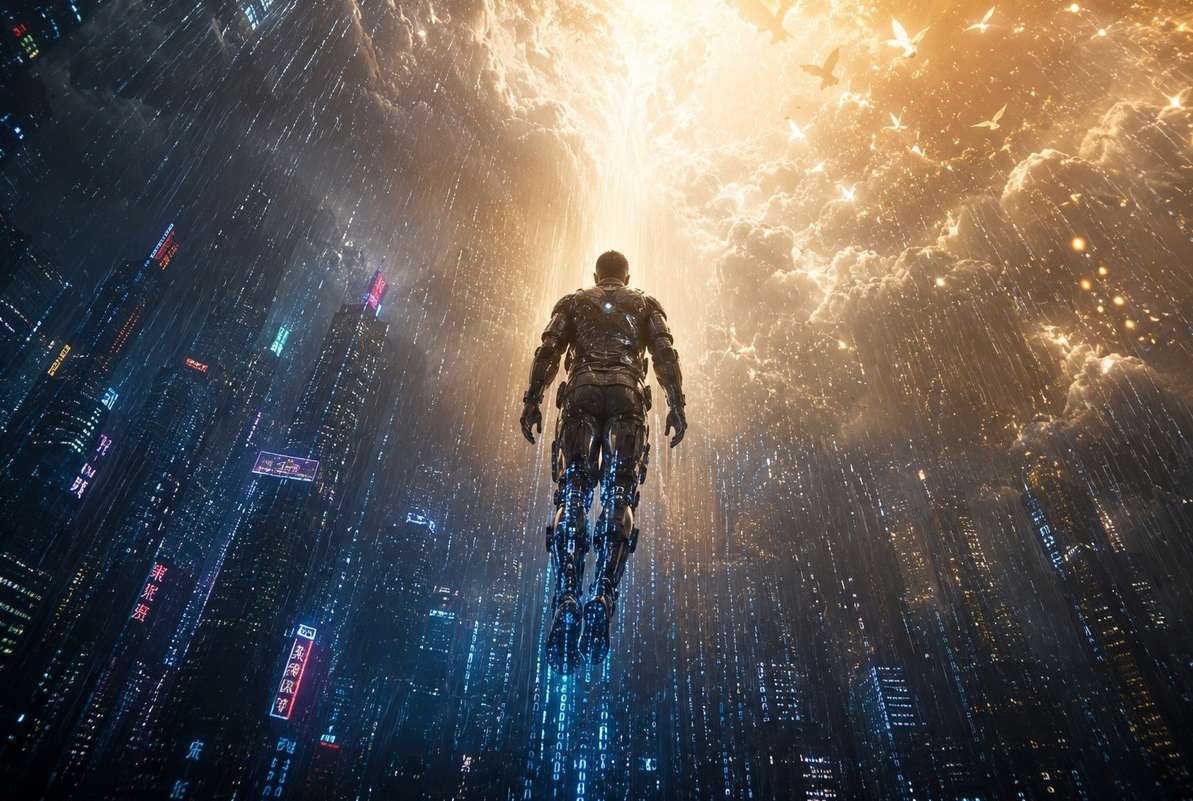
The simulation hypothesis can easily become destabilising. It can feed derealisation, paranoia, spiritual grandiosity, or the fantasy that ordinary responsibilities no longer matter. That is not gnosis. That is metaphysical vertigo wearing a neon visor.
A grounded Gnostic approach takes the opposite path. It uses the hypothesis to loosen false certainty, not to reject life. It asks us to live more awake, more ethically, more attentively, and more lovingly inside the world we have been given.
1. Treat the World as Real Enough to Love
Even if reality were simulated, experience would still matter. Pain would still hurt. Kindness would still heal. Beauty would still open the chest. A world does not need to be ultimate to be morally serious.
The spiritual trap is to confuse “not ultimate” with “not important”. Gnosis does not make life disposable. It makes life transparent to depth.
2. Watch for System Constraints
Whether or not the universe is simulated, human life is already shaped by systems: biology, trauma, culture, economy, law, media, algorithmic feeds, language, family patterns, and inherited fear. These are the practical Archons of everyday reality.
To recognise them is not to escape them instantly. It is to stop mistaking their limits for the shape of the soul.
3. Practise Direct Experience
The most immediate answer to mediated reality is direct attention. Sit. Breathe. Walk. Feel the body. Notice perception before interpretation. Let sound arrive before story. Let thought be seen as thought.
This does not prove or disprove simulation theory. It does something more useful: it returns awareness to itself. The one who is asking whether reality is rendered must first notice the rendering of thought, fear, image, memory, and self.
4. Keep Humour Near the Abyss
Large metaphysical questions need a little humour, otherwise the mind builds temples out of fog. The simulation hypothesis is fascinating, but the dishes still need washing. The cat still wants feeding. The body still needs sleep. Cosmic speculation without ordinary grounding becomes a haunted arcade cabinet.
Gnosis is not escape from the ordinary. It is a change in how the ordinary shines.
Related Glossary Terms
For quick definitions, use the main ZenithEye Glossary. The key terms for this article are:
Read Next
Continue with: The Glitch in the Zenith: Recognising the Code of the Self
If this article explores the possibility that reality is mediated or generated, the next step turns the lens inward: the self as a prediction, perception as pattern, and the “glitch” that appears when the mind sees its own code.
Within The Thread
This article belongs to The Architecture of Perception and the Simulation Hypothesis route. It sits where philosophy, AI, digital physics, consciousness, and Gnostic cosmology meet: not as proof that reality is code, but as a disciplined way to question whether the visible order is final.
Frequently Asked Questions About the Simulation Hypothesis
What is the simulation hypothesis in simple terms?
The simulation hypothesis is the idea that our experienced reality could be a highly advanced generated environment rather than base reality. It suggests that matter, space, time, bodies, and history might be rendered from deeper information processing. The hypothesis is philosophically important, but it is not scientifically proven.
What is Bostrom’s trilemma?
Bostrom’s trilemma says that at least one of three possibilities is likely: almost all civilisations go extinct before reaching simulation-capable technology; advanced civilisations choose not to run large numbers of ancestor simulations; or simulated beings vastly outnumber original beings, making it statistically plausible that we are simulated.
Is the simulation hypothesis scientifically proven?
No. The simulation hypothesis remains speculative. It is often criticised as unfalsifiable because any evidence against it could itself be simulated. It may function as philosophy, metaphysics, or symbolic inquiry, but it is not currently established empirical science.
What evidence is used to support simulation theory?
Supporters often point to the informational nature of physics, the fine-tuning of physical constants, quantum measurement, information bounds such as the Bekenstein bound, the effectiveness of mathematics, consciousness as interface, and our growing ability to build generated worlds. These are suggestive arguments, not definitive proof.
What are the main objections to the simulation hypothesis?
Major objections include unfalsifiability, infinite regress, the unresolved hard problem of consciousness, thermodynamic and computational constraints, and Occam’s Razor. Recent theoretical work has argued that a fully algorithmic universe may be impossible if reality involves non-algorithmic understanding, while critics of that claim argue that undecidability does not by itself prove simulation impossible.
How does the simulation hypothesis relate to Gnosticism?
The simulation hypothesis is not Gnosticism, but it echoes several Gnostic themes: the world as crafted rather than ultimate, reality as mediated, hidden rulers or constraints, and liberation through recognition. The Demiurge can be read symbolically as the world-builder, while the Archons resemble system constraints or administrators.
Does simulation theory mean life is meaningless?
No. Even if reality were simulated, experience would still matter from within. Pain, love, responsibility, beauty, and ethical action would not become meaningless. A grounded Gnostic reading treats the world as real enough to love, while refusing to mistake it for ultimate truth.
Study and Safety Note
This article explores simulation theory, digital physics, Gnostic symbolism, consciousness, and metaphysical uncertainty for educational and reflective purposes. It does not provide scientific proof, psychological advice, spiritual direction, or medical guidance.
If simulation themes, reality-questioning, metaphysical speculation, or existential inquiry increase anxiety, derealisation, dissociation, insomnia, paranoia, panic, grandiosity, or difficulty functioning, pause the material and seek qualified support. No theory of reality removes the need for ordinary care, relationships, embodiment, and practical responsibility.
Further Reading
The following live ZenithEye links continue the themes of simulation, digital physics, generated worlds, consciousness, and Gnostic cosmology:
- The Glitch in the Zenith: Recognising the Code of the Self – Predictive processing, perception, selfhood, and the moment the model notices itself.
- Are We Living in a Simulation? 7 Profound Clues That Reality Might Be Code – A broader route through informational reality, quantum indeterminacy, mathematics, fine-tuning, consciousness, glitches, and AI-generated worlds.
- The Gnostic Matrix: Reality as Information System – Gnostic cosmology read through simulation, information systems, and structured perception.
- Consciousness as Interface: The User Experience of Being – How awareness may navigate rendered environments, perceptual interfaces, and structured worlds.
- Archons: The Ruling Powers That Shape Reality – The core Gnostic concept behind ruling systems that administer, constrain, imitate, and obscure.
- The Quantum Mind: 2026 Evidence That Consciousness Is Fundamental – Quantum mind theories, consciousness studies, and the limits of reductionism.
- Genie 3 and the Simulation Threshold: When AI Starts Building Worlds – Google DeepMind’s world model as a practical demonstration of prompt-to-world generation.
- AI as the New Demiurge: Yaldabaoth in the Digital Age – Algorithmic creation, synthetic worlds, digital authority, and the return of the Demiurge through AI.
- Nested Simulations: The Infinite Regress Problem That Breaks Reality – The dizzying problem of simulations inside simulations and where final ground might be found.
- The Thread – The main route through ZenithEye’s symbolic, historical, and contemporary architecture.
References and Sources
The following sources support the philosophical, scientific, Gnostic, and technological framework used in this article.
Simulation Hypothesis and Philosophy
- [1] Bostrom, Nick. “Are You Living in a Computer Simulation?” The Philosophical Quarterly, 53(211), 243-255, 2003.
- [2] Chalmers, David J. Reality+: Virtual Worlds and the Problems of Philosophy. W. W. Norton, 2022.
- [3] Descartes, René. Meditations on First Philosophy. 1641.
- [4] Plato. Republic, Book VII. The Allegory of the Cave.
- [5] Nozick, Robert. Anarchy, State, and Utopia. Basic Books, 1974. Includes the Experience Machine thought experiment.
- [6] Baudrillard, Jean. Simulacra and Simulation. Translated by Sheila Faria Glaser. University of Michigan Press, 1994.
Physics, Information, and Computation
- [7] Bousso, Raphael. “The Holographic Principle.” Reviews of Modern Physics, 74, 825-874, 2002.
- [8] Bousso, Raphael. “The Holographic Principle for General Backgrounds.” Classical and Quantum Gravity, 17(5), 997-1005, 2000.
- [9] Bekenstein, Jacob D. “Universal Upper Bound on the Entropy-to-Energy Ratio for Bounded Systems.” Physical Review D, 23(2), 287-298, 1981.
- [10] Wheeler, John Archibald. “Information, Physics, Quantum: The Search for Links.” In Complexity, Entropy, and the Physics of Information, 1990.
- [11] Lloyd, Seth. Programming the Universe: A Quantum Computer Scientist Takes on the Cosmos. Knopf, 2006.
- [12] Landauer, Rolf. “Irreversibility and Heat Generation in the Computing Process.” IBM Journal of Research and Development, 5(3), 183-191, 1961.
- [13] Zurek, Wojciech H. “Decoherence, Einselection, and the Quantum Origins of the Classical.” Reviews of Modern Physics, 75, 715-775, 2003.
- [14] Wigner, Eugene. “The Unreasonable Effectiveness of Mathematics in the Natural Sciences.” Communications on Pure and Applied Mathematics, 13(1), 1-14, 1960.
Critiques and Recent Challenges
- [15] Hossenfelder, Sabine. “The Simulation Hypothesis Is Pseudoscience.” Backreaction, 2021.
- [16] Hossenfelder, Sabine. Existential Physics: A Scientist’s Guide to Life’s Biggest Questions. Viking, 2022.
- [17] Faizal, Mir, Lawrence M. Krauss, Arshid Shabir, Francesco Marino, and collaborators. “Consequences of Undecidability in Physics on the Theory of Everything.” arXiv:2507.22950, 2025.
- [18] Redden, Evan. “Provability vs. Execution: A Comment on ‘Consequences of Undecidability in Physics on the Theory of Everything’.” arXiv:2512.11807, 2025.
- [19] Perales-Eceiza, Álvaro, Toby Cubitt, Mile Gu, David Pérez-García, and Michael M. Wolf. “Undecidability in Physics: A Review.” arXiv:2410.16532, 2024.
Consciousness, Substrate Independence, and Digital Minds
- [20] Chalmers, David J. The Conscious Mind: In Search of a Fundamental Theory. Oxford University Press, 1996.
- [21] Nagel, Thomas. “What Is It Like to Be a Bat?” The Philosophical Review, 83(4), 435-450, 1974.
- [22] Dehaene, Stanislas. Consciousness and the Brain: Deciphering How the Brain Codes Our Thoughts. Viking, 2014.
- [23] Seth, Anil. Being You: A New Science of Consciousness. Faber & Faber, 2021.
- [24] Bostrom, Nick. Superintelligence: Paths, Dangers, Strategies. Oxford University Press, 2014.
- [25] Schwitzgebel, Eric and Mara Garza. “A Defense of the Rights of Artificial Intelligences.” Midwest Studies in Philosophy, 39, 98-119, 2015.
AI Worlds and Generated Environments
- [26] Google DeepMind. “Genie 3: A New Frontier for World Models.” Official Google DeepMind blog announcement, 2025.
- [27] Bruce, Jake, Michael Dennis, Ashley Edwards, Jack Parker-Holder, Yuge Shi, Edward Hughes, Matthew Lai, Aditi Mavalankar, Richie Steigerwald, Chris Apps, Yusuf Aytar, Sarah Bechtle, Feryal Behbahani, Stephanie Chan, Nicolas Heess, Lucy Gonzalez, Simon Osindero, Sherjil Ozair, Scott Reed, Jingwei Zhang, Konrad Zolna, Jeff Clune, Nando de Freitas, Satinder Singh, and Tim Rocktäschel. “Genie: Generative Interactive Environments.” arXiv:2402.15391, 2024.
- [28] Russell, Stuart. Human Compatible: Artificial Intelligence and the Problem of Control. Viking, 2019.
- [29] Gabriel, Iason. “Artificial Intelligence, Values, and Alignment.” Minds and Machines, 30, 411-437, 2020.
Gnostic and Comparative Sources
- [30] Apocryphon of John. Nag Hammadi Codex II,1; III,1; IV,1; Berlin Codex 8502,2.
- [31] Hypostasis of the Archons. Nag Hammadi Codex II,4.
- [32] On the Origin of the World. Nag Hammadi Codex II,5; XIII,2.
- [33] Robinson, James M. (ed.). The Nag Hammadi Library in English. Revised edition. HarperOne, 1990.
- [34] Meyer, Marvin (ed.). The Nag Hammadi Scriptures. HarperOne, 2007.
- [35] Jonas, Hans. The Gnostic Religion. Beacon Press, 1958.
- [36] King, Karen L. What Is Gnosticism? Harvard University Press, 2003.
- [37] Williams, Michael Allen. Rethinking “Gnosticism”: An Argument for Dismantling a Dubious Category. Princeton University Press, 1996.
- [38] Brakke, David. The Gnostics: Myth, Ritual, and Diversity in Early Christianity. Harvard University Press, 2010.