The Default Mode Network: Neuroscience of the Narrative Self
In the early 2000s, neuroscientists identified something paradoxical: the brain is often highly active when we appear to be doing nothing. When we daydream, ruminate, remember the past, imagine the future, or reflect on ourselves, a network of regions now called the default mode network becomes especially important. Marcus Raichle and colleagues described a “default mode” of brain function in 2001 after observing that certain brain areas consistently decreased activity during goal-directed tasks and became more active during rest.
The default mode network, or DMN, is now widely associated with self-referential thought, autobiographical memory, mind-wandering, social imagination, and the construction of a narrative self. It is not the whole self, and it is not a tiny homunculus sitting in the skull. It is better understood as part of the brain’s self-storying machinery: a set of processes that helps experience become “my life,” “my past,” “my future,” and “my identity.”
But what happens when that self-storying machinery quiets, loosens, or reorganises? Psychedelic research, meditation studies, and altered-state reports suggest that changes in DMN activity and connectivity often accompany shifts in selfhood: less rumination, weakened narrative boundaries, a diminished sense of separateness, or what researchers call ego dissolution. For a Gnostic reading, this does not prove the divine spark. Neuroscience does not prove metaphysics. But it does give modern language for an ancient intuition: the self we defend so fiercely may be constructed, and what is constructed can sometimes become transparent.
This article explores the default mode network as the neural architecture of the narrative self, the role of ego dissolution in psychedelic and contemplative experience, and the resonance between modern neuroscience and Gnostic themes of spark, archon, self, and liberation. The bridge is interpretive, not reductive. The brain is not the enemy of spirit. It is one of the places where the drama of selfhood becomes visible.
In Plain Terms
The default mode network is a set of brain regions strongly involved in self-referential thought, memory, imagination, mind-wandering, and the story of “me.” When this network is highly active, the mind often turns towards biography, worry, fantasy, comparison, and personal narrative.
Ego dissolution refers to a temporary loosening of ordinary self-boundaries. It can occur in psychedelic states, deep meditation, mystical experience, trauma, dissociation, or crisis, so context matters. In a Gnostic frame, DMN research can be read as a modern map of the narrative veil: not proof of spirit, but a useful way to understand how the story-self can obscure direct knowing.
Sources and Disciplines Discussed
- Default mode network research, beginning with Raichle and colleagues’ 2001 work on the brain’s baseline or default mode.
- Ego dissolution research, including the Ego-Dissolution Inventory developed by Nour and colleagues.
- Psychedelic neuroscience, including psilocybin, LSD, DMN connectivity, REBUS, and ALBUS.
- Meditation research, especially studies linking experienced meditation with differences in DMN activity and mind-wandering.
- Clinical neuroscience, including rumination, depression, TMS, and the risks of destabilising altered states.
- Gnostic symbolism, especially the divine spark, archons, Demiurge, narrative illusion, and direct knowing.
How to Read This Article
This article does not claim that neuroscience proves Gnosticism, or that the DMN is literally the Demiurge, the ego, or the archons. Those are interpretive correspondences, not laboratory conclusions. The science describes brain networks and measurable reports. The Gnostic language describes lived meaning, symbolic structure, and the drama of recognition.
The useful question is not “Has science proved the soul?” but “What does modern neuroscience reveal about the constructed nature of self-experience, and why does that matter for direct knowing?”
Table of Contents
- The DMN: Architect of the Narrative Self
- Ego Dissolution: When the Self-Story Loosens
- The REBUS Model: Relaxing Beliefs Under Psychedelics
- The Newer Evidence: Precision and Mechanism
- The Gnostic Resonance: Neuroscience and the Spark
- Beyond Pharmacology: Contemplative DMN Modulation
- Clinical Implications: Healing, Risk, and Reintegration
- Living the Recognition: Practice and the DMN
- Related Glossary Terms
- Read Next
- Frequently Asked Questions
- Further Reading
- References and Sources

The DMN: Architect of the Narrative Self
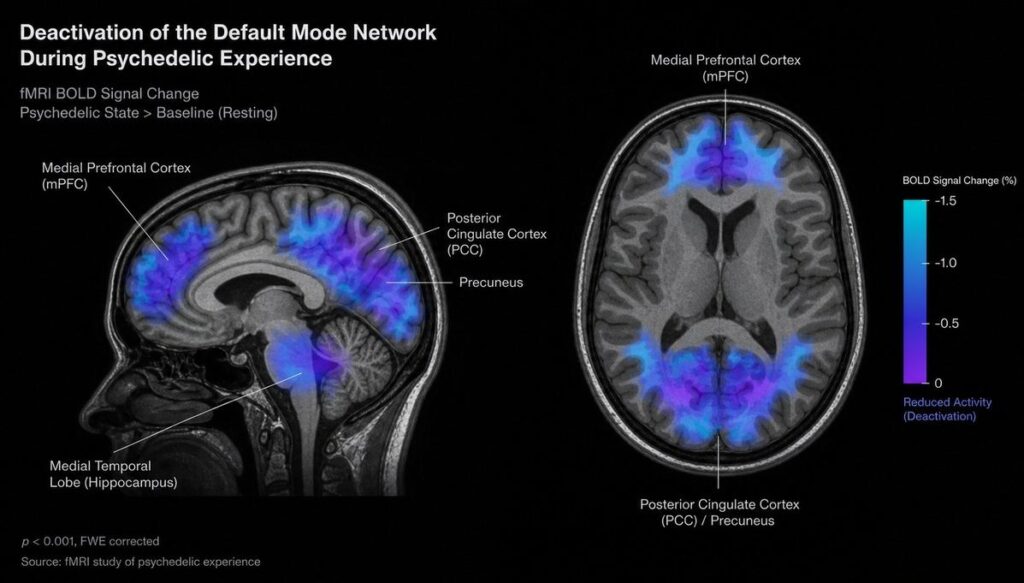
The default mode network performs functions essential to ordinary consciousness. It is strongly involved in self-referential processing: the ability to think about oneself, one’s traits, one’s history, one’s social position, and one’s possible future. The medial prefrontal cortex, posterior cingulate cortex, precuneus, angular gyrus, and related regions all participate in this wider pattern.
Autobiographical memory is another core DMN function. The network helps stitch memory into identity. It allows experience to become a story with continuity: I was there, I became this, I may become that. Without some version of this function, life would not easily cohere as biography. With it, however, consciousness can also become trapped inside a personal novel that never stops narrating itself.
The DMN is also involved in mental time travel. It helps project the self backward into remembered scenes and forward into imagined possibilities. This can support planning, empathy, creativity, and reflection. It can also become worry, rumination, regret, fantasy, and rehearsed suffering. The same network that gives the self continuity can become the loom on which anxiety keeps weaving tomorrow from yesterday.
Theory of mind, the capacity to imagine other minds, also draws on DMN-related processes. When we think about what another person believes, feels, intends, or sees, we often use neural machinery that overlaps with self-reflection. To imagine the other, the brain partly consults the self. This is useful, but it also means social identity, comparison, shame, longing, status, and belonging can become tightly braided into the narrative self.
For this reason, the DMN can be called a self-storying mechanism. It does not create the whole of consciousness, but it helps generate the feeling of being a continuous, separate, autobiographical subject. When it functions flexibly, it supports ordinary life. When it becomes rigid, the story can feel like a prison. The Gnostic problem begins there: not with having a self, but with mistaking the story-self for the whole of what we are.
Ego Dissolution: When the Self-Story Loosens
Ego dissolution refers to a temporary loosening or loss of ordinary self-boundaries. A person may report that the distinction between observer and observed has softened, that personal identity has become less central, that body boundaries feel porous, or that time and space no longer organise experience in the usual way.
These experiences can occur in many contexts. Psychedelic states are the most studied in contemporary neuroscience, but similar themes appear in deep meditation, mystical experience, near-death reports, extreme stress, trauma, dissociation, and some psychiatric states. This is why the experience itself must not be romanticised automatically. Ego dissolution can be liberating, frightening, destabilising, healing, confusing, or dangerous depending on context, preparation, support, and the person’s underlying vulnerability.
The Ego-Dissolution Inventory, validated by Nour and colleagues in 2016, gave researchers a concise way to measure subjective experiences of compromised self-boundaries. That made it easier to compare reports with neuroimaging findings. In psychedelic research, ego dissolution has often been associated with altered connectivity in DMN-related regions, especially the posterior cingulate cortex and medial prefrontal cortex, though the details vary across substance, dose, study design, and analysis method.
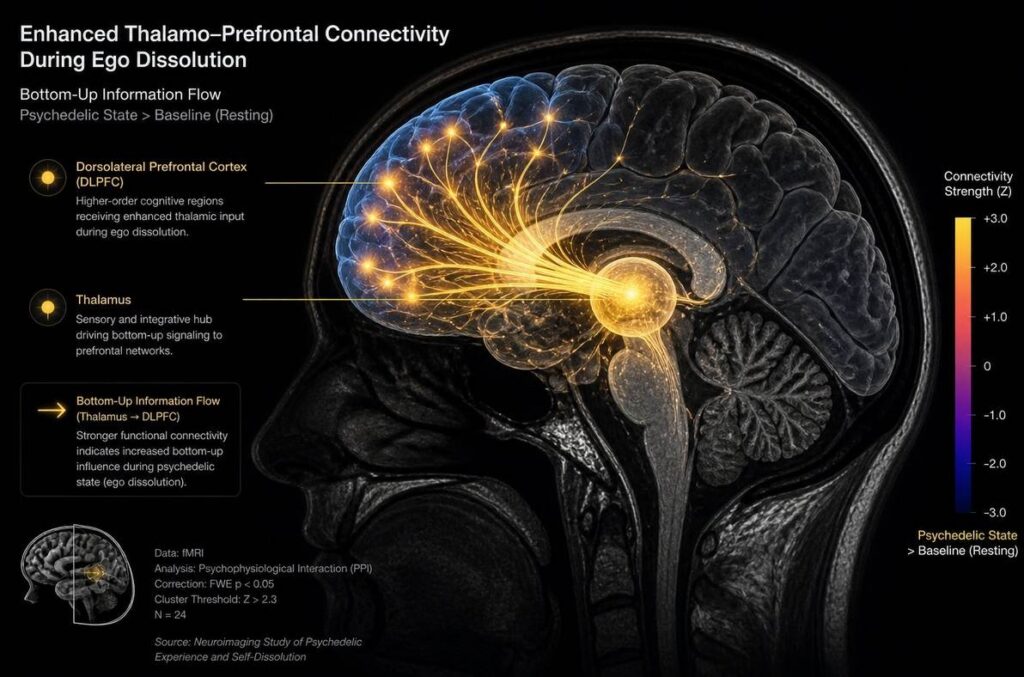
One influential psilocybin study by Carhart-Harris and colleagues found decreased positive coupling between the medial prefrontal cortex and posterior cingulate cortex. Other research on LSD has linked ego dissolution with changes in global connectivity and altered communication between high-level cortical regions and thalamic systems. The overall picture is not a simple “DMN off, mysticism on” switch. It is more like a reorganisation of self-related processing, prediction, sensory gating, and network integration.
For the contemplative reader, the crucial point is modest but profound: the ordinary self is not as fixed as it feels. The narrator can loosen. The boundary can shift. The autobiographical centre can become less dominant. Beneath the story, another mode of knowing may appear.
The REBUS Model: Relaxing Beliefs Under Psychedelics
To explain psychedelic findings, Robin Carhart-Harris and Karl Friston proposed the REBUS model, short for Relaxed Beliefs Under Psychedelics. Their 2019 paper links psychedelic effects to predictive processing and the free-energy principle. In simple terms, the brain is understood as a prediction-making system. It uses prior beliefs to interpret incoming experience. Some priors are helpful. Others become rigid.
According to REBUS, psychedelics may relax the precision of high-level priors, allowing lower-level sensory, emotional, or bodily information to flow upward with less constraint. This can make experience feel vivid, strange, meaningful, unstable, revelatory, or overwhelming. The self-model may become less fixed. Old assumptions may loosen. A person may temporarily see the story of “me” as a construction rather than an absolute fact.
The model is powerful because it does not reduce psychedelic experience to mere hallucination. It suggests that altered states may make entrenched beliefs more revisable. This has obvious clinical relevance for depression, addiction, trauma, and obsessive self-stories. It also has spiritual relevance: if the self is partly held together by predictive certainty, then loosening certainty can feel like metaphysical rupture.
Newer work has added nuance. The 2025 ALBUS proposal, Altered Beliefs Under Psychedelics, argues that psychedelic states may involve both relaxed and strengthened belief processes, depending on dose, context, set, setting, and neural regime. Meaning can open. But meaning can also overgrow. Insight can arise. So can confusion, apophenia, paranoia, or false certainty.
This is crucial for a responsible Gnostic reading. The collapse of an old self-model is not automatically gnosis. Sometimes it is liberation. Sometimes it is disorientation. Sometimes it is material surfacing for integration. The veil tearing is not the same as wisdom. The work begins with what comes through the tear.
The Newer Evidence: Precision and Mechanism
Recent research has sharpened the discussion by looking not only at the DMN as a whole, but at specific relationships between prefrontal regions, thalamic gating, visual association areas, and subjective reports of ego dissolution. A 2025 multimodal study in Human Brain Mapping, for example, investigated the role of the dorsolateral prefrontal cortex during LSD-induced ego dissolution and emotional arousal using fMRI and MEG data.
The details are technical, but the larger pattern is readable: ego dissolution does not seem to belong to one isolated switch in the brain. It emerges from changed relationships between systems that regulate self-relevance, sensory gating, emotion, memory, visual association, and high-level interpretation.
Posterior Cingulate Cortex
The posterior cingulate cortex, or PCC, is one of the central hubs of the DMN. It is heavily implicated in self-referential processing, autobiographical orientation, and the integration of experience around a felt centre. In many altered-state discussions, the PCC becomes a key region because it seems closely tied to the felt continuity of “me here, having this experience.”
When PCC activity or connectivity changes, the usual anchoring of self-experience may change with it. This does not mean the PCC is “the ego.” That would be too crude. But it does appear to be part of the system through which experience becomes centred, embodied, remembered, and personally owned.
Dorsolateral Prefrontal Cortex
The dorsolateral prefrontal cortex, or DLPFC, is more often associated with executive function, working memory, cognitive control, and regulation. Newer psychedelic research suggests that changes in DLPFC connectivity, especially with thalamic and visual regions, may be relevant to ego dissolution and emotional arousal under LSD.
One useful way to read this is that altered states may change what becomes self-relevant. Normally, the mind filters and ranks incoming information according to the needs of the current self-model. When that filtering changes, more of the world may seem meaningful, connected, alive, or personally dissolved into a larger field. This can be awe. It can also be overload.
Thalamus and Sensory Gating
The thalamus is often described as a relay and gating structure, although that shorthand does not capture its full complexity. It helps regulate the flow of information between sensory systems and higher cortical networks. Psychedelic research has increasingly looked at thalamocortical communication because altered gating may help explain why perception becomes intensified, unusual, or less constrained by ordinary categories.
If the thalamic gate changes, the world may no longer arrive in the old arrangement. More signal passes through, or signal is weighted differently. The self-model then has to interpret material it normally filters. The result may be wonder, confusion, insight, or chaos depending on the person and setting.
Parahippocampal and Contextual Systems
The parahippocampal region helps anchor experience in context, place, memory, and situational framing. Psychedelic studies have linked altered connectivity in medial temporal and parahippocampal systems with changes in meaning, memory, imagery, and self-boundary. When contextual framing loosens, experience may feel less tied to the ordinary coordinates of here, now, me, and mine.
Again, the point is not to locate the soul in a brain region. The point is to see how selfhood depends on many coordinated processes. When those processes change, the self may become less solid, more porous, or more obviously constructed.
The Gnostic Resonance: Neuroscience and the Spark
The resonance between DMN research and Gnostic anthropology is interpretive rather than literal. The divine spark is not a neural circuit. The archons are not just predictive priors. The Pleroma is not a pattern of global connectivity. Yet the parallels are useful because both traditions ask how ordinary identity becomes a veil.
Gnostic texts often describe the human being as caught between matter, soul, and spirit. The lower world is not merely physical; it is perceptual and interpretive. The soul forgets its origin because it becomes entangled in the systems that name, rank, frighten, seduce, and define it. Modern neuroscience cannot confirm the myth, but it can illuminate one of its psychological doors: the self is built, maintained, defended, and sometimes loosened.
Hylic Identification
In a cautious symbolic reading, hylic identification corresponds to being fully absorbed in body, biography, status, appetite, fear, and the visible world. The DMN does not cause hylic consciousness, but rigid identification with the self-story can help explain how a person becomes enclosed within the given world. The story says: this body, this history, this wound, this role, this ambition, this fear. Nothing beyond it is real.
Psychic Attachment
The psychic condition, in Gnostic and Valentinian language, belongs to soul: morality, striving, emotion, memory, faith, development, and inner conflict. In modern terms, this resembles the person who can observe the self-story but still remains deeply invested in it. The narrator is recognised, but not yet transparent. The soul knows it is in a drama, yet still takes the drama personally.
Pneumatic Recognition
The pneumatic condition points towards spirit, the capacity for direct recognition. In a neuroscience conversation, this can be compared with moments when narrative selfing becomes quiet enough for awareness to know itself without immediately turning the experience into autobiography. This is not proof that spirit equals DMN deactivation. It is a useful analogy: when the story relaxes, another mode of knowing may be noticed.
Archonic Constraint
Archonic constraint can be read psychologically as the force of rigid priors, inherited scripts, fear-based interpretation, and self-protective prediction. The archon says, “This is all you are. This is all the world is. Do not look beyond the model.” Predictive processing language says something less mythic but structurally similar: perception is shaped by prior expectation, and rigid expectations can prevent new information from transforming the system.
Gnosis and Liberation
Gnosis, in this frame, is not the annihilation of the self but the recognition that the self-story is not ultimate. The narrator may return. In ordinary life, it must return. But it no longer deserves the throne. It becomes a tool, a garment, a useful interface, not the sovereign of reality.
The divine spark is therefore not “found” by destroying the brain’s selfing systems. It is recognised when those systems become transparent enough that awareness is not wholly captured by them. The story continues, but the light is no longer mistaken for ink.
Beyond Pharmacology: Contemplative DMN Modulation
Psychedelics are not the only context in which DMN-related selfing can change. Meditation research suggests that experienced meditators may show differences in DMN activity and connectivity consistent with reduced mind-wandering. This is not identical to a psychedelic state. It is slower, trained, repeatable, and embedded in discipline.
Meditation can be understood as training in disidentification. The practitioner learns to notice thoughts as thoughts, sensations as sensations, emotions as movements, and stories as stories. The aim is not to destroy the narrator, but to stop mistaking the narrator for the whole field of awareness.
Open monitoring meditation is especially relevant because it involves non-reactive awareness of whatever arises. Rather than narrowing attention to one object, the practitioner rests in a broader field. Thoughts appear. Self-references appear. Memories appear. Plans appear. But the practice is to recognise them as appearances, not as commands.
Some traditions speak of recognising awareness itself. Dzogchen uses the term rigpa for primordial knowing or awake awareness. Advaita speaks of the witness. Christian apophatic mysticism speaks of a darkness beyond concept. Gnostic language speaks of the spark, gnosis, and return. These traditions are not identical, and their differences matter. Yet all point to the same practical distinction: awareness can know the movements of mind without being reduced to them.
Psychedelics may offer a dramatic window. Meditation may cultivate a door that can be opened and closed with more stability. Neither is automatically liberating. Both require integration, ethics, grounding, and humility.
Clinical Implications: Healing, Risk, and Reintegration
The DMN is often discussed in relation to depression because depression commonly involves rumination, repetitive self-focus, and rigid negative narratives. Studies of depression and resting-state networks suggest altered DMN activity and connectivity in some patients, although depression is far too complex to be reduced to one network. The phrase “DMN run amok” is vivid, but clinically too simple. Better to say that the DMN can participate in loops of self-referential suffering.
Therapeutic approaches that alter self-related processing are therefore of serious interest. Psychedelic-assisted therapy, still legally restricted and clinically controlled, is being studied partly because it may disrupt rigid belief patterns and allow emotional or autobiographical material to be revisited differently. TMS, approved by the U.S. Food and Drug Administration for major depression when other treatments have not been effective, usually targets prefrontal regions and may affect wider mood-regulation networks. Meditation-based interventions may reduce rumination and improve flexibility in some people.
None of this means that ego dissolution should be chased casually. For some people, altered states can be destabilising, especially with trauma histories, dissociation, bipolar vulnerability, psychosis risk, high anxiety, poor support, or unsafe psychedelic use. Dissolution without containment can become fragmentation. Opening without integration can become flood.
The Gnostic path is not a competition to erase the self. It is a movement from false identification towards clearer relationship. The self can soften without collapsing. The narrator can become transparent without being destroyed. The point is not permanent self-loss, but a life in which the self no longer blocks the light it was meant to serve.
Living the Recognition: Practice and the DMN
Understanding the DMN’s role in self-construction offers practical orientation for the contemporary seeker. These are not techniques for conquering the brain. They are ways of loosening over-identification with the narrator while keeping the body grounded and ordinary life intact.
1. Recognise the Narrator
The constant mental commentary, the voice that judges, plans, remembers, compares, rehearses, and worries, is not ultimate truth. It is a process. Recognising it as process creates space. The aim is not to silence thought by force, but to see thought as an event in awareness rather than the ruler of awareness.
2. Cultivate Stillness
Meditation, contemplative prayer, sensory immersion, slow reading, breath awareness, and body-based practice can reduce the grip of self-referential thought. Stillness is not blankness. It is the condition in which the self-story becomes audible enough to stop being mistaken for reality.
3. Treat Dissolution with Respect
If ego dissolution occurs through practice, grief, crisis, psychedelics, breathwork, or spontaneous mystical experience, do not rush to crown it as enlightenment. Notice the quality of the experience. Is there clarity, compassion, groundedness, and integration? Or is there panic, inflation, dissociation, confusion, and instability? The difference matters.
4. Integrate and Return
The narrative self returns. That is not failure. The question is how it returns. Does it return as tyrant, demanding worship again? Or as servant, carrying memory, language, responsibility, and ordinary function? Integration is the art of letting the self come back translucent.
The Gnostic does not abandon the world. The Gnostic returns with clearer sight, recognising that the story is useful but not ultimate, the body is precious but not final, and the spark was never manufactured by the narrative that tried to explain it.

Related Glossary Terms
For quick definitions, use the main ZenithEye Glossary. The key terms for this article are:
Read Next
Continue with: The Architecture of the Infinite Scroll: How Short-Form Content Rewires Neural Pathways
If this article explores the neural architecture of the narrative self, the next step is the digital architecture that keeps that self fragmented: infinite scroll, interruption, reward loops, and the engineered erosion of sustained attention.
Within The Thread
This article belongs to The Architecture of Perception, a layer of The Thread concerned with how reality is filtered, framed, narrated, embodied, and mistaken for the whole. The default mode network belongs here because it helps reveal how the story of self is assembled before it is believed.
Frequently Asked Questions
What is the default mode network?
The default mode network, or DMN, is a set of interacting brain regions associated with self-referential thought, autobiographical memory, mind-wandering, social imagination, and mental time travel. It becomes especially relevant when the mind turns inward towards the story of me, my past, my future, and my identity.
Is the DMN the same as the ego?
No. The DMN is not the ego itself. It is a brain network involved in processes that help generate the narrative self. Calling it the ego is too simple, but it can be useful to see the DMN as part of the self-storying machinery through which identity, memory, and personal narrative are maintained.
What happens to the DMN during ego dissolution?
During ego dissolution, studies often show altered activity or connectivity in DMN-related regions, especially those involved in self-referential processing. Under psychedelics, meditation, or other altered states, the ordinary boundaries of self may loosen. The details vary across studies, substances, methods, and individuals, so it is better to speak of reorganisation rather than a simple DMN off switch.
What is the REBUS model?
REBUS means Relaxed Beliefs Under Psychedelics. It is a model proposed by Robin Carhart-Harris and Karl Friston in 2019. It suggests that psychedelics may relax the precision of high-level beliefs or priors, allowing entrenched self-models and rigid interpretations to become more revisable.
Can meditation affect the default mode network?
Yes. Meditation research suggests that experienced meditators can show differences in DMN activity and connectivity, often linked with reduced mind-wandering and altered self-referential processing. Meditation does not simply switch off the DMN. It trains a different relationship to thought, identity, and awareness.
What is the Gnostic meaning of DMN research?
The Gnostic meaning is interpretive rather than literal. DMN research does not prove the divine spark or the archons. It does, however, illuminate how the narrative self is constructed and how that construction can loosen. This resonates with Gnostic themes of false identity, direct knowing, and the spark obscured by lower-world patterns.
Is ego dissolution safe?
Ego dissolution can be meaningful or healing in safe, supported contexts, but it can also be frightening or destabilising. People with trauma histories, dissociation, bipolar vulnerability, psychosis risk, or severe anxiety should approach altered states with caution and professional support. The goal is not permanent self-loss, but grounded reintegration.
Further Reading
These links connect the neuroscience of ego dissolution to related resources within the ZenithEye archive, offering context on consciousness, altered states, attention, integration, and direct knowing.
- The Architecture of the Infinite Scroll: How Short-Form Content Rewires Neural Pathways – How digital environments fragment attention and train the self into interruption.
- Spiritual Practice: Attention and Presence – The attentional foundation required before altered states can be integrated wisely.
- Integration and Grounding After Mystical Experience – Practical methods for stabilising insight after non-ordinary states.
- Shadow Work: Excavating the Repressed – Why unintegrated material can shape rigid self-stories and resist dissolution.
- Spiritual Emergency: When Transformation Becomes Crisis – How to recognise when altered states become destabilising and need support.
- The Ordinary Saint: Invisibility as Completion of the Transformation – The return to ordinary life after recognition, without spiritual performance.
- Pneumatic, Hylic, and Psychic: The Three Natures and the Geography of Awakening – A Gnostic anthropology of matter, soul, spirit, and recognition.
- The Hilarity of Liberation: Cosmic Humour as Archonic Sabotage – The comic undoing of false seriousness after the self-story loosens.
- The Thread – The main map of the archive and its routes through source, practice, consciousness, and modern systems.
References and Sources
The following sources support the neuroscientific, clinical, and interpretive framework of this article.
Default Mode Network and Ego Dissolution
- [1] Raichle, Marcus E., et al. “A Default Mode of Brain Function.” Proceedings of the National Academy of Sciences, 98(2), 676-682, 2001.
- [2] Buckner, Randy L., Jessica R. Andrews-Hanna, and Daniel L. Schacter. “The Brain’s Default Network: Anatomy, Function, and Relevance to Disease.” Annals of the New York Academy of Sciences, 1124, 1-38, 2008.
- [3] Andrews-Hanna, Jessica R. “The Brain’s Default Network and Its Adaptive Role in Internal Mentation.” The Neuroscientist, 18(3), 251-270, 2012.
- [4] Nour, Matthew M., Lisa Evans, David Nutt, and Robin L. Carhart-Harris. “Ego-Dissolution and Psychedelics: Validation of the Ego-Dissolution Inventory.” Frontiers in Human Neuroscience, 10, 269, 2016.
Psychedelic Neuroscience and Predictive Processing
- [5] Carhart-Harris, Robin L., et al. “Neural Correlates of the Psychedelic State as Determined by fMRI Studies with Psilocybin.” Proceedings of the National Academy of Sciences, 109(6), 2138-2143, 2012.
- [6] Carhart-Harris, Robin L., and Karl J. Friston. “REBUS and the Anarchic Brain: Toward a Unified Model of the Brain Action of Psychedelics.” Pharmacological Reviews, 71(3), 316-344, 2019.
- [7] Tagliazucchi, Enzo, et al. “Increased Global Functional Connectivity Correlates with LSD-Induced Ego Dissolution.” Current Biology, 26(8), 1043-1050, 2016.
- [8] Safron, Adam, et al. “On the Varieties of Conscious Experiences: Altered Beliefs Under Psychedelics (ALBUS).” Neuroscience of Consciousness, 2025(1), niae038.
- [9] Coleman, Clayton R., et al. “The Role of the Dorsolateral Prefrontal Cortex in Ego Dissolution and Emotional Arousal During the Psychedelic State.” Human Brain Mapping, 46(5), 2025.
- [10] Clark, Andy. “Whatever Next? Predictive Brains, Situated Agents, and the Future of Cognitive Science.” Behavioral and Brain Sciences, 36(3), 181-204, 2013.
- [11] Friston, Karl. “Learning and Inference in the Brain.” Neural Networks, 16(9), 1325-1352, 2003.
Meditation, Depression, and Clinical Context
- [12] Brewer, Judson A., et al. “Meditation Experience Is Associated with Differences in Default Mode Network Activity and Connectivity.” Proceedings of the National Academy of Sciences, 108(50), 20254-20259, 2011.
- [13] Sheline, Yvette I., et al. “The Default Mode Network and Self-Referential Processes in Depression.” Proceedings of the National Academy of Sciences, 106(6), 1942-1947, 2009.
- [14] Berman, Marc G., et al. “Depression, Rumination and the Default Network.” Social Cognitive and Affective Neuroscience, 6(5), 548-555, 2011.
- [15] Mayo Clinic. “Transcranial Magnetic Stimulation.” Mayo Clinic patient information, updated 2023.
- [16] Grof, Stanislav and Christina Grof (eds.). Spiritual Emergency: When Personal Transformation Becomes a Crisis. Tarcher, 1989.
Gnostic and Comparative Context
- [17] Robinson, James M. (ed.). The Nag Hammadi Library in English. 3rd ed. HarperSanFrancisco, 1990.
- [18] Meyer, Marvin (ed.). The Nag Hammadi Scriptures: The International Edition. HarperOne, 2007.
- [19] Williams, Michael Allen. Rethinking “Gnosticism”: An Argument for Dismantling a Dubious Category. Princeton University Press, 1996.
- [20] Brakke, David. The Gnostics: Myth, Ritual, and Diversity in Early Christianity. Harvard University Press, 2010.
- [21] Norbu, Namkhai. The Crystal and the Way of Light: Sutra, Tantra and Dzogchen. Snow Lion, revised edition.
- [22] Kornfield, Jack. After the Ecstasy, the Laundry: How the Heart Grows Wise on the Spiritual Path. Bantam, 2000.
Study and Safety Note
This article explores neuroscience, altered states, meditation, psychedelics, and Gnostic interpretation. It does not provide medical, psychological, psychiatric, psychedelic, or spiritual-direction advice. Psychedelic substances are controlled or illegal in many jurisdictions and should not be used outside legal, professionally supported clinical contexts where such contexts exist.
If you experience persistent dissociation, paranoia, psychosis, mania, severe anxiety, inability to function, or difficulty distinguishing internal impressions from external reality, seek support from qualified mental health professionals or emergency services. Contemplative practice, self-inquiry, and symbolic interpretation can support growth, but they do not replace clinical care where needed.