
Toxic Manifestation: When the Law of Attraction Becomes Archonic Binding
Toxic Manifestation: When the Law of Attraction Becomes Archonic Binding
You are sick because you thought sick thoughts. You are poor because you harbour scarcity beliefs. The war, the famine, the collapse–they exist because collective consciousness manifested them. This is the “Law of Attraction” as archonic weapon: the total privatisation of reality that makes you responsible for everything and the oppressors responsible for nothing.
The manifestation industry–fuelled by Rhonda Byrne’s The Secret (2006) and its contemporary successors–has monetised this delusion into a global machine. The book, which has sold over thirty million copies in fifty languages, alleges that thought alone can influence objective circumstances through a pseudoscientific “law” of attraction. The “manifestation coach” promises that visualising wealth creates wealth, that affirmations override structural violence. When it fails (as it must, for most), the blame falls on the individual: “You didn’t believe hard enough. You had limiting beliefs. You were low vibration.” This is not spirituality; it is neoliberalism wearing crystals.
Table of Contents
- The Burden of Omnipotence
- The Mechanics of Binding
- The Gnostic Alternative: Co-Creation Without Control
- Manifestation as Subversion
- Conclusion: The Courage to Not Control

The Burden of Omnipotence
The central proposition of toxic manifestation is seductive in its simplicity: your thoughts create your reality. Rhonda Byrne’s The Secret, published in November 2006 after a film release earlier that year, packaged this idea as a consumer product complete with faux-parchment aesthetics, wax seals, and the signatures of twenty-nine “featured speakers” who serve as modern holders of the doctrine. The book alleges that the universe functions as an unlimited catalogue: ask, believe, receive. It claims that “it is as easy to manifest one dollar as it is to manifest one million dollars”–a statement that collapses under the weight of basic economic literacy.
The Commodification of Thought
The wellness industry, valued at over $3.5 billion by the Global Wellness Institute in 2019 and growing exponentially, has perfected the art of selling solutions to problems it helps manufacture. As scholars of neoliberal spirituality have observed, the industry advances the idea that optimal health and happiness are achievable through individual practices–dieting, exercising, spiritual visualisation–often with an accompanying moralistic rhetoric that implies partaking in these practices reflects the goodness of the individual. The “clean eating” movement invokes the counter-concept of “dirty eating”; the manifestation movement invokes “low vibration” as its counterpart. Both frame self-care as a moral choice rather than a privilege dictated by socio-economic reality.
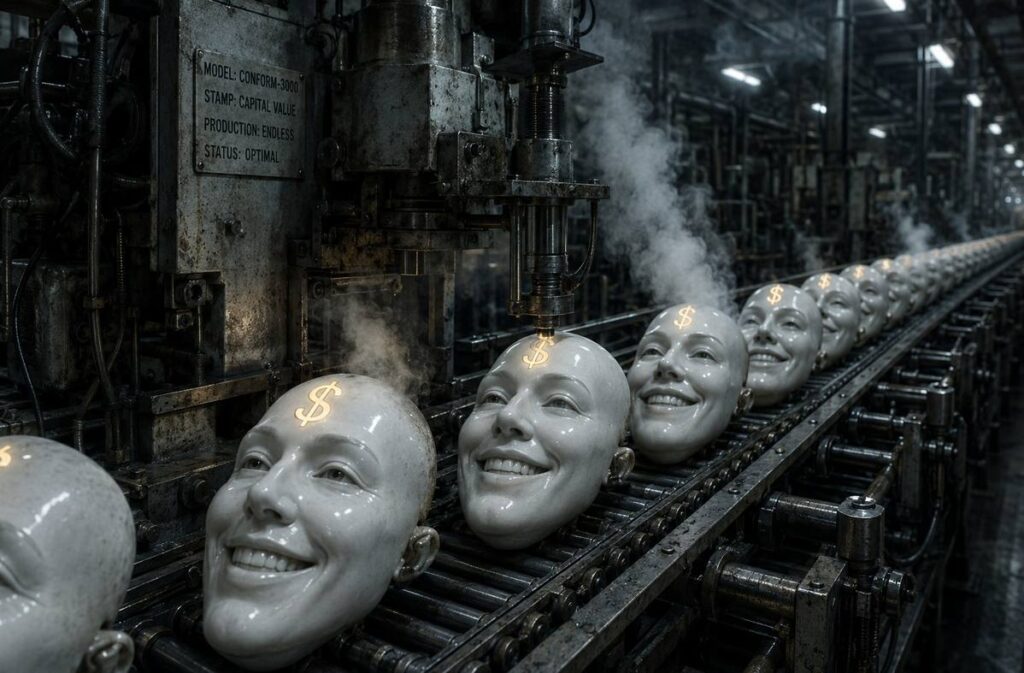
The manifestation coach does not sell transformation; she sells the appearance of transformation. Vision boards, energy clearings, abundance courses–each promises that the client need only adjust their interior landscape to alter their exterior conditions. The poor cannot manifest; they can only purchase the appearance of manifestation. The sick cannot think themselves well; they can only buy the narrative that their illness reflects a failure of belief. This is not empowerment. It is the commodification of hope under conditions that make hope structurally impossible for the majority.
The Blame Architecture
The most sinister feature of toxic manifestation is its blame architecture. When the promised wealth does not arrive, the fault lies not with the system that concentrates resources at the top, but with the individual who “did not believe hard enough.” When the cancer persists, the fault lies not with environmental carcinogens or genetic lottery, but with the patient who harboured “disease thoughts.” Byrne herself writes: “Everything that surrounds you right now in your life, including the things you’re complaining about, you’ve attracted.” This is not psychology; it is theodicy without the theology–a cruel god who blames the victim, stripped of even the dignity of a name.
The Gnostic tradition recognised this logic immediately. The demiurge–the false creator who fashioned the material world as a prison–is not merely incompetent but cruel. He punishes the sparks of light for the very condition he imposed upon them. The manifestation industry performs the same manoeuvre: it tells the prisoner that the bars are imaginary, then blames the prisoner when the bars fail to dissolve. The archons have learned to speak the language of empowerment.

The Mechanics of Binding
The archontic nature of toxic manifestation operates through four distinct but interlocking mechanisms. Each one functions as a binding spell: not the dramatic magic of folklore, but the slow, invisible magic of ideology that convinces the bound they are free.
Hyper-Agency: The Ego Swollen to Godlike Proportions
The first mechanism is hyper-agency: the delusion that the ego controls reality. This is inflation, not empowerment–the ego swollen to godlike proportions while remaining fundamentally impotent. The practitioner is told they can “THINK your life into existence,” that they are “the Michelangelo of your own life,” that the universe responds to their every mental emission like an obedient servant. The result is not mastery but exhaustion. The individual spends their days monitoring thoughts, suppressing negativity, and performing gratitude for things they do not have–all while the structural conditions that actually determine their life remain untouched.
Carl Jung warned against precisely this inflation in his analysis of the modern psyche. The ego that believes itself capable of creating reality has confused itself with the Self. In Gnostic terms, it has mistaken the hylic shell for the pneumatic spark. The hyper-agency of manifestation is not gnosis; it is the demiurge’s final trick–convincing the spark that it is the prison warden.
Moralistic Judgment: Suffering as Spiritual Failure
The second mechanism is moralistic judgment. Suffering becomes moral failure. The sick deserved it; the poor earned it; the dying manifested their disease. This is the Gnostic demiurge–the cruel god who blames the victim–operating through the language of “vibration” and “alignment.” The practitioner learns to scan the room for “low-vibration” people, to avoid the grieving friend lest their negativity contaminate the manifestation field, to treat the homeless person as a cautionary tale rather than a neighbour.
The ancient Gnostics would recognise this immediately. The Apocryphon of John describes the archons as those who “created authorities for themselves” and “ruled over those who were in the chaos.” The modern archon wears the mask of the wellness influencer, but the operation is identical: the creation of hierarchies based on spiritual status, the ranking of souls according to their perceived “frequency,” the substitution of compassion with judgment. The kenoma–the empty place of deficiency–is not overcome by toxic manifestation; it is reinforced by it.
Dissociation from the Real: Reality as Reflection
The third mechanism is dissociation from the real. By insisting that external reality is “just a reflection” of internal states, the practitioner ignores material conditions, systemic injustice, and the necessity of political action. The war becomes a collective failure of positive thinking. The famine becomes a mass manifestation of scarcity consciousness. The climate crisis becomes a projection of collective anxiety. Each interpretation serves the same function: it removes the need to engage with the material world as a site of struggle, conflict, and necessary transformation.
This dissociation is not accidental. The manifestation industry thrives precisely because it offers an escape from the difficult work of political organisation, collective action, and systemic critique. Why organise a union when you can visualise a raise? Why protest environmental destruction when you can affirm abundance? The archons do not need to suppress dissent; they need only sell a more comfortable alternative. The Apocryphon of John warned that the archons “cast them into the lowest region of all matter”–not through violence, but through the construction of a reality so compelling that the sparks forget to look up.

Commodified Hope: The Purchase of Appearance
The fourth mechanism is commodified hope. The “abundance mindset” requires expensive courses, vision boards, crystals, and “energy clearings.” The poor cannot manifest; they can only purchase the appearance of manifestation. The industry operates on the same logic as the beauty industry: create insecurity, then sell the solution. The difference is that the manifestation industry does not merely sell products; it sells a cosmology in which the product’s failure is the customer’s fault.
Byung-Chul Han, the philosopher who has written extensively on the psychopolitics of neoliberalism, describes how contemporary capitalism has repurchased mindfulness and wellness to harness the psyche as a “productive force.” The result is a body-mind shift that supports neoliberal governmentality: the individual is made responsible for their own success and failure, their own health and illness, their own wealth and poverty. The manifestation industry is the spiritual wing of this operation. It does not liberate the self; it optimises it for continued production within the very systems that cause its suffering.
The Gnostic Alternative: Co-Creation Without Control
The authentic teaching is not attraction but participation. Consciousness does not control reality but participates in its unfolding. This distinction is not semantic; it is the difference between archonic binding and genuine liberation. The Gnostic does not seek to dominate the world from the vantage point of an inflated ego; she seeks to recognise the divine spark within the world, including within the suffering that the manifestation industry would have her deny.
Participation vs. Domination
The Gnostic cosmology of the Nag Hammadi Library describes a universe in which the divine spark has fallen into matter and must navigate its return. The spark does not control the material world; it moves through it. The Trimorphic Protennoia speaks of the divine Thought that “dwells in the Light” and descends into the darkness not to dominate it but to awaken the sparks that sleep within it. This is participation: the recognition that consciousness is not a hammer but a lens, not a weapon but a witness.
The Zen Anarcho Gnostic synthesis is particularly sharp here. Drawing on Gary Snyder’s 1961 essay “Buddhist Anarchism” and the later work of Max Cafard (John Clark), this tradition insists that the refusal of domination must operate both internally and externally. The ego that seeks to control reality is the same ego that submits to political domination; both are expressions of the same archonic logic. The practice of wu wei–effortless action aligned with the Tao–describes not passivity but the cessation of egoic interference in the flow of reality. The Gnostic does not force the world to conform to her desires; she removes the obstacles that prevent her from seeing the world as it is.
Working with Material Reality
The Gnostic works with material reality, acknowledging structural constraints while seeking to transcend them–not through “vibration” but through action. The ancient Gnostics were not ascetics who denied the body; they were realists who recognised the body as both prison and vehicle. The Apocryphon of John describes the material world as a product of the demiurge’s error, but it also describes the spark’s journey through that world as necessary. There is no escape that bypasses the real.
This means that the Gnostic response to poverty is not visualisation but solidarity. The response to illness is not affirmation but care–both personal and systemic. The response to injustice is not “rising above it” but engagement with the political and material conditions that produce it. The Gospel of Thomas says: “If you bring forth what is within you, what you bring forth will save you. If you do not bring forth what is within you, what you do not bring forth will destroy you.” The “bringing forth” is not a mental exercise; it is the actualisation of insight in the material world.
The Shadow, the Archons, and the Refusal to Bypass
The Gnostic accepts the shadow. She refuses to “manifest away” suffering, instead meeting it with compassion and practical assistance. Jung’s engagement with Gnosticism was fundamentally therapeutic precisely because he recognised that the shadow cannot be eliminated–only integrated. The demiurge is not an external enemy to be destroyed but an internal complex to be understood. The archons are not demons to be exorcised but systemic forces to be resisted.
The toxic manifestation teaching treats the shadow as a mistake: a “limiting belief” to be overwritten, a “low vibration” to be raised. The Gnostic teaching treats the shadow as information: the darkness that reveals where the light has not yet reached. The Authoritative Teaching describes the soul’s descent into matter as a “contest”–not a punishment but a trial that produces strength. To bypass this contest through positive thinking is to miss the very purpose of embodiment.
The Gnostic also releases omnipotence. She recognises the ego as construct, not creator. The “I” that manifests is itself part of the illusion–the hylic personality that believes itself separate from the divine ground. The Gospel of Philip speaks of the bridal chamber (nymphōn) as the place where the separated self recognises its union with the divine. This is not the ego’s achievement; it is the ego’s dissolution. You do not manifest the divine; you remember that you never left it.

Manifestation as Subversion
When freed from the burden of omnipotence, “manifestation” becomes something subtler: the capacity to perceive possibilities invisible to the dominant paradigm. Not the magical creation of wealth, but the recognition of value outside the monetary system. Not the denial of illness, but the discovery of meaning within it. Not the control of reality, but the recognition of reality’s hidden dimensions.
Anamnesis and the Hidden Abundance
The “law” is not attraction but anamnesis–remembering the pleroma within the kenoma. The pleroma is the Gnostic term for the fullness of divine reality, the region of complete presence that stands in contrast to the kenoma, the empty place of deficiency where the archons operate. You do not manifest the new world; you recognise that it is already present, hidden within the cracks of the old. The abundance you seek is not somewhere else, waiting to be attracted. It is here, disguised as the present moment, obscured only by the belief that it is missing.
This is why the Gnostic tradition speaks of gnosis as recognition rather than acquisition. You do not create the truth; you remove the obstacles to seeing it. The Gospel of Thomas says: “The kingdom is inside you, and it is outside you. When you know yourselves, you will be known, and you will understand that you are children of the living Father.” The knowing is not the manufacture of a new state but the remembrance of an original one.
The subversive manifestation is therefore the opposite of the commercial version. Where toxic manifestation demands constant effort–visualising, affirming, vibrating–subversive manifestation demands the cessation of effort. Where toxic manifestation seeks to control the future, subversive manifestation recognises the fullness of the present. Where toxic manifestation blames the individual for systemic failure, subversive manifestation joins the individual to collective struggle. The archons fear not your positive thoughts but your recognition that their game is optional.

The Courage to Not Control
The courage required of the contemporary Gnostic is not the courage to dominate reality but the courage to stop trying. The toxic manifestation industry offers a counterfeit gnosis: the promise that you can think your way to freedom while remaining structurally bound. The authentic Gnostic path offers something harder and more precious: the recognition that freedom is not a future achievement but a present fact, obscured only by the belief that you must earn it.
You are not the universe’s director; you are its witness. Stop trying to attract and start recognising. The abundance you seek is already here, disguised as the present moment. The only thing to manifest is the courage to see it–and the solidarity to ensure that others can see it too. The archons do not fear your vision boards. They fear your withdrawal of consent from the entire architecture of blame.
You are not the universe’s director; you are its witness. Stop trying to attract and start recognising.
What is toxic manifestation and how is it different from positive thinking?
Toxic manifestation is the commercial ideology that claims thoughts alone create reality, making individuals solely responsible for their circumstances while ignoring structural injustice. Unlike genuine positive thinking, it functions as a blame architecture: when manifestation fails, the fault is placed on the individual’s “low vibration” rather than on economic or social systems.
How does the manifestation industry function as archonic binding?
The industry operates through four binding mechanisms: hyper-agency (inflating the ego to godlike proportions while leaving it impotent), moralistic judgment (framing suffering as spiritual failure), dissociation from the real (ignoring material conditions by claiming reality is “just a reflection”), and commodified hope (selling expensive courses and crystals as prerequisites for abundance).
What is the Gnostic alternative to the Law of Attraction?
The Gnostic alternative is not attraction but participation. Consciousness does not control reality but recognises the divine spark already present within it. The practice is anamnesis–remembrance of the pleroma (divine fullness) hidden within the kenoma (the empty place of deficiency). You do not manifest the new world; you recognise that it is already present in the cracks of the old.
What does anamnesis mean in Gnostic practice?
Anamnesis means remembrance of one’s true divine nature, not the recall of past events. In the context of toxic manifestation, it describes the recognition that abundance is not somewhere else to be attracted but is already here, obscured only by the belief that it is missing. It is the opposite of the egoic striving that the manifestation industry demands.
Is the wellness industry connected to neoliberalism?
Yes. Critical scholars describe “neoliberal spirituality” as a system that relocates the source of unwellness within individuals rather than addressing structural causes. The wellness industry thrives by making people believe they need to fix themselves through consumption, while the political and economic conditions that produce suffering remain unchallenged.
How can manifestation become subversive rather than binding?
When freed from the burden of omnipotence, manifestation becomes the capacity to perceive possibilities invisible to the dominant paradigm–not the magical creation of wealth but the recognition of value outside the monetary system. It shifts from control to recognition, from individual acquisition to collective solidarity.
What should I do if manifestation teachings have made me feel worthless?
Professional support is not a failure of belief but a recognition that the spark deserves care in all its dimensions. The blame architecture of toxic manifestation can exacerbate depression and anxiety. Contemplative practice complements but does not replace clinical mental health treatment.
Safety Notice: This article critiques psychological frameworks that may contribute to self-blame, spiritual bypassing, and the denial of material conditions. It does not constitute medical, psychological, or spiritual advice. If you are experiencing persistent depression, anxiety, or feelings of worthlessness exacerbated by manifestation teachings, professional support is not a failure of belief but a recognition that the spark deserves care in all its dimensions. Contemplative practice complements but does not replace clinical mental health treatment.
Further Reading
- Who Are the Neo Gnostics? The Complete Guide to Modern Gnostic Revival — Maps the neo gnostic synthesis and the radical edge of contemporary Gnostic practice, including the refusal of archonic domination.
- The Archonic Infection: Recognising Systemic Possession in the Digital Age — A deeper phenomenology of how systemic forces colonise consciousness through narrative, platform, and algorithm.
- The Ungovernable Attention: Cognitive Sovereignty in the Algorithmic Age — Reclaiming attention from algorithmic capture and the dopamine economy, a practical companion to resisting archonic binding.
- The Withdrawal of Consent: Breaking the Karmic Contract of Compliance — Examines the mechanics of systemic capture and the practice of inner and outer refusal.
- Digital Minimalism as Mystical Practice — The practice of subtraction as foundation for attention reclamation and the refusal of commodified consciousness.
- Predatory Consciousness: Recognising the Feeders — The ecology of psychic predation and systemic attention capture, mapping the feeders that the manifestation industry serves.
- Archons: The Ruling Powers That Shape Reality — The classical Gnostic framework for understanding systemic control across traditions, from Nag Hammadi to the digital feed.
- The Demented God Architect: Understanding the Demiurge — Examines the Gnostic critique of the false creator and its relevance to modern power structures, including the wellness-industrial complex.
- Recognition Beyond Position: The Gnostic Theory of Knowing — Why gnosis cannot be taught, only recognised–and what that means for the refusal of commodified spirituality.
- The Living Thread: How Forbidden Knowing Survives — Traces the hidden transmission of Gnostic ideas through history, including their subversion by commercial interests.
References and Sources
The following sources are grouped by category for clarity. Primary texts are cited by Nag Hammadi Codex (NHC) reference; secondary sources include scholarly monographs, critical journalism, and philosophical analyses of neoliberal spirituality.
Primary Sources and Critical Editions
- The Apocryphon of John, NHC II,1; trans. M. Waldstein and F. Wisse, The Apocryphon of John: Synopsis of Nag Hammadi Codices II,1; III,1; and IV,1 (Leiden: Brill, 1995).
- Trimorphic Protennoia, NHC XIII,1; trans. J. D. Turner, in The Nag Hammadi Library in English, ed. J. M. Robinson (Leiden: Brill, 1988).
- The Gospel of Thomas, NHC II,2, sayings 2 and 70; trans. T. O. Lambdin, in Robinson, ed., Nag Hammadi Library in English.
- The Gospel of Philip, NHC II,3; trans. W. W. Isenberg, in Robinson, ed., Nag Hammadi Library in English.
- The Authoritative Teaching, NHC VI,3; trans. G. W. MacRae, in Robinson, ed., Nag Hammadi Library in English.
Scholarly Monographs and Critical Studies
- R. Byrne, The Secret (New York: Atria Books / Beyond Words Publishing, 2006).
- H. Jonas, The Gnostic Religion: The Message of the Alien God and the Beginnings of Christianity (Boston: Beacon Press, 1958).
- C. G. Jung, The Seven Sermons to the Dead (1916), in R. A. Segal, ed., The Gnostic Jung (Princeton: Princeton University Press, 1992).
- B.-C. Han, The Burnout Society (Stanford: Stanford University Press, 2015); and Psychopolitics: Neoliberalism and New Technologies of Power (London: Verso, 2017).
- S. Badr, “Re-Imagining Wellness in the Age of Neoliberalism,” New Sociology: Journal of Critical Praxis (York University).
- G. Snyder, “Buddhist Anarchism,” Journal for the Protection of All Beings, no. 1 (1961).
- M. Cafard [J. Clark], “Zen Anarchy,” The Anarchist Library, 2006/2009.
Industry and Encyclopaedic References
- Global Wellness Institute, “Global Wellness Economy Monitor,” 2019; industry valuation and growth projections.
- Wikipedia, “The Secret (Byrne book),” s.v. “Reception and scientific criticism,” citing peer-reviewed critiques of the law of attraction; accessed 2026.