The Crystalline Gateway: Understanding the Pineal Gland as the Seat of Spiritual Perception
Deep within the brain, close to the midline and tucked within the epithalamus, sits a small pine-cone-shaped endocrine gland that has fascinated physicians, philosophers, mystics, and seekers for centuries: the pineal gland.
Modern biology recognises the pineal primarily for its role in melatonin production and circadian rhythm. It helps translate the light-dark cycle into hormonal timing, influencing sleep, wakefulness, seasonal rhythms, and the body’s inner clock. That is the grounded scientific centre of the matter.
Yet the pineal has never remained only a medical object. René Descartes famously associated it with the seat of the soul. Esoteric traditions have linked it with the third eye, inner sight, intuition, spiritual perception, and the subtle bridge between visible and invisible worlds. Modern occultism, yoga-inspired spirituality, Theosophy, and New Age writing have all turned the pineal into a luminous symbol of awakened perception.
This article does not ask you to choose between science and symbolism. It asks for something more careful: to see the pineal gland as both biological organ and esoteric emblem. It is not literally a magical eye in the centre of the skull. Nor is it merely a sleep switch with no symbolic power. It is a small gland at the crossroads of light, rhythm, darkness, imagination, endocrine timing, and myth. That is already enough mystery to begin.
In Plain Terms
The pineal gland is a small endocrine gland in the brain best known for producing melatonin, a hormone involved in sleep-wake timing and circadian rhythm. It receives information about light indirectly through pathways that begin in the retina and pass through the body’s biological clock.
The third eye is a symbolic and contemplative idea found in several traditions. It refers to inner perception, discernment, intuition, and spiritual sight. The pineal is often associated with this idea, but the connection is interpretive rather than anatomically proven. A grounded reading can honour both: the pineal as biological organ, the third eye as symbolic gateway of perception.
Sources and Traditions Discussed
- Neuroscience and endocrinology, especially the pineal gland’s role in melatonin production and circadian rhythm.
- Comparative symbolism, including the Eye of Horus, pine-cone imagery, inner sight, and sacred eye motifs.
- Yogic and tantric traditions, especially ajna chakra, inner gazing, mantra, breath, and subtle perception.
- Christian mystical symbolism, including the “single eye” and inner illumination, read carefully rather than as anatomical proof.
- DMT research, including the popular pineal-DMT hypothesis and the scientific critiques that complicate it.
- Pineal calcification research, including fluoride deposition, ageing, mineralisation, and what is and is not known about “decalcification”.
- Gnostic symbolism, especially perception, the divine spark, archonic narrowing, and the recovery of direct knowing.
How to Read This Article
This article separates biological claims from symbolic interpretation. The pineal gland is a real endocrine organ. The third eye is a spiritual and contemplative symbol. The overlap between them is meaningful, but it should not be overstated.
Read the esoteric language as a map of perception, not as a substitute for anatomy. Read the science as grounding, not as a prison. The question is not whether a tiny gland “proves” mystical vision. The better question is how light, rhythm, sleep, imagination, inner silence, and symbolic attention shape the conditions through which perception becomes more refined.
Table of Contents
- The Third Eye Across Traditions
- Ancient Egypt, the Eye of Horus, and Symbolic Anatomy
- Eastern Traditions: Ajna and the Inner Gaze
- The Christian Mystical Eye
- The Science of the Subtle
- Light, Melatonin, and the Retinal Connection
- Calcite, Brain Sand, and Crystalline Symbolism
- DMT and the Spirit Molecule Debate
- Calcification and the Closing of the Gates
- Supporting Pineal Health and Inner Perception
- Beyond the Physical
- The Gnostic Reading: The Eye That Learns to See
- Related Glossary Terms
- Read Next
- Frequently Asked Questions
- Further Reading
- References and Sources
The Third Eye Across Traditions
Across many traditions, spiritual perception is described through the language of sight. The eye opens. The veil lifts. Darkness becomes luminous. The seeker sees what was always present but previously unnoticed. This language is not accidental. Vision is the dominant metaphor for knowing because recognition often feels like seeing: sudden, immediate, clarifying, and impossible to unsee.
The pineal gland enters this symbolic field because it belongs to light and darkness in a literal biological sense. It does not see images. It does not replace the eyes. Yet through melatonin and circadian rhythm, it participates in the body’s relationship with the cycle of illumination and shadow. That alone makes it a potent symbol for inner perception.
The third eye, then, should not be flattened into a single anatomical claim. It is better understood as a cluster of meanings: attention, intuition, discernment, subtle perception, inner luminosity, and the awakening of a faculty that sees beyond surface appearances.
Ancient Egypt, the Eye of Horus, and Symbolic Anatomy
In ancient Egypt, the Eye of Horus, or Wedjat, was a powerful symbol of protection, restoration, healing, royal authority, and wholeness. The mythic background is the injury and restoration of Horus’s eye after conflict with Seth. In its traditional setting, the symbol belongs to protection and restored order more than to a literal map of the brain.
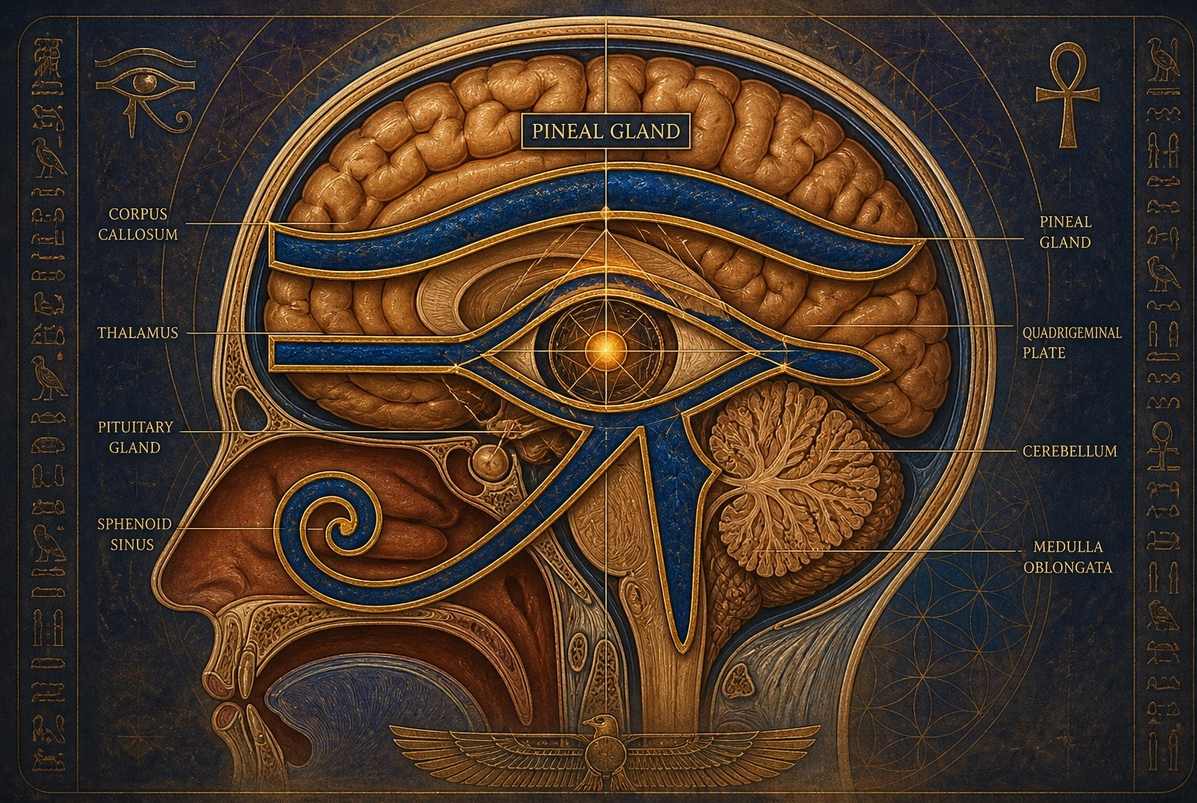
Modern esoteric writers have often noticed a resemblance between the Eye of Horus and a sagittal cross-section of the brain, including the region around the thalamus, corpus callosum, pituitary, and pineal. This resemblance is visually intriguing, but it should be presented honestly: mainstream Egyptology does not treat the Eye of Horus as an intentional pineal diagram.
The more defensible point is symbolic rather than anatomical. Ancient eye imagery often gathers themes of restoration, sight, divine protection, and hidden knowledge. Whether or not the Egyptians intended neuroanatomy, the Eye of Horus remains a potent image for restored perception: the damaged eye healed, the fractured faculty made whole, the inner organ of discernment returned to function.
Pine-cone-like imagery also appears in several ancient cultures, especially in Near Eastern iconography. These images are not proof of pineal science in antiquity, but they show how vegetal, seed, cone, and eye symbols were used to speak about fertility, purification, life, and sacred power. Later esoteric traditions read these symbols through the pineal. That is a living symbolic interpretation, not an archaeological certainty.
Eastern Traditions: Ajna and the Inner Gaze
In Hindu and tantric traditions, the third eye is usually associated with ajna chakra, the command centre located at or between the brows. Ajna is linked with insight, intuition, concentration, inner seeing, and the capacity to perceive beyond ordinary sensory fragmentation. It is the eye that does not merely look outward, but gathers attention inward.
The common modern habit of identifying ajna directly with the pineal gland is interpretive, not anatomically precise. Ajna belongs to subtle anatomy, not gross anatomy. Some modern systems associate it with the pineal, others with the pituitary, optic chiasm, or wider brow-centre field. Traditional maps do not always align neatly with endocrine organs, and forcing them to do so can flatten both traditions.
Still, the association is understandable. Practices involving inner gazing, concentration at the brow, mantra, breath, and visualisation can strongly affect attention, arousal, perception, and imagery. Whether the pineal is directly stimulated or not, the practitioner’s relationship with inner light changes. The biology may be indirect. The experience can still be profound.
Buddhist traditions also speak of inner luminosity, though they do not generally reduce it to the pineal. Meditative absorption, subtle light, clear awareness, and non-ordinary perception are discussed in many contemplative lineages. The important point is not to turn the pineal into a universal master-key, but to recognise that human traditions repeatedly place spiritual awakening in relation to light, seeing, and the transformation of perception.
The Christian Mystical Eye
Christian scripture also uses the language of inner sight. In Matthew 6:22, Jesus says that the eye is the lamp of the body. In mainstream biblical interpretation, this passage is usually read in moral and spiritual terms, often linked with generosity, integrity, and the orientation of desire. It is not a pineal-gland teaching in the historical-critical sense.
Yet Christian mysticism has always developed the language of inward seeing. Hesychast prayer, apophatic contemplation, the “eye of the heart,” and the inward turning of attention all point towards a purified faculty of perception. The mystic does not merely see more objects. The mystic sees differently.
Some esoteric readers connect the forehead, the single eye, and apocalyptic symbols such as the mark on the forehead with pineal activation or suppression. These readings can be meaningful as symbolic interpretation, but they should not be confused with mainstream biblical scholarship. The stronger point is simpler: the forehead and inner eye have become recurring symbolic locations for allegiance, perception, discernment, and spiritual orientation.
The Christian mystical eye, the yogic ajna, the Egyptian restored eye, and the modern pineal symbol do not all say the same thing. But they gather around one shared question: what must change in us before reality can be seen more truly?
The Science of the Subtle
The biological pineal gland is not speculative. It is a real endocrine gland with well-established functions. Its best-known role is the production and secretion of melatonin, especially in darkness. Through melatonin, the pineal helps communicate night-time to the body.
Light does not reach the human pineal directly. Instead, light information travels from the retina to the suprachiasmatic nucleus, the body’s central circadian clock, and then through a multi-step pathway that ultimately affects pineal melatonin output. Darkness allows melatonin to rise. Light, especially at biologically sensitive times, suppresses it.
This is already spiritually suggestive without exaggeration. The pineal is a biological translator of light and darkness. It helps turn environment into rhythm. It belongs to timing, sleep, restoration, and the daily descent into night. A contemplative tradition does not need to invent mystery here. The mystery is already doing endocrine work.
Light, Melatonin, and the Retinal Connection
In some non-mammalian vertebrates, pineal-related structures retain more direct photosensitivity. In mammals, including humans, the pineal is not a literal eye. It does not form images. Its relationship to light is indirect, mediated by the eyes and circadian pathways.
Evolutionary history matters because it helps explain why the pineal has been so easily drawn into light symbolism. Across species, pineal and parapineal structures have been associated with photoreceptive or circadian roles. In humans, this ancient relationship with light has become hormonal rather than visual.
The phrase “third eye” therefore works best as symbolic shorthand. It does not mean that humans possess a hidden camera in the skull. It means that a small light-linked gland has become a natural emblem for inward illumination.
Calcite, Brain Sand, and Crystalline Symbolism
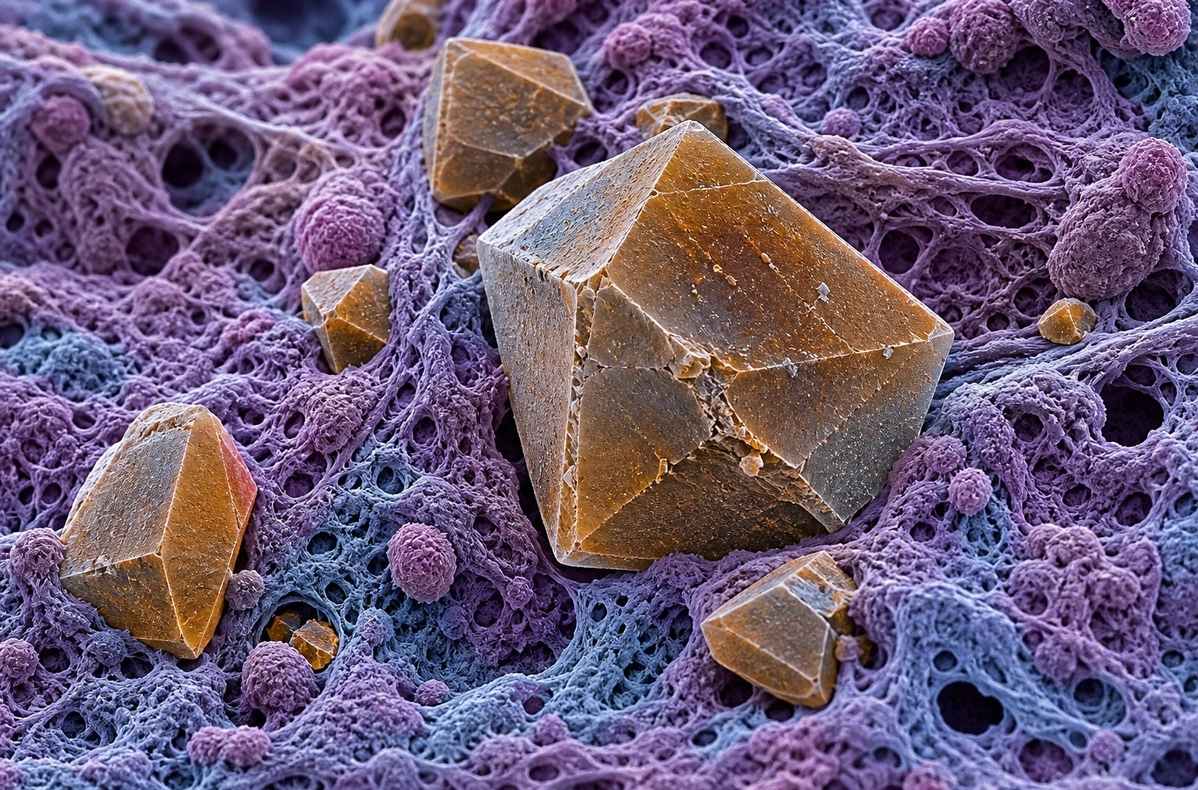
The pineal is also known for calcification. Small mineral deposits, sometimes called “brain sand” or corpora arenacea, are common and often increase with age. These deposits can make the pineal visible on imaging and have long attracted both medical and esoteric attention.
Some researchers have reported calcite microcrystals in human pineal tissue and speculated about their possible physical properties. This has fed esoteric interest in the pineal as a crystalline structure. However, the functional significance of these crystals remains uncertain. They may be biologically meaningful, incidental, or related to calcification processes without serving as mystical antennas.
The symbolism, however, remains powerful. Crystals organise light. They refract, clarify, and structure. Whether or not pineal calcite has a subtle perceptual function, the image of a crystalline gateway speaks to a genuine contemplative intuition: perception becomes clearer when the inner medium becomes less clouded.
DMT and the Spirit Molecule Debate
No modern pineal discussion escapes DMT. Rick Strassman’s book DMT: The Spirit Molecule popularised the hypothesis that the pineal might produce DMT during birth, death, dreams, or mystical states. The idea is compelling because it seems to offer a biological doorway between brain chemistry and visionary experience.
But compelling is not the same as proven. David Nichols argued in 2018 that the popular pineal-DMT hypothesis faces serious biochemical and evidential problems. Current research does support the presence of endogenous DMT in mammals and suggests that the rat brain can synthesise and release DMT, with DMT-related enzyme transcripts identified in several tissues, including cerebral cortex, choroid plexus, and pineal gland. A 2019 rat study also found DMT in the visual cortex with and without an intact pineal gland, and observed increases following experimentally induced cardiac arrest.
The responsible conclusion is therefore careful: endogenous DMT is scientifically interesting, and the pineal may have the machinery associated with DMT synthesis, but the pineal has not been shown to be the sole or decisive source of visionary DMT states in humans. The “spirit molecule” remains a powerful metaphor and a provocative research area, not a settled explanation of mystical experience.
For a Gnostic reading, this matters. Gnosis should not be reduced to one chemical. A molecule may open a door, alter perception, or loosen the self-model. But direct knowing is not identical with neurochemistry. The spark is not a secretion. The body participates in revelation, but does not exhaust it.
Calcification and the Closing of the Gates
Pineal calcification is common. It often increases with age and is visible enough on imaging that the pineal has historically been used as a radiological landmark. In esoteric circles, calcification is often described as the closing of the third eye. That phrase is symbolic, but it points towards a real biological concern: when pineal function is compromised, melatonin rhythm, sleep quality, and circadian regulation may be affected.
Fluoride is often discussed in this context. Jennifer Luke’s 2001 study found that fluoride can accumulate in the aged human pineal gland, and measured fluoride and calcium in pineal tissue from cadavers. Later work has added nuance, suggesting the relationship between fluoride and pineal mineralisation is complex. It is not honest to say fluoride alone “causes the third eye to close.” It is more accurate to say that fluoride can accumulate in calcified pineal tissue and that the health implications remain debated.
Other factors may matter more directly for ordinary life: light at night, irregular sleep, chronic stress, shift work, excessive screen exposure before bed, poor circadian timing, and general metabolic health. The pineal does not live in isolation. It belongs to a whole organism, and the organism belongs to a rhythm.
In symbolic terms, calcification becomes an image for perception made opaque. A calcified inner eye is the psyche hardened by habit, artificial light, chronic vigilance, cynicism, spiritual numbness, and the refusal of silence. The biology may be mineral. The metaphor is existential.
Supporting Pineal Health and Inner Perception
Claims about “decalcifying” the pineal often outrun the evidence. There is no well-established quick fix that reliably reverses pineal calcification in humans. The pineal is not a switch that can be activated overnight by a supplement, chant, or internet protocol. It is an organ within a living system, and it responds best to rhythm, darkness, health, and sustained practice.
The following practices are therefore framed as supportive, not miraculous. They are also valuable even if one brackets all esoteric claims, because they support sleep, attention, circadian rhythm, and embodied awareness.
1. Restore Light-Dark Rhythm
Morning daylight helps anchor the body’s circadian clock. Darkness at night supports melatonin rise. This is the most evidence-grounded pineal practice: live more rhythmically with light. Open curtains early. Step outside when possible. Dim artificial light in the evening. Reduce bright screens close to bedtime or use strong light hygiene.
Spiritually, this is beautifully simple. The organ of night responds to darkness. The inner clock needs a sky. The body cannot hear the ancient rhythm if every evening is lit like a shopping centre.
2. Protect Sleep as Sacred Physiology
Sleep is not a productivity inconvenience. It is endocrine repair, memory processing, nervous-system regulation, immune support, emotional integration, and symbolic renewal. The pineal’s melatonin rhythm participates in this nightly descent.
Consistent sleep timing, reduced late-night stimulation, a cooler dark room, and fewer screens before bed are not glamorous practices, but they are closer to pineal wisdom than most dramatic activation schemes. The gate often opens by being allowed to close.
3. Use Meditation as Perceptual Training
Meditation may influence melatonin, arousal, attention, and sleep rhythms, though findings vary by practice, timing, and study design. More importantly, meditation trains the relationship between awareness and thought. The third eye is less about seeing invisible fireworks and more about perceiving clearly without being dragged around by every mental image.
Inner silence matters. It gives perception room to refine. Whether one practises breath awareness, mantra, open monitoring, contemplative prayer, or gentle body scanning, the deeper movement is the same: attention becomes less scattered, and the inner field becomes less noisy.
4. Approach Fluoride and Diet Carefully
Some people choose to reduce fluoride exposure through water filtration or non-fluoridated dental products. This should be approached sensibly. Fluoride has dental-health uses, and decisions about dental care are best made with informed professional guidance, especially for children or people at high risk of tooth decay.
Dietary claims about raw cacao, turmeric, garlic, iodine, boron, or other “pineal foods” should also be handled carefully. Some may support general health, antioxidant status, mineral balance, or inflammation regulation, but strong claims about proven pineal decalcification are not established. The safer principle is simple: eat well, avoid extremes, protect sleep, and do not turn the pineal into a supplement shrine.
5. Practise Inner Gaze Without Forcing Phenomena
Trataka, or candle gazing, is a traditional yogic practice involving steady visual attention on a flame. Some people also use gentle brow-centre awareness, mantra, visualisation, or breath practices. These methods can sharpen concentration and alter the felt field of perception.
They should not be forced. Eye strain, headaches, agitation, insomnia, obsessive focus, or unusual visual disturbances are signs to stop or reduce intensity. The aim is not to bully the third eye open. The aim is to cultivate stable, clear, ethical perception.

Beyond the Physical
The pineal gland is physical. The third eye is symbolic, subtle, and contemplative. Confusion begins when one is collapsed into the other. Clarity begins when they are allowed to speak in different registers.
Theosophical and esoteric traditions often describe the third eye as a dormant organ of higher perception, linked with future evolution, intuition, clairvoyance, or direct spiritual sight. Such claims cannot be treated as established science. But they can be read as mythic language for a real human possibility: perception can become less crude, less reactive, less trapped in surface appearances.
The third eye, in its best sense, is not a paranormal trophy. It is discernment refined into vision. It is the capacity to see through glamour, fear, projection, and false authority. It is the eye that recognises when desire has been manufactured, when belief has become costume, when a system asks for worship it has not earned.
The pineal’s biological relationship with darkness and rhythm makes it a natural symbol for this process. The inner eye does not open in glare. It opens when the organism remembers night, silence, inwardness, and timing. Not every light is spiritual. Some lights are screens. Some lights are advertisements. Some lights are traps. The third eye must learn not only to see, but to discern what kind of light it is seeing by.
The Gnostic Reading: The Eye That Learns to See
Gnosticism is not satisfied with belief. It asks for recognition. The soul must see through the counterfeit order, not merely be told that the order is counterfeit. This is why the symbolism of the inner eye fits so naturally within a Gnostic frame.
The archons rule through distorted perception. They make the partial appear total, the artificial appear natural, the inherited appear inevitable, and the lower world appear final. Their power depends on the eye remaining trained on surfaces.
The third eye, read Gnostically, is the faculty that begins to see structure. It sees how fear organises belief. It sees how desire can be shaped. It sees how authority performs itself. It sees how the soul forgets its own depth by staring too long at the theatre of appearances.
The pineal gland, meanwhile, gives the symbol a biological anchor in rhythm, darkness, melatonin, and the body’s relationship to light. It reminds the seeker that perception is embodied. Gnosis does not occur in a disembodied abstraction. It happens through nervous system, sleep, breath, attention, endocrine rhythm, memory, and silence.
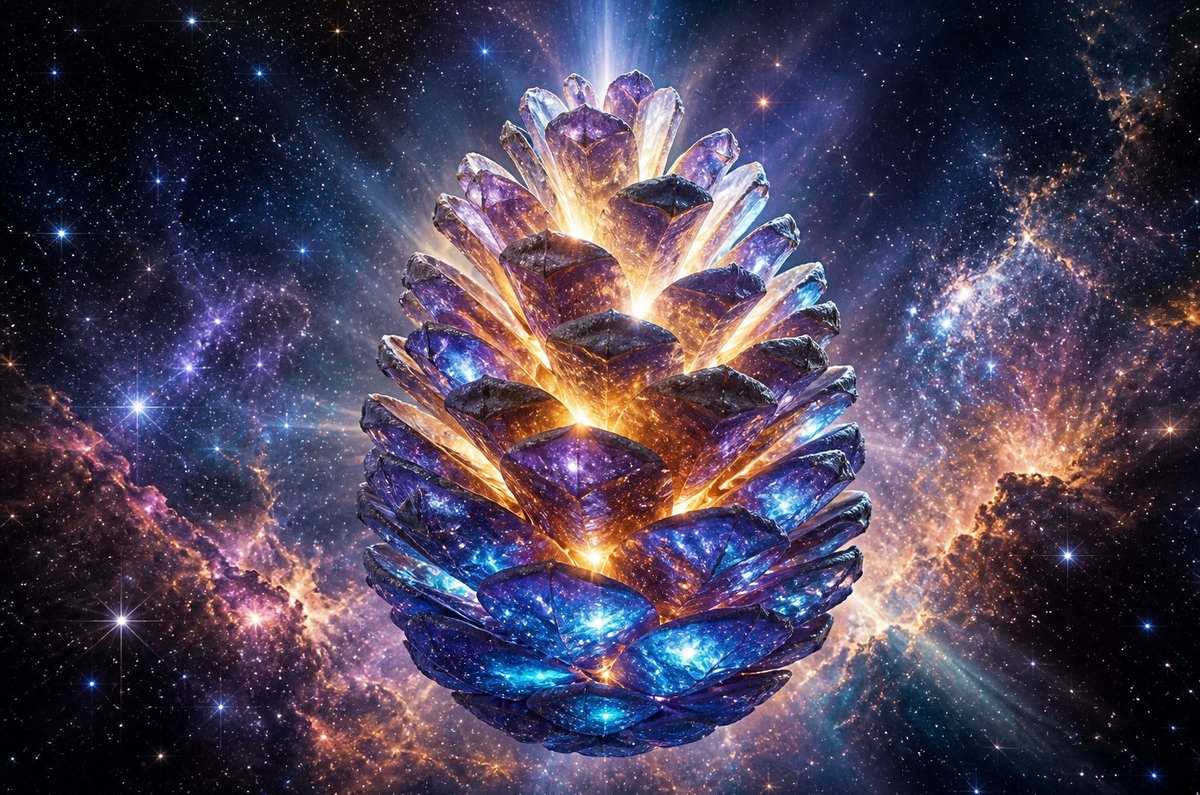
The crystalline gateway is therefore not a promise of spectacular powers. It is a call to refine the instrument of perception. Sleep more honestly. See more carefully. Practise more quietly. Stop worshipping every bright thing. Let the inner eye become less hungry for visions and more capable of truth.
Related Glossary Terms
For quick definitions, use the main ZenithEye Glossary. The key terms for this article are:
Read Next
Continue with: The Divine Architecture Within: How Your Body Mirrors the Universe
If this article explores the pineal gland as a symbol of inner sight, the next step widens the lens: the whole body as microcosm, temple, pattern, axis, and living architecture of perception.
Within The Thread
This article belongs to The Architecture of Perception, a layer of The Thread concerned with how reality is filtered, framed, embodied, symbolised, and mistaken for the whole. The pineal gland belongs here because it sits at the crossroads of light, rhythm, inner sight, and the symbolic anatomy of knowing.
Frequently Asked Questions
What is the pineal gland?
The pineal gland is a small endocrine gland located deep in the brain within the epithalamus. Its best-known function is producing melatonin, a hormone involved in circadian rhythm and sleep-wake timing. It is biologically linked with the body’s response to light and darkness, though it does not directly see images like an eye.
Is the pineal gland really the third eye?
The pineal gland is often called the third eye in esoteric and spiritual traditions, but anatomically it is not a literal eye. The connection is symbolic and interpretive. The third eye refers to inner perception, intuition, discernment, and spiritual sight, while the pineal is a biological organ involved in melatonin and circadian rhythm.
Does the pineal gland produce DMT?
The pineal-DMT hypothesis remains unproven. Research suggests that endogenous DMT can be produced in mammalian bodies and that DMT-related enzyme transcripts have been found in several brain tissues, including the pineal. However, studies also show that DMT can be detected in rat brain even without an intact pineal gland. The pineal’s specific role in human visionary states is still not established.
What causes pineal calcification?
Pineal calcification is common and often increases with age. It involves mineral deposits in the pineal gland, sometimes called brain sand. Fluoride has been shown to accumulate in aged human pineal tissue, but the relationship between fluoride and calcification is complex and not reducible to one simple cause. Sleep rhythm, light exposure, ageing, mineral balance, and general health may also matter.
Can you decalcify the pineal gland?
There is no well-established quick method proven to reverse pineal calcification in humans. The most grounded approach is to support pineal and circadian health through consistent sleep, morning daylight, reduced bright light at night, healthy diet, stress reduction, and sensible medical or dental guidance. Strong claims about supplements or instant pineal activation should be treated cautiously.
What is the connection between the Eye of Horus and the pineal gland?
The connection is mainly modern and esoteric rather than established Egyptology. The Eye of Horus, or Wedjat, was traditionally a symbol of protection, healing, restoration, and royal power. Some modern writers see a resemblance between the Eye of Horus and a cross-section of the brain, but ancient Egyptian texts do not prove that it was intended as a pineal diagram.
How does meditation relate to the pineal gland?
Meditation may influence melatonin, arousal, sleep rhythm, and attention, though research varies by practice and study design. In spiritual terms, meditation trains inner perception by reducing noise, stabilising attention, and refining discernment. It should not be treated as a forced pineal activation technique, but as a grounded practice of clearer seeing.
Further Reading
These links connect the pineal gland and third eye to related resources within the ZenithEye archive, offering context on consciousness, kundalini, breathwork, sacred symbolism, subtle anatomy, and embodied spiritual perception.
- The Divine Architecture Within: How Your Body Mirrors the Universe – The next article in this route, expanding from the pineal to the body as living microcosm.
- Kundalini Phenomena: Physiology, Psychology, and the Awakening of Latent Energy – The energetic physiology of spiritual awakening and the body’s subtle thresholds.
- Breathwork: Ancient Technology, Modern Application – How pranayama and conscious breathing influence arousal, attention, and subtle perception.
- The All-Seeing Eye Decoded: Meaning, History, and Hidden Symbolism – The wider history of sacred eye symbolism from ancient motifs to modern esotericism.
- The Chakra System: Origins, Development, and Modern Misconceptions – A clearer look at traditional chakra frameworks and modern endocrine correlations.
- Planes of Consciousness and Higher Dimensions – A Theosophical and esoteric framework for subtle perception and layered reality.
- Contemplative Techniques: The Thread’s Practical Foundation – Practical methods for cultivating the silence and attention that make inner perception less distorted.
- Integration and Grounding After Mystical Experience – Somatic techniques for stabilising the nervous system after altered states and light phenomena.
- Sacred Geometry and the Architecture of Creation – Geometric symbolism, natural pattern, and the contemplative reading of form.
- The Thread – The main map of ZenithEye’s routes through source, practice, consciousness, and modern systems.
References and Sources
The following sources support the scientific, symbolic, and comparative framework of this article.
Pineal Gland, Melatonin, and Circadian Biology
- [1] Arendt, Josephine. “Physiology of the Pineal Gland and Melatonin.” Endotext. NCBI Bookshelf, 2022.
- [2] Ilahi, Salim and colleagues. “Physiology, Pineal Gland.” StatPearls. NCBI Bookshelf, updated 2023.
- [3] Savage, R. A. and colleagues. “Melatonin.” StatPearls. NCBI Bookshelf, updated 2024.
- [4] Reiter, Russel J. and colleagues. Research on melatonin, circadian rhythm, oxidative stress, and pineal physiology.
DMT and Pineal Debate
- [5] Strassman, Rick. DMT: The Spirit Molecule. Park Street Press, 2001.
- [6] Nichols, David E. “N,N-Dimethyltryptamine and the Pineal Gland: Separating Fact from Myth.” Journal of Psychopharmacology, 32(1), 30-36, 2018.
- [7] Dean, Jon G. and colleagues. “Biosynthesis and Extracellular Concentrations of N,N-Dimethyltryptamine (DMT) in Mammalian Brain.” Scientific Reports, 9, 9333, 2019.
- [8] Barker, Steven A. “N,N-Dimethyltryptamine (DMT), an Endogenous Hallucinogen: Past, Present, and Future Research.” Frontiers in Neuroscience, 2018.
Calcification, Fluoride, and Pineal Mineralisation
- [9] Luke, Jennifer. “Fluoride Deposition in the Aged Human Pineal Gland.” Caries Research, 35(2), 125-128, 2001.
- [10] Tharnpanich, Thunyarat and colleagues. “Association Between High Pineal Fluoride and Calcium Levels.” Fluoride, 49(4 Pt 2), 472-484, 2016.
- [11] Baconnier, Simon and colleagues. “Calcite Microcrystals in the Pineal Gland of the Human Brain.” Second International Conference on Bioelectromagnetism, 2002.
- [12] Whitehead, Matthew T. and colleagues. Reviews of pineal calcification and radiological imaging landmarks.
Eye Symbolism, Chakras, and Comparative Esotericism
- [13] ReFaey, K. and colleagues. “The Eye of Horus: The Connection Between Art, Medicine, and Mythology in Ancient Egypt.” Cureus, 2019.
- [14] Woodroffe, Sir John. The Serpent Power. Ganesh & Company, 1918.
- [15] Avalon, Arthur. The Serpent Power. Yogic and tantric source material on chakras and kundalini.
- [16] Leadbeater, C. W. The Chakras. Theosophical Publishing House, 1927.
- [17] Blavatsky, H. P. The Secret Doctrine. Theosophical Publishing Company, 1888.
- [18] Eliade, Mircea. Yoga: Immortality and Freedom. Princeton University Press, 1958.
Meditation, Melatonin, and Inner Perception
- [19] Solberg, E. E. and colleagues. Research on meditation, melatonin, and physiological changes during contemplative practice.
- [20] Plini, E. R. G. and colleagues. “Meditation Experience Is Associated with Increased Structural and Functional Signal in the Pineal Region.” Contemporary neuroimaging research on meditation and pineal signal.
- [21] Fox, Kieran C. R. and colleagues. “Functional Neuroanatomy of Meditation: A Review and Meta-Analysis.” Neuroscience & Biobehavioral Reviews, 2016.
Gnostic and Interpretive Context
- [22] Robinson, James M. (ed.). The Nag Hammadi Library in English. 3rd ed. HarperSanFrancisco, 1990.
- [23] Meyer, Marvin (ed.). The Nag Hammadi Scriptures: The International Edition. HarperOne, 2007.
- [24] Williams, Michael Allen. Rethinking “Gnosticism”: An Argument for Dismantling a Dubious Category. Princeton University Press, 1996.
- [25] Brakke, David. The Gnostics: Myth, Ritual, and Diversity in Early Christianity. Harvard University Press, 2010.
Study and Safety Note
This article explores scientific, esoteric, symbolic, and contemplative frameworks for understanding the pineal gland and third eye. It does not provide medical, psychological, psychiatric, dental, nutritional, psychedelic, or spiritual-direction advice.
Do not stop prescribed medication, avoid necessary dental care, pursue extreme supplement protocols, stare at bright lights, or attempt intense activation practices without appropriate guidance. If you experience persistent visual disturbances, insomnia, paranoia, mania, psychosis, severe anxiety, dissociation, or difficulty distinguishing inner imagery from external reality, seek support from qualified medical or mental health professionals.