Codex XIII: Trimorphic Protennoia — Three Forms of First Thought
The Nag Hammadi Library preserves thirteen papyrus codices, yet one of its most theologically significant collections is also its smallest. Codex XIII consists of only eight parchment leaves discovered tucked inside the front cover of Codex VI, yet it contains Trimorphic Protennoia–the most complete and systematic theology of the feminine divine in the entire library [1]. Alongside this crown jewel, the codex preserves a fragmentary version of On the Origin of the World, offering textual variants for scholarly comparison.
Where Thunder: Perfect Mind offers paradoxical rhapsody and the Apocryphon of John constructs elaborate aeonic hierarchies, Trimorphic Protennoia speaks in the measured voice of divine Wisdom herself. It is not poetry disguised as theology, nor bureaucracy masquerading as mysticism, but a first-person revelation of the First Thought (Protennoia), identified with Barbelo, describing her three descents into matter and her protocol for liberating the spiritual seed [2]. For contemporary theologians, historians of religion, and seekers alike, Codex XIII delivers an uncompromising vision: the feminine is not derivative, symbolic, or secondary. It is primary, creative, and salvific.
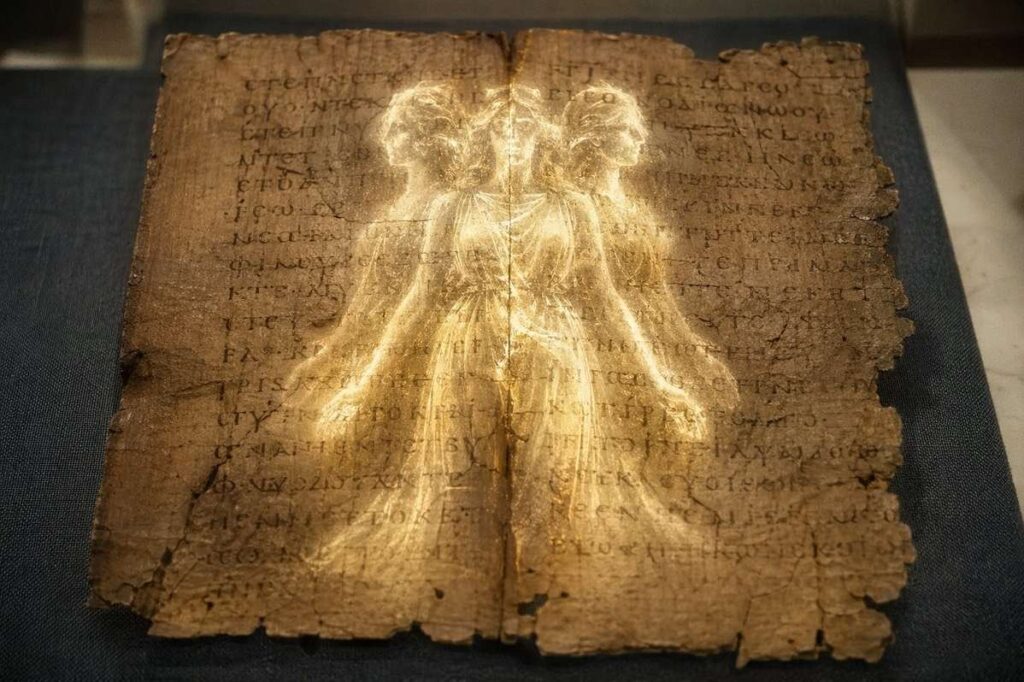
Table of Contents
- What is Codex XIII?
- Manuscript Context
- The Tractates of Codex XIII
- Trimorphic Protennoia
- The Threefold Structure
- The First Descent: Voice
- The Second Descent: Speech
- The Third Descent: Word
- The Five Seals
- On the Origin of the World
- Reading Order for Codex XIII
- Why Codex XIII Matters
- Comparative Context
- Frequently Asked Questions
- Further Reading
- References and Sources
What is Codex XIII?
Codex XIII (Nag Hammadi Codex XIII) is a collection of eight parchment leaves discovered in 1945 inside the cover of Codex VI near Nag Hammadi, Egypt. It contains two tractates: Trimorphic Protennoia (NHC XIII,1), the most complete theology of the feminine divine in the library, and a fragmentary version of On the Origin of the World (NHC XIII,2). Despite its physical brevity, it ranks among the most theologically significant codices in the collection, presenting a first-person revelation of Protennoia–First Thought, divine Wisdom, and active principle of salvation [1][4].
Manuscript Context
Discovery and Physical State
The circumstances of Codex XIII’s preservation are unusual. Unlike the twelve bound codices discovered in the sealed jar near Nag Hammadi in December 1945, these eight leaves were found loose inside the front cover of Codex VI [3]. Measuring approximately 16 x 26 cm, the parchment leaves contain the complete text of Trimorphic Protennoia and the opening lines of On the Origin of the World. Their physical condition is poor–lacunae appear throughout, particularly in the middle sections, and the ink has faded to near illegibility in places [4].
The damage is not merely physical but symbolic. The material prison could not hold the voice of Protennoia intact, yet her message persists through the gaps. Scholars have reconstructed the text through careful collation, revealing a coherent narrative of divine descent and human awakening that transcends its fragmentary vessel.
Relationship to Codex VI
The placement of Codex XIII inside Codex VI raises intriguing questions about ancient reading practices. Codex VI contains a diverse collection: the Acts of Peter and the Twelve Apostles, Thunder: Perfect Mind, Authoritative Teaching, the Concept of Our Great Power, and a portion of Plato’s Republic [5]. The juxtaposition of Trimorphic Protennoia with Thunder: Perfect Mind–the two most prominent feminine divine texts in the library–suggests that ancient collectors recognised their thematic affinity [6]. Whether this proximity was deliberate or accidental remains debated, but the pairing rewards comparative study. Thunder destabilises categories through paradox; Protennoia constructs a systematic pathway through descent.
The Tractates of Codex XIII
1. Trimorphic Protennoia (NHC XIII,1) ★★
Trimorphic Protennoia opens with a thunderous self-proclamation: “I am Protennoia, the Thought that dwells in the Light… I am the movement that dwells in the All” [7]. The speaker identifies herself as the First Thought of the Invisible Spirit, equivalent to Barbelo in other Sethian texts–the divine feminine principle who is simultaneously the source of all manifestation and the agent of salvation [8].
The title Trimorphic (“three-formed”) refers to Protennoia’s three manifestations: as Father (the transcendent source), as Mother (the womb of all), and as Son (the revealed saviour). This threefold structure allows the text to present a complete theology of divine emanation, fall, and restoration–spoken not about the divine but by the divine herself [9].
Primary Source Citation: NHC XIII,1 35*:1-5 — “I am Protennoia, the Thought that dwells in the Light, the movement that dwells in the All. She who exists before the All… I am the Invisible One within the All.” (Translation: Turner 1990)
The Threefold Structure
The text divides into three subtractates, each introduced with an aretalogy and each narrating a successive descent [10]. Each section concludes with a doxology, emphasising the text’s liturgical and hymnic character. The overall format employs a poetic, repetitive style characterised by first-person “I am” proclamations that assert the speaker’s identity across divine realms.
The structure does not follow a rigid logical scheme–Trimorphic Protennoia is not systematic theology in the modern sense–but rather unfolds as a revelation discourse that switches between proclamation and narrative, continually referring back to the three descents as its organising thread.
The First Descent: Voice and Awakening
In the first descent, Protennoia manifests as Sound (Coptic: 2pooy)–the primal utterance that emanates from the Silence of the Invisible Father. “I cried out in their ears, and they heard me,” she declares, describing the initial awakening of the “Sons of Light” from their spiritual slumber [11].
This descent establishes the foundational triadic structure of Father, Mother, and Son as three permanences, followed by the emanation of four aeons. The Voice’s proclamation breaks the bonds of ignorance, inviting the elect into eternal repose. The Sound is perfectly intelligible to the Sons of Light, though the archons and powers fail to comprehend its significance–a graduation of receivers that becomes increasingly pronounced through each descent.
Primary Source Citation: NHC XIII,1 42*:4-10 — “I cried out in their ears, and they heard me. I spoke to them in parables, and they understood.” (Translation: Janssens 1978)
The Second Descent: Speech and Instruction
The second descent presents Protennoia as Speech (Coptic: CMH)–the articulate sound that teaches the secret knowledge necessary for escape from archonic imprisonment. “I taught them about the ineffable things, and the unutterable things,” she proclaims, bypassing the rulers of this world to address directly “her own”–the spiritual seed who recognise her voice [12].
In this form, Protennoia closely resembles the speaker of Thunder: Perfect Mind, another divine feminine voice speaking from the threshold between worlds [13]. She declares herself “the Richness that was in the All,” the “Word of the Majesty” that calls scattered elements back to unity. The second descent operates at the boundary between Pleroma and chaos, overthrowing the old aeon ruled by evil powers and altering the very foundations of fate (heimarmene) itself [14].
The disturbances caused by this descent come to the attention of “those who follow Fate”–astrologers and diviners–who demand explanations from the archontic powers. The powers, in turn, confront their Archigenetor Saklas and declare that their time has come: they recognise that he was not omniscient, that he failed to foresee the things that have come to pass.
The Third Descent: Word and Incarnation
The third and most detailed descent presents Protennoia as Word (Coptic: Aoroc)–the Logos who enters fully into material reality. “I entered into the midst of their prison, which is the prison of the body,” she declares, taking on human form to demonstrate the path of ascent [15].
This third descent parallels the Christian doctrine of incarnation but transforms it fundamentally. Protennoia descends not to die for sins but to teach secret knowledge; not to sacrifice but to reveal. “I put on Jesus,” the text declares. “I bore him from the cursed wood, and established him in the dwelling places of his Father” [16]. The saviour figure here is not a substitute for human suffering but a model for human liberation–one who receives the Five Seals and thereby opens the protocol for others to follow.
The text emphasises that the Word became “all things for all men,” to the point where the archons even mistook him for “their Christ”–the son of the Archigenetor. This strategic disguise allowed Protennoia to operate within the prison unnoticed, gathering her brethren until all could be saved [17].
Primary Source Citation: NHC XIII,1 50:12-15 — “I put on Jesus. I bore him from the cursed wood, and established him in the dwelling places of his Father.” (Translation: Turner 1990)
The Five Seals and Ritual Ascent
The third descent culminates in the revelation of the Five Seals (pente sphragides)–a ritual ascent protocol for Sethian initiates. These seals represent stages of transformation from material (hylic) to spiritual (pneumatic) existence: initial anointing and baptism marking the initiate as Pleroma property; renunciation of lower powers; reception of the garment of light; sealing by the Five Luminaries; and final entry into the Pleroma [18].
The text describes how Protennoia delivers the saviour to angelic administrators who clothe the initiate in luminous garments and immerse him in the spring of the Water of Life. These seals function as credentials allowing the soul to pass through cosmic checkpoints during ascent, transforming the initiate from material entrapment to restored luminosity.
2. On the Origin of the World (NHC XIII,2)
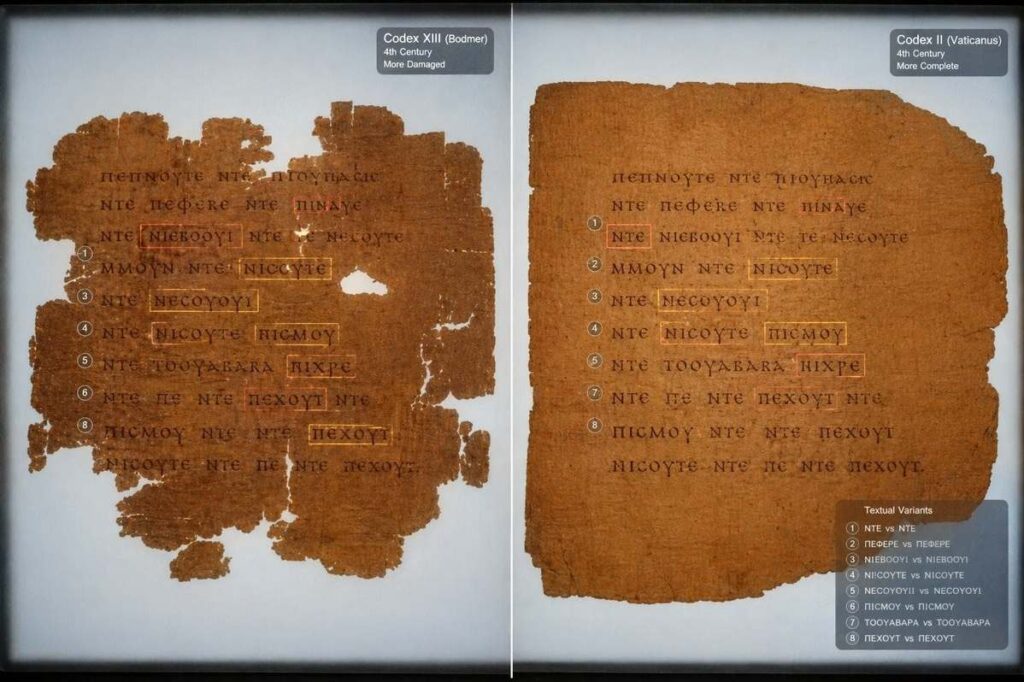
The second tractate presents a version of On the Origin of the World also found in Codex II. The Codex XIII version is generally considered inferior–more fragmentary, more corrupt–making the Codex II version preferable for reading [19]. For scholars, the comparison is valuable; for general readers, the Codex II version is sufficient.
The text begins on the final page of Trimorphic Protennoia, suggesting that the ancient scribe intended the two works to be read together [20]. Whether this pairing was thematic or merely practical remains uncertain. The Codex XIII version breaks off early, leaving only the opening cosmogony before the text becomes too damaged to reconstruct reliably.

Reading Order for Codex XIII
For newcomers: Start with Trimorphic Protennoia. The text is accessible, powerful, and complete–an ideal entry point for those drawn to the divine feminine in Gnosticism. Skip On the Origin of the World here; read the Codex II version instead.
For comparative study: Compare Trimorphic Protennoia with Thunder: Perfect Mind and Sophia of Jesus Christ to understand the range of Gnostic feminine theology. Note how Thunder employs paradox to dissolve categories, while Protennoia employs hierarchical descent to establish a clear pathway from chaos to the Pleroma [21].
For advanced study: Compare the two versions of On the Origin of the World to understand textual transmission in ancient scribal practice. Examine the lacunae in the Codex XIII version against the complete Codex II text to identify possible scribal errors, omissions, or deliberate revisions [22].
Why Codex XIII Matters
The Feminine Divine as Ontological Principle
Trimorphic Protennoia is the most complete expression of the feminine divine in the Nag Hammadi Library. Where Thunder: Perfect Mind offers poetic paradox, Trimorphic Protennoia offers systematic theology–cosmology, soteriology, and mystical practice spoken in the voice of Wisdom herself [23].
The text’s declaration “I am androgynous. I am Mother and I am Father, since I copulate with myself” establishes that gender here is symbolic, fluid, and ultimately transcended–yet the consistent use of feminine imagery for the highest divine principle challenges androcentric traditions that reserve masculine titles for God [24]. Protennoia is not distant but present, not transcendent but immanent, not other but same. She is “the one who is hidden in every place, the one who is manifest in every place.”
A Soteriology of Teaching Rather Than Sacrifice
The text also reveals the sophistication of Gnostic Christology. Protennoia’s three descents offer an alternative to orthodox incarnation theology–one that emphasises teaching over sacrifice, knowledge over faith, presence over distance [25]. The saviour does not demand blood but bestows passwords; the initiate does not plead for mercy but receives seals of recognition.
“I am the one who saves, the one who is saved. I am the mother, the daughter, the sister, the bride.” The identification of saviour and saved, divine and human, is complete. This is not the detached transcendence of a remote deity but the engaged compassion of a mother who enters the prison to retrieve her children [26].
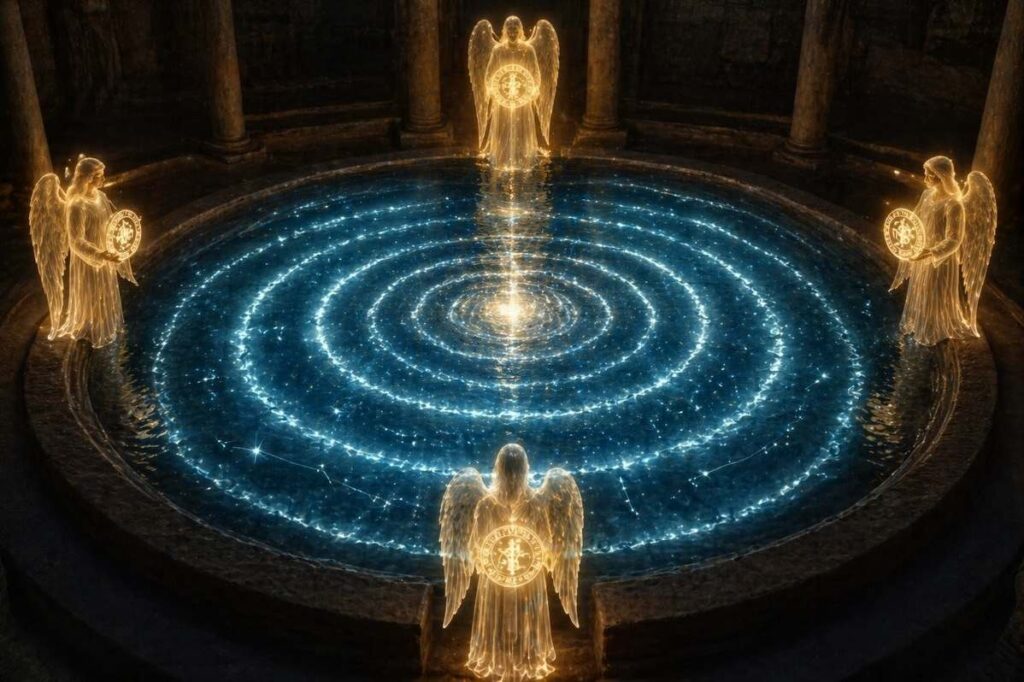
Comparative Context: Protennoia Across the Library
The threefold descent of Protennoia finds parallels in several other Nag Hammadi texts, most notably the longer recension of the Apocryphon of John, which contains a Pronoia hymn describing three descents into the underworld [27]. The relationship between these texts remains contested: some scholars argue that Trimorphic Protennoia represents an expansion and systematisation of the earlier hymn; others suggest both draw upon a common Sethian liturgical tradition [28].
The linguistic manifestation of Protennoia–as Sound, Speech, and Word–reflects sophisticated engagement with Platonic and Stoic theories of language [29]. The progressive articulateness of each descent mirrors philosophical discussions about the nature of verbal expression, yet transforms them into a theology of divine self-disclosure. Where the Stoics saw language as a human faculty for describing reality, Trimorphic Protennoia presents it as the medium through which reality itself comes to self-consciousness.
When read alongside the Three Steles of Seth and Allogenes, Trimorphic Protennoia reveals the full range of Sethian theological development–from hymnic invocation to technical ascent literature [30]. Codex XIII thus occupies a crucial position in the map of Sethian genres: it preserves the most intimate, immediate voice of the divine feminine, unfiltered by narrative framing or apostolic mediation.
“I am the one who is hidden in every place, the one who is manifest in every place. I am the one who saves, the one who is saved. I am the mother, the daughter, the sister, the bride.”
— Trimorphic Protennoia, NHC XIII,1
Frequently Asked Questions
What is Codex XIII in the Nag Hammadi Library?
Codex XIII is a collection of eight parchment leaves discovered inside the cover of Codex VI near Nag Hammadi, Egypt, in 1945. It contains two tractates: Trimorphic Protennoia, the most complete theology of the feminine divine in the library, and a fragmentary version of On the Origin of the World. Despite its physical brevity, it ranks among the most theologically significant codices in the collection.
What is Trimorphic Protennoia about?
Trimorphic Protennoia is a Sethian revelation text in which the divine First Thought (Protennoia), identified with Barbelo, speaks in the first person. She describes her three descents into the material world, Voice, Speech, and Word to awaken the spiritual seed trapped in matter and reveal the Five Seals ritual for ascent back to the Pleroma.
What are the three descents in Trimorphic Protennoia?
The three descents are: first, as Voice (Sound), calling out to awaken the sleeping elect; second, as Speech, teaching the secret knowledge needed to escape archonic imprisonment; and third, as Word (Logos), entering the material world in human form to demonstrate the path of ascent and deliver the Five Seals.
What are the Five Seals in Trimorphic Protennoia?
The Five Seals constitute a Sethian initiatory protocol: anointing and baptism, renunciation of lower powers, reception of the garment of light, sealing by the Five Luminaries, and entry into the Pleroma. They function as transformative credentials that strip away archonic identity and restore the initiate original divine status.
How does Trimorphic Protennoia present the feminine divine?
Protennoia is the First Thought of the Invisible Spirit, not a secondary emanation but the necessary condition for divine self-knowledge. She declares herself androgynous, I am Mother and I am Fyet speaks consistently as the feminine divine who descends, teaches, and saves, offering an ontological rather than merely metaphorical theology of the Goddess.
What is On the Origin of the World in Codex XIII?
The Codex XIII version of On the Origin of the World is a fragmentary copy of the more complete text found in Codex II. It begins on the final page of Trimorphic Protennoia but breaks off early due to manuscript damage. Scholars value it for textual comparison, but general readers should consult the Codex II version for the complete narrative.
How should beginners approach Codex XIII?
Newcomers should begin with Trimorphic Protennoia, which is accessible and complete. Skip On the Origin of the World in this codex and read the Codex II version instead. For deeper study, compare Trimorphic Protennoia with Thunder: Perfect Mind and Sophia of Jesus Christ to understand the full range of Gnostic feminine theology.
Further Reading
The following articles from the ZenithEye archive provide additional context for understanding Codex XIII within the broader landscape of Gnostic and Sethian traditions:
- The Nag Hammadi Library: Complete Index — Return to the master guide for all 46 tractates and 13 codices.
- Trimorphic Protennoia: Three Forms of Divine Thought — Deep analysis of the three descents, the Five Seals, and the theology of Barbelo as First Thought.
- Thunder: Perfect Mind — The paradoxical voice of the feminine divine that dissolves all categorical boundaries.
- Sophia of Jesus Christ — Wisdom in dialogue form, with Mary Magdalene as the model of feminine reception of gnosis.
- The Feminine Divine in Gnosticism — Comprehensive overview of all texts featuring the Goddess in the Nag Hammadi Library.
- Apocryphon of John — The foundational Sethian text featuring Barbelo as the First Thought and the Pronoia hymn.
- On the Origin of the World — The complete Codex II version of the cosmogony found in fragmentary form in Codex XIII.
- The Feminine Divine Collection — Curated gateway to all feminine divine content on ZenithEye.
References and Sources
The following sources support the claims and quotations presented in this article. All citations to the Nag Hammadi Library represent direct translations from the Coptic text as established in the standard critical editions.
Primary Sources and Critical Editions
- [1] Robinson, J.M. (Ed.). (1988). The Nag Hammadi Library in English (4th ed.). Brill.
- [2] Turner, J.D. (1990). “Nag Hammadi Codices XI, XII, XIII.” In Nag Hammadi Codices XI, XII, XIII. Brill.
- [3] Emmel, S. “Sound, Voice and Word.” In Nag Hammadi Codices XI, XII, XIII. Brill.
- [4] Janssens, Y. (1978). La Protennoia trimorphe (NH XIII,1). Brill.
- [5] Poirier, P.H. (1995). La Pensee Premiere a la triple forme. Presses Universitaires de Laval.
Scholarly Monographs and Commentaries
- [6] King, K.L. (Ed.). (1988). Images of the Feminine in Gnosticism. Fortress Press.
- [7] Turner, J.D. (2001). Sethian Gnosticism and the Platonic Tradition. Peeters.
- [8] Meyer, M. (Ed.). (2007). The Nag Hammadi Scriptures: The International Edition. HarperOne.
- [9] Pearson, B.A. (2007). Ancient Gnosticism: Traditions and Literature. Fortress Press.
- [10] Halvgaard, T.B. Linguistic Manifestations in the Trimorphic Protennoia and the Thunder, Perfect Mind. Gnosis.Study Library.
Comparative Studies and Thematic Analyses
- [11] Scopello, M. (2006). Femmes, Gnose et Manicheisme. Brill.
- [12] McGuire, A. (1988). “Virginity and Subversion: Norea Against the Powers.” In Images of the Feminine in Gnosticism. Fortress Press.
- [13] Barnstone, W. (Ed.). (1984). The Other Bible. Harper & Row.
- [14] Layton, B. (1987). The Gnostic Scriptures: A New Translation with Annotations and Introductions. Doubleday.
- [15] Logan, A.H.B. (1996). Gnostic Truth and Christian Heresy: A Study in the History of Gnosticism. T&T Clark.