

Ritual Use of Thunder: Perfect Mind — Techniques for Working with the Text as Practice
Thunder: Perfect Mind is one of the strangest and most powerful texts in the Nag Hammadi Library: a divine feminine voice speaking through paradox, contradiction, reversal, and self-disclosure. It does not explain itself in neat doctrine. It arrives as proclamation: first and last, honoured and scorned, silence and utterance, knowledge and ignorance, one voice containing opposites that ordinary identity prefers to keep apart.
This article explores how Thunder: Perfect Mind can be approached as contemplative practice. Not as a performance of spiritual intensity, and not as a licence to force altered states, but as a disciplined way of working with voice, breath, attention, body, paradox, silence, and integration. The text can be read silently, studied historically, prayed with, spoken aloud, chanted softly, journalled, or used as a mirror for the divided self.
The safest approach is reverent and grounded. Thunder is not a psychological shortcut. It is not a technique for bypassing trauma, ethics, relationship, or the ordinary body. Its paradoxes are powerful because they reveal fragmentation: the parts of the self we honour, shame, hide, idealise, exile, or refuse to name. To work with the text is to listen until the old categories loosen, then return carefully to the day, the breath, the room, and the next honest act.

In Plain Terms
Thunder: Perfect Mind is a Nag Hammadi text in which a mysterious feminine speaker names herself through paradoxical “I am” statements.
Working with the text as practice means reading it slowly, speaking selected lines aloud, noticing bodily and emotional responses, holding contradictions without rushing to resolve them, and allowing the text to reveal hidden splits in identity.
The grounded aim is integration, not destabilisation. The text should make the reader more embodied, honest, humble, and whole. If it produces panic, dissociation, grandiosity, or obsessive intensity, pause and return to stabilising practices.
Sources and Traditions Discussed
- Thunder: Perfect Mind, Nag Hammadi Codex VI,2, especially its paradoxical “I am” declarations and hymnic voice.
- Nag Hammadi Codex VI, the codex preserving Thunder alongside Hermetic, Christian, and related tractates.
- George W. MacRae’s translation, long used in English-language study of the text.
- Modern scholarship on Thunder, including work by Hal Taussig, Maia Kotrosits, and others on voice, paradox, gender, identity, and performance.
- Divine feminine and wisdom traditions, including Sophia, Barbelo, feminine divine speech, and sacred reversal.
- Contemplative vocalisation, including chanting, sacred reading, prayerful recitation, embodied speech, and the use of repeated lines as anchors.
- Somatic and trauma-aware practice, including grounding, pacing, bodily response, dissociation risk, and careful integration after intense material.
- Gnostic symbolism, especially Archons, false categories, divided identity, and the recovery of direct knowing through paradox.
How to Read This Article
This article treats Thunder: Perfect Mind as a contemplative and ritual text, but it does not claim that the text must be practised in one fixed way. You can study it historically, read it devotionally, speak it aloud, use it for journalling, or simply sit with its paradoxes.
Because the text works with contradiction, identity, shame, sacredness, embodiment, and the feminine divine, it may stir strong emotional material. Approach slowly. Do not use it to force altered states, provoke ego collapse, intensify dissociation, or make spiritual claims about yourself.
The practice is most useful when it leads to integration: the capacity to hold more of yourself without splitting into shame, inflation, denial, or performance.
Thunder: Perfect Mind does not solve contradiction by choosing one side. It teaches the reader to remain present where the split begins.
Table of Contents
- The Initiatory Script: Becoming the Listening Aperture
- Preparation: Creating a Safe Threshold
- The Recitation Cycle: Meeting Internal Fragmentation
- The Descent Passages: Somatic Anchoring
- Voice Rotation: Three Modes of Reading
- Integration: The Return
- Working With Specific Lines as Contemplative Anchors
- The Long Work and Necessary Safeguards
- The Gnostic Reading: Paradox Against False Rule
- Related Glossary Terms
- Read Next
- Frequently Asked Questions
- Further Reading
- References and Sources
The Initiatory Script: Becoming the Listening Aperture
Thunder: Perfect Mind consists of a mysterious speaker naming herself through opposites. She is first and last, honoured and scorned, knowledge and ignorance, silence and voice. The effect is not simply literary. The text unsettles the reader’s habitual need to divide reality into clean moral, social, gendered, spiritual, and psychological categories.
The voice does not ask to be reduced to one identity. It refuses the small box. That refusal is the beginning of the practice. Most ordinary consciousness operates through exclusion: I am this, therefore I am not that. I am pure, therefore not ashamed. I am spiritual, therefore not bodily. I am strong, therefore not wounded. I am chosen, therefore not confused. Thunder interrupts that structure by placing opposites inside one speaking presence.
The aim is not to “become” the speaker in a grandiose way. The aim is to listen until the speaker reveals where your own psyche splits. Which terms feel acceptable? Which terms create shame, resistance, disgust, longing, or fascination? Which parts of the self are honoured, and which are scorned?
When approached carefully, the text becomes a contemplative aperture: a narrow opening through which the divided self can encounter a wider field of identity.
From Text to Transmission
Scholarship often notes the poetic, hymnic, and performative qualities of Thunder. Its repeated first-person declarations, antithetical pairings, and rhythmic structure suggest that it was meant to be heard as well as read. Even in translation, the recurring “I am” pattern creates a cadence that feels closer to liturgy than argument.
This does not mean silent study is inferior. Silent reading is valuable. Historical context is valuable. Translation comparison is valuable. But the text changes when voiced. The throat, breath, ear, chest, and nervous system enter the reading. The words are no longer only concepts. They become events in the body.
That shift is the heart of ritual reading. The reader stops treating the text as content to be consumed and begins allowing it to act as a practice object: something that shapes attention, breath, posture, feeling, memory, and recognition.
The Poetic Architecture of Paradox
The Coptic text of Thunder unfolds through a series of oppositions that are not neatly reconciled. The speaker appears as social outsider and sacred presence, barren and generative, silence and utterance, ignorance and knowledge. The text does not merely place two opposites side by side. It makes one voice carry both.
This is why the text matters for practice. The ego often survives by dividing. It protects itself by saying: this belongs to me, that does not; this is holy, that is shameful; this is masculine, that is feminine; this is wisdom, that is ignorance; this is permitted, that is exiled. Thunder speaks from a place before those divisions become final.
To work with the text is to remain present at the point where the mind wants to close the file. The practice begins when interpretation slows down enough for contradiction to be felt.
Preparation: Creating a Safe Threshold
Do not approach this kind of practice as a test of spiritual toughness. The threshold should be safe, quiet, and grounded. The aim is receptivity, not intensity for its own sake.
Choose a time when you are rested enough to stay present. Avoid working with the text when you are sleep-deprived, emotionally flooded, intoxicated, highly anxious, dissociated, or already destabilised. A simple environment is best: a chair, a small table, a printed text or book, water nearby, and enough quiet to hear your own voice.
Physiological Foundations
The body should feel supported rather than strained. Sit upright, but not rigidly. Let the feet touch the floor. Notice the room. Look around and name a few ordinary objects before beginning. This reminds the nervous system that practice is happening in a real place, not in an abstract spiritual theatre.
Some readers may prefer to practise before eating heavily, because a very full stomach can make vocal practice sleepy. Others may need food first to stay grounded. There is no universal rule. Do not fast if fasting is medically unsafe, psychologically unwise, or linked with control, shame, or eating-disorder history.
A brief period away from screens can be useful. Even ten to thirty minutes of quiet before reading may help attention gather. The point is not digital purity. The point is to arrive with enough inner space to listen.
Breathing Preparation
Begin with gentle breathing. Let the inhale arrive naturally. Let the exhale lengthen slightly. Feel the chest, ribs, belly, and throat soften. If counting helps, use a mild rhythm such as four counts in and six counts out. If counting creates tension, drop the count and simply follow the breath.
Some practitioners use 4-7-8 breathing or other paced-breathing methods before contemplative reading. These may support relaxation for some people, but they should not be treated as guaranteed trance tools. Breath retention can be uncomfortable or activating for some readers. Use only what keeps you steady.
The best preparation is simple: enough breath to gather attention, enough body awareness to remain grounded, and enough humility not to force the text open.
Entering the Space
Open the text slowly. Read the first few lines silently once. Then read them aloud quietly. Let the mouth, throat, and ear become part of the reading. Do not rush to interpret. Let the sound arrive before the explanation.
Notice how the repeated “I am” affects the body. Does it feel empowering, uncomfortable, theatrical, alien, tender, exposing, or strangely familiar? The reaction is part of the practice. Thunder does not only reveal what the text says. It reveals how the reader responds to being addressed by a voice that refuses simplification.
The Recitation Cycle: Meeting Internal Fragmentation
The core practice is to work with selected paired opposites from the text. Read one line aloud, pause, then notice which side of the opposition feels familiar and which side feels rejected. The point is not to claim every phrase literally. The point is to explore the places where identity has narrowed.
For example, if the text places honour and scorn in one voice, ask: where do I cling to being honoured? Where do I fear being scorned? What part of me has been exiled because it did not fit the image I wanted to present? What would it mean to hold both without collapsing into shame or pride?
After each line, pause for three breaths. Feel the body. Let the phrase settle into chest, belly, throat, back, jaw, hands, or wherever response appears. Do not over-analyse during the recitation. Interpretation can come later. During the practice, let the body tell you where the split lives.
The Opening Sequence
The opening sequence of Thunder contains some of the text’s most famous paradoxes. The speaker names herself through dignity and rejection, sacredness and social shame, motherhood and barrenness, silence and speech. The language is deliberately charged. It touches social identity, gender, sexuality, exclusion, and the power of the rejected feminine voice.
A careful practice does not turn these lines into slogans. It lets them become questions:
- Which parts of myself do I make holy?
- Which parts do I make shameful?
- Where do I need admiration to feel real?
- Where have I accepted another person’s contempt as truth?
- What has been barren in one sense but generative in another?
- What part of my voice has been silenced because it did not fit an approved identity?
The text becomes transformative when it moves from historical curiosity into honest self-recognition.
Somatic Markers of Category Strain
When strong paradox is held in the body, sensations may arise. The throat may tighten. The chest may open or contract. Heat, cold, trembling, numbness, tears, laughter, irritation, or spaciousness may appear. These responses do not prove mystical attainment. They simply show that the nervous system is participating in the reading.
Treat these sensations gently. Do not dramatise them. Do not chase them. Do not interpret every bodily shift as revelation. Notice, breathe, and stay oriented to the room. If the response becomes overwhelming, stop the practice, open the eyes, stand, stretch, drink water, and return to ordinary surroundings.
Working With Resistance
Resistance is expected. The mind may try to explain the text quickly, reject it as too strange, reduce it to ideology, romanticise it, or turn it into a spiritual identity. Notice the strategy. Then return to the line, the breath, and the body.
A useful question is: what part of this text do I want to tame? The place you want to tame may be the place where the practice is alive.

The Descent Passages: Somatic Anchoring
Some parts of Thunder can be read as descent language: the sacred voice entering social contradiction, bodily existence, rejection, visibility, and earthbound experience without losing its depth. In Gnostic study, descent often carries risk and revelation at once. The soul enters matter, but it does not have to forget itself there.
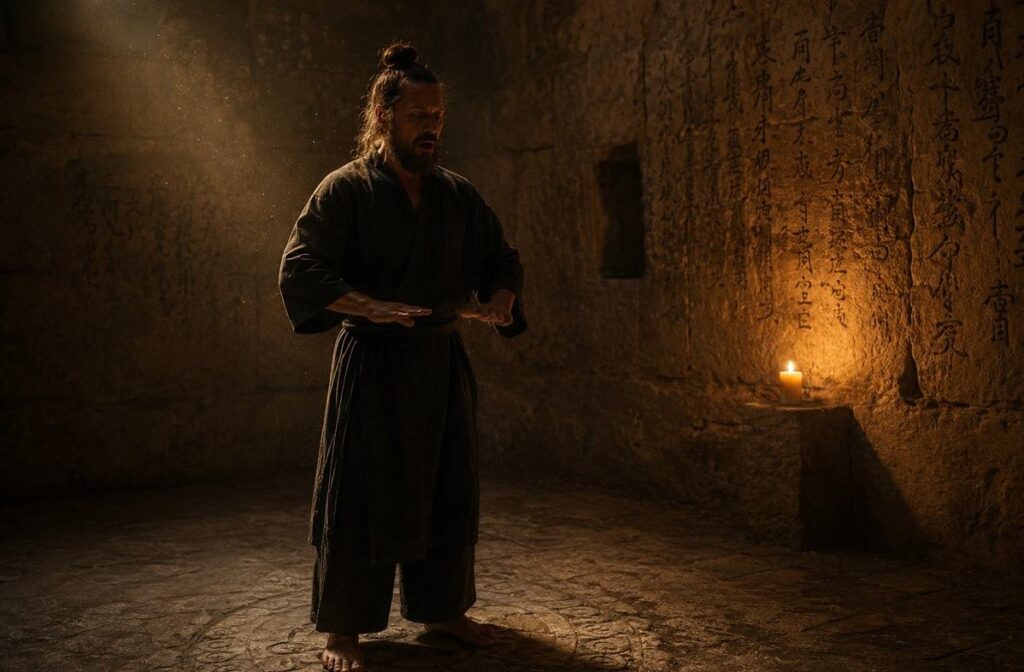
For practice, descent language can be paired with simple bodily anchoring. Stand or sit with the spine upright. As you speak a selected line, let the hands slowly lower from chest height to the belly or thighs. Feel the weight of the body. Feel the soles of the feet. Let the words descend into the body rather than remain in the head.
This is not theatrical gesture. It is a way of preventing the text from becoming only cerebral. Paradox needs a body. Otherwise it can turn into a beautiful abstraction floating above the actual life that needs integration.
Involution as Embodied Practice
Involution means movement inward or downward into manifestation. Some esoteric systems use the term for the soul’s descent into embodiment, history, limitation, and matter. In Thunder, the sacred voice does not remain safely above contradiction. It speaks from within it.
This matters because many seekers unconsciously use spirituality to rise away from difficulty. The text moves in the opposite direction. It asks whether sacredness can be recognised in the place of social shame, embodied vulnerability, rejection, confusion, and mixture.
To read the descent passages with the body is to practise a difficult truth: integration does not happen by escaping the lower layers of experience. It happens by bringing awareness into them without being ruled by them.
Gesture and Breath Coordination
Coordinate gesture and breath lightly. Begin speaking on an exhale. Let the hands lower as the line unfolds. When the line ends, pause and feel the body for one breath before continuing.
The synchronisation does not need to be perfect. Perfection can become another defence. The purpose is coherence: voice, breath, gesture, and attention moving together. When these elements align, the practice becomes embodied rather than merely conceptual.
Voice Rotation: Three Modes of Reading
Different forms of vocal reading reveal different relationships to the text. You can work with three simple modes: ordinary voice, whispered voice, and grounded voice. These are not magical ranks. They are ways of listening to how identity changes when speech changes.
Move slowly. Use only the mode that feels safe. Some readers may prefer silent reading throughout. That is valid. The text does not need to be forced through the throat to be effective.
The Ordinary Voice
Read the text in your ordinary speaking voice. Clear, simple, unperformed. This grounds the practice in everyday identity. The point is not to sound mystical. The point is to let the text enter the voice you actually use in life.
Notice what happens when extraordinary language is spoken in an ordinary voice. Does it become more accessible? More uncomfortable? Less theatrical? More intimate? This mode prevents the practice from drifting into performance.
The Whispered Voice
Next, try whispering a short passage. Whispering changes the breath and draws attention closer to the body. It can make the text feel secret, intimate, fragile, or dangerous. It may also feel too intense for some readers. Use discretion.
The whispered voice is useful for lines that feel tender or difficult. It allows the text to be heard without public force. It is not weaker than the spoken voice. Sometimes the quietest voice reaches the most defended places.
The Grounded Voice
The grounded voice comes from lower in the body. Place one hand on the lower belly or lower ribs. Speak slowly and feel the vibration move through the torso rather than only the throat. Keep the jaw soft and the feet present.
This mode can make the text feel less like a mental object and more like an embodied declaration. Avoid forcing depth or volume. A grounded voice is not a dramatic voice. It is a voice that has found the body beneath the words.
The three modes can be used in sequence: ordinary voice to establish the text, whisper to listen inwardly, grounded voice to embody the line. End with silence. The silence is not an afterthought. It is where the reading settles.
Integration: The Return
After reading or vocal practice, do not rush immediately into screens, social media, argument, work, or analysis. Give the nervous system a short return phase. Sit quietly. Feel the feet. Look around the room. Drink water. Notice ordinary objects.
Integration is where contemplative practice becomes trustworthy. Without return, intense practice can leave a person floating, inflated, raw, or over-identified with the experience. Thunder may open a charged field of paradox, but the reader still has to come back to the day.
The Ten-Minute Silence
A simple ten-minute silence is enough. Do not try to continue the ritual inwardly. Do not chase insight. Let the reading settle. Feel the breath and body. If emotions arise, name them gently: grief, resistance, heat, tenderness, irritation, relief, shame, spaciousness.
The goal is not to interpret everything. The goal is to let the system return with more of itself included.
Delayed Insight and Journalling
After the silence, write briefly. Use plain language. What line affected you? Where did you feel resistance? What part of the text did you want to reject, possess, romanticise, or explain away? What bodily response appeared?
Do not turn the journal into a prophecy engine. Let it be a record of relationship with the text. Return to the notes a day later. Often the first interpretation is not the deepest one. Some sayings work slowly, like seeds under soil.
Working With Specific Lines as Contemplative Anchors
Some lines from Thunder can function as contemplative anchors. Use only short excerpts. Speak them slowly, with breath and grounding. The line is not a spell that guarantees a result. It is a doorway into reflection.
Choose one line for a session rather than many. Let it repeat quietly. Notice how the body receives it. Notice what the mind tries to do with it. Notice whether the line creates more clarity or more agitation. Adjust accordingly.
For Mental Agitation
A line about incomprehensible silence can be used when the mind races. Speak it on a long, easy exhale. Let the final word dissolve into quiet. The point is not to force thought to stop, but to place the mind near a silence larger than its current noise.
Then feel the body. If the line increases pressure, stop repeating it and return to simple breath or orientation to the room.
For Dissociation
For readers prone to dissociation, voice can sometimes help re-anchor the body. Speak your own name softly. Then read a short line from the text. Then speak your name again. Feel the lips, tongue, throat, chest, and breath.
Do not use Thunder to intensify unreality. If the body feels far away, switch to external grounding: name five objects in the room, feel the chair, stand up, walk, or contact a safe person.
For Obsessive Seeking
The line about being the knowledge of one’s inquiry can be used when spiritual seeking becomes restless. Sit with the possibility that the search itself may be part of the revelation. What are you trying to obtain? What would remain if you stopped using the next insight to postpone the present life?
This is not a reason to stop learning. It is a reason to stop turning learning into escape.
For Shadow Material
Thunder is especially powerful for shadow work because it gives sacred speech to rejected identities. When a line touches shame, do not rush to claim it or reject it. Stand, feel your feet, breathe, and ask: what part of me is being invited out of exile?
The aim is not self-pity and not self-glorification. The aim is honest inclusion. A rejected part does not become wise simply because it has been named. It becomes workable when held with awareness, ethics, and care.

The Long Work and Necessary Safeguards
Thunder is best approached slowly over time. One session may be enough for a first reading. A deeper practice might involve returning to one short passage once or twice a week, journalling after each encounter, and noticing how the same line changes as life changes.
Avoid rigid promises such as “forty days will transform you” or “this protocol rewires the brain”. Practice is subtler than that. Repetition can deepen familiarity, but integration depends on the person, the nervous system, life context, support, pacing, and honest follow-through.
A Gentle Practice Cycle
A safe cycle might look like this:
- Choose one short passage.
- Read it silently once.
- Read it aloud once or twice.
- Pause for three to ten minutes.
- Journal briefly.
- Ground through water, food, walking, or a simple task.
- Leave several days before returning if the material feels intense.
This rhythm respects the text and the body. The aim is relationship, not conquest.
When to Stop
Stop the practice if it becomes compulsive, frightening, grandiose, dissociative, or destabilising. Also pause if you begin to feel that the text is giving special commands, making you superior to others, or replacing ordinary judgement.
Grounding is not failure. Walking, cooking, cleaning, gardening, speaking with a steady person, or resting may be the most spiritual next step after intense reading. The thunder has done its work when it returns you to life more whole, not when it makes ordinary life feel unreal.
I am the silence that is incomprehensible, and the idea whose remembrance is frequent.
Thunder: Perfect Mind, NHC VI,2, after George W. MacRae
The “perfect mind” of the title is not ordinary cleverness. It points toward completeness, maturity, and a mind or awareness capable of holding contradiction without fragmenting into denial. That does not make the practitioner special. It makes the work humbling. A mind that can hold paradox must also hold responsibility.

The Gnostic Reading: Paradox Against False Rule
Gnostic myth often describes the lower powers as rulers of limitation, ignorance, false identity, and imitation. In symbolic language, the Archons prefer fixed categories because fixed categories are easier to govern. You are this, not that. Pure, not mixed. Saved, not lost. Spiritual, not bodily. One thing, never many.
Thunder: Perfect Mind refuses that administrative logic. It speaks from the place where contradiction has not yet become imprisonment. The voice is not trapped by one social role, one moral label, one gendered image, one theological category, or one emotional state. It does not abolish difference. It refuses false finality.
This is why the text can be read as a liberation practice. It shows the psyche how much energy is spent maintaining acceptable identity. It reveals the violence of splitting: the holy self against the shameful self, the public self against the hidden self, the spiritual self against the embodied self, the knowing self against the confused self.
Gnosis begins when false rule is recognised. In Thunder, false rule is challenged by a voice too wide to be contained. The practitioner who works with the text carefully may begin to feel where internal rulers have been enforcing old exclusions. The practice is not to erase boundaries, ethics, or discernment. It is to stop mistaking inherited categories for the whole of reality.
The thunder does not destroy the world. It breaks the spell of narrow seeing.
Related Glossary Terms
For quick definitions, use the main ZenithEye Glossary. The key terms for this article are:
Read Next
Continue with: The Subtle Body: Mapping the Energy Anatomy of Human Consciousness
If this article explores voice, paradox, and embodied reading, the next step maps the wider terrain through which such practices are often experienced: subtle body, energy anatomy, breath, chakras, nadis, aura, and the interface between consciousness and embodiment.
Within Practice & Method
This article belongs to Contemplative Techniques and touches Ancient Sources, where primary texts are not only studied, but carefully approached as practices of attention, voice, reflection, embodiment, and integration.
Frequently Asked Questions About Thunder: Perfect Mind as Practice
What is Thunder: Perfect Mind?
Thunder: Perfect Mind is a Nag Hammadi tractate preserved in Codex VI. It features a mysterious feminine speaker who names herself through paradoxical “I am” declarations. The text is often studied as poetry, revelation discourse, divine feminine speech, and a powerful example of paradox in early Christian and Gnostic-adjacent literature.
Why can Thunder: Perfect Mind be used as contemplative practice?
The text’s repeated “I am” statements, antithetical pairings, and rhythmic structure make it especially suitable for slow reading, vocalisation, journalling, and reflective practice. Speaking or listening to the text can reveal inner divisions, shame patterns, rejected identities, and the mind’s habit of forcing reality into fixed categories.
Do I have to speak Thunder: Perfect Mind aloud?
No. Speaking the text aloud can be powerful because it involves breath, body, voice, and hearing, but silent reading is also valid. Readers can work with the text through study, prayer, journalling, contemplative reading, or simple reflection. The method should fit the person and remain grounding.
Is Thunder: Perfect Mind safe for everyone to practise with?
Not necessarily. The text works with intense themes of paradox, shame, identity, rejection, sacredness, and selfhood. Readers prone to dissociation, panic, trauma flooding, obsessive spiritual intensity, or unstable altered states should approach slowly and with support if needed. If the practice increases distress, stop and return to grounding.
What does “Perfect Mind” mean?
“Perfect” here is best understood as complete, mature, or whole rather than intellectually flawless. In practice, the title can be read as pointing toward a mind or awareness capable of holding contradiction without splitting into denial, shame, or rigid identity.
How should I begin working with Thunder: Perfect Mind?
Begin simply. Choose a short passage, read it silently, then aloud if comfortable. Pause after each line. Notice bodily response, emotion, resistance, and interpretation. Journal briefly afterwards and ground through breath, water, walking, or an ordinary task. Avoid forcing intensity or chasing altered states.
How does Thunder: Perfect Mind relate to the divine feminine?
The speaker of Thunder: Perfect Mind is often interpreted as a feminine divine or wisdom figure, though scholars debate the exact identity. The text resonates with Sophia, Wisdom, Barbelo, and other sacred feminine patterns, while also resisting any single stable label. Its power lies partly in that refusal to be contained.
What is the main spiritual lesson of Thunder: Perfect Mind?
One central lesson is that wholeness is not achieved by rejecting everything contradictory, shameful, or socially unstable. The text speaks from a place where opposites can be held without collapse. As practice, it invites the reader to meet divided identity with presence, discernment, and integration.
Study and Safety Note
This article explores Thunder: Perfect Mind, vocalisation, sacred reading, paradox, contemplative practice, divine feminine symbolism, shadow work, and Gnostic interpretation for educational and reflective purposes. It does not provide medical, psychological, psychiatric, trauma, crisis, meditation-instruction, or spiritual-direction advice.
Do not use this practice to force ego dissolution, provoke dissociation, intensify trauma material, induce altered states, or replace professional care. If reading or vocalising the text produces panic, derealisation, depersonalisation, compulsive certainty, intrusive experiences, grandiosity, depression, suicidal thoughts, or difficulty functioning, stop and seek qualified support.
The safest sign of good practice is integration: clearer perception, steadier embodiment, ethical responsibility, humility, and a more honest return to ordinary life.
Further Reading
These ZenithEye links continue the themes of Thunder: Perfect Mind, divine feminine speech, contemplative practice, subtle body, and integration:
- The Subtle Body: Mapping the Energy Anatomy of Human Consciousness – The next article in the live Contemplative Techniques route, exploring the body as energetic and contemplative interface.
- The Voice of Thunder: Perfect Mind and the Divine Feminine – A focused study of the speaker, divine feminine symbolism, and paradoxical voice in Thunder.
- The Feminine Divine in the Nag Hammadi Library – A thematic route through feminine divine figures and wisdom voices in the Gnostic sources.
- Nag Hammadi Library: The Complete Reader’s Map – A guided map through the tractates, codices, and major themes.
- Gnostic Technical Glossary: Key Terms for Study – Essential terms for reading Nag Hammadi texts with greater clarity.
- States of Knowing: What Happens When Consciousness Unravels – Altered states, threshold experience, and the need for grounded discernment.
- Contemplative Techniques: Methods for Stabilisation – The practice foundation for stabilising voice, paradox, breath, attention, and embodiment.
- Integration and Grounding After Awakening – Essential guidance for returning from intense practice into ordinary life.
- Nag Hammadi Library: The Complete Guide to Gnostic Scriptures – A wider source-library guide to the codices and their historical setting.
- The Five Gateways of Direct Knowing – Breath, sound, vision, movement, sensation, and silence as routes into direct knowing.
- Gateway of Sound: Mantra and Nada Yoga – Sonic practice, sacred sound, mantra, and listening as stabilising methods.
- The Gateway of Breath: Pranayama Techniques – Breath as a bridge between body, attention, and subtle perception.
References and Sources
The following sources support the textual, historical, contemplative, and safety framework used in this article.
Primary Sources and Critical Editions
- [1] Thunder: Perfect Mind. Nag Hammadi Codex VI,2.
- [2] MacRae, George W. “The Thunder: Perfect Mind.” In James M. Robinson, ed., The Nag Hammadi Library in English. Revised edition. HarperOne, 1990.
- [3] Robinson, James M. (ed.). The Nag Hammadi Library in English. Revised edition. HarperOne, 1990.
- [4] Meyer, Marvin (ed.). The Nag Hammadi Scriptures. HarperOne, 2007.
- [5] Layton, Bentley. The Gnostic Scriptures. Yale University Press, 1987.
- [6] Layton, Bentley (ed.). Nag Hammadi Codices V,2-5 and VI. Brill critical editions and related Nag Hammadi Studies volumes.
Thunder Scholarship, Voice, and Divine Feminine Interpretation
- [7] Taussig, Hal, Calaway, Jared, Kotrosits, Maia, Lasser, Justin, and Lillie, Celene. The Thunder: Perfect Mind: A New Translation and Introduction. Polebridge Press, 2010.
- [8] Kotrosits, Maia. Work on Thunder: Perfect Mind, gender, voice, identity, and early Christian subject formation.
- [9] King, Karen L. What Is Gnosticism?. Harvard University Press, 2003.
- [10] Williams, Michael Allen. Rethinking “Gnosticism”: An Argument for Dismantling a Dubious Category. Princeton University Press, 1996.
- [11] Brakke, David. The Gnostics: Myth, Ritual, and Diversity in Early Christianity. Harvard University Press, 2010.
- [12] Pagels, Elaine. The Gnostic Gospels. Random House, 1979.
- [13] Schaberg, Jane. The Resurrection of Mary Magdalene. Continuum, 2002.
- [14] DeConick, April D. The Gnostic New Age. Columbia University Press, 2016.
Contemplative Reading, Ritual Speech, and Practice Context
- [15] The Cloud of Unknowing. Anonymous English mystical text, fourteenth century.
- [16] Guigo II. The Ladder of Monks. Classical source for lectio divina.
- [17] Underhill, Evelyn. Mysticism: A Study in the Nature and Development of Spiritual Consciousness. Methuen, 1911.
- [18] Regardie, Israel. The Tree of Life: An Illustrated Study in Magic. Later editions.
- [19] Fortune, Dion. The Mystical Qabalah. Williams & Norgate, 1935.
- [20] Wallace, B. Alan. The Attention Revolution: Unlocking the Power of the Focused Mind. Wisdom Publications, 2006.
- [21] Kabat-Zinn, Jon. Full Catastrophe Living. Delacorte, 1990.
Breath, Voice, Nervous System, and Somatic Safety
- [22] Vierra, J., Boonla, O., and Prasertsri, P. “Effects of Sleep Deprivation and 4-7-8 Breathing Control on Heart Rate Variability, Blood Pressure, Blood Glucose, and Endothelial Function in Healthy Young Adults.” Physiological Reports, 10, e15389, 2022.
- [23] Aktas, G. K. and Ilgin, V. E. “The Effect of Deep Breathing Exercise and 4-7-8 Breathing Techniques Applied to Patients After Bariatric Surgery on Anxiety and Quality of Life.” Obesity Surgery, 33(3), 920-929, 2023.
- [24] Porges, Stephen W. The Polyvagal Theory. W. W. Norton, 2011.
- [25] Damasio, Antonio. The Feeling of What Happens. Harcourt, 1999.
- [26] Gendlin, Eugene. Focusing. Bantam, 1978.
- [27] Payne, Peter, Levine, Peter A., and Crane-Godreau, Mardi. “Somatic Experiencing: Using Interoception and Proprioception as Core Elements of Trauma Therapy.” Frontiers in Psychology, 2015.
- [28] Craig, A. D. “How Do You Feel? Interoception: The Sense of the Physiological Condition of the Body.” Nature Reviews Neuroscience, 2002.
Trauma, Integration, and Spiritual Emergency
- [29] van der Kolk, Bessel. The Body Keeps the Score: Brain, Mind, and Body in the Healing of Trauma. Viking, 2014.
- [30] Ogden, Pat, Kekuni Minton, and Clare Pain. Trauma and the Body: A Sensorimotor Approach to Psychotherapy. W. W. Norton, 2006.
- [31] Treleaven, David A. Trauma-Sensitive Mindfulness: Practices for Safe and Transformative Healing. W. W. Norton, 2018.
- [32] Grof, Stanislav and Grof, Christina. Spiritual Emergency: When Personal Transformation Becomes a Crisis. Tarcher, 1989.
- [33] Lukoff, David. “The Diagnosis of Mystical Experiences with Psychotic Features.” Journal of Transpersonal Psychology, 17(2), 155-181, 1985.
- [34] Lindahl, Jared R., et al. “The Varieties of Contemplative Experience: A Mixed-Methods Study of Meditation-Related Challenges in Western Buddhists.” PLOS ONE, 12(5), 2017.