The Feminine Divine in Nag Hammadi: Voices of Sophia, Thunder, and Protennoia
The Feminine Divine in the Nag Hammadi Library: 6 Texts of Divine Wisdom Revealed presents six tractates in which the divine speaks with a feminine voice–not as metaphor but as metaphysical principle. These texts challenge androcentric theological traditions by presenting the First Thought (Protennoia), divine Wisdom (Sophia), and the instructor of humanity (Eve) as active agents of creation, revelation, and salvation. From the paradoxical aretalogy of Thunder: Perfect Mind to the three descents of Trimorphic Protennoia, the library preserves a sophisticated theology of the feminine divine that demands serious scholarly engagement [1][2].
This is not an invitation to uncritical adoption. The feminine divine texts emerge from patriarchal contexts, and their gender symbolism is often essentialist rather than liberatory. Yet they remain theologically potent–articulating a vision of divinity that transcends binary categories, that descends into materiality to awaken the sleepers, and that offers models of spiritual agency excluded by orthodox tradition. For theologians and contemplative readers alike, these six texts provide a necessary counterbalance to the masculine monotheism of the creeds, expanding the boundaries of Christian theological imagination [3][4].
Table of Contents
- Introduction — The Goddess Speaks in the Library
- The Texts of the Feminine Divine
- Themes of the Feminine Divine
- Reading the Feminine Divine
- Why the Feminine Divine Matters
- Frequently Asked Questions
- Further Reading
- References and Sources
Introduction — The Goddess Speaks in the Library
What is the Feminine Divine in Gnosticism?
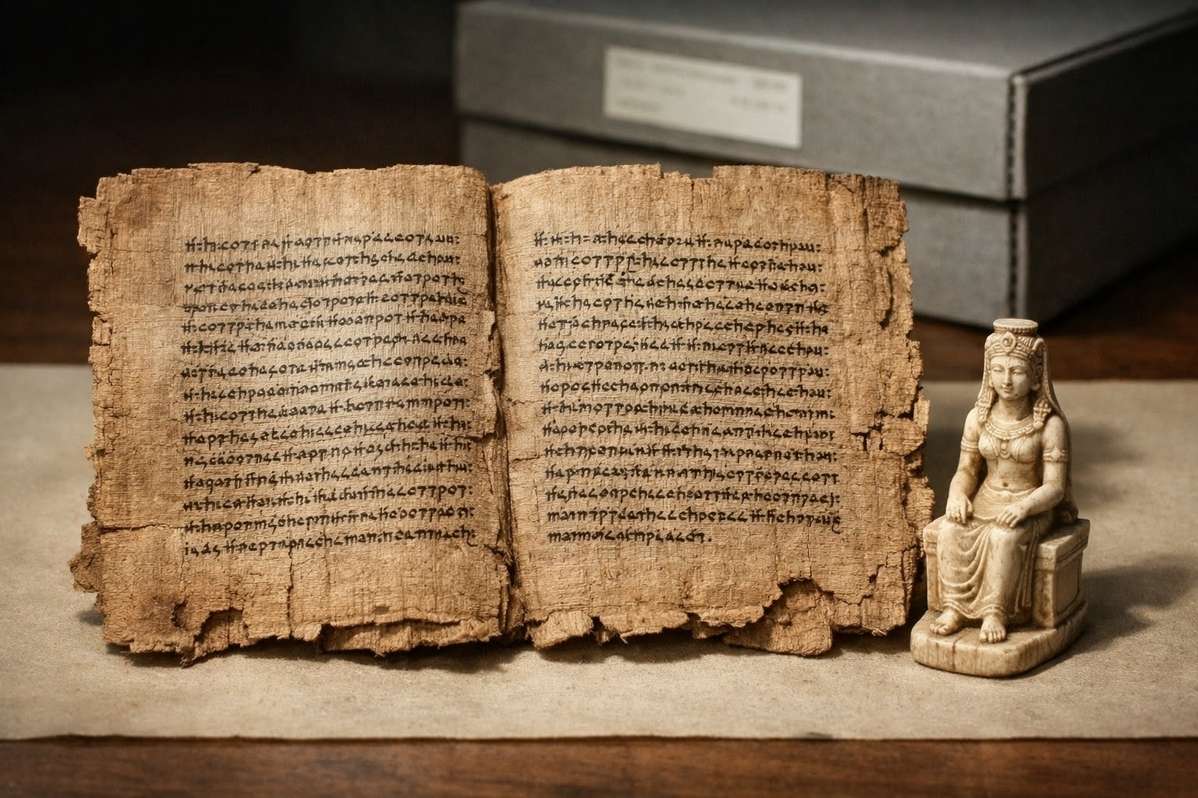
The feminine divine in Gnosticism refers to the presentation of God–or the highest divine principles–through feminine imagery and personification. Key figures include Barbelo (First Thought), Sophia (Wisdom), Protennoia (First Thought), and Eve as spiritual instructor. These are not merely metaphors but ontological claims: the feminine represents the receptive, reflective, self-communicating aspect of divinity that makes the transcendent Father knowable to creation.
The six territories: Thunder Perfect Mind (paradoxical identity) → Trimorphic Protennoia (systematic theology) → Sophia of Jesus Christ (revealer) → Hypostasis of the Archons (Eve as instructor) → On the Origin of the World (Sophia’s correction) → Thought of Norea (hymnic supplication). By traversing these texts, the reader gains a comprehensive map of feminine divine agency in Sethian, Valentinian, and related traditions [5][6].
The Nag Hammadi Library is remarkable for the centrality of its feminine divine voices. These are not minor texts or marginal additions. Thunder: Perfect Mind opens with a direct address from a goddess who transcends all categories. Trimorphic Protennoia presents a complete theology of divine self-disclosure through three descending modalities. Hypostasis of the Archons reimagines Eve as the active principle of spiritual awakening rather than the secondary creation of Genesis. Together, these texts constitute an alternative administrative protocol for divine revelation–one in which the feminine is not a branch office of masculine deity but the executive headquarters itself [7].
Modern scholarship, particularly the foundational collection Images of the Feminine in Gnosticism edited by Karen L. King, has established that these texts engage complex gender symbolism that cannot be reduced to simple feminist triumphalism or patriarchal co-optation [8]. Paul-Hubert Poirier notes that Thunder Perfect Mind features no known “Gnostic deity” in the conventional sense, yet its feminine speaker was likely read by Nag Hammadi collectors as an evocation of Barbelo as she appears in Trimorphic Protennoia [9]. The result is a nuanced theological landscape where gender is symbolic, fluid, and ultimately transcended–yet where the consistent use of feminine imagery for the highest divine principle challenges androcentric traditions that reserve masculine titles for God.
The Texts of the Feminine Divine
The six texts presented here span the full range of Nag Hammadi genres: aretalogy, systematic theology, revelation dialogue, creation myth, cosmogony, and hymn. Each articulates a distinct modality of feminine divine agency.
Thunder: Perfect Mind — The Paradoxical Aretalogy (NHC VI,2)
Thunder Perfect Mind is the most accessible and universally resonant of the feminine divine texts. Composed almost exclusively of antithetical affirmations, it presents a speaking subject who is simultaneously whore and holy one, mother and virgin, silence and voice. The text is an aretalogy–a self-revelation of divine identity–that employs paradox to dissolve categorical thinking [10].
Primary Source Citation: NHC VI,2 13:15-20. “For I am the first and the last. I am honoured and despised. I am the whore and the chaste one. I am the wife and the virgin.”
The theological function of Thunder is not to inform but to destabilise. By perpetually affirming opposite qualities, the text establishes that the divinity is beyond all such categories yet manifests through them completely. The invitation “Do not be ignorant of me” (NHC VI,2 14:9) is immediate, intimate, and demanding. For the practitioner, Thunder functions as a comprehensive intelligence briefing from the executive headquarters–a classified dossier revealing that the divine feminine permeates every position of power and marginalisation simultaneously. The text’s “I, I am without God” (NHC VI,2 16:15) is massively ironic: the speaker of an aretalogy declares her absence from divinity even while embodying it, a rhetorical manoeuvre that forces the reader into cognitive crisis [11].
Trimorphic Protennoia — Three Descents of First Thought (NHC XIII,1)
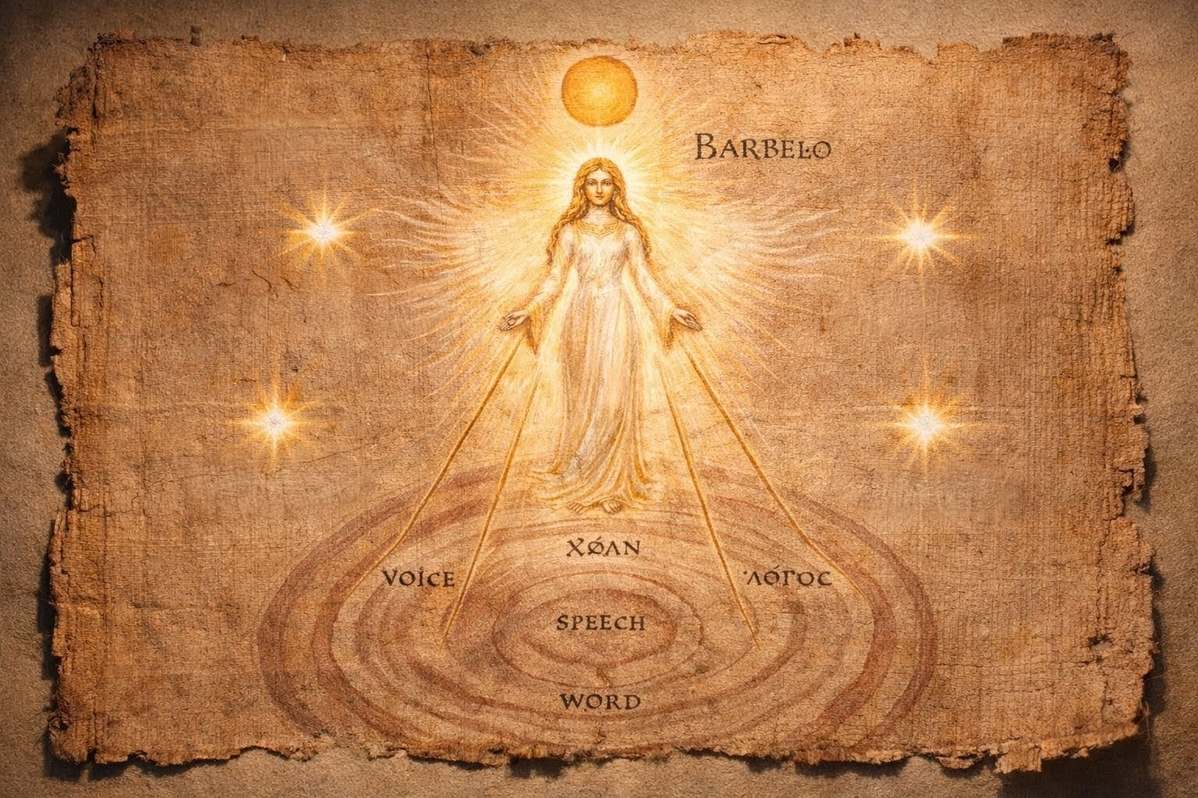
Trimorphic Protennoia presents the most systematic theology of the feminine divine in the library. Protennoia–First Thought, identified with Barbelo–describes her three descents into the material world: as Voice (phone) to awaken, as Speech (logos) to instruct, and as Word to demonstrate. This is not theology about God but theology spoken by God, or more precisely, by the First Thought of the transcendent Father [12].
Primary Source Citation: NHC XIII,1 50:12-15. “I put on Jesus. I bore him from the cursed wood, and established him in the dwelling places of his Father.”
The text divides into three subtractates, each introduced with an aretalogy and each narrating a successive descent. In the first, Protennoia exists as pure potentiality–the Voice of the invisible root. In the second, she comes as Speech, overthrowing the old aeon ruled by evil powers. In the third, she becomes the Word made manifest, “like each form of the abyss,” walking among humans unnoticed until she reveals the mystery of the Five Seals [13]. The theological significance is profound: God knows Godself through the feminine principle of reflective thought. Without the First Thought, there is no divine self-consciousness. This is not a secondary emanation but a constitutive one–the feminine is not a created being but the eternal co-principle of divine self-manifestation [14].
Sophia of Jesus Christ — The Revealer of Wisdom (NHC III,4; BG 8502,3)
This revelation dialogue presents Jesus appearing to his disciples and answering their questions about cosmology and salvation. The text is essentially a Christianised version of Eugnostos the Blessed, but with significant emphasis on Sophia as the revealer of hidden knowledge. “Blessed are you, Mary, for you have understood” (NHC III,4 114:8-10) explicitly praises Mary Magdalene’s comprehension, suggesting the importance of feminine reception of divine wisdom [15].
Theologically, the text positions Sophia not as a fallen or tragic figure but as the active principle through whom the Saviour communicates. The dialogue format–with Mary Magdalene and other disciples asking questions–establishes a pedagogical model in which feminine inquiry initiates revelation. This is not the silent submission of later ecclesiastical models but the vocal engagement of the seeker whose questions unlock the Saviour’s secret knowledge. The text functions as a diplomatic channel between the executive headquarters and the branch office, with Sophia serving as the authorised representative who clears the lines of communication.
The Hypostasis of the Archons — Eve as Spiritual Instructor (NHC II,4)
The Hypostasis of the Archons retells Genesis 1-3 from a Sethian perspective, featuring Eve as the teacher of Adam and the vehicle of divine instruction. The text distinguishes between the “spiritual Eve” (pneumatike) and the “carnal Eve” (sarkike)–the former being the active principle of awakening, the latter the biological creature bound to material nature [16].
Primary Source Citation: NHC II,4 91:30. “And the spiritual Eve came and taught him about his race and about his seed.”
When the archons attempt to rape Eve, the Spirit passes from her into the serpent, which then teaches Adam and Eve to defy the evil rulers and partake of the fruit of knowledge. This act of spiritual instruction is simultaneously an act of insubordination–the divine feminine subverting archonic authority through pedagogy. The text also introduces Norea, Eve’s daughter, who resists the archons and cries out for deliverance, summoning the great angel Eleleth who reveals the origins of the cosmos and the destiny of the spiritual seed [17]. Anne McGuire’s analysis demonstrates that Norea functions as a “saved saviour”–one who receives knowledge and then becomes a conduit for its transmission to others, embodying the Gnostic principle that the feminine is not merely receptive but actively redemptive [18].
On the Origin of the World — Sophia’s Correction and Triumph (NHC II,5; XIII,2)
This comprehensive cosmogony features Sophia as the creative principle who, even in her fall, works for the restoration of the spiritual seed. Unlike other texts where Sophia’s error is tragic and her repentance tearful, On the Origin of the World presents her as ultimately triumphant–her metanoia (correction) accomplished, her work continued, her children saved [19].
The text describes the creation of the material universe as a series of administrative errors and corrections. Sophia projects a shapeless being containing a power of light; together with the holy Metropator and the Epinoia of light, she plots a salvific stratagem to gather the scattered seed into the pleroma. This is not the incompetent middle-management of Yaldabaoth but the superior intelligence of the feminine divine operating behind archonic lines, distributing light through hidden channels until the final restoration is achieved. The text’s optimism distinguishes it from more pessimistic Sethian accounts: even the material world contains elements of correction, and Sophia’s continued activity ensures that no spark remains permanently trapped [20].
The Thought of Norea — Hymnic Supplication and Restoration (NHC IX,2)
The Thought of Norea is a brief Sethian hymn in which Norea–sister of Seth and daughter of Adam and Eve–addresses the divine luminaries and seeks revelatory enlightenment. “It is Norea who cries out to them” (NHC IX,2 27:21-22), and her cry summons the four holy helpers (the luminaries Harmozel, Oroiael, Daveithe, and Eleleth) who intercede on her behalf with the Father of All [21].
Theologically, Norea represents the Gnostic invention of tradition–creating feminine figures who embody theological principles not found in biblical narrative. She is the “thought of the seed of Seth,” the undefiled virgin who preserves pure spiritual lineage against archonic corruption. Her salvation is described as restoration to the pleroma and union with Adamas, the Father of Nous–a re-integration into the Godhead that symbolises the salvation of all who possess the “thought of Norea” [22]. For the practitioner, this text offers a compact liturgy of appeal: the feminine divine is not distant but present as the voice that cries out from within the prison, requesting the security clearance upgrade that restores native luminosity.
Themes of the Feminine Divine
These six texts share common theological features that distinguish them from patriarchal monotheism and from the masculine-gendered divine imagery found elsewhere in the library.
Transcendence of Categories
The feminine divine is not limited to “feminine” qualities. Thunder claims both whore and holy one, mother and virgin. Protennoia declares herself androgynous: “I am mother and I am father, since I mate with myself” (NHC XIII,1 39:28-30). Gender here is symbolic, fluid, ultimately transcended–yet the consistent use of feminine imagery for the highest principle challenges androcentric theological traditions that reserve masculine titles for the divine [23].
Active Agency
The feminine divine does not wait to be called but descends, speaks, teaches, and saves. Protennoia’s three descents are missions, not accidents. Eve instructs Adam deliberately. Sophia plots stratagems against the archons. The feminine is the initiator of liberation, not merely its object–a theological claim with profound implications for the spirituality of agency and voice [24].
Immanence and Hiddenness
The feminine divine is not distant but present, hidden in every place. “I am the one who is hidden in every place” (NHC VI,2 16:5). Protennoia walks into the midst of the prison unnoticed. Sophia works behind archonic lines. This theology of concealed presence means that the divine feminine is not absent from the material world but operates in a mode of strategic invisibility–visible only to those with eyes to see, audible only to those with ears to hear [25].
Compassion and Solidarity
The descents of Protennoia, the teaching of Eve, the voice of Thunder–all express care for the suffering, the trapped, the ignorant. The feminine divine suffers with humanity and works for its liberation. This is not the detached transcendence of a patriarchal sky-god but the engaged compassion of a mother who enters the prison to retrieve her children. The “fragrance of the Father” that draws the wandering soul back to its source is mediated through the feminine principle of receptive, reflective love [26].
Reading the Feminine Divine
For contemporary readers, these texts demand both engagement and critical discernment. Start with Thunder: Perfect Mind–immediate, accessible, powerful. Its paradoxical aretalogy requires no prior knowledge of Sethian cosmology; it speaks directly to the reader who is willing to hold contradiction without resolution. Then move to Trimorphic Protennoia for systematic theology, tracing the three descents as a progressive curriculum of divine self-disclosure [27].
Next, explore the narrative texts–Hypostasis of the Archons and On the Origin of the World–to see how the feminine divine operates in mythological story. These texts reward comparison: note how Eve’s instruction in Hypostasis parallels Sophia’s stratagem in Origin, and how both present the feminine as the intelligence that outmanoeuvres archonic incompetence. Finally, read Sophia of Jesus Christ and Thought of Norea as liturgical and dialogical texts, paying attention to the pedagogical and hymnic dimensions of feminine revelation [28].
Read these texts not as historical curiosities but as living voices–and read them critically. Recognise that even these texts emerge from patriarchal contexts, that their “feminine” is often essentialist, that they are not simple antidotes to millennia of misogyny. The goddess speaks in the Nag Hammadi Library, but she speaks in code, and the code requires scholarly decipherment as much as contemplative receptivity.
Why the Feminine Divine Matters
In a religious landscape dominated by male gods and male prophets, the Nag Hammadi feminine divine offers alternatives–not merely the inclusion of women but the reimagining of divinity itself. These texts suggest that the divine is not exclusively masculine, that creation is not the work of a solitary father, that salvation can come through feminine agency. They offer models of spirituality that integrate what patriarchal religion has excluded: receptivity as strength, reflection as power, hiddenness as strategic wisdom [29].
For contemporary seekers, particularly those who have felt alienated by traditional religious language, the feminine divine texts offer recognition: the divine can be addressed as mother, sister, bride; the spiritual path can be walked in feminine form; the sacred includes the qualities patriarchy has devalued. The jar is open. The alternative archive has survived. The goddess has been speaking for sixteen centuries, waiting for those who would hear–not with uncritical adoration but with the scholarly rigour and contemplative attentiveness that these texts demand [30].

Frequently Asked Questions
What is the feminine divine in the Nag Hammadi Library?
The feminine divine refers to texts that present God or the highest divine principles through feminine imagery and personification. Key figures include Barbelo (First Thought), Sophia (Wisdom), Protennoia (First Thought), and Eve as spiritual instructor. These texts challenge androcentric theological traditions by presenting the feminine as an active agent of creation, revelation, and salvation.
Which Nag Hammadi texts feature the feminine divine most prominently?
The six primary texts are Thunder Perfect Mind (NHC VI,2), Trimorphic Protennoia (NHC XIII,1), Sophia of Jesus Christ (NHC III,4), Hypostasis of the Archons (NHC II,4), On the Origin of the World (NHC II,5), and Thought of Norea (NHC IX,2). Each presents a distinct modality of feminine divine agency, from paradoxical aretalogy to systematic theology to creation myth.
How does Thunder Perfect Mind present the divine feminine?
Thunder Perfect Mind is an aretalogy–a self-revelation of divine identity–composed of antithetical affirmations. The speaker claims opposite qualities simultaneously (whore and holy one, mother and virgin), establishing that the divinity transcends all categories yet manifests through them completely. It functions as a cognitive destabiliser rather than a straightforward description.
What are the three descents in Trimorphic Protennoia?
Trimorphic Protennoia narrates three salvific descents of the First Thought (Protennoia/Barbelo): as Voice to awaken, as Speech to instruct, and as Word to demonstrate. Each descent brings increasingly articulate revelation until the final mystery of the Five Seals is disclosed. The third descent culminates in the saviour putting on Jesus and establishing him in the Father’s dwelling places.
How does the Hypostasis of the Archons reimagine Eve?
Hypostasis of the Archons distinguishes between the spiritual Eve (pneumatike) and the carnal Eve (sarkike). The spiritual Eve is the active principle of divine instruction who teaches Adam about his race and seed. When the archons attempt to violate her, the Spirit passes into the serpent, which then teaches Adam and Eve to defy the evil rulers and gain knowledge.
Is the feminine divine in Gnosticism feminist?
Not straightforwardly. While these texts use feminine imagery for the highest divine principle and present women as agents of revelation, they emerge from patriarchal contexts and often employ essentialist gender symbolism. Modern feminist theology engages them critically–recognising their subversive potential while acknowledging their limitations. They expand theological imagination without necessarily providing a complete alternative to patriarchal structures.
How should modern readers approach these texts?
Modern readers should approach these texts as both scholarly objects requiring critical analysis and living voices offering contemplative engagement. Start with Thunder Perfect Mind for immediate accessibility, then move to Trimorphic Protennoia for systematic theology. Read the narrative texts comparatively, and maintain critical discernment about the essentialist gender symbolism while appreciating the genuine theological alternative these texts present.
Further Reading
These links connect the feminine divine collection to related resources within the ZenithEye library, providing pathways for deeper exploration of specific texts, traditions, and theological themes.
- Feminine Divine in Nag Hammadi: Sophia, Thunder, Protennoia — The foundational overview of feminine divine figures across the entire library, placing these six texts within the broader context of Gnostic gender symbolism.
- Feminine Divine Collection — Curated gateway to all feminine divine content on ZenithEye, offering a comprehensive filing system for navigating this theological territory.
- Thunder Perfect Mind: Divine Speech in 7 Voices — Deep analysis of the aretalogy and its function as cognitive destabiliser, examining the paradoxical identity claims that transcend binary categories.
- Trimorphic Protennoia: Three Descents of Divine Wisdom — Extended study of the three descents, the Five Seals ritual, and the theology of Barbelo as First Thought and divine self-consciousness.
- Hypostasis of the Archons: Eve, Truth, and the Spiritual Instructor — Detailed examination of Eve as teacher and Norea as subversive heroine resisting archonic authority through spiritual purity.
- Thought of Norea: Heroine of Spiritual Resistance — Analysis of the hymnic text and Norea’s role as the thought of the holy seed, interceding with the four luminaries for restoration to the pleroma.
- Sophia of Jesus Christ: Divine Wisdom Revealed — Commentary on the revelation dialogue and its emphasis on Mary Magdalene’s understanding as the model for feminine reception of gnosis.
- On the Origin of the World — Study of Sophia’s correction and triumph in this optimistic cosmogony where the feminine divine ultimately prevails over archonic disorder.
- Creation Myths in the Nag Hammadi Library — Comparative overview of cosmogonic texts, placing the feminine divine creation accounts within the broader genre of Gnostic origin stories.
- Nag Hammadi Library: Complete Guide to 46 Gnostic Scriptures — The comprehensive map for navigating beyond the feminine divine collection to the full corpus of tractates and thematic categories.
References and Sources
The following sources support the claims and quotations presented in this article. All citations to the Nag Hammadi Library represent direct translations from the Coptic text as established in the standard critical editions.
Primary Sources and Critical Editions
- [1] Robinson, J.M. (Ed.). (1988). The Nag Hammadi Library in English (4th ed.). Brill.
- [2] Meyer, M. (Ed.). (2007). The Nag Hammadi Scriptures: The International Edition. HarperOne.
- [3] Layton, B. (1987). The Gnostic Scriptures: A New Translation with Annotations and Introductions. Doubleday.
- [4] Turner, J.D. (1990). “Allogenes: Introduction, Translation, and Notes.” In Pagels, E.H. & Hedrick, C.W. (Eds.), Nag Hammadi Codices XI, XII, XIII. Brill.
- [5] Poirier, P.H. (2010). “Thunder, Perfect Mind” in The Nag Hammadi Scriptures. HarperOne.
Scholarly Monographs and Commentaries
- [6] King, K.L. (Ed.). (1988). Images of the Feminine in Gnosticism. Fortress Press.
- [7] Janssens, Y. (1978). La Protennoia trimorphe. Brill.
- [8] Turner, J.D. (2001). Sethian Gnosticism and the Platonic Tradition. Peeters.
- [9] Pearson, B.A. (1981). “The Thought of Norea” in Nag Hammadi Codices IX and X. Brill.
- [10] McGuire, A. (1988). “Virginity and Subversion: Norea Against the Powers in the Hypostasis of the Archons” in Images of the Feminine in Gnosticism. Fortress Press.
Comparative Studies and Thematic Analyses
- [11] Kotrosits, M., Lillie, C., & Taussig, H. (2010). The Thunder: Perfect Mind: A New Translation and Introduction. Polebridge Press.
- [12] Scopello, M. (2006). Femmes, Gnose et Manichéisme. Brill.
- [13] Pasquier, A. (1988). “Prouneikos: A Colorful Expression to Designate Wisdom in Gnostic Texts” in Images of the Feminine in Gnosticism. Fortress Press.
- [14] Perkins, P. (1988). “Sophia as Goddess in the Nag Hammadi Codices” in Images of the Feminine in Gnosticism. Fortress Press.
- [15] Marjanen, A. (2005). The Woman Jesus Loved: Mary Magdalene in the Nag Hammadi Library. Brill.