The Sentences of Sextus: Pythagorean Wisdom in Christian Dress
The Sentences of Sextus (NHC XII,1) presents a bureaucratic anomaly within the Nag Hammadi Library—a text requiring no celestial navigation permits, no aeonic jurisdiction disputes, and no elaborate angelic intermediaries. Instead, it offers 451 lines of distilled ethical protocol: practical wisdom for those seeking to maintain spiritual hygiene amid the administrative chaos of material existence. Preserved in the fragmented Codex XII alongside remnants of the Gospel of Truth, this collection of Pythagorean maxims represents the only surviving Coptic translation of a widely circulated Greek manual for moral formation. For Gnostics weary of complex metaphysical cartography, here is a straightforward field guide to character—reminding us that even cosmic dissidents require basic operational discipline before attempting advanced metaphysical maneuvers.
What are the Sentences of Sextus?
The Sentences of Sextus (NHC XII,1)—also known as Sententiae Sexti—is a collection of 451 ethical maxims preserved in Coptic translation within the Nag Hammadi Library. Originally composed in Greek during the 2nd century CE, possibly by a Pythagorean philosopher named Sextus or compiled by later Christian redactors, the text represents a distinctive fusion of Greek wisdom literature and early Christian ethics. Organised as gnomic sayings—pithy, single-line injunctions—the collection addresses practical moral formation: control of speech, restraint of desire, and interior discipline. Unlike the esoteric cosmologies dominating the Nag Hammadi corpus, the Sentences function as paraenetic literature (ethical exhortation) intended to form character preparatory to advanced spiritual knowledge. The Coptic version in Codex XII is the only complete surviving manuscript, though fragments exist in Latin, Syriac, and Armenian translations, indicating the text’s wide circulation in early Christian and monastic communities.
Primary Source Citations: Nag Hammadi Codex XII,1; folios 15-16, 28-34 of the Coptic manuscript (with lacunae). The Greek original is lost, though the Coptic translation preserves approximately 451 maxims. Related versions appear in the Latin Sentences of Sextus (Rufinus translation), Syriac Sentences of the Syriac Menander, and fragments in Armenian and Georgian. Scholarly consensus dates the Greek original to the mid-2nd century CE, with Coptic translation likely occurring 3rd-4th century CE.

Wisdom Literature in the Gnostic Library
Amidst the vertiginous cosmologies and visionary ascent itineraries dominating the Nag Hammadi collection, the Sentences of Sextus offers something refreshingly concrete: practical wisdom for daily living that requires no specialised metaphysical equipment. This collection of 451 ethical maxims, preserved in Codex XII alongside fragments of the Gospel of Truth, represents the only surviving Coptic version of a widely circulated Greek text whose presence in the library testifies to a crucial but often overlooked Gnostic concern—moral formation as prerequisite to spiritual advancement.
The Practical Turn in Gnostic Ethics
The inclusion of such straightforwardly ethical material suggests that the compilers of Codex XII recognised a fundamental operational truth: speculative knowledge (gnosis) requires stable character infrastructure to maintain. One might map the aeons perfectly and still sabotage the journey through inability to govern speech, restrain appetite, or maintain silence. The Sentences address this foundational layer of spiritual practice—the mundane discipline necessary before attempting advanced metaphysical navigation.
The text’s origins remain contested among scholars. Some identify “Sextus” as a 2nd-century Pythagorean philosopher operating within the Neopythagorean revival of the early Roman imperial period; others suggest a Christian redactor compiling pagan material for catechetical purposes. The Nag Hammadi version displays clear signs of Christian adaptation—references to God, faith, and the soul permeate the collection—yet the core wisdom retains broad applicability, reflecting the cosmopolitan ethics circulating throughout Mediterranean intellectual culture.

The Form: Wisdom in Brief
The Sentences consist of pithy injunctions, typically one line in length, organised loosely by thematic jurisdiction rather than systematic argument. This form—gnomic wisdom—carried ancient pedigree stretching back to the Seven Sages of Greece, through the biblical Book of Proverbs, into the Stoic tradition of apophthegmata. The brevity serves specific pedagogical functions: maxims are memorable, portable, suitable for meditation during daily administrative duties, and resistant to the corruption that afflicts longer theological treatises.
Typical Maxims and Their Logic
Representative examples demonstrate the collection’s operational philosophy: “Control your tongue; desire what is noble; pursue what is profitable to your soul.” “The wise man is not the one who speaks much, but the one who listens well.” “That which is given by God is to be preferred to that which is taken from men.” These are not complex syllogisms requiring philosophical training but distilled recognitions intended for repeated contemplation until they become habitual dispositions—internal firmware upgrades rather than external rule-following.
The collection assumes an audience already engaged in serious spiritual practice. Many sentences presuppose ascetic commitments bordering on the encratite: “Fast from the world; you will find the kingdom.” “The body is the garment of the soul; keep it pure.” “Sexual intercourse is a loss of wisdom.” Such injunctions align the text with rigorous ascetic tendencies visible elsewhere in the library, particularly in the Book of Thomas the Contender, suggesting the Sentences served communities practicing significant bodily restraint as preparation for receiving higher mysteries.
The Pedagogy of Brevity
The gnomic form operates through compression—each maxim functions as a conceptual seed capable of generating extensive contemplative growth. This pedagogical efficiency suits communities requiring portable wisdom during periods of persecution or geographical dispersion. Unlike the bulky cosmological treatises requiring safe storage and extended study periods, the Sentences could be memorised, transmitted orally, and internalised through repetition during manual labour or travel.
“Control your tongue; desire what is noble; pursue what is profitable to your soul. The wise man is not the one who speaks much, but the one who listens well.”
— Sentences of Sextus, NHC XII,1
Pythagorean Roots and Christian Branches
The maxims reflect distinctively Pythagorean concerns filtered through Christian redaction: the cultivation of silence (hesychia), the value of friendship as spiritual bond, the necessity of continuous self-examination, implied doctrines of soul transmigration, and the essential divinity of the rational soul. These themes resonate with classical portraits of Pythagoras while adapting to the theological requirements of 2nd-4th century Christian communities.
Evidence of Christian Adaptation
Christian editorial intervention appears through several modification types identifiable through comparative manuscript analysis:
- Monotheistic reframing: Original references to “the gods” become singular “God” or “the Father,” eliminating polytheistic resonances incompatible with emerging Christian orthodoxy.
- Christological hints: Phrases such as “That which is given by God” potentially allude to grace or divine revelation, though such interpretations remain contested among scholars.
- Eschatological specification: Enhanced emphasis on the soul’s post-mortem fate and final judgment aligns the text with Christian concerns about ultimate destiny.
- Communal solidarity: Treatment of fellow practitioners as “brothers” deserving special ethical consideration reflects early Christian fraternal language and community structures.
Nevertheless, the redaction remains remarkably light-handed. The Sentences of Sextus never mentions Jesus, the cross, resurrection, or distinctive Christian sacraments. It functions effectively as “natural theology”—ethical wisdom accessible to rational reflection and confirmed by revelation rather than derived exclusively from Christian proclamation. This broad accessibility may explain the text’s extensive circulation across linguistic and doctrinal boundaries.
Pythagorean Continuities
Despite Christian overlays, the text retains core Pythagorean emphases: the purification necessary for philosophical insight, the transmission of wisdom through succession (diadoche), and the mathematical-cosmic order reflecting divine rationality. The Sentences thus preserve a transitional moment in Western spiritual history—pagan wisdom being naturalised into Christian curricula without violent distortion of its essential character.

The Ascetic Programme
Despite their brevity, the Sentences outline a comprehensive ascetic protocol addressing the three primary domains of spiritual vulnerability: speech, desire, and cognition. This tripartite discipline mirrors the threefold structure of temptation familiar from Christian tradition (the lust of the flesh, the lust of the eyes, the pride of life) while maintaining distinctively Pythagorean tonalities.
Control of Speech (Logos)
Numerous maxims address the tongue’s dangerous capacity for disorder: “Let your speech be better than silence, or be silent.” “The tongue is the organ of death for the fool; for the wise, it is the organ of life.” This emphasis reflects the Pythagorean valuation of silence as preparation for philosophical insight—hesychia not merely as absence of noise but as positive receptivity to divine communication.
The stakes are cosmically high: speech creates the social world we inhabit; careless words generate the karmic entanglements that obstruct spiritual perception. The Sentences treat verbal discipline not as social politeness but as ontological hygiene—purification of the primary instrument through which humans interact with reality.
Control of Desire (Epithumia)
The flesh and its appetites appear as primary obstacles to wisdom: “Desire is the chain of the soul; wisdom is its liberation.” “That which you do not wish to suffer, do not do to another.” This negative formulation of the Golden Rule suggests ethics begins with restraint rather than positive benevolence—first do no harm, then cultivate active virtue.
Sexual restraint receives particular emphasis: “Sexual intercourse is a loss of wisdom” reflects the encratite conviction that bodily fluids carry psychic substance, that sexual emission represents depletion of spiritual capital. Such rigorism aligns the Sentences with the severe ethics of the Book of Thomas the Contender and certain strands of Syrian Christianity, suggesting the text circulated among communities practicing significant bodily asceticism.
Control of Thought (Dianoia)
The mind requires guarding against disturbing passions: “Drive anger from your soul; it is a thief of wisdom.” “The prudent man is not the one who thinks much, but the one who thinks well.” Such maxims assume interior discipline precedes and enables exterior action—that the cultivation of stable attention creates the conditions for moral consistency.
This interior focus distinguishes the Sentences from externally focused legal codes. The concern is not merely correct behaviour but correct disposition—the transformation of reactive patterns into responsive wisdom. One does not merely avoid adultery; one cultivates the interior freedom that renders adultery unthinkable.
Place in the Nag Hammadi Library
The Sentences of Sextus appears in Codex XII, a textual miscellany containing fragments of the Gospel of Truth and other unidentified material. This placement suggests the compiler valued practical ethics alongside speculative theology—comprehensive spiritual formation requiring both character development and cosmological knowledge.
The Library as Paideia
The library is not merely a collection of esoteric secrets for metaphysical specialists but a resource for complete human transformation—including the mundane discipline necessary to receive higher mysteries. The presence of the Sentences indicates Gnostic communities engaged in systematic character formation (paideia) comparable to Stoic and Platonic philosophical schools, preparing practitioners through ethical groundwork before introducing advanced theological concepts.
The text’s presence also signals the cosmopolitan intellectual environment of these communities. These were readers familiar with Greek philosophical traditions, capable of appreciating Pythagorean wisdom whether or not it bore explicit Christian markings. The library’s diversity—mythological treatises, apocalypses, wisdom collections, hermetic dialogues—reflects a theological literacy spanning multiple traditions and registers.
Codex XII: Context of Preservation
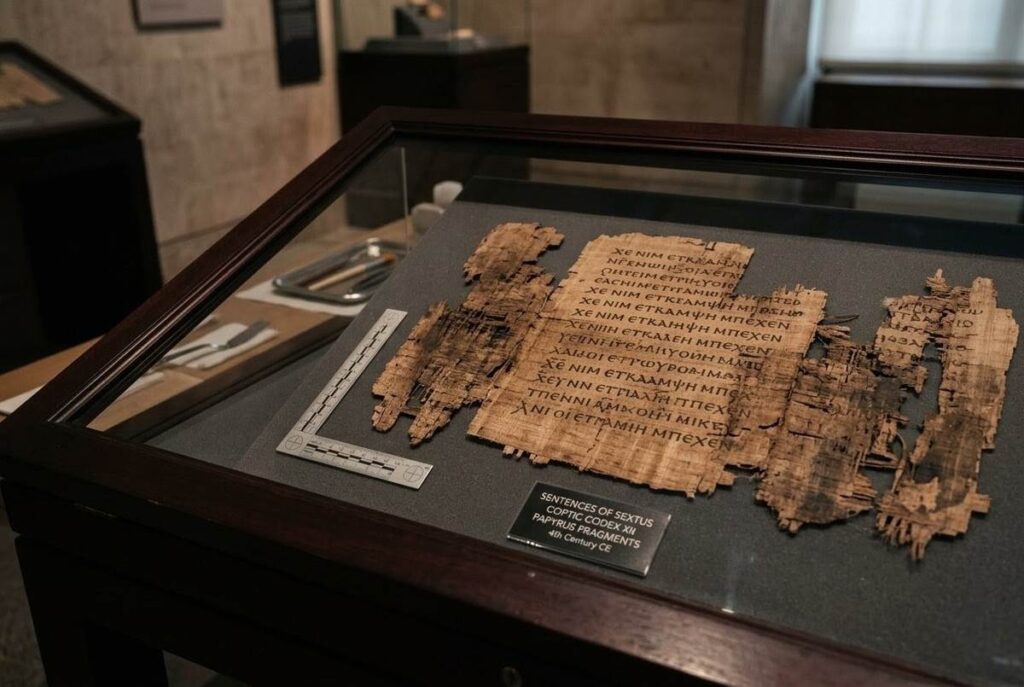
Codex XII presents particular manuscript challenges—the papyrus is severely fragmented, with the Sentences occupying the most complete sections (folios 15-16, 28-34). The text’s survival in this damaged codex, rather than the better-preserved Codex I or II, may indicate its secondary status within the collection—practical wisdom being less treasured than cosmological revelation, or conversely, being so widely circulated that duplicate preservation seemed unnecessary.
The proximity to the Gospel of Truth fragments is theologically suggestive. Where the Gospel offers Valentinian reflections on the error of separation and the joy of recognition, the Sentences provide the ethical infrastructure for maintaining that recognition in daily conduct. Theory and practice, cosmology and character, speculative theology and moral formation—the two texts together model the comprehensive spirituality the library promotes.
The Sentences of Sextus reminds us that even the most sophisticated metaphysical systems require basic operational integrity. In a corpus dominated by complex cosmologies and elaborate ascents, these 451 maxims offer refreshingly concrete guidance: control the tongue, restrain desire, guard the mind. The text’s survival across linguistic and doctrinal boundaries testifies to the universal recognition that spiritual advancement requires character infrastructure—one cannot navigate the aeons while sabotaging the journey through ethical negligence. Whether read as Pythagorean wisdom, Christian formation, or simply practical philosophy, the Sentences remain essential equipment for anyone attempting to maintain spiritual coherence amid the administrative chaos of embodied existence.
Frequently Asked Questions
What are the Sentences of Sextus in the Nag Hammadi Library?
The Sentences of Sextus (NHC XII,1) is a collection of 451 ethical maxims preserved in Coptic translation within the Nag Hammadi Library. Originally a 2nd-century Greek text possibly written by a Pythagorean philosopher named Sextus, it was later adapted by Christian editors. The collection provides practical wisdom for moral formation through brief, memorable injunctions covering control of speech, desire, and thought. It represents the only surviving Coptic version of this widely circulated ethical manual.
Is the Sentences of Sextus a Christian or Pagan text?
The Sentences represent a fusion of both traditions. The core material reflects Pythagorean ethical concerns—silence, self-examination, friendship, and the divinity of the soul—while Christian redactors added monotheistic language, references to God and faith, and eschatological emphasis. However, the text never mentions Jesus, the cross, or resurrection, functioning largely as ‘natural theology’ accessible to reason while compatible with Christian revelation.
What are the main ethical teachings of the Sentences of Sextus?
The text outlines a threefold ascetic programme: (1) Control of speech—cultivating silence and avoiding idle or harmful words; (2) Control of desire—restraining fleshly appetites and sexual activity, following a negative formulation of the Golden Rule; (3) Control of thought—guarding against anger and cultivating prudent reflection. These disciplines prepare the soul for receiving higher spiritual knowledge.
How do the Sentences of Sextus relate to other Nag Hammadi texts?
Unlike the esoteric cosmologies and ascent narratives dominating the library, the Sentences focus on practical ethics and character formation. It appears in Codex XII alongside fragments of the Gospel of Truth, suggesting the compiler valued moral preparation alongside speculative theology. Its encratite tendencies (strict asceticism) align with the Book of Thomas the Contender, while its wisdom form connects to the Teachings of Silvanus.
What is the significance of the number 451 in the Sentences of Sextus?
The 451 maxims represent a comprehensive but manageable collection for memorisation and meditation. While the exact numerological significance remains unclear, the substantial quantity suggests systematic coverage of ethical life rather than random aphorisms. The number allowed for thematic organisation and comprehensive treatment of moral challenges while remaining portable enough for oral transmission and daily contemplation.
Why is the Sentences of Sextus important for understanding Gnosticism?
The text demonstrates that Gnostic communities practiced serious ethical formation (paideia) alongside their speculative theologies. Its presence counters stereotypes of Gnosticism as purely elitist or antinomian, showing concern with character transformation necessary for spiritual advancement. The text also illustrates the cosmopolitan intellectual environment of these communities, capable of appreciating Greek philosophical wisdom alongside Christian and Jewish traditions.
Where does the Sentences of Sextus appear in the Nag Hammadi manuscripts?
The text appears in Codex XII, folios 15-16 and 28-34, preserved alongside fragments of the Gospel of Truth and other unidentified material. Codex XII is severely fragmented compared to other Nag Hammadi codices, making the Sentences’ relatively complete preservation particularly valuable. The manuscript is written in Coptic (Subachmimic dialect) and dates to approximately 350-400 CE, though the Greek original likely dates to the 2nd century CE.
Further Reading
Explore related ethical traditions, wisdom literature, and manuscript contexts within the Nag Hammadi Library:
- The Teachings of Silvanus: Practical Wisdom for Spiritual Life – Compare another paraenetic text offering ethical guidance and practical philosophy from the library.
- Gnostic Ethics: Asceticism, Sexuality, and Community Life – Study broader ethical themes and encratite tendencies across the Nag Hammadi corpus.
- The Book of Thomas the Contender: Flesh, Soul, and the Saved – Explore rigorous encratite ethics in dialogue form, aligning with the Sentences’ severe asceticism.
- Codex XII: Fragments and the Sentences of Sextus – Learn about the manuscript context, preservation challenges, and textual neighbours of this wisdom collection.
- The Gospel of Truth: Poetics of Recognition – Study the Valentinian text found in the same codex, representing the theological counterpart to the Sentences’ practical ethics.
- The Authoritative Teaching: The Soul’s Descent and Return to Light – Examine another text from the wisdom tradition addressing moral formation and spiritual education.
- The Concept of Our Great Power: Apocalypse of Divine Light – Continue reading Codex VI materials and explore the relationship between ethical preparation and eschatological expectation.
- Nag Hammadi Library Complete Reader’s Guide – Navigate the full corpus with our comprehensive introduction to all 46 tractates and their thematic interconnections.