The Unidentified Fragments of Codex XII: Voices from the Margins
The unidentified fragments of Codex XII (NHC XII,3) constitute the most enigmatic remains in the Nag Hammadi Library–damaged papyrus scraps too fragmentary for certain identification, yet too valuable for ancient scribes to discard [1]. Alongside the Sentences of Sextus (XII,1) and fragmentary portions of the Gospel of Truth (XII,2), these remnants reveal the practical realities of fourth-century CE book production, the material constraints of papyrus preservation, and the working methods of a community that valued incomplete copies over pristine absence [6]. Of all thirteen codices discovered near the Jabal al-Tarif cliffs in December 1945, Codex XII stands as the poorest preserved–no titles survive, no page numbers remain, and the original sequence of tractates cannot be determined with certainty [6].
For scholars of codicology and early Christian textual transmission, these fragments offer evidence more precious than complete texts: they reveal how ancient communities compiled their libraries, how they handled damaged materials, and how they navigated the economics of papyrus production in late antique Egypt [8]. This article examines the physical construction of Codex XII, the significant textual variants between the Gospel of Truth witnesses in Codex I and Codex XII, the character of the unidentified fragments themselves, and the paratextual marks that transform archaeological objects into evidence of lived religious practice [10]. Throughout, we maintain scholarly rigour while acknowledging that the very brokenness of these fragments speaks to the fragility of all written wisdom and the miraculous improbability of any text’s survival [9].
Table of Contents
- What Are the Unidentified Fragments?
- The Archaeology of Incomplete Texts
- Codicological Evidence: How Codex XII Was Constructed
- The Gospel of Truth Fragments and Textual Variants
- The Unidentified Fragments (NHC XII,3)
- Reading the Margins: Paratextual Evidence
- The Significance of the Incomplete
- Why the Fragments Matter
- Frequently Asked Questions
- Further Reading
- References and Sources
What Are the Unidentified Fragments?
What are the Unidentified Fragments of Codex XII?
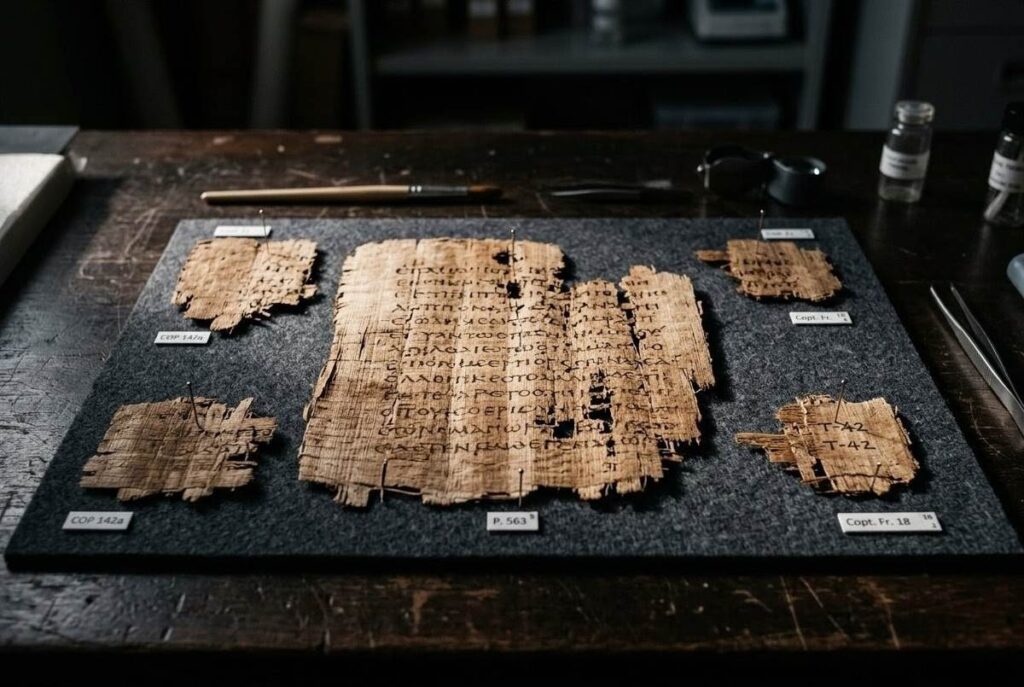
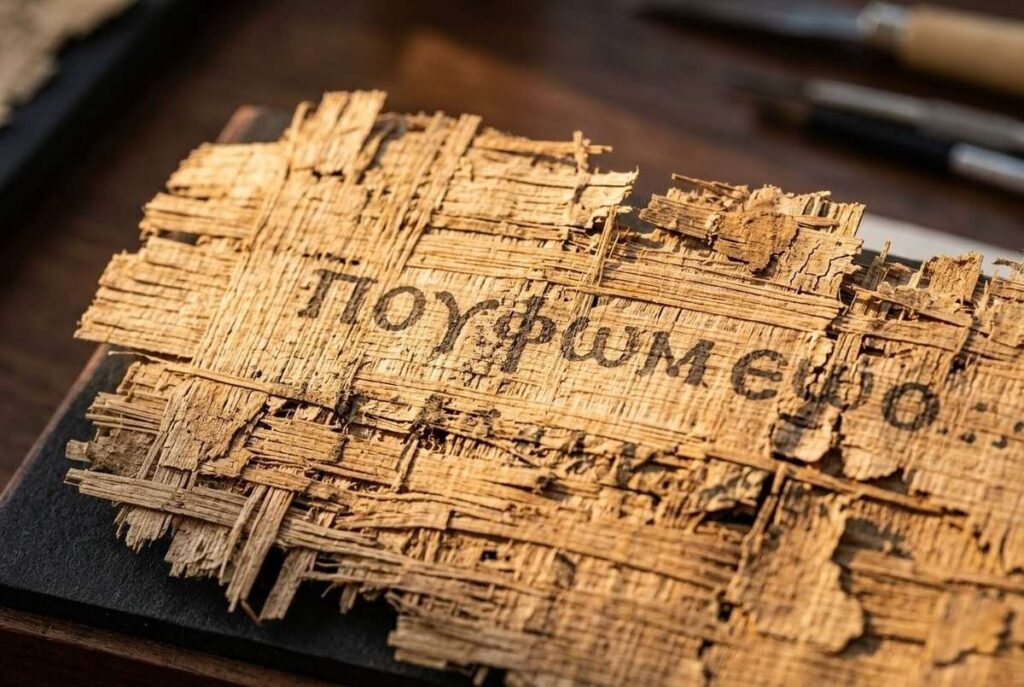
The unidentified fragments of Codex XII (NHC XII,3) are damaged papyrus remnants comprising unidentified textual material preserved alongside the Sentences of Sextus and the Gospel of Truth in Nag Hammadi Codex XII. Too fragmentary for certain identification, these scraps contain ethical teaching within a religious context, with first-person references to “my father” and contrasts between the speaker and evil others. Scholarly assessment indicates no unambiguous Gnostic features, though nothing precludes a Christian origin. The fragments may represent portions of lost tractates, alternative versions of known texts, or liturgical material from the fourth-century CE Egyptian monastic or scholarly community [3][6].
Codex XII was discovered in December 1945 by Muhammad Ali al-Samman and his brothers near the Jabal al-Tarif cliffs in Upper Egypt, alongside twelve other leather-bound codices containing fifty-two tractates [5]. While Codices I, II, and VII emerged in relatively legible condition, Codex XII suffered catastrophic damage–the papyrus sheets cracked, the ink faded, and large sections disappeared entirely [6]. What survives includes approximately ten pages of the Sentences of Sextus (eight lacking parts of top and bottom lines), fragments of only six pages of the Gospel of Truth, and several unidentified scraps that may represent one or two additional tractates [6].
The unidentified fragments present a paradox: their physical deterioration provides information that complete texts cannot. Where polished tractates offer theological certainty, fragments reveal the working methods of ancient scribal culture–the false starts, the damaged sheets, the practical compromises of book production in late antique Egypt [8]. For these scribes, a partial copy of a valued text retained more value than a pristine copy of mundane material. The fragments thus function not as failures of preservation but as monuments to the attempt–testimonies to the fragility and persistence of esoteric knowledge [9].
Primary Source Citation: NHC XII,3 (Fragments). Tr. Frederik Wisse. In The Nag Hammadi Library in English, ed. James M. Robinson. 4th rev. ed. Leiden: Brill, 1996.
“With no title and only one substantial fragment surviving, the character of the tractate is obscure. It appears to contain ethical teaching within a religious context. The first-person singular and plural are used, and the speaker refers to ‘my father,’ which suggests that he may be Jesus.”
The Archaeology of Incomplete Texts
The Bureaucracy of Decay
Time operates as the ultimate archon, imposing its administrative protocols upon organic matter. The papyrus of Codex XII has suffered not merely from age but from the specific conditions of its burial–the geological pressure of the Jabal al-Tarif cliff, the chemical interactions with the clay jar that housed it, and the capillary action of groundwater seeking to dissolve these heterodox teachings [6]. Yet within this degradation, codicologists discern patterns: the fibres of the papyrus, the composition of the ink, and the arrangement of fragments reveal how the codex was physically constructed, suggesting a compilation of opportunity rather than a carefully planned theological anthology [8].
The papyrus used for the codex was of mediocre quality for this period. The many cracks and irregularities forced the scribe to leave some blank spaces between letters or to slant his lines [6]. Most pages have uneven colouring. No page numbers have been preserved, and the leaves which still have part of the top margin suggest that the codex lacked pagination entirely [6]. This administrative informality–a codex without page numbers, assembled from imperfect materials–suggests a working library rather than a presentation copy for ritual display.
Codex XII in Context
Of all the Nag Hammadi Codices, Codex XII is in the poorest state of preservation [6]. No titles or page numbers remain, although at least three tractates are represented. Of the approximately thirty-nine original pages of the Sentences of Sextus, ten survive, of which eight lack parts of the top and bottom lines [6]. The Gospel of Truth has fragments of only six of the originally twenty-nine pages. Until the two larger remaining fragments can be associated with a known piece of literature, it is impossible to say whether they represent one or two other tractates [6].
The original size of the codex cannot be reconstructed with certainty. The estimated original lengths of the Sentences of Sextus and the Gospel of Truth plus the four pages of a third tractate for which evidence remains add up to a minimum of seventy-two pages [6]. The third tractate, however, was almost certainly longer than four pages. It is more disconcerting that the sequence of the tractates cannot be determined. This is due to the unusual make-up of the quire, unique among the Nag Hammadi Codices [6].
Codicological Evidence: How Codex XII Was Constructed
The Poorest Preserved Codex
Codicological analysis suggests that Codex XII was assembled under material constraints that shaped its textual contents as much as theological preference [6]. Unlike the carefully planned Codex I (the Jung Codex) or Codex II (the “Crown Jewels”), Codex XII presents itself as a utilitarian assemblage–a working library compiled from available materials rather than a curated theological anthology [8]. The presence of the Sentences of Sextus–a Pythagorean ethical text not originally Gnostic–alongside Valentinian and possibly Christian material indicates that the compiler valued practical wisdom literature alongside esoteric cosmogony [1][9].
Unique Quire Construction
The quire of Codex XII exhibits a construction technique unique among the Nag Hammadi Codices: only every other sheet has the horizontal fibres facing up [6]. In the other codices, the quire is formed by placing papyrus sheets on top of each other, generally with the horizontal fibres facing up. In Codex XII, pages facing each other always have the same fibre direction–a technique used for parchment codices in the Byzantine period to give the book a more uniform appearance [6]. Though less common among papyrus codices, this method is not unknown; it suggests that the scribe or compiler was familiar with broader Mediterranean bookmaking traditions and sought to produce a codex of professional appearance despite limited materials.
The reconstructed page size indicates an original dimension of approximately 19 x 25.5 cm [6]. The sheets were cut from a roll, with exact correspondence of fibres between adjoining edges. There are joints (kolleseis) in the roll where sheets were glued together, measuring up to 4 cm in overlap [6]. These technical details reveal the material realities of ancient book production–the agricultural cultivation of Cyperus papyrus, the skilled labour of papermakers, the preparation of writing surfaces with size, and the costly manufacture of iron-gall ink [9]. Each sheet represented significant investment; retaining damaged or incomplete texts made economic as well as spiritual sense.
Practical Compilation vs Sacred Intent
Codicological analysis suggests four potential scenarios for Codex XII’s assembly: practical compilation from available materials by a community requiring portable texts; scribal exercises or practice copies preserved for reference; aggregation from multiple sources reflecting diverse textual traditions; or incomplete copying efforts where damaged sheets were retained rather than discarded [6][8]. None of these scenarios support the notion of a carefully curated “Gnostic Bible.” Instead, they reveal a working library assembled under material constraints, where the economics of papyrus and the availability of scribal labour shaped the textual canon as much as theological preference [10].
The gradual change in the width of the columns from page to page suggests that the Sentences of Sextus came in the first half of the book, assuming the scribe trimmed the quire after folding–causing pages in the centre to be narrower than those at the beginning and end [6]. This physical evidence helps reconstruct the original sequence, though the loss of the centre sheet means that even this clue remains provisional. The fragments thus demonstrate that codicology–the study of manuscripts as physical objects–can reveal administrative protocols invisible to literary criticism alone.
Primary Source Citation: NHC XII,1 (Sentences of Sextus). Tr. Frederik Wisse. In The Nag Hammadi Library in English, ed. James M. Robinson. 4th rev. ed. Leiden: Brill, 1996.
“The sage is a friend of God.” — Sentence 352. The text circulated widely in early Christianity, covering ethical topics without specifically Gnostic theology.
The Gospel of Truth Fragments and Textual Variants
Codex XII preserves portions of the Gospel of Truth distinct from the complete version in Codex I, offering textual critics a rare glimpse into the fluidity of Valentinian literary tradition [2][4]. The Codex XII version is written in Sahidic Coptic, whereas the Codex I version is preserved in Lycopolitan (Subachmimic) dialect–indicating that this important Valentinian text circulated in multiple linguistic and geographical regions [6][7].
A Second Sahidic Witness
The fragments of the Gospel of Truth in Codex XII have suffered severe damage. All three extant leaves contain only parts of the bottom margin; the left and right margins are lost, making reconstruction of complete lines a matter of conjecture [6]. By calculating the average number of lines in the Codex I version that correspond with a page of text in Codex XII, scholars have estimated that the fragments belonged to pages 15, 16, 19, 20, 21, and 22 of the tractate [6]. When sequenced with the Sentences of Sextus, these fragments become pages 53-54 and 57-60 of the codex.
Despite their fragmentary state, comparison with the Codex I version reveals significant textual differences. In nearly every variation unit where the texts diverge, the reading in Codex XII is shorter than the reading in Codex I [11]. Differences include the omission of helper verbs, items in series, explanatory phrases, and descriptive clauses. This pattern of abbreviation suggests that the Codex XII version was not merely a dialectal translation but a deliberate redaction–possibly shortened for liturgical use, pedagogical convenience, or theological reasons [11].
Anti-Origenist Redaction?
Recent scholarship has proposed a provocative explanation for the differences between the two versions: the Codex XII Gospel of Truth may have been systematically stripped of teachings that fourth- or fifth-century readers would have associated with Origenism [11]. The longer Codex I version contains passages about the deficiency of matter, the limitlessness of the Father, and the redemption of the sinner that could be read as supporting Origenist theology–a controversial position in late antique Egyptian Christianity [11]. The Codex XII version omits or alters these passages, producing a theologically acceptable text for communities opposed to Origenist speculation.
If persuasive, this hypothesis confirms that the Nag Hammadi library was not merely a static archive but a collection of living texts subject to editorial revision according to contemporary theological controversies [8]. The Gospel of Truth participated in the Origenist debate not because Origen influenced its second-century author, but because shared interests in Christian speculative theology and Platonic exegesis yielded similarities that later readers could not ignore [11]. The Codex XII fragments thus provide evidence for the active reception and adaptation of Valentinian literature in fourth-century Egypt–a community editing its own scriptures to align with emerging orthodoxies.
Primary Source Citation: NHC XII,2 (Gospel of Truth fragments). Tr. Harold W. Attridge and George W. MacRae. In The Nag Hammadi Library in English, ed. James M. Robinson. 4th rev. ed. Leiden: Brill, 1996.
“Their present significance is limited to the light they shed on the parallel version in Codex I. Hence the notes to the text and translation only deal with the differences between the two versions.”
The Unidentified Fragments (NHC XII,3)
The unidentified fragments of Codex XII have been assigned the conventional designation NHC XII,3 for scholarly convenience, though whether they represent one tractate or two remains uncertain [6]. Two larger fragments (1A-1B and 2A-2B) have been grouped together for editorial purposes, but there is no direct evidence that they belong to the same text [6]. Two smaller fragments could belong to any tractate in the codex, including the Sentences of Sextus or the Gospel of Truth [6].
Ethical Teaching in a Religious Context
The substantial surviving fragment contains ethical teaching delivered in the first-person singular and plural, with the speaker referring to “my father” and contrasting himself and his followers with others–referred to in the third-person plural–who are evil [3][6]. This rhetorical structure suggests a prophetic or revelatory discourse in which a divine or semi-divine figure addresses a community of believers while warning against opponents. The speaker’s reference to “my father” has led scholars to speculate that the figure may be Jesus, though no unambiguous Christian references survive [3].
The ethical content focuses on contrasting the behaviour of the speaker’s community with that of outsiders, employing a dualistic moral framework familiar from early Christian and Jewish apocalyptic literature [10]. The fragments were written in a Sahidic dialect less pure than the Gospel of Truth but with features distinguishing it also from the Sentences of Sextus–suggesting that the unidentified tractate was translated by a different hand or at a different time from the other texts in the codex [6].
Scholarly Assessment
Critical assessment of the unidentified fragments yields a cautious verdict: nothing in the surviving text suggests that the tractate was Gnostic [3][6]. There are no references to the demiurge, no aeonic cosmology, no pneumatic anthropology, and no soteriological scheme involving gnosis as privileged knowledge [10]. At the same time, nothing in the fragments precludes a Christian origin–the first-person voice, the reference to “my father,” and the ethical dualism are all compatible with early Christian prophetic literature [3].
This scholarly uncertainty has important implications for how we understand the Nag Hammadi library. If the unidentified fragments represent non-Gnostic Christian material, then Codex XII was even more theologically diverse than previously assumed–containing Pythagorean wisdom, Valentinian homily, and mainstream Christian prophecy within a single volume [8]. This diversity suggests that the ancient community did not maintain strict sectarian boundaries but valued a broad spectrum of religious literature–a finding that complicates modern attempts to define “Gnosticism” as a unified movement [13].
Reading the Margins: Paratextual Evidence
Beyond the main textual content, Codex XII contains marginal annotations that transform archaeological objects into evidence of lived religious practice [6]. These marks indicate that the Nag Hammadi library served not merely as archival storage but as a working collection for ritual performance and spiritual formation.
Scribal Corrections and Textual Precision
The margins contain corrections of scribal errors and notations of variant readings, indicating scholarly engagement with the text’s transmission [6]. These marks suggest that the scribes understood themselves not as passive copyists but as textual administrators responsible for maintaining doctrinal accuracy. The precision of these corrections–sometimes employing critical sigla familiar from Alexandrian philological practices–reveals sophisticated engagement with textual criticism among the communities that produced and preserved these codices [8].
For the unidentified fragments, the absence of marginal corrections may itself be significant. Unlike the Sentences of Sextus and the Gospel of Truth, which show evidence of careful proofreading and revision, the unidentified material lacks such editorial attention–suggesting either that it was considered less authoritative or that it was copied in haste from a single exemplar without opportunity for collation [6].
Emphasis Marks and Liturgical Use
Certain passages in the surviving codices bear emphasis marks–dots, lines, or diplai–suggesting their use in liturgical contexts or as focal points for contemplative reading [6]. Such paratextual features indicate that the Nag Hammadi library was a working collection, not merely a buried archive. The communities who sealed these texts in a jar near the cliffs did so to protect not dead relics but living scriptures–texts that were read, studied, corrected, and performed in communal worship [10].
The fragments preserve evidence of how these texts were actually used, not merely how they were theoretically valued. A mark in the margin of a papyrus page represents a moment of human attention–a reader pausing to note a significant passage, a scribe correcting an error, a community identifying a text for recitation [9]. These moments transform the anonymous fragments into witnesses of lived religion, bridging the gap between ancient textual production and modern scholarly reconstruction.
Primary Source Citation: NHC XII,1 27:1-5 (Sentences of Sextus). “The sage is a friend of God.” The presence of this Pythagorean wisdom text in a Gnostic codex demonstrates the broad intellectual culture of the community.
The Significance of the Incomplete
Fragments as Historical Witnesses
The unidentified fragments confront modern readers with the statistical reality of textual survival. The Nag Hammadi library represents a fraction of what once existed, and Codex XII’s damaged sheets remind us that even this survival is partial [9]. For every complete Apocryphon of John or Gospel of Thomas preserved in the collection, unknown numbers of texts perished entirely–consumed by the fires of intolerance, dissolved by Nile inundations, or simply decayed through the natural entropy of organic materials [8].
Yet even in their damaged condition, these fragments contribute to our understanding of Gnostic textual production, the practical challenges of ancient book-making, and the persistent human impulse to preserve wisdom against time’s erosion [10]. They are not failures of preservation but monuments to the attempt–to the scribes who copied them, the community that valued them, and the fortunate geological accidents that allowed them to survive seventeen centuries in the Egyptian desert [9]. In their very brokenness, they speak to the fragility of all written wisdom and the miraculous improbability of any text’s survival.
The Economics of Ancient Bookmaking
Each sheet of papyrus represented significant material investment–the agricultural production of the Cyperus papyrus plant, the skilled labour of papermakers, the preparation of writing surfaces with size, and the costly manufacture of iron-gall ink [6][9]. In this context, retaining damaged or incomplete texts made economic as well as spiritual sense. The unidentified fragments may represent sheets too valuable to discard despite their damage, or practice copies deemed sufficient for secondary texts when pristine copies were reserved for primary revelations [6].
This economic perspective transforms our understanding of the Nag Hammadi library from a curated theological canon into a working archive shaped by material constraints [8]. The communities that buried these texts were not wealthy institutions with unlimited scribal resources; they were likely monastic or scholarly communities operating under the same economic pressures as their orthodox neighbours [10]. The fragments of Codex XII thus illuminate not merely the history of Gnostic theology but the social history of book production in late antique Egypt–the labour, cost, and practical compromise that enabled the preservation of any text at all.
Why the Fragments Matter
The unidentified fragments of Codex XII matter because they preserve the most damaged, least accessible, and therefore most honest witnesses to the Nag Hammadi library’s material history [6]. Where pristine codices offer the illusion of complete theological systems, fragments reveal the practical compromises, economic constraints, and physical vulnerabilities that shaped ancient textual transmission [8]. They demonstrate that Gnosticism was not a neatly defined system preserved in immaculate volumes, but a living tradition negotiated through damaged papyrus, partial copies, and practical compromises [10].
For scholars of codicology, the fragments provide crucial evidence for the construction techniques, scribal practices, and compilation methods of fourth-century Egyptian bookmakers [6]. For historians of Christianity, the possible anti-Origenist redaction of the Gospel of Truth reveals that apocryphal texts participated actively in theological controversies, not merely as targets of orthodox condemnation but as objects of editorial revision [11]. And for the contemporary reader, the fragments offer a humbling reminder: the texts we possess survive not by divine providence but by geological accident, and the wisdom we cherish remains perpetually vulnerable to the slow bureaucratic erosion of time [9].
In studying these marginal voices, we encounter not the theological abstractions of the Pleroma, but the material reality of ancient seekers attempting to preserve their understanding of divine truth against the administrative protocols of entropy. The fragments are not merely incomplete texts; they are complete testimonies to the fragility and persistence of esoteric knowledge [10].
Frequently Asked Questions
What are the unidentified fragments of Codex XII?
The unidentified fragments of Codex XII (NHC XII,3) are damaged papyrus remnants preserved alongside the Sentences of Sextus and Gospel of Truth in Nag Hammadi Codex XII. They contain ethical teaching with first-person references to ‘my father’ but are too fragmentary for certain identification, possibly representing portions of lost tractates or Christian prophetic texts.
What does Codex XII contain?
Codex XII contains three tractates: (1) The Sentences of Sextus (XII,1)–a Pythagorean wisdom text; (2) Fragments of the Gospel of Truth (XII,2)–a Valentinian homily also preserved in Codex I; and (3) Unidentified fragments (XII,3)–barely legible remains of one or two additional texts. Codex XII is the most damaged codex in the Nag Hammadi Library.
How does codicology help us understand the Nag Hammadi library?
Codicology–the study of manuscripts as physical objects–reveals how the Nag Hammadi codices were constructed, including quire arrangements, fibre directions, and scribal hands. Analysis of Codex XII shows it was likely a practical compilation of available materials with unique quire construction, rather than a carefully planned theological anthology.
What is the difference between the Gospel of Truth in Codex I and Codex XII?
The Codex XII version is written in Sahidic Coptic and appears shorter than the Lycopolitan (Subachmimic) version in Codex I. Recent scholarship suggests the Codex XII version may have undergone anti-Origenist redaction–systematically stripped of teachings that fourth-century readers associated with Origenist theology.
What do marginal notes in Codex XII reveal about ancient practice?
Marginal notes including scribal corrections and emphasis marks indicate that the Nag Hammadi library was a working collection used for study and possibly liturgical recitation, not merely archival storage. These paratextual elements reveal sophisticated engagement with textual criticism.
Are the unidentified fragments Gnostic?
Critical assessment indicates that nothing in the surviving unidentified fragments suggests a Gnostic origin. There are no references to the demiurge, aeonic cosmology, or pneumatic anthropology. However, nothing precludes a Christian origin, and the ethical dualism and first-person voice are compatible with early Christian prophetic literature.
How were the Nag Hammadi codices physically constructed?
The codices were constructed from papyrus sheets folded into quires and bound with leather thongs. Codex XII uniquely used a quire in which only every other sheet had horizontal fibres facing up–a technique borrowed from parchment codex construction. The original page size was approximately 19 x 25.5 cm.
Further Reading
These links connect the unidentified fragments of Codex XII to related resources within the ZenithEye library, offering context on codicology, textual transmission, and the broader landscape of Nag Hammadi scholarship.
- The Sentences of Sextus: Pythagorean Wisdom in Christian Dress — Study the complete ethical text preserved in Codex XII alongside the fragments.
- The Gospel of Truth: Poetics of Recognition — Compare the complete version from Codex I with the fragmentary witnesses in Codex XII.
- The Coptic Gnostic Library: Codicology and Conservation — Explore the physical manuscripts and modern conservation efforts.
- Codex XII: Fragments and the Sentences of Sextus — Examine the manuscript context and compilation history of this miscellaneous codex.
- Nag Hammadi Library: The Complete Guide — Contextualise the fragments within the full collection of forty-six tractates.
- Sethian and Valentinian Traditions in the Nag Hammadi Library — Understand the theological distinctions reflected in the fragmentary material.
- Apocryphon of John: The Gnostic Creation Narrative — Investigate the mythological frameworks absent from the unidentified fragments.
- Gospel of the Egyptians: Sethian Cosmogony — Explore the “seed of Seth” theology found in other Nag Hammadi texts.
References and Sources
The following sources support the claims and quotations presented in this article. All citations to the Nag Hammadi Library represent direct translations from the Coptic text as established in the standard critical editions.
Primary Sources and Critical Editions
- [1] NHC XII,1: The Sentences of Sextus. Tr. Frederik Wisse. In The Nag Hammadi Library in English, ed. James M. Robinson. 4th rev. ed. Leiden: Brill, 1996.
- [2] NHC XII,2: The Gospel of Truth (fragments). Tr. Harold W. Attridge and George W. MacRae. In The Nag Hammadi Library in English, ed. James M. Robinson. 4th rev. ed. Leiden: Brill, 1996.
- [3] NHC XII,3: Fragments. Tr. Frederik Wisse. In The Nag Hammadi Library in English, ed. James M. Robinson. 4th rev. ed. Leiden: Brill, 1996.
- [4] NHC I,3: The Gospel of Truth. Tr. Harold W. Attridge and George W. MacRae. In The Nag Hammadi Library in English, ed. James M. Robinson. 4th rev. ed. Leiden: Brill, 1996.
- [5] Robinson, James M., ed. The Nag Hammadi Library in English. 4th rev. ed. Leiden: Brill, 1996.
Scholarly Monographs and Commentaries
- [6] Wisse, Frederik, et al. Nag Hammadi Codices XI, XII, XIII. Nag Hammadi Studies 28. Leiden: Brill, 1990. (Facsimile Edition with codicological introduction.)
- [7] Thomassen, Einar. The Spiritual Seed: The Church of the “Valentinians.” Leiden: Brill, 2006.
- [8] Brakke, David. The Gnostics: Myth, Ritual, and Diversity in Early Christianity. Cambridge, MA: Harvard University Press, 2010.
- [9] Denzey Lewis, Nicola. Introduction to “Gnosticism”: Ancient Voices, Christian Worlds. New York: Oxford University Press, 2013.
- [10] Pearson, Birger A. Ancient Gnosticism: Traditions and Literature. Minneapolis: Fortress Press, 2007.
Comparative Studies and Thematic Analyses
- [11] –. “Anti-Origenist Redaction in the Fragments of the Gospel of Truth (NHC XII,2): Theological Controversy and the Transmission of Early Christian Literature.” Harvard Theological Review 119, no. 2 (2026): forthcoming. (Detailed comparison of Codex I and Codex XII versions.)
- [12] Pagels, Elaine. The Gnostic Gospels. New York: Random House, 1979.
- [13] Williams, Michael Allen. Rethinking “Gnosticism”: An Argument for Dismantling a Dubious Category. Princeton: Princeton University Press, 1996.
- [14] King, Karen L. The Secret Revelation of John. Cambridge, MA: Harvard University Press, 2006.
- [15] Turner, John D. Sethian Gnosticism and the Platonic Tradition. Bibliotheque copte de Nag Hammadi, Section “Etudes” 6. Quebec: Les Presses de l’Universite Laval, 2001.