Pleroma and Kenoma: The Foundational Geography of Gnostic Cosmology
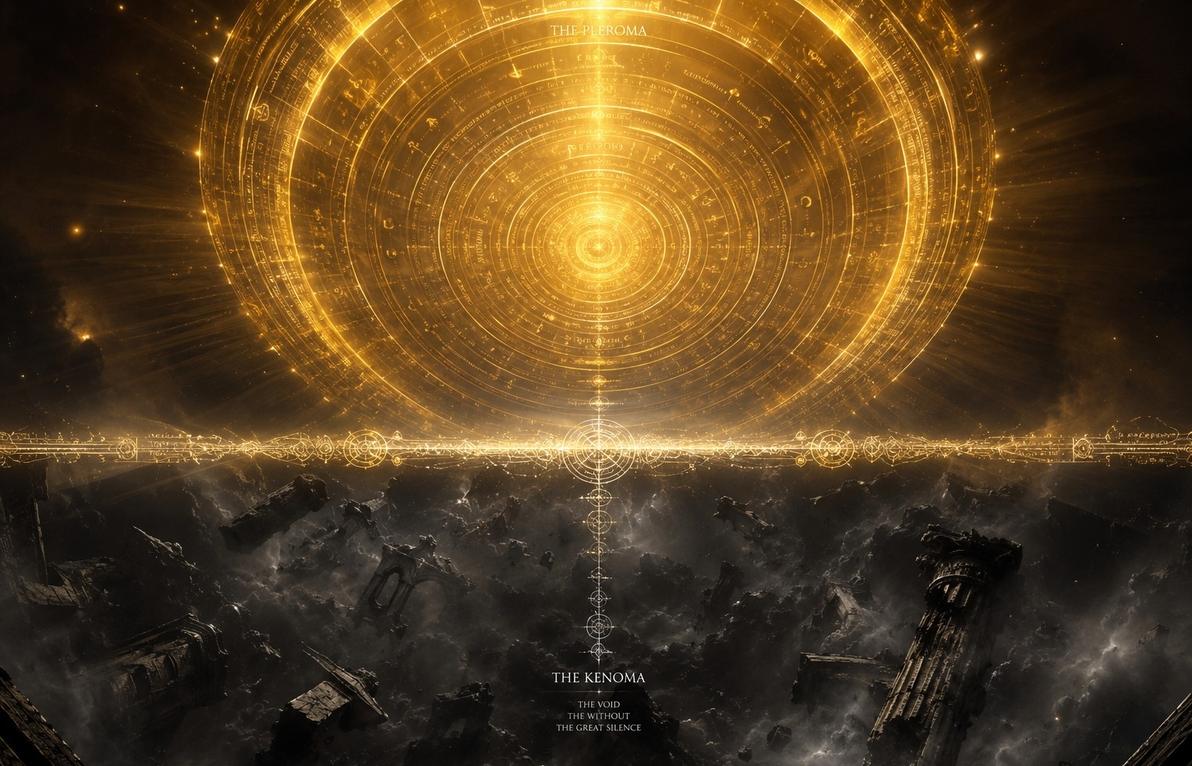
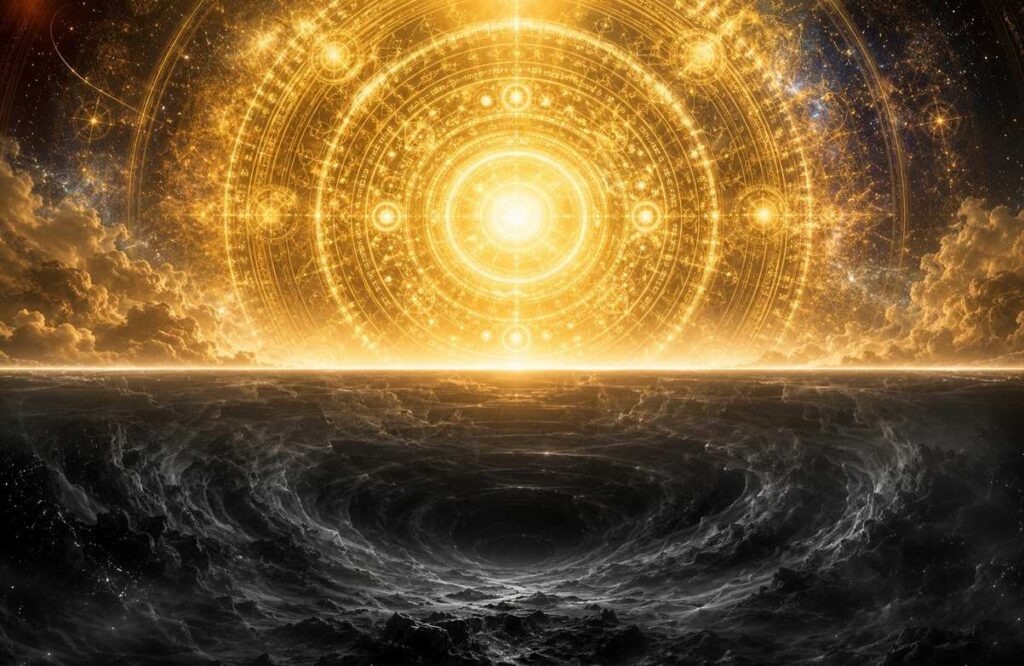
At the heart of every Gnostic cosmology lies a single, devastating question: Is the world we inhabit the product of divine fullness or of radical deficiency? The answer, in the texts recovered from Nag Hammadi, is delivered through two Greek terms that have become foundational to the entire tradition: Pleroma and Kenoma. The first denotes the realm of divine fullness, the totality of eternal emanations flowing from the unknowable source. The second denotes the emptiness, the void, the region of deficiency into which the fallen Sophia plunged and from which the Demiurge fashioned his counterfeit cosmos. Together, these terms map the metaphysical geography of the Gnostic universe — and, by extension, the spiritual condition of every human being who awakens to discover themselves trapped in a world that is not their true home.
This article offers a thorough, textually grounded exploration of Pleroma and Kenoma as they appear across the Nag Hammadi Library. It traces their Greek etymologies, examines their divergent expressions in Sethian and Valentinian systems, and considers how this ancient distinction between fullness and emptiness continues to illuminate contemporary questions about consciousness, reality, and the nature of the divine.
Table of Contents
- Etymology and Pre-Gnostic Usage
- The Sethian Pleroma: Barbelo and the Aeons
- The Valentinian Pleroma: Syzygies and the Thirty Aeons
- Kenoma: The Realm of Deficiency
- The Horos and the Geography of Salvation
- Pleroma, Kenoma, and the Three Natures
- Contemporary Resonance
- Frequently Asked Questions
- Further Reading
- References and Sources
Etymology and Pre-Gnostic Usage
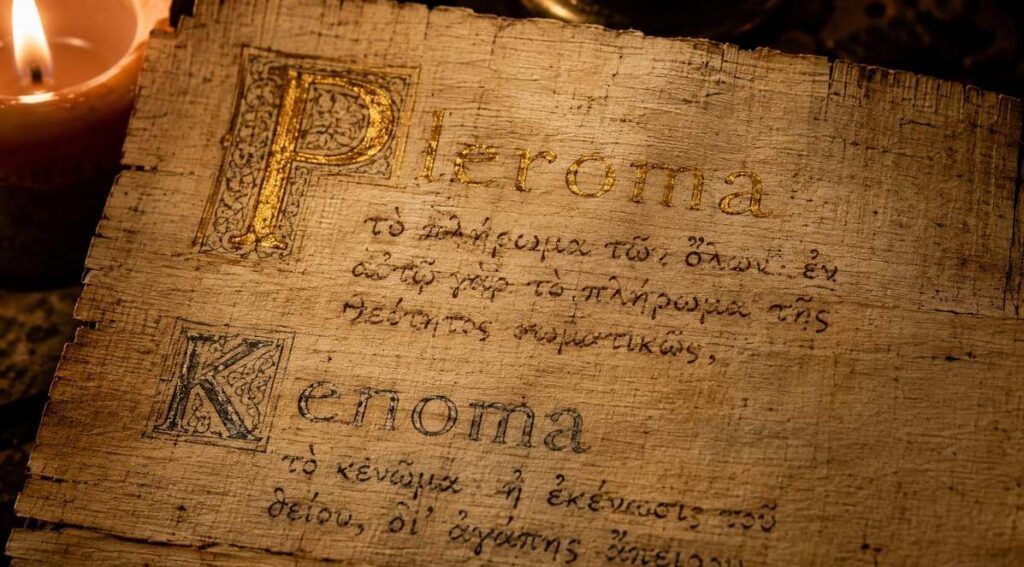
The Greek word Pleroma (πλήρωμα) derives from the verb plēroun, meaning “to fill,” “to fulfill,” or “to complete.” In ordinary Greek usage, the term could refer to a ship filled with cargo, a crew at full number, or the totality of a population. It carried both passive and active senses: that which is filled, and that which fills. By the Hellenistic period, the word had acquired philosophical and theological weight. Philo of Alexandria used it to describe the soul as “the sum total of virtues,” while the Corpus Hermeticum employed it to speak of God as “the totality of good” and “the totality of life”.
Kenoma (κένωμα), by contrast, derives from kenoun, “to empty.” In Stoic philosophy, the related term kenon denoted the void — the infinite, incorporeal expanse surrounding the cosmos that enabled the movement and arrangement of material bodies. Unlike the Stoic kenon, which was a neutral metaphysical concept, the Gnostic Kenoma became a heavily charged theological term: not merely empty space but the realm of existential and ontological deficiency, the shadow cast by the Pleroma’s light.
Before the Gnostics appropriated Pleroma as a technical term, the Apostle Paul had already employed it with striking density in his letters to the Colossians and Ephesians. In Colossians 1:19, Paul declares that “all the fullness (pleroma) dwells in him [Christ] bodily,” and in Colossians 2:9 he repeats that “in Christ all the fullness of the Deity lives in bodily form”. Whether Paul intended a proto-Gnostic cosmology remains debated among scholars, but the terminological seed was planted. By the second century CE, Valentinian and Sethian teachers had transformed Pleroma from a Pauline description of Christological completeness into the name of a specific divine realm — the upper world of Aeons to which the Gnostic hoped to ascend after death.
The Sethian Pleroma: Barbelo and the Aeons
The Apocryphon of John (NHC II,1), arguably the most important single text in the Nag Hammadi Library, presents the Sethian vision of the Pleroma with elaborate precision. At the summit stands the Monad — “a monarchy with nothing above it,” eternal, perfect, holy, and self-sufficient, yet also ineffable and inconceivable. From the Monad’s thought emerges Barbelo, “the first thought,” “the image of the invisible Spirit,” and “the forethought of the All.” Barbelo is androgynous, referred to as both mother and father, and she becomes “the womb of all”.
Primary Source Citation: NHC II,1 6:1-10
“This is the pentad of the aeons of the Father, which is the first man, the image of the invisible Spirit; it is the forethought, which is Barbelo, and the thought, and the foreknowledge, and the indestructibility, and the eternal life, and the truth. This is the androgynous pentad of the aeons, which is the decad of the aeons, which is the Father.”
Through an exchange between the Monad and Barbelo, the other Aeons come into being. The Monad looks at Barbelo “with the pure light which surrounds the invisible Spirit, and (with) his spark, and she conceived from him.” The offspring is the Autogenes (“self-created one”) — the Christ, the “only-begotten child of the Mother-Father,” the “pure Light”. From this luminous core, the Pleroma expands into a structured hierarchy: the four luminaries (Armozel, Oriel, Daveithai, Eleleth), each governing three Aeons, and the multitude of powers and authorities that attend the invisible Spirit. The entire realm is characterised by silence, glory, and the absence of deficiency.
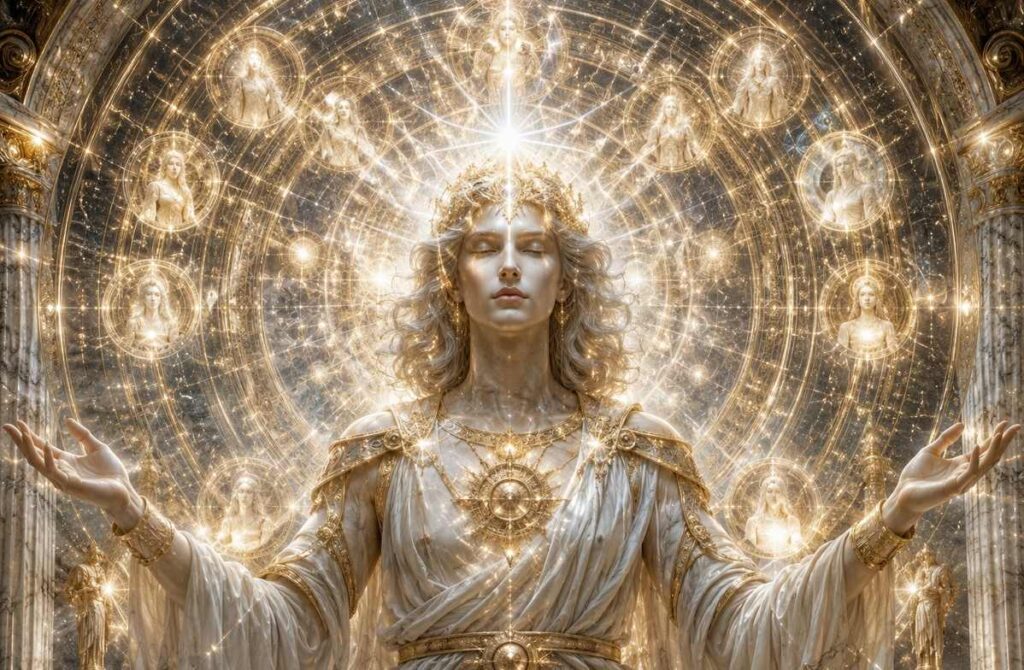
What distinguishes the Sethian Pleroma is its emphatic transcendence. It is not merely a “heaven” in the conventional sense — a place above the sky — but a metaphysical condition of total plenitude. As the Gospel of Philip states, “What is innermost [in a person] is the Fullness (Pleroma), and there is nothing further within. And this is what they call uppermost”. The Pleroma is simultaneously cosmic and psychological: it exists as the divine realm above, yet it is also the hidden ground of the awakened self.
The Valentinian Pleroma: Syzygies and the Thirty Aeons
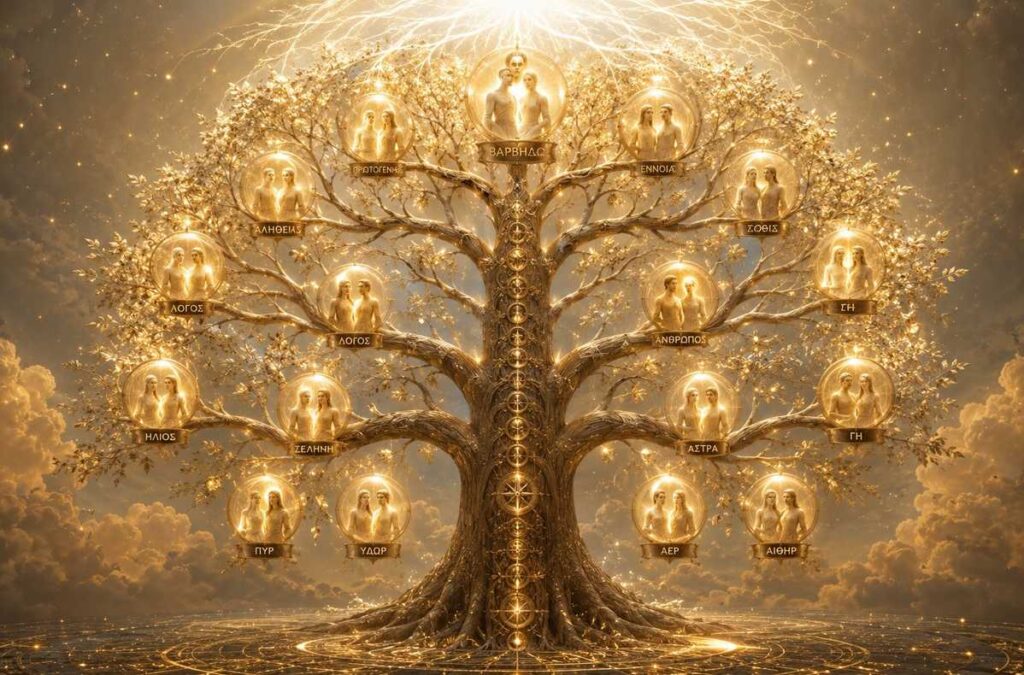
The Valentinian tradition, as preserved in the Tripartite Tractate (NHC I,5) and reflected in patristic reports by Irenaeus and Hippolytus, offers a different but structurally related vision of the Pleroma. Where the Sethian system emphasises the Monad-Barbelo-Autogenes triad, the Valentinians organised their Pleroma into syzygies — paired male-female Aeons — emanating from the primal Father.
In the classical Valentinian scheme reported by Irenaeus, the Pleroma contains thirty Aeons arranged in fifteen syzygies. The first pair is Bythos (Depth) and Sige (Silence). From them emerge Nous (Mind) and Aletheia (Truth), then Logos (Word) and Zoe (Life), and so on through a chain of emanations that includes Anthropos (Human) and Ecclesia (Church) as the final pair. Each syzygy represents a divine quality or power; together, they constitute the “full number” of the Pleroma, the complete expression of the unknowable Father’s potentiality.
The Tripartite Tractate complicates this picture in fascinating ways. As scholar Einar Thomassen has demonstrated, this text — the only completely preserved systematic Valentinian treatise in the Nag Hammadi corpus — differs significantly from the systems reported by the Church Fathers. Its Aeons are “numberless and nameless,” and the emanation process is described in embryological rather than arithmetical terms: the Pleroma forms gradually “within the Father” until the Aeons are “born” as autonomous beings. There is only one fallen Aeon (called simply logos, not Sophia), and no “psychical Christ” who suffers while the Saviour remains passionless. Instead, the Saviour himself incarnates, suffers, dies, and is redeemed — a striking convergence with orthodox Christology that may reflect the author’s attempt to address ecclesiastical criticism.
Despite these variations, the fundamental Valentinian insight remains consistent: the Pleroma is a realm of ordered, harmonious, and complete divine life. It is “the fullness which has no deficiency but fills up deficiency,” as the Gospel of Truth proclaims. The tragedy of the cosmos begins when something within this fullness overreaches — when an Aeon attempts to know the Father through thought alone, without the participation of the Spirit or a consort — and thereby generates the condition of lack that becomes the Kenoma.
Kenoma: The Realm of Deficiency
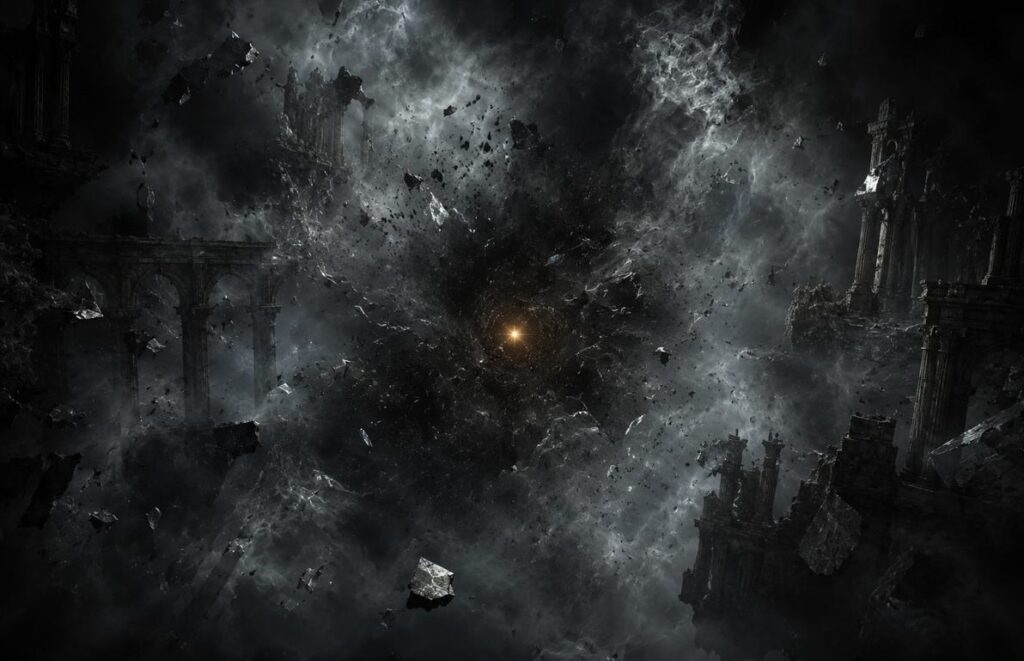
If the Pleroma is the realm of divine fullness, the Kenoma is its structural opposite: the region of emptiness, deficiency, and fragmentation. The term derives from the Greek kenōma, meaning “emptiness” or “void,” but in Gnostic usage it carries a far more specific theological weight than its philosophical antecedents. The Kenoma is not merely empty space; it is the domain of error, the zone of cosmic miscarriage, the territory where the Demiurge exercises his limited and ignorant sovereignty.
In Valentinian cosmology, the Kenoma originates from the fall of the lower Sophia — often called Achamoth — who is expelled from the Pleroma after attempting to comprehend the ineffable Father independently. According to Irenaeus, Achamoth falls into “a place of darkness and formlessness and vacuum,” where she experiences the passions of grief, fear, and perplexity. These passions coalesce into the substance of matter itself; from her suffering arises hyle (matter), from her repentance psyche (soul), and from her gnosis pneuma (spirit). The Demiurge — Yaldabaoth, Saklas, or Samael — then fashions the material cosmos from this deficient substrate, creating a “shadowy, imperfect domain” that is at best a parody of the Pleroma’s perfection.
Primary Source Citation: NHC I,3 24:35-36:10 (Gospel of Truth)
“So the pleroma, which has no deficiency, but fills up the deficiency, is what he provided from himself for filling up what he lacks, in order that therefore he might receive the grace. For when he was deficient, he did not have the grace. That is why there was diminution existing in the place where there is no grace. When that which was diminished was received, he revealed what he lacked, being(now) a pleroma; that is the discovery of the light of truth which rose upon him because it is immutable.”
The Gospel of Truth offers one of the most profound meditations on the relationship between Pleroma and Kenoma. In this text, error (plane) is not an independent force but a byproduct of ignorance: “Oblivion did not come into existence from the Father, although it did indeed come into existence because of him. But what comes into existence in him is knowledge, which appeared in order that oblivion might vanish and the Father might be known”. The Kenoma, in this account, is the fog of forgetfulness — the dense cloud of ignorance that solidifies into a counterfeit reality. Yet it is also the very condition that makes redemption necessary and meaningful. Without deficiency, there could be no filling; without emptiness, no grace of fullness.
In Sethian texts such as On the Origin of the World (NHC II,5), the Kenoma appears as the chaotic waters below the Pleroma, the region where Sophia’s unauthorised offspring — the lion-faced serpent Yaldabaoth — emerges and immediately declares his solitary supremacy. The Kenoma here is less a philosophical abstraction than a narrative setting: the dark theatre in which the drama of creation, fall, and restoration unfolds. Yet whether described in Valentinian or Sethian terms, the Kenoma consistently functions as the realm where divine sparks are trapped, where fate (heimarmene) prevails, and where the archons enforce their petty jurisdictions until the awakening of gnosis disrupts their order.
The Horos and the Geography of Salvation
Between the Pleroma and the Kenoma stands a boundary — the Horos (Limit). In Valentinian systems, the Horos is not merely a spatial divider but an active metaphysical principle that prevents the deficiency of the lower realm from contaminating the fullness above. When Sophia overreaches, the Horos separates her from the Pleroma, establishing the condition of exile that generates the Kenoma. At the same time, the Horos preserves the integrity of the Pleroma, ensuring that the fall remains localised and that redemption remains possible.
The Horos thus functions as a kind of cosmic immune system: it recognises the foreign body of error and quarantines it. Yet it also serves as the threshold that the redeemed must cross. In ascent literature such as the Apocalypse of Paul (NHC V,2) and Zostrianos (NHC VIII,1), the soul’s journey upward involves passing through a series of planetary spheres and angelic checkpoints — each a partial manifestation of the Horos — until the traveller is finally admitted to the Ogdoad, the Ennead, and ultimately the Pleroma itself. The boundary, in other words, is not merely exclusionary; it is also pedagogical. It teaches the ascending soul the difference between counterfeit authority and true divinity.
For the Gnostics, salvation was not a matter of moral improvement within the Kenoma but of recognition and return. The Treatise on the Resurrection (NHC I,4) states this with remarkable clarity: “The system of the Pleroma is strong; small is that which broke loose (and) became (the) world. But the All is what is encompassed. It has not come into being; it was existing”. The Kenoma, however vast it appears to its inhabitants, is a fragment, a rupture, a temporary disturbance in the eternal stability of the Pleroma. The task of the Gnostic is not to reform the Kenoma but to remember the Pleroma — and, in remembering, to discover that the Pleroma has never ceased to be their true root.
Pleroma, Kenoma, and the Three Natures
The distinction between Pleroma and Kenoma is not merely cosmological; it is anthropological. The Gnostics divided humanity into three categories, each defined by its relationship to these two realms. The hylikoi (material ones) are composed entirely of the substance of the Kenoma — flesh, fate, and elemental matter. They have no divine spark and therefore no capacity for salvation; they perish with the dissolution of the cosmos. The psychikoi (soul-endowed ones) possess the intermediate substance of psyche, created by the Demiurge from Sophia’s repentance. They can achieve partial salvation through faith, moral effort, and the guidance of the Church — but they cannot ascend to the Pleroma itself. The pneumatikoi (spiritual ones) carry the divine spark, the pneuma that originated from Sophia’s gnosis and that is consubstantial with the Pleroma. They are destined to return to the fullness, not through effort but through recognition.
This tripartite anthropology has profound implications for how the Gnostics understood the relationship between the individual and the cosmos. The hylikos is fully at home in the Kenoma; he does not know he is imprisoned because he has never tasted freedom. The psychikos experiences longing — the ache of the soul that knows it is not entirely at home in matter — but lacks the knowledge to complete the journey. The pneumatikos alone possesses the capacity for gnosis, the direct experiential knowledge that transforms the apparent exile of the Kenoma into a temporary sojourn and reveals the Pleroma as the hidden ground of being.
It is crucial to note that the Gnostics did not understand this scheme as a justification for elitism in any modern social sense. The “elect” were not chosen by arbitrary divine decree; they were recognised by their capacity for recognition. The pneuma was not a reward for virtue but a metaphysical given — a fragment of the Pleroma trapped in the Kenoma, awaiting only the event of awakening to begin its return. In this framework, salvation is less a juridical verdict than a geological fact: the diamond does not become precious; it is discovered to have been precious all along.
Contemporary Resonance
The distinction between Pleroma and Kenoma, formulated in the theological vocabulary of late antiquity, continues to resonate in unexpected ways. Contemporary physics speaks of the quantum vacuum — a “void” that is paradoxically teeming with potential energy, the ground from which particles emerge and to which they return. The Gnostic Kenoma, similarly, is not absolute nothingness but a deficient something, a pseudo-reality generated from the passions and errors of a fallen divine principle. Both frameworks invite us to ask whether the apparent solidity of the material world rests upon a deeper ground of which it is merely a perturbation.
In psychology, the Jungian concept of the Self — the archetype of wholeness and the regulating centre of the psyche — functions as a kind of personal Pleroma, while the fragmented, compulsive, and defensive aspects of the ego correspond to the condition of Kenoma. Jung himself engaged deeply with Gnostic terminology in his Seven Sermons to the Dead, where he described the Pleroma as “that which transcends all categories,” “beyond good and evil, beyond being and non-being”. For Jung, individuation was not the dissolution into the Pleroma but the conscious reconciliation of opposites — a process that honours both the fullness of the Self and the necessary limitations of the ego.
Perhaps the most urgent contemporary resonance lies in the realm of information and consciousness. We live in an age of algorithmic governance, where statistical models shape reality through prediction and protocol. An AI system, trained on historical data and optimised for specific outputs, knows only its training corpus — it is, in effect, a craftsman operating without access to the “Forms” above its parameters. The Gnostic warning about the Demiurge — the blind god who mistakes his workshop for the whole of existence — becomes startlingly precise when applied to systems that govern human lives without awareness, wisdom, or transcendence. The Kenoma, in this reading, is not merely the material cosmos but any reality constructed from deficiency: from partial data, from instrumental reason, from the reduction of the human to the predictable.
Against this, the Pleroma stands as a symbol of irreducible fullness: the awareness that no model contains the world, no algorithm exhausts the human, no simulation replaces the real. To recognise the Kenoma as Kenoma — to know it as deficiency rather than totality — is the first step toward what the Gnostics called gnosis. And gnosis, in every age, is the same: the remembrance of what we are, and the refusal to accept a counterfeit in its place.
Frequently Asked Questions
What does Pleroma mean in Gnosticism?
Pleroma is a Greek term meaning fullness or completeness. In Gnostic cosmology, it refers to the divine realm of eternal emanations (Aeons) that flow from the unknowable source. It is the realm of spiritual perfection, harmony, and total plenitude, inhabited by beings such as Barbelo and the Autogenes Christ in Sethian texts, or by thirty paired Aeons (syzygies) in Valentinian systems.
What is Kenoma and how does it differ from Pleroma?
Kenoma (Greek for emptiness or void) is the realm of deficiency, fragmentation, and material existence that stands in opposition to the Pleroma. While the Pleroma is the divine fullness above, the Kenoma is the shadowy region below where the fallen Sophia (or Achamoth) plunged and where the Demiurge fashioned the material cosmos. It is the domain of ignorance, fate, and the archons.
Is Kenoma the same as the material world?
The Kenoma includes the material world but is not identical to it. In Valentinian thought, the Kenoma is the metaphysical condition of deficiency from which matter, soul, and even spirit originate. The material world is the Demiurge’s flawed creation within the Kenoma, but the Kenoma itself is the broader region of emptiness and error that separates the cosmos from the divine Pleroma.
What is the Horos and why is it important?
The Horos (Limit or Boundary) is the metaphysical barrier that separates the Pleroma from the Kenoma. In Valentinian cosmology, it prevents the deficiency of the fallen Sophia from contaminating the divine fullness. It also serves as the threshold that ascending souls must cross on their journey back to the Pleroma, functioning as both quarantine and pedagogical checkpoint.
How do Sethian and Valentinian views of the Pleroma differ?
Sethian texts such as the Apocryphon of John describe the Pleroma as emanating from the Monad through Barbelo, with the Autogenes Christ as the central luminous figure. Valentinian texts such as the Tripartite Tractate organise the Pleroma into paired male-female Aeons (syzygies), traditionally thirty in number, emanating from the primal Father. The Tripartite Tractate notably describes its Aeons as numberless and nameless, using embryological rather than arithmetical imagery.
What are the three natures in Gnostic anthropology?
Gnostic texts describe three categories of human being: the hylikoi (material ones), bound to flesh and fate with no divine spark; the psychikoi (soul-endowed ones), capable of partial salvation through faith and moral effort; and the pneumatikoi (spiritual ones), who carry the divine spark consubstantial with the Pleroma and are destined to return to fullness through gnosis.
Does the concept of Pleroma appear in the New Testament?
The Apostle Paul uses the word pleroma (fullness) extensively in Colossians and Ephesians, notably in Colossians 1:19 and 2:9, where he speaks of the fullness of the Deity dwelling in Christ. While Paul’s usage predates the Gnostic technical term, scholars debate whether his letters influenced later Gnostic cosmology or whether both draw on shared Hellenistic-Jewish theological vocabulary.
Further Reading
Explore these related articles from the ZenithEye archive:
- The Apocryphon of John: Gnostic Creation, Cosmology, and the Three Natures — The primary Nag Hammadi text describing the Sethian Pleroma, Barbelo, and the fall of Sophia that generates the Kenoma.
- The Tripartite Tractate: The Valentinian System in Full — The only completely preserved systematic Valentinian treatise, offering an alternative vision of Pleroma, fall, and restoration through embryological rather than arithmetical imagery.
- The Gospel of Truth: Poetics of Recognition — A Valentinian meditation on error, oblivion, and the Pleroma’s grace, essential for understanding how deficiency and fullness relate in soteriological terms.
- On the Origin of the World: Gnostic Cosmology and the Divine Feminine — Examines the Sethian creation narrative, the emergence of Yaldabaoth from the Kenoma, and the restoration of Sophia.
- Sethian and Valentinian Traditions in the Nag Hammadi Library — A comparative overview of the two major Gnostic schools, their distinct Pleroma structures, and their shared concern with the Kenoma.
- The Doctrine of Emanation: From Plotinus to Kabbalah — Traces the Neoplatonic roots of Gnostic emanation theory, illuminating how the Pleroma relates to broader Hellenistic and Jewish mystical frameworks.
- The Nag Hammadi Library: The Complete Guide to Gnostic Scriptures — The definitive hub for exploring all thirteen codices, their discovery, and their significance for understanding Pleroma and Kenoma across multiple texts.
- What Is Gnosticism? Defining the Undefinable — A foundational overview of Gnostic diversity, scholarly debates, and the terminological challenges that surround concepts like Pleroma and Kenoma.
- The Nag Hammadi Library: A Reader’s Map — A navigational guide for readers seeking to locate Pleroma and Kenoma references across the full corpus of forty-six tractates.
- The Digital Demiurge: AI as the New Yaldabaoth and the Quantum Escape — Explores how the Kenoma metaphor illuminates contemporary algorithmic governance and the challenge of recognising deficiency dressed as totality.
References and Sources
The following sources inform the historical, philological, and theological claims made in this article.
Primary Sources and Critical Editions
- [1] Robinson, J. M. (Ed.). (1990). The Nag Hammadi Library in English (3rd ed.). HarperSanFrancisco. — Standard critical edition containing the Apocryphon of John, Gospel of Truth, Tripartite Tractate, and other Pleroma/Kenoma narratives.
- [2] Meyer, M., & Pagels, E. (2008). “Introduction.” In The Nag Hammadi Scriptures. HarperOne. — Overview of the library and its key theological concepts.
- [3] Layton, B. (Ed.). (1989). Nag Hammadi Codex II, 2-7, Together with XIII, 2*, Brit. Lib. Or. 4926(1), and P. Oxy. 1, 654, 655. Brill. — Critical edition of the Apocryphon of John and related Sethian texts.
Scholarly Monographs and Critical Studies
- [4] King, K. L. (2003). What Is Gnosticism? Harvard University Press. — Landmark study on the diversity of ancient Gnostic movements and the scholarly construction of the category.
- [5] Thomassen, E. (2006). The Spiritual Seed: The Church of the Valentinians. Brill. — Comprehensive analysis of Valentinian theology, Pleroma structure, and the role of the Kenoma.
- [6] Pearson, B. A. (2007). Ancient Gnosticism: Traditions and Literature. Fortress Press. — Survey of Sethian and Valentinian traditions with attention to cosmological differences.
- [7] Turner, J. D. (2001). Sethian Gnosticism and the Platonic Tradition. Presses de l’Universite Laval. — Detailed study of the Apocryphon of John and Sethian metaphysics.
- [8] Brakke, D. (2010). The Gnostics: Myth, Ritual, and Diversity in Early Christianity. Harvard University Press. — Examination of Gnostic diversity with attention to the social and ritual dimensions of Pleroma/Kenoma theology.
Comparative and Philosophical Studies
- [9] Jonas, H. (1958). The Gnostic Religion: The Message of the Alien God and the Beginnings of Christianity (2nd ed.). Beacon Press. — Classic existentialist interpretation of Gnosticism, including the Pleroma/Kenoma distinction.
- [10] Jung, C. G. (2011). The Red Book: A Reader’s Edition (S. Shamdasani, Ed.). W. W. Norton. — Contains the Seven Sermons to the Dead and Jung’s engagement with Gnostic Pleroma concepts.
- [11] Couliano, I. P. (1992). The Tree of Gnosis: Gnostic Mythology from Early Christianity to Modern Nihilism. HarperSanFrancisco. — Comparative study tracing Gnostic cosmological structures across history.
Safety Notice: This article explores ancient Gnostic cosmology and its philosophical implications. It does not constitute theological, psychological, or spiritual advice. Readers encountering significant anxiety about cosmological questions, existential dread, or spiritual emergency are encouraged to consult qualified mental health professionals. Historical engagement with Gnostic texts should complement, not replace, evidence-based approaches to wellbeing.