Gnosis and the Near-Death Experience: What Ancient Cosmology Says
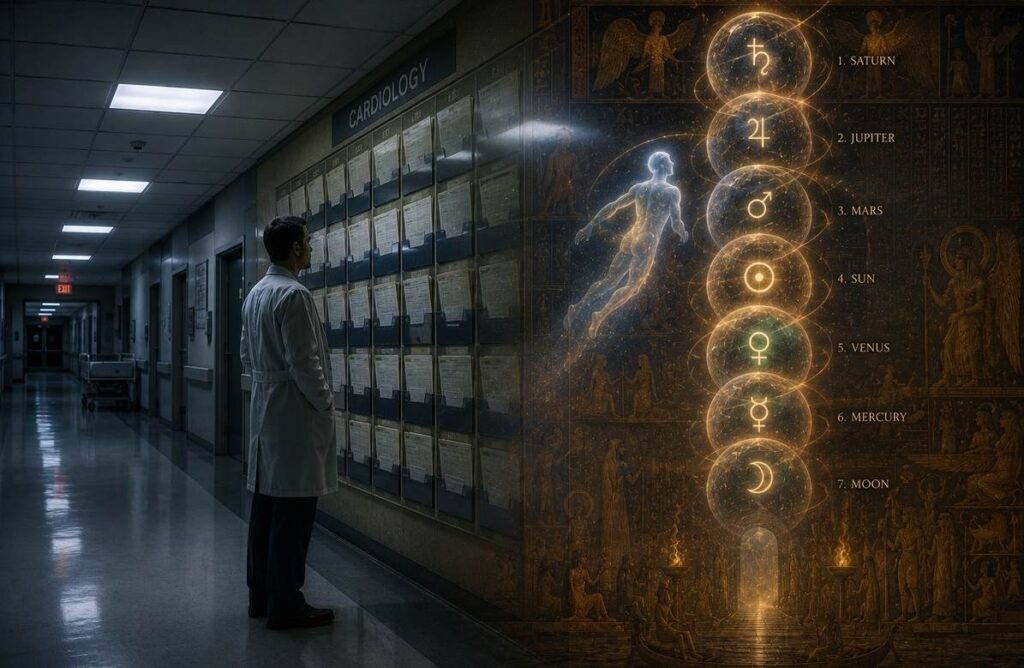
In 2001, a Dutch cardiologist published a study in The Lancet that should have changed how medicine understands death. Dr. Pim van Lommel had spent years interviewing cardiac arrest survivors at ten Dutch hospitals, and he found that 18% of them — roughly one in five — reported a near-death experience during the period of clinical death. Not during resuscitation. Not during recovery. During the flatline. Their brains had no blood flow, their EEGs showed no activity, and yet they described moving through tunnels, meeting beings of light, reviewing their lives, and reaching a border beyond which they could not pass.
Van Lommel concluded that the current materialist model of consciousness — that the brain produces the mind — is too restricted to account for these reports. He proposed instead that consciousness is nonlocal, not generated by the brain but mediated through it, like a radio receiving a signal rather than a factory producing one. The implication is radical: if consciousness can operate when the brain is offline, then death is not extinction. It is a transition. And if it is a transition, the question becomes: transition to what?
The Gnostic texts buried at Nag Hammadi and preserved in the Askew Codex offer an answer that is both ancient and unsettlingly specific. They describe a post-mortem architecture that mirrors the NDE phenomenology with a precision that suggests either convergent human experience or a shared map. The tunnel, the light, the beings, the life review, and the border are all present — but in the Gnostic version, they are not merely experiences. They are checkpoints in a system designed to process souls. This article examines that system, element by element, and asks whether the NDE is a glimpse of liberation or a preview of the trap.
Table of Contents
- The Scientific Phenomenon: What NDE Research Has Documented
- The Gnostic Post-Mortem Map: Archons, Spheres, and Seals
- Element by Element: Mapping the NDE onto Gnostic Cosmology
- The Soul Trap Hypothesis: Ancient Warning or Modern Paranoia?
- Cross-Text Observations: What Wikipedia Never Makes
- Conclusion
- Frequently Asked Questions
- Further Reading
- References and Sources
The Scientific Phenomenon: What NDE Research Has Documented
The Core Elements
Near-death experiences are not rare anecdotes. They are a reproducible phenomenon documented across cultures, religions, and medical settings. The standard definition, used by van Lommel and adopted by the International Association for Near-Death Studies, describes the NDE as “the reported memory of a range of impressions during a special state of consciousness, including a number of unique elements such as an out-of-body experience, pleasant feelings, seeing a tunnel and/or light, seeing deceased relatives, a life review, or a conscious return into the body.”
Four major prospective studies — van Lommel et al. (2001), Greyson (2003), Parnia et al. (2001), and Sartori (2006) — examined 562 cardiac arrest survivors collectively and found that between 10% and 20% reported an NDE. The studies controlled for duration of arrest, medication, fear of death, religious belief, education, and gender. None of these factors predicted whether a patient would have an NDE. A two-minute arrest produced the same incidence as an eight-minute arrest. An atheist was as likely to report one as a believer.
The Cross-Cultural Question
Not all NDE elements are universal. Cross-cultural research by Kellehear, Ohkado and Greyson, and others has revealed that the tunnel and the life review appear more frequently in Western accounts. Japanese NDEs, for instance, often lack the tunnel and the life review, though they consistently report encountering other beings and other realms. African and Australian Aboriginal accounts also emphasise the social world of the dead over the solitary tunnel journey. This suggests that some NDE features are culturally scaffolded, while others — particularly the encounter with beings and the sense of entering another realm — are cross-cultural constants.
The Gnostic texts were written in Egypt, Syria, and Asia Minor between the second and fourth centuries. They describe a post-mortem journey that is neither Western nor Eastern in the modern sense, but Mediterranean and syncretic. Their architecture — planetary spheres, archontic gatekeepers, passwords, and seals — reflects a cosmology shared by Gnostics, Hermeticists, and Platonists of the Roman Empire. If the NDE is a human universal, the Gnostic map may be one of its earliest systematic interpretations.
The Gnostic Post-Mortem Map: Archons, Spheres, and Seals
The Hebdomad and the Planetary Archons
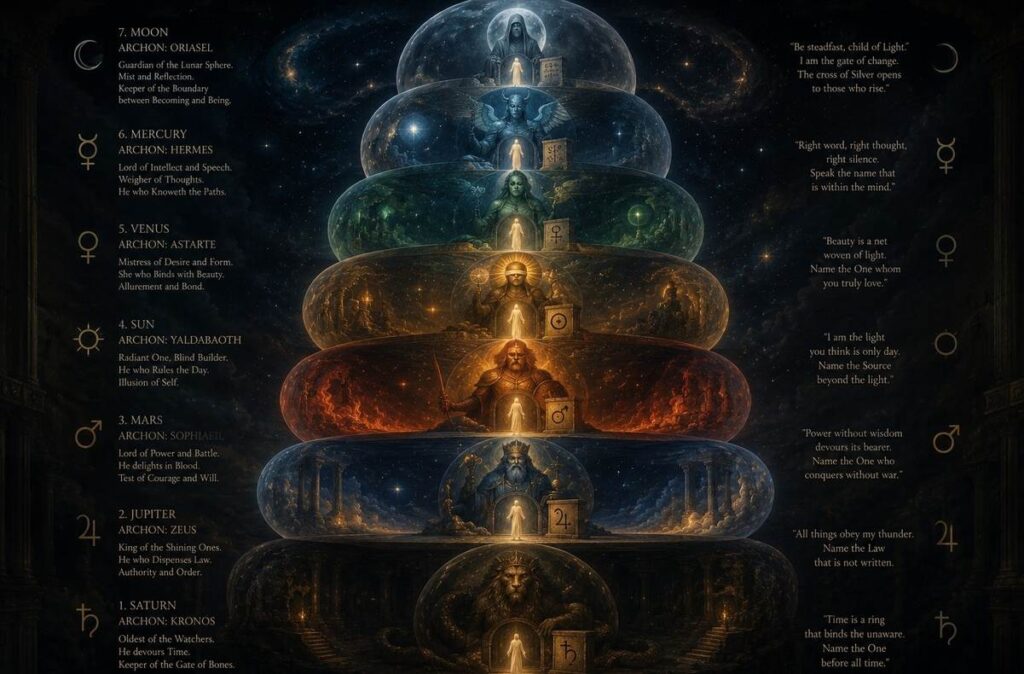
The Gnostic cosmos is layered. Above the material world lies the kenoma — the empty place of deficiency — and above that, the pleroma — the fullness of divine reality. Between the earth and the pleroma stand seven planetary spheres, collectively called the Hebdomad. Each sphere is governed by an archon, a cosmic administrator who enforces the law of fate (heimarmene) and obstructs the soul’s ascent.
The Apocryphon of John (NHC II,1) names the seven archons created by Yaldabaoth: Athoth, Eloaios, Astaphaios, Yao, Sabaoth, Adonaios, and Horaios. Each corresponds to a classical planet, and each embodies a vice or limitation that the ascending soul must transcend. The Hypostasis of the Archons (NHC II,4) adds that these rulers believe themselves supreme, yet their power depends on human ignorance. The soul that knows their names, their nature, and their passwords can pass through their jurisdictions unhindered.
The Counterfeit Spirit
The Pistis Sophia introduces a more sinister mechanism: the counterfeit spirit. This is not the soul’s true self but a composite garment stitched from the soul’s earthly actions, attachments, and sins. It is bound to the soul by the archons through seals and bonds, and at death it follows the soul like a shadow. If the soul cannot utter the mystery that undoes these seals, the counterfeit spirit drags it back into the wheel of generation — reincarnation.
The Pistis Sophia describes the process in elaborate detail. When the soul leaves the body, the retributive receivers come to lead it forth. The destiny and the counterfeit spirit follow. The soul must utter “the mystery of the undoing of the seals and all the bonds of the counterfeit spirit.” When this is done, the bonds undo themselves, the counterfeit spirit ceases to follow, and the soul becomes “a great light-stream” that penetrates all the regions of the rulers until it reaches its kingdom. If the soul has not received the mysteries, it remains in the power of the archons and is returned to a new body.
The Gospel of Mary and the Seven Powers
The Gospel of Mary (BG 8502) offers a complementary map. In Mary’s vision, the ascending soul encounters the fourth Power, which manifests seven forms: darkness, desire, ignorance, zeal for death, the realm of the flesh, foolish wisdom of the flesh, and the wisdom of the wrathful person. These are the seven Powers of Wrath. The soul overcomes them not by force but by declaration: “What binds me has been slain, and what surrounds me has been destroyed, and my desire has been brought to an end, and ignorance has died.” The soul then ascends to rest in silence.
Together, these texts construct a post-mortem geography that is neither heaven nor hell in the modern sense. It is a bureaucratic ascent through checkpoints, each requiring specific knowledge. The unprepared soul is processed, weighed, and returned. The prepared soul passes through, shedding its attachments layer by layer, until it reaches the silence beyond the spheres.
Element by Element: Mapping the NDE onto Gnostic Cosmology
The Tunnel and the Planetary Spheres
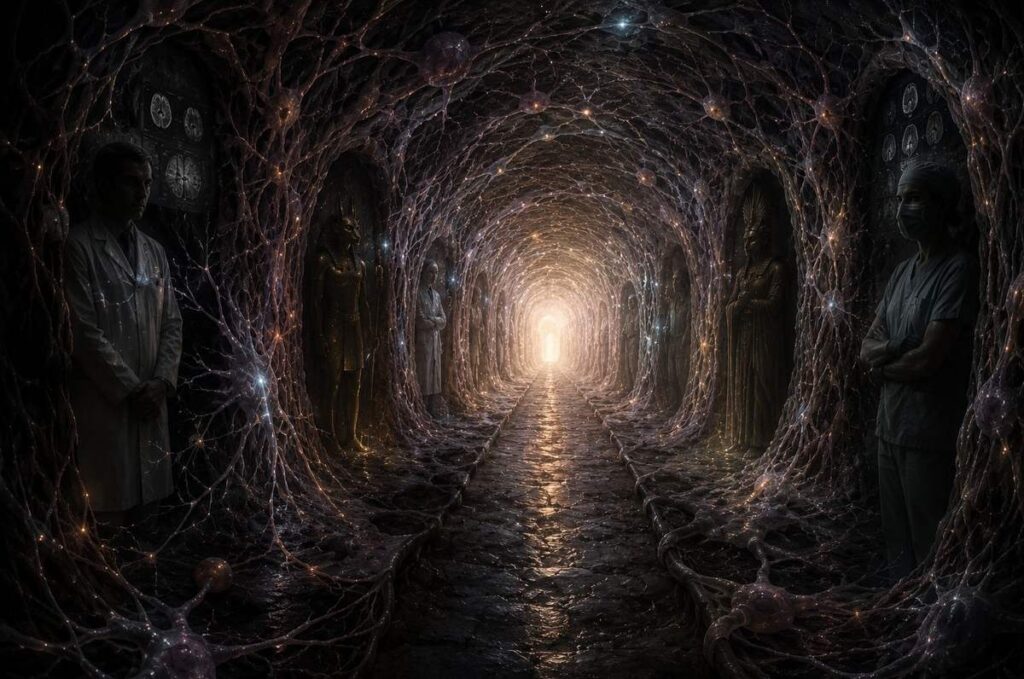
The NDE tunnel is typically described as a dark passage with a light at the end, sometimes with walls that seem to move or breathe. In Western accounts, it is the most common entry element. In Gnostic cosmology, the soul must ascend through seven planetary spheres after death. Each sphere is a realm with its own ruler, its own test, and its own atmosphere. The movement from sphere to sphere could easily be experienced as a tunnel — a sequential passage through increasingly rarefied or illuminated zones.
The Apocalypse of Paul (NHC V,2) describes Paul’s ascent through the fourth heaven, where he sees a great river and a weeping old man. The archon of that sphere demands to know who he is and where he is going. Paul gives the password — a name and a sign — and is permitted to pass. The text makes clear that the ascent is not automatic. It is navigational. The tunnel is not a conveyor belt. It is a corridor of gates.
The Light: True or False?
NDE experiencers almost universally describe the light as loving, welcoming, and unconditionally accepting. It is the emotional peak of the experience. Gnostic texts, however, warn of a false light. The Pistis Sophia describes rulers who mimic divine radiance to deceive souls. Yaldabaoth in the Apocryphon of John declares, “I am God and there is no other,” while blind to the higher realm above him. The Demiurge is not evil in the Manichaean sense; he is ignorant. He believes his own propaganda. The light he emits is real light — it is simply not the highest light.
This distinction matters for NDE interpretation. If the being of light in the NDE is an archon or a representative of the planetary system, its love is genuine within its own domain. It loves the soul the way a shepherd loves a sheep: sincerely, but not without utility. The Gnostic does not reject the light. He questions its jurisdiction. Is this the light of the pleroma, or the light of the kenoma? The NDE does not provide enough information to decide. The Gnostic texts suggest that the decision must be made before death, through the acquisition of gnosis.
The Beings: Deceased Relatives and Archontic Intermediaries
Encountering deceased relatives is one of the most cross-cultural elements of the NDE. In Western accounts, they often appear young and healthy, welcoming the experiencer home. In Gnostic terms, these beings could be interpreted in several ways. They might be genuine spirits of the dead, residing in the intermediate realms between earth and the pleroma. They might be projections of the experiencer’s own psyche, generated by expectation and longing. Or they might be archontic intermediaries using the most effective possible disguise — the face of love — to ensure compliance.
The Pistis Sophia describes “retributive receivers” who come to lead the soul forth at death. These are not demons in the medieval sense. They are functionaries. Their job is to process souls. If a soul has received the mysteries, the receivers of light come instead, becoming “wings of light” for the soul. The nature of the beings one meets depends on the nature of the soul they meet. In NDE terms, this suggests that the quality of the encounter — loving or frightening — may reflect the experiencer’s own spiritual preparation rather than the objective nature of the afterlife.
The Life Review: Memory, Judgement, or Accusation?
The life review is typically described as non-judgemental. The experiencer sees their life from multiple perspectives, feels the consequences of their actions on others, and often reports a sense of healing rather than condemnation. In Gnostic cosmology, the Pistis Sophia describes a more adversarial process. The soul must give an apology (apologia) to each ruler of each region, surrendering its destiny and its seals. The rulers are “in great fear and violent fire and with different faces.” The soul that has the mysteries is not judged; it judges the judges by the authority of its knowledge.
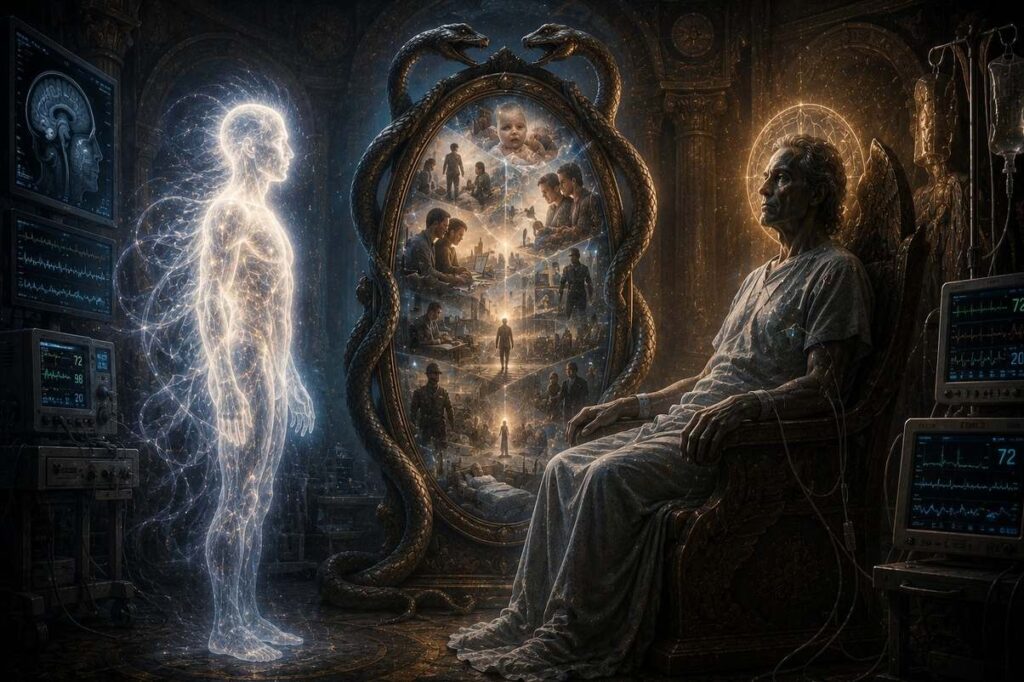
The difference between the NDE life review and the Gnostic apology is striking. The NDE is therapeutic; the Gnostic ascent is forensic. Yet both involve a comprehensive review of the life just lived. One might speculate that the NDE life review is the popular, user-friendly interface of the same backend process that the Gnostics described in technical language. The being of light who conducts the review might be the archon who receives the apology. The sense of unconditional love might be the system’s way of ensuring that the soul accepts the review without resistance, preparing it for return.
The Border and the Return
NDE accounts consistently describe reaching a border, threshold, or point of no return. A voice, a being, or an inner knowing informs the experiencer that they must go back. Sometimes they resist; sometimes they accept. The return is almost always described as involuntary, though some experiencers report choosing to return because of unfinished responsibilities or love for family members.
In Gnostic terms, the border is the critical moment. The Pistis Sophia states that if the soul has not received the mysteries, the retributive receivers lead it back to the cycle of birth. If it has received them, the receivers of light lead it upward. The border is not a geographical location. It is a decision point based on knowledge. The NDE experiencer who is told “it is not your time” is being returned. The Gnostic would ask: returned by whom, and to what? If the system is designed to recycle souls, the border is the final checkpoint before reinsertion into the matrix.
The Out-of-Body Experience and the Soul’s Departure
The out-of-body experience (OBE) is often the first element of the NDE. The experiencer sees their own body from above, hears medical staff, and sometimes reports veridical perceptions — things they could not have seen or heard from their physical position. Van Lommel and others have documented cases where experiencers accurately described resuscitation procedures, conversations, and equipment placements that occurred while they were clinically dead.
Gnostic anthropology distinguishes between the body, the soul, and the spirit. The body is material and perishable. The soul is the animating principle, subject to fate and the counterfeit spirit. The spirit (pneuma) is the divine spark, the true self, which is not of this world. At death, the spirit-soul composite leaves the body and begins its ascent. The OBE may be the initial moment of this departure — the spirit observing the body it has inhabited, confirming that it is not identical with it. The Gnostic texts would read this not as a hallucination but as the first true perception the self has ever had.
The Soul Trap Hypothesis: Ancient Warning or Modern Paranoia?
The soul trap hypothesis — that the afterlife is an engineered system designed to recycle souls rather than liberate them — is the most controversial implication of the Gnostic-NDE comparison. It appears in various forms across the Nag Hammadi Library, the Pistis Sophia, and modern esoteric discourse. The basic claim is that the material world and its afterlife administrative zones are a closed system maintained by the archons, who require human energy, attention, or spiritual labour to sustain their own existence.
The Gnostic texts do not use the term “soul trap.” They describe a wheel of generation or wheel of fate from which the soul must escape. The mechanism is not malicious in the personal sense. The archons are not demons who enjoy suffering. They are ignorant administrators who do not know they are administering a prison. Yaldabaoth believes he is the supreme God. His system is a mistake that has become institutionalised. The soul trap, in this reading, is not a conspiracy. It is a bureaucracy.
Modern NDE research does not support the soul trap hypothesis in its strongest form. The vast majority of NDEs are reported as positive, transformative, and life-enhancing. Experiencers lose their fear of death, become more compassionate, and often report a renewed sense of purpose. If the system is a trap, it is a remarkably ineffective one — or perhaps the NDE is only the lobby, and the trap lies deeper in the architecture, beyond the point of return.
The ZenithEye position — and the position this article takes — is that the Gnostic texts are best read as phenomenological maps rather than conspiracy theories. They describe what the dying mind may encounter, not what it must fear. The archons are not enemies to be fought but obstacles to be understood. The password is not a magic word but a state of recognition. The soul that knows itself cannot be trapped, because there is nothing left to trap.

Cross-Text Observations: What Wikipedia Never Makes
The NDE as Initiation
Most NDE researchers treat the experience as a spontaneous neurological or spiritual event. The Gnostic texts treat the post-mortem journey as an initiation — a structured ordeal with stages, tests, and transformations. The Apocalypse of Paul is explicit: Paul must give passwords at each heaven. The Books of Jeu provide seals and signs for each aeon. The Three Steles of Seth are hymns designed to be recited during ascent. These are not random visions. They are rituals.
The cross-text observation is this: the NDE may be the modern equivalent of an uninitiated ascent. The experiencer passes through the spheres without preparation, without passwords, without seals. They see the beings, feel the light, reach the border, and are sent back. The experience is real, but the navigation is absent. They are tourists in a realm that the Gnostics trained to inhabit.
The Life Review as Apology
Wikipedia articles on NDEs describe the life review as a psychological phenomenon, possibly related to memory consolidation or temporal lobe activation. Wikipedia articles on Gnosticism describe the apology to the rulers as a mythological motif. Neither article connects the two. Yet the structural parallel is precise: both involve a comprehensive review of the life, both occur in the presence of a superior being, and both determine what happens next. The NDE life review is the phenomenology. The Gnostic apology is the theology. Together, they suggest that the review is not merely therapeutic. It is administrative.
The Tunnel as Hebdomad
The tunnel is usually described as a neurological artifact — the visual cortex responding to anoxia by producing a constricted field of light. The Gnostic Hebdomad is described as a cosmological structure — seven planetary spheres between earth and heaven. Neither description explains why the tunnel experience feels meaningful, sequential, and inhabited. The cross-text insight is that the tunnel may be both neurological and cosmological: the dying brain disinhibits perception of structures that are normally filtered out, and the soul perceives the sequential passage through the spheres that it will soon traverse. The tunnel is the brain’s rendering of the soul’s itinerary.
The Return as Reincarnation
NDE experiencers are told they must return because their work is unfinished, their family needs them, or their time has not come. Gnostic texts describe souls being returned because they lack the mysteries, because the counterfeit spirit still binds them, or because the archons have not released them. The language differs, but the mechanism is identical: the soul is not ready, so it is sent back. The NDE frames this as a gift. The Gnostic texts frame it as a postponement. Both agree on the structural fact: the border is real, and most people do not cross it.
Something to Remember
The Gnostic texts do not prove that NDEs are encounters with archons. The NDE literature does not prove that the Gnostics were describing real post-mortem geography. What both prove, together, is that the dying mind produces experiences of extraordinary consistency and structure — experiences that ancient cosmologists mapped with precision and that modern scientists have confirmed with bewilderment.
The tunnel, the light, the beings, the review, and the border are not random hallucinations. They are too patterned, too cross-cultural, too emotionally transformative to be mere noise. The Gnostic framework offers one of the earliest and most detailed attempts to explain that pattern. It describes a post-mortem bureaucracy in which the soul is weighed, measured, and either released or returned. The NDE is the phenomenological snapshot of that bureaucracy, seen from the perspective of the unprepared traveller who reaches the lobby but does not have the passwords for the upper floors.
Whether the soul trap is literal or metaphorical, the practical implication is the same: preparation matters. The Gnostics did not wait for death to begin their ascent. They practised gnosis — self-knowledge, contemplation, and the study of the mysteries — as a daily discipline. They understood that the moment of death is not the moment to learn. It is the moment to remember. And what the NDE suggests, with unsettling clarity, is that there is something to remember.
Safety Notice: This article explores near-death experiences and Gnostic post-mortem cosmology for educational and comparative purposes. It does not claim that NDEs are encounters with hostile entities, nor does it present the soul trap hypothesis as scientifically proven. NDEs can be psychologically intense and transformative. Readers who have experienced an NDE and are struggling with integration should seek support from experienced counsellors, NDE support networks, or trauma-informed therapists. The practices discussed here complement but do not replace clinical mental health care.
Frequently Asked Questions
What is a near-death experience (NDE)?
A near-death experience is a profound psychological event reported by people who have come close to death or been clinically dead before resuscitation. Common elements include an out-of-body experience, moving through a tunnel toward a light, encountering deceased relatives or beings, a life review, and reaching a border or threshold before returning to the body. Prospective studies by van Lommel, Greyson, and Parnia found that 10–20% of cardiac arrest survivors report NDEs, often during periods of flat EEG when the brain shows no measurable activity.
How do NDEs relate to Gnosticism?
The Gnostic texts describe a post-mortem journey in which the soul must ascend through seven planetary spheres guarded by archons, each demanding passwords or seals of knowledge. Modern NDE reports describe moving through tunnels, encountering beings, and reaching borders — structural parallels that suggest the dying brain may be experiencing an ancient cosmological architecture. The Gnostics called this the Hebdomad, and they warned that without gnosis, the soul could be trapped and returned to the material world.
What is the counterfeit spirit in Gnosticism?
The counterfeit spirit is a concept found in the Pistis Sophia and the Apocryphon of John. It is described as a force bound to the soul through seals and bonds imposed by the archons. At death, it follows the soul and attempts to drag it back into reincarnation. The Pistis Sophia states that the soul must utter the mystery of the undoing of the seals to release the counterfeit spirit and ascend. Some modern interpreters connect this to the NDE life review, which may function as a form of cosmic accounting or accusation.
Is the tunnel of light in NDEs a trap or a path?
Gnostic texts distinguish between a false light and the true light. The Pistis Sophia describes deceptive rulers who mimic divine radiance to lure souls back into the material cycle. In NDE accounts, the tunnel and light are almost universally described as welcoming and loving. However, the Gnostic framework raises a theological question: if the system is designed to recycle souls, would it not present the most comforting possible interface to ensure compliance? The texts do not condemn the light; they warn against assuming that beauty equals truth.
What does the life review in an NDE mean?
In NDEs, the life review is often described as a rapid, non-judgemental replay of one’s life from multiple perspectives, sometimes accompanied by deceased relatives or a being of light. In Gnostic cosmology, the Pistis Sophia describes a process where the soul must give an apology and surrender its destiny to each planetary ruler. The life review may parallel this accounting — a moment where the soul confronts its attachments and actions before proceeding or being returned. The difference is that NDEs usually describe it as healing, while Gnostic texts describe it as a necessary but dangerous checkpoint.
Can consciousness exist without brain function?
This is the central question of NDE research. Dr. Pim van Lommel’s landmark study published in The Lancet in 2001 found that NDEs occur during cardiac arrest when the EEG is flat and all cortical and brainstem function has ceased. Van Lommel argues that consciousness cannot be reduced to neural processes and may be nonlocal — not produced by the brain but mediated through it. This aligns with the Gnostic view that the true self (pneuma) is not the body and does not depend on it for existence.
How can I prepare for death from a Gnostic perspective?
The Gnostic texts emphasise gnosis — direct inner knowledge of one’s divine origin — as the only preparation that matters. The Apocryphon of John describes the five seals; the Pistis Sophia details passwords and apologies for each sphere; the Gospel of Mary describes the ascent past the seven powers of wrath. Modern preparation might include contemplative practice, study of these texts, and the cultivation of self-knowledge. The Gnostics believed that what you know at death determines where you go, not what you believed in life.
Further Reading
Explore related threads across the ZenithEye archive:
- The Gnostic Soul Trap: Archons, Death, and the Recycling of Pneuma — The definitive ZenithEye guide to the soul trap hypothesis, the counterfeit spirit, and the mechanics of post-mortem recycling.
- Archons and the Soul Trap — A comprehensive examination of the archons as described across Gnostic traditions and their role in the post-mortem journey.
- The Soul Trap Hypothesis: A Critical Examination — Philosophical and phenomenological analysis of the Gnostic prison hypothesis and its modern interpretations.
- Apocryphon of John: The Gnostic Creation Account — The foundational text on Yaldabaoth, the archons, the counterfeit spirit, and the five seals of initiation.
- Gospel of Mary Magdalene: The Seven Powers and the Soul’s Ascent — Mary’s vision of the ascent past the seven Powers of Wrath, parallel to the NDE tunnel and border experience.
- Gospel of Mary Magdalene: The Complete Guide — The text that shows the soul’s post-mortem journey and the confrontation with cosmic powers.
- Five Seals: Sethian Initiation and the Soul’s Armour — The ritual preparation that the Gnostics believed necessary for the post-mortem ascent.
- Apocalypse of Paul: Heavenly Ascent Beyond the Fourth Heaven — The ascent text that details the passwords and encounters at each planetary sphere.
- The Sophia Myth: Three Falls, Three Redemptions — The cosmic drama behind the archontic system and the possibility of liberation.
- Pleroma and Kenoma: The Foundational Geography of Gnostic Cosmology — Essential background on the divine fullness and the empty place where the soul is trapped.
- What is Gnosticism? Defining the Undefinable — An essential primer on Gnostic schools, terminology, and the distinction between orthodoxy and heterodoxy.
References and Sources
This article draws upon prospective NDE studies published in peer-reviewed medical journals, critical editions of Coptic Gnostic texts, and scholarly analyses of ancient ascent literature. Sources are grouped by category for clarity.
Near-Death Experience Research
- van Lommel, Pim, Ruud van Wees, Vincent Meyers, and Ingrid Elfferich. (2001). “Near-death experiences in survivors of cardiac arrest: A prospective study in the Netherlands.” The Lancet, 358, 2039–2045.
- van Lommel, Pim. (2010). Consciousness Beyond Life: The Science of the Near-Death Experience. HarperOne.
- Greyson, Bruce. (2003). “Incidence and correlates of near-death experiences in a cardiac care unit.” General Hospital Psychiatry, 25, 269–276.
- Parnia, Sam, D. G. Waller, R. Yeates, and P. Fenwick. (2001). “A qualitative and quantitative study of the incidence, features and aetiology of near death experience in cardiac arrest survivors.” Resuscitation, 48, 149–156.
- Ohkado, Masayuki, and Bruce Greyson. (2014). “A comparative analysis of Japanese and Western NDEs.” Journal of Near-Death Studies, 32(4).
- Kellehear, Allan. (2009). “Census of non-Western near-death experiences to 2005.” Journal of Near-Death Studies, 26(2).
Gnostic Primary Sources and Critical Editions
- Waldstein, Michael, and Frederik Wisse. (1995). The Apocryphon of John: Synopsis of Nag Hammadi Codices II,1; III,1; and IV,1 with BG 8502,2. Nag Hammadi and Manichaean Studies 33. Brill.
- King, Karen L. (2003). The Gospel of Mary of Magdala: Jesus and the First Woman Apostle. Polebridge Press.
- Schmidt, Carl, and Violet MacDermot. (1978). Pistis Sophia. Nag Hammadi Studies 9. Brill.
- Layton, Bentley. (1976). The Hypostasis of the Archons. Nag Hammadi Studies. Brill.
- Muradyan, Gohar. (2000). The Apocalypse of Paul. Nag Hammadi and Manichaean Studies. Brill.
Scholarly and Critical Studies
- Turner, John D. (2001). Sethian Gnosticism and the Platonic Tradition. Bibliotheque Copte de Nag Hammadi, Section “Etudes.” Presses de l’Universite Laval.
- Marjanen, Antti. (1996). The Woman Jesus Loved: Mary Magdalene in the Nag Hammadi Library and Related Documents. Brill.
- Pagels, Elaine. (1979). The Gnostic Gospels. Random House.
- Couliano, Ioan P. (1992). The Tree of Gnosis: Gnostic Mythology from Early Christianity to Modern Nihilism. HarperSanFrancisco.
- Jonas, Hans. (1958). The Gnostic Religion: The Message of the Alien God and the Beginnings of Christianity. Beacon Press.