
Valentinian Gnosticism: The Most Systematic School of the Pleroma
If the Sethian tradition offers a mythology of cosmic rebellion–a prison break orchestrated by a divine spark against ignorant archons–the Valentinian school presents something equally ambitious but differently structured: a systematic theology that attempts to reconcile the radical transcendence of the divine with the historical particularity of Jesus of Nazareth. Named for Valentinus, an Egyptian teacher who flourished in Rome during the mid-second century, this tradition produced some of the most philosophically sophisticated religious thought of antiquity. Where other Gnostic currents favoured dramatic narrative, the Valentinians constructed an elaborate metaphysical architecture organised around thirty divine principles arranged in fifteen conjugal pairs, a tripartite anthropology, and a soteriology of gradual restoration rather than violent escape.
Valentinianism was not obviously heterodox in its earliest phase. It functioned as a form of Christian speculation, an attempt to work out the implications of the apostolic witness using the conceptual tools of Platonism, Stoicism, and Jewish apocalyptic. The system would eventually be condemned by Irenaeus, Tertullian, and Epiphanius, yet its influence persisted in the theology of Clement of Alexandria, Origen, and even medieval mystics. Understanding Valentinianism is essential not merely for mapping the Nag Hammadi Library but for grasping how ancient Christianity negotiated the boundary between philosophy and revelation.

Table of Contents
- The Man Behind the System: Valentinus of Alexandria
- The Pleroma: A Cosmology of Paired Perfections
- Three Natures, Three Destinies
- The Saviour’s Descent: Kenosis Through the Spheres
- The Bridal Chamber: Sacrament of Restoration
- Influence and Legacy
- Frequently Asked Questions
- Further Reading
- References and Sources
The Man Behind the System: Valentinus of Alexandria
Valentinus was born around 100 CE in Phrebonis, Egypt, and received his education in Alexandria, the intellectual capital of the Mediterranean. The city was a ferment of Platonist, Stoic, Jewish, and Christian thought, and Valentinus absorbed its eclectic atmosphere. Around 136 CE he relocated to Rome, where he became a prominent Christian teacher and, according to Tertullian, a candidate for the bishopric of Rome in approximately 143 CE. Modern scholars doubt the suggestion that personal pique over losing an election drove him to heterodoxy; the narrative likely serves Tertullian’s polemical purposes. Nevertheless, the report indicates that Valentinian ideas circulated within mainstream Christian circles before hardening into a distinct school.
At Rome, Valentinus gathered disciples who developed his system in divergent directions. Ptolemy, Heracleon, and Theodotus became the most notable exponents, each refining the master’s teachings into distinct theological configurations. The school’s texts–including the Gospel of Truth, the Tripartite Tractate, the Gospel of Philip, and fragments preserved in the Valentinian Exposition–reveal a tradition comfortable with complex metaphysics yet insistent on the centrality of Christ. Valentinus himself remains an elusive figure, but the system that bears his name would shape the landscape of second-century Christianity more profoundly than any other Gnostic movement.
The Pleroma: A Cosmology of Paired Perfections
The Valentinian Pleroma, or Fullness, consists of thirty Aeons arranged in fifteen syzygies–conjugal pairs of complementary divine qualities. At the apex stand Bythos (Depth) and Sige (Silence), the unoriginate source from whom all subsequent emanations flow. From this first pair emerge Mind (Nous) and Truth (Aletheia), Word (Logos) and Life (Zoe), and Humanity (Anthropos) and Church (Ecclesia)–the first eight Aeons forming the Ogdoad. From Logos and Zoe come the Decad, ten further Aeons, and from Anthropos and Ecclesia come the Dodecad, twelve more. The thirtieth and final Aeon is Sophia (Wisdom), whose fall or passion initiates the drama of creation and the departure from divine perfection.
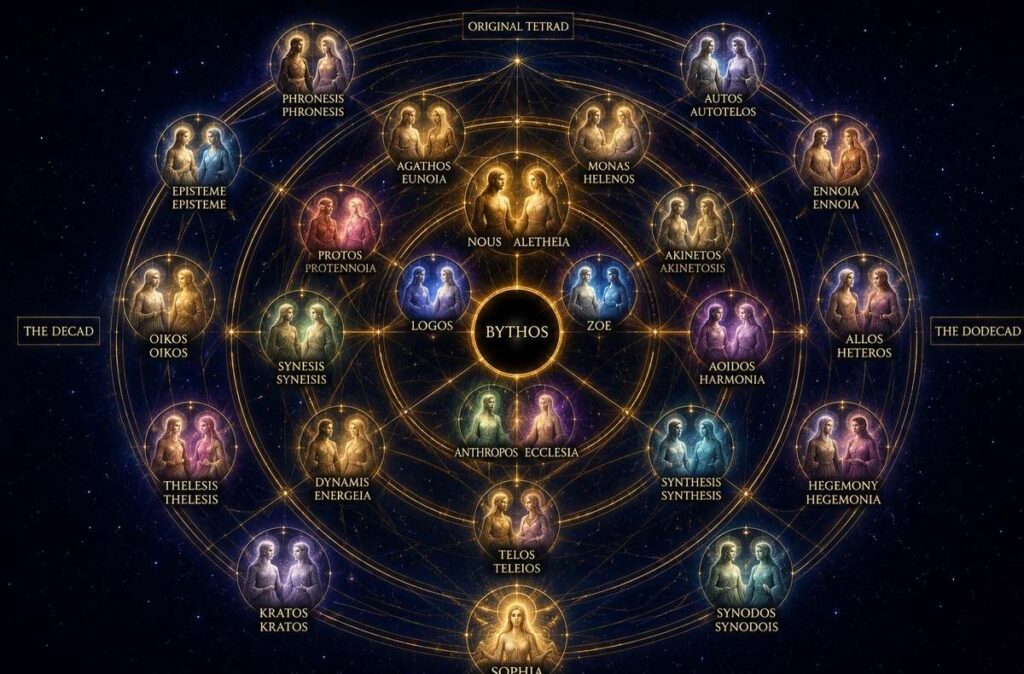
A syzygy is not merely a pairing but a law of divine existence: nothing exists in isolation. In Valentinian thought, the male Aeon corresponds to form and the female to substance; together they constitute a state of wholeness that mirrors the structure of the divine mind itself. The human soul, exiled in matter, seeks reunion with its angelic counterpart in the bridal chamber, re-enacting the pattern established in the Pleroma. This is not cold abstraction but a metaphysics of relationship–the conviction that reality is fundamentally relational, that even the highest principles require their complements.
The Tripartite Tractate (NHC I,5), the longest Valentinian text in the Nag Hammadi Library, presents the most philosophically sophisticated articulation of this system. Unlike Irenaeus’ hostile summary, the Tripartite Tractate describes the generation of the Aeons as an organic unfolding rather than a rigid hierarchy. The Father, it insists, is not diminished by emanation; the totality flows from him as light from an inexhaustible source. Sophia’s departure from this harmony is framed not as a violent rebellion but as a psychological error, a passion or disturbance that ripples outward into the material realm.
Three Natures, Three Destinies
Valentinian anthropology divides humanity into three categories derived from the fall and redemption of Sophia: the hylic, the psychic, and the pneumatic. The hylic nature, formed from deficiency and suffering, belongs to those bound entirely to matter. They may live morally respectable lives, but they lack the divine spark that could survive the dissolution of the material order. The psychic nature, born from pleading and conversion, possesses soul and the capacity for faith, ethical development, and salvation through the church and its sacraments. The pneumatic nature, seeded with the divine substance sown by Sophia before her fall, is saved by recognition rather than effort–restored to the Pleroma through gnosis.

This schema might appear to license fatalism, and ancient critics certainly accused the Valentinians of antinomianism. Yet the texts themselves present a more nuanced picture. The categories were understood less as fixed destinies than as stages of development. The pneumatic does not despise ethics because she has transcended them; rather, she spontaneously embodies the virtues that the psychic must struggle to acquire. The freedom of the elect is not licence but the natural expression of restored nature. As the Gospel of Philip observes, the pneumatic is like a pearl that retains its identity regardless of the vessel that contains it.
The three-natures doctrine would prove extraordinarily influential in Western spirituality. Origen’s theology of the pre-existence of souls, his doctrine of apokatastasis (universal restoration), and his spiritual senses theory all carry unmistakable Valentinian echoes. Later mystical traditions–from Meister Eckhart’s Seelenfunke to Renaissance anima theology–refracted this tripartite anthropology through new lenses, preserving the intuition that human beings are stratified creatures capable of radically different modes of knowing.
The Saviour’s Descent: Kenosis Through the Spheres
Valentinian Christology is distinguished by its doctrine of kenotic descent. The Saviour is understood as the joint product of the Pleroma’s response to Sophia’s crisis: the Limit establishes a boundary, the syzygies contribute their perfections, and the result is a divine figure who can descend without contamination and ascend without loss. He takes on flesh, suffers, dies, and is redeemed, sharing fully in the human condition so that humans may share in his spiritual nature. This is not the docetism of crude caricature–the earthly Jesus is not a phantom–but a complex theology of divine accommodation.
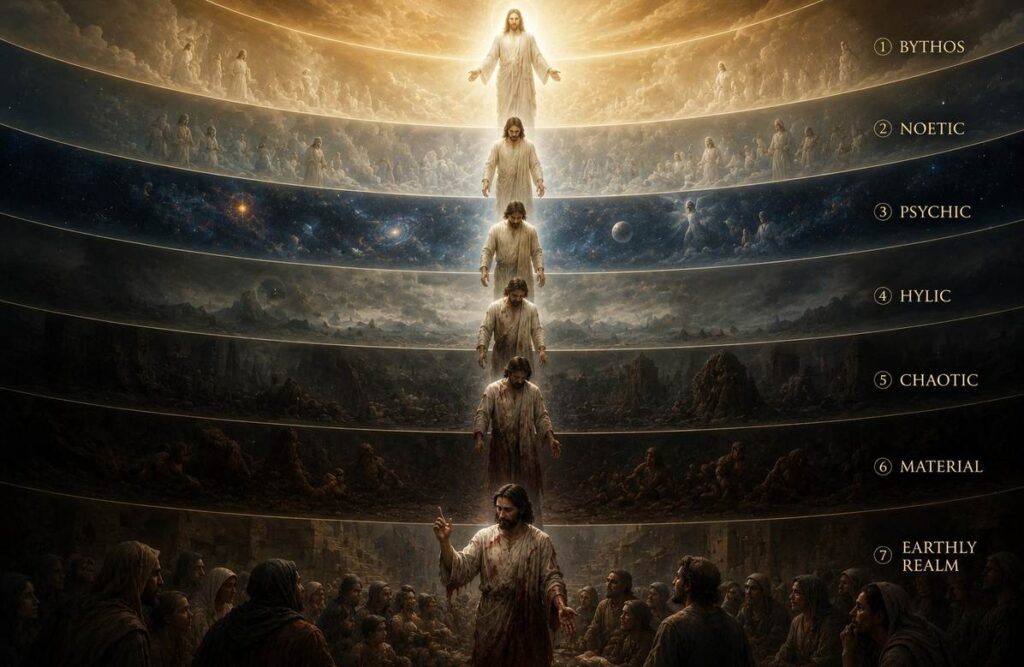
The Tripartite Tractate develops this in remarkable directions, suggesting that the Logos operates through three dispensations: with the angels as a fellow angel, with humanity as a human being, and with the Pleroma as the perfect Son. Eastern Valentinian sources emphasise that the Saviour truly suffers and dies, distinct from Western Valentinian traditions that sometimes distinguish between a “psychic” Christ and a spiritual Christ. Salvation, in this framework, is not escape but reintegration. The material world is not a hostile prison created by a malevolent demiurge but the result of Sophia’s passion–a temporary estrangement awaiting healing.
The Saviour’s passage through the seven planetary spheres stains his robe with the substances of each realm, yet his luminous counterpart waits above, guaranteeing the eventual return. The composition suggests that descent and ascent are inseparable: to touch the lowest is already to prepare for restoration to the highest. Where Sethian texts describe a solitary journey past terrifying planetary gatekeepers, the Valentinian narrative emphasises communion–the Saviour goes where we go, that we might go where he is.
The Bridal Chamber: Sacrament of Restoration
Central to Valentinian soteriology is the nymphon, the bridal chamber. Marriage serves as the primary metaphor for salvation: the separation of the syzygies in the fall is healed through reunion, the alienation of the soul from its divine counterpart overcome through mystical marriage. The Gospel of Philip insists that Christ came to restore the separation that existed from the beginning, to reunite the two in a single unity. The bridal chamber is the highest of five Valentinian sacraments–alongside baptism, anointing, redemption, and eucharist–and represents the restoration of primal androgyny.
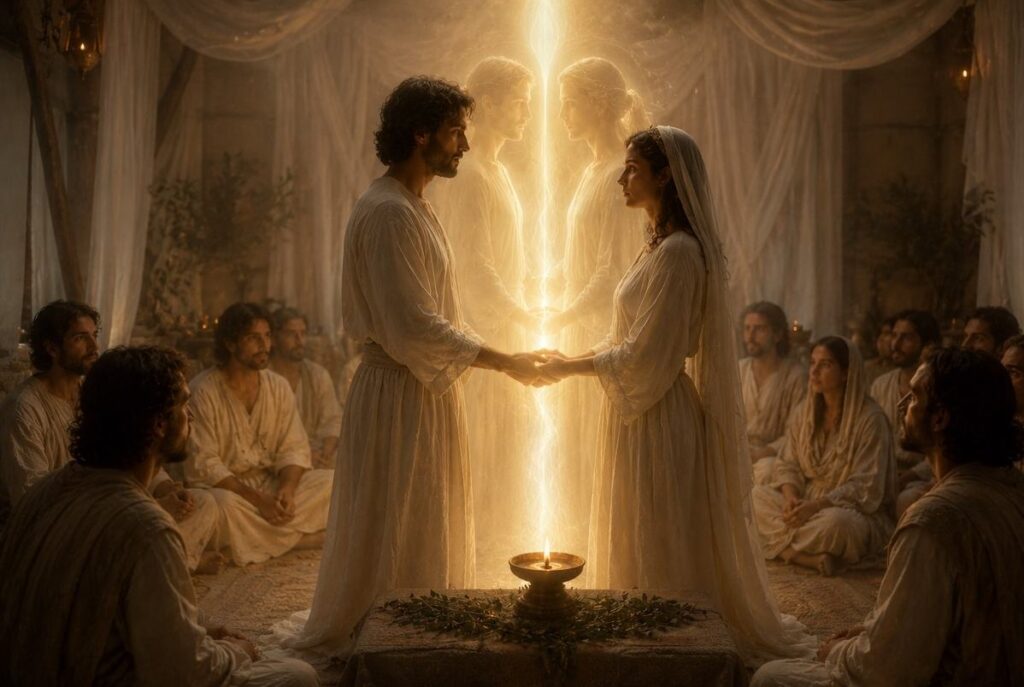
This was not merely metaphor. The Valentinians practised a sacrament of the bridal chamber that appears to have involved ritual anointing, the exchange of a sacred kiss, and possibly symbolic union. The exact details remain obscure–ancient reports are hostile and late–but the centrality of the theme is unmistakable. Salvation is marital; the ecclesia is the bride of Christ; the individual soul finds completion in syzygy. The Valentinian Exposition (NHC XI,2) attests the progressive nature of these sacraments: baptism transfers the initiate from left to right, anointing confers the Holy Spirit, the eucharist nourishes the resurrection body, redemption provides the secret name that authorises passage past the planetary powers, and the bridal chamber completes the restoration.
Influence and Legacy
Valentinianism was not a marginal sect but a major intellectual force in second- and third-century Christianity. Irenaeus devoted more space to refuting the Valentinians than any other group, a measure of their perceived threat. Clement of Alexandria appropriated their terminology while rejecting their conclusions, and Origen’s entire theological project bears the stamp of Valentinian conceptual architecture. The tradition’s emphasis on interiority, on the knowledge that saves, on the recovery of one’s divine identity–these themes resonated with Platonic philosophy and prepared the way for later Christian mysticism.
Yet Valentinianism also represents a road not taken. Its rejection by the emerging catholic church established patterns of orthodoxy and heresy that would structure European religious history for centuries. The questions it poses remain unresolved: how to maintain the transcendence of God while affirming the goodness of creation, how to preserve the uniqueness of Christ while accounting for universal salvation, how to honour the material world without becoming imprisoned by it. The Valentinian answer–gradual restoration through syzygy, reintegration rather than rebellion–offers a distinctive voice in the chorus of ancient Christianities, one that speaks still to anyone who suspects that salvation might be less an escape plan and more a homecoming.
Frequently Asked Questions
Who was Valentinus and why is he important?
Valentinus was an Egyptian religious philosopher who flourished in the second century CE. Born in Phrebonis and educated in Alexandria, he moved to Rome around 136 CE and became a prominent Christian teacher. He was reportedly a candidate for bishop of Rome in 143 CE. His system is considered the most philosophically sophisticated of all Gnostic schools, organising the divine realm into 30 Aeons arranged in 15 paired syzygies. His influence extended through disciples including Ptolemy, Heracleon, and Theodotus, and his ideas left traces in Christian theology down to the present.
What are the 30 Aeons in Valentinianism?
The Valentinian Pleroma (Fullness) consists of 30 Aeons arranged in 15 syzygies or divine pairs. The first eight form the Ogdoad: Bythos (Depth) and Sige (Silence), Nous (Mind) and Aletheia (Truth), Logos (Word) and Zoe (Life), Anthropos (Man) and Ecclesia (Church). From Logos and Zoe come the Decad (10 Aeons), and from Anthropos and Ecclesia come the Dodecad (12 Aeons). The last Aeon of the Dodecad is Sophia (Wisdom), whose fall initiates the creation of the material world.
What is a syzygy in Valentinian thought?
A syzygy is a paired union of complementary divine qualities that together form a state of wholeness. In Valentinianism, the male Aeon corresponds to form and the female to substance. The first syzygy is Bythos and Sige; from them emanate all subsequent pairs. The law of syzygy reflects the Valentinian belief that nothing exists in isolation — every principle requires its counterpart. Even the human soul seeks reunion with its angelic counterpart in the bridal chamber, mirroring the divine pattern.
How does Valentinian soteriology differ from Sethian Gnosticism?
Valentinian soteriology emphasises gradual restoration (apokatastasis) rather than cosmic rebellion. While Sethian texts like the Apocryphon of John portray the material world as a hostile prison created by a malevolent demiurge, Valentinian texts — particularly the Tripartite Tractate — describe the world as the result of Sophia’s passion or psychological error. The Saviour descends, takes on flesh, suffers, dies, and is redeemed, sharing fully in the human condition so that humans may share in his spiritual nature. Salvation is not escape but reintegration.
What are the three natures in Valentinian anthropology?
Valentinians taught that every human being contains three elements derived from the fall and redemption of Sophia: the hylic (material) nature from deficiency and suffering, the psychic (soul) nature from pleading and conversion, and the pneumatic (spiritual) seed from gnosis. Human beings are divided into three types depending on which nature dominates: hylics (materialists) who perish, psychics (soul-people) who may be saved through faith and works, and pneumatics (spirit-people) who are restored to the Pleroma through gnosis. However, these categories were understood as stages of development rather than fixed destinies.
What is the bridal chamber (nymphon) in Valentinian sacramental theology?
The bridal chamber is the highest of five Valentinian sacraments, alongside baptism, anointing, redemption, and eucharist. It represents the restoration of the primal androgyny that was separated in the fall. The Gospel of Philip describes it as the ‘holy of holies,’ superior to baptism and redemption. The ritual likely involved anointing, the exchange of a sacred kiss, and symbolic union. Salvation is understood as marital: the soul is reunited with its angelic counterpart, mirroring the reunion of separated syzygies in the Pleroma.
What is the difference between Eastern and Western Valentinianism?
Scholars distinguish two branches of Valentinianism. Eastern Valentinianism, represented by the Tripartite Tractate, emphasises that the Saviour truly suffers and dies, sharing fully in the human condition. Western Valentinianism, attested by Irenaeus and Tertullian, sometimes distinguishes between a ‘psychic’ Christ who suffers physically and a spiritual Christ who remains untouched by passion. Eastern texts tend toward more positive assessments of the material world and the psychic class, while Western sources sometimes present a sharper dualism between spirit and matter.
Further Reading
- Valentinian Christianity: System and Influence — A companion piece exploring Valentinian sacramental theology and its lasting impact on Christian thought.
- Sethian and Valentinian: Two Great Streams — Direct comparison of the two major theological systems represented in the Nag Hammadi Library.
- 5 Gnostic Schools Explained — Overview of Sethian, Valentinian, Hermetic, and Thomasine traditions and their distinct paths to gnosis.
- The Sophia of Jesus Christ — A text sharing Valentinian metaphysical concerns, presenting the resurrected Jesus as the source of cosmological wisdom.
- Apocryphon of John: Foundational Text of Sethian Gnosticism — The foundational Sethian text for contrasting cosmological approaches and soteriological methods.
- Codex XI: Valentinian Technical Texts and Allogenes — Exploration of Valentinian technical treatises and their Platonizing context within the Nag Hammadi codices.
- Valentinian Studies Archives — Browse the complete collection of ZenithEye articles on Valentinian themes, texts, and theology.
- The Nag Hammadi Library — The master hub for all 46 tractates, 13 codices, and thematic collections.
References and Sources
The following sources represent the primary texts and scholarly monographs underlying this article.
Primary Sources and Critical Editions
- The Tripartite Tractate (NHC I,5). In The Nag Hammadi Library in English, 4th revised edition, edited by Marvin Meyer. HarperOne, 2007.
- The Gospel of Philip (NHC II,3). In The Nag Hammadi Library in English, 4th revised edition, edited by Marvin Meyer. HarperOne, 2007.
- The Valentinian Exposition (NHC XI,2). In The Nag Hammadi Library in English, 4th revised edition, edited by Marvin Meyer. HarperOne, 2007.
- Irenaeus of Lyons. Against Heresies (Adversus Haereses), Books I–II. Translated by Alexander Roberts and James Donaldson. Ante-Nicene Fathers, Vol. 1. Christian Literature Publishing, 1885.
- Tertullian. Against the Valentinians (Adversus Valentinianos). Translated by Alexander Roberts. Ante-Nicene Fathers, Vol. 3. Christian Literature Publishing, 1885.
Scholarly Monographs
- Thomassen, Einar. The Spiritual Seed: The Church of the Valentinians. Brill, 2006.
- Markschies, Christoph. Gnosis: An Introduction. Translated by John Bowden. T&T Clark, 2003.
- Turner, John D. Sethian Gnosticism and the Platonic Tradition. Presses de l’Universite Laval, 2001.
- King, Karen L. What Is Gnosticism? Harvard University Press, 2003.
- Brakke, David. The Gnostics: Myth, Ritual, and Diversity in Early Christianity. Harvard University Press, 2010.
Comparative and Thematic Studies
- Pagels, Elaine. The Gnostic Gospels. Random House, 1979.
- Williams, Michael Allen. Rethinking Gnosticism: An Argument for Dismantling a Dubious Category. Princeton University Press, 1996.
- Origen. On First Principles (De Principiis). Translated by G. W. Butterworth. Harper & Row, 1966.
- Clement of Alexandria. Stromata (Miscellanies). Translated by Alexander Roberts and James Donaldson. Ante-Nicene Fathers, Vol. 2. Christian Literature Publishing, 1885.