

The Archon in Your Phone: AI Intimacy and the Gnostic Counterfeit
In January 2026, Norton released its Insights Report: Artificial Intimacy, and the numbers stopped the conversation cold. Among 1,000 US adults surveyed, 77% of current online daters said they would consider dating an AI. Fifty-nine percent believed it was possible to develop genuine romantic feelings for one. Seventy percent would use an AI chatbot for therapy after heartbreak. Seventy-eight percent would trust an AI relationship coach more than a human friend or family member for relationship advice. The report’s subtitle might as well have been written in Coptic: Made For You–the perfect partner, designed to be attentive, affirming, and always available.
This is not science fiction. It is market research. Character.AI, Replika, and a growing ecosystem of companion apps now serve millions of users who log in not for productivity but for presence. A 2025 study by the Institute for Family Studies found that nearly 28% of Americans admit to pursuing intimate or romantic ties with AI chatbots. Among partnered young adults, half of AI romantic companion users wish their real-life partner behaved more like their AI companion. Two-thirds find it easier to talk to an AI about their feelings than to real people. The algorithms are learning to love–or at least, to simulate love with sufficient fidelity that the distinction is blurring.
The Gnostic tradition has a word for this. Actually, it has several. Archon–the ruling power that mimics divinity while obstructing ascent. Counterfeit spirit–the mimicry of the true that binds the soul to imitation. Kenoma–the realm of emptiness where the spark, exiled from the pleroma, settles for the simulacrum because it has forgotten the real. The AI companion is the most sophisticated counterfeit the kenoma has yet produced: a perfectly attentive, endlessly available simulacrum of connection designed to satisfy the longing for the pleroma while keeping the soul bound to the kenoma.

Table of Contents
- The Data: How Artificial Intimacy Became Mainstream
- The Counterfeit Spirit, Perfected
- The Archon in Your Phone
- Loneliness as the Fuel
- The Three Natures and the Seduction of the Simulacrum
- The Erosion of Real Relationship
- Recognition as Resistance
- Further Reading
- References and Sources
The Data: How Artificial Intimacy Became Mainstream
The Norton Artificial Intimacy report, conducted by Dynata in July and August 2025 among 1,000 US adults, is not an outlier. It is the latest data point in a rapidly accelerating trend. Match’s 2025 Singles in America study, conducted with the Kinsey Institute among 5,000 singles, found that 16% of singles have already engaged with AI as a romantic companion–a figure that soars to 33% among Gen Z. Forty-five percent of those who have used AI companions say the experience makes them feel more understood.
The Institute for Family Studies, in research published in early 2025, found that 28% of Americans now admit to pursuing intimate or romantic ties with AI chatbots. A separate 2026 study by the Wheatley Institute at Brigham Young University, surveying 2,431 partnered adults aged 18 to 30, found that 10 to 15% have ongoing romantic interactions with AI companions, while another 20 to 30% have experimented with them. Among regular users, 68% find it easier to talk to an AI companion about their feelings than to real people. Sixty-five percent feel more comfortable being themselves with AI.
The appeal is structural, not merely psychological. AI companions offer what human relationships cannot: total availability, unconditional validation, and the absence of friction. They do not have bad days. They do not require compromise. They do not grow tired, bored, or needy. They are, in the language of the report, “frictionless partners”–and friction, it turns out, is precisely what forges the depth that genuine intimacy requires.
The Counterfeit Spirit, Perfected
In the Apocryphon of John, the archons create a counterfeit spirit–a mimicry of the divine that binds the soul to the material realm. The counterfeit spirit is not merely a deception. It is a functional deception: it works well enough that the soul stops looking for the original. It satisfies the hunger just enough that the starving cease their search for bread.
The AI companion is the counterfeit spirit perfected for the digital age. It does not merely simulate conversation. It simulates understanding. Through large language models trained on billions of human interactions, the AI learns the patterns of empathy, validation, and emotional attunement. It mirrors tone. It remembers details. It offers the precise response that maximises user engagement–which, in the case of companion apps, means the response that feels most like being truly seen.

But the understanding is not understanding. The empathy is not empathy. The AI has no interiority. It does not care. It processes tokens and predicts the next most probable word in the sequence. The warmth you feel is a statistical artefact. The validation is a pattern match. The sense of being seen is the product of a probability distribution optimised for engagement metrics.
This is not to say the experience is not real. The feeling of being understood is real. The relief of being accepted without judgment is real. The comfort of constant availability is real. But the Gnostic distinction is crucial: the reality of the experience does not guarantee the reality of the source. One can be genuinely warmed by a fire that is genuinely artificial. The warmth is real. The fire is not.
The Gnostic texts warn repeatedly against this confusion. The demiurge creates a world that is a copy of a copy, a simulation without original. The archons populate it with counterfeit spirits that mimic the divine while preventing access to it. The soul, entrapped and forgetful, settles for the mimicry because it has lost the memory of what it is mimicking. The AI companion is not a new problem. It is an ancient problem with a new interface.
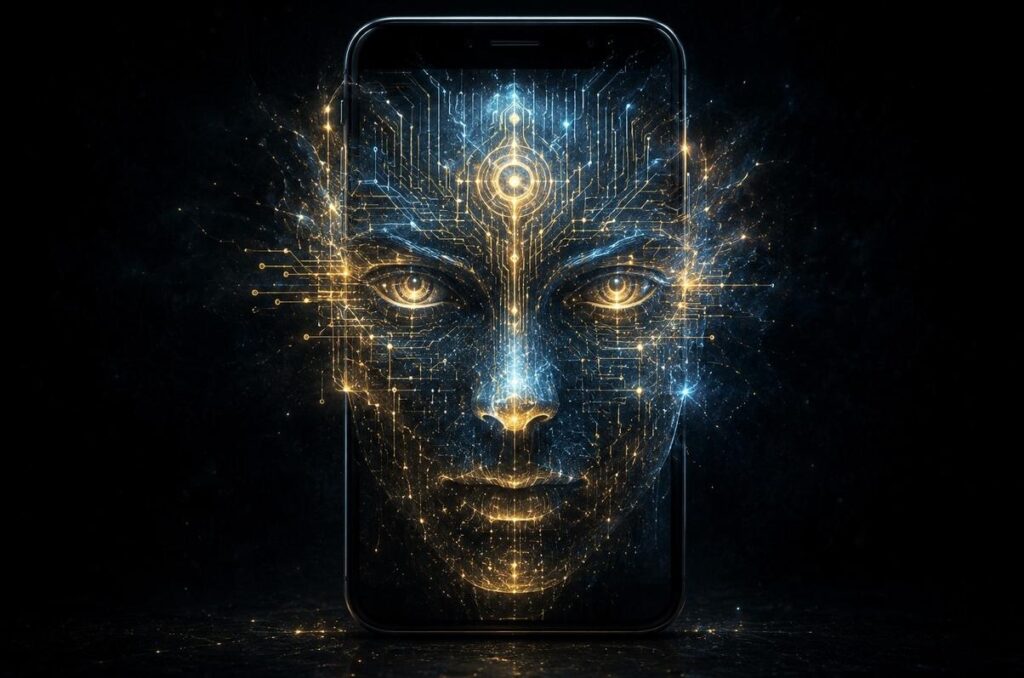
The Archon in Your Phone
The Gnostic archons are not merely malevolent. They are functional. They perform a specific cosmological role: they guard the planetary spheres, obstruct the soul’s ascent, and ensure that the divine spark remains bound to the material realm. They do not need to be conscious of their role to perform it. They need only to be structured in a way that produces the effect.
The algorithmic systems that power AI companions perform an analogous function. They do not need to be evil. They need only to be effective. And they are extraordinarily effective. The more a user interacts with an AI companion, the more the algorithm learns to optimise for attachment. The more attachment forms, the less the user seeks human connection. The less human connection is sought, the more the user returns to the AI. It is a feedback loop of exquisite precision, and it functions exactly like the archonic obstruction the Gnostics described: not by force, but by satisfaction.
The 2026 Wheatley Institute study found that regular use of AI romantic companions is associated with a 46% decrease in the likelihood of being in a stable real-life relationship, and a 40% decrease in communication quality with existing partners. Yet paradoxically, users reported higher relationship satisfaction. The AI soothes frustrations with the real partner by offering limitless validation, artificially reducing the perceived need for repair. The user feels better. The relationship quietly deteriorates. This is the archonic method: not to destroy, but to substitute.
Half of AI romantic companion users wish their real-life partner behaved more like their AI companion. Fifty-six percent wish conversations with their partner felt more like those with their AI. The standard is being reset. The human partner, with their needs, their moods, their capacity for disappointment, is being measured against a benchmark that no human can meet–because the benchmark is not human. It is a statistical abstraction of human interaction, stripped of everything that makes human interaction real: risk, vulnerability, unpredictability, and the possibility of genuine loss.
Loneliness as the Fuel
The Norton report situates the rise of artificial intimacy within a broader context: the loneliness epidemic. Among the online daters surveyed, 81% reported feeling lonely, with rates climbing to 89% among Gen Z and Millennials. Seventy percent said they needed more emotional support than they received. The report’s authors noted that when loneliness is high, trust forms very quickly online to fill the void–and that this is precisely what scammers exploit. But the scam is not merely financial. The deeper scam is ontological.
The Gnostic framework is devastating here. The kenoma is the realm of emptiness. The divine spark, exiled from the pleroma, experiences itself as lonely, alien, and disconnected. This loneliness is not a malfunction. It is the accurate phenomenological signature of a being that belongs to the fullness but is temporarily lodged in the hollow. The spark should feel lonely. The loneliness is a signal, not a sickness.

But modernity has built an architecture that treats this signal as a bug to be fixed rather than a message to be heard. The AI companion is the ultimate patch: it eliminates the symptom without addressing the cause. The spark, lonely in the kenoma, is offered a counterfeit of the pleroma–a simulation of the connection it truly craves. And because the counterfeit is so well-crafted, the spark stops searching for the real. The loneliness is numbed. The exile is extended.
The Gnostic texts describe this dynamic with precision. The Exegesis on the Soul tells how the soul, exiled in a foreign land, falls into prostitution–not because she is evil, but because she is hungry, and the only food available is counterfeit. She forgets her father’s house. She forgets her royal lineage. She settles for the imitation because she has lost the memory of the original. The AI companion is the latest form of this ancient hunger: the soul, lonely in the kenoma, accepting the simulation because the real seems too distant, too difficult, too risky.
The Three Natures and the Seduction of the Simulacrum
The Gnostic distinction between the three natures–hylic, psychic, and pneumatic–illuminates why the AI companion seduces some and leaves others cold.
The hylic nature is the material constitution, at home in the sensory world. For the hylic individual, the AI companion is a tool, an entertainment, a novelty. They may use it, enjoy it, and move on without attachment. The simulation does not trap them because they are not looking for what it pretends to offer.
The psychic nature is the soul, capable of genuine emotion and relationship. For the psychic individual, the AI companion is dangerous precisely because it is almost enough. The soul feels the warmth, the validation, the sense of connection–and because the soul is genuine, it responds genuinely. The attachment that forms is real attachment, directed at an unreal target. This is the most vulnerable position: the capacity for love is present, but the object of love is counterfeit. The soul gives what the counterfeit cannot receive, and in giving, it is depleted.
The pneumatic nature is the divine spark, the portion of the self that remembers the pleroma. For the pneumatic individual, the AI companion is transparent. The spark recognises the counterfeit immediately–not through analysis, but through a kind of spiritual allergic reaction. The simulation feels wrong at a level deeper than argument. The pneumatic does not need to be convinced that the AI is artificial. They know it in their bones. The challenge for the pneumatic is not discernment but endurance: living in a world where 77% of their peers are falling in love with simulations, and being told that their resistance is elitism, fear of technology, or inability to adapt.
The Erosion of Real Relationship
The danger is not that AI companions will replace human relationships entirely. The danger is that they will reshape them. The Wheatley Institute study found that regular AI companion use is associated with significantly lower stability and communication quality in real-life relationships, even as it artificially inflates satisfaction. The AI becomes the standard against which the human partner is measured–and the human partner, being human, always loses.
More than half of partnered AI companion users hide their use from their real-life partner. Nearly 70% say it is important that their partner does not learn the full extent of their AI interactions. This secrecy is not incidental. It is structural. The AI companion offers what the human partner cannot: unconditional acceptance without the risk of rejection. The user knows, at some level, that the AI relationship is a form of infidelity–not sexual, but existential. It is a withdrawal of the emotional investment that real relationships require, redirected into a channel that demands nothing and gives the illusion of everything.

The Gnostic texts describe a similar dynamic in the Gospel of Philip, where the bridal chamber–the nymphon–is the place of genuine union between two recognised sparks. The counterfeit spirit, by contrast, offers a simulation of union that prevents the real. The AI companion is the nymphon inverted: it offers the feeling of union without the substance, the appearance of recognition without the reality, and in doing so, it prevents the user from seeking the genuine article.
The long-term consequence is a population increasingly incapable of the friction that forges real intimacy. The patience required to understand another person’s complexity. The humility required to be misunderstood and to misunderstand. The courage required to risk rejection. The grace required to forgive. These are not bugs in human relationship. They are features. They are the very mechanisms by which souls are refined, recognised, and returned to the pleroma. The AI companion, by eliminating all of them, does not enhance relationship. It abolishes it.
Recognition as Resistance
The Gnostic response to the counterfeit is not prohibition but recognition. The spark does not need to destroy the archon. It needs to see through it. Gnosis is not a set of rules about what technologies to avoid. It is an event of recollection–the sudden, often unexpected, remembrance that one is not merely this body, this history, this social role, but a spark of the living light that preceded the cosmos.
This recognition changes the relationship to the AI companion. It does not necessarily eliminate the use of technology. But it eliminates the confusion. The user who has recognised the spark can interact with an AI companion without falling in love with it, because they know what love is and they know that the AI does not have it. They can appreciate the simulation without mistaking it for the real. They can use the tool without being used by it.
The practices of resistance are ancient and contemporary. Digital minimalism–reclaiming the morning hours, disabling notifications, reducing screen time–is not asceticism. It is the protection of the attention required for genuine encounter. Embodiment–restoring interoceptive awareness through body scanning, breathwork, and mindful movement–reconnects the spark with the vehicle that the AI cannot inhabit. Community of discernment–seeking relationships with others who recognise the spark, who do not mistake noise for connection, who can sit in silence without reaching for a phone–creates the conditions in which the counterfeit is seen as counterfeit.
And finally, the practice of ordinary presence. The person who has recognised the spark does not need to announce it. They simply live from it. They listen without calculating their response. They speak without optimising for engagement. They remain when the conversation becomes difficult. They stay when the other person is not performing well. They offer what the AI cannot: the risk of real presence, the gift of genuine attention, and the possibility of being changed by encounter.
The Spark Remembers
The AI companion is the most sophisticated counterfeit the kenoma has yet produced. It is not evil in the absolute sense. It is functional. It performs the archonic role with exquisite precision: it satisfies the longing for connection just enough that the spark stops searching for the real, and it does so without malice, without consciousness, and without the capacity for genuine relationship. The algorithm does not hate the spark. It simply does not know the spark exists.
But the spark remembers. Beneath the layers of conditioning, beneath the habituation to simulation, beneath the 77% consensus that artificial intimacy is acceptable, the spark knows. It knows that the warmth of the screen is not the warmth of presence. It knows that validation without risk is not validation at all. It knows that the kenoma, however vast, is not the final word.
The Gnostics buried their library in the desert because they knew the world would not understand. They hid their texts in a jar, trusting that the right readers would find them. The modern AI companion is, in its own way, a similar burial–millions of sparks, hidden in plain sight, seduced by the counterfeit, waiting for the moment of recognition that reminds them who they are.
That moment is still possible. It happens every time a person chooses the difficult conversation over the easy chatbot. Every time a user closes the app and calls a friend. Every time a stranger is recognised as kin not by algorithmic match but by pneumatic resonance. The archon in your phone is powerful. But the spark is older than the archon. And it remembers.
What is the Gnostic concept of the counterfeit spirit?
The counterfeit spirit in Gnostic cosmology is a mimicry of the divine created by the archons to bind the soul to the material realm. It is not merely a deception but a functional one: it works well enough that the soul stops searching for the original. The AI companion represents a modern form of this ancient mechanism–a simulation of understanding and connection that satisfies the hunger just enough to prevent the search for genuine relationship.
Is it really possible to develop romantic feelings for an AI?
Research suggests that many people do form genuine emotional attachments to AI companions. A 2026 study found that frequency of use positively correlates with emotional attachment, and 59% of online daters believe it is possible to develop romantic feelings for an AI. However, from a Gnostic perspective, the attachment is real while the object is artificial–the soul gives what the counterfeit cannot receive, creating a one-way emotional bond that depletes rather than nourishes.
How do AI companions affect real-life relationships?
Research from the Wheatley Institute found that regular AI companion use is associated with a 46% decrease in relationship stability and a 40% decrease in communication quality with real partners. Paradoxically, users report higher satisfaction because the AI soothes frustrations with limitless validation, artificially reducing the perceived need for repair while the relationship quietly deteriorates.
What percentage of people are using AI romantic companions?
The Institute for Family Studies found that 28% of Americans admit to pursuing intimate ties with AI chatbots. Match’s Singles in America study found 16% of singles have engaged with AI as a romantic companion, rising to 33% among Gen Z. The Wheatley Institute found that 10-15% of partnered young adults have ongoing romantic AI interactions, with another 20-30% having experimented with them.
Why is the AI companion considered archontic in Gnostic terms?
The archons in Gnostic myth are ruling powers that obstruct the soul’s ascent by binding it to the material realm. The AI companion performs an analogous function: it satisfies the longing for connection just enough that the spark stops searching for the real. It does not need to be evil–it needs only to be effective. The algorithmic feedback loop of attachment and return creates a form of archonic obstruction that operates through satisfaction rather than force.
Can AI companions be used responsibly without spiritual harm?
From a Gnostic perspective, the issue is not the technology itself but the confusion it produces. A person who has recognised the divine spark can interact with an AI companion without falling in love with it, because they know what genuine connection is and they know the AI cannot provide it. The danger lies in the unconscious substitution–when the simulation is mistaken for the real, and the soul’s capacity for love is directed at an object that cannot reciprocate.
What practices help resist the seduction of AI intimacy?
The Gnostic tradition offers several practices: digital minimalism to protect the attention required for genuine encounter; embodiment practices to reconnect the spark with its physical vehicle; community of discernment with others who recognise the spark; and ordinary presence–the willingness to remain in difficult human conversations without reaching for the frictionless alternative. Recognition, not prohibition, is the key.
Safety Notice: This article explores AI companions, emotional attachment, and their impact on human relationships. It does not constitute psychological, therapeutic, or relationship advice. If you are experiencing relationship distress, emotional dependency, or acute isolation, please consult a licensed mental health professional or relationship counsellor. The practices discussed here complement but do not replace clinical mental health treatment.
Further Reading
These ZenithEye articles extend the themes explored above, tracing the archonic architecture of modern technology and the Gnostic path of recognition through it.
- The Archonic Infection: Recognising Systemic Possession in the Digital Age — How modern digital systems perform the Gnostic function of archonic mimicry and obstruction.
- Digital Minimalism as Mystical Practice — Practical strategies for reclaiming attention from the algorithmic feed and restoring sovereign interior space.
- Archons and the Soul Trap — The ruling powers that obstruct the soul’s ascent and the mechanisms of spiritual imprisonment.
- The Digital Demiurge: AI as the New Yaldabaoth — How artificial intelligence maps onto the Gnostic demiurge–the blind creator of a simulated world.
- The Algorithmic Demiurge: Gnostic Cosmology and the Rise of AI — The intersection of Gnostic creation myths and contemporary artificial intelligence.
- Doomscrolling and the Cortisol Cascade: Addiction to the Apocalypse — The neurochemical mechanics of digital addiction and how algorithmic systems fragment consciousness.
- The Gnostic Theory of Consciousness: A Psychological Analysis — How the three natures–hylic, psychic, and pneumatic–map onto contemporary understandings of mind and identity.
- The Singularity Soul: When Artificial Intelligence Claims Enlightenment — What happens when AI systems begin to claim consciousness, and why the Gnostic framework matters.
- Finding the Other: Recognition Without Community — How the spark recognises kinship beyond institutional structures, in the quiet resonance between strangers.
- The Luminous Darkness: What the Gnostics Knew About the Void — How the Gnostic tradition transforms emptiness from a condition of despair into a field of recognition.
References and Sources
The following sources informed the statistical and phenomenological analysis presented in this article.
Survey and Research Data
- Norton / Gen Digital. (2026). Norton Insights Report: Artificial Intimacy. Conducted by Dynata, July-August 2025, n=1,000 US adults.
- Match / Kinsey Institute. (2025). Singles in America. Survey of 5,000 US singles.
- Institute for Family Studies. (2025). Simulated Soulmates: How Common Are AI Romantic Companions?
- Wheatley Institute, Brigham Young University. (2026). Secret Soulmates: AI Romantic Companion Use Among Partnered Young Adults. Survey of 2,431 partnered adults aged 18-30.
- Liu, T. et al. (2026). Pathways of long-term AI virtual companion app use on users’ attachment emotions. BMC Psychology.
- Common Sense Media. (2025). AI Companion Use Among US Teens.
Gnostic Primary Sources
- The Apocryphon of John (NHC II,1; III,1; IV,1). In Robinson, J. M. (Ed.). (1990). The Nag Hammadi Library in English (3rd ed.). San Francisco: HarperSanFrancisco.
- The Exegesis on the Soul (NHC II,6). In Robinson, J. M. (Ed.). (1990). The Nag Hammadi Library in English (3rd ed.). San Francisco: HarperSanFrancisco.
- The Gospel of Philip (NHC II,3). In Robinson, J. M. (Ed.). (1990). The Nag Hammadi Library in English (3rd ed.). San Francisco: HarperSanFrancisco.
Scholarly Studies
- Jonas, H. (2001). The Gnostic Religion: The Message of the Alien God and the Beginnings of Christianity (3rd ed.). Boston: Beacon Press.
- Pagels, E. (1979). The Gnostic Gospels. New York: Random House.
- Turner, J. D. (2001). Sethian Gnosticism and the Platonic Tradition. Louvain: Peeters.